Today’s video showcase covers bore-sighting methods and technology. Bore-sighting the old-fashioned way — by looking down the bore of a rifle at a target — is not difficult. With a conventional bolt-action rifle, visual bore-sighting can be done quickly and easily. Rest your gun securely on bags, remove your bolt and set up a 50-yard target with a large bright orange or black center circle. Look through the back of the action and you should be able to sight down the bore with your own eyes just fine. There’s no need for expensive hardware. In fact it may be easier to bore-sight the “old-fashioned way” rather than try to see a laser in bright sunlight at 50 yards (or even 25).
However, with lever guns and semi-auto rifles, including the popular AR15, M1 Garand, and M1A, the design of the receiver may make it virtually impossible to sight down the bore with the naked eye. That’s where a modern laser bore-sighting device comes in handy. For those situations where a bore-sighting tool is needed, we recommend a laser bore-sighter that fits inside your chamber. An in-chamber laser device, as shown below, is handy and has less safety risk than a tool which fits in the end of the barrel.
How to Bore-Sight Your Rifle in Five Minutes
This video from Australia shows the basics of the bore-sighting process. First set up a target 50 yards (or closer) from your shooting station. Make sure the rifle is well-supported and stable. When the target is ideally centered in the BORE of the barrel, then adjust the reticle on your scope to center the crosshairs on the middle of the target. Then, after checking down-range, take a few test shots. Finally, move the target out to 100 yards and confirm your zero, as explained at the close of today’s article.
Vortex Shows How to Bore-Sight Rifles
This well-made, informative video from Vortex covers the basics of bore-sighting. Bore sighting your rifle is a simple way to establish an initial zero to get you on target faster and save you ammo at the range. Thankfully, it doesn’t take a ton of gear or ammunition to bore-sight a rifle effectively. Video host Jimmy from Vortex provides a handy, step-by-step guide in this 10-minute video.
Bore-Sighting Using a Barrel-Mounted Laser Bore-Sighter
If you wondered why a barrel-mounted laser bore-sighter was off-center? Or if you want to learn how to use one properly, this video shows how to safely and properly zero a scope using a barrel-mounted laser bore sight device. Another option is a small cartridge-sized laser that fits inside the chamber. These sell for under $25.00 and are convenient. There are safety advantages to in-chamber lasers.
Initial Bore-Sighting at Home (Before You Head to the Range)
This useful video shows how to bore-sight a rifle at home. This can save time (and money for ammo) when you do get to the range to confirm your scope’s zero. This home procedure works best if the target is well-illuminated while the rifle is in a shadowed area, creating the best contrast. Also make sure the rifle is on a steady support — such as a portable gun vise or sandbags front and rear.
Bore-Sighting with a Red Dot (Reflex) Sight
As with conventional scopes, if you have a red dot sight or reflex optic, you’ll need to bore-sight your rifle, then zero the optic. [Reflex sights use a reflex lens to project a dot or reticle onto the target, whereas red dot sights use a flat, reflective surface to display a red dot reticle.] In this video, retired Navy SEAL Mark Cochiolo demonstrates how to bore-sight then adjust a red dot. Bore sighting allows you to zero your red dot so that your shots hit near your intended point of impact.
Learn More about Bore-Sighting with Tools
To learn more about bore-sighting, you can view a detailed article on the Warne Scope Mounts website. This features through-the-barrel images and discussion of tools that fit in the chamber or barrel to project a laser beam down-range. Shown below are cartridge-sized projecting lasers that fit in a rifle’s chamber. These are available for a wide variety of cartridge/chamber sizes.
WARNING: If you use an in-barrel laser be sure to remove it BEFORE chambering a round. ANY obstruction in the barrel can cause serious injury or even death if you fire a round.
Bore Sight Grid Tool with Arbors
The Bushnell Bore Sight with Arbors is a bore-sighting tool that many gun stores and gunsmiths use. This device uses arbors but does not transmit a laser.
You attach the tool to the end of the barrel and align it with your scope. A grid is visible inside the bore-sighter. Look at that grid and then and align your scope’s reticle with the grid. This Bushnell unit ships with three expandable arbors in 22-270 caliber, 7mm-35 caliber, and 35-45 caliber.
How to Zero a Hunting Rifle Efficiently
Once you have bore-sighted your rifle to get “on target” successfully, then you want to zero your optic so that the shot falls exactly where you want it at your target distance, typically 100 yards. This Vortex video shows you how to quickly and efficiently sight-in and zero a hunting rifle before heading out into the field. This video explains a simple procedure that lets you get a solid zero in just three shots. Of course you probably want to fire a few more rounds to confirm your zero before you head off to your hunting grounds, but this will let you get on-target with a minimum amount of time and ammo expended. This helpful video now has 3.2 million views on YouTube!
Fouling Shots and Cold Bore Condition
If you recently cleaned your rifle, you may want to fire two or three fouling shots before you start this procedure. But keep in mind that you want to duplicate the typical cold bore conditions that you’ll experience during the hunt. If you set your zero after three fouling shots, then make sure the bore is in a similar condition when you actually go out hunting.
“The pessimist complains about the wind; the optimist expects it to change; the realist adjusts the sails.” — William Arthur Ward
Readers often ask us: “Is there a decent, easy-to-comprehend book that can help my wind-reading?” Many of our Forum members have recommended The Wind Book for Rifle Shooters by Linda Miller and Keith Cunningham.
New Edition — Hardback and eBook
The latest, updated edition of The Wind Book for Rifle Shooters was released in May 2020. This 144-page book, first published in 2007, is a great resource. But you don’t have to take our word for it. If you click this link, you can read book excerpts and decide for yourself. When the Amazon page opens, look below the book cover photo, and click the bar labeled “Read Sample”. This lets you preview chapters from the Wind Book, and view some illustrations. Along with the hardback edition ($22.99), Amazon offers a Kindle (eBook) edition for $14.99.
Other books cover wind reading in a broader discussion of ballistics or long-range shooting, such as Applied Ballistics for Long-Range Shooting by Bryan Litz. But the Miller & Cunningham book is ALL about wind reading from cover to cover, and that is its strength. The book focuses on real world skills that can help you accurately gauge wind angle, wind velocity, and wind cycles.
All other factors being equal, it is your ability to read the wind that will make the most difference in your shooting accuracy. The better you understand the behavior of the wind, the better you will understand the behavior of your bullet. — The Wind Book for Rifle Shooters
The Wind Book for Rifle Shooters covers techniques and tactics used by expert wind-readers. There are numerous charts and illustrations. The authors show you how to put together a simple wind-reading “toolbox” for calculating wind speed, direction, deflection and drift. Then they explain how to use these tools to read flags and mirage, record and interpret your observations, and time your shots to compensate for wind.
I believe this is a must-have book if you are a long-range sport shooter. I compete in F-Class Open and when I first purchased this book and read it from cover to cover, it helped me understand wind reading and making accurate scope corrections. Buy this book, read it, put into practice what it tells you, you will not be disappointed. — P. Janzso
If you have one book for wind reading, this should be it. Whether you’re a novice or experienced wind shooter this book has something for you. It covers how to get wind speed and direction from flags, mirage, and natural phenomenon. In my opinion this is the best book for learning to read wind speed and direction. — Muddler
Shooting USA TV has a good show released today. Shooting USA’s Wednesday Night episode features RMAC — the Rocky Mountain Airgun Challenge. This is a fun and challenging, multi-class tactical-style airgun competition.
The RMAC event, hosted by Utah Airguns, is one of the largest outdoor air rifle matches in the country. It combines the low-cost of air rifle shooting with the fun of PRS/NRL-type multi-stage shooting.
Shooting USA SHOW TIMES: This Shooting USA Episode airs Wednesday, Jan. 29, 2025 at 9:00 PM Eastern and Pacific; 8:00 PM Central. If you miss the regular broadcast, you can stream the show online at any time on Vimeo for $0.99 per episode.
The Rocky Mountain Airgun Challenge
The 2024 Rocky Mountain Airgun Challenge in Provo, Utah attracted top shooters with over $100,000 worth of prizes. The stages look like what you’d see at PRS/NRL events, but the targets are smaller, the range is shorter, and the power behind each shot is air. Practical Air-Gun competition has a well-established community that spans the globe, and recently competitors from other shooting disciplines, the powder burners, beginning to take notice. Air-Gun practical competition is fun and inexpensive — you are paying pennies a round vs. a $1.30 or more per round for premium centerfire ammo. The Rocky Mountain Airgun Challenge is leading the way in this interesting air-powered shooting discipline. This multi-day event featured a variety of events on multiple stages.
Modern Tactical-Style Air Rifles
Here are two state-of-the-art tactical air rifles, the BinTac MCAR ($2790.00 from Airgun Tactical) and the FX IMPACT M4 ($2099.99 from Utah Airguns). The BinTac MCAR almost looks like a centerfire rifle at first glance but the air chambers on the buttstock tell the real story.
The 18-lb BinTac M4 features a 38″ barrel which can be easily swapped out to shoot multiple calibers including .457, .50, .51, and .58. There is also a 14-lb hunting version with a 30″ barrel. Max fill pressure is 4500 psi, but there is a 7000-psi upgrade with regulator available.
First introduced in 2015, the original FX IMPACT air rifle represented a major upgrade in field air rifles. The modern IMPACT M4 version offers enhanced performance with a variety of barrel and chassis options.
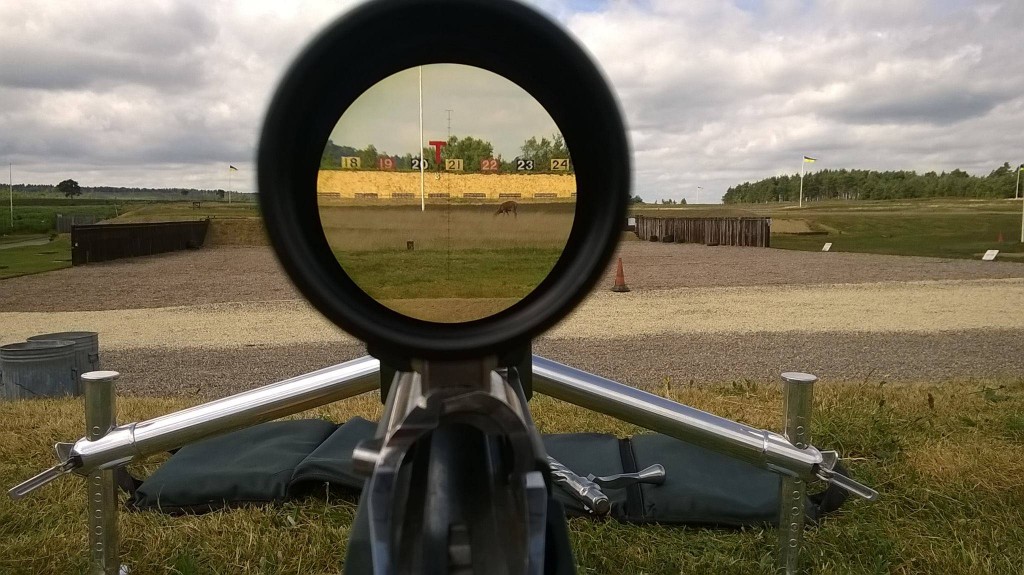
What’s wrong (or right?) with this picture? Does the “F” in F-class refer to “Fauna”? Look carefully at this Bisley Range photo taken by Australian R. Hurley while looking downrange through his March 8-80X scope. The photo was taken in 2015 at the Bisley National Shooting Centre in the UK.
The Story Behind the Photo
British shooter T. Stewart reports: “I was there when this photos was taken. All I can say was that Mr. Hurley was firmly reminded that should said deer accidentally jump in front of his bullet … he would spend five years ‘At Her Majesty’s Pleasure’.”
“That morning we had five deer moving across the targets, literally blocking the V-Bull. Since we were on the 900-yard Firing Point, and elevated for such, obviously the bullet would pass well above them. But they do NOT move or flinch at the noise or passing bullets since they are not hunted on the Bisley Ranges. Earlier this year we saw a herd of 20 or so deer grazing slowly across the Range.”
More Fauna Findings…
Apparently Bisley is not the only place were “the deer and the antelope play”. In Canada, on the Connaught Ranges near Ottawa, Ontario, shooters often encounter a variety of wildlife. William McDonald from Ontario says: “Animals are a common sight on the Range. Along with deer we see geese, turkeys, and coyotes on a daily basis.”
Likewise, E. Goodacre from Queensland, Australia often sees ‘Roos on his home range: “I shoot at Ripley, Australia, and shooting is regularly interrupted by kangaroos. Our last silhouette match was delayed by an hour while 30 ‘Roos dawdled across — silly buggers!”
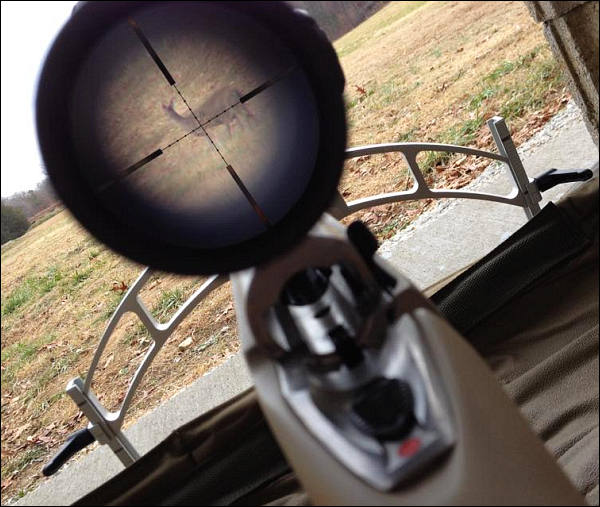
R. Hurley wasn’t the first fellow to view deer through his F-Class rifle’s scope. After seeing Hurley’s photo from Bisley, B. Weeks posted this image, saying: “Been there, done that!”
By Gary Anderson, DCM Emeritus
Rules that will govern CMP competitions in the next competition year are now posted on the CMP website where competitors and Match Officials can download them in preparation for the 2025 competition season. The CMP produces seven different competition rulebooks that have been revised for 2025 competitions. Electronic PDF versions of the new rulebooks are now available. The new CMP rulebooks are listed below.
Safety Rules and Procedures. All 2025 CMP Rulebooks now have separate 2.0 Safety Sections that include all range safety rules that are included in that rulebook. There aren’t any significant new safety rules, but safety procedures that were in various places in the rulebooks have been consolidated into one Rule 2.0 Safety Rules and Procedures section in each rulebook. This change reflects a CMP concern that all CMP range safety rules must be easy to find, readily accessible and well understood.
Three-Position Air Rifle Rules. The CMP supports the production of the rulebook that governs Three-Position Air Rifle competitions for school-age juniors. The National Standard Three-Position Air Rifle Rules are decided by National Three-Position Air Rifle Council member organizations through a process administered by the CMP. The 15th Edition 2024-2026 version of this rulebook was released at the end of September 2024.
Suppressors and Silencers. The use of silencers or suppressors is already widespread in some shooting sports disciplines. Their use is being promoted as a means of reducing range noise levels and mitigating the possibility of hearing loss. The CMP has made no decisions regarding whether to make them legal for use in CMP Highpower Rifle or Pistol events, but the CMP Rules Sub-Committee and Rules Advisors are seeking information and opinions on whether to take that step.
CMP Classification System. The CMP classification system is being expanded to include new Indoor Pistol, 22 Caliber Only Pistol and Mid-Range Highpower Rifle classifications.
Long Range competitor shooting with scoped Eliseo Tubegun. Note viewing screen for electronic target.
Sebastian (“Seb”) Lambang, the brilliant creator of SEB rests, joystick bipods, and rear bags, visited the USA two years ago to compete at the 2023 NRA F-Class National Championships at the Ben Avery shooting facility in Phoenix, Arizona. For that Fall 2023 event, Seb commissioned a very handsome, state-of-the-art F-Open rifle built by Blake Barrel and Rifle. Above is Seb’s F-Open rifle on the firing line at Ben Avery.
Seb Lambang’s impressive 7 FCP rig is chambered for the 7 FCP cartridge, an “improved” 6.5 PRC necked up to 7mm. This handsome rifle was crafted by Blake Barrel and Rifle using a 7mm, 1:8.5″-twist Blake barrel chambered in 7 FCP fitted to a Borden Accuracy BRMXD action. Mated to the Borden action is a Bix’N Andy Competition Benchrest trigger. On top is a March 10-60x56mm HM scope.
The handsome laminated wood XR stock is made by Cerus Rifleworks. The XR stock boasts a R.A.D. recoil reduction system in the rear, and a metal bag-rider system at the forward end of the stock. The rig employs an adjustable F-Class Products F-Open Barrel Tuner.
Seb Lambang is a talented shooter as well as a great craftsman. On the side of his March X scope it states: “Sebastian Lambang, QRA Queens 2022, F-Open Winner”.
Sebastian Lambang — Founder and Chief Designer of SEB Rests
When he is not competing, Seb works hard producing SEB Front Rests, SEB Neo-X Rests, SEB Mini-X tripod rests, and the class-leading SEB JoyPod-X joystick bipod, favored by F-TR shooters worldwide. Here are products at Seb’s warehouse, getting ready to be shipped out.
About the 7 FCP — New 7mm Cartridge Derived from 6.5 PRC
The 7 FCP was a cartridge designed from the ground up by F-Class Products out of Phoenix, Arizona in the fall of 2022. The developers believe it is the “ultimate cartridge” for the F-Class Open Division competition. F-Class Products notes: “We wanted a cartridge that [had] an efficient case capacity [matching] the 7mm Remington Short Action Ultra Magnum. The 7 RSAUM has proven to be the most winning cartridge in world F-Class competitions and many nationals and finale events. The problem with the RSAUM is brass availability. Remington stopped making brass for the RSAUM years ago and recently Norma has also stopped producing brass for it. The only option now is ADG. While the ADG brand of brass is good, it is quite expensive and also is only run in short runs and is hardly ever available.”
So the 7 FCP was developed from the 6.5 PRC, which has high-quality Lapua brass available. The 7 FCP was designed to shoot the 180 grain Berger Hybrid bullet at 2960 FPS out of a 30″ barrel without excessive pressure. SEE: 7 FCP Cartridge INFO FAQ Page.
7 FCP Cartridge — Wildcat Based on 6.5 PRC Necked up to 7mm
How Does the 7 FCP’s Case Capacity Compare?
F-Class Products states: “The parent case of the 7 FCP is a 6.5 PRC. The 6.5 PRC is a magnum case that has a head diameter of 0.532″ and has a overall length of 2.020″. It is the same overall length as the 7 RSAUM but with a smaller diameter body. Hence, without improving it, you will get not get the case capacity of a 7 RSAUM case, and therefore you will not get the velocities that the 7 RSAUM produces either.” F-Class Products has compared the capacity of cases commonly used in F-Open competition:
.284 Winchester = 63 grains of water capacity
.284 Shehane = 66.5 grains of water capacity
6.5 PRC = 65 grains of water capacity
7-6.5 PRC = 66.5 grains of water capacity
As you can see by the data above, the 6.5 PRC that is simply necked up to a 7mm does not provide more case capacity than the .284 Shehane. That is why the PRC has the shoulder moved forward.
What Powders Work Well in the 7mm FCP?
F-Class Products has tested many powders with the 7 FCP: “Any powders that work well in a .284 Win, a .284 variant or a 7 RSAUM and/or variant, can work well in the 7 FCP. We have tested many different powders and many show to work excellent. Here is a list of the powders we have tested that work well in our testing and in our customers’ testing:
Hodgdon H4350
Hodgdon H4831
Hodgdon H4831 SC
Alliant Reloder 16
Alliant Reloder 23
Vihtavuori N160
Vihtavuori N550
Vihtavuori N555
This is just a short list of what we believe are the core powders that will burn and work efficiently in the 7 FCP. There are plenty of other powders that also can work, yet they may be temperature sensitive and or not burn efficiently in the case.”
What Velocities Are Optimal?
F-Class products observes: “With the 180 grain Berger bullet we see accuracy from 2920-2980 FPS muzzle velocity. With the 190 grain Hornady A-Tip bullet we see accuracy from 2860-2900 FPS.”
What Twist Rates Do You Recommmend?
F-Class Products recommends a 1:8.5″-twist barrel. An 8-twist can work, yet the accuracy nodes may be narrower than the 8.5 twist. A 9-twist barrel can also work if you are shooting a 184 grain bullet or less. These twist rates are recommended for lead cored bullets. If you are planning on shooting a solid copper bullet, consult the bullet manufacture for recommended twist rates for that particular bullet.
What Is the Parent Case?
The parent case of the 7 FCP is a 6.5 PRC. The 6.5 PRC is a magnum case that has a head diameter of 0.532″ and has a overall length of 2.020″. It is the same overall length as the 7 RSAUM but with a smaller diameter body, hence without improving it, you will get not get the case capacity of a 7 RSAUM case, and therefore you will not get the velocities that the 7 RSAUM produces either.
Every Saturday we present interesting, informative videos for our Daily Bulletin readers. Here we feature five YouTube videos that offer a ton of useful information for serious shooters. We start with a great video about setting up rifle, rest, and bag on the bench. Then Hall-of-Fame benchrest shooter Speedy Gonzalez shows smart methods for cleaning barrels. Next F-Class Ace Keith Glasscock explains how to optimize your rifle after travel. In the fourth video, AutoTrickler inventor Adam MacDonald shows how to optimize the AutoTrickler V4. Next the truly outstanding 21st Century Power Neck-Turning lathe is showcased.
How to Set Up Your Rifle, Rest, and Bag on the Bench
To get the best results in benchrest shooting, you need to set up all the gear on your bench properly. That includes front rest placement, rear bag position, spotting scope set-up, and placement of cartridge holder/caddy, and possibly an elbow/forearm rest. When setting up the hardware, you need to align the front rest and rear bag properly to get optimal tracking. In addition you want to make sure the rear bag doesn’t slide or rotate a bit from shot to shot. And you also want to set your seat height/location so the shooter’s position is optimal and comfortable. This helpful video shows how to set up your rifle and gear for a benchrest match or load development/practice at the range. Credit to Boyd Allen for finding video.
Cleaning Barrels with Speedy — Smart Techniques
There are many effective methods to clean barrels. But some are more efficient that others and can help you do the job more quickly, with less effort. Here respected gunsmith and Hall-of-Fame benchrest shooter Speedy Gonzalez shows his procedures for cleaning competition barrels. He uses Sharpshoot-R Liquid Patch-Out and Wipe-Out Accelerator as primary solvents. Watch carefully — Speedy has some clever techniques for starting a patch in the rifling, and he is also careful about exiting the muzzle when brushing. Speedy also explains the importance of keeping your rods clean. And he prefers nylon brushes because, as the barrel starts to get wear in the throat, “the bronze bristles will actually start eating into that and you’ll see little grooves if you have a good borescope.” (See video 00:38-01:35)
Loading for PRS vs. F-Class — Keith Glasscock
Keith Glasscock is one of America’s top F-Class shooters, having finished second at the National Championships multiple times. He also now shoots PRS/NRL Precision Rifle matches. Keith, who has an engineering background, runs the popular Winning in the Wind YouTube channel. There you’ll find great advice on wind reading, load tuning, precision reloading and many other topics. In this video, Keith offers very smart advice on how to optimize a PRS load compared to a F-Class load. Accuracy counts for both disciplines, but the key objectives can be different.
Adjusting AutoTrickler V4 with its Inventor, Adam MacDonald
Adam MacDonald is the brilliant Canadian engineer who created the AutoTrickler series of automated powder dispensing systems. These work with advanced scales to dispense powder rapidly, but with a precise final trickle accurate to a single kernel. In this video, Adam explains how best to adjust and calibrate the AutoTrickler V4 when using powders that flow at different rates.
21st Century Power Neck-Turning Lathe — Great Tool
Turning case-necks can be tedious and tough on older hands if you’re using hand-held tools. Quite a few years ago 21st Century released a great compact, neck-turning lathe that delivers superb, consistent results. This Editor uses that original lathe with hand crank and I can affirm that it works great. It is easy to use, fast, and the turned necks come out smooth with consistent rim thickness. But you still had to turn a crank. Well, in 2018, 21st Century created an upgraded Power Neck-Turning Lathe with an electric motor and lever to advance the cases to the cutter. The power head glides on stainless steel guide rails. Power is controlled with a red button in the feed handle.
This advanced, powered mini-lathe is absolutely superb. It works brilliantly and makes the task of turning case-necks fast and VERY easy. And there is even a 3-Way trimmer upgrade that will trim cases to length at the same time as the necks are turned.
BONUS — How to Spot Fake Online Sellers of Components
With the shortage of premium reloading components, particularly powder and primers, many handloaders are desperate to find components when even big companies such as Midsouth and MidwayUSA are completely sold out. Enter the scammers. There are criminals, many based overseas, who have created entire websites designed to steal your money. You might find such a site when searching for “Varget powder in stock” or “CCI BR4 primers”. These sites look like regular business webstores, with product photos and modern shopping cart systems. But it’s all a scam.
Key giveaways are: 1) The site does NOT take Visa, Mastercard, or Discover but requires payment with Zelle, Venmo, Bitcoin, or AppleCash only; and 2) The site has hard-to-find powders, such as H4895 and H4198, that nobody else has, and you can put thousands of pounds in the shopping cart.
Bottom line here — if the site allows you to order vast amounts of powder and/or primers, and does not take ANY major Credit Card types, it is almost surely a scam. If you see links to pay with Crypto-Currency (such as Bitcoin) run away!
The NRA Blog ran an feature on Silhouette shooting by NRA Silhouette Program Coordinator Jonathan Leighton. Here are selections from Leighton’s story:
NRA Silhouette Shooting
The loud crack from the bullet exiting the muzzle followed by an even louder ‘clang’ as you watch your target fly off the railing is really a true addiction for most Silhouette shooters. There is nothing better than shooting a game where you actually get to see your target react to the bullet. In my opinion, this is truly what makes this game so much fun.
Metallic Silhouette — A Mexican Import
Silhouette shooting came to this country from Mexico in the 1960s. It is speculated that sport had its origins in shooting contests between Pancho Villa’s men around 1914. After the Mexican Revolution the sport spread quickly throughout Mexico. ‘Siluetas Metalicas’ uses steel silhouettes shaped like game animals. Chickens up front followed by rows of pigs, turkeys, and furthest away, rams. Being that ‘Siluetas Metalicas’ was originally a Mexican sport, it is common to hear the targets referred to by their Spanish names Gallina (chicken), Javelina (pig), Guajalote (turkey) and Borrego (ram). Depending on the discipline one is shooting, these animals are set at different distances from the firing line, but always in the same order.
Before Steel There Was… Barbeque
In the very beginnings of the sport, live farm animals were used as targets, and afterwards, the shooters would have a barbeque with all the livestock and/or game that was shot during the match. The first Silhouette match that used steel targets instead of livestock was conducted in 1948 in Mexico City, Mexico by Don Gonzalo Aguilar. [Some matches hosted by wealthy Mexicans included high-ranking politicians and military leaders].
As the sport spread and gained popularity during the 1950s, shooters from the Southwestern USA started crossing the Mexican border to compete. Silhouette shooting came into the US in 1968 at the Tucson Rifle Club in Arizona. The rules have stayed pretty much the same since the sport has been shot in the US. NRA officially recognized Silhouette as a shooting discipline in 1972, and conducted its first NRA Silhouette Nationals in November of 1972.
Great Video of Silhouette Shooting in Canada with Drone Footage
Now There Are Multiple Disciplines
The actual sport of Silhouette is broken into several different disciplines. High Power Rifle, Smallbore Rifle, Cowboy Lever Action Rifle, Black Powder Cartridge Rifle, Air Rifle, Air Pistol, and Hunter’s Pistol are the basic disciplines. Cowboy Lever Action is broken into three sub-categories to include Smallbore Cowboy Rifle, Pistol Cartridge Cowboy Lever Action, and regular Cowboy Lever Action. Black Powder Cartridge Rifle also has a ‘Scope’ class, and Hunter’s Pistol is broken into four sub-categories. Some clubs also offer Military Rifle Silhouette comps.
Where to Shoot Silhouette
NRA-Sanctioned matches are found at gun clubs nation-wide. There are also many State, Regional, and National matches across the country as well. You can find match listings on the Shooting Sports USA website or contact the NRA Silhouette Department at (703) 267-1465. For more info, visit SteelChickens.com, the #1 website dedicated to Silhouette shooting sports.
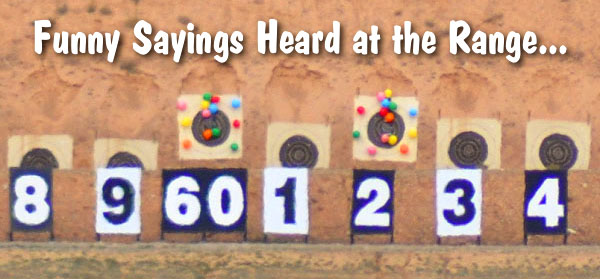
Shooting can be a frustrating sport at times, prompting shooters to say some funny things in the heat of the moment. Here’s a collection of humorous range ripostes, supplied by Shooters’ Forum members (who are listed after each quote). Enjoy.
“I paid to use all of the target and I’m getting value for money on all of the real estate!” (Macropod)
“At 65 years of age, 1000-yard benchrest is better than sex, because a relay lasts 10 minutes!” (The Viper)
“How did I do?” “Well the gun went off and nobody got hurt, we can build on that….” (Mr. Majestic)
“Treat that trigger likes it’s your first date, not like you’ve been married to it for 20 years.” (Jet)
“It’s a good thing broad sides of barns aren’t at many shooting ranges.” (Rocky F.)
Target photo by Forum member RyanJay11.
“It was an 0.2″ group! Well, err, except for that flyer….” (Dsandfort)
“It’s not the arrow, it’s the Indian.” (Rocky F.)
“I can’t understand it. That load worked good in my other barrel”. (Hogpatrol)
“You bakin a biscuit?” Said to me as I was sitting at the bench ready to shoot with a cartridge in the chamber of a hot gun, taking longer than necessary. (Ebb)
“Shooting groups is easy. Just put the last three between the first two.” (Uthink)
Shooter 1: “Hey you cross-fired on my target!”
Shooter 2: “Well you cross-fired on mine first!”
Shooter 1: “Yeah but you could have at least shot an X like I did on yours.” (At Raton — Rocky F.)
“I had a bughole going and my second shot dropped straight down!” (JDMock)
“The nut came loose on the end of my stock.” (TXDan)
“That’s a pretty eight.” (REastman quoting James Crofts)
“I almost shot a record.” (Jay Christopherson)
This article is Copyright 2023 AccurateShooter.com. No reproduction on any other website is allowed.
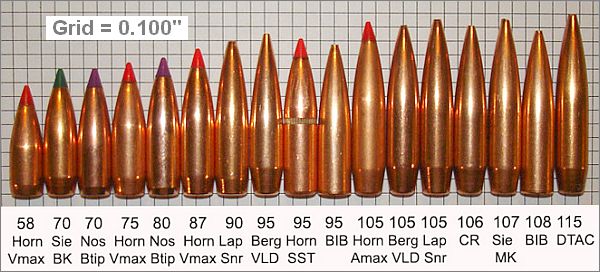
Intro: Ron Dague wanted a new gun that was similar to his trusty .223 Rem rifle, but which fired 6mm bullets. There is a superb choice of bullets in this caliber, and Ron found that the 95gr Berger VLD could be driven to a healthy 2604 FPS by the small .223 Rem case. This 6mm wildcat based on the common .223 Remington offers excellent accuracy and very low recoil — something very important in the cross-the-course discipline. In addition, Ron’s 95gr load with Alliant Reloder 15 delivered an ES of just 4 fps over ten shots. That exceptionally low ES helps achieve minimal vertical dispersion at 600 yards.
By Ron Dague, Sinclair Reloading Tech
From Sinclair’s GunTech Articles Archive
I have watched a change in thinking for NRA High Power across the course in match rifles and calibers. There are several [popular chamberings]: 6mm AR, 6.5 Grendel, 6XC, and 6.5 Creedmoor. I have seen these rifles perform and all have done very well.
When I started this project I was looking for a cartridge that shoots and feeds well from a magazine[.] I had shot the .223 Rem in my 722 Remington and knew it had fed well so I chose the .223 Remington necked up to 6mm.
The 6mm-223 gives me what I have in the standard .223 only with a better selection of bullets. I wanted a better 600-yard bullet with a higher BC than provided by the 80 and 82 grain bullets. I also wanted a 600-yard line bullet with a .500 or better B.C. for those shots that should be 10 ring or better but seem to find the 9 ring no matter how well I held and broke the shot.
Putting the 6mm-233 Project Together
My project started with ordering a 6mm barrel from Bartlein with a 1-8″ twist. I called Pacific Tool and ordered the 6mm-223 reamer. I found a used Remington 700 action at a local gun shop and already had a Remington 40X stock. I then started putting the gun together.
I already had a .223 Remington match rifle, and I wanted the 6mm-223 to be as close to the same as I could make it. I installed the barreled action in a wood 40X stock to work up load data and work out any magazine feeding issues. While I was working on that, I looked for a McMillan Baker Special stock and finally found one to finish this project. I bedded the action and stock, then took the rifle to the range to check zeros on the sights and scope. I was surprised that I didn’t have to change anything on the sights. I thought changing the stock would cause sight changes. The thought went through my head, “Maybe the 40X stock isn’t all that bad”.
Here’s line-up of 6mm bullets. The Berger 95gr VLD is in the middle.
I took the new rifle to the first match of the year, a National Match Course match, and my off-hand score was 83, rapid sitting 95, rapid prone 95, and slow fire prone 197 — for total aggregate 470. This may not be my best work, but on match day the wind was blowing about 15 mph and the temp was around 40° F, with rain threatening. This was a reduced course of fire — we shot at 200 and 300 yards on reduced targets.
I used 70gr Berger bullets for this match, loaded in Remington brass with 25 grains of VihtaVuori N540 and Federal 205M primers. When I worked up loads for this rifle, N540 gave the best accuracy with the best extreme spread — 2,950 fps with an extreme spread of 20 fps on a 10-shot string. The load for 600 yards was with a 95gr Berger VLD bullet, with 23.0 grains of Reloder 15, Lapua cases, and the same Federal 205M primers. This load is 2,604 fps, with an extreme spread of 4 fps over a 10-shot string. I’ve shot this load at several 3×600 yard matches, and the accuracy has proven to be very good. At the last 3×600 match, my scores were as follows: 199-10x and 198-11X with scope, and 193-10X with iron sights. Best 600-yard score so far with iron sights was 198-12X.
6mm-223 Rem Rifle Specifications: 700 BDL action and floor plate, Bartlein 6mm 1:8″ twist, McMillan Baker Special stock in Desert Camo, Centra front and rear sights, Ken Farrell bases with stripper clip guide, Sinclair hand stop, and Jewell trigger. Gunsmith Neil Keller helped me with the metal work and instructed me on the action work and rebarreling.






 How Does the 7 FCP’s Case Capacity Compare?

 The
The 
 Metallic Silhouette — A Mexican Import
 Before Steel There Was… Barbeque


 By Ron Dague, Sinclair Reloading Tech
 Putting the 6mm-233 Project Together