Story based on report by Ashley Dugan, CMP Staff Writer
After years of testing, the Civilian Marksmanship Program (CMP), has announced “full use” of eTargets at the 2025 National Rifle Matches at Camp Perry, which run July 20 through August 9, 2025. The advanced Kongsberg eTargets will be used at all Highpower rifle matches, National Trophy Rifle competitions, and Rifle Games events. In addition the eTargets will be used for the Rimfire Sporter Match on July 20 and the National Mid/Long Range Matches in August. The use of eTargets eliminates the need for pit duty, drastically cutting down the duration of each match. “Shooting on eTargets is just a better experience for all competitors” notes Brian Williams, CMP Highpower manager.
The CMP’s Kongsberg Target System (KTS) registers shots with extreme precision. The system includes monitors at each firing point so competitors can instantly see the location and score for their shots — they don’t have to wait for a target to be pulled and marked. The use of the targets also eliminates the need for pit duty, drastically cutting down the duration of each match. The 2025 National Matches will be held on the historic ranges at the Camp Perry National Guard Training Facility in Port Clinton, Ohio. Learn more at Thecmp.org/cmp-national-matches.
Brian Williams, CMP Highpower manager stated: “We have utilized this system for years, and during that time, we have made countless upgrades and improvements. We believe that we now offer the most accurate, easiest to use eTarget system available [giving] competitors the very best system interface. Competitors have been asking for this for years, and we have spent a great deal of time and energy getting the system ready to be used on the biggest stage in competitive shooting”.
The KTS system has been permanently installed at CMP’s Talladega Marksmanship Park as well as on Camp Perry’s Petrarca Range in Ohio. The mobile version of the KTS system, featured at CMP Travel Games events, will be the eTarget types used at most of the 2025 National Matches.
“With an increasing number of affiliate local clubs converting to eTarget systems, there is a growing expectation that the National Matches should be conducted this way,” Williams addedd. As another advantage, the eTarget system at the National Matches will include the KTS Shooter’s Journal, which keeps a log of each individual’s shots/scores on the firing line.
Some years ago, Forum Member Jeff R. (“aJR”) from Australia crafted a slick, handsome cartridge holder to use with his heavy Benchrest Gun. This is a simple, elegant design that would be relatively easy to build in a home workshop. Composed of two blocks of wood with parallel metal arms, the unit adjusts for height and block angle. Jeff tells us: “This is my new cartridge dispenser I knocked up in the shed. I wanted to get the record rounds up next to the action and this is adjustable for just about any gun/port configuration, right or left.” The cartridge caddy has ten round holes (for record shots) in the top wood block, stacked in two rows. The base piece has five holes for sighters, with the holes cut at an angle for easy access.
For the blocks, Jeff used “Jarrah” wood, a deep, red hardwood native to West Australia. Jeff says he did not stain the wood–what you see is the natural color, just sprayed with acrylic lacquer. A similar wood available in the USA is Satiné, also known as “Bloodwood”.
By the way, Jeff’s 1000-yard rifle shown in the top photo is worth mentioning in its own right. The gun shot a large 30-cal magnum wildcat cartridge and 17 years ago set many Australian BR records. The rifle features a tensioned barrel system, custom Magnum drop-port action, and a metal/composite stock. Click HERE for more info. There’s even a YouTube Video showing Jeff shooting his big boomer at 1000-yard match at Brisbane QRA.
The Civilian Marksmanship Program (CMP) has returned its annual Camp Perry Open match to its original winter timeslot in 2025. The 2025 Open will take place next month, January 17-19, 2025. This event will offer air rifle and air pistol competition over three days at the Gary Anderson CMP Competition Center. Registration is now open, but capacity is limited, so sign up early for this exciting and challenging event.
The 2025 Camp Perry Open includes a junior 3×20 air rifle match and 60 Shot air rifle and air pistol competitions for adults and juniors, with adaptive athletes also welcome. Additionally, an air gun clinic will provide an educational opportunity for participants. All air gun events will be held within CMP’s Gary Anderson Competition Center electronic target indoor air gun range.
In recent years, the Camp Perry Open was held in May so it could include a smallbore rifle match. However, no smallbore competition will be offered at the 2025 Camp Perry Open this year.
The Camp Perry Open Super Final will return, though without smallbore (rimfire) shooting this January. During the Super Final, top competitors from each of the day’s air rifle and air pistol qualification round meet on the firing line to compete in an intense elimination event. The Super Final is a very popular event.
Electronic Targets with Results Streamed Online
The Gary Anderson Center boasts state-of-the-art electronic targets that record scores the instant each shot is fired. Shot-by-shot feeds are then displayed online through as Live Target Images that can be viewed anywhere there is an Internet connection. CLICK HERE to See Live Target Feeds
To shoot tight groups and high scores from the bench, or in prone F-Open competition, a quality front rest is essential. And a good rest is also very valuable when zeroing rifles, testing loads, and shooting varmints from a portable bench. Today’s Saturday video showcase includes multiple video reviews of some of the best front rests on the market — great products from SEB, Rodzilla, 21st Century, Lenzi, and Sinclair Int’l. In addition, the lead-off video from F-Class John covers some of the less expensive rests as well as SEB Joy-Pod coaxial bipods.
Review of Many Popular Front Rests from $250 to $2200
If you are shopping for a front rest, definitely watch this comprehensive 42-minute video from start to finish. This is probably the most informative video about premium shooting rests available on YouTube. Top F-Class shooter and video-maker F-Class John covers a wide selection of front rests, with some observations about coaxial bipods as well. John covers the impressive new SEB NEO-X, the easy-to-transport SEB Mini-X, the excellent Rodzilla Rest, the innovative 21st Century Hybrid Rest, the sleek Italian Lenzi Rest. And at the end of the video John reviews the very affordable Caldwell Fire Control Rest ($220.93 on Amazon), explaining how it can be a decent choice for shooters on a limited budget.
NEW SEB NEO-X — Set-Up in the Field
Still in its final prototype stage, the innovative SEB NEO-X raises the bar for transportable coaxial front rests. An innovative design with hinged legs allows the 20-lb NEO-X to be transported in a small case. Once the legs are extended however, the NEO-X has proven to be very stable. And this new coaxial rest offers very precise, easy-to-use controls. A swivel head speeds up deployment, as the allows you to quickly align the rest top to the target. Users have confirmed the NEO-X works great and is very stable. In the video above ace F-Class shooter Erik Cortina (below) shows how to quickly deploy the NEO-X in the field.
Rodzilla T-Rex — High Quality, Big Footprint, Advanced Features
The impressive Rodzilla T-Rex front rest offers outstanding stability with smooth, precise performance. Designer/builder Rod Brakhage (the Rod in Rodzilla) started from the ground up to create a user-friendly, match-ready, modular front rest on the market. The T-Rex weighs just over 21 pounds, and the T-Rex has a large footprint, rivaling the largest rests on the market. That provides exceptional stability, even with heavy-recoiling rifles.
The T-Rex boasts an adjustable joystick that extends from 15.5″ to 21″ in length. With this adjustability, no matter what your stock length or design, you can find a comfortable position without having to stretch uncomfortably. Rodzilla delivers the T-Rex in a custom-designed hard carry case that fits it perfectly and still has room for additional feet and accessories. The T-Rex can be ordered with excellent Sand Feet. Along with the T-Rex, Rodzilla now offers the excellent Raptor Front Rest, a lighter rest designed for easy air travel and portability without sacrificing features or stability.
21st Century Hybrid-X Front Rest
Lateral Control Arm, Vertical Elevation Knob
The innovative 21st Century Hybrid-X front rest offers the “best of both worlds”. It allows precise lateral movement (for wind holds) with no elevation change. The entire center section of the rest rotates as one unit for fast, perfect horizontal alignment to target. Then adjust vertical precisely with the rotary knob on the outboard end of the control rod. Our Daily Bulletin Hybrid-X article has a full description with multiple photos of this unique rest. See additional Hybrid-X Video.
Sinclair Int’l Competition Front Rest — Sturdy and Stable Design
The Sinclair Int’l Competition Rest is a classic heavy and very stable rest that works great on the bench. Weighing 30+ pounds, with a 1″-thick steel base, this rest has a very low center of gravity and is ultra-stable. Currently priced at $579.99, the Sinclair Competition Rest is less than half the cost of the more exotic front rests.
Horizontal (windage) movement is controlled with a large rear knob which uses dual sets of twin tapered roller bearings for a non-binding windage operation. Nearly four feet of windage adjustment is offered at 100 yards. Elevation changes are made with the large wheel. With its mass and low COG, this Sinclair Rest is very stable. And because of its ability to hold elevation shot to shot, this rest has been popular with long-range benchrest competitors who often shoot quick strings of 5 or 10 shots.
SEB Mini-X and SEB Mini — Transportable Joystick Tripod Rests
The original SEB Mini was an innovative collapsible tripod rest with a coaxial top. On its introduction the SEB Mini became immediately popular with varminters, F-TR shooters, and anyone who wanted an affordable, easy-to-transport front rest that offered easy, precise and rapid adjustment of windage and elevation with the Joystick. Building on the success of the original SEB Mini, the SEB Mini-X offers an improved head design, and new adjustable “ankle” units on all three legs. This makes it easier to level the Mini-X on uneven ground. The Mini-X has proven very successful in competition, winning major F-Open matches. Folding into a very compact package, it is easy to transport in airline luggage. Yet it offers a very stable shooting platform with precise, effortless joystick control of elevation and windage.
SFC Emil Praslick III is now retired from the U.S. Army, but he left a great legacy as one of the USAMU’s greatest coaches and team leaders. A highly-respected wind expert, Praslick also was known for his ability to help his shooters master the “mental game”, which is so important at the highest levels of competition. Here is an article from the CMP Archives in which Praslick explains how to focus your mind to achieve greater success.
Thinking Your Way to Success by SFC Emil Praslick III (Ret.)
Why does it seem that the same small group of shooters wins the majority of the matches? Within the Army Marksmanship Unit’s Service Rifle Team, the same effect applies. On a team filled with uncommonly talented shooters, the same two or three are consistently at the top of the final results bulletin. What is the difference among shooters who are technically equal? Confidence. A confident shooter is free to execute his shots without the fear of failure, i.e. shooting a poor shot.
Negative thoughts (can’t, won’t be able to, etc.) will destroy a skilled performance. The mind’s focus will not be on executing the task, but on projecting fear and self-doubt. Fear is the enemy, confidence is the cure.
How does a shooter on the eve of an important match (the President’s or NTI, for example) attain the confidence needed to perform up to his potential? A pre-competition mental plan can assist in acquiring that positive mental state. The plan can be broken down into a few phases.
Build a feeling of preparedness. Developing and executing a plan to organize your equipment and pre-match routine will aid you in feeling prepared on match day.
Avoid negative and stressful thoughts. Focusing on “winning” the match or shooting for a specific score (like making the “cut” or making the President’s 100) can cause undue stress. Good shooters focus on aspects that are within their control: their sight picture, their sight alignment, their position. Each shot should be treated as an individual event.
Train stage-specific tasks during your practice sessions. Instead of shooting matches or practice matches only, include some drills that focus on your problem areas. Training in this manner will assist your level of confidence.
As part of your pre-match routine, imagine yourself shooting perfect shots. Visualize getting into the perfect position, acquiring a perfect sight picture, and perfect trigger control.
Let a feeling of calm and well-being wash over you. Spend a few minutes alone thinking positive thoughts. Many shooters use their favorite music to help build the mood.
Once you develop your pre-competition mental plan, stick with it. Through your training you will develop the physical skills to shoot higher scores. The confidence you will need to apply them in match conditions will grow as you develop into a complete shooter; both physically and mentally.
The USAMU’s article archives are a great resource for competitive shooters. Click HERE for more excellent instructional articles by Emil Praslick and other USAMU Coaches and shooters. You’ll find articles on Wind-Reading, Fitness, Equipment, Shooting Positions, Shooting Techniques, Match Strategies and much more.
Keith Glasscock is one of America’s greatest F-Class shooters, as well as a highly respected wind coach. A High Master, Keith finished second overall at the 2021 NRA F-Class Long Range Championship in F-Open division. He also finished second at the 2020 F-Open Nationals, and second at the 2019 F-Open Nationals. His consistency is unrivaled, which means he definitely knows the secrets of competition shooting and loading ultra-accurate ammo. Recently Keith has started PRS/NRL competition, bringing his shooting skills to those popular tactical disciplines.
Keith has a great YouTube Channel with new content every week. On Keith’s Winning in the Wind channel, Keith offers 235+ informative videos on a wide range of topics including wind reading, reloading, component selection, load development, and training.
For today’s Saturday Video Showcase, we offer eight of our favorite Keith Glasscock videos. These cover many key topics — ballistics, barrel care, gunsmithing, bullet sorting, reloading, maintenance and more. Each video has important points that can benefit any competitive rifle shooter, whether you shoot in local 100-yard fun matches or compete at the National Level in F-Class, LR Benchrest, Palma, High Power, or PRS/NRL.
For most disciplines, if you want to achieve maximum accuracy and consistency, you should have your action bedded. This provides an optimal “seating” for the action which quells shot-to-shot motion and helps reduce vibration. Gunsmiths say a good bedding job can produce immediate benefits. In this video Keith Glasscock explains how to check your stock bedding and discusses the realistic benefits you can expect in group size and consistency over long strings.
Keith Glasscock is one of the very few PRS/NRL competitors who has shot F-Class at the very highest level, finishing second three times in F-Class National Championships. PRS/NRL and F-Class are very different disciplines with different challenges. F-Class is shot prone with time between shots and target distances from 600 to 1000 yards. In PRS/NRL competition, you are shooting from multiple positions, at many distances from 100 yards on out, with fast follow-up shoots. For F-Open, you want an extremely accurate load that can deliver sub-quarter MOA groups at 200 yards. For PRS/NRL you don’t necessarily need that level of accuracy (though it helps). But you also need a load that is very consistent, has relatively low recoil, but can also provide sufficient impact energy to clearly show a hit on distant steel. In this video, Keith Glasscock explains his reloading objectives for the two disciplines.
Hard carbon is the bane of rifle shooters. Hard carbon build-up in the barrel can adversely affect accuracy, and in extreme cases, can lead to increased pressure. If possible, you should clean your barrel(s) soon after a match (or shooting session) before the carbon fully hardens. We’ve used Wipe-Out Foam right after a match (with an hour soak time) and that dramatically reduced the amount of brushing required. In this video Keith Glasscock explains the negatives of hard carbon in your barrel, and he discusses how to diagnose the problem and how to remove the carbon build-up efficiently.
Benchrest and F-Class shooters don’t worry about magazines, because their rifles typically employ single-shot actions. However, with PRS/NRL rifles you’ll be shooting from a magazine. Likewise many hunting rifles use magazines to enable quick follow-up shots. In selecting the best magazine(s) for your rifle and discipline you need to consider a variety of factors including fit, capacity, reliability, and, yes, cost. In this video Keith Glasscock examines a variety of magazines for bolt-action rifles used in PRS/NRL competition as well magazines for hunting rifles.
Barrel break-in is a controversial subject. With premium finish-lapped barrels from top manufacturers, some ace F-Class shooters get away with hardly no break-in — just shoot for score right from the get-go. On high-quality custom barrels, we’ve had success with minimalistic break-in with a few wet patches ever 3 rounds for the first 20 rounds. However, with relatively rough factory barrels, you may get better long-term results with a systematic break-in process, even using specialized products on your patches. In this video Keith Glasscock explains break-in procedures he’s found to work for various barrel types and applications.
In general, we have gotten the best match results with loads showing an Extreme Spread (ES) under 13 FPS and an extremely low Standard Deviation (SD). We know that F-Class and ELR shooters competing at 1000 yards and beyond definitely want an extremely low ES to minimize vertical dispersion at long range. That said, some short-range Benchrest competitors look at group size more than ES/SD. In this video, Keith Glasscock talks about the reloading process and methods for lowering ES and SD. Proper brass prep is important, as is precise powder measuring. And long range shooters may want to test 3 or 4 different powder types to find the one that offers the best combination of accuracy and low ES/SD.
Should you sort your bullets? If so, should you sort by weight, OAL, base-to-ogive, or max diameter? Which factor? Well the answer is “it depends”. You need to carefully examine a couple dozen bullets from each batch to see how consistent they are. We had some Lapua bullets that were ultra-consistent with 97 out of 100 within .0015″ base to ogive length. We used those bullets unsorted to set a local range record at 600 yards. On the other hand if you find significant differences in weights, diameters, or bearing surface lengths, you probably should sort. One tip — many shooters do not consider the width difference in bullets. We have seen 6mm bullet diameters vary from 0.2428″ to 0.2436″. We have one 3-groove 6BR barrel that likes the skinny bullets and another 6-groove barrel that definitely prefers the fatter bullets.
The Kestrel 5700 Elite Wind Meter boasts sophisticated ballistics capabilities and LiNK Bluetooth connectivity. With the Kestrel 5700 Elite, once you enter data about bullet type (and BC), velocity, zero, and rifle, the Kestrel can calculate come-ups and wind corrections. The Kestrel 5700 can “talk” to a mobile device that runs the Applied Ballistics APP that contains bullet databases and allows you to easily enter key information such as muzzle velocity, bullet BC, zero distance, velocity, wind, and environmental factors. In this video Keith Glasscock explains the Kestrel 5700’s features including the ability to program sectors for a PRS/NRL match.
The 2025 NRA National High Power Rifle, Smallbore Rifle, and Precision Pistol Championships — the NRA National Matches — will be held at multiple locations across the USA. This marks a notable change from recent years when NRA rifle and pistol championships were held at Camp Atterbury, Indiana. After discussion with representatives from each discipline, the NRA has determined that in 2025, these NRA National Matches will take place at multiple locations in Ohio, Oklahoma, and Wisconsin.
The 2025 NRA National Matches kick off with the National High Power Rifle Across the Course (XTC) Championships at Winnequah Gun Club in Lodi, Wisconsin, June 1-7, 2025 (see below).
After that, the Nat’l High Power Mid-Range Championships will be conducted at Oklahoma City Gun Club in Arcadia, Oklahoma, June 4-8, 2025, followed by the Nat’l High Power Long-Range Championships at Alliance Rifle Club in Malvern, Ohio, July 2-6, 2025. The Nat’l Precision Pistol Championships will be at the Cardinal Shooting Center in Marengo, Ohio, July 6-10, 2025, and the National Matches will conclude with the Nat’l Smallbore Rifle Championships, also at the Cardinal Shooting Center, July 20-27, 2025.
Here Are the Dates and Locations for the 2025 NRA National Matches.
NRA National High Power Across the Course Championships
Winnequah Gun Club — Lodi, Wisconsin Dates: June 1-7, 2025
Registration links and official match program: coming soon winnequahgunclub.org
NRA National High Power Mid-Range Championships
Oklahoma City Gun Club — Arcadia, Oklahoma Dates: June 4-8, 2025
Registration links and official match program: coming soon okcgunclub.org
NRA National High Power Long-Range Championships
Alliance Rifle Club — Malvern, Ohio Dates: July 2-6, 2025
Registration links and official match program: coming soon alliancerifleclub.org
NRA National Precision Pistol Championships
Cardinal Shooting Center — Marengo, Ohio Dates: July 6-10, 2025
Registration links and official match program: coming soon thecardinalcenter.com
NRA National Smallbore Championships
Cardinal Shooting Center — Marengo, Ohio Dates: July 20-27, 2025
Registration links and official match program: coming soon thecardinalcenter.com
2025 NRA National Matches Calendar
Here is the 2025 NRA National Matches Calendar showing major championship events and dates. Different events are indicated by various colors: Red for High Power Across the Course, Yellow for High Power Mid-Range, Green for High Power Long-Range, Dark Red for Smallbore and Blue for Pistol. Click the Calendar to ZOOM for easier reading.
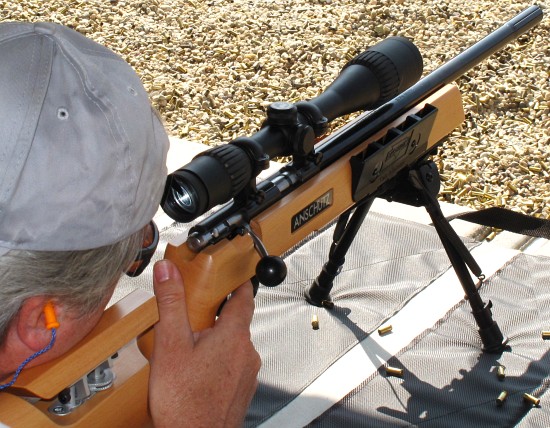
AccurateShooter’s Editor trains with .22 LR Anschutz model 64R back in 2008.
Rimfire Tactical Matches Aren’t Really New
NRL22 and PRS rimfire shooting disciplines are fun, affordable forms of competition. We’re pleased to see the rapid growth of NRL22 and PRS rimfire. However, the concept of a rimfire tactical/practical match is not new — at least on the West Coast. Way before anyone every heard of PRS, California shooting clubs conducted “Rimfire Tactical” matches. These matches were first fired nearly two decades ago. CLICK HERE to read our comprehensive Rimfire Tactical report from way back in 2008. That article includes free targets, ballistics charts, and a complete run-down on suitable rimfire rifles.
The Concept Behind the Rimfire Tactical Match by Bill Erwin
Many guys who shoot long-range tactical matches practice with .22 LR rifles of similar configuration. Rimfire ammo is way more affordable than centerfire, you do not need a big range facility, and shooting rimfire saves wear and tear on your centerfire rifle. Further, for learning how to read the wind, there really is no better training tool than a 22 LR, even as close as 50 yards. Check out this table showing how a .22 LR ballistics compare to .308 Win:
.22 LR vs. .308, Distances for Equal 10 MPH Wind Drift
This table shows the corresponding distances at which a 10 mph full-value crosswind pushes a .22 LR bullet and .308 projectile the same amount. Values are based on 0.130 BC for a 40gr .22 LR bullet, and 0.496 BC for 175gr .308 bullet.
22 LR 40gr 1050 fps
50 yd Wind 1.0″
75 yd Wind 2.2″
100 yd Wind 3.8″
125 yd Wind 5.8″
150 yd Wind 8.2″
175 yd Wind 11.0″
200 yd Wind 14.3″
.308 Win 175gr 2650 fps
130 yd Wind 1.07″
180 yd Wind 2.15″
230 yd Wind 3.68″
280 yd Wind 5.63″
330 yd Wind 7.98″
380 yd Wind 10.71″
440 yd Wind 14.56″
This table shows how the .22 LR can be an effective substitute for a .308 Win during training. Because the smaller bullet drifts more in the wind, a .22 LR rimfire shooter will experience roughly the same crosswind effects as if he was shooting a 175gr .308 Win twice as far out. So, rimfire work can teach you to dope the wind like a .308 Win, but at less than half the distance. Shooting a .22 LR at 100 yards is like shooting a .308 Win (with 175gr SMK) at 230 yards.
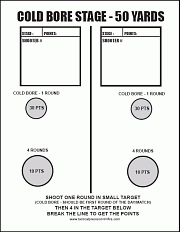
SPECIAL BONUS–Rimfire Tactical Precision Targets
These FREE targets by DesertFrog are offered in Adobe Acrobat format for easy printing. CLICK HERE to download all six targets as a .ZIP archive.
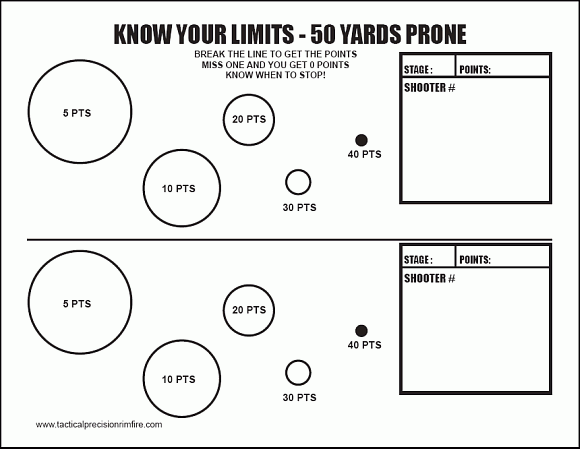
Rimfire Training Target for Fun Matches
Here’s a rimfire training target with “big to small” target circles. Start with the largest circles, then move to the smaller ones in sequence. This systematic drill provides increasing challenge shot-by-shot. Novices often are quite surprised to see their accuracy improve as they move from bigger to smaller aiming points. That provides positive feedback — always a good thing.
Right Click and “Save as” to download printable PDF versions of target.
For this Sunday GunDay article we feature a “blast from the past” — David Tubb’s engineering tour de force, the Tubb 2000, or “T2K” for short. With the remarkable T2K, David earned multiple NRA High Power championships, and David shot the first-ever perfect score in the NRA Long-Range “any sights” championship two decades ago.
Our write-up this week focuses mostly on “hardware” because David’s performance with the rifle speaks for itself. He has won eleven High Power National Championships at Camp Perry, and in 2004 David mounted a scope to his rifle and captured the Long-Range “any sights” Championship with a 1450/1450, the first and only perfect score ever logged at Camp Perry. He did this all with his trusty 6XC-chambered T2K, shooting the DTAC 115gr bullet in a 1:7.5″-twist Schneider P5 barrel. For more information about this remarkable competition rifle, read on.
[Editor’s NOTE: Because this is an article from our older Archives, some technical details may have changed with time. For all specifications on current TUBB rifles visit DavidTubb.com.]
Mag-Feed Action with Unique Bi-Camming Bolt
The action is machined from 17-4 stainless steel to true benchrest quality standards. The design features a solid top with a loading port. This increases action stability, stiffness, and strength. The loading port is easily accessible and is angled to aid the shooter in single loading rounds. The Tubb 2000 is fed via 10- or 20-round box magazines.
“I prefer using 20-round magazines with the Tubb 2000 because it provides a secure hand hold when shooting off the bipod. For across the course competition, the 10-round magazines are the best choice as they do not encumber sling-supported shooting positions. There is no difference in the functioning or reliability of either capacity magazine.”
One-finger Bolt Operation
Low effort bolt operation was a key goal in the design of the Tubb 2000 action. The exclusive bi-camming design employs two cams that engage during bolt lift to radically reduce bolt lift effort. Bolt lift is 75 degrees. The cone-faced bolt has two locking lugs which are narrower and taller than on conventional actions. This design allows the magazine to be mounted higher in the action for smoother, more positive feeding. The bolt handle is designed for superior performance in sustained fire operation. Its ergonomic shape allows operation with a single finger, if desired. The bolt is machined from 8620 carbon steel and rides back into the butt extension, under the shooter’s face so the bolt can be operated without the shooter having to change his head position. This low center of gravity also improves the rifle’s feel and performance under recoil.
The action features a full-length Picatinny rail that will accept Weaver®-style mounts. The action’s adjustable sight mounting system allows the rail to be mounted at one of three pre-set mounting angles — 0, 5, and 10 degrees — to allow the shooter to level the sights to fit his shooting style. A custom base is available to mount match iron sights. All barrels have a small section at the muzzle turned down to accept a clamping-style front sight mount or cant indicator.
The T2K’s Lock Time is ONE millisecond — over three times faster than a Model 70 Winchester.
Barrel Configuration
Tubb 2000 rifles featured hand-lapped stainless steel match barrels with the exclusive “Tubb Contour.” This unique contour maximizes accuracy and minimizes weight — it’s the perfect balance. According to David: “It’s a contour where the barrel wouldn’t shoot one bit better if it was one bit bigger.” The Tubb 2000 was conceived as a “switch barrel” gun — it’s designed to be easily re-barreled by the customer. This feature means that the same rifle can support different calibers and shooting disciplines. Finished barrels in a variety of calibers were available for “do-it-yourself” installations. The gun shown here has a Schneider barrel.
The Tubb 2000 has, over the years, been offered in a variety of chamberings including: .22-250; .243 Winchester; 6mmBR Norma (6BR); 6XC; .260 Remington; 7mm-08; and .308 Winchester. Available accessories include finished barrels, extra 10- or 20-round magazines, cleaning rod guide, adjustable bipods, custom adjustable handstop, fore-end weight rail, and cant indicator.
Trigger, Stock Adjustment and Other Features
The Tubb 2000 uses the superb Anschütz® fully-adjustable two-stage trigger (with safety); one of the finest available to the precision rifleman. This trigger can also be adjusted to provide single-stage operation. The buttstock assembly, forend, buttstock clamping block, and magazine housing, trigger guard assembly are made from 60-series aluminum, hard anodized in the customer’s choice of 6 colors: light and dark teal, purple, red, forest green, and black. (The T2K Tactical (see below) comes in matte black only.) These four parts are each available in any of the listed colors, allowing the purchaser to design his own distinct rifle.
The buttstock is FULLY adjustable for length, height, cant (angle), and offset. The cheekpiece is adjustable for height. An easily accessible knurled wheel allows the shooter to adjust the cheekpiece from the shooting position. Shooter comfort is further augmented by an ergonomic pistol grip. All adjustment features on the Tubb 2000 were designed for easy shooter access. The butt extension, clamping block, shock housing, and buttplate all have index marks to allow the shooter to record and repeat adjustment settings. The tubular fore-end can be rotated and positioned to accommodate the shooter’s preference. An integral accessory rail accepts a custom adjustable handstop or bipod. The fore-end also incorporates a built-in barrel heat wave blocking system which eliminates optical distortion in the sighting plane.”
David Tubb Explains T2K Stock Adjustments
I advocate setting stock length a little longer than most people might. I am a firm believer that it is best to “reach” slightly for the pistol grip as this ensures a strong, secure hold on the rifle. I pull the rifle firmly into my shoulder pocket when shooting offhand, and also prefer to have what I would characterize as very firm contact between rifle butt and shoulder in the sitting and prone positions as well. When using a sling in prone or sitting, stock length (and sling tension) should be great enough so that, at the least, you have to push the buttpad forward with your hand in order to place the stock into the shoulder pocket. My buttstock is shortest offhand and longest prone. If my standing setting is “0”, I’m usually out about 1-1/2 inches for sitting and about another inch for prone. I have found that many people tend to shoot with a stock that’s too long in sitting and too short everywhere else.
I have found the cast off/on adjustment feature on the buttstock to be of great help to me in attaining the natural shooting positions I desire. For prone, I offset the clamping block so the buttplate moves outward [the index mark on the clamp is to the right of center on the scale on the receiver extension tube]. I swing it a little bit inward for offhand and slightly more inward for sitting. The amounts of cast on/off (in clock-face terms) are approximately 6:30 for standing, 4:30 for prone, and 8:00 o’clock for sitting.
Stock Length Adjustment Procedure
The buttstock is adjustable in length 4+ inches. This adjustment is accomplished by moving the buttplate tube in or out after loosening the four screws on the clamping block. Ensure that the buttstock tube is fully contained in the block. The extent of rearward (lengthening) movement is determined by the front of the buttstock tube fitting flush with the front of the block.
Stock Cast and Cant Adjustment Procedure
The buttstock is adjustable for cast or offset by loosening the four screws on the clamping block and swiveling the block on the receiver extension tube. The buttplate itself is adjustable for cant up to 360 degrees and after loosening the screw directly in the center of the rubber recoil pad is adjustable for height at approximately 1-1/2 inches. The cheekpiece is adjustable vertically approximately one inch. The vertical cheekpiece adjustment is accomplished via the top knurled ring. The lower knurled ring will then secure the setting.
About David Tubb — Tubb 2000 Designer
David Tubb is arguably the winningest centerfire rifleman in history. He has won a record eleven NRA National High Power Rifle Championship titles at Camp Perry, along with six NRA Long Range HP Championships. In addition, David is an NRA Silhouette Rifle legend, having won nearly 30 open, individual National Championship titles in all four rifle categories. David has also won seven Sportsmen’s Team Challenge Championships and multiple Wimbledon Cups. Another big win by David was the 2019 NRA ELR Championship in Heavy Gun Class.
For more information on the
Tubb 2000 Rifle contact:
David Tubb Accuracy
and Precision Gun Parts
800 N. 2nd Street
Canadian, TX 79014 DavidTubb.com
Phone: (806) 323-9488
There are many tactical-style video producers on YouTube. Many of these guys, to be honest, aren’t very knowledgeable about firearms, nor are they particularly good shooters. By contrast, videos hosted by Tactical Hyve regularly feature top Action Pistol, PRS and 3-gun competitors as well as military SPECOPS veterans. The vets include SEAL team members who really know their stuff. The Tactical Hyve YouTube channel currently hosts over 560 videos! Here are seven of our favorite Tactical Hyve videos featuring highly-skilled instructors.
1. How to Aim a Pistol with Iron Sights or Red Dot
We recommend this video for persons training for a CCW permit, or who are getting started in pistol shooting competition. The video shows proper technique for using iron sights. In addition, it offers some important advice for shooting with Red Dots. Shooting with Red Dot sights can be easier than with iron sights because you only have to put the dot on the target, rather than align front blade with rear notch. But it does take some familiarization to get things right. And persons with astigmatism can have challenges with Red Dot sights.
2. Five Most Common Pistol Shooting Mistakes
In this video, Myles, the founder of Tactical Hyve, talks about the five most common pistol shooting mistakes he sees in classes and how to correct them. Many folks begin pistol shooting without a qualified instructor. Or they try to imitate what they see on TV. This can lead to new pistol shooters forming bad habits. This video helps handgunners correct those bad habits. This popular video has 1.9 million views.
3. Dry-Fire Techniques with Pistol Master Champion J.J. Ricaza
Released on 8/4/22, this is the latest video from the Tactical Hyve YouTube channel. The featured shooter, J.J. Ricaza, a multi-time Steel Challenge champion, is one of the top 10 action pistol shooters in the country. Racaza show how to dry fire like a grandmaster in this video. Dry-firing lets you polish your technique at home, and improve your skills without the cost of live ammunition.
4. Reticle Types Reviewed — MOA and MilRAD
In this video, Billy Leahy, former USCG Precision Marksmanship Instructor, talks about the common optics reticles you’ll encounter. This is a good video to watch if you are shopping for a new scope and are considering a variety of reticle types, both MilRAD (Milliradian) and MOA, SFP and FFP. In this video, Leahy covers the following reticles:
Standard Mil Dot
Leupold TMR
Nightforce Mil-XT
Horus Tremor3
Vortex EBR-7C (MRAD)
Vortex EBR-2C (MRAD)
Vortex EBR-4 (MOA)
5. Use of Tripods for Precision Rifle Competitions
In this video, retired Green Beret and nationally-ranked precision rifle shooter, Scott Satterlee, shares precision rifle tripod shooting tips. This is a “must-watch” video for PRS/NRL shooters who may use tripods in competition. This video can also benefit hunters who might use a tripod in the field.
6. Pistol and Rifle Methods for CROSS-Dominant Shooters
What is “Cross Dominance” and how do you adjust for it? Those questions are answered in this video. If your dominant eye is opposite your dominant hand, then you are cross-dominant. For example, this Editor is right-handed but my LEFT eye is dominant. So I am cross-dominant. This video starts with a simple exercise to determine your dominant eye. Then the video shows how to hold a pistol correctly if you are cross-dominant. Finally, the video shows techniques that benefit cross-dominant rifle shooters.
7. Setting Up an AR-15 for Home Defense
In this video, retired Navy SEAL Mark “Coch” Cochiolo shares how his primary AR for home defense is set up. Coch reviews various optics choices and he also explains how to mount a lamp on your home defense rifle(s). The AR-15 set-ups of ten other tactical experts are revealed in a Tactical Hyve web article. See:


 The
The 


 Keith has a great








 Trigger, Stock Adjustment and Other Features


 Stock Cast and Cant Adjustment Procedure