The International Benchrest Shooters (IBS) has updated its Official Rules of Competition. The complete IBS rules, with all recent updates, are presented in the latest Rulebook #12a. This is updated through July 2011. Rulebook #12A includes 2010 rule changes and 2011 temporary rules. New rules are highlighted with red text. You can now download the updated Rulebook #12a, as a .PDF file, from the IBS website.
Metallic Sights Standing Competition Video
Yesterday, 21 August, marked the opening of the Smallbore 3-Position Competition at the NRA Championships in Camp Perry, Ohio. The video below shows some of the shooters during the standing segment of the Metallic Sight portion of the smallbore championship events.
Standing Position Shooting
This week, smallbore competitors compete in three different positions: Prone, Standing, and Kneeling. Here are images from the standing portion of the event.
Prone Shooting
Here is a slide-show from the prone segment of the Smallbore three-position tournament at Camp Perry. These photos were taken on 21 July, during the first relay.
Images provided courtesy the NRA Blog, used by permission, all rights reserved.
Montana 1K benchrest shooter Leo Anderson has set a pair of astounding multi-match Light Gun Score Agg records. These are “records for the ages”. This season, Leo’s 6-match Score Aggregate was 99.5 (99,99,99,100,100,100), while his 10-match Score Aggregate was 96.8 (84,94,95,98,99,99,99,100,100,100). That’s amazing consistency. Given how hard it is to shoot a single 100 score at 1000 yards, Leo’s Aggs are jaw-dropping. It will be a long time before these Agg records are broken (if they ever are). Leo set his 99.5 (6-match) and 96.8 (10-match) records shooting a 17-lb rifle chambered for the 6mm Dasher. The Lawrence barrel was chambered by Montana gunsmith John King and Leo did the stock work himself (starting with a Shehane MBR Tracker).
99.5 Six-Match Agg and 96.5 Ten-Match Agg at 1000 Yards
Leo set these multi-match Agg records at the Deep Creek Range near Missoula, Montana. Tom Mousel, another record-holding Montana shooter reports: “Our Agg season is now complete here in Montana. Leo ‘Legend’ Anderson has broken both the 6-match and 10-match score aggregate records. He hasn’t just broken them, he has smashed them, with a couple Aggs that are truly remarkable. As a fellow 1000-yard competitor, I fully understand what it takes to grind out a quality Aggregate. What Leo has done this year is the most impressive thing I think we might ever see in the 1000-yard benchrest game. Leo is one of the best of the ‘good guys’, and also, in my opinion, Leo is the best 1000-yard shooter to ever grace our sport. You’d have to check with Leo, but I believe these are his 14th and 15th world records in his career. Leo also holds our Club record for Light Gun group and score, when he drilled a 3.476″/100 back in August of 2008″. (See photo below)
Record-Breaking 6mm Dasher Light Gun Specs
There’s nothing really exotic about the 17-lb Light Gun with which Leo set his score records. The stock is a laminated Shehane MBR Tracker with some modifications by Leo to make it track better. Leo altered the angle of the toe to match the forearm and modified the taper of the sides of the buttstock to ride better in the bags. Pillar-bedded into the stock is a Stiller Viper Drop Port. Leo loves this action. He says it is very fast to operate and the flat bottom makes it easy to install in the stock. In addition, the Viper action works well with his preferred CCI 400 primers: “I can run stout loads of H4895 with the Viper without cratering the primers. Some guys with other factory and custom actions have problems with the CCI 400s which are not as hard as the 450s.”
The 29.5″, 5-groove, 0.237″ land, HV-counter barrel was crafted by Lawrence Barrels. Based in Lewiston, Montana, Lawrence Barrels currently makes mostly AR barrels, but Leo says they make great cut-rifled tubes: “I currently have Lawrence barrels on both my Light Gun and my Heavy Gun. These Lawrence barrels both shoot great. I think they are the equal of the best examples from top barrel-makers such as Krieger and Bartlein.” Leo has tried straight-contour barrels, but he prefers some taper (similar to a Krieger #17 contour): “In my experience, tapered barrels seem to shoot better, at least in a 17-pounder. The gun is less nose-heavy and tracks better.” The barrel on Leo’s record-setting Light Gun currently has about 900 rounds through it.
For optics, Leo runs a 12-42x56mm Nightforce BR model with NP2DD reticle. Leo tells us: “the NP2DD reticle is my favorite and I have great confidence in the Nightforce. We tried it side-by-side with a big name European-made high magnification scope, and the Nightforce was visibly better. At 1000 yards it had better clarity, better sharpness, better resolution.”
Record Setting Dasher Recipe: Berger 105gr VLD, Hodgdon H4895, CCI 400, Lapua Brass
While many top 6mmBR and Dasher shooters use Varget or Reloder 15, Leo prefers Hodgdon H4895, which has a slightly faster burn rate. Leo tells us: “Right now, the H4895 and CCI combo is giving the best accuracy, and it’s a clean combination. I’ve shot a lot of Reloder 15, but the H4895 burns so much cleaner.” Leo’s load is running around 3050 fps, but “he’s not too concerned with what the chronograph says — when we tune our loads we go by what shows up on the target.” Leo is loading a bit more than 32 grains of H4895. (Editor’s NOTE: This load is for fully fire-formed Dasher cases ONLY. It is NOT safe to use in a 6mmbr with 105s.) Leo’s favorite projectiles are the “thin-jacket” Berger 105gr VLDs, pointed with a Whidden pointing tool. Leo turns his necks with a K&M neck turner.
To save on barrel life, Leo fire-forms his brass using a separate barrel. He prepares the brass with a false shoulder, then fires the cases loaded with pistol powder, cream of wheat and low-density plug in the end. He tried forming case with pistol powder alone, but that required much more powder and didn’t produce results as good as the cream of wheat method.
Shooting Fast — the Importance of Smooth Tracking
Leo tells us that you need a great-tracking rig to be competitive in the 1K game these days: “Some guys are getting 10 shots downrange in 20 seconds or less. It takes me about 30 seconds.” To shoot that fast, the gun needs to track perfectly so you can just slide it back and stay on target. “If you want to shoot fast, everything’s got to be working right — and your stock really needs to track well. If you’re chasing the knobs on your rest, you’re not getting [your bullets] down range.” Leo says the stock’s geometry must be “near perfect” in order for the gun to come back to the same spot shot after shot.
Leo Anderson’s Advice for New Long-Range Shooters.
We asked Leo if he had any advice for shooters new to the long-range benchrest game. Here are some of his thoughts:
1. Pick a Winning Cartridge – Leo thinks the Dasher is just about perfect for a 17-lb rifle: “Any more cartridge than that, you have too much gun movement. Something in the Dasher range is the perfect size. We shoot the Dashers around the 3050 fps node. Even with the 6-6.5×47 you’re just burning more powder, and at the higher node, the gun starts rocking and things start getting away from you.”
2. Get Good Equipment Right from the Start – “Go ahead and bite the bullet and buy good stuff right off. Too many guys try to get off cheap in the beginning. They end up buying two or three guns as they upgrade. You save money in the long run by buying good stuff in the beginning.”
3. Practice, Practice, Practice – “We get a lot of practice in the process of tuning and load development. We put in the time — on things like bullet sorting, case prep, load tuning.”
4. Keep Pushing for Perfection – “A lot of guys get a load that seems pretty good, and then they get lazy. Don’t be content when you get a 6-inch group at 1000, because the gun might shoot a LOT better. I’ve got Aggs in the five-inch range.”
Leo reports: “Here’s our ‘secret’ 1000-yard range out in the sticks where we do some spring tuning”.
The two-day 2011 Creedmoor Nationals for Black Powder rifles concludes today in Raton, NM. Many of the nation’s top black powder shooters are vying for the historic “Castle” trophy at the Whittington Center Range. Today’s course of fire is identical to Sunday’s — ten shots at each of three distances: 800, 900 and 1,000 yards. Weather was reasonably stable on Sunday, 17 July, but thunderstorms are predicted for this afternoon.
The Creedmoor Championship and the Castle Trophy
The Creedmoor Nationals’ match history dates back to the 19th century with the purchase of the Creed Farm in Long Island, New York. A long range black powder match between the United States and Ireland at the brand new Creedmoor range drew a significant amount of attention to the shooting sports and drew eventually drew its name from the NRA’s range. The 2011 championship currently being conducted at the Whittington Center is based on the original course of fire in keeping with the tradition of the match.
Castle Trophy
The Castle Trophy was first awarded to the 25th Lanarkshire Volunteers by Lord Elcho for their win over England and Ireland in a shooting match in 1871. The trophy was used as a prize at Creedmoor matches over the next couple of years. A noted inscription on the trophy reads: “Overall winners National Rifle Association of America 2nd Round” April 25, 1873. To honor the victors in the famous Creedmoor 1874 challenge match the USA and Ireland, this trophy was given to Colonel John Bodine of the United States of America Team.
Shown below, looking rather dapper in their waistcoats and top hats, are members of the American rifle team that defeated the Irish squad in 1874:
Story and photos by KJillson courtesy of the NRA Blog.
On Monday, 11 July, the 2011 NRA National Rifle and Pistol Championships officially commenced at Camp Perry, Ohio. DCM Emeritus Gary Anderson led a procession of special guests into the ceremony.
Poor weather cancelled the traditional delivery of the colors by a parachute team, so the flag was presented to Anderson by a squad from the Ohio National Guard. VIP Guest Joseph Westphal, Under Secretary of the Army, addressed the gathering, and then Westphal fired the ceremonial First Shot, followed by wounded warrior SFC Sene Polu, who fired the second shot.
Now that the championships have begun, each morning the National Matches start with a bang — a big bang. With the raising of the colors, a cannon is fired in salute. On 12 July, Mike Krei, NRA’s Director of Competitive Shooting was chosen to fire the cannon, marking the first day that shots are going down range at the NRA National Pistol Championships.
Pistol Championships Underway
We are now into the second day of competition in the National Pistol Championships. It’s day two of the NRA National Pistol Championships, and that means competitors are firing the NRA Preliminary Pistol Championship today in three separate relays. In this morning’s first relay, shooters took to the range to complete the Center Fire, .22 Caliber, and .45 Caliber stages of fire. The aggregate of these stages comprises each competitor’s total score.
Who are the front-runners? SFC Jim Henderson of the Army Marksmanship Unit won this Championship last year with a score of 890-42X, but the record of 894-50X was set by Brian Zins in 1996. At this stage in the match it’s too early to tell who the winners might be, but with 10-time National Champion Brian Zins sitting out this year, there may be some surprises. James Lenardson, SSG Jean-Noel Howell, David Lange, and SSG Patrick Franks are just a few of the competitors who are riding high after yesterday’s Revolver Matches, but Philip Hemphill, SFC Henderson, John Zurek, and many others could still finish on top of the podium.
Story by Kerrin Brinkman and photos courtesy the NRA BLOG.
USA v Scotland F-TR at Blair Atholl Match Report by Laurie Holland
After their success in Ireland (Bulletin June 27th) a third of the American shooters, Tony Robertson in F Class and a complete F-TR team captained by Darrell Buell, travelled to Scotland to shoot over Perthshire’s famous Jubilee Range above Blair Atholl. As well as competing in six individual 900 and 1,000-yard matches in the Scottish Long-Range Meeting, the USA challenged Scotland to a 900-, 1,000-, and 1,100-yard yd F-TR team competition, to be held on the American Independence Day, July 4th.
After practice on Friday, July 1st, US competitors did well in the six individual matches over the weekend taking four out of the top six places overall with Stan Pate and Michelle Gallagher leading the way. However, Scottish home team captain Paul Crosbie took all three 900-yard matches and one 1,000-yard yard match. Winners of the other two 1000-yard events were Michelle Gallagher, and Scotland’s Laurie Holland, shooting his .223 Rem (That’s right — Laurie beat all the .308s with a .223). The weekend’s overall F-TR winner was Paul Crosbie on 405.23v (ex 450.90v) narrowly leading Stan Pate and Michelle Gallagher. After tying on Saturday, Scottish Shooter Les Bacon slowly pulled ahead of Tony Robertson in F Class and took this section by five points on an aggregate of 420.25v.
Scottish team captain Paul Crosbie and coach Tim Kidner pause during a wind change.
Independence Day Challenge — Team Scotland Beats Team USA
The 4th of July started cooler and cloudy with a near calm disturbed by intermittent light fish-tailing breezes from behind. The 900-yard scores benefitted from this, the six strong teams averaging 70 or more points per shooter out of the possible 75. After the 900-yard stages, Team USA was ahead with 427-24V against Scotland’s 420-20V.
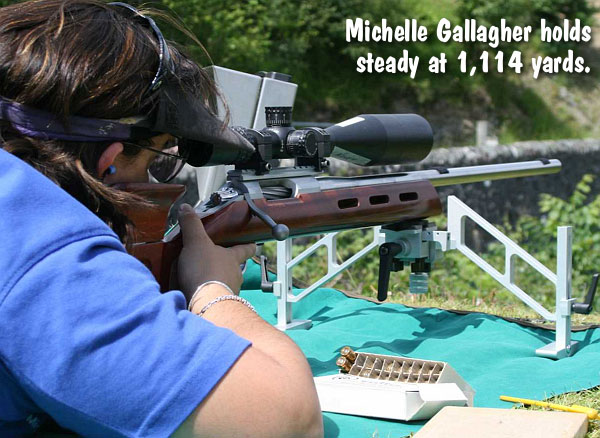
By the time the teams relocated to 1,000 yards, the overcast had gone, sunshine alternated with moving shadows from big white puffy clouds to produce heat-induced, variable winds and intermittent mirage. Scores tumbled and there were many gaps between shots as the wind coaches stayed their hand waiting for a previous condition to return or trying to read a new one. Different wind doping approaches were apparent with Scotland’s Tom Kidner and Hamish Hunter relying mostly on the wind flags and plots while Nancy and Michelle spent considerable amounts of time glued to a pair of massive spotting scopes trying to read the mirage.
Nancy calls 1K wind for daughter Michelle Gallagher. USA captain Darrel Buell is just behind them.
At 1000 yards, the Scots produced 357-8V against the visitors’ 346-8V, putting them into a four-point lead overall. Remarkably, however, the youngest American shooter, Sierra Scott nailed the best individual 1,000-yard score, a 65-2V. With everything hanging on the 1,100-yard stage, conditions were as for 1,000 yards only more so — warmer, still more variable winds and intermittent aiming difficulties from a boiling mirage downrange. The Scottish coaches’ experience really paid off now, their shooters scoring 295-2V, 23 points ahead of the visitors. Three out of the top four individual results (with scores of 50 or better) were by Scots, and top scorer Paul Crosbie posted a 59 shooting the big 210gr Bergers. Michelle Gallagher (shooting Berger 155.5s) nailed an excellent 57 to edge Scotland’s Peter Burbridge (55 points shooting 208gr Hornady A-Max). Laurie Holland posted an impressive. His .223 Rem ‘mouse gun’ was obviously still in the groove at 1,114 yards!
So, the home team kept its honor and Blair Atholl’s reputation intact. While disappointed, the visitors knew they had done really well given their inexperience with the quirks of this most difficult of venues. Everybody had a great time, some old friendships were renewed, new ones made. This was F-TR at its most enjoyable with four days shooting that no participant will ever forget. There was even an informal 1,233-yard competition on the Saturday afternoon won by US team captain Darrell Buell.
Congratulations to all of the 2011 winners and thanks to everyone who made the trip to Camp Perry for the competition this year. We would also like to extend our thanks to the staff, volunteers, and our friends with the Civilian Marksmanship Program and Ohio National Guard for their hard work that made this year such a big success.
2012 Championship Moves to Alabama
Match organizers hope to see everyone again in 2012 when the competition moves to Anniston, Alabama! Below is a slide show from Day 1 of the competition at Camp Perry in late June.
Story by Kerrin Brinkman and photos courtesy the NRA BLOG.
The White Horse Center Range near Peeltree, West Virginia, will host the 2011 National IBS 1000-Yard Nationals from September 3-5, 2011. The good news is that the match directors have lowered the fees in response to the week economy and high gas prices. If you register before August 8th, the match fee is only $80.00 per gun.
Match Schedule and Fees
The 1K Nationals will be a 3-target Aggregate match for both Light Gun (LG) and Heavy Gun (HG) with six (6) targets total. Membership in the IBS, NBRSA, or Williamsport organizations is required — bring your membership card. The match will run Saturday, Sunday, and MONDAY, September 3, 4, and 5. Practice and Sight-in will be available Wednesday (8/31), Thursday (9/1) and Friday (9/2), starting daily at 8:00 am. NOTE: There will be a $10.00 per target fee during practice days and the shooter must furnish his/her own target puller.
Match fees for the Nationals are $80 per gun ($40 per gun for Juniors), if post-marked before August 8, 2011. Thereafter fees go to $90 per gun ($45 per gun for juniors). All registrations MUST be received by 3:00 pm Friday, September 2nd. No walk-up registrations will be accepted on match days.
How to Get There
The Center is located 9.7 miles south on State Route 20 from I-79, exit 115 or 10.1 miles north of Route 20 from Buckhannon. Look for a brown and yellow Dept. of Natural Resources sign on Route 20. Take Crouse Road to the next sign, turn right at the sign, and proceed up the hill to the Center. Map coordinates are: 39°, 7′, 11″ North latitude; 80°, 13′, 4″ West longitude. The White Horse Center website has information on area hotels and campgrounds.
Story Tip by EdLongrange. We welcome submissions from our readers.
Smallbore competitors — mark your calendars for July 15 through July 19. That’s when the 2011 NRA National Metric Smallbore Championships will be held at the Wa-Ke’-De Range in Bristol, Indiana. Practice Relays will be held on the 15th. With Position shooting scheduled for July 16-17 and Prone for July 18-19, this event is a great way to tune up your marksmanship skills prior to the Smallbore Championships at Camp Perry which kick off on July 21st.
The Second Annual NRA Metric Smallbore Championships are limited to the first 200 competitors. You can still register now by contacting H.Q. Moody at 703-267-1475 or HMoody@nrahq.org. Don’t procrastinate — anyone attempting to sign up after July 8th will have to do so at the Statistical Office at the Chief Wa-Ke’-De’ Range. The Jameson Inn in Elkhart, Indiana is the host hotel. Mention the National Metric Championships to receive a special rate.
USA Shooting is pleased to announce that 2008 Olympian Jamie Beyerle (Lebanon, Pa.) has qualified for a nomination to the 2012 U.S. Olympic Team pending approval by the United States Olympic Committee. Upon approval, Beyerle will be competing in her second consecutive Olympic Games in Women’s 50m Rifle Three Position. At the 2008 Olympic Games in Beijing, Beyerle finished fourth in Women’s 10m Air Rifle and fifth in Women’s 50m Rifle Three Position. Beyerle is currently the top-ranked Women’s 50m Rifle Three Position shooter in the world. In 2011, Beyerle won gold at ISSF World Cup events in Sydney, Australia and at her home range in Fort Benning, Georgia. In the ISSF video below, you can watch Jaimie’s winning performance in Sydney:
National Rifle Coach Major Dave Johnson said, “Jamie has continued her march to the top of our sport. In the last 12 months, Jamie has earned three gold medals in World Cups and placed in the top five in two more starts. Her performance has earned her a spot on the U.S. Olympic Team as one of the best in the world.” Jaime credits Johnson and the USAMU for much of her success: “It is an honor to be nominated to represent the United States in the 2012 Olympic Games. I would not have that honor without the support of USA Shooting and Coach Dave Johnson as well as the U.S. Army Marksmanship Unit and Coach Tom Tamas, who have all helped me to achieve my goals thus far.”


 The International Benchrest Shooters (IBS) has updated its Official Rules of Competition. The complete IBS rules, with all recent updates, are presented in the latest Rulebook #12a. This is updated through July 2011. Rulebook #12A includes 2010 rule changes and 2011 temporary rules. New rules are highlighted with red text. You can now download the updated Rulebook #12a, as a .PDF file, from the IBS website.


 Montana 1K benchrest shooter Leo Anderson has set a pair of astounding multi-match Light Gun Score Agg records. These are “records for the ages”. This season, Leo’s 6-match Score Aggregate was 99.5 (99,99,99,100,100,100), while his 10-match Score Aggregate was 96.8 (84,94,95,98,99,99,99,100,100,100). That’s amazing consistency. Given how hard it is to shoot a single 100 score at 1000 yards, Leo’s Aggs are jaw-dropping. It will be a long time before these Agg records are broken (if they ever are). Leo set his 99.5 (6-match) and 96.8 (10-match) records shooting a 17-lb rifle chambered for the 6mm Dasher. The Lawrence barrel was chambered by Montana gunsmith John King and Leo did the stock work himself (starting with a Shehane MBR Tracker).


 The Creedmoor Nationals’ match history dates back to the 19th century with the purchase of the Creed Farm in Long Island, New York. A long range black powder match between the United States and Ireland at the brand new Creedmoor range drew a significant amount of attention to the shooting sports and drew eventually drew its name from the NRA’s range. The 2011 championship currently being conducted at the Whittington Center is based on the original course of fire in keeping with the tradition of the match.
 On Monday, 11 July, the 2011 NRA National Rifle and Pistol Championships officially commenced at Camp Perry, Ohio. DCM Emeritus Gary Anderson led a procession of special guests into the ceremony.



 The complete, official Results Bulletin from the
  The White Horse Center Range near Peeltree, West Virginia, will host the 2011 National IBS 1000-Yard Nationals from September 3-5, 2011. The good news is that the match directors have lowered the fees in response to the week economy and high gas prices. If you register before August 8th, the match fee is only $80.00 per gun.
 Match Schedule and Fees


