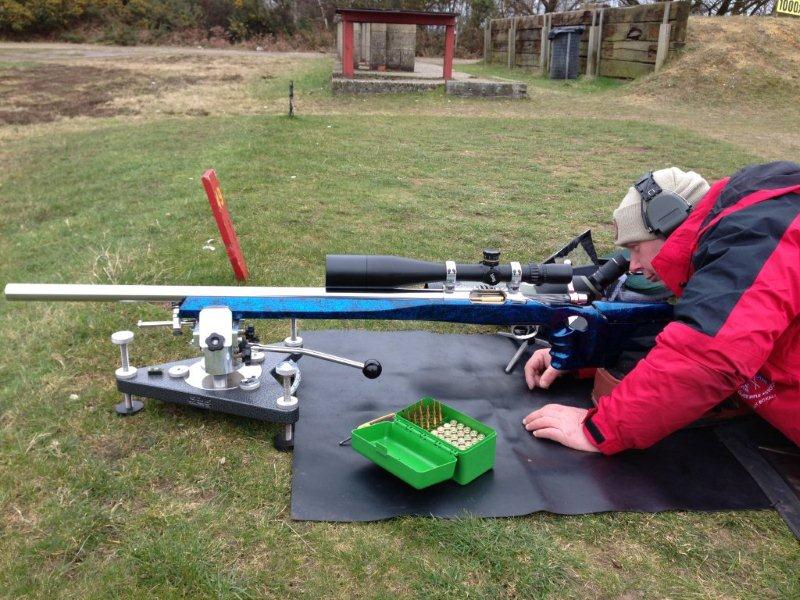
For today’s Sunday Gunday feature, we present a splash of color — the beautiful blue 7mm-270 WSM of Forum member Ian B. (aka “Elwood”) from Great Britain. A very knowledgeable guy, Ian has been one of the UK’s top F-Class shooters. And he’s the proud owner of a very “Flash” F-Class rig.
About the Shooter — Ian’s Background
Ian tells us: “I started shooting F-Class Open [many] years ago when a good friend invited me to Bisley to shoot with the Dorset Riflemen. I found it very enjoyable and a real challenge. The next year I attended the GB F-Class league’s Introduction to F-Class course, and soon afterwards started to compete in the GB F-Class league, while still shooting once a month with the Dorset Riflemen. In this short time frame, I’ve managed to finish 8th in the league last year, 12th in the Europeans, and I was a part of the GB squad that won the team event at the European Championship. I was then selected for the GB F-Open World Championship Team. Unfortunately, due to work commitments, I have had to withdraw.”
Ian’s Beautiful Blue 7mm-270 WSM F-Class Rifle
Report by Ian B. (aka “Elwood”)
Having spent my first year competing with a magazine-fed 7mm WSM tactical/sporting rifle (Surgeon action and AICS mag) and doing reasonably well with it, I then moved on to a .284 Shehane (.284 Winchester Improved). I love the Shehane and still use it but … I wanted something for those windy long-range days and so there was only one logical choice, the 7 WSM. This time I chose a 7mm-270 WSM as I quite enjoy case prep (just kidding). Actually, there’s not much to do really. The quality of Norma brass is well known and the Norma 270 WSM brass is quite easy to obtain in the UK.
The action is a Right Bolt, Left Port (RBLP) Stolle Panda F-Class action, with Jewell trigger. There wasn’t any particular reason behind the RBLP configuration — it was more of a case of that’s what I could get at the time. I had a 1.250″-diameter, straight-profile Bartlein barrel finished at 32 inches and chambered for the Berger 180gr VLD with a .313″ neck diameter. All my metal work and quite a bit of the wood work is done by the excellent Neil McKillop of McKillop Engineering. As with all top gunsmiths, Neil is meticulous to a point of obsessiveness and he’s the name behind quite a few winning rifles including several used by the GB Open and F-TR teams. Neil also inletted the stock from a blank and did the bedding for the action and the front bag runners.
Loading for the 7mm-270 WSM
I have one “tried and tested” load: 7mm Berger 180gr VLDs, seated .020″ into the lands, Vihtavuori N165 powder and CCI BR2 primers. This load is supremely accurate, but at 2990 FPS it’s a bit slow. To get more speed, I’m currently testing H1000 with good results, but it looks like I may have a slow barrel. I have another Bartlein barrel chambered and ready to screw on when the weather gets warmer. If that new barrel shoots well, the current barrel will probably be used as a practice barrel.
Loading Procedure
I do full case prep, neck-turning, uniforming primer pockets after the first firing, chamfering necks inside and out, and removing burrs around flash holes. Even the best brass sometimes suffers from imperfect quality control. I try to use Redding dies if possible, and will use bump dies, neck bushing dies, and competition seating dies.
I use an RCBS ChargeMaster 1500 to throw a charge just slightly under my desired weight and then trickle-up to final weight using the superb Dandy trickler and a Gem Pro 250 scale.
I anneal every other firing using a Bench-Source machine. Before this I used a Ken Light and also did them by spinning them in a drill. Never again will I do that after using the Bench-Source. After I have annealed, I always run a nylon brush wrapped in 0000 wire wool into the neck to remove any debris.
I keep to the same lot numbers of primers, powders, and bullets. Even the Bergers can vary from lot to lot — I have two different lots of 7mm 180gr VLDs that vary .020″ from bullet base to the ogive. I trim and point my bullets. Pointing may be a mental thing — I had a fantastic shoot while using trimmed and pointed bullets so I do it all the time now. ( A fellow GB team shot refers to them as “Pointless Dies” — I have witnessed him shoot a 99-14V at 1000 yards with bullets that weren’t trimmed or pointed). My next move will be to start measuring bearing surface…where does it all end?
Custom Wood Stock Was Modified by Ian and Treated to a Fancy Paint Job
The stock is a custom-made design crafted by Joe and Simon West of Joe West Rifle Stocks. I had several modifications done to one of their existing stock designs. Having done a lot of my shooting with the AICS, I was quite used to a thumbhole stock, so thought I would try one in F-Class. I told Simon what I wanted and he sent me down a prototype made from very inexpensive Tulip wood. We had a few discussions and then made some more mods..
I made two main changes to the stock. First, I removed the lip at the bottom of the pistol grip because I felt I might rest my hand on this and possibly disturb the rifle. Second, I had the protruding pistol grip base removed so that the bottom of the stock was completely flat like the Precision Rifle & Tool F-Class stock. Simon also made the finger grips to fit my hand and flattened them off to allow for a bit more movement. The stock was then sent to Hydro Graphics in the UK to have a custom exterior finish. The paint color is a Marbleized Candy Oriental Blue. As always, Hydro Graphics did a great job.
Optics and Rings
The scope is the excellent 5-50x56mm March with the MTR-2 reticle — far and away the best reticle I have used for F-Class. March makes great optics. During the 2012 European individual F-Class event, using another March (my 8-80x56mm), I could see my shooting partner’s impacts in the white V-Bull at 800 yards! And just recently at a club match I called two V-Bulls at 900 yards using the 8-80X (not at full power). Granted the light has to be perfect to be able to do this, but my highest praise for the Deon Optics glass is that it rivals that of Schmidt & Bender. Having owned both March and S&B scopes and compared them side-by-side, I feel that I can make this statement fairly.
UK-based Third Eye Tactical made the nice, 34mm rings. The UK is now producing some excellent products. We now have UK-made custom actions, rings, rails, stocks and more. It would be nice to think we could have a 100% British-made rifle, and not rely completely on USA-made products. I think all we need is the trigger? But I can’t see there ever being a UK-made scope!
Wind effects are complex. In trying to access wind speeds and angles, you’ll want to watch multiple indicators — mirage, dust, wind-flags, grass movement, and more. You’ll also need to be concerned about wind cycles. In the video below, Bryan Litz talks about variable wind speed along a bullet’s flight path. A respected ballistics guru, Bryan is the founder of Applied Ballistics and a designer of Berger’s Hybrid Match projectiles. He is also a past F-TR National Champion and a High Master Palma ace.
In this video, Bryan discusses how wind effects can vary in intensity at different points along the bullet’s flight path to the target. Sometimes the firing line is sheltered, and the strongest winds come into effect in the middle of the trajectory. Bryan concludes: “Wind matters everywhere … but the best thing you can do is try to get a handle on the wind [velocity and angle] where you are. That may or may not represent the wind down-range — that’s when you have to look downrange and make a judgment[.]”
Litz Competition Tip: Select your wind shooting strategy carefully. For beginners and veterans, most points are typically lost to wind. Successful shooters put a lot of thought into their approach to wind shooting. Sometimes it’s best to shoot fast and minimize the changes you’ll have to navigate. Other times it’s best to wait out a condition which may take several minutes. Develop a comfortable rest position so you have an easier time waiting when you should be waiting.
More Wind Tips from Wind Wizard Emil Praslick
In these two short videos, Emil Praslick III, former coach of the USAMU and USA National long range teams, explains how to find the wind direction and how to confirm your no-wind zero. Praslick is widely considered to be one of the best wind coaches in the USA.
When Winds Are EXTREME — Near Gale Force at Ben Avery
This video shows INSANE winds at NBRSA 100/200 Benchrest Nationals. This was filmed at the Ben Avery Range in Phoenix, AZ during the recent NBRSA 100/200 yard National Championships. Extreme to say the least. Based on what we’re seeing here, there are 20-25 mph crosswinds, with gusts to 35 mph — near Gale Force. Video by Hall-of-Fame Benchrest competitor Gene Bukys, whom we sadly lost to COVID last year. RIP Gene.
Texas gunsmith Mike Bryant reports: “This video shows the Unlimited Class 200 at the Nationals in Phoenix. I had three 10-shot groups in the low 2″ range with a 2.228″ being my big group and was glad they weren’t bigger. Thursday and Friday were the worst of the windy days. Unfortunately those were the days for the UL 200 and it was about as windy through most all of the Sporter 200.”
Excellent Wind Reading Resource
The Wind Book for Rifle Shooters covers techniques and tactics used by expert wind-readers. The authors provide a wind-reading “toolbox” for calculating wind speed, direction, deflection and drift. They explain how to read flags and mirage, record and interpret your observations, and time your shots to compensate for wind. Here are two reviews:
This is a must-have book if you are a long-range sport shooter. I compete in F-Class Open and when read it from cover to cover, it helped me understand wind reading and making accurate scope corrections. Buy this book, read it, put into practice what it tells you, you will not be disappointed. — P. Janzso
If you have one book for wind reading, this should be it. It covers how to get wind speed/direction from flags, mirage, and natural phenomenon. This is the best book for learning to read wind speed and direction. — Muddler
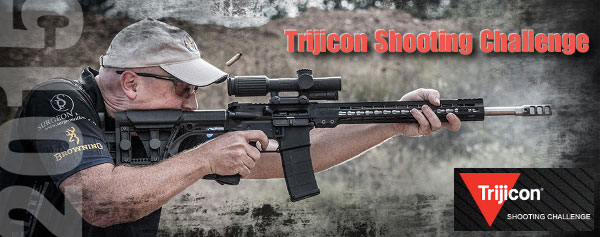
In October 2015, the legendary Jerry Miculek won the Trijicon Shooting Challenge at the Rockcastle Shooting Center. That impressive victory earned Jerry big bucks — a $50,000 grand prize. By any measure, that’s some serious cash — mucho dinero.
To celebrate his October Trijicon Challenge victory back in 2015, Jerry Miculek decided to do some pumpkin carving — with a .50 BMG Barrett rifle.
Shooting the 30-lb rifle off-hand, Jerry blasted some serious holes in Mr. Pumpkin. Needless to say, the results were dramatic, if somewhat messy. Advancing the science of terminal ballistics, Jerry (not surprisingly) confirmed that “the 663-grain bullet did manage to penetrate the pumpkin all the way.”
Jerry Miculek earned $50,000 as the winner of the 2015 Trijicon Challenge.
This Gun Digest book has become a “go-to” resource for NRL22 and PRS Rimfire shooters. Key topics included in this 2021 Edition full-color Gun Digest book include: rimfire semi-autos and how they work; bolt-action accuracy; match shooting skills; DIY precision gunsmithing; hunting with rimfires; and the future of the rimfire market.
With the growth of rimfire tactical competition, the .22-Caliber rimfire rifle is more popular than ever. Every major gun manufacturer has brought at least one new .22 LR rimfire rifle to the market in the last two years. Gun Digest’s Rimfire Revolution has extensive coverage of new models from major manufacturers.
The .22 Long Rifle (.22 LR) is the planet’s most popular ammunition type and firearm chambering. The .22 LR is used in the Olympics by 3P marksmen, but it also serves benchrest competitors, NRL22 shooters, backyard plinkers, small-game hunters, and tactical trainers. With the expansion of NRL22 matches (and the PRS equivalent), the humble .22 LR is undergoing a major resurgence in the USA. And with centerfire reloading components being so costly and difficult to find, many folks are shooting less centerfire, but way more rimfire.
This 272-page book also covers .17-caliber rimfire cartridges: 17 HM2 (Mach 2), 17 HMR, and 17 WSM. These are all excellent varmint rounds, with the 17 WSM effective out to 250 yards. The 17 HM2 will run in a normal .22 LR action and feed from standard .22 LR magazines. So, for most rifles, all you need to do a .22 LR to 17 HM2 conversion is a barrel switch. That gives your rimfire rig twice the versatility. Shoot .22s and .17s with the same gun.
NRL22 — Challenging Practical Competition with .22 LR Rifles
The USA has seen a big growth in rimfire tactical matches over the last five years. Right now there are probably ten times as many rimfire tactical matches as sanctioned PRS and NRL centerfire matches. The reason is simple — rimfire ammo is much less costly, and clubs can run challenging rimfire tactical matches at nearly any outdoor gun range that allows shooting out to 200+ yards.
NRL22 Competition — Tactical Rimfire Matches
The NRL22 match format is a great shooting discipline. NRL22 offers a high fun factor at relatively low cost. You don’t have to reload match ammo. A couple of 50-round boxes of .22 LR ammo will get you through the match. While some people bring lots of gear to matches, that’s by choice and not by necessity. You can keep it simple and still be competitive (and win).
Tips for NRL22 Competitors by Jonathan Ocab
I am a match director at my gun club and run our local NRL22 matches. People often ask me for tips for competing in NRL22. First, I recommend getting the course of fire for the month in advance and practicing those stages at the range. Here are other specific tips that should help NRL22 competitors improve their gun-handling and match results.
1. Dry Fire Practice — If you are not able to do live fire practice at the range, I encourage shooters to practice their shooting positions at home via dry fire. Setup props or barricades with pasters or other faux targets on a wall in the garage or inside the house and run through each stage.
2. Scope Magnification Level — The most common issue I see with newer shooters in NRL22 is the tendency to maximize their scope magnification. The timer will start, and the shooter gets into position on a target, but the scope is set to 15x or higher and the shooter can’t find the target. The shooter lowers the magnification, locates the target, and then increases the magnification again, takes the shot, transitions to another target, and repeats the process of decreasing magnification, locating target, etc. Novice NRL22 shooters should try using the mid-range magnification. Try shooting 7x-12x and learn to balance field of view and target image.
We first ran this story a few years back. But it’s still a very interesting subject for benchrest shooters. Shown above, the 30 BR (a 6mmBR necked up to .30 caliber) currently rules the benchrest-for-score game. However, a 30 BR Improved offers some potential advantages, particularly when the winds are strong or tricky. In this article Al Nyhus explains his 30 BRX wildcat. Running Hodgdon H4198, Al says he gets an easy 150 – 200 FPS more than the conventional 30 BR. That can translate to less drift in the wind. It also lets you pursue a higher speed node, which can lead to improved accuracy with some barrels.
Forum member Al Nyhus is a top-level score shooter who has competed successfully with the 30 BR cartridge in VFS (Varmint for Score) matches. Al has been working on an “improved” 30 BR cartridge that delivers extra velocity. Al’s 30 BRX cartridge is inspired by the 6mm BRX cartridge, popular in 600-yard benchrest and across-the-course competition. The 6mm BRX cartridge maintains the same sidewall profile and shoulder angle as the parent 6mmBR case. Likewise, the 30 BRX retains the 30° shoulder used on the popular 30 BR cartridge.
Al reports: “Thought you might like to see what I’ll be working with in my VFS gun this season. It’s a true 30 BRX — a 30 BR with the shoulder moved forward 0.100″ with the standard BR shoulder angle. Stan Ware of SGR Custom Rifles built one last season for Steve Grosvenor and I was really impressed by the performance of Steve’s gun. The 30 BR barrel on my VFS gun needed replacing, so the new 30 BRX got the nod.”
30 BRX Delivers 150-200 FPS More Velocity than 30 BR
Al says his 30 BRX gives a solid 150-200 fps speed gain over the 30 BR at the top, while needing just 2.5-3.0 more grains of Hodgdon H4198 to do so. A 30 BR case holds on average 40.8 grains of water, while the 30 BRX holds 42.3 grains (roughly 4% more). So the 30 BRX delivers a 7% increase in velocity with a mere 4% increase in H20 capacity. That’s pretty good efficiency. [Editor’s Note: Assuming 34 grains of H4198 is a typical 30 BR match load, Al’s increase of 2.5-3.0 grains for the 30 BRX represents roughly a 7.5-8.5% increase in actual powder burned. That explains the higher velocities.]
Why did Nyhus decide to try an “improved” 30 BR?
Al explains: “The 30 BRX was created to operate at a [higher] velocity level than can be achieved with the standard 30 BR case, while at the same time keeping the easy-tuning characteristics of the standard 30 BR case. We also wanted to use the same powders currently used with the 30 BR and maintain similar operating pressures.” Is the 30BRX harder to shoot because of the increased velocity? Al doesn’t think so: “In a 13.5-lb HV gun, the 30 BRX case is a pleasure to shoot with just a flea bite of recoil.”
Will the 30 BRX Become Popular in Score Competition?
The 30 BR is already an exceptionally accurate cartridge that dominates short-range Benchrest for Score competition. Will the 30 BRX make the standard 30 BR obsolete? Nyhus doesn’t think so. However, Al believes the 30 BRX offers a small but important edge in some situations: “On any given day, it’s the shooter that hits the flags best and makes the fewest mistakes that ends up on top. No amount of velocity will save you when you press the trigger at the wrong time. Missing a switch or angle change at 200 yards that results in 3/4″ of bullet displacement on the target can’t be compensated for with another 200 fps. That’s the hard fact of benchrest shooting. But on those days when, as Randy Robinett says, ‘our brains are working’, the BRX may offer enough of an advantage to turn a close-but-no-cigar 10 into an ‘X’ at 200 yards. Or turn a just-over-the-line 9 into a beggar 10.” Given the fierce competition in Score matches, an extra 10 or another X can make the difference between a podium finish and also-ran status.
SEB Rests has come out with a new, more compact front joystick rest for rimfire and air rifle competition. Designed for benchrest rimfire and air rifle shooting, the new AR250 Rest takes its name from the perfect score of 250 in WRABF competition. Balancing mobility, performance, and cost, this rest features a rigid, extendable central post and two elevation adjustment systems for rapid and smooth height changes. Current price is $620 US dollars, a bargain compared to some other joystick rests.
The new AR250 provides a very stable shooting platform yet is still easily transportable. The versatile design makes it suitable for multiple rimfire and air rifle disciplines. The AR250 joystick travel is designed to be able to cover most target sizes from WRABF to NRA/ARA at 25-100 yards and 25-100 meters. Fitted with an adjustable counterweight system for smooth joystick action, the newly designed top plate secures the custom front bag firmly in place with minimal play. The AR250 rest is offered with three bag options: one 2 1⁄4″-wide bag, one 3″-wide bag, or both sizes.
SEB AR250 rest has very extensive height adjustment range to fit varying rifle styles and target heights.
Initial user reviews have been very positive. Here are comments from customers and testers:
— “I am delighted with the accuracy and smoothness of operation. Brilliant product.”
— “The rest is very compact and lightweight. I recommend for anyone who… has struggled shooting rimfire with oversize pedestals designed for centerfire benchrest.”
— “The joystick feels smooth and precise, and the counterweight makes aiming feel wonderful.”
— “The rest is very solid for as small that it is, and the construction is wonderful.”
— “It transports far easier than any of the rests I have tried so far.”
Included in the box are: AR250 rest and front bag(s), Joystick arm and adjustable counterweight, leveling screws, 3 rest feet with hard neoprene rubber bottoms, spare bolts/accessories, and user manual.
For full product description and more product photos, visit AR250.sebrests.com.
Today we feature a top-flight tactical .22 LR rig belonging to Jonathan Ocab. A talented Highpower marksman with the Distinguished Rifleman Badge, Jonathan also enjoys rimfire tactical disciplines which he features on his Youtube Channel. Jonathan has run a monthly NRL22 match in California. His interest in the NRL22 game started with a CZ 455, but soon he stepped up to the impressive rig you see here. This boasts all top-tier components: Vudoo V-22 mag-fed action, Bartlein barrel, MPA Chassis, and Kahles K525i scope. Jonathan carefully selected all this hardware and assembled the rifle himself.
My Vudoo/MPA Rifle for NRL22 and Long Range Rimfire Report by Jonathan Ocab,Ocabj.net.
I became interested in rimfire shooting due to not having as much access to longer distance ranges, and the emergence of NRL22 matches. Back in 2017 I had acquired a CZ 455 and ran it in NRL22 club matches. It worked well, but as I started spending most of my time on my club’s rimfire range, I focused on getting a Vudoo Gun Works V-22. The Vudoo V-22 appeared to offer a true repeater that had the feel of a full-sized centerfire rifle along with high accuracy/precision potential.
After a lot of research, I decided to put in an order for a barreled action and acquired a Vudoo Gun Works V-22 action with a 20″ Bartlein barrel, 1-16″ twist, and MTU contour, all in Flat Dark Earth Cerakote (along with a +30 MOA base). I then acquired the TriggerTech Diamond Trigger Pro Curved, Masterpiece Arms BA Comp chassis (in Flat Dark Earth), American Rifle Company M10 34mm rings (28mm height), and Kahles K525i 5-25x56mm SKMR3 LSW scope.
CZ as a Starter NRL22 Option — The CZ 450-series is a solid family of .22 LR rifles, but I wanted to see what existed beyond the CZ level of rimfire rifles. One of my complaints with the CZ 455 is that the trigger leaves much to be desired even with the trigger kits available. Since the Vudoo V-22 action has a Remington 700 footprint and can accept most Rem 700-compatible triggers, I can actually run a top-tier trigger that would exceed anything available for the CZ.
Component Selection for the Ultimate NRL22 Competition Rifle
My choices in components were biased due to my prior experience — I went with quality hardware I knew and trusted…
Barrel Choice — I chose the Bartlein barrel over Vudoo’s in-house Ace barrels because I run a Bartlein barrel on my 6mm Creedmoor rifle and I have become a big Bartlein fan. Secondly, I chose the Masterpiece Arms BA Competition chassis because I also run the MPA BA Comp on my 6mm Creedmoor rifle. You can see the two rifles side-by-side below:
You are not seeing double. There are two rifles, both with an MPA Comp BA chassis, and both weighing about 15 pounds. In front is the featured Vudoo-action .22 LR rimfire rig with 20″ barrel, while behind is Ocab’s ARC Mausingfield 6mm Creedmoor PRS/NRL centerfire rig with 24″ barrel.
After running this rifle build for over a year now, I can say that I am more than happy with this platform as I have it configured. Having a .22 LR rifle in the same chassis as my 6mm Creedmoor rifle makes me feel right at home behind either rimfire or centerfire platform. My Vudoo V-22 weighs 15.2 lbs with Atlas CAL bipod while my 6mm Creedmoor rifle build weighs right at 15.0 lbs with the same Atlas CAL bipod. The “feel” and handling of my Vudoo V-22 MPA is as close to a centerfire gun as you can get.
Scope and Rings — I chose the 5-25x56mm Kahles K525i SKMR3 LSW because I was interested in running the Kahles after handling a few K624i and K525i scopes and hearing about how great they tracked. I run ARC M10 rings on several rifles because I think they are superbly designed.
Trigger Choice — I chose the TriggerTech Diamond because I already have a TriggerTech on one of my centerfire platforms and I wanted to try their Diamond trigger on a gun.
Outstanding Accuracy with Multiple .22 LR Ammo Types — Lapua and SK
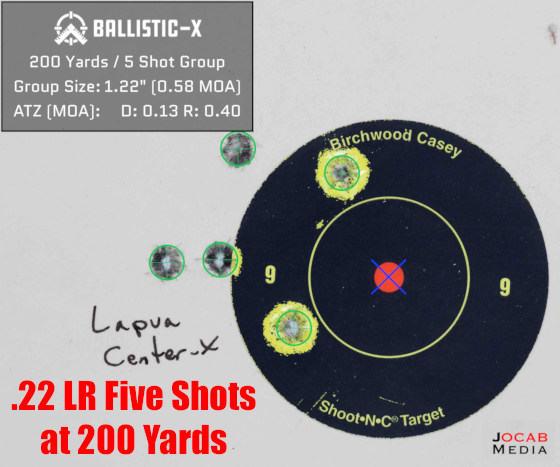
My .22 LR ammo of choice is Lapua Center-X. This is the most commonly-chosen ammunition among Vudoo V-22 shooters. I also had good results with SK Rifle Match and Lapua Midas+ in casual 50-yard and 100-yard testing but have stayed with Lapua Center-X because my rifle shot all the lots of Center-X I put into it equally well out to 200 yards.
SUMMARY — The Vudoo V-22 and MPA Package Is Outstanding
I can hands down recommend the Vudoo Gun Works V-22 for anyone who is interested in getting one. The “full-sized” rimfire rifle segment is not a one-horse race anymore and there are other options out there, but I feel very few will regret going with a Vudoo V-22 over another alternative. If you do not have a centerfire rifle designed for NRL/PRS style of shooting, you could probably just opt to go with a CZ 457 or Tikka T1x and have a lot of room to modify and tailor those rifles to your own tastes and still have an accurate rifle for NRL22. But if you also run a precision centerfire rifle, you should seriously consider a Vudoo V-22 or other 700-pattern rimfire action if purchasing a new .22 LR rimfire rig.
My Vudoo Gun Works V-22 build is an all-purpose gun for me. It is setup for NRL22-style matches but can be utilized for (extreme) long range .22 LR shooting (300 yards and beyond). For that rimfire ELR Game, I am seriously considering getting a Vudoo V-22S (single-shot) action to put in an F-Class stock to have a dedicated ELR .22 LR gun. While I built my Vudoo Gun Works V-22 with NRL22 in mind, I realized this gun could do more so I took it out to shoot 300 yards. After that, I stretched it out to 400 yards and then 500 yards in subsequent range visits. Now I am intrigued by extreme long range .22 LR shooting and often shoot 400 yards and beyond with the Vudoo V-22 when I can.
Long Range .22 LR Rimfire — Out to 500 Yards
Jonathan shoots his competition rifle in Long Range Rimfire matches with targets out to 500 yards. That’s definitely Extreme Long Range for the little .22 LR cartridge, requiring 27.8 MILs of up elevation! Jonathan notes: “I originally had a +30 MOA base on my rifle and it worked fine to 400 yards, but I ran out of adjustment on the K525i to get to 500 and had to hold over. I ended up getting a +40 MOA base.”
NRL22 Competition — Tactical Rimfire Matches
The NRL22 match format is a great shooting discipline. NRL22 offers a high fun factor at relatively low cost. You don’t have to reload match ammo. A couple of 50-round boxes of .22 LR ammo will get you through the match. While some people bring lots of gear to matches, that’s by choice and not by necessity. You can keep it simple and still be competitive (and win).
Tips for NRL22 Competitors
I am a match director at my gun club and run our local NRL22 matches. People often ask me for tips for competing in NRL22. First, I recommend getting the course of fire for the month in advance and practicing those stages at the range. Here are other specific tips that should help NRL22 competitors improve their gun-handling and match results.
1. Dry Fire Practice — If you are not able to do live fire practice at the range, I encourage shooters to practice their shooting positions at home via dry fire. Setup props or barricades with pasters or other faux targets on a wall in the garage or inside the house and run through each stage.
2. Scope Magnification Level — The most common issue I see with newer shooters in NRL22 is the tendency to maximize their scope magnification. The timer will start, and the shooter gets into position on a target, but the scope is set to 15x or higher and the shooter can’t find the target. The shooter lowers the magnification, locates the target, and then increases the magnification again, takes the shot, transitions to another target, and repeats the process of decreasing magnification, locating target, etc. Novice NRL22 shooters should try using the mid-range magnification. Try shooting 7x-12x and learn to balance field of view and target image.
The author at NRL22 Match at West End Gun Club in San Bernardino, CA.
3. Support Side Shooting — NRL22 matches often include support-side shooting stages. This requires you to shoot with your opposite (non-dominant) hand and eye. I often hear people complain about shooting support-side. My only real tip for this is to actually spend time at the range shooting this way. Practice makes perfect. It’s all a question of learning how to shoot again and using fundamentals. Learn to get a consistent cheek weld and consistent eye relief. If necessary, figure out if you need to set your scope’s diopter for your opposite eye and mark it on the scope.
4. Tripod Practice — Even though tripods are not used in the NRL22 courses of fire, I practice shooting off of a tripod often. I will often setup targets at various distances and spaced far apart to run drills firing shots on each target with the goal of speeding up transitions and target acquisitions. Target acquisition after transition from target to target is where time is lost, so it is good to become efficient in this area.
BONUS Video — Modern NRL22 Hardware, Optics, and Ammo
Released on October 5, 2024, this recent Pursuit of Accuracy channel video reviews some of the latest and greatest equipment options for NRL22 and Precision rimfire disciplines. The host covers action and stock options at 1:10 time mark. Then at the 4:00 minute mark, he explains popular scope options. At 7:02 in the video he explains how he selects and tests .22 LR ammunition (he favors ELEY). Finally, at 11:52 he explores barrel options while including suggestions on efficient barrel maintenance. This video includes excellent Shooter’s POV footage shot with a video camera mounted on the rifle.
Erik Cortina is one of America’s top F-Class competitors. He has won major matches and is a member of Team Lapua-Brux-Borden. Erik, who produces his own line of EC Barrel Tuners and Tuner Brakes, also has a popular Believe the Target YouTube Channel which features interviews with top shooters, parts makers, and gunsmiths. For this Saturday Movie showcase, we feature videos created by Erik for his channel.
Interview with Bryan Litz of Applied Ballistics
Bryan Litz, head honcho of Applied Ballistics LLC, is arguably the leading ballistics expert on planet earth. A talented shooter who has won major F-Class, ELR, and Palma matches, Bryan is a high-IQ scientist who has developed the ballistics software many of us now use in Kestrels and other devices to calculate scope clicks with extreme precision. In this interview, Bryan explains basic ballistics principles and also corrects some popular misconceptions. This is a great interview that has received much praise from viewers, one of whom has noted: “Bryan is a walking science lab. He puts out amazing data-based info[.]” With 87,000 views, this is Erik’s second-most popular video ever.
Interview with 6-Time Nat’l Long Range Champion John Whidden
CLICK HERE for full 81-minute interview with John Whidden.
John Whidden of Whidden Gunworks is one of the greatest American marksman in history. Shooting sling rifles, John has won the U.S. Long Range National Championship a remarkable six times. He has also won a Palma World Championship, and this summer John won the 2022 Smallbore Prone U.S. National Championship. While a humble individual, John has superb shooting skills and unrivaled mental toughness. In this interview, John talks about the challenges of competition and what motivates him to excel. John also talks about the products he has developed for Whidden Gunworks.
Interview with NBRSA 3-Gun and Tackdriver Champ Bart Sauter
Bullet-maker Bart Sauter is one of the world’s best benchrest shooters. He won the 2022 NBRSA 3-Gun National Championship this year, and he also has won the multi-class Tack Driver event two years in a row. Plus he has set small-group world record at 600 yards. In this very informative interview, Bart talks about bullets, equipment selection, match preparation, and shooting techniques. We think every benchrest shooter should watch this video.
Master at Work — Sauter in Action
If you want to see how a world-class bench shooter runs his rifle, check out this short video showing Bart Sauter in action. He runs five shots in about 9 seconds.
Interview with Tod Hendricks, 2021 F-Open National Champion
A member of Team Lapua/Brux/Borden, Tod Hendricks has been one of the most talented and consistent F-Open competitors for many years. He used his mental toughness and wind-reading skills to capture a National Championship in 2021. In this wide-ranging interview with his team-mate Erik Cortina, Tod reveals what it takes to win in F-Open these days, covering equipment, ammo quality, and match preparation.
Brux Barrels is a machine tool company located in Lodi, Wisconsin, specializing in premium, custom, cut-rifled barrels. Brux barrels have set some impressive benchrest records, and have won championships in multiple disciplines. In this video Erik Cortina interviews Ken Clemens of Brux. They discuss the production process at Brux, from the selection of top-quality steel blanks to the final hand-lapping procedures.
Interview with Lanny Bassham, Olympic Gold Medalist and Author
Erik Cortina recently interviewed noted author and Olympic Gold Medal-winning shooter Lanny Bassham. Erik asked Lanny about his book With Winning in Mind. Lanny discussed the “mental game” in the shooting sports and Lanny’s program for visualization of a winning performance. Lanny explains that after you have mastered your rifle skills, and learned to read the wind, it is important to adopt a winning mentality and to visualize success. Lanny should know. He won a shooting Gold Medal in the Olympics along with 22 world individual and team titles.
Interview with Lindsey Paul, Queen of 2 Miles
Lindsey Paul is the only women to win the King of Two Miles ELR competition, becoming the first-ever QUEEN of Two Miles, shooting a .375 CheyTac. In 2021, the talented lady Texan beat a field of top competitors, including past KO2M Champions, all guys. Lindsey had a truly outstanding performance, including 3 hits in 5 shots at the max distance, 2.0 miles (3520 yards). In this interview, Lindsey, who works in the law enforcement field, talks about the Extreme Long Range (ELR) game, and she also explains what it’s like to shoot the heavy-recoiling .375 CheyTac.
Interview with Frank Galli — Founder of Sniper’s Hide
The founder of the popular Sniper’s Hide Forum, Frank Galli is an online pioneer and living legend in the tactical shooting sports world. A former U.S. Marine Scout-Sniper, Frank (aka “Lowlight”) runs a very active Forum with over 180,000 members. Along with moderating his Forum, Frank runs training clinics and hosts regular podcasts. Frank is also the author of the book Precision Rifle Marksmanship: The Fundamentals, an excellent resource for PRS/NRL competitors as well as tactical marksmen.
BONUS Videos — Two Great Tech and Reloading Videos
How to Find Jam Point on your Barrel
Loading for F-Class
Erik Cortina produces his own line of EC Barrel Tuners and Tuner Brakes. These have been used successfully by many top shooters. View the full line of Cortina Precision products at: ShootSmallGroups.com.
The NRA has released a special-edition digital publication, What NRA Does for Women, celebrating NRA women members and spotlighting NRA programs for women. What NRA Does for Women highlights NRA programs and activities geared toward women: recreational and competitive shooting; hunting; Second Amendment advocacy; and today’s primary reason for firearm ownership by women—self-defense.
This eZine spotlights the roles played by women in the NRA’s 153-year history, featuring ladies who helped shape the NRA into the most influential gun rights organization in the world. The eZine highlights champion women shooters and prominent lady gun journalists and commentators.
Women are now the fastest-growing demographic of gun owners. And women were well-represented within the NRA even in its earliest days. While it would still be nearly 50 years after the NRA came into existence before full women’s suffrage in the U.S. was realized, women have always been essential in transforming the nation’s oldest civil rights organization into the world’s most influential gun-rights group.
Created by the women editors of NRA Media, What NRA Does for Women spotlights some of the major milestones and accomplishments of the pioneering women who forged the path for today’s lady gun owners. This special edition eZine also includes reviews of recommended firearms for ladies.
While the NRAWomen.com website regularly features news and information for women gun owners, this new digital eZine highlights the NRA’s many programs and activities geared toward women. There are stories on hunting, competition shooting, and training for self-defense.
At AccurateShooter.com, our primary focus is precision target shooting with rifles. But it’s definitely fun to shoot pistols too, and we bet most of our regular readers own handguns. Here are six tips for shooting safely and accurately with handguns. These pointers will help you advance your skills and have more fun with your pistols and revolvers. Top image courtesy Sanctuary Gun Club.
1. Make Sure Safety Is Number One
Whether you own one gun or one hundred, gun safety must always be your main priority. In this video, Smith & Wesson Team Captain Julie Golob covers the basics of gun safety.
2. Start with a .22 LR Handgun
We strongly recommend that new pistol shooters start off with a .22 LR rimfire handgun. The .22 LR cartridge is accurate but has very low recoil, less “bark” than a centerfire, and very little smoke and muzzle flash. New shooters won’t have to fight muzzle flip, and won’t develop a flinch from the sharp recoil and muzzle blast common to larger calibers. With the .22 LR, the trainee can focus on sight alignment, breathing, and trigger pull. When he or she has mastered those skills, move on to a .38 Special or 9mm Luger (9x19mm).
What gun to use? We recommend the 10-shot Smith & Wesson Model 617. This is ideal for initial training, shooting single action, slow-fire. You want to focus on sight picture and holding steady. Shown above is the 4″-barrel Model 617 which balances well. There is also a 6″-barrel version. It has a longer sight radius, but is a little nose-heavy. Both are great choices. They are extremely accurate and they boast a very clean, precise trigger.
If you prefer a semi-auto .22 LR pistol, we recommend the Browning Buck Mark series. Buck Marks are very accurate and very reliable. This rimfire pistol is available in a variety of models starting at under $350.00. Like the S&W Model 617, a good Buck Mark will serve you for a lifetime.
3. Use Quality Targets with Multiple Aim Points
It’s common for new pistoleros to start shooting at cans or clay birds at a public range. That can be fun, but it’s better to start with proper targets, placed at eye level, at 7-10 yards. We like to use targets with large, brightly colored circles. Focus on putting 5 shots in a circle. We recommend targets that have multiple bullseyes or aiming points — that way you don’t have to constantly change your target. There are also special paper targets that can help you diagnose common shooting problems, such as anticipating recoil. EZ2C Targets offers many great target designs with bright, red-orange aim points. You can also use the bright orange Birchwood Casey stick-on Target Dots (right). These come in a variety of diameters. We like the 2″ dot at 10 yards.
4. Shoot Outdoors If You Can
We recommend that new pistol shooters begin their training at an outdoor range. There are many reasons. First, the light is better outdoors. Indoor ranges can be dark with lots of shadows, making it harder to see your target. Second, sound dissipates better outdoors. The sound of gunfire echoes and bounces off walls indoors. Third, an outdoor range is a more comfortable environment, particularly if you can get out on a weekday morning. Indoor ranges, at least in urban areas, tend to be crowded. Many also have poor ventilation. If you can make it to an outdoor range, you’ll be happy. Many outdoor ranges also have some steel pistol targets, which offer a fun alternative to paper. When shooting steel however, we recommend polymer encased or lead bullets to avoid ricochets.
Too many new pistol shooters try to move right to rapid fire drills. It’s better to start slow, practicing the basics, under the guidance of a good mentor. If you belong to a club, ask if there are certified instructors who will help out. This Editor learned pistol shooting from a seasoned bullseye shooter, who got me started with a .22 LR revolver and very close targets. Over the course of a few range sessions we progressed to farther targets and faster pace. But the fundamentals were never forgotten. When starting your pistol training, it’s wise to view some instructional videos. Top Shot Champion Chris Cheng hosts an excellent Handgun 101 Series produced by the NSSF. We’ve linked one of these Handgun 101 videos for Tip #6.
6. SLOW DOWN — This Is Not a Race
When you learned to ride a bicycle, you started slow — maybe even with training wheels. The same principle applies to pistol shooting. When you get started with handguns, we recommend you shoot slowly and deliberately. Start with the handgun unloaded — just work on your sight alignment and breathing. With snap caps in place, try some dry-firing drills. Then progress to live fire. But be deliberate and slow. With the target at 20 feet, see if you can get three successive shot-holes to touch. Believe it or not, many common pistols are capable of this kind of accuracy (but you won’t see many shooters at indoor ranges who pursue that kind of precision). Once you master your form and accuracy, then you can work on your speed.




 Optics and Rings



 Forum member Al Nyhus is a top-level score shooter who has competed successfully with the




 It’s common for new pistoleros to start shooting at cans or clay birds at a public range. That can be fun, but it’s better to start with proper targets, placed at eye level, at 7-10 yards. We like to use targets with large, brightly colored circles. Focus on putting 5 shots in a circle. We recommend targets that have multiple bullseyes or aiming points — that way you don’t have to constantly change your target. There are also special paper targets that can help you diagnose common shooting problems, such as anticipating recoil.


