“The pessimist complains about the wind; the optimist expects it to change; the realist adjusts the sails.” — William Arthur Ward
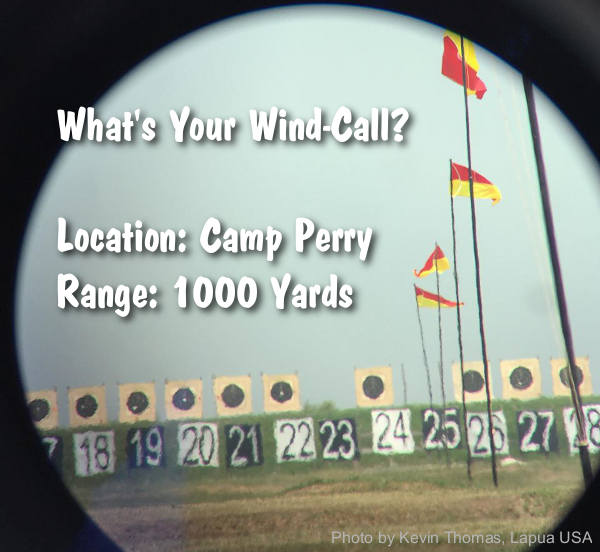
Readers often ask us: “Is there a decent, easy-to-comprehend book that can help my wind-reading?” Many of our Forum members have recommended The Wind Book for Rifle Shooters by Linda Miller and Keith Cunningham.
New Edition — Hardback and eBook
The latest, updated edition of The Wind Book for Rifle Shooters was released in May 2020. This 144-page book, first published in 2007, is a great resource. But you don’t have to take our word for it. If you click this link, you can read book excerpts and decide for yourself. When the Amazon page opens, look below the book cover photo, and click the bar labeled “Read Sample”. This lets you preview chapters from the Wind Book, and view some illustrations. Along with the new hardback edition ($22.99), Amazon offers a Kindle (eBook) edition for $14.99.
Other books cover wind reading in a broader discussion of ballistics or long-range shooting, such as Applied Ballistics for Long-Range Shooting by Bryan Litz. But the Miller & Cunningham book is ALL about wind reading from cover to cover, and that is its strength. The book focuses on real world skills that can help you accurately gauge wind angle, wind velocity, and wind cycles.
All other factors being equal, it is your ability to read the wind that will make the most difference in your shooting accuracy. The better you understand the behavior of the wind, the better you will understand the behavior of your bullet. — The Wind Book for Rifle Shooters
The Wind Book for Rifle Shooters covers techniques and tactics used by expert wind-readers. There are numerous charts and illustrations. The authors show you how to put together a simple wind-reading “toolbox” for calculating wind speed, direction, deflection and drift. Then they explain how to use these tools to read flags and mirage, record and interpret your observations, and time your shots to compensate for wind.
I believe this is a must-have book if you are a long-range sport shooter. I compete in F-Class Open and when I first purchased this book and read it from cover to cover, it helped me understand wind reading and making accurate scope corrections. Buy this book, read it, put into practice what it tells you, you will not be disappointed. — P. Janzso
If you have one book for wind reading, this should be it. Whether you’re a novice or experienced wind shooter this book has something for you. It covers how to get wind speed and direction from flags, mirage, and natural phenomenon. In my opinion this is the best book for learning to read wind speed and direction. — Muddler
2023 Smallbore and Air Rifle Champion: Cecelia Ossi
Story based on article by CMP’s Sheri Trusty
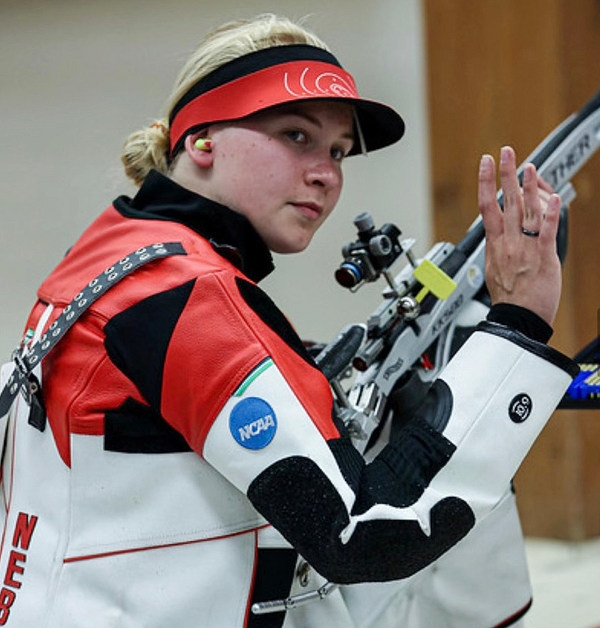
At the 2023 National Matches at Camp Perry this summer, 21-year-old competitor Cecelia Ossi achieved a remarkable double-discipline victory. Ossi placed first in the new Three-position (3P) Smallbore and Air Rifle Aggregate combo event. She did this shooting both outdoors and indoors. This was a great “twin win” by a very talented young lady. A member of the rifle team at the University of Nebraska, Ossi recorded a historically great performance at Camp Perry this summer. Cecelia won the 3P Smallbore and Air Rifle Aggregate with a score of 2421-60X.
For 2023, the CMP created a Three-Position Smallbore and Air Rifle Aggregate Championship for those who competed in both disciplines. Earning the inaugural win in the match was the talented Cecelia Ossi, who shoots for the University of Nebraska rifle team. The CMP had modified the match schedule to allow shooters to compete in Smallbore matches on Camp Perry’s outdoor Petrarca Range as well as in Air Gun events at the Gary Anderson CMP Competition Center located just next door — all during the same day.
The 2023 National Matches marked the first time Ossi shot outdoors at Camp Perry. The unique environment gave her the opportunity to test her skills: “Shooting outdoors created a lot of challenges, which is why I loved Camp Perry. You have to figure out how the wind is affecting your shooting, and it’s very rewarding when you get it right.”
Ossi has one more year at the University of Nebraska-Lincoln, and then she plans to join the Army Marksmanship Unit (USAMU) in Georgia. “I trained with [the USAMU] for a week this summer. I’m really excited about joining them in 2024″, she said. Ossi labels herself a perfectionist, and marksmanship provides a venue to be the best she can be (as the Army would say).
“Marksmanship gives me the opportunity to be a perfectionist. It’s very interesting and mentally challenging to figure out position and challenge myself to be perfect in everything I’m doing.” — Cecelia Ossi
A former gymnastics competitor, Ossi transitioned to marksmanship in her junior year of high school. She is now at the University of Nebraska, where she competes with the rifle team. Ossi is now heading into her senior year at Nebraska. “Marksmanship taught me a lot about the mental side of competing. I think I would have done better in gymnastics had I known all that. The mental side can outweigh the physical side. That’s something that’s overlooked in a lot of sports.”
Ossi said her coaches played a big role in her early, rapid success: “I had phenomenal coaches that helped me progress quickly. They knew my goals and how to help me meet them. They were a huge part of this.” Ossi trained with coaches Tom Fister, Tab Rhode, and Bill Burkert in Pennsylvania and with Peter Fiori (Senior) in New Jersey. Mindy Miles is head coach and J.T. Schneiring is assistant coach at University of Nebraska-Lincoln.
Cecelia Competes with both Air Rifles and Smallbore (.22 LR) Rifles
Ossi shot the air rifle competitions with a Walther Monotec rifle, and she shot smallbore with a Walther KK500 equipped with custom modifications. “My parts are mostly custom built by Peter Fiori, Sr. He played a big part in my marksmanship”, Ossi explained. Both her rifles have very sophisticated stocks that allow precise adjustment of cheekpiece height and buttstock height/length/angle to suit the three different positions that she shoots: standing, kneeling, and prone.
Camp Perry — Shooting Outdoors with Electronic Targets
Camp Perry’s unique shooting environment drew Ossi to the 2023 National Matches. “Camp Perry is the only place I’ve had the chance to shoot team matches. I had never shot team smallbore before. That was very fun. It’s fun to bring the team aspect into shooting and work together”, she said. “Each person shot a different position, so it highlighted each person’s strengths. I was nominated to shoot standing, which is my strength, so that was fun.”
Camp Perry employed electronic targets for the National smallbore matches for the first time this year. Ossi enjoyed this modern technology: “The electronic targets were a big reason why I decided to shoot smallbore at the National Matches. The electronic targets brought a bigger crowd overall for the matches and made the whole experience really great. The staff did really well making the matches run smoothly.”
Path to Success — How Young Shooters Can Win a Spot on College Teams
Ossi’s rushed entrance into competitive marksmanship gives her a unique view into the challenges young college hopefuls face, and she is open to advising young recruits as they maneuver through the college process: “I talk to a lot of recruits and young rifle shooters. The biggest thing, when you’re looking to get into college, is putting yourself out there and introducing yourself. It says a lot about you, and the coaches remember that.”
Ossi said college recruiting rules limit the connections between college hopefuls and coaches, so she encourages young marksmen to talk to college athletes like herself: “Don’t hesitate to reach out to college shooters. I’m always open to answer questions. You can always talk to collegiate shooters when you can’t always talk to coaches.”
From Gymnastics to Competitive Shooting After years of training as a high-level gymnast in her early teens, Cecelia transitioned to marksmanship competition in her junior year of high school. She had little time to perfect the skills necessary to earn a spot on a collegiate team, but she applied the discipline she learned as a gymnast to her new sport and achieved success. Her high school rifle match performances earned Ossie an invitation to join the University of Nebraska-Lincoln rifle team.
“In my junior year of high school, I had to retire from gymnastics due to injuries, and I felt a little lost,” she said. “I had done a lot with 4-H shooting sports — muzzleloader, shotgun, you name it. I did a lot of different disciplines, so I had a little bit of shooting experience.”
When Ossi learned a friend’s sister was a member of a collegiate rifle team, it opened her mind to new possibilities: “I dove right in. The coaches were amazing, and it brought me to the college 1 ½ years later. It was a quick transition from gymnastics to shooting.”
Ossi applied her gymnastics training to marksmanship: “I think all that training as a high-level gymnast played a part. I knew how to train for long hours every day, and I knew how to set goals. Having physical discipline and mental discipline helped. It was just a different sport.”
CMP Online Resources for Junior Competitors and Parents
The CMP has good resources for junior competitors on the CMP Website. There you will find information on youth shooting programs, along with College Connect and Guide to College Recruiting. These are excellent resources for parents and juniors.
Are you looking to get started in tactical/practical competitions? Or perhaps you already have have some PRS/NRL experience but want to upgrade your equipment and enhance your match results. Here are eight videos that can help you improve your game. These videos feature top tactical PRS/NRL competitors and George Gardner of G.A. Precision, considered one of the founding fathers of the PRS game. You’ll find other related videos on the Long Range Precision Shooters YouTube channel.
How Accurate Are The World’s Top PRS Shooters?
In this video, MDT put three top centerfire PRS shooters to the test, running them through some of the most difficult stages. The goal? To showcase the level of accuracy and precision these top shooters can achieve. From shooting off barricades to hitting targets from rooftops and rocks, these shooters demonstrate why they are considered among the best in the world.
Cartridge Choice for PRS and Tactical Competition
This video reviews many of the different cartridge options popular for PRS-style competition. The video examines pros and cons of various cartridge choices, focusing on accuracy, recoil, mag-feeding, and value for money. This segment features G.A. Precision owner/founder George Gardner.
Most top PRS shooters are using 6mm cartridges these days. These deliver excellent accuracy with lower recoil and cheaper bullet cost. Popular choices include 6 Dasher, 6 BRA, 6mm Creedmoor, 6XC, and the new 6GT cartridge, which is sort of a stretched version of a 6mmBR. It has a bit more case length for better feeding, and greater case capacity than a 6BR so you can shoot 105-108 grain bullets at 2950 fps with ease. That’s a popular Dasher accuracy node that the 6GT can achieve at somewhat lower pressures.
CLICK HERE for a full write-up on a 6GT rifle build by Mike McCasland (Texas Precision). This includes load development suggestions and a 6GT reamer print. The popular 0.120″ freebore chamber allows for the majority of high-BC 6mm projectiles. Mike had good luck with the pointed 107gr Sierra Match Kings (SMK), as well as the 110gr Hornady A-Tips in his rifle.
PRS Tactical Division — Rifle, Ammo, Optics, and Set-Up
In this video MDT Shooter Matt Stiner explains the basics of competition in the PRS Tactical division. The video covers rifle, cartridge choice, optics, and key accessories. He also explains how to set up your PRS Tactical rig for best results. In addition Matt talks about bullet and brass options.
PRS Ace Shows Skills Barricade Technique — with POV Video
This video features 2015 PRS Champion David Preston shooting the PRS Skills barricade. Dave Preston has been among the best in the nation running this PRS stage. Dave nearly always shoots 100% with the fastest recorded time. In this video you’ll see him successfully nail all eight shots in under 43 seconds. This includes a POV sequence (4:35 time-mark) showing the actual view through Dave’s scope.
The PRS Skills Barricade is an 8-round, 4-position stage featured at most PRS matches. It’s called a “Skills Stage” as it is run the same way at every national match and gives shooters the ability to compare skill levels based on hit percentage and speed. The target is a 10″ plate at 400 yards. There are four different positions, with two shots each. Most people run this stage in about 70 seconds, while Dave does it in the low 40s!
Know Your Limits PRS Stages — Pro Tips
This video showcases how 2018 Oklahoma PPS Champion Clay Blackketter approaches Know Your Limit Stages. With these particular type of stages you have to make judgment calls about your rifle’s accuracy and your ability to hold on target. You can boost your score by shooting the smallest target(s), but you risk losing points if you miss. Clay explains how best to manage a Know Your Limits stage.
PRS on a Budget — Converting a Basic Rifle for PRS Use
Top of the line rifles for competition are exceedingly expensive, but there is another option if you have a rifle in the safe that doesn’t get much use. Top F-Class shooter and wind coach Keith Glasscock notes: “I converted my .223 Remington varmint rifle into a Tactical class/PRS training rifle to save costs on ammunition and barrels so I can get better, faster.” Keith shows a very logical way to get started in the PRS/NRL game.
Bare Minimum: What You Need To PRS/NRL Competition
Like most shooting sports, PRS/NRL precision rifle competition can seem daunting once you start adding up the costs for the rifle, the optic, and all the important gear. We note the maximum price limit for “factory class” has risen steadily over the years, reaching $3000 currently. So even in the least expensive division, you can expect to put out a serious chunk of cash. This month, Dustin Sanchez talks with Brian Whalen about the minimum gear you need to start shooting long range and still be competitive.
1. Rifle (1 MOA capable)
2. Ammo
3. Bipod
4. Optic
5. Data Management (App, Kestrel, etc.)
“Road to the PRS” Episode One Presented by Kestrel Ballistics
Join Jeremy Flinn, the owner of Stone Road Media, as he begins Precision Rifle Series (PRS) shooting with the help of respected instructors and shooters. Follow along with Jeremy and Katie Godfrey of Kestrel Ballistics as they travel to eastern Pennsylvania to meet instructor Jordan Glassman, a renowned long-range shooting specialist and PRS beginners match instructor. He helps get Jeremy in preparation for an upcoming PRS Beginners Match.
This Saturday Video showcase was suggested by Boyd Allen.
Precision Rifle fans should watch Shooting USA this week. On Wednesday, August 2, 2023 Shooting USA offers a special edition devoted to the 2022 Armageddon Gear AG Cup Invitational. The AG Cup posts the biggest cash money match in Precision Rifle Competition. It’s an elimination format shot over three days of challenging competition on stages of fire created at K and M Precision’s ranges in West Tennessee. Match organizer, Tom Fuller joins John Scoutten to narrate the action and the award of the cash in extended coverage of the match.
This video shows highlights from the 2022 AG Cup, with many stages illustrated.
It’s the fourth year for the richest rifle tournament in the world. The AG Cup is the brainchild of Tom Fuller, the owner of Armageddon Gear, and to say it’s a success is a bit of an understatement. $75,000 in prize money was up for grabs, with a huge cash prize for the overall matche winner.
Shooting USA runs on the Outdoor Channel Wednesdays 9:00 PM Eastern and Pacific, 8:00 PM Central.
No Outdoor Channel on cable? Then you can subscribe to Stream the Broadcast on the internet.
During this week’s Shooting USA special, John Scoutten and Armageddon Gear’s Tom Fuller report the action and interview top precision rifle shooters. The Grand Prize of $20,000 was awarded for the best overall score, based on accuracy and time. There were also substantial cash prizes for each stage winner.
This 2022 AG Cup video has good footage of the stages and views downrange.
Arena Training Facility — 2300 Acres
The 2300-acre Arena Training Facility is a premier shooting facility with multiple shooting ranges from 50m to 2100m. Arena’s 1000-yard covered Known Distance range offers multiple benches, steel and paper targets out to 1000 yards. On Arena’s UKD (unknown distance) range shooters can engage steel out to 2300 yards. This 2100m UKD range boasts a 3-Story Shooting Tower, Air-Conditioned Shoot House, and multiple Positional Challenges.space.
Armaggedon Gear — Tactical Accessories Armageddon Gear, founded by former U.S. Army Ranger Tom Fuller, sells support bags, gun cases, slings, suppressor covers, scope covers, and a wide variety of other accessories popular with the PRS/NRL crowd. Armageddon Gear now provides products to the U.S. Military, Law Enforcement, as well as PRS/NRL competitors.
A few seasons back, I wrote an article on cartridge choices for F-Class shooters. CLICK HERE to READ ARTICLE. Since the first article I wrote, F-Class has continued to grow, and push the limits of precision and accuracy. While the .284 Win and its variants are still the most common F-Open cartridges, more and more top F-Open shooters are using magnum cartridge types to win competitions and set new records. In this article, I will list some of the advantages and disadvantages of the most commonly used magnums, and will cover the strengths and weaknesses of each one of them.
Performance factors we will consider for magnum F-Open cartridges include:
1. Equal or better accuracy than standard chambers
2. Better ballistic performance
3. Enhanced case life
4. Barrel life
Accuracy Potential of Magnum Cartridges for F-0pen Competition
John Meyrs has won four National Mid-Range Championships using the .300 WSM. Tim Vought used the same cartridge to win two Mid-Range Nationals and used a 7-6.5 PRC to win the long range Nationals. Standard .437″ case head (.308 Win head size) cartridges still have more Nationals wins overall, but the magnums are quickly catching up, and my prediction is that magnums will dominate soon.
The accuracy and precision potential of magnums used in F-Class (.300 WSM, 7-270 WSM, 7mm RSAUM or “7 SAUM”, 7-6.5 PRC) is better than non-magnum cartridges because their shapes are closer to the ideal “fat/short” body associated with wider nodes and extreme precision. For example a .300 WSM is proportionally much closer to the 6 PPC, 6 Dasher, and 6 BRA than is the .284 Winchester.
Stunning F-Open rifle with SEB Mini front rest with Blake Machine accessories.
The first thing that comes to mind when magnums are discussed is power and speed. In my humble opinion most shooters are missing out on accuracy because they push their magnums right past the most stable and accurate nodes. Recently I met my good friend from the Army Marksmanship Unit, SFC Brandon Green, at a shooting competition. We discussed the latest and greatest in long-range shooting. I knew that the USAMU had switched from 6.5-284 Norma to 7mm RSAUM several years back, but didn’t know what load they are currently using. Brandon told me that the load featured Berger 180gr hybrids in Nosler cases at 2820 fps. We all know that the 7 SAUM is capable of much higher speeds, “but at around 2820 fps the load/rifle combo will hammer the X-Ring anywhere under any conditions” SFC Green said.
F-Open rifles on the firing line at the Ben Avery Shooting Facility in Phoenix, Arizona.
Most shooters jump right into magnum territory velocities when testing, missing out on better precision at standard chamber speeds. For example, my 30 KMR can easily reach 2880 fps with 230gr Hybrids, and it actually shoots pretty good. But the same rifle at around 2770 fps will absolutely hammer the X-Ring in any condition anywhere. When it’s all said and done, F-Class is a long-range shooting competition at a known distance which requires extreme precision and accuracy. It is not a speed race.
IMPORTANT — Case-Head Dimensions Do Make a Difference
Magnums, when shot within reasonable velocities, on average will give better case life due to the bigger case + lower pressure and “more meat” in the case-head area. For example a 7 SAUM case will outlast a .284 Win case when both are loaded to around 2900 fps.
Disadvantages of Magnum F-Open Cartridges
Perhaps the biggest disadvantage linked to magnums is recoil. Some people complain about developing the “gun shy” syndrome after shooting a magnum for a while. Muzzle blast and recoil are significantly more pronounced in magnums, but that can be easily managed with a properly-built rifle equipped with appropriate recoil mitigation hardware such as RAD and the various butt plates.
F-Open rifle equipped with recoil reduction buttpad system.
Barrel Life — “Barrels are Expendable Components”
It is true that certain magnums can torch a barrel in just a few hundred rounds. But the same is true when improving a 6BR to 6 Dasher for example — barrel life might be reduced significantly. More powder = more heat = diminished accuracy after a certain round count. In my experience, a F-Open magnum’s barrel life is very close to high-performance standard cartridges such as the .284 Shehane or .284 KMR. I “retire” my barrels around 1200 rounds regardless of the cartridge being a magnum or not. After that many rounds most barrels will still shoot OK but will copper up, and you will start seeing those unexplained vertical 9s. The bottom line is this, barrels are expendable components very much like brass. You can’t get the performance of .300 WSM and the barrel life of the .308 Win at the same time. If you want to race in NASCAR, fuel mileage should not be the top priority!
Top Magnum Cartridge Types Used in F-Class Open Division
.300 Winchester Short Magnum
The .300 WSM (Winchester Short Magnum) tops the popularity chart in F-Class Open division. It has been used to win numerous National championships and has set many National records. The .300 WSM’s short/fat case shape, with minimal body taper and 35-degree shoulder, contribute greatly to its outstanding performance at long range. Components are readily available as well. Best brass remains to be Norma, although ADG is just as good and some would even say better, but it is more expensive and harder to get at this time.
The .300 WSM has been described as a “super-sized Dasher”.
For the .30-cal magnums, in my opinion, the best bullets by far are made by Berger. If your rifle does not shoot 215gr, 230gr hybrids, or 210gr VLDs well, you likely have a rifle problem, NOT a bullet issue. My “go to” bullet is the Berger 230gr Hybrid. The 215-grainer is a close second, followed by Berger’s accurate but ballistically inferior 210gr VLD, which I use in calm and steady conditions.
Top powders for the .300 WSM are Hodgdon H4831SC and H4350. I know there are many more powders suitable for the .300 WSM cartridge, but none I have used can match Hodgdon’s consistency when shot in different geographical locations and weather conditions.
7mm Remington Short Action Ultra Magnum
The 7mm RSAUM (aka 7 SAUM) used to be the darling of F-Open. Its case capacity and shape are about perfect for launching 180gr pills with great ballistics and precision. Its popularity faded a little, due to the lack of good brass, and the rise of the improved versions of the .284 Win which can almost match the RSAUM performance. Norma still makes 7 RSAUM brass which is pretty good but little on the soft side and hard to find. ADG is arguably producing the best RSAUM brass right now. It is very uniform, reasonably priced, and seems to hold up very well even when pushed hard. The best bullets are again made by Berger, and those are the 180gr hybrid, 184gr hybrid, and 180gr VLD. Best powders are H4831sc, H4350, and Alliant Reloder 16 and Reloder 23.
7-270 WSM, 7-300 WSM, and 7 WSM
The first two are pretty much identical, the only difference being that the 7-270 WSM is necked up .270 WSM while the 7-300 WSM is a .300 WSM necked down to 7mm. I personally prefer the first one since necking-up is easier than necking-down (with fewer doughnut issues).
The WSM case-based 7mms will give you great velocity flexibility as well as superb precision when tuned well. In the 2013 world championship in Raton NM, I was scoring for a gentleman from Canada who was shooting 7-270 WSM. The wind was blowing pretty hard that day. On one of his shots, just before he pulled the trigger the wind gusted. I remember thinking that’s going to be an 8 for sure. The target came up a line 10! I asked him after the match what he was shooting, and he replied 180s at 3100fps. Although capable of such speeds, I think that potentially better and more consistent accuracy can be achieved at much slower speeds. The best powders and bullets are again Hodgdon and Berger respectively. Best cases are made by Norma and ADG, with Winchester being a third option.
7-6.5 PRC — Popular Wildcat
Last but not least on our chart is the 7-6.5 PRC. This particular cartridge is actually a wildcat. It is a 6.5 PRC necked up to 7mm. It is pretty much identical to the 7 RSAUM with the only differences being a shorter neck and .01″-narrower body. Currently the 7-6.5 PRC is the most requested cartridge that I offer when building new rifles. It seems to fill the gap between the .284 Win and the larger magnums very nicely. It is capable of reaching 3000fps but most shooters are getting their best results around 2920-2950 fps. The biggest advantage of this wildcat is brass. Lapua makes super high-quality, readily-available 6.5 PRC brass. Best powders are H4831sc, H4350, Reloder 16, and Vihtavuori VV 555. The best bullet in my opinion is the 180gr Berger. I am yet to hear about a better-performing bullet in this chamber.
Conclusion In conclusion, magnums are not perfect but their performance advantages should be very seriously considered when building a rifle for long-range F-Class. In part three, I will list the most common wildcat magnums, and present the KMR magnums which will make you (if you haven’t already) buy a magnum action and get a magnum build for sure!
– 2014 F-Class Open National Champion
– 2015 F-Class Open National Championship, Silver Medal
– F-Class Open National Championship Teams, 2015, 2014, 2013, Shooting Team Member
– Over 15 wins in Regional and State Championships in Palma, F-TR, F-Open
– 2013 U.S. National Team Member
– 2023 F-Open Gold Medal Team USA Member, 2023 World Championship in South Africa
Image from 2021 when Amanda was serving with the USAMU.
Amanda Elsenboss has won the 2023 NRA National High Power Rifle (Mumma Trophy) and Service Rifle (Dupont Trophy) Championships with a Grand Aggregate score of 2387-113X. Shooting at Camp Atterbury in Indiana, Elsenboss set a new Service Rifle record and also earned High Woman and High National Guard honors. Amanda was a member of the USAMU Team for many years and now serves in the National Guard. This is not Amanda’s first trip to the podium — she also won the NRA High Power Championship in 2021 shooting a service rifle in all matches (Read More HERE). And last year, Amanda won the prestigious President’s 100 Match at Camp Perry, the first woman in history to do so.
At the 2023 NRA National High Power Rifle Championships, held July 8-14th at Camp Atterbury Elsenboss triumphed over a strong field of 54 of the nation’s top service rifle competitors.
Here are Elsenboss’s individual 2023 Championship scores, event by event:
Grand Aggregate — 2387-113X
Erdman Trophy – 594-21X
Centenary Trophy – 596-28X
Nevada Trophy – 795-34X
Scott Trophy – 200-15X
Crescent Cup – 199-5X
Crowell Trophy – 199-11X
Marine Gunner DI Boyd II Memorial Trophy – 1190-49X
Vandenberg Cup – 796-40X
Clarke Trophy – 796-39X
In addition, Elsenboss, who shoots with Team Berger, was a member of the Veteran’s Family Brigade Anderson team, who won the RNDC Trophy team match with a 1985-93X score. Team members included: Samuel Freeman, Hugo Adelson, Julia Carlson, James Mauer (Captain), and Norman Anderson (Coach).
For her service rifle, Elsenboss used Berger .22 Cal 80.5gr Fullbore Target Rifle bullets and 77gr OTM Tactical Rifle bullets. Elsenboss will also be competing at the 2023 Civilian Marksmanship Program (CMP) National Rifle Matches at Camp Perry.
About Berger and Capstone Precision Group
Berger manufactures precision projectiles and match-grade ammunition for Target, Hunting, and Tactical applications in Mesa, Arizona. Berger is part of the Capstone Precision Group, the exclusive U.S. distributor for Berger, Lapua, Vihtavuori and SK-Rimfire products. For more information, visit Bergerbullets.com.
Now through Sunday, July 30th, 2023, classic military rifles will fill the firing lines at Camp Perry. The National John C. Garand, Springfield, Vintage and Modern Military Match (GSMM) commenced on the 26th, and will run through this upcoming Sunday the 30th, with the one-day Springfield M1A Match on Sunday only. (See CMP Camp Perry 2023 Calendar.) Some participants will shoot just one rifle type, but there is also a combined GSMM 4-Gun Aggregate. This GSSM Agg encompasses a series of position shooting matches on NRA SR targets at the CMP Nationals. As the matches are completed, day by day, results will be posted on the CMP National Matches Results Page.
This video shows the Garand Match at Camp Perry. The rifles are still the same a decade later…
The annual GSMM event is one of the most popular events at Camp Perry, drawing participants from around the nation. One of America’s top GSSM shooters is Brian Williams, who was profiled in our Daily Bulletin. The 4-gun Aggregate includes Garand, 1903 Springfield/1917 Enfield (or similar bolt rifle), M1 Carbine, and AR-type rifle for “Modern Military”. Remarkably, Brian has won the GSMM 4-Gun at the CMP National Matches in Camp Perry three years in a row — the inaugural 2017 4-Gun Agg, plus 2018 and 2019. Below, Brian offers some thoughts on the classic wood-stocked rifles used in GSMM competition.
The Classic Wood Guns of CMP 4-Gun Competition
Perspectives on M1 Garand, M1903A3, M1917, and M1 Carbine
Brian provides perspectives on the “Wood Gun” game, with suggestions on how to improve your performance with the M1 Garand, M1903 Springfield, M1917 Enfield, M1 Carbine, and other 20th Century military rifles. Brian explains what to look for
Q: What should one look for when acquiring older rifles for CMP 4-Gun Games — M1 Garand, M1903/1903A3, M1917, M1 Carbine? What are realistic budgets for these firearms? What kind of accuracy can one expect? What upgrades are important?
Brian: All of these military surplus rifles are out there, but they are getting harder to get your hands on. And, just like everything else, the prices continue to rise. Not that long ago you could get your hands on a M1 Garand for four or five hundred dollars. In today’s market they are usually about double that price. But understand that these rifles are all unique and all have a story to tell. No two are alike, or have the same story. Just like the guns themselves, there are fewer and fewer dedicated gunsmiths for these vintage rifles. But I promise if you look for a good smith, they are out there and they are some of the most interesting people you will ever meet.
M1 Garand — Of the four (4) centerfire guns I shoot in the CMP games, my favorite has to be the M1 Garand. There were over 6 million of them produced in a very short time period, and every single one has its own unique story, and that is just cool. M1 Garands are capable of good accuracy. I believe that a well-maintained M1 with at least a replacement barrel is capable of shooting between 1 and 1.5 MOA.
M1903A3 Springfield — I find that the sights on a M1903A3 are a little easier to see than the sights of the M1903, but both are very accurate rifles. Like most military rifles in the current climate the prices have risen dramatically, but there are some gems out there that can be had for far less than $1000. The nice thing about the Springfield rifle is that almost all of the accuracy than you would want can come from just replacing a worn out 80-year-old barrel. In terms of accuracy, I think a good M1903A3 can shoot 1 MOA most of the time.
M1917 Enfield — This rifle is the newest of my collection and it shoots very well, with just a new Criterion barrel — again about 1 MOA with iron sights. These rifles are very close in price to the M1903 Springfield. But if you do your homework and keep your eyes open, there are always great deals to be found. I actually prefer shooting the M1917 to my M1903A3, due primarily to the M1917’s cock-on-close bolt which allows smoother cycling.
Public domain photo from Armémuseum (The Swedish Army Museum).
M1 Carbine — By 1945 there had been more M1 Carbines built than Garands. Today the Carbine can be harder to find, and due to the scarcity the price has shot up and most military M1 Carbines are going for more than $1000 at this point. The great thing about the M1 Carbine is that as long as you have a good ammo supply this rifle can shoot. Honest. I have had countless numbers of people that tell me that there is not an M1 carbine that will shoot. I can tell you from experience that they will, but you are going to have to put in some time with one to learn how to get it to shoot where you want it.
The M1 Carbine shoots the .30 Carbine round, with 110gr bullet going about 1990 FPS. In comparison, the .30-06 Springfield round used in the M1 Garand is almost three times more powerful than the .30 Carbine.
Report by Craig Arnzen, Area 419
As the PRS and other tactical/practical competitions continue to grow, a guy tends to wonder, just how good are the top competitors? And what are they actually doing (and viewing) as they complete a stage? Well, a great video from the Long Range Precision Shooters YouTube Channel let us see what the best in the sport see through their scopes when they shoot.
This video features Dave Preston, 2015 National Champion and consistent top performer, shooting the PRS Skills barricade. Dave Preston has been considered among the very best in the nation running this PRS stage. Dave nearly always shoots 100% with the fastest recorded time. In this video you’ll see him successfully engage all eight shots in under 43 seconds — that’s crazy fast. This includes a POV sequence (4:35 time-mark) showing the actual view through Dave’s scope as he completes the stage.
Watch this video! Dave offers excellent advice on gun-handling and body positioning for barricades. Listen to what he says and you WILL shoot better.
This video features the PRS Skills Barricade, an 8-round, 4-position stage featured at the majority of PRS matches throughout country. It’s called a “Skills Stage” as it is run the same way at every national match and gives shooters the ability to compare skill levels based on hit percentage and speed.
The target is a 10″ plate at 400 yards. There are four different positions, with two shots each. Most people run this stage in about 70 seconds, some in the mid-60s, the greats in the high 50s, and Dave does it in the low 40s… mighty impressive!
The Right Gear Aids Stability and Lets You Shoot Faster
Let’s also take a look at two pieces of gear that really helped Dave Preston get stable and shoot fast.
1. BARRICADE BAG — To Get Stable, Really Stable
In the video Dave is using a Solo Sac from Short Action Precision This bag was designed by USMC Solomon Mansalala. It’s a very soft/dense bag and is popular at matches.
The other bag that sees a LOT of use, and is far and away the most used, is the patented Gamechanger Bag from Reasor Precision Solutions and Armageddon Gear.
2. MUZZLE BRAKE — To Make Your Follow-Up Faster
You’ll notice that in the video the rifle is very steady through firing, even though he is not applying a lot of pressure to the rifle. Dave is using a Hellfire Muzzle Brake from Area 419. Combined with the soft-recoiling 6mmBR cartridge he is able to spot his impacts and make adjustments, and can also make very fast follow-up shots as his rifle hasn’t bounced way off target.
At the request of our readers, we provide select “Deals of the Week”. Every Sunday afternoon or Monday morning we offer our Best Bargain selections. Here are some of the best deals on firearms, hardware, reloading components, optics, and shooting accessories. Be aware that sale prices are subject to change, and once clearance inventory is sold, it’s gone for good. You snooze you lose.
NOTE: All listed products are for sale to persons 18 years of age or older. No products are intended for use by minors.
⏺ Fast, programmable, accurate dispenser at great price
The Frankford Arsenal Intellidropper is a high-quality powder scale/dispenser. It’s accurate to +/- one-tenth of a grain, dispenses in seconds, and can be controlled by a handy mobile App that stores charge weights for different cartridges. This unit has a 7000-grain capacity with both auto and manual trickle capability. This is a fine deal — you save $41 (18%) off the regular $229.99 price. The same Intellidropper is $189.14 at MidwayUSA with FREE Shipping using Code RELOADING071823.
2. Precision Reloading — 12% Off Sitewide Summer Sales Event
⏺ Significant savings on nearly all products in stock with $100+ order
Now through Thursday, July 27th, you can save 12% on nearly all in-stock items at Precision Reloading with a $100 minimum order. This Summer Sales Event includes loaded ammo, reloading supplies, brass, bullets, presses, optics, tools, gun cleaners, and much more. To save 12% use Coupon Code 72123 at checkout. And through 11:59 pm on Monday 7/24/23 you can get FREE hazmat with a $150 or more powder purchase. Use code FREEHAZ.
3. Palmetto SA — AR Upper and Lower with Vortex Optic, $809.98
⏺ Great deal for AR upper WITH Scope and complete lower
Are you looking to build an AR-platform rifle but want better performance than a .223 Rem? If so, check out these AR bundle packages at PSA. For just $809.98 you get a complete upper, Vortex optic, and a complete lower (with adjustable buttstock). This AR bundle includes the PSA lower, .224 Valkyrie-chambered 20″ 1:6.5″-twist barrel, complete upper with M-Lok handguard, PLUS a Vortex Eagle 1-8x24mm scope with cantilever mount. You can also grab the 6.5 Grendel upper with Vortex 4-12x44mm riflescope (and mount) for only $579.99.
⏺ Great spotting scope for the price with rock-solid warranty
Having a quality spotting scope can help when in the field, at matches, or just having fun at the range. We found a great deal on the Vortex Diamondback 20-60x60mm spotting scope, now just $324.99 at MidwayUSA, an amazing bargain. This spotting scope has good light transmission throughout the magnification range. Sharpness is good, and the spotting scope’s construction stands up to rough field use. This spotter is protected by Vortex’s VIP Unlimited Lifetime Warranty.
5. CDNN Sports — Ruger Handgun Super Sale, Save 20-42%
⏺ Huge savings on 50+ Ruger pistols and revolvers
Ruger makes fine pistols and revolvers that are rugged and reliable. Right now you can get big savings — up to 42% — on Ruger handguns at CDNN Sports. There are over 50 Ruger handguns on sale. You can save $349.00 on the new Ruger 57 (5.7x28mm) semi-auto pistol or save 42% with the sale price for the .22 LR Ruger LCP II. There are also big savings on single- and double-action revolvers.
6. MidwayUSA — ZEISS Conquest V4 6-24X, $849.99
⏺ Save hundreds on great SFP ZEISS scope — top choice for varmint work
Here’s a great deal on an excellent ZEISS 6-24x50mm SFP optic — a great scope for club matches and varmint shooting. There’s plenty of magnification on the high end, plus a wide field of view at 6X. The glass is great — at the $849.99 sale price, you’ll be hard to beat the quality of this scope which delivers 90% to-the-eye light transmission. With a Second Focal Plane Z-MOA1 reticle and 1/4 MOA clicks this scope has an impressive range of total elevation and windage travel with Zeiss’ Ballistic Stop feature. Here are actual purchaser reviews: “Excellent, A++, Clear glass”; Awesome clarity and the adjustments are spot on — Zeiss V4 scopes are hard to beat for the money”; “Great mid-level scope. Clear Glass with a good no nonsense reticle and easy to operate turrets”.
7. Midsouth — Winchester 9mm Pistol Ammo, $129.99/500
⏺ Very good price on good American-made 9mm FMJ ammo
Right now quality, USA-made Winchester 9x19mm ammunition is $129.99 for 500 rounds at Midsouth. That works out to just $0.26 per round or $12.99 per 50-rd box. This service grade 9mm Luger ammo has 115gr Full Metal Jacket bullets and Winchester brass. This ammunition is new production, non-corrosive, in reloadable brass cases. If you shoot large quantities of 9mm ammo, this is a very good deal.
8. Amazon — MOZETO Shooting Mat, $39.99
⏺ Nice 78″-long padded nylon mat stows conveniently
Whether in the field or at the range, having a comfortable mat to keep you and your gear dry and clean is critical. The Mozeto XL Shooting Mat is made from durable 1000D nylon with EPE padding fabric for long-lasting durability. There is an extra-thick padded section for elbows and knees. This big 78″ x 28.5″ mat has convenient straps and carry handle, plus storage pockets. To transport, just roll it up, fold it over and attach the quick release plastic snap buckles.
⏺ Excellent scope for varminters and grounghog matches
Looking to clean your brass and/or gun parts? The H&B Ultrasonic Cleaning Machine is a bargain at just $84.98 on Amazon. This unit features a heated tank for cleaning of cartridge brass and metal parts. The ultrasonic cavitation lifts and dissolves carbon, dirt, and any residue left on fired cases. Chose cycles from 90 to 480 seconds. Not only can you clean brass, but this unit can clean pistol slides, magazines, jewelry, and silverware. Note: This unit, an “Amazon Choice” with 84% 4- or 5-star reviews, is nearly identical to the unit Lyman has sold for $120+.
10. CDNN Sports — Grid Target Packs starting at $1.89/12
⏺ Great deals on colorful Champion grid target packs
NOTE: Respected Shooting USA host Jim Scoutten passed away yesterday, 7/18/2023. We were saddened to learn of his passing. Jim was a great defender of the Second Amendment and supporter of the shooting sports. The Shooting Wire Blog noted: “Scoutten has been a well-known and respected figure in the shooting industry, serving as the longtime host of Shooting USA. As managing editor of Tier One Media, LLC, he created two of the most successful cable television shows on the Outdoor Channel.”
The 2022 PRS Pro Series Finale was held November 5-6 at the K&M Precision Rifle Training Complex in Finger, Tennessee. The Finale brings together the best of the best within the PRS Pro Series to crown the annual champion. Competitors qualify through regional events to attend the Finale based on previous match results through the season. The 2022 PRS Finale is the headline feature on Shooting USA TV today.
Shooting USA SHOW TIMES: This Shooting USA Episode airs Wednesday, July 19, 2023 at 9:00 PM Eastern and Pacific; 8:00 PM Central. If you miss the regular broadcast, you can stream the show online at any time on Vimeo for $0.99 per episode.
The Precision Rifle Series (PRS) is the leading organization running Precision Rifle (tactical-style) competition. In ten years, PRS has grown exponentially, not only in the USA but also internationally. The PRS records results from local and regional competitions to establish a world leader board to invite the top competitors to the Finale at the K & M Precision Complex in Tennessee.
Great K&M Complex video — overhead and action shots — Click II pause button to halt:
PRS Finale Hardware
You’ll find the latest and greatest PRS hardware at the PRS Finale. Notable in recent seasons was the fact that many top competitors moved down from the 6.5/6mm Creedmoor to the smaller, more efficient 6mm Dasher, 6BRA, 6GT and other 6mm cartridges. The 6mm Dasher offers excellent accuracy with less recoil than the 6.5 Creedmoor. New magazine designs allow very reliable feeding with the shorter cartridges.
Allison Zane Takes Top Honors among Lady PRS Competitors
Congratulations to Team Lapua’s Allison Zane for winning overall Top Lady for the 2022 Precision Rifle Series (PRS). Zane, who scored a 169 at the PRS Pro Series Finale, clinched the Top Lady title for the third consecutive year. That’s an impressive “Three-Peat” for the Ladies’ title. Out of 260 competitors, Zane finished Top Lady and placed 27th overall.
Zane competed at the worlds with a 6mm Creedmoor rifle shooting Lapua brass and Berger 109gr LRHT bullets. Her precision rifle was built by Short Action Customs using a Defiance Machine Ruckus Tactical action, Modular Driven Technologies (MDT) ACC chassis system, Vortex Razor HD Gen III 6-36×56 scope, Hawk Hill Custom Marksman Contour barrel with MDT brake, and Huber two-stage trigger.
Precision Rifle Series (PRS) Finale
Attendance at the PRS Finale is by invitation. The Precision Rifle Series collects scoring information/results from regional competitions to compile a ranked world leader board over the course of an annual season. The top competitors from the season are thereby qualified for the Finale at the state-of-the-art K & M Training complex in Tennessee — one of the best precision shooting facilities in the world.


 Readers often ask us: “Is there a decent, easy-to-comprehend book that can help my wind-reading?” Many of our Forum members have recommended The Wind Book for Rifle Shooters by Linda Miller and Keith Cunningham.


 After years of training as a high-level gymnast in her early teens, Cecelia transitioned to marksmanship competition in her junior year of high school. She had little time to perfect the skills necessary to earn a spot on a collegiate team, but she applied the discipline she learned as a gymnast to her new sport and achieved success. Her high school rifle match performances earned Ossie an invitation to join the University of Nebraska-Lincoln rifle team.


 In conclusion, magnums are not perfect but their performance advantages should be very seriously considered when building a rifle for long-range F-Class. In part three, I will list the most common wildcat magnums, and present the KMR magnums which will make you (if you haven’t already) buy a magnum action and get a magnum build for sure!


