Rainy September Days in Vermont
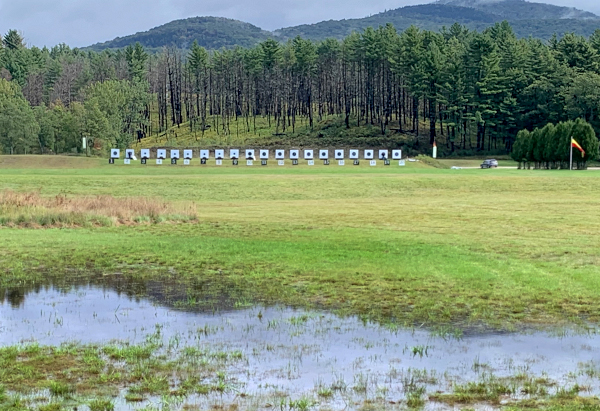
The Civilian Marksmanship Program’s New England Games Matches, held September 18-25, 2022, at the Camp Ethan Allen National Guard Training Site in Vermont, can be described in one word: WET.
Though suffering one of the toughest weather weeks in the event’s history through cold temperatures and steady rainfall, Pistol and Rifle competitors still managed to give outstanding performances on the firing line, with some new record scores being set.
The New England Games event features CMP’s full lineup of vintage and modern military rifle and pistol competitions. These matches are suitable for those just beginning in the sport of marksmanship while offering significant challenges for more experienced marksmen and markswomen.
Notable 2022 New England Games Results and New Records
In CMP Games rifle events, Brian Williams, 48, who is a current New England Games record holder in several events, set yet another record with a 383-6X in the Carbine Match. This topped the previous score he had set himself in 2016. Williams was also only two points away from setting a new record in the Modern Military event — he holds the current record in the match from his 2018 performance.
Maisey Loucks, 28, showed great talent in the Rimfire Sporter Rifle Match, finishing with 579-26X, just three points from the current TU class record. Earlier this year, at the Camp Perry National Matches in July, Maisey earned the High Woman title in the National Carbine Match, setting a record in the process.
Reaching a new New England Games record in the Vintage Sniper Match was Hard Leg #2 (James Horton, Jack Chomko), who beat the previous record set in 2018 by one x-shot, with a score of 397-16X.
Setting a New England Games record in the Vintage Sniper Match was team Hard Leg #2 (James Horton, Jack Chomko), who beat the previous record set in 2018 by one X, with a score of 397-16X.
Bettering a record in the EIC Match by X-Count was SSG Verne Conant, 26, who accumulated a score of 497-26X in his impressive win. Top competitors of the match earned EIC (Excellence-In-Competition) points toward a Distinguished Badge, including two junior athletes: Jack Marshall, 20, and Shannon Moriarty, 14. Marshall finished the match fourth overall while Shannon Moriarty took fifth.
Outside of the recreational Games Matches, the CMP hosted a series of High Power matches that included a team event, three days of 800 Aggregate shooting, and a culminating 2400 Aggregate. Individuals were recognized for their Service or Match Rifle use, scores at each position and Civilian or Military status.
Along with the matches, a Rifle Marksmanship 101 clinic was held at Camp Ethan Allen.
Want to learn the basics of position shooting? Then you should check out an article by Gary Anderson, DCM Emeritus, in On the Mark digital magazine (Summer 2014, pp. 6-13). This article covers all the key elements: body position (prone, sitting, standing), sling use/adjustment, sight picture, aiming process, and trigger control. While this 8-page article was specifically written for Rimfire Sporter shooters, the techniques described by Anderson apply to all types of position shooting, whether you shoot air rifles, smallbore rifles, or centerfire rifles.
Here’s what Anderson says about aiming — how to keep your sights steady and get them centered on the middle of the target:
Trigger Contact and Center As soon as aiming at the target begins, the index finger must move from the trigger-guard to contact the trigger. It is important to get initial pressure on the trigger as soon as aiming begins. Then the shooter must focus on the sight picture and centering the sight picture movements over the aiming point. No one, not even champion shooters, can hold the aligned sights perfectly still. The sights are going to move a little bit or a lot, depending on the shooter’s skill level. The secret is to center those sight picture movements over the aiming point on the target (see trace illustration) before pulling the trigger.
When the sight picture movements on the target are centered, the last step in firing the shot is to add… smooth pressure on the trigger until the shot breaks.
Anderson also discusses the 5 Basics of Shot Technique:
Rimfire is hot now. Across the nation, .22 LR rimfire disciplines are now the fastest growing types of rifle competition. And with today’s featured rig, the Competition Machine (Eliseo) Universal Match Rimfire Rifle (UMRR), you can shoot a variety of matches — NRA rimfire, NRL22, NRL22X, PRS Rimfire, local silhouette-style steel matches, even local rimfire benchrest matches (with a bag-rider fitted up front).
Compared to shooting centerfire, rimfire shooting is much less costly. You can get pretty good match ammo for under $8.00 per box. That works out to just 16 cents per round. Compare that to $1.20 or more per round for handloaded centerfire ammunition. And you don’t have to deal with the persistent shortages of powder and primers, or spend hours hand-loading. With rimfire, just open your .22 LR ammo box, load your magazine, and shoot.
Versatile, Accurate, Affordable — Universal Match Rimfire Rifle
If you’re a Palma shooter and want to shoot rimfire with a rifle with identical ergonomics and “feel” as your centerfire tubegun, Gary Eliseo’s new Universal Match Rimfire Rifle (UMRR) is your logical choice. Or if you are looking for a high-quality bolt-action chassis rifle for NRL22 (rimfire tactical) competition, this is a great option. Running a smooth Tikka T1x action, the UMRR offers match-grade performance at an attractive price — $1750.00 for the Sport-Target model with 20″ Tikka factory barrel.*
The Tikka T1x action is a smooth, short-throw action that cycles quickly and easily:
Gary Eliseo, head honcho of Competition Machine in Arizona, explained the features of the UMRR: “Our Universal Match Rimfire Rifle system has all the features of its big brother the Universal Match Rifle System (UMRS) and will accept all the same accessories and attachments. The rimfire UMRR is identical in size to the centerfire version so it’s possible to have your centerfire and rimfire rifles set up exactly alike.” That’s ideal for guys who compete in both centerfire and smallbore matches, and likewise it is ideal for cross-training using lower-cost rimfire ammo.
The UMRR is built around the excellent Tikka T1x platform. Gary notes: “We have accurized and tuned the T1x to give the best possible performance from factory barrel and trigger. The UMRR can also be customized with a high-end match barrel and trigger. By just changing the attachments, the UMRR can be used in multiple shooting disciplines like NRL22 and NRA rimfire competitions.” Gary also noted that Tikka recently updated the T1x bolt and magazine for improved feeding and extraction. See video below.
Sport-Target UMRR Shows Excellent Accuracy with Factory Barrel
Eliseo confirms that the Sport-Target UMRR with factory Tikka barrel and trigger is easily capable of sub-MOA precision. Check out those five-shot groups shot at 50 yards. The smallest group (.210″) works out to 0.40 MOA, while the largest group (0.39″) is 0.74 MOA. Remember this is with Tikka factory barrel!
The Sport-Target UMRR with factory Tikka barrel and trigger is capable of sub-MOA precision.
The Sport-Target version uses the factory 20″ Tikka barrel with threaded muzzle that has been set back and re-chambered so the bullet will engrave the rifling, which increases the precision of the rifle significantly. The excellent Tikka trigger is tuned to a pull weight of one pound. Overall the UMRR is a great choice as an XTC/LR prone trainer or NRL competition rifle at very reasonable cost.
Superb Accuracy from UMRR Match-Target Model
The Match-Target version comes with a top of the line Benchmark match barrel and Eley match chamber with the muzzle configured for your application to accept a front sight, tuner, or threaded, there are several aftermarket single-stage or two-stage match triggers available. Current Eliseo Rifles price for the UMRR Match-Target is $2400.00.*
The Match Target with Benchmark match barrel is capable of competing at the highest level. Shown above are 50-meter sling targets and Lapua 50-meter test center results. The bottom box shows 20 shots with a superb 10.52 average score.
Updates from Tikka Improve the T1x Action and Magazine
Gary noted that Tikka recently made an update to the Tikka bolt and magazine to improve feeding and extraction. Tikka replaced a wire-type system with a solid ejector element in the magazine. Gary says that improves the reliability of both feeding and extraction. Watch the video to see how this works.
Centerfire Accesories Will Work on UMRR
Gary notes that all the centerfire UMRS attachments will fit the UMRR, including handstop, rear balance weights, Picatinny scope rail, ARCA accessory rail, rear bag-rider, bipod mount, and front bag riding attachments. This easy adaptability makes the UMRR a true multi-discipline system for smallbore matches, NRL22/PRS rimfire competition, and cross-training.
Adapt the UMRR Easily to Multiple Shooting Disciplines
The UMRR can be easily configured for NRL, PRS, or NRA rimfire competitions by just changing the attachments. The UMRR is built on the excellent Tikka T1x barreled action that’s been accurized and bonded into the UMRR chassis system. Gary says the UMRR feeds .22 LR rounds flawlessly from the Tikka 10-round magazine, especially with the new, improved magazines. The UMRR is currently available in two basic configurations, both of which can be customized to your specifications.
Two Versions — Sport-Target and Match-Target
The Sport-Target version of the UMRR uses the factory 20″ Tikka barrel with threaded muzzle. Gary can tune the excellent Tikka T1x trigger down to a pull weight of around one pound, though for tactical work he says you may want to leave it stock. Gary tells us the Sport-Target is a great choice as an XTC/LR prone trainer or NRL22 competition rifle.
Match Target UMRR with Benchmark Custom Barrel
The Match-Target version comes with a top-of-the-line Benchmark match barrel and Eley match chamber with the muzzle configured for your application to accept a front sight, tuner, or suppressor. There are several aftermarket single-stage or two-stage match triggers available.
Tikka T1x — Quality Rimfire Technology from Finland
Gary Eliseo’s impressive UMRR is based on the smooth, reliable Tikka T1x rimfire action shown below. Note the nice craftsmanship of action, bolt, mag system, and trigger group. There is an extensive review of the T1x (.17 HMR version) on Britain’s GunMart.net website.
Gary Eliseo of Competition Machine. Here is UMRR designer Gary Eliseo at the 2017 Berger SW Nationals. Gary is a talented rifle marksman who competes in both smallbore and high power disciplines.
* Price is subject to change. Price may be increased based on increased costs of actions, barrels, and components. Contact Eliseo Rifles for current pricing.
The 2022 NRA F-Class National Championships commence this weekend at the Ben Avery range in Phoenix, Arizona. The Mid-Range F-Class Nationals commence this Sunday, October 16, with practice on Saturday, October 15. The 1000-yard Long Range match starts on October 20th.
How to Avoid “Train Wrecks” In Competition
In any shooting competition, you must try to avoid major screw-ups that can ruin your day (or your match). In this article, past F-TR National Mid-Range and Long Range Champion Bryan Litz talks about “Train Wrecks”, i.e. those big disasters (such as equipment failures) that can ruin a whole match. Bryan illustrates the types of “train wrecks” that commonly befall competitors, and he explains how to avoid these “unmitigated disasters”.
Urban Dictionary “Train Wreck” Definition: “A total @#$&! disaster … the kind that makes you want to shake your head.”
Success in long range competition depends on many things. Those who aspire to be competitive are usually detail-oriented, and focused on all the small things that might give them an edge. Unfortunately it’s common for shooters lose sight of the big picture — missing the forest for the trees, so to speak.
Consistency is one of the universal principles of successful shooting. The tournament champion is the shooter with the highest average performance over several days, often times not winning a single match. While you can win tournaments without an isolated stellar performance, you cannot win tournaments if you have a single train wreck performance. And this is why it’s important for the detail-oriented shooter to keep an eye out for potential “big picture” problems that can derail the train of success!
Train wrecks can be defined differently by shooters of various skill levels and categories. Anything from problems causing a miss, to problems causing a 3/4-MOA shift in wind zero can manifest as a train wreck, depending on the kind of shooting you’re doing.
Below is a list of common Shooting Match Train Wrecks, and suggestions for avoiding them.
1. Cross-Firing. The fastest and most common way to destroy your score (and any hopes of winning a tournament) is to cross-fire. The cure is obviously basic awareness of your target number on each shot, but you can stack the odds in your favor if you’re smart. For sling shooters, establish your Natural Point of Aim (NPA) and monitor that it doesn’t shift during your course of fire. If you’re doing this right, you’ll always come back on your target naturally, without deliberately checking each time. You should be doing this anyway, but avoiding cross-fires is another incentive for monitoring this important fundamental. In F-Class shooting, pay attention to how the rifle recoils, and where the crosshairs settle. If the crosshairs always settle to the right, either make an adjustment to your bipod, hold, or simply make sure to move back each shot. Also consider your scope. Running super high magnification can leave the number board out of the scope’s field view. That can really increase the risk of cross-firing.
2. Equipment Failure. There are a wide variety of equipment failures you may encounter at a match, from loose sight fasteners, to broken bipods, to high-round-count barrels that that suddenly “go south” (just to mention a few possibilities). Mechanical components can and do fail. The best policy is to put some thought into what the critical failure points are, monitor wear of these parts, and have spares ready. This is where an ounce of prevention can prevent a ton of train wreck. On this note, if you like running hot loads, consider whether that extra 20 fps is worth blowing up a bullet (10 points), sticking a bolt (DNF), or worse yet, causing injury to yourself or someone nearby.
[Editor’s Note: The 2016 F-Class Nationals will employ electronic targets so conventional pit duties won’t be required. However, the following advice does apply for matches with conventional targets.]
3. Scoring/Pit Malfunction. Although not related to your shooting technique, doing things to insure you get at least fair treatment from your scorer and pit puller is a good idea. Try to meet the others on your target so they can associate a face with the shooter for whom they’re pulling. If you learn your scorer is a Democrat, it’s probably best not to tell Obama jokes before you go for record. If your pit puller is elderly, it may be unwise to shoot very rapidly and risk a shot being missed (by the pit worker), or having to call for a mark. Slowing down a second or two between shots might prevent a 5-minute delay and possibly an undeserved miss.
4. Wind Issues. Tricky winds derail many trains. A lot can be written about wind strategies, but here’s a simple tip about how to take the edge off a worse case scenario. You don’t have to start blazing away on the command of “Commence fire”. If the wind is blowing like a bastard when your time starts, just wait! You’re allotted 30 minutes to fire your string in long range slow fire. With average pit service, it might take you 10 minutes if you hustle, less in F-Class. Point being, you have about three times longer than you need. So let everyone else shoot through the storm and look for a window (or windows) of time which are not so adverse. Of course this is a risk, conditions might get worse if you wait. This is where judgment comes in. Just know you have options for managing time and keep an eye on the clock. Saving rounds in a slow fire match is a costly and embarrassing train wreck.
5. Mind Your Physical Health. While traveling for shooting matches, most shooters break their normal patterns of diet, sleep, alcohol consumption, etc. These disruptions to the norm can have detrimental effects on your body and your ability to shoot and even think clearly. If you’re used to an indoor job and eating salads in air-conditioned break rooms and you travel to a week-long rifle match which keeps you on your feet all day in 90-degree heat and high humidity, while eating greasy restaurant food, drinking beer and getting little sleep, then you might as well plan on daily train wrecks. If the match is four hours away, rather than leaving at 3:00 am and drinking five cups of coffee on the morning drive, arrive the night before and get a good night’s sleep.”
Keep focused on the important stuff. You never want to lose sight of the big picture. Keep the important, common sense things in mind as well as the minutia of meplat trimming, weighing powder to the kernel, and cleaning your barrel ’til it’s squeaky clean. Remember, all the little enhancements can’t make up for one big train wreck!
The 10th Annual GA Precision/Elite Tactical GAP Grind PRO-AM was held September 30 through October 2, 2022 at the K&M Shooting Complex in Tennessee. The GAP Grind, the largest, most popular PRS match in the world, drew hundreds of amateur and pro shooters from across the USA and from many other nations. Recognized as the premier PRO-AM precision rifle match with individual and team competition, the GAP Grind has introduced thousands of new shooters to the sport since its inception. It was great to see the GAP Grind successfully mark its 10th Anniversary.
In overall standings, Daniel Hereid (photo below) finished first among Pro shooters, while Toby Phillips was top Amateur Overall. The Top Five Pros and Amateurs, along with Top Five Teams are listed overall below. There were four hardware-based divisions: Gas Gun, Open, Production, and Tactical. Pro shooter Robert Brantley led the Tactical Division and pro Ryan Kerr topped the Production Division. Notably, both Brantley and Kerr were running Bushnell Elite Tactical XRS3 riflescopes.
1st – Daniel Hereid
2nd – Francis Colon
3rd – Chad Heckler
4th – Chris Simmons
5th – Nathan Cushman
Top 5 Amateurs:
1st – Toby Phillips
2nd – Tyler Yauch
3rd – Jeff Johnson
4th – Ryder Smith
5th – Caleb Purinton
Top 5 Pro/Am Teams:
1st – Tate Streater + Toby Phillips
2nd – Chad Heckler + Jacob Strutt
3rd – Joey McConnell + Ryder Smith
4th – Daniel Herald + Vince Yarling
5th – Troy Livesay + Rick Lovely
Excellent Attendance at 10th Annual GAP Grind Event
The year’s largest PRS match drew hundreds of attendees, and more than 80,000 rounds were fired throughout the three-day event. In addition to competition stages, the GAP Grind featured a vendor area, live music and entertainment. Bushnell gave out $5,000 to the top place finishers and added over $5,000 worth of product to the prize table.
The PRS website explains how the GAP Grind is conducted and scored: “Competitors will compete as individuals and as a team; scores will be maintained for both. Trophies will be awarded to the top 5 teams, top 5 professionals, and to the top 5 amateurs. Each team member will shoot a similar course of fire with slight modifications for the Amateurs. Professionals will shoot first and unassisted. The Amateur will shoot each stage with the Professional’s assistance. Scores for both days will count toward team standings and individual standings. This allows Precision Rifle Series shooters the ability to earn 2 day PRO Series points for this match. Amateurs … may earn PRS Regional Series points.”
In this video Eagle Eye Shooting Shares Highlights from the 2022 GAP Grind
Lots of Action, with 20+ Stages
The GAP Grind is a challenging, “high tempo” match with minimal down-time between stages. Over the course of 20+ stages, competitors will fire 200+ shots at a variety of steel, paper, moving, and reactive targets out to 1,200 yards. Targets vary in size/difficulty based on the shooter’s position, distance, and time allotted. Most stages include “stressors” — i.e. time limits or required movement(s).
This extensive, 45-minute video shows many of the 2022 GAP Grind Stages
“Sponsoring the GAP Grind is always a privilege, and this 10-year mark made it especially fun,” said Matt Rice, Bushnell senior media relations manager. “GAP Grind is all about giving both experienced and new shooters a welcoming place to test and hone their skills, and our partners at K&M, G.A. Precision and PRS have done a fantastic job of making that goal a reality.”
The 2022 United States F-Class National Championships commence Sunday, October 16, 2022 at the Ben Avery Shooting Facility (BASF) in Phoenix. There’s a “hybrid” format this year. (The range should be open for practice on Saturday 10/15/2022). For 2022, the Nationals combine both Mid-Range and Long-Range competitions in one extended mega-match. The Mid-Range U.S. F-Class Nationals take place October 16-19, 2022, with all shooting at 600-yard targets. The Long Range F-Class National Championships then run Thursday, October 20 through Sunday October 23, 2022. All Long Range matches are at 1000 yards. The competitions will have two different divisions: F-Open and F-TR (Target Rifle). Registration is now closed for both Mid-Range and Long-Range Championships.*
Located on 1,650 acres in north Phoenix, Ben Avery is one of the nation’s largest publicly operated shooting facilities. A City of Phoenix “Point of Pride,” the facility has received a five-star rating from the National Association of Shooting Ranges. A camping area is available for competitors. Contact Ben Avery Shooting Range Camping to reserve a camping spot.
Firing line at 2015 F-Class Nationals at Ben Avery Shooting Facility.
You’ll see some serious hardware on the firing line at Ben Avery. Here’s a modern F-Open rig with a handsome maple stock. The gun, belonging to David Mann of Texas, shoots as good as it looks.
RULES: Current NRA F-Class Rules shall apply. TARGETS: MR-1FC at 600 yards and LRFC at 1000 yards. TARGET SERVICE: Competitors will pull their own targets. SCORING: Competitors will score. Any competitor failing to perform his scoring duties may be disqualified. SQUADDING: All matches will be squadded. Squadding tickets for individual matches will be issued at the Stat. Office starting at 6:30 AM Sunday 16 October. Any competitor who fails to obtain his squadding ticket by 7:30 AM will only be squadded to fill up vacancies. CLASSIFICATION: NRA F-Class Classifications will be used. Those competitors unclassified or without proof of a lower classification, will be required to compete in the Master class. Please indicate classification on the registration and entry form. EMPTY CHAMBER INDICATOR (ECI): Approved NRA empty chamber indicators are required to be used at all times except during the preparation period time and firing.
* Registration officially ended on Monday, October 10, 2022. Entries after this time are considered late entries and may be accepted to fill vacancies on existing relays only. An additional $20.00 will be charged for late entries.
I have seen it time and time again, shooters on the line wrestling with their rifle trying to get the bolt closed while the wind is switching. They were too focused trying to get their bolt to close and getting their rifle settled back on the bags that they missed the wind switch. Bang… Eight! The straw that broke the camel’s back for me was at the 2017 Canadian Nationals. I was paired up with a young girl and she would try really hard to close the bolt on her rifle. The majority of the time she would get it to close, but often times she could not even get the round to chamber. She was focused on her rifle the entire time rather than on the conditions. When we completed our strings, she had five rounds that did not chamber our of 15! That is way too many!. I told her she needed to think about Full-length sizing with 0.002″ shoulder bump, or Controlled Full-length Sizing like I call it. I told her not to worry about losing accuracy. I told her that I full-length size all my rounds and asked if she noticed how smooth my bolt was and noticed my score. She said yes, they were both great!
Controlled Full-length Sizing Does NOT Harm Accuracy
I have found that Controlled Full-length Sizing does NOT hurt accuracy or shorten brass life. I find that I can focus much more on the conditions when I don’t have to think about chambering a round nor extracting it. It has become second nature. After firing, I keep my head welded to the stock, I open the bolt by placing my thumb on top of stock and rotating hand upwards. I reach in and retrieve spent case, place it back in ammo box, and pick up another loaded round and put in chamber. I verify conditions and when ready, I push the bolt in and close it with my index and middle finger.
With Controlled Full-length Sizing you “bump” the shoulder around .002″ for bolt guns.* Image courtesy Sinclair International which carries a variety of Full-length dies.
Whidden Full-Length Sizing Dies by AccurateShooter.com Editor
For proper Full-length sizing, you want a quality die that’s a very good match to your chamber. For our project rifles we usually turn to Whidden Gunworks which offers both bushing and non-bushing FL dies. And if you want the hot new option, check out Whidden’s patent-pending, click-adjustable FL-sizing die. This gives instant, precise control over shoulder bump. It works great.
*With gas guns, such as the AR10, you may want to increase shoulder bump to .003″ or more. With some benchrest cartridges, .0015″ bump may prove optimal. But .002″ is a good starting point.
Here’s a cool product that makes it easier to stow and/or transport your precious cleaning rods. Sure you can tuck a single rod in a gun case, but what if you want to carry a variety of rods to the range? This affordable MTM Gun Cleaning Rod Case (CRC) holds up to four (4) rods securely, and keeps solvent residues off your fine firearms.
MTM’s bright red Cleaning Rod Case (CRC) will hold four rifle or shotgun cleaning rods up to 47″ long. Each rod is held in an individual slot and there are foam inserts on either end, making transportation secure and rattle-free. You don’t have to worry about the rods banging into each other. We like the fact that MTM has cleverly included multi-sized “corrals” to hold patches from large to small. Plus there is plenty of room to hold jags and brushes.
We’ve used this cleaning rod case, now just $19.19 on Amazon, and can recommend it. Forum member TIMO agrees: “Just received one, 100% worth the investment. Got it from Midsouth Shooters Supply.”
MTM explains the benefits: “Long gun enthusiasts no longer have to fumble and search for miscellaneous cleaning equipment since it will all be in an easy to access container.”
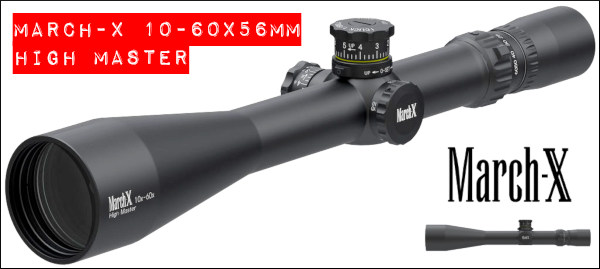
Review of March-X 10-60x56mm High Master Riflescope
By James Mock
This review is about the impressive new March-X 10-60x56mm High Master scope with Super ED lenses. We’ll start with some background. About 15 years ago, I saw Turk Takano at the Super Shoot and he seemed excited about a new rifle scope that he had on his benchrest rifle. It was a March 40x fixed power model that was a prototype. This was the first March to reach the USA. He told me that it was hand assembled in Japan by top optical engineers. When asked if I would like to look through it, I jumped at the opportunity. This scope was breath-taking in its clarity, brightness and quality of image. This scope soon was selling very well in a tough market. Some who made this possible were Turk Takano, the Kelbly family and Lou Murdica. All of these invested time and money into seeing that this new scope was available to American shooters.
I have had the pleasure of testing many high-magnification rifle scopes. Most have been exceptionally well suited to the task for which they were designed. Presently, I shoot 300- and 600-yard competition and the scopes that I favor are second focal plane (SFP) high-powered variables with an MOA-type reticle. Many in the optics industry have been very generous to enable me to test their scopes. Among those who have helped me over the years is Lou Murdica. When March first came to the USA, Lou loaned me his 40X fixed power scope, an exceptional scope for 100/200 yard BR shooting.
March-X 10-60x56mm High Master Scope — Impressive New Optic
I quit shooting short-range benchrest in 2013, but have been shooting 300- and 600-yard benchrest matches since then. It was quite a change for me to shoot a target to which I could not see my bullet holes. With my 78-year-old eyes and the Louisiana atmosphere, I have only been able to see 6mm bullet holes (in good conditions) at 600 yards with two scopes. They were the 15-55x52mm Nightforce Competition and the 12-52x56mm Valdada Terminator. Although I have not had the conditions with which to see small bullet holes at 600, Lou states that he can with this scope on days without mirage.
March introduced the world to ED lenses in rifle scopes and all of their scopes with lenses larger than 24mm have these superb lenses. Most of today’s premium scopes feature ED glass. However, March has now upped the ante and has a “Super ED” lens in certain tier 1 “High Master” scopes. According to March, these scopes produce images approaching the quality of the images produced by PURE fluorite lens.*
After reading some glowing reports about March’s High Master scopes, I contacted Lou Murdica and asked if he had a 10-60x56mm High Master he could loan me for an evaluation. The High Master Lens System has two Super ED lens elements within its lens system. By using Super ED lens elements, March was able to suppress chromatic aberration even more than with ED lenses and thus produce a sharper image with greater contrast, while still having a strong scope. March found a better way with this new objective lens system. High Master scopes also have addressed the problem of focus change with temperature variations.
Lou sent me a 10-60x56mm High Master for evaluation. I received the scope in July, when Louisiana’s weather is VERY hot. Although I tested with considerable mirage, this gives me a chance to test in less than ideal conditions. The scope that I received had a duplex reticle similar to the duplex made famous by Leupold. The section between the heavy lines subtends 3 inches at 25X, or 1.5 inches from the crosshair in the center to the heavy line. The technical data for this scope reveals why it carries a high price tag. Many believe that it is the Super ED lens that causes the high price, but that is only partially the reason. March designed a 56mm objective lens with THREE large segments (two of which are 50mm). These 50mm segments replace some of the 20mm lens others use in the tube body. The lenses used by March have high fluorite content and produce superb images. The lenses are fully multi-coated with the finest coatings for maximum light transmission. Chose either standard or illuminated reticle.
March-X 10-56x56mm High Master Scope Specifications:
34mm main tube, scope body machined from aluminum ingot
56mm front objective
Elevation adjustment range 60 MOA
Windage adjustment range 40 MOA
Length 16.2 inches
Weight 33.1 ounces
Eye Relief 3.98 inches at 10x and slightly less at 60x
Side Focus Parallax range 10 yards to infinity
High Master lens system (Super ED lenses)
Temperature Anti-Drift Lens System
All Japanese metal parts with no plastic part except for minimum essentials such as an insulator.
.243 Ackley Improved for Long-Range Varminting and Benchrest Competition
Whenever Matt Bianchini brings his bright yellow .243 Ackley to the firing line, heads turn. This is one truly handsome rig–as good-looking as it is accurate. Built to smoke varmints at long-range as well as compete in 1000-yard benchrest matches, this rifle is proof that competition improves the breed. Fitted with a Farley action, Jewell trigger, Leupold LRT scope, and Lilja or Krieger barrel, the Yellow Ackley is a “no compromise” match rifle that can run with the big dogs in 1K Benchrest competition. And with the Ackley’s ability to toss 106gr Clinch Rivers at 3350 fps, this is one flat-shooting, hard-hitting varmint rifle.
Ultra-Fast, Ultra-Smooth Farley Action…and One Wicked Paint Job
The heart of Matt’s rifle is a Farley action. Farleys have found favor with Benchrest competitors, because the bolt can be worked so fast. And the Farley is as smooth as it is speedy. The difference is quite noticeable if you compare it to a blue-printed Rem 700, or even a recent Stolle Panda. Farleys were true customs, built one at a time by the Farley family in Oklahoma. Unlike a BAT action which is machined from billet steel, a Farley starts with a stainless investment casting, much like Ruger pistol frames. It uses a cone bolt for smooth, yet solid lock-up.
One of the unique features of the Farley is the ejector–it can be switched on or off, depending on the shooter’s preference. So, if you’re load testing some hot rounds, you can turn the ejector off. In a match you can turn the ejector “on” to function normally. Matt is now a confirmed Farley fanatic. He tells us: “I’ve got quite a few other very nice actions, including Nesikas. But none of them are as slick as that Farley. When you work the bolt it feels like it’s on ball-bearings.”
Matt’s Screamin’ Yellow Ackley–The Need for Speed
.243 Ackley Improved Speed Demon
In a long-range varmint rifle, speed kills. Ultra-high velocities will deliver flatter trajectories and more explosive hits on critters. That’s where the .243 Ackley Improved really shines.
Matt has explored the upper limits of .243 Ackley Improved (AI) performance with his yellow long-range rig, fitted with a 29″ Lilja 3-groove, 1:8″-twist barrel. Using a stout load of Alliant Reloder 25, Matt’s “Screamin’ Yellow Ackley” has topped 3340 fps with Clinch River 106s. That’s serious speed for heavy 6mm bullets. This shows a well-built .243 AI leaves Dashers and 6XCs in the dust when it comes to pure velocity.
Ultimate Evolution of the .243 Winchester
Matt’s show-stopping rifle is a .243 Ackley Improved (40-degree shoulder, .271″ neck), chambered with a Manson reamer. On top of the stainless Farley “S” action, in Farley 30mm rings, sits a Leupold LRT (1/16 MOA dot) boosted to 18X-40X by Premier Reticles. Matt has SIX barrels for the gun, three Lilja 3-grooves, a couple Kriegers, and a Shilen.
Matt’s gun currently sports an 8-twist 29″ Lilja 3-groove HV taper that Matt says cleans up like a dream. The stock is a Shehane ST-1000 Tracker made in fiberglass by McMillan, with a BAT trigger guard and Shehane polished billet aluminum buttplate. Prior to final finishing, Matt worked over the flats and some of the angles. That’s why the facets are so well-defined on this rifle compared to some ‘glass Trackers you may have seen. The gun was chambered by Dave Bruno of Cheswick, PA.
Matt bedded the stock and applied the stunning Sikken “Viper” yellow paint job himself. That flawless, smooth-as-glass Screamin’ Yellow finish is no ordinary paint-job, but then Matt Bianchini is no ordinary do-it-yourself painter. His family runs an automotive body-shop, so he had access to premium paints and a quarter-million-dollar spray booth with all the latest technology. Still, Matt spent many hours on this stock to get everything right, trying a couple colors before he settled on a Sikken automotive “Viper Race Yellow” formulated for the Dodge Viper sports car. After careful prep work, Matt sprayed two coats of Viper Yellow, and then added three coats of high-grade automotive clear, which was then baked-on in a heat chamber. Matt also painted the Sinclair front rest to match the stock, and even polished the surfaces of the Hoehn windage top. A lot of effort, Matt told us, was required to achieve the results you see here.
3300 fps for 1000 Yards
Though Matt’s Ackley has harvested its share of varmints, the gun was built with 1000-yard benchrest competition in mind. At left is the firing line at Thunder Valley, Ohio. Yep those targets (upper right) are 1000 yards away. Now you know why Matt has a 40-power scope.
The Yellow Ackley weighs just under 17 pounds to meet IBS and NBRSA “Light Gun” weight limits. While Matt says his bullets don’t “go to sleep” for a couple hundred yards, this gun can still shoot 1/4″ groups at 100 yards and hold that accuracy much, much farther. Matt reports, “my best-ever group was five shots in .397″ at 400 yards. Yep, I got lucky with the conditions, but this is a very accurate rifle.”
.243 Ackley Improved–More Velocity, Less Case Stretch
by Bob Blaine, Sinclair International
Parker Ackley reluctantly developed the .243 Ackley Improved (“AI”). Ackley finally gave in to his customers’ requests to develop the .243 AI. He had always felt that the .243 Winchester was already an improved configuration, but he did say that the best thing to be gained by improving the .243 Winchester was to substantially reduce the case-stretching problems. The .243 Winchester parent case has always stretched brass, almost as bad as the Swift. Even though you get more velocity with the improved .243, I’ve also found that the improved version gives a bit more throat life than the parent case does.
The .243 AI delivers more velocity by virtue of enhanced case capacity–roughly five grains more H20 capacity than a standard .243 Winchester. The .243 AI has a water capacity of approximately 57 to 58 grains, compared to 52-53 grains for the standard .243 Winchester.
Loading for Long-Range
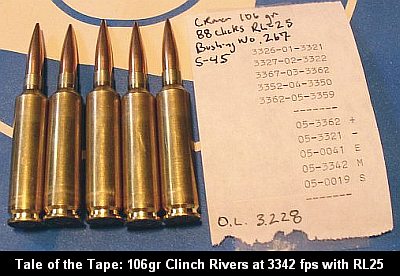
For long-range shooting, Matt loads 106gr Clinch Rivers with 47.5gr of Alliant Reloder 25 for his Krieger barrels, a little more powder with the Lilja 3-grooves. The Lilja load runs 3342 fps, with a 3.228″ OAL. Cases are neck-turned Lapua .243 Winchester. He uses Wilson inline seater and Wilson eck-sizer dies (.267″ bushing), and a custom, reamer-cut FL sizing die.
Not Just for BR, This Gun Can Hunt
While Matt has a big stable of varmint rifles, the Yellow Ackley has seen plenty of duty in the ‘Hog fields. Matt is from a farming family and he can shoot practically right out his back door (see top photo at the farm). He has nailed some big ground-hogs at 800 yards and beyond. The .243 AI does kick a bit compared to other varmint cartridges, but even with 105-106gr bullets, it’s not bad. He has considered adding a muzzle brake at some point to one of the barrels, just so he can see impacts better.
Screamin’ Yellow Dasher?
Matt originally thought of building the gun up as a 6BR or a 6BR Improved. He has a Manson reamer similar to a 6mm Dasher, with a 40-degree shoulder and .008″ body taper. He actually chambered a couple barrels with that 6BR Improved reamer, but he hasn’t shot them yet. He was so pleased with how the gun performed in .243 AI, that he saw no reason to change. And it may be a while before he slaps a Dasher-chambered barrel on the rig: “I really like the way it shoots as a .243 AI. I’m so impressed with it that I don’t want to mess with anything. And I don’t think I’ll be running out of Ackley barrels anytime soon.”
Since the .243 Win is such a popular cartridge, all the major die-makers offer reloading dies. It’s hard to go wrong with a Redding Type ‘S’ Full-length bushing die–item 77114 for the standard .243 Win and item 77420 for .243 AI. Whidden Gunworks also makes great .243 Win sizing dies (and custom .243 Win AI dies on request). These will both resize the case (and bump the shoulder) as necessary, and allow you to adjust neck tension with bushings. Alternatively, you can go with a body die, and a separate neck bushing die.
If you load primarily one brand of bullets, another slick set-up is to buy a Forster or Whidden full-length, non-bushing .243 Win sizing die, and then have Forster or Whidden hone the neck for your desired amount of tension. This elegant one-pass sizing solution produces very straight rounds with low run-out.
For bullet seating, both the Redding Competition Seater (item 55114) and the Forster Ultra-Seater (item U00034) work great for the standard .243 Win case. If you shoot a .243 Ackley, Redding’s .243 AI Comp Seater (item 55420) costs quite a bit more than the standard version Forster doesn’t list a .243 AI seater in their catalog. However, you can just run your chambering reamer into the inner sleeve of either seating die to fit the .243 Ackley Improved case.
If you want the “Cadillac” of production seater dies for the .243 Win, order the Wilson Stainless Micrometer seater (item 50-1114S) from Sinclair International. Costing only a few dollars more than a Redding Comp seater, this die is a joy to use, providing very positive control over bullet seating depth. When used with a quality arbor press, the Wilson offers unrivaled “feel” for bullet-seating force. This can help you monitor neck tension, one of the most critical factors in maintaining low ES and SD for long-range accuracy.




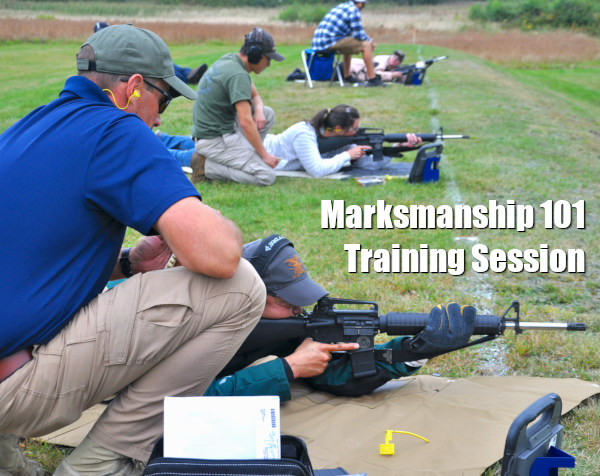


 As soon as aiming at the target begins, the index finger must move from the trigger-guard to contact the trigger. It is important to get initial pressure on the trigger as soon as aiming begins. Then the shooter must focus on the sight picture and centering the sight picture movements over the aiming point. No one, not even champion shooters, can hold the aligned sights perfectly still. The sights are going to move a little bit or a lot, depending on the shooter’s skill level. The secret is to center those sight picture movements over the aiming point on the target (see trace illustration) before pulling the trigger.




 Train Wrecks (and How to Avoid Them)
 4. Wind Issues. Tricky winds derail many trains. A lot can be written about wind strategies, but here’s a simple tip about how to take the edge off a worse case scenario. You don’t have to start blazing away on the command of “Commence fire”. If the wind is blowing like a bastard when your time starts, just wait! You’re allotted 30 minutes to fire your string in long range slow fire. With average pit service, it might take you 10 minutes if you hustle, less in F-Class. Point being, you have about three times longer than you need. So let everyone else shoot through the storm and look for a window (or windows) of time which are not so adverse. Of course this is a risk, conditions might get worse if you wait. This is where judgment comes in. Just know you have options for managing time and keep an eye on the clock. Saving rounds in a slow fire match is a costly and embarrassing train wreck.




 Ultimate Evolution of the .243 Winchester


 If you load primarily one brand of bullets, another slick set-up is to buy a Forster or Whidden full-length, non-bushing .243 Win sizing die, and then have Forster or Whidden hone the neck for your desired amount of tension. This elegant one-pass sizing solution produces very straight rounds with low run-out.


