Shooting steel targets is fun — both at close-range with pistols and rimfire, and at long range with centerfire rifles. If you’ve been thinking of getting some steel targets, here’s a great SAVINGS opportunity. Right now, as a June 2022 Pre-Father’s Day Deal, Action Target is offering a full 20% off ALL Steel Targets. That’s a great promo from one of the most respected metal target-makers on the planet.
IMPORTANT — Though this is listed as a Father’s Day SALE, the discount is only valid for TWO DAYS — June 1st and 2nd, 2022. So don’t hesitate. Use discount code FATHERS2022 during checkout on the ActionTarget.com website.
Action Target posted: “Father’s Day is just around the corner, and we know Dads want steel shooting targets. So from June 1st-2nd, use coupon code FATHERS2022 and save 20% on all steel targets.”
If you shoot pistols, or rimfire rifle, this Dueling tree is a ton of fun. Shoot solo or two shooters can enjoy challenge matches on this PT Dueling Tree. With the 20% Off code you can save $93.20 off the regular $466.00 price. There are many other great steel targets, such as the rimfire plate rack or the full Steel Challenge Kit.
An notable era in modern benchrest history is ending. The last Benchrest Super Shoot at the Kelbly’s Range has concluded. Held May 24-27, 2022, this was the “final showdown” of the world’s group-shooting benchrest aces at the Kelbly’s range facility in Ohio. The overall 2022 Super Shoot Champion, with best combined 100 and 200-yard group-size Two Gun Aggregates (Aggs), was Jeff Summers. Gun writer James Mock noted: “The master of the Super Shoot, Jeff Summers, did it again. He fought the tough conditions and came out on top of the 200+ shooters at the final Kelbly-held Super Shoot. [That is] four times that Jeff has finished first. This shows that good guys can do well. Second place went to Ohioan Don Powell.” Summers finished with a 0.2513 Agg. Shown below are the combined 100/200 Two Gun Aggs for the top 21 finishers. SEE Forum Thread.
Over 200 competitors shot at the XLVIII Super Shoot event, considered the “Superbowl of Short-Range Benchrest”. The vast majority of competitors were shooting the 6 PPC cartridge with 6mm bullets under 70 grains. Another Super Shoot-type event may be held in the future in Texas, but this was the last event to be held at the impressive Kelbly’s Range in North Lawrence, Ohio.
This major event, held annually for many years, attracted hundreds of the world’s top short-range benchrest-for-group shooters. Over the years, at the Super Shoot, you would find the world’s best benchrest shooters on the long firing line, including Hall of Fame legends like Tony Boyer, Wayne Campbell, Lester Bruno, Alan Euber and other talented PPC pilots.
Conditions this year were sometimes tough, with brisk winds and rain. Here is a video from Forum member Jay Wallace, captured on Thursday May 26th. You can see the raindrops falling:
Rain Falls at 2022 Super Shoot at Kelbly’s Range in Ohio:
This year’s Super Shoot winner, Jeff Summers, was featured in the Daily Bulletin in 2012, when Jeff won the 40th Annual Super Shoot a decade ago. That article mentioned that Summers used a bag squeezing technique at that time. This shows that while many competitors use expensive joystick rests, bag squeezing (to aim the rifle) can still achieve great results. This shows that one can still be very competitive without having the most sophisticated rest or expensive new toys.
Super Shoot — What It’s All About
The excitement and anticipation leading up to a Super Shoot can be hard to explain to those who haven’t been to one. Every year, some shooters arrive at the Super Shoot a week early to dial in their rifles, learn wind conditions for the range, and enjoy the camaraderie of their fellow shooters. As the match draws closer, campers and RVs fill the area behind the range, and shooters stake out turf all over the property with their reloading and cleaning equipment setups.
Many shooters choose to load cartridges in the main barn directly behind the 60-bench firing line, while others decide to work in pop-ups, campers and other outbuildings around the facility. Benchrest shooters tend to load in small batches, and some most load cartridges between each match. Many shooters clean their rifles after each match, while others sometimes go two or three matches between cleanings, depending on the number of rounds they fire.
Another part of high-level benchrest competition that will amaze first-time attendees is the quality and amount of equipment benchrest shooters use. Just in front of the shooting benches and the targets, range flags of all kinds sprout up, from the typical “daisy wheel” flags to very sophisticated velocity indicators that show varying wind intensity. Shooters adjust their flags to align with the particular target in front of a specific bench, just slightly below the path of the bullet but still partially visible in the high-powered scopes.
The rifles represent a variety of actions, usually custom, with heavy benchrest barrels by various barrel makers. The most popular cartridge used is the 6mm PPC, but occasionally you will run into someone using a Grendel necked to 6mm or 6mmBR-based case. Rifle rests used are typically heavy tripods or plate rests. You see a lot of Sinclair rests, Farley rests, SEB Rests, and a variety of others, including a few homemade rests. Bags are typically Edgewood, Protektor, and now some Lenzis.
Super Shoot — Runners, Pickers and the Pursuit of Perfection
The techniques vary between shooters, and they are interesting to observe. Some shooters “run” their targets and will shoot a quick sighter and then run all 5 shots as fast as they can before conditions change. Others are “pickers” and shoot each shot carefully, going back and forth between the record target and the sighter target to verify wind conditions and bullet drift. These guys will sometimes shoot up to 10 sighters and use the full seven minutes. Both styles of shooting work and many shooters use both techniques depending on the match conditions[.]
Coalinga Range in California. At dawn we could clearly see 7mm and .30 Cal bullet holes at 1000 yards.
While attending the CA Long Range Championship a few seasons back, we had the opportunity to test the performance of a high-magnification (63X) spotting scope in near-ideal conditions (maybe the best I’ve ever witnessed). On the event’s last day we arrived at 5:45 am, literally as the sun was cresting the horizon. I quickly deployed our Pentax PF-100ED spotting scope, fitted with a Pentax SMC-XW 10mm fixed-power eyepiece. When used with the 100mm Pentax scope, this 10mm eyepiece yields 63X magnification. Befitting its $299.00 price, this eyepiece is extremely clear and sharp.
At the crack of dawn, viewing conditions were ideal. No mist, no mirage, no wind. The first thing this Editor noticed was that I could see metal nail heads on the target boards. That was astonishing. As soon as the first practice targets went up, to my surprise, I could see 6.5mm, 7mm, and 30-caliber bullet holes in the white at 1000 yards. No lie…
That’s right, I could see bullet holes at 1000. I know many of you folks may not believe that, but there was no mistaking when I saw a 7mm bullet cut the white line separating the Nine Ring and Eight Ring on the target in view. (I was watching that target as the shot was fired and saw the shot-hole form). And when I looked at the 30-cal targets, the bullet holes in the white were quite visible. In these perfect conditions I could also make out 3/8″ bolt heads on the target frames.
The Human Factor — Good Vision Required
When viewing the bullet holes, I was using my left naked eye (no safety glasses or magnification). I also had a contact lens in my right eye (needed for distance vision). To my surprise, while I could see the bullet holes without much difficulty with my left eye, things were fuzzier and slightly more blurry with the right eye, even when I re-focused the scope. That contact lens was degrading the fine resolution.
Then I invited 3 or 4 shooters to look through the scope. One younger guy, with good eyes, said immediately: “Yeah, I can see the holes — right there at 4 o’clock and seven o’clock. Wow.” Some older guys, who were wearing glasses, could not see the holes at all, no matter what we did to the scope’s main focus and diopter adjustment.
The lesson here — if you have to wear glasses or corrective contact lenses, just that extra bit of optical interference may make a difference in what you can see through the scope. Basically anything that goes between the scope eyepiece and your eyeball can degrade the image somewhat. So… you may be better off removing your glasses if you can still obtain good focus sharpness using the diopter adjustment and focus ring. I did the left vs. right eye test a half dozen times, and I could definitely see small features at 1000 yards with my naked eye that I could not see with my right eye fitted with a contact lens. (I did have to re-focus the scope for each eye, since one had a corrective lens while the other did not.)
Mirage Degrades Image Sharpness and Resolution
The “magic light” prevailed for only an hour or so, and then we started to get some mirage. As soon as the mirage appeared I was no longer able to see raw bullet holes, though I could still easily see black pasters on the black bulls. When the mirage started, the sharpness of the visible image degraded a huge amount. Where I could see bullet holes at dawn, by mid-morning I could barely read the numbers on the scoring rings. Lesson: If you want to test the ultimate resolution of your optics, you need perfect conditions.
Chromatic Aberration Revealed
As the light got brighter and the mirage increased I started to see blue and red fringing at the edges of the spotting disk and the large numerals. This was quite noticeable. On one side of the bright, white spotting disc you could see a dark red edge, while on the other side there was a blue edge (harder to see but still present).
The photo below was taken through the Pentax spotter lens using a point and shoot camera held up to the eyepiece. The sharpness of the Pentax was actually much better than this photo shows, but the through-the-lens image does clearly reveal the red and blue fringing. This fringing is caused by chromatic aberration — the failure of a lens to focus all colors to the same point. Chromatic aberration, most visible at high magnification, causes different wavelengths of light to have differing focal lengths (see diagram). Chromatic aberration manifests itself as “fringes” of color along boundaries that separate dark and bright parts of the image, because each color in the optical spectrum cannot be focused at a single common point on the optical axis. Keep in mind that the Pentax does have “ED” or low-dispersion glass, so the effect would be even more dramatic with a cheaper spotting scope.
If you wonder why top-of-the-line spotting scopes (such as the $2980 Swarovski ATS-80 ) cost so much, the answer is that they will deliver even LESS chromatic aberration at long range and high magnification. With their exotic apochromatic (APO), ultra-low-dispersion glass, a few ultra-high-end spotting scopes can deliver an image without the color edging you see in the photo above.
The Pentax PF-100ED is a heck of a spotting scope. Any scope that can resolve bullet holes at 1000 yards is impressive. But if you want the ultimate in optical performance, with minimal chromatic aberration, you may need to step up to something like the 88mm Kowa Prominar TSN-884 with Flourite Crystal lenses ($2450.00 body only), or the 82mm Leica APO ($3899.00 with 25-50X eyepiece).
EDITOR’s NOTE: The purpose of this report is to show what is possible… in IDEAL conditions. With this Pentax 100mm, as well as a Swarovski 80mm, we can often resolve 6mm bullet holes at 600 yards. But again, that performance requires really good viewing conditions. By 10:00 am at my range, even with the 100mm Pentax at 75 power, seeing 6mm bullet holes is “iffy” at best. So don’t go out and mortgage the house to buy a $4000 optic with the hope that you’ll be able to spot your shots at 1000 yards. If conditions are anything less than perfect, you’ll be lucky to see bullet holes at 500 yards. The real solution for very long-range spotting is to set up a remote target cam that broadcasts a video picture to a screen at your shooting station. Among the target cams on the market, we recommend the LongShot LR-3. It boasts excellent resolution and incredible range. The LongShot LR-3 target cam is used in major ELR competitions.
After a one-year hiatus, the United States Practical Shooting Association’s Multi-Gun Nationals event is back at new South Carolina venue — the Clinton House Plantation, which features shooting bays and an impressive 2000-acre hunting preserve. The USPSA Multi-Gun Nationals ran April 1-3, 2022.
Multi-gun competition is tough. Competitors must master pistol, rifle, and shotgun –three platforms, three calibers. Along with having great marksmanship skills, competitors must be very fit — the matches involve a significant amount of running. It’s all part of the challenge at the USPSA’s Multi-Gun Nationals.
If you are a fan of 3-Gun competition, tune in to Shooting USA this week. The latest episode, which airs Wednesday May 25 at 9:00 pm Eastern, 8:00 PM Central, features the 2022 USPSA Multi-Gun Nationals in South Carolina. You can see many of the nation’s top 3-Gun shooters attacking challenging stages with pistols, rifles, and shotguns. CLICK HERE for TV Schedule.
Multi-gun competition has evolved considerably since it started 30+ years ago. The firearms are more sophisticated, the optics are better, and the stage times are much faster. Still, the challenge remains the same: How fast can you shoot multiple targets, with the score determined by speed and accuracy? For the best in the sport, the answer is very fast indeed.
Joe Farwell hosts highlights from 2022 USPSA Multi-Gun Nationals.
Most people compete in the Tactical Division. Competitors in that division are not allowed a bipod, so many competitors utilize structures on the stage to stabilize their long gun. Regardless of division, the USPSA Multi-Gun Nationals is a true test of manipulating three different weapons, under pressure, on run-and-gun courses of fire. And the pressure is definitely on when a National Championship is on the line.
SHOOTING USA TV Air Times
View Shooting USA on the Outdoor Channel Wednesdays 9:00 PM (Eastern and Pacific) + 8:00 PM Central.
NOTE: If you miss today’s 5/25/22 broadcast, you can still view the show on Vimeo for a small 99-cent fee, or just $1.99 per month unlimited. LINK HERE: Shooting USA on Vimeo.
Shooting USA is available On Demand via Vimeo.com. Watch a single episode for $0.99, or get a full-month subscription for $1.99 and watch as many shows as you like with limited commercial interruptions.
Here’s a really impressive feat of marksmanship and rifle accuracy. Starting with a cold bore, i.e. no sighters and no warm-up shots right before the string, Curtis Roman made 3 hits in a row at 1.404 MILES (2472 yards). The hits were on a steel target 3-foot square (36″x36″). To put things in perspective, one MOA at 2472 yards spans 25.88 inches. Looking at the target, his three shots were very close to 1 MOA.
Sterling Precision and Applied Ballistics shooter Curtis Roman set a new FCSA Extreme Long Range (ELR) Cold Bore Record on Sunday, May 22, 2022, at the Spring Canyon ELR Match at the NRA Whittington Center in Raton, NM. At this match, Curtis was able to make 3 consecutive impacts at 2472 yards, starting with a cold bore. This feat was witnessed by fellow competitors. Through his spotting and wind-reading skills, Roman’s teammate David Lindsey played a key role in setting this new Cold Bore ELR World Record.
Curtis was shooting a Sterling Precision-built .416 Stroker with 500 grain Cutting Edge Lazer bullets. The ballistics solution for the 2472-yard distance was calculated by a Kestrel 5700X with Applied Ballistics using Doppler radar data.
This video shows Curtis Roman at the 2021 KO2M event at the Whittington Center last year:
Rules of Extreme Long Range Competition There are various rule sets for different ELR events at different venues. However the Extreme Long Range Shooting Organization (ELRSO) has created a set of standardized rules with the goal of running ELR matches under uniform guidelines. Here are some highlights of the ELRSO Rules for Extreme Long Range Competition:
Any caliber of rifle up to and including .50 CAL can be shot at any ELRSO Unlimited event. Eligible rifles must be .50 caliber or smaller.
Rifle, as ready to fire with all equipment attached, may not exceed (50 lbs. Heavy) or (25 lbs. Light), scales will be required at each match to verify weight compliance.
Attached Bipods for the front rest, and rear bag or pad for rear support will be the only rest systems permitted. No mechanical rests, mono-pods are allowed.
Bipod must be rigid and may only have two points of contact with the ground and one point of attachment to the rifle. Distance between feet may not exceed 20 inches.
Weight of all equipment must be brought to firing line in a single trip. No additional weight may be added to the rifle [after] weigh-in.
No electronic data gathering equipment, flags or wind data references permitted forward of the firing line.
No electronic communication will be permitted between the shooter, or spotter, and any other person.
Range Distance Requirements Light Class – Minimum distance for initial target will be no less than 1,000 yards. Maximum distance for final target will be no more than 1,800 yards. Range must be capable of extending to 1,800 yards to host an ELRSO Limited Class match.
Heavy Class – Minimum distance for initial target will be no less than 1,400 yards. Maximum distance for final target will be no less than 2,600 yards, and no more than 3,600 yards. Range must be capable of extending to a minimum of 2,600 yards to host an ELRSO Unlimited Class match.
Do you own a Ruger 10/22? Here’s a new product you may want to acquire. Luth-AR’s new Modular Chassis Assembly (MCA) offers adjustability and features that can transform a 10/22 into a much more effective rifle for rimfire gun games. Priced at just $189.95, the new MCA-22 modular chassis is great for NRL22 competition, Tactical 22 matches, Steel Challenge, Practical Rimfire Challenge matches, as well as casual plinking.
The new MCA-22 Rimfire Chassis is compatible with the original Ruger 10/22 barreled action as well as 10/22 clone actions such as the PRP Rubicon.
A well-known seller of AR parts and accessories, Luth-AR now offers the MCA-22 Modular Chassis Assembly for 10/22-style rimfire barreled actions. The MCA-22 was developed by Roth Performance in conjunction with Luth-AR.
The MCA-22 Rimfire Chassis provides improved ergonomics and adjustability along with M-LOK mounting options. This can make your 10/22 more effective for rimfire competition shooting and general recreation use. The Ruger 10/22 (or similar) receiver, trigger group, and barrel can be easily installed in the MCA-22 chassis, which accepts standard or bull barrels with the use of an insert.
MCA™-22 features:
— Easy to install, light weight chassis and cost effective.
— Constructed with high-strength glass filled nylon, 6061 aluminum and steel.
— Designed for comfort and ergonomic control for wide range of body types.
— Ambidextrous goose-neck style pistol grip with palm swell.
— Aggressive grip panel and front grip strap texturing.
— Click-adjustable cheek piece.
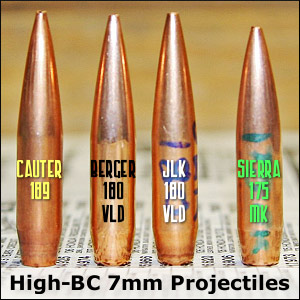
7mm (.284) remains the caliber to beat in F-Class Open Division (though some shooters have had success with .30-Cal short magnums.) With a standard .284 Winchester, or better yet, a .284 Improved, you can drive the high-BC Berger 180gr and 184gr bullets to competitive velocities.
The straight .284 Win is an excellent cartridge, quite capable of winning F-class matches. However, in most barrels, it can’t push the 180s at 2900-2950 fps velocity levels*. A lot of barrels will top out at about 2850 fps. That’s where the .284 Shehane comes into play.
The .284 Shehane is a slightly modified wildcat that retains the same 35° shoulder as the parent case. However, by blowing the sidewalls out 0.010″, the .284 Shehane picks up about 3.3 grains of extra case capacity. That enhancement makes a BIG difference. The extra boiler room is enough to drive the 180s at 2900-2950 fps with 30-32″ barrels using H4831sc, Vihtavuori N560, or Alliant Reloder 16. (That’s with a reasonably fast barrel. Some barrels are faster than others.)
Norm Harrold Won 2018 F-Class Open Division Nationals with .284 Shehane Rifle
Norm Harrold (above) won the 2018 USA F-Class Nationals shooting a .284 Shehane. Norm’s F-Open rig features a McMillan Kestros ZR stock and Bartlein barrel chambered for the .284 Shehane, which has a bit more case capacity than a standard .284 Winchester. Norm loaded Berger 184gr 7mm bullets in Lapua brass. Norm revealed his load in an Erik Cortina YouTube Video.
F-Class shooter Erik Cortina notes that the .284 Shehane has a velocity edge over the straight .284 Win because it holds more powder: “The Shehane has more capacity than the .284 Winchester. Ryan is using 54.0 grains simply as a fire-forming load. Typical load for a Shehane is around 57.0 grains of Hodgdon H4831 SC.” By blowing the sidewalls out 0.010″, the .284 Shehane picks up about 3.3 grains of extra case capacity. That enhancement makes a BIG difference. The extra boiler room is enough to drive the 180s at 2900-2950 fps with H4831sc, with long barrels.
Forum member Jim Hardy has shot the .284 with great success. He tells us: “In my humble opinion, the .284 Shehane is the best balanced long-range round there is — bar none. Here is why:
You have to shoot a 30 Cal Magnum with a 240gr bullet to equal the performance of most 7mm chamberings with the 180 Berger VLD. With the .284 Shehane, you have a .308 bolt face, medium action, and Lapua brass. You use less powder than the 7 mags, and have great accuracy and ballistics even while fire-forming. The .284 Shehane shoots inside the 6.5 AND the straight .284, the .300 WSM, and the .300 Win Mag with less recoil. What is not to love about the 284 Shehane? It is a no-brainer for long range — F-Class or Prone or 1000-yard Benchrest.”
Amazing Accuracy When Fire-Forming .284 Shehane
If you look at that 5-round group you might think it was shot with a 6 PPC or maybe a 6mmBR. But no, this was done with heavy 180gr Berger Hybrid bullets and the .284 Shehane. In fact, this impressive sub-quarter MOA group was shot while fire-forming with a very well-worn barrel! Gun builder Ryan Pierce of Piercision Rifles explains: “Here’s a 5-shot 0.191″ group at 100 yards with my .284 Shehane fireforming loads. This barrel has 2200 rounds through it. It had 2000 as a straight .284 Win and then I set it back to .284 Shehane to form brass with. [The load was] 180 Hybrids with 54.0 grains of H4831 SC.”
Scotland’s Grant Taylor. who used the .284 Shehane to finish third at the 2009 F-Class Worlds in England says the .284 Shehane is “very accurate with superb vertical spreads at 1000 yards. [This] caliber… has awesome accuracy. I’m getting 2930-2950 fps with spreads in the 3-5 fps range. I use Hodgdon H4831sc powder, CCI BR2 primers, and pointed 180gr Bergers.”
.284 Shehane Showcase — Two Special F-Open Rifles
Jason Cohen’s “We the People” patriotic .284 Shehane F-Class rifle. This rig scored second place in its very first match, a 3×20 at 1000 yards in Wyoming.
Here’s another handsome .284 Shehane F-Open rifle. Owner Jason Cohen explained why he chose the .284 Shehane chambering: “The .284 Shehane has a proven record of accomplishments and that is why I have chosen it. I use Lapua brass (6.5-284 necked-up), CCI BR-2 primers, Hodgdon H4350 powder, and Berger 184gr bullets. All these components have been a successful combination that has worked flawlessly[.]”
The barrel is a Blake Machine 1:8″-twist finished at 32 inches. It was fitted to my action by Dale Woolum of Woolum Accuracy. Dale also threaded the barrel for a Woolum Accuracy tuner. This has proven to be a valuable tool in my load development.
The rifle began its life as a Will McClosky Cerus stock. This was sent that to Bryan Blake at Blake Machine. Jason noticed that Bryan had been adding aluminum rails to the front of Cerus stocks to lower the center of gravity and improve tracking. Jason asked Bryan to fit the stock with forearm rails, shown in the photo below. Bryan did all the stock work and fitted the action, rails, and RAD recoil pad.
The .284 Shehane — Accurate and Forgiving Wildcat
Jason explains why he selected the .284 Shehane chambering: “The .284 Shehane is amazing, very forgiving and not temperamental. Straight .284 or Shehane — you cannot go wrong. I run a 184gr Berger at about 2850 FPS and get great brass life in my other rifles. I usually start to consider tossing the brass around 15 firings. Primer pockets start to get a little looser and the brass seems to need more sizing than the newer brass with less firings.”
.284 Shehane Load Development
Load development for me starts with each new barrel. I screw on the new barrel, fire 25 rounds of whatever I have left over and then clean it. I push out to 600 yards and do a ladder test in round-robin format. I start 0.6 grains lower than my last charge that worked. I work up from that reduced charge weight in increments of 0.3 grains. The paper tells the rest of the story. Once I get something that works well at 600 yards I go back in work around that by 0.1 grains. After that I play a little with seating depth and look for a change. I will occasionally mess with the tuner and tighten things up if possible.
.284 Shehane Raffle Prize Rifle for Team USA
This stunning .284 Shehane rifle was constructed as a raffle prize to benefit Team USA members preparing for the F-Class World Championship. This eye-catching F-Open rifle was crafted by Blake Barrel and Rifle in Arizona. This prize rifle features all top-of-the-line components: Borden BRMXD Action, Cerus multi-laminate stock with forearm extension, R.A.D. recoil reduction system (hydraulic-damped buttpad), Bix ‘N Andy trigger, and Nightforce Competition scope. The stainless Blake barrel is chambered for the .284 Shehane wildcat, and sports an F-Class Products tuner on the end.
.284 Shehane Also Shines in 1K Benchrest Competition
The .284 Shehane has won in Benchrest as well as F-Class competition. In 2013, Henry Pasquet won the IBS 1000-Yard Nationals shooting a .284 Shehane. Henry’s Championship-winning rig is shown below. Note the 5″-wide fore-end which is not legal for F-Class. Henry also runs a combo tuner/muzzle-brake.
*Some exceptional barrels chambered in straight .284 Win can reach 2900 fps with the 180s. Ryan Pierce has a 32″ Brux barrel that is delivering 2900 fps with the straight .284. However, Ryan acknowledges that his velocities are not typical: “A lot of .284 Win barrels top out at around 2850 fps with the 180s”.
Ready to learn more about marksmanship? This summer, the CMP will offer a wide selection of training programs at the National Matches at Camp Perry. CMP training courses serve all levels of shooters, with personalized instruction for all. During this year’s National Matches, there will be an array of educational courses taught by experts, including USAMU team personnel and coaches. Courses span from junior to advanced, delivering a little something for everyone.
Participants in CMP National Matches clinics receive one-on-one instruction. Here is a quick guide (ranked from Advanced to Beginner) for scheduled learning events at the 2022 Camp Perry National Matches, which run July 12 through August 13, 2022.
ADVANCED – Team CMP Advanced Highpower Clinic:
Led by members of CMP Gold (CMP’s own competitive Highpower squad), the Advanced Highpower Clinic offers more complex instruction in service rifle competition techniques using classroom and range discussion. Though the class traditionally utilizes only dry-fire training on the range, in 2021, a 600-yard live-fire portion was added. This course is only open to those who have attended the Advanced Small Arms Firing School at least once and have an “Expert” classification with the CMP or National Rifle Association.
The Advanced High Power Clinic, led by Team CMP members including Bob Gil (above), provides advanced training on wind reading, mental management and more.
INTERMEDIATE/ADVANCED – Junior Smallbore and Air Rifle Camp:
The camp is open to intermediate and advanced junior athletes who shoot both three-position smallbore and standing or international air rifle. Instruction is held on CMP’s outdoor Petrarca Range and within the Gary Anderson CMP Competition Center indoor air range, both located on the grounds of Camp Perry. Participants must be between the ages of 12 to 20 and currently involved in three-position smallbore competition matches and international air rifle. Camp will cover safety and a reinforced understanding of the fundamentals, among several other points of interest. Those juniors hoping to move their marksmanship careers on to college are encouraged to sign up for this valuable course.
INTERMEDIATE – U.S. Marine Corps Junior Highpower Clinic:
The three-day clinic gives focus to more advanced training outside of fundamentals, including weather conditions, how to read wind, equipment use, shooting positions and rulebook standards. Juniors in the clinic spend one day in the classroom, followed by two days of live-fire on the range at 200, 300 and 600 yards. Those young athletes who would like to attend this clinic must first attend the Rifle Small Arms Firing School.
BEGINNER – Small Arms Firing Schools (SAFS):
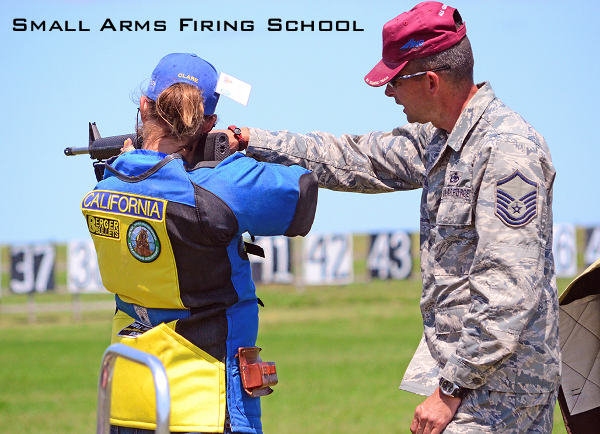
One of the most popular events of the National Matches, the SAFS course is a combination of classroom education and hands-on instruction on fundamentals, competition basics and safety. Training is led by members of military marksmanship teams as well as certified CMP instructors. At the conclusion of the course, students fire real competitions on the range, with instructors nearby. Equipment is provided by the CMP, with participants only needing a willingness to learn in order to attend. Currently, the CMP offers Small Arms Firing Schools for Pistol (M9), Smallbore Rifle, .22 caliber Rimfire Sporter Rifle and Highpower Rifle (M16) during the National Matches as well as an Advanced SAFS course for further training.
BEGINNER — As-Issued Military Rifle Clinics:
Any CMP Games competitors who have not previously fired in one of these matches are required to attend a clinic before they fire. All other competitors in these matches are encouraged to attend as well. These free one-hour clinics will cover the Garand-Springfield-Vintage Matches with instruction and demonstrations. Topics include match rules, shooting positions and techniques, scoring and pit pulling procedures and how to fire the courses of fire. The clinic is open to all competitors. More experienced juniors may attend the USMC clinic, taught by current marksmanship professionals.
BEGINNER — M1 Maintenance Clinic:
CMP Armorers will present this two-hour clinic on disassembly, assembly and maintenance of the M1 Garand Rifle. Special attention will be given to accurizing steps that can be taken with the rifle while maintaining its legality for CMP-sanctioned As-Issued Military Rifle Matches. Topics such as head space, barrel installation, component purpose/function, general rifle assembly, rifle/component maintenance and various other techniques will be covered during the course.
Fans of PRS/NRL competition should watch Shooting USA today March 16, 2022. This action-packed episode features the 2021 Armageddon Gear (AG) Cup Invitational, a major PRS event with $75,000 in cash prize awards. The show airs today, Wednesday 5/18/22 at 9:00 PM Eastern/Pacific (8:00 PM Central) on the Outdoor Channel. You can also stream the show anytime on Vimeo for $0.99.
$75,000 in cash prizes makes the AG Cup the biggest cash money match in Precision Rifle Competition. It’s an elimination format shot over three days of challenging stages of fire at K & M Precision’s ranges in West Tennessee. In this episode, match organizer Tom Fuller joins John Scoutten to narrate the action and the award of the cash in extended coverage of the match. The 2020 AG Cup showcased an all-star line-up of tactical talent with the nation’s top PRS/NRL marksmen invited to the three-day match in TN.
Highlights of 2020 Armageddon Gear Cup Tactical Match:
Armageddon Gear Founder Tom Fuller competes in PRS and supervised the latest AG Cup.
SHOOTING USA TV Air Times
View Shooting USA on the Outdoor Channel Wednesdays 9:00 PM (Eastern and Pacific) + 8:00 PM Central.
NOTE: If you miss today’s 5/18/22 broadcast, you can still view the show on Vimeo for a small 99-cent fee, or just $1.99 per month unlimited. LINK HERE: Shooting USA on Vimeo.
Shooting USA is available On Demand via Vimeo.com. Watch a single episode for $0.99, or get a full-month subscription for $1.99 and watch as many shows as you like with limited commercial interruptions.
Some folks say you haven’t really mastered marksmanship unless you can hit a target when standing tall ‘on your own hind legs’. Of all the shooting positions, standing can be the most challenging because you have no horizontally-solid resting point for your forward arm/elbow. Here 10-time National High Power Champ Carl Bernosky explains how to make the standing shot.
Carl Bernosky is one of the greatest marksmen in history. A multi-time National High Power Champion, Carl has won ten (10) National High Power Championships in his storied shooting career, most recently in 2012. In this article, Carl provides step-by-step strategies to help High Power shooters improve their standing scores. When Carl talks about standing techniques, shooters should listen. Among his peers, Carl is regard as one of the very best standing shooters in the history of High Power shooting. Carl rarely puts pen to paper, but he was kind enough to share his techniques with AccurateShooter.com’s readers.
If you are position shooter, or aspire to be one some day, read this article word for word, and then read it again. We guarantee you’ll learn some techniques (and strategies) that can improve your shooting and boost your scores. This stuff is gold folks, read and learn…
How to Shoot Standing by Carl Bernosky
Shooting consistently good standing stages is a matter of getting rounds down range, with thoughtfully-executed goals. But first, your hold will determine the success you will have.
1. Your hold has to be 10 Ring to shoot 10s. This means that there should be a reasonable amount of time (enough to get a shot off) that your sights are within your best hold. No attention should be paid to the sights when they are not in the middle — that’s wasted energy. My best hold is within 5 seconds after I first look though my sights. I’m ready to shoot the shot at that time. If the gun doesn’t stop, I don’t shoot. I start over.
2. The shot has to be executed with the gun sitting still within your hold. If the gun is moving, it’s most likely moving out, and you’ve missed the best part of your hold.
3. Recognizing that the gun is sitting still and within your hold will initiate you firing the shot. Lots of dry fire or live fire training will help you acquire awareness of the gun sitting still. It’s not subconscious to me, but it’s close.
4. Don’t disturb the gun when you shoot the shot. That being said, I don’t believe in using ball or dummy rounds with the object of being surprised when the shot goes off. I consciously shoot every shot. Sometimes there is a mistake and I over-hold. But the more I train the less of these I get. If I get a dud round my gun will dip.* I don’t believe you can learn to ignore recoil. You must be consistent in your reaction to it.
5. Know your hold and shoot within it. The best part of my hold is about 4 inches. When I get things rolling, I recognize a still gun within my hold and execute the shot. I train to do this every shot. Close 10s are acceptable. Mid-ring 10s are not. If my hold was 8 inches I would train the same way. Shoot the shot when it is still within the hold, and accept the occasional 9. But don’t accept the shots out of the hold.
6. Practice makes perfect. The number of rounds you put down range matter. I shudder to think the amount of rounds I’ve fired standing in my life, and it still takes a month of shooting standing before Perry to be in my comfort zone. That month before Perry I shoot about 2000 rounds standing, 22 shots at a time. It peaks me at just about the right time.
This summarizes what I believe it takes to shoot good standing stages. I hope it provides some insight, understanding, and a roadmap to your own success shooting standing.
— Good Shooting, Carl
* This is very noticeable to me when shooting pistol. I can shoot bullet holes at 25 yards, but if I’ve miscounted the rounds I’ve fired out of my magazine, my pistol will dip noticeably. So do the pistols of the best pistol shooters I’ve watched and shot with. One might call this a “jerk”, I call it “controlled aggressive execution”, executed consistently.


 Action Target posted: “Father’s Day is just around the corner, and we know Dads want steel shooting targets. So from June 1st-2nd, use coupon code FATHERS2022 and save 20% on all steel targets.”


 While attending the CA Long Range Championship a few seasons back, we had the opportunity to test the performance of a high-magnification (63X) spotting scope in near-ideal conditions (maybe the best I’ve ever witnessed). On the event’s last day we arrived at 5:45 am, literally as the sun was cresting the horizon. I quickly deployed our
  Then I invited 3 or 4 shooters to look through the scope. One younger guy, with good eyes, said immediately: “Yeah, I can see the holes — right there at 4 o’clock and seven o’clock. Wow.” Some older guys, who were wearing glasses, could not see the holes at all, no matter what we did to the scope’s main focus and diopter adjustment.
 Chromatic Aberration Revealed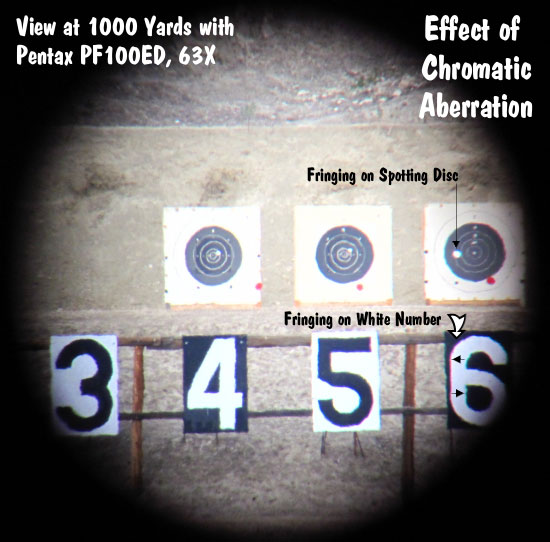




 There are various rule sets for different ELR events at different venues. However the


 7mm (.284) remains the caliber to beat in F-Class Open Division (though some shooters have had success with .30-Cal short magnums.) With a standard .284 Winchester, or better yet, a .284 Improved, you can drive the high-BC Berger 180gr and 184gr bullets to competitive velocities.




 How to Shoot Standing
 5. Know your hold and shoot within it. The best part of my hold is about 4 inches. When I get things rolling, I recognize a still gun within my hold and execute the shot. I train to do this every shot. Close 10s are acceptable. Mid-ring 10s are not. If my hold was 8 inches I would train the same way. Shoot the shot when it is still within the hold, and accept the occasional 9. But don’t accept the shots out of the hold.


