The National Rifle League (NRL) started off sponsoring major centerfire tactical matches, similar to PRS competitions. That proved successful so the NRL added a .22 LR Rimfire series, called NRL22. The NRL22 rimfire discipline has been a major success, as rimfire guns are fun to shoot and ammo is very affordable. The most popular NRL22 matches have drawn up to 200 rimfire competitors. And now there is a companion rimfire long-range series, NRL22X. Learn more about NRL22 and NRL22X at NRL22.org.
NRL22 is a great way to get into competition shooting with minimal expense. There are five (5) classes: Open, Base, Ladies, Young Guns (8-16) and Air Rifle. Base Class is for the budget-minded shooter — the combined MSRP of Rifle and Optic may not exceed $1200.00 (so you could spend $700 on a rifle and $500 on a scope for example). That keeps the sport affordable. Open, Youth, and Ladies Classes have no price limits on Rifle and Optic. Visit NRL22.org to find an NRL22 match near you.
The NRL also sponsors NRL22X matches. These involve significantly longer distances for greater challenge. The latest NRL22X match is the XLR Rimfire Rumble, to be held in Grand Junction, Colorado this Saturday, September 18, 2021.
The two videos above from Long Range Shooters of Utah feature footage from the January 2019 course of fire from the NRL22 Rimfire Competition Series. Note the snow-capped hills in the lower video. Useful commentary explains how competitors establish their shooting positions.
How to Participate in NRL22 and/or NRL22X
If you want to get started in NRL22 or NRL22X competition, you’ll need an NRL22 annual membership. These run from $25-$85 depending on class and discipline. CLICK HERE for annual membership information.
NRL22 Membership Benefits Include:
– Eligibility to participate in all NRL22 matches
– Eligibility to participate in all NRL22X matches
– Welcome gift (not all welcome gifts are the same)
– Scoring and Ranking for all events
– Newsletters and updates
– Eligibility for special NRL22 raffles and giveaways
– Access to special NRL discounts from participating sponsors
NRL22 Publishes Monthly Courses of Fire
This video from a Utah NRL22 Match features shooters from each of the four rimfire classes. With the NRL22 program, scores from from local matches like this are ranked against scores from other matches nationwide. In advance of match dates, NRL22.org publishes 5 courses of fire to be used in that month. Each course of fire will always include 2 prone stages, 1 positional, 1 barricade, and a fifth that can be any of those. Details of the course of fire, including target distances, target sizes, time limits, and barricade profiles, are listed at NRL22.org.
Official NRL22 Rimfire Steel Target Package
To facilitate consistent NRL22 match scoring, there is an official NRL22 Rimfire Steel Target Kit. Crafted by JC Steel Targets from AR500 steel, this kit from JC Steel Targets includes 8 hanging targets, 4 KYL (Know Your Limits) targets, plus all needed hangers. That’s lot of steel and hardware for $394.99. There is also an official 2020/2021 Expansion Target Package with 5 more hanging targets for $79.95.
About NRL22 Tactical/Practical Competition The goal of NRL 22 is to make Precision Rifle competitions more available to every community. However, nearly all localities have access to 100-yard ranges and most shooters own a .22 LR rifle. The NRL22 program is designed so any facility with a 100-yard range can host matches. Participants at local NRL22 events can then attend a National Championship. NRL22 started with four classifications: Open, Base, Ladies, and Young Guns (8-18 age). Air Rifle is the new fifth class. For the 2018/2019 Competition Season, over 700 shooters attended NRL22 matches. In the 2019/2020 Competition Season, the NRL22 expects significant growth and is excited to welcome new members and clubs.
The 2022 NRA National Rifle and Pistol Championships will be held July 15 through August 22, 2022 at Camp Atterbury, Indiana. A provisional calendar for next summer has been released, which we publish below so our readers can start their planning.
The 2022 NRA Rifle and Pistol Championships at Camp Atterbury will start with OTC (Over the Course) High Power Rifle competition. This is unlike 2021 when the Nationals at Atterbury started with Smallbore events. In 2022 the Smallbore cycle runs from July 28 through August 10. Some competitors have lamented that this overlaps with the Long Range Championship (July 20 – August 4), so shooters will have to choose one or the other. The 1-Mile ELR Match returns to the National Matches Calendar after being dropped in 2021.
OTC Events and Championship: 15-21 July, 2022
Precision Pistol Championship: 17-24 July, 2022
Mid-Range Championship: 23-28 July, 2022
Long Range Championship: 30 July – 4 August, 2022
Smallbore Nationals: 28 July – 10 August, 2022
Extreme Long Range 1-Mile Shoot: 5-7 August, 2022
The 2022 NRA High Power Across the Course, Mid-Range, and Long Range Championships will be fired on the ranges of Camp Atterbury. Matches will begin on July 15 and run through August 4. This year the NRA revives the Extreme Long Range Challenge, which will run August 5-7. All registrations are through the NRA Competition Portal.
NOTE: The F-Class Nationals, to our knowledge, will NOT be held at Camp Atterbury in 2022. We’ve been informed that the probable venue will be the Ben Avery Range in Arizona, with probable dates in late October 2022.
The 2021 Rifle Small Arms Firing School helped train over 250 individuals on the range.
This article recognizes the efforts of military men and women who teach others shooting skills and preserve the proud traditions of American marksmanship.
The National Matches at Camp Perry, a staple in the marksmanship world for over 100 years, include many excellent training clinics taught by military teams as well as CMP instructors. The CMP offers an entire lineup of educational courses for those new to the sport and those eager to develop their skills. The types of rifle and pistol courses span from junior to adult, competitive to maintenance and everything in between. Along with classes taught by CMP staffers, other courses are taught by military personnel, including many past and current National Champions and record-holders.
Small Arms Firing School Led by 3-Time Nat’l HP Champion SSG Brandon Green
This year, the Small Arms Firing School was directed by many top-flight marksmen from a number of military teams. The rifle classroom portion was led by the USAMU’s SFC Brandon Green (shown below), a 3-Time National High Power Champion who holds multiple national records including a perfect score in the President’s Rifle event.
Out on the line, world-class shooters such as SSG Amanda Elsenboss and MAJ Samuel Freeman, the 2021 winner of the President’s Rifle Match, brought their knowledge and experience into one-on-one training with participants. Elsenboss is one of America’s greatest shooters. She recently won the 2021 National High Power Championship at Camp Atterbury, after winning the National Long-Range Championship in 2019.
“Having those world-class shooters serve as instructors is an honor and one the students should remember always”, Cooper added.
U.S. Marine Corps Junior Clinic
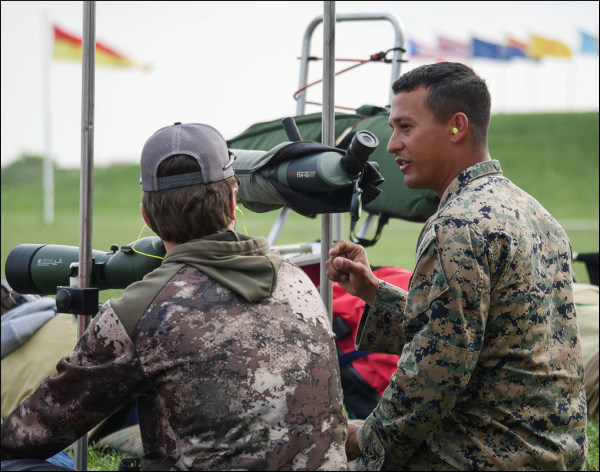
The Marine Corps junior clinic, guided by MAJ Martinez (USMC Shooting Team Officer), is always a big hit with up-and-coming young rifle shooters. CMP Training Manager Steve Cooper noted: “It was great to see so many enthusiastic young people, who revere the Marine Corps Shooting Team, come out and take advantage of the instruction at this year’s clinic.”
The 3-day clinic includes more advanced training beyond fundamentals, including weather conditions, how to read wind, equipment use, shooting positions, and rulebook standards. Juniors in the clinic spend one day in the classroom, followed by two days of live-fire on the range at 200, 300, and 600 yards.
“We talk to them and try to understand them, what they struggle with as individuals and their process,” Cooper said of the USMC’s training technique. “We try to give them tiny, little fixes to what they already have going on.”
GySgt Daniel Rhodes, the staff non-commissioned officer in charge of the Marine Corps Rifle Team, helped lead instruction on the firing line in 2021. Rhodes was pleased with the turnout of around 80 juniors. Rhodes explained that around 25 percent of the juniors in the clinic were first-timers.
Team CMP Advanced High Power Clinic:
Led by members of Team CMP (the organization’s own competitive High Power squad) the Advanced High Power Clinic offers more complex instruction in service rifle competition techniques using classroom and range discussion. Though the class traditionally only utilizes dry-fire training on the range, in 2021, a 600-yard live-fire portion was added.
The Advanced High Power Clinic, led by Team CMP members including Bob Gil (above), provides advanced training on wind reading, mental management and more.
With 65 individuals signed up, the course was broken into groups headed by Sara Rozanski, James Fox, Nick Till, Danny Arnold, Robert Taylor and Bob Gil — all experienced and award-winning marksmen. Each focused on a specific area, such as wind reading, mental management and positioning.
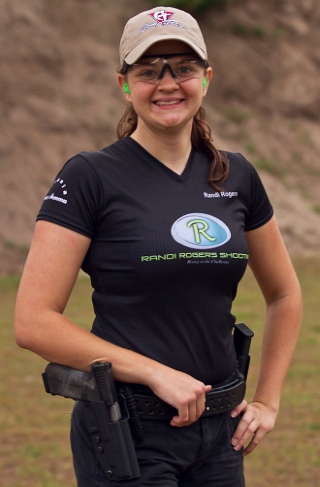
Randi Rogers is one of best female action shooters in the world. Randi has captured over 60 World and National Titles in seven different shooting disciplines for pistol, shotgun, and rifle. From her early wins in the world of Cowboy Action Shooting, to bringing home a Gold Medal from the 2011 IPSC World Shot in Greece, Randi is a winner. Competing as ‘Holy Terror’, Randi has won the ladies’ division at the SASS Cowboy Action World Championships so many times, they might as well retire the Ladies’ Trophy with her name on it. Randi, who started shooting at age 11, now competes in several disciplines including Cowboy Action Shooting, USPSA, Steel Challenge, IDPA, IPSC, and NRA Action Pistol. When Randi is not on the road or in the office (where she serves as Comp-Tac’s Marketing/Sales Manager), there’s a good chance you’ll find Randi on the range preparing for the next match. In this article from RandiRogersShooting.com, Randi talks about the “mental game” and how she gets ready for a big match.
Preparing Mentally for a Shooting Competitionby Randi Rogers
As I head to [a major match] I have a lot of tasks to complete. One of the most important [tasks] is preparing mentally. For an experienced shooter, the mental part of shooting is more important than knowing how to pull a trigger. The mind is an amazing thing and if you/it believes something, your mind will override all the skills you have. Example: if you think that you are bad at throwing a ball you will throw the ball badly.
Over the years I have formed a few techniques to help myself with my mental game:
1. Make Peace with your Current Skills. When I get on the plane is when my mental preperation really starts. This is when I decide that I am ready to shoot, confident in my skills and can achive the goals I set for myself. From this point forward I make peace with my shooting and tell myself that if I follow my plan I will achive my goals. There is no longer any time for me to become a better shooter.
2. Set a Goal and a Plan. When I attend a shooting competition I have a goal in mind and a plan for how I want to get there. This varies on what shooting sport it is. I may have the goal that I want to place in the top half of the shooters in my division. In order to achieve that goal I may have decided that I need to concentrate on accuracy. When you set goals and plans they need to reflect all of the work you have been doing. For instance, it does not make sense to say “I will win everything” if you haven’t practiced in four years. It is important to set achievable but still challenging goals.
3. Stay Positive! Whenever you set goals or “talk” to yourself mentally it is important to stay away from negative commands and negative words. I don’t tell myself “Don’t Miss,” because this is a negative command. It is like telling a child “Don’t spill the milk.” What are they going to do? Spill the milk.
4. Stick to the Plan. As I get ready and start competing in the match sometimes my mental voice goes haywire saying things like, “that wasn’t fast enough,” “that was a huge mistake,” “look how fast they are,” “they are going to beat you” and so on. It is hard but you have to banish these thoughts. You can’t change your plan now, there is nothing that you can do to suddenly become a better shooter. Instead think of your goal and plan and repeat it to yourself over and over again. For instance, “I am going to finish in the top half of my division and I am going to shoot accurately.”
As I head into a major competition my mental plan is to [remember] “Sights” and “Stay Aggressive.” I want to make sure I am remembering to look at my sights and shoot accurately, but I also want to make sure that I am not getting lazy. I need to move and shoot as fast as possible while still making my hits. As for my goal, I will keep that a secret for now.
5. Work on your Weak Points On her Facebook Page, Randi posted: “Fun fact — when I first started shooting, my left hand was so weak that the gun would jam up every single shot. So my grandfather made me shoot for a week straight with nothing but support hand. To this day I never sweat support hand stages even if they are limited!”
Have a great next match and remember Rise to the Challenge! — Randi Rogers, Team Ruger
Watch Randi Speed Through a Cowboy Action Competition Stage
On September 19-26, the CMP 2021 New England Games will take place in Jericho, Vermont. Hosted by the Vermont State Rifle and Pistol Association and the Burlington Rifle and Pistol Club, the New England Games will be conducted at the Camp Ethan Allen Training Site, a beautiful facility.
New England Games Registration is currently open. Competitors are encouraged to register right away, though interested shooters will also be able to register for additional matches while attending the event. The CMP expects over 150 competitors this year. The New England Games have become extremely popular for the breathtaking views and serene environment. Add in the new electronic target system and you have a recipe for success.
IMPORTANT — New Magazine Restrictions. To comply with a new Vermont law, competitors may NOT bring 20-round magazines into Vermont. Competitors may use 10-round magazines during the New England Games to be compliant with the new Vermont State Law. Note, however, you may BORROW a 20-round magazine from a member of the Vermont State Rifle and Pistol Association after your arrival to Camp Ethan Allen. Contact a CMP associate during check-out process for magazine loans.
The 2021 New England Games will feature the CMP’s electronic High Power targets. The electronic target system is now well-sorted and provides accurate scoring. Shooters have monitors right at their shooting stations, providing instant scoring info — no more waiting for the targets to be marked manually. And with the elimination of pit duty allowed by the target system, matches are completed more quickly.
Here’s the view from the berm, looking back to the firing line…
Similar to the Eastern, Western, and Oklahoma CMP Travel games, the New England Games features a variety of competitive shooting matches. The CMP Highpower Rifle Matches include a 4-Man Team Match, two CMP 800 Aggregate Matches followed by an EIC Service Rifle Match. Following the CMP HP Matches will be the CMP Games Matches. The CMP Games Matches include Rifle Marksmanship 101 & M16 Match (formerly SAFS), Garand/Springfield/Vintage/Modern Military Matches, Carbine Match, Rimfire Sporter Match and Vintage Sniper Team Match. There are also several pistol matches for competitors to fire including CMP As-Issued 1911 Pistol Match, EIC Service Pistol Match, and .22 Rimfire Pistol EIC Match.
There will also be a GSM New Shooter Clinic and an M1 Maintenance Clinic during the event. CMP Sales will be at NE Games with a limited supply of rifles. They will also have ammo available for purchase.
High Praise for Venue and Match
Competitors at past CMP New England Games were mightily impressed by Camp Ethan Allen, a beautiful venue. “I was blown away by the facilities at Camp Ethan Allen,” said Steve Cooper, CMP North general manager. “The grounds were neatly manicured, our offices for registration and sales were very convenient and the classrooms were perfect for our clinics.” Photos from past events are posted on the CMP’s Zenfolio website.
Of course, it wouldn’t be a true CMP Games event without a Rimfire Sporter Match.
The CEATS Pistol Range hosted both centerfire and rimfire matches in a lovely, tree-lined setting.
Learn More about the CMP New England Games
For registration, travel, and housing information, visit the New England Games Page on the CMP website. If you have questions, Contact Vera Snyder at vsnyder@thecmp.org or call 888-267-0796, ext. 782. Competitors can also find more housing information here at Vermont.org/places-to-stay.
Take a look at that unusual target below. We bet you’ve never seen one of these before. It’s a 50-Yard Sighting Target for the M1 Garand (and other .30-06 Springfield vintage military rifles). It’s designed to allow a rifleman to confirm his zeros for multiple yardages all the way out to 1000 yards. But importantly, he can establish those zeros at a very “short” shooting facility, since the target is positioned at a mere 50 yards.
Here’s how it works. The target is placed at fifty (50) yards. You start at the bottom, aiming at the black circle. Then check your come-up table and work your way up, clicking step-by-step to the various horizontal lines set for 200, 300, 500, 600 and 1000 yards. This is NOT “spray and pray” — you need to have a pretty good idea of the clicks you need, based on your ammo’s ballistics. This target is calibrated for the U.S. Military M72 Ball Ammo. The targets are available from Champion’s Choice ($0.75 each) or from Creedmoor Sports (12 for $5.95).
Kevin Thomas used this target to get zeroed for a D-Day Anniversary Match at the Talladega Marksmanship Park a few seasons back. Kevin used the target for both his M1 Garand as well as his M1903A1 Springfield, both chambered for the .30-06 Springfield cartridge.
Zeroing at a Short Distance — How to Use the 50-Yard Sighting Target, by Kevin Thomas
As part of my preparation for the Garand Match at the CMP’s Talladega Marksmanship Park, I needed to zero my new M1 Garand, but I was crunched for time. I didn’t have time to get to my normal range and confirm zeros at actual yardages. But a 50-yard zero target came to the rescue. Made for M1s using the M72 National Match ammo, the target allows the shooter to establish fairly good zeros at 200, 300, 500, 600 and 1,000 yards if you’ve got access to a 50-yard range.
I have no idea when these 50-yard Sighting Targets were first developed, but they’ve been around for at least as long as I’ve been involved in this game (longer than I care to admit). It consists of a tall target, with a smallish black bullseye located at the bottom center. The bullseye is an aiming point only. Extending through the top of the target is a vertical line that runs directly up the center, to nearly the top of the paper. Across this, there are intersecting horizontal lines that are marked 200, 300, 500, 600 and 1,000.
The target was designed for the M1 Garand rifle using then-issued M72 National Match ammunition. This ammo launched a 173gr FMJBT bullet at approximately 2,640 FPS. It was a good load in its day, supersonic out to the 1,000-yard line. While that ammo is fairly scarce these days, this isn’t a problem for the handloader. My standard match load for the M1 Garand utilizes the 175gr Lapua Scenar HPBT, and delivers remarkably similar ballistic performance. Thus my normal Garand load translates nicely to this 50-yard target. Yes, this is by design. No point in reinventing the wheel when Lake City has already established what works!
In use, the shooter sets the target up at a measured 50 yards, and (this is critical) checks the vertical line with a plumb bob or a carpenter’s level, to ensure that it is absolutely vertical. Once the target is set, the rifle is fired and the group noted. From there, it is a simple matter of zeroing it normally to bring the groups into alignment with the vertical line, at the elevation needed for a particular range. Once your group is hammering the intersection of the vertical line and the horizontal line marked “200”, you have established your 200-yard zero for that rifle. Record the number of clicks, and you’re good to go. Raise the impacts up to coincide with the line marked “300” and you now have a 300-yard zero as well. And so on, right up the target. Record those settings in your data book, and you’re ready to go to the range at the full distances. If done carefully, you may be in the X-Ring, but at the very least, you’ll be well-centered and ready to get some hard dope recorded for future shoots.
The same target can also be used with an M14/M1A, at least at the shorter distances. The ballistics of the M118 and the current M118LR are similar enough that this will get you on target at the full distances, probably requiring just a half MOA or so change from the 50 yard zero you recorded. Same bullets, moving at a slightly more sedate 2,550 fps, you’ll be in the ballpark at least.
Barney M. Auston of Tulsa, OK with rifle he built to break NBRSA record and win $250 cash award from Sierra Bullets. (From cover of Precision Shooting magazine. May 1956).
Way back in 1955 Sierra Bullets offered a $1000 prize for anyone setting a new Aggregate benchrest record with a 6mm (or larger) bullet. At the time the .222 Remington ruled the roost, and Sierra wanted to promote the larger caliber. (NOTE: That was serious money in 1955 — the equivalent of $10,187 in current dollars corrected for inflation). Sierra also offered a $250.00 prize for a record-breaking performance with any size caliber (including the .22s). Here is the story of how a Tulsa shooter claimed the $250.00 award with a world-record-setting Aggregate involving 10-shot groups at 100 and 200 yards.
Barney Auston’s record-setting rifle was built on an FN Mauser action with double set trigger, with a Hart stainless steel barrel, 30″ x 1 1/8″, chambered for the .222 Remington cartridge. The stock, made by Auston, has a hydraulic bedder as made by L. F. Landwehr of Jefferson City, MO. The scope is a 24X, 2″ inch Unertl. Mr. Auston shot 50gr bullets, custom made by W. M. Brown of Augusta, Ohio, with .705″ Sierra cups and soft swedged. His powder charge was 21 grains of 4198. The rifle rests, both front and rear, were also made by Auston.
Record-Setting Performance
On August 20, 1955, shooting at night in a registered shoot on the John Zink range near Tulsa, Oklahoma, Barney M. Auston of Tulsa broke the existing National Match Course aggregate record. As the first person to do that in 1955, Auston won the Sierra Bullets $250 cash award. Here is the original Sierra Bullets prize offer from 1955:
10-Shot Groups at 100 and 200
Mr. Auston’s winning Aggregate for the National Match Course (five 10-shot groups at 100 yards and five 10-shot groups at 200 yards) was .4512 MOA. He also broke the 200-yard aggregate with an average of .4624 MOA, beating the .4801 match MOA record set by L.E. Wilson only a month earlier.
Barney Auston was a custom rifle maker in Tulsa who fabricated the rifles used by many of the leading benchrest competitors in the Mid-Continent and Guild Coast Regions. Auston was himself one of the top benchrest shooters in those regions during his shooting career.
Editor’s Note: Both of Mr. Auston’s records were broken before the end of the 1955 shooting season, but Auston was the first to win the Sierra Prize. Interestingly, in setting his record, Austin broke the existing Agg record by L.E. Wilson of Cashmere, Washington — yes, the same L.E. Wilson that now makes dies.
Note the owner’s name, “S. Limbourne” was engraved on the bolt release (and trigger guard, see below).
Competition rifles don’t need to be beautiful, as long as they shoot. But who doesn’t like a spectacular figured-wood stock, particularly when it is combined with a superb custom action and a tack-driving barrel. This custom .284 Winchester F-Class Open division rig was crafted by gunsmith Thomas “Speedy” Gonzalez for competitive shooter Scott Limbourne. The handsome Bacote wood stock comes from Cerus Rifleworks, while the action is a polished Borden RBRP BRMXD. Two Brux 1:9″-twist barrels were chambered for the project, both finished at 32″. The stock is also fitted with a R.A.D. Recoil System. This rig has top-of-the-line hardware all around.
Action: Borden BRMXD – Polished
Rail: 20 MOA Polished
Chambering: .284 Winchester
Trigger: Jewell BR – Blueprinted
Barrel: (2x) Brux 32″ 1:9″ Twist
Stock: Cerus F-Open in Exhibition Grade Bacote
Recoil System: R.A.D. System
Extras: Carbon Fiber Tunnel Plate, Custom Engraving Work on Action, Trigger Guard, and Bolt Release.
You’ll find other impressive rigs on Speedy’s Facebook Page. If you’d like a superb custom rifle like this, call Thomas “Speedy” Gonzalez at 972-672-6630, or send email to: speedy.godzilla [at] msn.com.
Hail the new Champion — SSG Amanda Elsenboss is the 2021 NRA High Power Rifle National Champion. Amanda secured the High Power title with a Grand Aggregate score of 2386-133X. This is a major achievement for Amanda. In winning the coveted High Power title, Amanda is now just the third female to earn this honor, along with Nancy Tompkins and Nancy’s daughter Sherri Gallagher. And we believe this is the first time a woman won the High Power title shooting a Service Rifle in all matches.
Elsenboss, formerly with the U.S. Army Marksmanship Unit, now competes with the Pennsylvania Army National Guard Team. She is classified as a High Master in NRA High Power. Finishing second overall was SSG John Coggshall of the Army National Guard with a score of 2380-125X. Coggshall, like Amanda, shot a Service Rifle. Kenneth Lankford, shooting a Match Rifle, finished third with 2379-104X.
The match was held August 22–28 at Camp Atterbury, Indiana. On her Facebook Page, Amanda posted:
“Today was a great day. After four long, hot days on the range I won the 2021 NRA [High Power] Rifle Championships. Thank you to everyone for the support and encouragement along the way. Congratulations to John Coggshall for coming in second overall and second Service Rifle, and to Kirk Freeman for being third Service Rifle. It was some great shooting by the Guard… and everyone really making the last day count.”
Amanda added: “I have to thank my biggest supporter — Perry Sabertooth X Mayfly” (shown above in Amanda’s shooting cart at Camp Atterbury).
Before Her High Power Victory, Amanda Took 2nd in Long Range
Before winning the 2021 High Power National Championship, Amanda took second in the 2021 NRA Long Range National Championship, also held at Camp Atterbury.
This has been a great summer for Amanda at Camp Atterbury. She finished second overall at the 2021 NRA Long-Range Nationals, behind Oliver Milanovic, and she also won the Canadian Cup at Atterbury. Prior to that, competing at Camp Perry with the National Guard All Guard Marksmanship Team, Amanda shot perfect individual scores in both the National Trophy and Hearst Doubles team events. Her 500-34X in the National Trophy Team (NTT) event set a National Record.
Amanda, then shooting with the USAMU team, previously won the NRA Long Range National Championship in 2019. Now that she has won BOTH High Power and Long Range National Championships, Amanda can truly be ranked among the most notable shooters in U.S. history.
Amanda Elsenboss — America’s New Leading Lady of Shooting
Before his retirement from the U.S. Army, Emil Praslick III coached Amanda as a shooter with the U.S. Army Markmanship (USAMU) team. Emil, considered one of the greatest shooting coaches in the nation, was impressed with Amanda’s skill and dedication. Emil posted: “[Amanda is] by far the easiest shooter to coach I’ve ever worked with. A machine.”
Video Interview with SSG Amanda Elsenboss
This video, featuring SSG Amanda Elsenboss, was created by the USAMU to mark Women’s History Month. Amanda talks about her career in the military, and her love of competitive shooting. This is a great video, well worth watching. There are images from many shooting ranges around the nation.
SSG Amanda Elsenboss. CLICK Speaker Icon to Hear Sound!
When serving with the USAMU, Amanda shot the sling division at the Berger SW Nationals:
No this isn’t the King of 2 Miles ELR event. But it is the rimfire equivalent — the King of 0.28 Miles (roughly 500 yards). Every year in Minnesota a challenging rimfire match is held at the scenic Rush Lake Range. This combines PRS-style stage shooting out to 300+ yards, along with prone rimfire ELR shooting out to the full “point28 miles”. The 2021 King of point28 Miles match kicked off on August 27, 2021, and concludes today, August 29, 2021. CLICK HERE for LIVE Video from 8/29/21 match, courtesy Applied Ballistics LLC.
The King of point28 Miles match features custom-painted steel targets
Here is an interesting rimfire rig with a unique front end.
Video from 2019 Match (Don’t mind the distorted first frame — the video is excellent!)
Tactical Rimfire and .22 LR Rimfire ELR
As conducted in recent years, the King of point28 Miles has been a unique “hybrid” type of competition. The match begins with multiple tactical-style stages with steel targets at various distances. Many of the steel targets are custom-painted, some with elaborate faces. Some stages included PRS/NRL-style barricades or support structures. In past years there have been some specialty targets such as the Accushot One-Shot Challenge (see right) which uses playing cards.
After the shorter stages, there is the namesake “point28 Miles” competition, with dozens of competitors lined up prone shoot distant targets — starting at about 300 yards and moving out progressively to targets 0.28 miles away (about 500 yards). How challenging is that? Consider this — at 500 yards a .22 LR rimfire cartridge may be only traveling 610 fps while a 10mph 90-degree wind can deflect the bullet 8.75 feet off point-of-aim!*
Competitor in Long-Range prone event with Masterpiece Arms (MPA) Chassis rifle.
Custom Personal Drag Models (PDMs) for Rimfire Competitors
The Team from Applied Ballistics was on hand for the King of point28 match. They brought the AB Mobile Lab trailer with its computers, sensors, and advanced Doppler Radar equipment. The Doppler Radar was employed to create custom ballistic profiles (aka “Personal Drag Models”) for 90+ shooters.
Personal Drag Models (PDMs) provide shooters with exact, precise ballistics data for their preferred ammo as fired in their match rifles. This is especially important for rimfire ammo which may start supersonic, then go transonic, and finish well subsonic during much of its flight. Bryan Litz explains: “The Doppler Radar system allows us to track the bullet’s velocity as it flies down-range. As the bullet’s velocity decays, that’s what tells you the ballistic coefficient, the drag, and [other factors].”
Prizes Galore for King of point28 Miles Competitors
With a big list of sponsors, the King of point28 Miles Match always has an impressive prize table. Vudoo Gunworks and Accurate Rifle Systems also provided a Match Charity Rifle.
Interesting 4-wheeled range carts from sponsor Range Tactical Gear. Carts are priced from $395 to $650.
* Trajectory calculated with JBM Ballistics based on .22-cal 40gr bullet with 1150 fps muzzle velocity and 0.125 G1 BC. With that BC and MV, the drop at 500 yards from 100-yard zero is 20.1 MOA. Rimfire bullets launched at higher MVs, or which have higher BCs, will exhibit less drop and less wind drift.


 NRL22 is a great way to get into competition shooting with minimal expense. There are five (5) classes: Open, Base, Ladies, Young Guns (8-16) and Air Rifle. Base Class is for the budget-minded shooter — the combined MSRP of Rifle and Optic may not exceed $1200.00 (so you could spend $700 on a rifle and $500 on a scope for example). That keeps the sport affordable. Open, Youth, and Ladies Classes have no price limits on Rifle and Optic. Visit NRL22.org to find an NRL22 match near you.
 How to Participate in NRL22 and/or NRL22X
The goal of NRL 22 is to make Precision Rifle competitions more available to every community. However, nearly all localities have access to 100-yard ranges and most shooters own a .22 LR rifle. The NRL22 program is designed so any facility with a 100-yard range can host matches. Participants at local NRL22 events can then attend a National Championship. NRL22 started with four classifications: Open, Base, Ladies, and Young Guns (8-18 age). Air Rifle is the new fifth class. For the 2018/2019 Competition Season, over 700 shooters attended NRL22 matches. In the 2019/2020 Competition Season, the NRL22 expects significant growth and is excited to welcome new members and clubs.




 2. Set a Goal and a Plan. When I attend a shooting competition I have a goal in mind and a plan for how I want to get there. This varies on what shooting sport it is. I may have the goal that I want to place in the top half of the shooters in my division. In order to achieve that goal I may have decided that I need to concentrate on accuracy. When you set goals and plans they need to reflect all of the work you have been doing. For instance, it does not make sense to say “I will win everything” if you haven’t practiced in four years. It is important to set achievable but still challenging goals.
 As I head into a major competition my mental plan is to [remember] “Sights” and “Stay Aggressive.” I want to make sure I am remembering to look at my sights and shoot accurately, but I also want to make sure that I am not getting lazy. I need to move and shoot as fast as possible while still making my hits. As for my goal, I will keep that a secret for now.
 On September 19-26, the


 Tactical Rimfire and .22 LR Rimfire ELR


