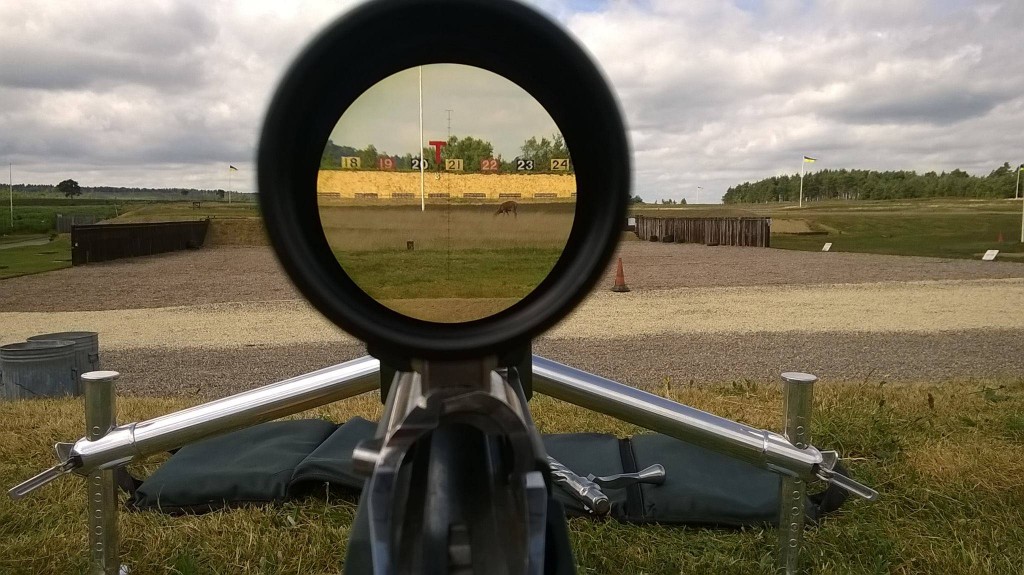
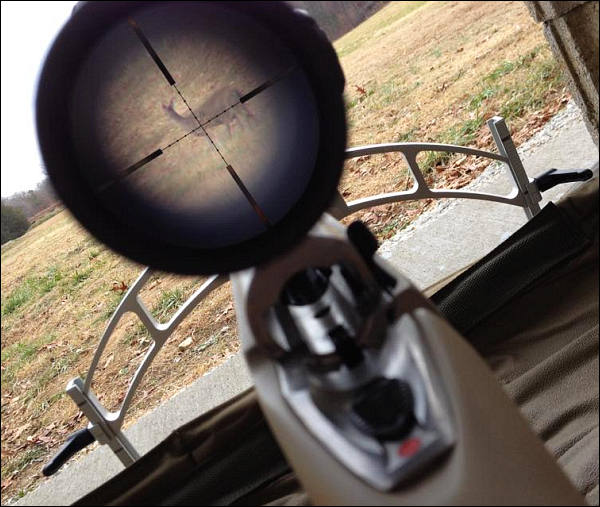
What’s wrong (or right?) with this picture? Does the “F” in F-class refer to “Fauna”? Look carefully at this Bisley Range photo taken by Australian R. Hurley while looking downrange through his March 8-80X scope. The photo was taken in 2015 at the Bisley National Shooting Centre in the UK.
The Story Behind the Photo
British shooter T. Stewart reports: “I was there when this photos was taken. All I can say was that Mr. Hurley was firmly reminded that should said deer accidentally jump in front of his bullet … he would spend five years ‘At Her Majesty’s Pleasure’.”
“That morning we had five deer moving across the targets, literally blocking the V-Bull. Since we were on the 900-yard Firing Point, and elevated for such, obviously the bullet would pass well above them. But they do NOT move or flinch at the noise or passing bullets since they are not hunted on the Bisley Ranges. Earlier this year we saw a herd of 20 or so deer grazing slowly across the Range.”
More Fauna Findings…
Apparently Bisley is not the only place were “the deer and the antelope play”. In Canada, on the Connaught Ranges near Ottawa, Ontario, shooters often encounter a variety of wildlife. William McDonald from Ontario says: “Animals are a common sight on the Range. Along with deer we see geese, turkeys, and coyotes on a daily basis.”
Likewise, E. Goodacre from Queensland, Australia often sees ‘Roos on his home range: “I shoot at Ripley, Australia, and shooting is regularly interrupted by kangaroos. Our last silhouette match was delayed by an hour while 30 ‘Roos dawdled across — silly buggers!”
R. Hurley wasn’t the first fellow to view deer through his F-Class rifle’s scope. After seeing Hurley’s photo from Bisley, B. Weeks posted this image, saying: “Been there, done that!”
Over the past six days the Civilian Marksmanship Program (CMP) conducted a major spring shooting event — the Talladega Spring Classic held at the Talladega Marksmanship Park in Alabama. This year’s event was a success, with participants enjoying a wide range of pistol and rifle competitions, plus training courses.
TALLADEGA SPRING CLASSIC 2021
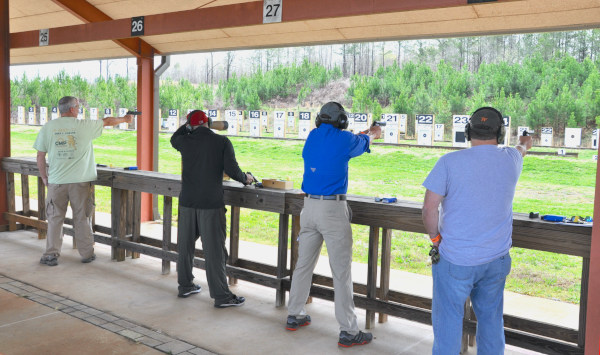
Spring has sprung! From March 16 through 21, the CMP has hosted a major series of rifle and pistol matches at the CMP Talladega Marksmanship Park in Alabama. The March 2021 Spring Classic event at Talladega included a mix of both new and traditional rifle matches, along with pistol competitions, and a variety of training courses.
On the rifle firing lines were Service Rifles, Vintage Military Rifles, and Rimfire Sporter Rifles. And there were even M1 Garands being shot from the bench. In the pistol areas, both rimfire and centerfire matches were held.
Spring Classic Featured New Benchrest Garand Match
The Talladega Spring Classic featured traditional matches plus some notable new events. Debuting this year was a Benchrest Garand Match. In addition there was a new Mid-Range 3×600 Rifle Match, and new Pistol 2700 Match. Along with the new events, the Spring Classic including CMP staple events including: Rimfire Sporter Rifle Match, .22 Rimfire Pistol EIC, Service Pistol EIC, and GSMM (Garand/Springfield/Vintage and Modern Military) Rifle matches.
There were also multiple training sessions including: Long Range Rifle Clinic, Team CMP 600-Yard Clinic, Rifle Marksmanship 101 Course/M16 Match, and Pistol Marksmanship 101 Course/M9 Match. These classes allow participants the opportunity to learn marksmanship from skilled, certified instructors.
This article was originally written by noted rimfire gunsmith Bill Myers. Sadly, Bill passed away in May 2010, but his legacy lives on. He pioneered many advancements in rimfire gunsmithing and Myers-built guns still win matches in benchrest competition.
Crafting competitive rimfire benchrest rifles is considered an art as much as a science. The smith must understand subtle, yet critical aspects of vibration control, barrel tuning, and rifle balance. In the United States, only a handful of gunsmiths consistently turn out rimfire BR rifles that consistently run at the front of the pack at major matches. Bill Myers was one of those master craftsmen. In this article Bill discussed the process of building a winning rimfire BR rig. He reveals some interesting secrets, including his procedures for testing bedding performance and his barrel indexing system. Bill’s methods obviously work, as the Suhl-actioned rifle featured here won a truckload of trophies in its very first match.
Building a Match-Winning Rimfire Benchrest Rig
by Bill Myers
In my opinion, a winning rimfire benchrest rifle is probably twice as difficult to build as a competitive centerfire rifle. The relatively slow .22 LR bullets stay in the barrel much longer than centerfire bullets. This means that vibration control is critical. Likewise bedding is critical. Bore finish and lapping are very important. The amount of bore taper or “choke” can have a huge effect on accuracy. Ignition is also very important and above all, rimfire BR rifles need a very stable stock that tracks perfectly. A rimfire that shoots great is a complete marriage of all components and of the shooter’s need to be aware of everything possible.
Click Photo to Zoom
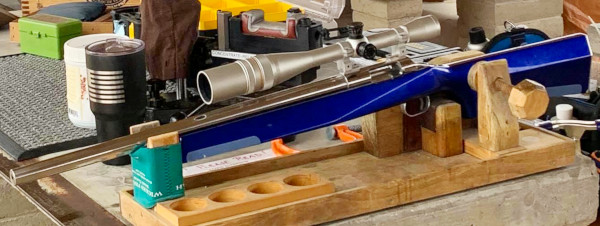
The rifle featured in this article was built from scratch with attention to all the details that go into accuracy. The goal was to build a gun that could win from the get-go. This would be a “Spec Gun”, meaning a rifle that was personally tested and tuned by me for optimum performance before it went out to the customer.
The Suhl trigger is as good as it gets so no change was needed. It easily adjusts down to about 2 ounces.
Baer Stock in Bubinga Wood
There are many choices when you start to build a complete rifle. It has to shoot well and it has to catch ones eye, or it’s just another rifle on the line. I prefer wood stocks on rimfires for two reasons: they are very stable if the right wood is used and they have a certain traditional appeal to many shooters. I chose Bubinga wood for this particular gun because it is very stable and heavy, it has a very dense grain and a very pronounced figure with a natural red color. The Bubinga is a very forgiving wood to work with.
Gerry and Bruce Baer in Pennsylvania do all my stock blanks. I do all my own inletting and bedding. The blank weighed 4.5 pounds when it came off of Bruce Baer’s duplicator. This Bubinga wood is so hard that it did not need pillars, but I put them in anyway. I bed all my stocks with Loctite Steel Bed liquid and add filler to desired thickness. The final bedding is done with an aircraft tooling epoxy that does not deteriorate over time. The stock has an ebony butt plate and six (6) coats of automotive clear, polished to a “high buff” finish.
Suhl 150-1 Action Accurized and BN-Nickel Plated
I used a new, unfired Suhl 150-1 action. As explained in the sidebar below, the Suhl 150 actions were originally crafted in East Germany for position rifles. They have a very fast lock-time and come with an outstanding trigger. However, they need some work when adapted to a modern BR gun. The action needed to be accurized and threaded. I have a special tool that I use to accurize actions. It uses two sets of spiders for dialing-in the bolt raceway. After the bolt raceway is running true, one can thread and true up all bearing surfaces so that everything is in perfect alignment with the action raceway bore.
BN-Nitride Plating on Action
I decided to plate the action and all bolt parts with Boron Nitride nickel plating. I bough the BN Electroless Nickel Kit from Caswell Plating and did the job myself. I started by bead-blasting the action so that it would end up with a “satin” finish. The plating material is then applied in a tank. The Boron Nitride goes directly into the plating solution, but you need to use a pump to keep the solution agitated so the BN distributes evenly.
Once the action is completely ready (the metal must be perfectly prepped, with no contaminants), the process goes easily and can be completed in about half an hour. The end result is a very slick, low-friction finish, that is .0002″ (two ten-thousandths) thick and hard as glass. The Boron Nitride makes everything very smooth. After the plating job, the action was noticeably slicker than before.
The cone breech (photo below) permits the barrel to be INDEXED (rotated around bore axis) to any position on the clockface. You then test various rotation settings to find the best accuracy. The system does work. Some barrels shoot best in a particular rotational setting. E.g. with index mark at 3 O’clock vs. 12 O’clock.
Fitting and Chambering the Barrel
As for a barrel, I had two good choices: one Shilen 1:16″-twist, 4-groove ratchet and one Benchmark 1:16″-twist, 3-groove. Both barrels were very accurate and at the end, I decided to leave the Shilen on the rifle because I wanted to put the Benchmark on another Suhl I’ve set aside for myself. I chambered the barrel for Eley flat nose EPS. We’ve found the gun also shoots the new Lapua X-ACT ammo very well.
The barrel finished at 25″ long and features a tuner by the Harrell brothers of Salem, Virginia. I use a flat 90° crown–it’s the most accurate and its gives a good seal against the tuner. I also use a 45°, 12-flute cutter that leaves no burr when cutting the crown. This chamfer protects the crown when cleaning the barrel. There is no sharp edge for the brush or jag to hit on the return stroke. The barrel was headspaced at .043″ and I use a tapered reamer ground by Dave Kiff of Pacific Tool & Gauge in Oregon. The chamber leade area is lightly polished to remove reamer burrs. The breech end of the barrel is machined with a 1/2″ ball end mill to produce what I call a “Myers cone breech.” Technically, it has a sloping radius as you can see, rather than a straight-sided cone. Finishing the breech in this fashion facilitates indexing the barrel, as the barrel can be rotated to any position (on the clockface), without requiring new extractor cuts.
Barrel Indexing — Finding the “Sweet Spot”
When indexing a barrel, one rotates it to different clockface positions relative to the action. Imagine marking a barrel at TDC or 12 o’clock, and then rotating it so the mark is at 3 O’clock, 6 )’clock, 9 O’clock and so on. At each position one shoots groups to determine at which index setting best accuracy is achieved.*
I know that barrel indexing is controversial. I don’t want to get into a lengthy debate other than to say that I believe that careful and thorough testing can reveal a “preferred” index position for a good barrel. With the barrel set in that particular position relative to the action I believe the barrel can yield optimal performance.
I perform the indexing tests indoors at 50 yards. I use a rail-gun with floating action. The barrel is held in place with a clamping fixture similar to an Anschutz 2000-series action. Basically, two vertically-stacked metal blocks clamp around the barrel. I can index the barrel this way simply by unclamping the barrel blocks, rotating the barrel and then re-clamping the system. I have a special system so the action can stay in the same position, even as the barrel is rotated.
It takes time and effort to get solid indexing results. Normally I shoot at least 400 rounds of ammo in 3-4 indexing sessions. Shooting a handful of groups is not enough. You may think you’ve identified the best index position, but you need to shoot many more rounds to verify that. Also, in a very good barrel, the effects of indexing may be subtle, so it will take many groups to confirm the optimal position. In my experience, really good “hummer” barrels do not benefit as much from indexing as an “average” barrel.
Accuracy Testing with Both Barrels
I tested the rifle indoors at 50 yards at the Piney Hill Benchrest Club range. There was no finish on the stock, but it shot well in my one-piece rest with the Benchmark 16-twist, 3-groove barrel and no added weight on the tuner. I shot 30 rounds of Eley Match EPS Black Box (1064 fps) and had 25 Xs and five 10s on the IR 50/50 style target. Not too shabby for a new barrel with no special break-in.
When the Shilen barrel arrived, I installed it on the rifle. By this time the stock had been clear-coated and finished, and the action had been polished and plated. I shot the Shilen barrel outside since it was too hot in the building. The first target was a 250-19X with a new lot of Eley Match EPS Black Box (1054 fps). The gun shot well. My friend Tony Blosser asked to shoot the gun, and he drilled a 250-20X in a steady wind using the same Eley ammo. See target at right.
Advanced Procedures — Vibration Control and Tuner Position
Barrel Tuning Using 2-Way Electronic Indicators
Before competing with this rifle, I put it in a firing fixture I use to tune the barrel. I employ a pair of very expensive Swiss 2-way electronic min/max hold indicators. These measure both up movement and down movement of the barrel as the gun is fired. I can measure the actual vertical travel of the barrel at any position from the front of the receiver to the tuner. I can also tell how long the barrel vibrates, time-wise. Using this fixture I found that the Shilen barrel was very consistent in readings and seemed to work well with no additional weight on the tuner. No barrel ever stops vibrating completely — but this was close, showing less than .002″ of total movement.
Bedding and Vibration Control
I have found that measuring the actual movement of the barrel during firing tells me a lot about the quality of the bedding. I have learned that if I see very big movements (e.g. .010″ up and .005″ down), then there may be a problem with the bedding. I saw this kind of big swing on a rifle with bedding that had not cured properly.
Another pattern I watch for is uneven vertical movement. For example, if the barrel vibrates .008″ up but only .002″ down, that tells me the bedding has issues. As noted above, I look for minimal vibration travel (after the tuner is fitted and optimized), and I also want that travel to be relatively equal both up and down. Good rimfire gunsmiths agree that proper bedding has an important influence on vibration control and tuning. By measuring actual barrel movement during firing, we can, to an extent, quantify how well the bedding is working. At a minimum, we can see if there’s a serious bedding problem.
Trial by Fire — Shooting the Gun in Competition
After semi-gluing in the action, the rifle was shooting great. So, I decided to take it to the Maryland State Unlimited Championship to see if it was truly competitive — whether it could “run with the big dogs”. As it turns out, the Bubinga Suhl was more than just competitive. The rifle won three of the six cards and won the meters championship. In the photo below you can see all the trophies the gun won in its very first match. One of the other competitors in Maryland, dazzled (and perhaps a bit daunted) by the Bubinga Suhl’s stellar performance, told me: “Sell that gun Bill. Whatever you do, just get that darn rifle out of here.” Confident that this was a rifle capable of winning major matches, I packed up the rifle and shipped it to Dan Killough in Texas. Killough has shot some impressive scores with the gun.
Suhl Target Rifles — East Germany’s Legacy
Suhl 150 rifles were manufactured in former East Germany (GDR) by the Haenel firearms factory in the town of Suhl. This region has a long history in arms production. In 1751, Sauer & Sohn founded the first German arms factory in Suhl. Following WWII, Suhl 150s were produced for Communist Bloc marksmen, including East German Olympic shooters. Prior to German unification, the East German national shooting arena was located at Suhl and hosted many top-level competitions including the 1986 ISSF World Championships.
Superb Rifles with Amazing Triggers
As a product of East Germany, the “mission” of the Suhl 150 was to rival the accuracy of the Anschütz, Walther and other premium match rifles built in the West. East German shooting teams wanted to finish on top of the podium, so they needed a rifle with superb inherent accuracy. The Suhl 150s have an outstanding trigger that can be adjusted down to about two ounces. The Suhl 150 action, like the Anschütz 54, boasts an extremely fast lock-time — an important factor in a position rifle. And Suhl barrels were legendary for accuracy.
Suhl 150 Benchrest Conversions
Many of the first used Suhl 150s that made it to America were converted to Benchrest rifles because the action/trigger/barrel combination was unbeatable for the price. Some of the barrels on these “surplus” Suhls were phenomenal — as good as any custom barrels available today. It was not unknown for a Suhl 150 barreled action, transplanted into a benchrest-style stock, to win BR matches with the original barrel. Today, however, most of the Suhl benchrest conversions end up with modern, American-made barrels. While some older Suhl barrels can “shoot with the best of ‘em”, new barrel designs optimized for use with tuners have an edge, at least in benchrest circles. That’s why builders such as Bill Myers swapped out the Suhl barrel with something like a Benchmark reverse-taper two-groove.
Today Suhl 150 rifles are very hard to find in North America. In 2006, a used Suhl 150, even without sights, might fetch $1200.00 or more. Then, in 2007 through early 2008, hundreds of Suhl match rifles were imported. This drove prices down, and those “in the know” snapped up complete Suhl 150s at prices ranging from $450 to $850 (see 2007 advert at right), depending on condition.
Many of these rifles were left “as built” and used successfully in prone competition. Others were converted into benchrest and silhouette rifles, “parted out” for the actions and triggers. If you were able to grab one of those imports at a good price–consider yourself lucky.
* Bill Myers actually created his own clamping rimfire action to facilitate barrel indexing. CLICK HERE for Myers Rimfire Action. To index the barrel, Myers simply loosened three clamping-bolts and rotated the barrel in the action. Because there is no thread to pull the barrel in or out, the headspace stays the same no matter how much the barrel is rotated. With a threaded action, you might have to use shims to test different rotational positions, or otherwise re-set the shoulder with each change.
Congrats to Lester Bruno, overall winner of the 2021 Cactus Classic Benchrest Match. This popular NBRSA match is held every year at the Ben Avery Range outside Phoenix, Arizona. Lester shot brilliantly, particularly at 200 yards, to win the Two-Gun convincingly with an 0.2099 Overall Aggregate. Ed Adams was second with a 0.2303 Two-Gun Agg, with Durward Wofford in third place with 0.2655. Along the way Lester nailed a remarkable 0.1742 200-yard Heavy Varmint Agg. That’s mighty impressive.
Click Image Below for full-screen Panorama Image:
Paul Parosky reported: “So the Cactus Classic COVID Edition of 2021 has come to an end. Lester Bruno won with some amazing shooting at the LV and HV 200 yards. Myself? I need some more time behind the rifle and at 200 yards. We came across some nasty mirage that basically it was really hard to see the bullet hole. I still was able to finish in the middle of the pack 29th in the 2-Gun Aggregate, which is OK with me. But most of all had super great time, meeting new people and also putting faces to the FB friends from the group. The referees, Matthew Schwartzkopf and his crew [plus] the Wickenburg School volunteers did a wonderful job keeping the match going flawlessly.”
2021 Cactus Classic Top 25 Two-Gun Overall Results:
In 100/200 yard Group Benchrest, most top competitors load at the range, tuning their loads for the conditions. Here you can see the portable powder measure (left) and a compact ARKCO Hood Press (right). That blue combo press can both size cases with a screw-in die and seat bullets using a Wilson Seater die (placed on left side). The vast majority of short-range benchrest-for-group competitors run the 6PPC cartridge with fast-burning powders such as Vihtavuori N133.
Capstone Precision Group (Berger Bullets, Lapua, SK, Vihtavuori) provided many valuable prizes to competitors at the 2021 Cactus Classic.
Are you a do-it-yourself kind of guy with a creative eye? Then you’ll love the FREE Target Generator from the folks at ShooterShed.com. This free, interactive webpage allows you to design a variety of fun targets, including grids, benchrest-type Score Shooting targets, sight-in targets, and even playing card targets. Choose the paper size and orientation (vertical or horizontal), then select the number of target elements on the page. For example, you could have four (4) bulls or 52 playing cards. Then click the Style TAB to choose your target style. Use the OPTIONS TAB to overlay a grid on the target, choose squares or diamonds, or include load information blocks. For bullseye targets, you can control the number, color, and spacing (diameter) of the rings. LINK to TARGET GENERATOR.
Click the TARGET STYLE TAB to select one of many target styles, including NBRSA Benchrest targets and 20+ types of NRA bullseye targets, scaled to distance:
Benchrest
Bullseye
Shapes
NRA High Power
NRA Pistol
NRA Rimfire
Images
Playing Cards
Load Test Blocks
The program provides a preview of each target you generate. There are controls to choose border and fill colors. If you like a particular design, save the file, and then print as many targets as you want. Check it out, this program is fun and handy to use. Here are five (5) targets your Editor created just for this article. With a bit of practice, you can be generating your own custom targets in minutes. We just created the green diamonds grid target in 5 minutes this morning. Have fun!
About the Creator of the Target Generator
The Target Generator program was created by Rod Brown of Sheridan, Wyoming. Rod tells us: “I build custom rifles and coach shooters. I’ve got a 100-yard range out my back door. I shoot short- and long-range benchrest competitively around the country. I’m a full-time software development consultant and an FFL holder. When I’m not developing custom software for my clients, I’m usually fiddling in the shop, building a custom benchrest rifle, traveling to a match, chambering a barrel, or reloading some ammunition.
Story tip from Boyd Allen. We welcome reader submissions.
Zombies are preparing to invade once again for the Zombies in the Heartland 3-Gun Match on June 4-6, 2021 at the Heartland Public Shooting Park in Grand Island, Nebraska. After canceling the match due to COVID-19 in 2020, Hornady will host the popular event again this year. For complete event information, visit the official Zombies in the Heartland website, or follow the Zombies in the Heartland Facebook page. Hornady posted: “We are already half full, so sign up fast! We look forward to having you this year!”
ZOMBIES MATCH REGISTRATION: Early registration for past competitors opened on February 24th. Returning competitors were emailed with registration links. General registration opened on 3/2/2021, so you can register now online via Practiscore (you’ll need to set up a free Practiscore Account):
LODGING INFO: Hotel rooms can be reserved at the Boarders Inn and Suites, 3333 Ramada Road, Grand Island, NE. Mention Zombies in the Heartland for reduced rates.
About the Zombies in the Heartland Match
The very popular Zombies in the Heartland event, one of the biggest three-gun shoots in the nation, will take place June 4-6, 2021 at the Heartland Public Shooting Park in Grand Island, Nebraska. The “Zombie Pandemic” match traditionally has a rich prize table worth over $150,000. Prizes include pistols, rifles, shotguns, scopes, AR uppers, gun parts, and gear of all kinds.
The Zombie Match is a veritable theme park for shootists, with many fun stages and innovative targets. Many unique, reactive zombie targets have been developed specifically for this match. The use of paper targets has been minimized — so it’s mostly “bang and clang”.
In recent years there have been TEN multi-gun stages. Rifles, pistols and shotguns are used on most stages, which feature handgun targets from 1-15 yards, shotgun targets from 10-20 yards, and rifle targets from 1-200 yards. There were also side matches with full-auto demo firearms, exploding targets, and specialty targets.
Zombies in the Heartland Highlights Video. This well-made 2017 video is worth watching! This video offers Shooter’s POV views of many stages including full auto:
ABOUT the RANGE FACILITY: Operated by the Grand Island Parks and Recreation Department, the Heartland Public Shooting Park is the largest and most complete public shooting facility in the Midwest. The facility hosts regional and national events, drawing shooters from around the world.
Here’s great news for rifle and pistol competitors — the National Matches will return to Camp Perry, Ohio in 2021. The National Rifle and Pistol Matches have been part of Camp Perry tradition since 1907. After being cancelled in 2020 due to the COVID-19 pandemic, the National Matches will be held again, but with some important changes:
— No First Shot Ceremony
— Squadding Reduced to Half Maximum Capacity
— Limiting Firing Points
— Social Distancing and Mask Wearing
— No Public Awards Ceremonies
REGISTER for National Matches Starting April 1, 2021
Registration for the 2021 National Matches opens April 1, 2021. Learn more about the event and get updates on the CMP.org Website.
Housing and Lodging — In the summer of 2021, Camp Perry on-base housing and RV spaces WILL be available. Visit the Camp Perry Lodging Conference Center website for more details and reservation links. This offers very affordable lodging and/or camping options. A barracks bed starts at $16.10/night. Reserve a 4-person hut for $58.65 per night.
Small Arms Firing Schools — We’re informed that the Small Arms Firing Schools (SAFS) are still on the schedule for 2021, with a reduced number of spots available. The CMP suggests you sign up early if you wish to participate.
Key Changes to Camp Perry National Matches for 2021
First Shot Ceremony: Due to the complexity of dealing with COVID concerns, the First Shot Ceremony, which typically serves as the formal opening event of the National Matches, will NOT be held this year.
Squadding: Squadding/participation for all events will be restricted to half maximum capacity. Competitors will be placed at every other firing point for distancing purposes. For those events squadded on the line, social distancing and masks will be required while squadding is taking place.
Awards Ceremonies: In order to prevent crowds, the traditional awards ceremonies will NOT be held in 2021. That also applies to competitor receptions held prior to the awards.
NM Welcome Center (In-Processing): Several check-in desks, appropriately spaced, will be available for arriving guests. A limited number of individuals will be permitted into the building at a time and will be required to be seated in chairs, six-feet apart.
Running the National Matches with Safe Protocols
The CMP is partnering with the Ohio National Guard to remain up-to-date on CDC guidelines, to provide an environment that is as safe as possible for guests of Camp Perry, while also staying true to the events and customs that have made the National Matches a celebrated destination for marksmanship enthusiasts for over a century. With the evolving regulations of COVID-19, CMP staff members are hard at work updating the National Matches to fit the modern era. Procedures for the 2021 National Matches include revisions to safety regulations (such as social distancing and mask wearing), limiting firing points, squadding protocols, in-processing, awards and other details.
The CMP would like to thank all individuals for their cooperation as we navigate the most efficient ways of hosting our events and ensuring the safety of our staff and supporters. We’re looking forward to seeing everyone back on the shores of Lake Erie for more marksmanship memories and fun in 2021!
The Caveat — Cancellations Might Occur if Health Guidelines Change
The CMP has posted: “Although it is CMP’s hope to hold our upcoming events, please keep in mind that we may have to cancel due to COVID-19 issues. For those events that we do conduct, we will follow the appropriate state’s guidelines and recommendations. We continue to monitor the venue states’ guidelines and adjust our procedures based on those guidelines and common sense.
NRA Competitive Shooting has released the Official Calendar for the 2021 NRA National Championships at Camp Atterbury. The 2021 NRA Nationals at Camp Atterbury start with registration for the Smallbore Championships on Tuesday, July 6. The Smallbore Nationals continue through Sunday, July 18. The Precision Pistol National Championships begin on Tuesday, July 20, with the F-Class Mid-Range Nationals starting July 22 (registration/practice), with F-Class Long-Range commencing on July 27. Moving on to High Power Rifle, the Fullbore event runs August 1-7, while the Mid-Range Nationals begin on Tuesday, August 9, followed by the Long-Range Nationals starting on August 14, 2021. Finally, the NRA Extreme Long-Range (ELR) Championship begins on Friday, August 20 and concludes Saturday, August 21. The last week of the month, August 22-27 is slated for OTC competition.
Smallbore Rifle Championship: 6-18 July, 2021
Precision Pistol Championship: 20-25 July, 2021
F-Class Mid-Range Championship: 21-25 July, 2021
F-Class Long Range Championship: 27-30 July, 2021
Fullbore Championship: 1-7 August, 2021
High Power Mid-Range Championship: 9-13 August, 2021
High Power Long Range Championship: 14-19 August, 2021
ELR 1-Mile Championship: 20-21 August, 2021
OTC Competition: 22-28 August, 2021
NOTE: Listed dates include registration/sign-up and/or practice day, and award ceremony.
See full 2021 Camp Atterbury NRA National Championships calendar below. CLICK to view larger, full-screen printable image that is easier to read. ENLARGE (+ with mouse) after loading to read small print.
CLICK CALENDAR to VIEW Full-screen PDF then click Enlarge (+)
To learn more about the 2021 NRA Nationals, visit compete.nra.org. And for the latest updates, subscribe to the free Shooting Sports USA Insider newsletter.
There WILL be shooting matches at Camp Perry in 2021, with safety protocols in effect to prevent COVID transmission. The Civilian Marksmanship Program (CMP) will host a variety of Garand, Springfield, Vintage and Modern Military (GSMM) rifle matches during the 2021 season at the historic Camp Perry National Guard Training Facility in Ohio. There will be matches at both the Petrarca Covered range and the Viale outdoor range. Registration for all matches is now open. Competitors of all skill levels are welcome to attend these recreational events. Knowledgeable CMP staff members will be on hand at all events. Space will be limited, so sign up soon.
Garand, Springfield, Vintage and Modern Military at Petrarca Range
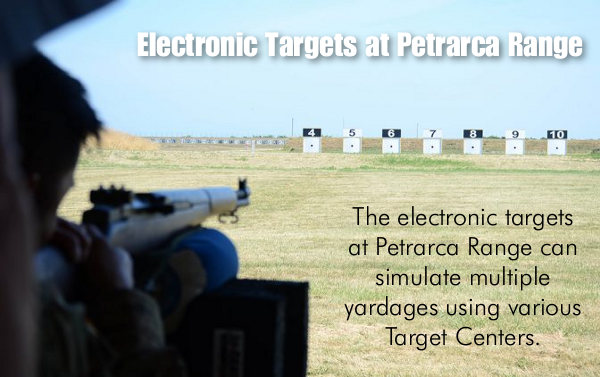
A series of GSMM matches will be held at Camp Perry’s Petrarca Range using Camp Perry’s advanced electronic target system. The use of the KTS (Kongsberg Target System) targets means faster competition time (with no need for pit duty) and extra convenience for competitors who can rely on the instant and accurate shot monitors, located beside each firing point. Dates for the 2021 GSMM events at Petrarca Range currently include: May 22, June 26, and September 25.
High Power Matches at Viale Range
In addition to the Petrarca matches, a set of High Power rifle 800 Aggregate and Excellence-In-Competition (EIC) events will be held on Camp Perry’s outdoor Viale Range, June 26-27, 2021. The CMP explains: “The matches are ideal for those in the quest for a Distinguished Rifleman Badge as well as those with a love for modern military rifle shooting.” The Viale matches will utilize CMP’s High Power electronic targets.
Availability of Petrarca Range for Public Shooting Practice
Along with organized competitions, Camp Perry’s Petrarca Range is open for public shooting each Monday, with advanced reservations. Opening day for Petrarca Range’s Open Public slots begin March 15, 2021. Every Monday, by appointment only, guests may use Petrarca during the hours of 9 a.m. to 5 p.m., March through May and September through November. During the summer months (June through August), Petrarca is open from 9 a.m. until 6 p.m.
Please note: During the National Matches scheduled July 12 – August 14, Petrarca Range will be open throughout the week but only after firing is complete on Rodriguez Range. Guests to Petrarca must adhere to current CDC guidelines, including masks and social distancing.
The U.S. Army Marksmanship Unit (USAMU), in cooperation with Shooting USA TV, has created a series of instructional Pro Tip pages covering a wide range of shooting disciplines. All totaled, there are more than 50 USAMU Pro Tips. Most relate to rifle marksmanship but there are also numerous tips for shotgunners and pistol shooters. Each Pro Tip entry includes multiple photos and 6-15 paragraphs, in an easy-to-follow format. Many Pro Tips also include an instructional video produced by Shooting USA. Here are three Pro Tip videos, and links to seven more Pro Tip web pages.
USAMU TOP TEN PRO TIPS
1. Reading the Wind with SGT Sherri Gallagher.
Apart from gravity, wind has the most pull on the bullet as it travels down range. Being able to accurately read the wind and mirage will greatly enhance your performance on the rifle range. National Champion, SGT Gallagher gives you some of her tips.
2. Angle Shooting with SFC (Ret.) Emil Praslick.
SFC Praslick shows you how to determine the angle to your target, and then how to include that to change your data necessary to hit your target on the first shot.
3. Rifle Grip, Stance and Body Position for 3-Gun with SFC Daniel Horner.
Professional 3-gun marksman SFC Daniel Horner, U.S. Army Marksmanship Unit (USAMU), give tips on how to properly handle a semi-automatic rifle, including grip, stance and body position.




 TALLADEGA SPRING CLASSIC 2021



 Accurized and BN-Nickel Plated
 BN-Nitride Plating on Action
 Fitting and Chambering the Barrel
 Accuracy Testing with Both Barrels


 Today Suhl 150 rifles are very hard to find in North America. In 2006, a used Suhl 150, even without sights, might fetch $1200.00 or more. Then, in 2007 through early 2008, hundreds of Suhl match rifles were imported. This drove prices down, and those “in the know” snapped up complete Suhl 150s at prices ranging from $450 to $850 (see 2007 advert at right), depending on condition.




 About the Zombies in the Heartland Match