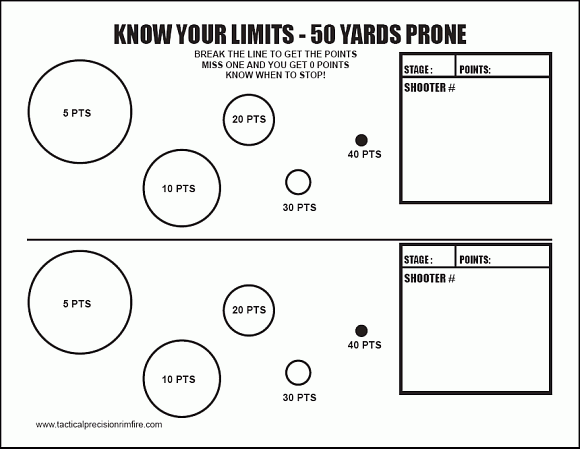
AIM SMALL, MISS SMALL: At 25 yards, this is a fun rimfire plinking target. At longer distances it can be a great training target for precision centerfire shooters.
We’re seeing great interest in NRL22 competition as well as .22 LR rimfire tactical cross-training . With a rimfire rig, you can practice regularly for a fraction of the cost of centerfire training. That way you can build your skill set without breaking the bank. Decent rimfire ammo can be had for five cents a round. Compare that to fifty cents (or more) for handloads and maybe $1.20 per round for factory ammo.
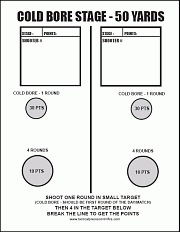
To help with rimfire cross-training, here are some of our favorite rimfire tactical targets, all in easy-to-print PDF format. Click each target image to download the FREE target. You’ll find more free targets for load development, precision practice, and fun shooting on our AccurateShooter FREE Targets Page
Targets for Rimfire Training and Fun Matches
Here’s a rimfire training target with “big to small” target circles. Start with the largest circles, then move to the smaller ones in sequence. This systematic drill provides increasing challenge shot-by-shot. Novices often are quite surprised to see their accuracy improve as they move from bigger to smaller aiming points. That provides positive feedback — always a good thing.
Right Click and “Save as” to download printable PDF versions of target.
Rimfire Practice Targets
SPECIAL BONUS–Rimfire Tactical Precision Targets
These FREE targets by DesertFrog are offered in Adobe Acrobat format for easy printing. CLICK HERE to download all six targets as a .ZIP archive.
NRL22 Competition — Tactical Rimfire Matches
The NRL22 match format is a great shooting discipline. NRL22 offers a high fun factor at relatively low cost. You don’t have to reload match ammo. A couple of 50-round boxes of .22 LR ammo will get you through the match. While some people bring lots of gear to matches, that’s by choice and not by necessity. You can keep it simple and still be competitive (and win).
Tips for NRL22 Competitorsby Jonathan Ocab
I am a match director at my gun club and run our local NRL22 matches. People often ask me for tips for competing in NRL22. First, I recommend getting the course of fire for the month in advance and practicing those stages at the range. Here are other specific tips that should help NRL22 competitors improve their gun-handling and match results.
1. Dry Fire Practice — If you are not able to do live fire practice at the range, I encourage shooters to practice their shooting positions at home via dry fire. Setup props or barricades with pasters or other faux targets on a wall in the garage or inside the house and run through each stage.
2. Scope Magnification Level — The most common issue I see with newer shooters in NRL22 is the tendency to maximize their scope magnification. The timer will start, and the shooter gets into position on a target, but the scope is set to 15x or higher and the shooter can’t find the target. The shooter lowers the magnification, locates the target, and then increases the magnification again, takes the shot, transitions to another target, and repeats the process of decreasing magnification, locating target, etc. Novice NRL22 shooters should try using the mid-range magnification. Try shooting 7x-12x and learn to balance field of view and target image.
3. Support Side Shooting — NRL22 matches often include support-side shooting stages. This requires you to shoot with your opposite (non-dominant) hand and eye. I often hear people complain about shooting support-side. My only real tip for this is to actually spend time at the range shooting this way. Practice makes perfect. It’s all a question of learning how to shoot again and using fundamentals. Learn to get a consistent cheek weld and consistent eye relief. If necessary, figure out if you need to set your scope’s diopter for your opposite eye and mark it on the scope.
A few good men (and women) — that’s what the shooting sports need these days. We need skilled, trained personnel to serve as Range Safety Officers (RS0s). Without RSOs, there would be no shooting matches — no F-Class, no High Power, no Smallbore Matches — you get the idea. Thankfully there are now ways to get requisite RSO training without costly travel far from home.
The NRA now offers an online training course for its Range Safety Officer (RSO) program. The online course teaches the skills needs to conduct and supervise safe shooting activities and range operations. Online RSO Course students can access the electronic course materials for 90 days. You can complete the course in multiple sessions. The program will save your progress so you can return later.
• Intro to the NRA Basic Range Safety Officer Course
• The Role of the NRA Range Safety Officer and Range Standard Operating Procedures
• Range Inspection and Range Rules
• Range Safety Briefing
• Emergency Procedures
• Firearm Stoppages and Malfunctions
Who Can Take the Course?: The Online RSO Course is available to anyone who currently possess a valid NRA Firearms Instructor certification or NRA Coach appointment. Course cost is $125.00. Individuals without a trainer rating must attend the in-person Range Safety Officer course consisting of both classroom time and practical exercises on a range.
Certification Procedure: Students must complete all six lessons and a short electronically administered test in order to become a certified Range Safety Officer. Once the test has been passed, newly certified Range Safety Officers will receive an electronic completion certificate that can be printed or saved to a computer.
The NRA RSO program was developed in response to the demand for a nationally-recognized range safety officer certification. More than 54,000 NRA Range Safety Officers are involved in aspects of target shooting, training, and range supervision around the USA.
Range Safety Officer supervises the line at Berger SW Nationals. Without dedicated RSOs, we could not have matches like these.
Hardware Choices: Actions, Stocks, Barrels, Optics and More Tech Talk by Jeff Stover
This article was prepared by past IBS President Jeff Stover based on results from the 2019 IBS 100/200 Group Nationals held August 12-17, 2019 at the Holton Gun & Bow Club in western Michigan.
Let’s examine the Top Ten rifles from the 2019 IBS Group Nationals in the 10.5-lb Light Varmint Class. We’ll focus on the most popular rifle components — the choices for Actions, Stocks, Barrels, and Scopes.
Hall of Famer Jeff Gaidos taking aim at the 2018 IBS Group Nationals. He has a low-profile carbon-fiber stock with a Leupold fixed-power scope.
For some years now, BAT has been the predominant action. This year BAT actions held nearly 100% of the Top Ten places in all the Bag Gun equipment lists. Bruce Thom’s Idaho-crafted actions, except for a couple stray actions in Heavy Bench, swept the top rankings.
Next, look at barrels. Bartlein or Krieger seem to rule with upstate New York’s venerable Hart barrels as competitive. Shooters tend to go with winners, so Wayne Campbell and Jeff Peinhardt dominate as gunsmiths for the top benchrest shooters.
In stocks there seems to be variety, but there is some commonality. The Scoville and Scarbrough stocks, both Michigan-made, are laminated wood (balsa and other wood) with carbon fiber and wrapped in carbon fiber. The Scoville stock on my 10.5-lb rifle weighs 18 ounces but is full size with a nice long fore-end. Bob Scarbrough makes a very similar product. Both are winners — it’s a choice of Ferrari or Lamborghini. The Roy Hunter and Terry Leonard stocks among these top rifles take a different route to winner’s circle. Both are wood (cedar or other), but super high-tech as they are laminated with carbon fiber. They are beautiful to boot. High-magnification Leupold, March, and Nightforce scopes rule the roost among benchrest optics.
Bullets and Powder
Bullets are important. Really important. A hot bullet gives you “Teen Aggs” and lots of trophies. An average bullet does not. Most of these are 68 grain 6mm boattails. The Peinhardt (StaMoly Precision) bullet is well represented on this list, but some top shooters make their own as you can see. Bullet jackets are likely StaMoly or J4. For powder, nearly everyone shoots Vihtavouri N133 except a few guys running LT30/32 or surplus 8208.
This week’s Shooting USA TV episode features CMP High Power competition. High Power Rifle, sometimes called XTC from “Across the Course”, is a shooting sport using centerfire (aka “fullbore”) target rifles. Major High Power matches are run by the CMP and NRA, as well as state rifle groups. The sport is divided into classes by equipment, and popular classifications include Service Rifle, and Open Class. This episode of Shooting USA focuses on High Power competition at the Talladega Marksmanship Park in Alabama.
This episode of Shooting USA airs Wednesday, July 7, 2021, 9:00 PM Eastern and Pacific, 8:00 PM Central on the Outdoor Channel. Shooting USA is also available On Demand via Vimeo.com.
This week Shooting USA TV features CMP High Power competition from the Talladega Marksmanship facility in Alabama. High Power is a challenging discipline that requires high accuracy in the rifle and great marksmanship skills in three positions — standing, sitting/kneeling, and prone. The CMP competition involves slow- and rapid-fire at 200, 300, and 600 yards in all three positions. There are separate Service Rifle and Open divisions.
Young 15-year-old Tyler Fisher from Arizona shot superbly at the 2020 CMP Western Games Match in Phoenix (Ben Avery). His impressive marksmanship secured second place overall (and High Junior) at the Western Games EIC Match shooting Service Rifle, a subclass of High Power.
High Power Open division Tubb 2000 with a shortened handguard, and custom hand support bracket forward of mag well.
HIGHPOWER CLINICS
The CMP conducts a number of High Power clinics each year. The CMP offers a pair of High Power clinics in conjunction with the U.S. Marine Corps Rifle Team and members of the Remington-Bushmaster rifle team. There is a Junior Clinic as well as an advanced High Power clinic. Both focus on service rifle disciplines.
USAMU PRO TIP: Bullseye Pistol Competition
In addition to the High Power rifle feature, this week’s Shooting USA episode has a good USAMU Pro Tips segment about bullseye pistols. Staff Sergeant Ryan Franks with the USAMU Service Pistol Team shows the fundamentals of bullseye shooting, the classic pistol competition shot from a one-handed standing position. In this Pro Tip, SSG Franks focuses on proper stance and grip.
Shooting USA will air Wednesday, July 7, 2021, at 9:00 PM Eastern and Pacific (8:00 PM Central) on the Outdoor Channel. Shooting USA is also available On Demand via Vimeo.com. Watch a single episode for $0.99, or get a full-month subscription for $3.99 and watch as many shows as you like with limited commercial interruptions.
For those headed to the Nationals, we are sharing some smart tips from a past F-Class Champion who is both a great shooter AND a ballistics wizard. In 2015, Bryan Litz won the F-TR Mid-Range AND Long-Range National Championships hosted at Ben Avery. And at the 2014 Berger SW Nationals (SWN), Bryan took top honors among all sling shooters. If you only know Bryan Litz from his Applied Ballistics Books and DVDs, you may not realize that this guy is a also great marksman along with being an actual rocket scientist!
Given his impressive track record in both F-Class and Palma (Fullbore) out to 1000 yards, we asked Bryan if he had any advice for other long-range competitors.
First Bryan provided three tips concerning Ballistics, his special area of expertise. Next Bryan offered three more general tips about long-range competition — how to analyze your shooting, how to choose your ‘wind strategy’, and how to avoid the most costly mistakes, i.e. how to avoid the “train-wrecks”.
Bryan Litz won the 2015 F-TR Mid-Range and Long-Range Championships with this sleek rig:
Litz Ballistics Tips
Ballistics TIP ONE. If you’re having trouble getting your ballistic software to match actual drops, you need to look at a number of possible reasons. Here are some common issues that can cause problems.
Click Values Are Not Exact. Scopes and iron sights don’t always produce accurate adjustments. In other words, if your ballistics program predicts 30 MOA of drop, and you dial 30 MOA but hit low, it might be that your sight actually only moved 28 MOA (for example). To see if your sight is adjusting accurately, shoot a tall target at 100 yards and measure group separation when dialing your sight.
Barometric vs. Station Pressure. This is a commonly misunderstood input to ballistics programs. You can avoid this pitfall by remembering the following: station pressure is the actual measured pressure at your location, and you don’t need to tell the program your altitude when using station pressure. Barometric pressure is corrected for sea level. If you’re using barometric pressure, you also have to input your altitude.
Muzzle Velocity. Chronographs are not always as accurate as shooters think they are — your true MV may be off by 10-20 fps (or more). If your drop is different than predicted at long range, it might be because your muzzle velocity input is wrong.
Mixing Up BC (G1 vs. G7). Knowledgeable long range shooters know that the G7 standard is a more representative standard for modern LR bullets. However, using G7 BCs isn’t just a matter of clicking the ‘G7′ option in the program. The numeric value of the BC is different for G1 and G7. For example, the G1 BC of the Berger 155.5 grain Fullbore bullet is .464 but the G7 BC is .237. If you were to enter .464 but click on G7, the results would be way off.
Ballistics TIP TWO. A properly installed level is absolutely essential for long range shooting. Without a good level reference, your long range wind zero will be off due to minor canting of the rifle from side to side. You can verify that your level is installed correctly on a 100-yard ‘tall target’. Draw a plumb line straight up the target and verify that your groups track straight up this line as you go up in elevation.
Ballistics TIP THREE. If your long range ballistic predictions aren’t tracking, always come back and verify your 100-yard zero. Sometimes a simple zero shift can be misconstrued as errors in long range ballistics predictions.
Litz Competition Shooting Tips
Competition TIP ONE. Improving your scores in long range competition is a constant process of self-assessment. After each match, carefully analyze how you lost points and make a plan to improve. Beginning shooters will lose a lot of points to fundamental things like sight alignment and trigger control. Veteran shooters will lose far fewer points to a smaller list of mistakes. At every step along the way, always ask yourself why you’re losing points and address the issues. Sometimes the weak links that you need to work on aren’t your favorite thing to do, and success will take work in these areas as well.
Competition TIP TWO. Select your wind shooting strategy carefully. For beginners and veterans, most points are typically lost to wind. Successful shooters put a lot of thought into their approach to wind shooting. Sometimes it’s best to shoot fast and minimize the changes you’ll have to navigate. Other times it’s best to wait out a condition which may take several minutes. Develop a comfortable rest position so you have an easier time waiting when you should be waiting.
Competition TIP THREE. Actively avoid major train wrecks. Sounds obvious but it happens a lot. Select equipment that is reliable, get comfortable with it and have back-ups for important things. Don’t load on the verge of max pressure, don’t go to an important match with a barrel that’s near shot out, physically check tightness of all important screws prior to shooting each string. Observe what train wrecks you and others experience, and put measures in place to avoid them.
Today we feature a modern switch-barrel PRS chassis rifle set up for quick changes between 6mm Creedmoor and 6.5 Creedmoor barrels. The owner, Forum member Jeff Cosgrove (aka “Punkur67″) uses the 6 CM barrel for competition, favoring the reduced recoil over its 6.5 mm big brother. He does use the 6.5 CM barrel for practice (given its better barrel life). The 6.5 CM barrel also gives him the chance to shoot a variety of factory 6.5 Creedmoor ammo.
- Terminus Zeus action with Quick Change (QC) barrel option.
– 6mm Creedmoor Pre-Fit Bartlein Heavy Varmint 400MODBB barrel for matches
– 6.5 Creedmoor Pre-Fit Benchmark Heavy Palma barrel for training
– MPA BA Competition chassis with full weight kit
– Zero Compromise Optic ZCO 5-27x56mm FFP scope
– TriggerTech Diamond trigger
This rifle represents an evolution for Jeff. Each step along the way in his PRS journey, he has learned more about what he wants and needs in a competition rifle. And what you see here, from the $3760 ZC527 scope to his high-tech reloading equipment, represents pursuit of excellence. Jeff even created a modern, spacious man cave/reloading center in his new house (photos below).
Quick-Change Barrel System with Terminus Zeus QC Action
This rifle has two pre-fit barrels that work with the Terminus Zeus QC Action for fast and easy barrel swaps. To remove a barrel, you simply release two tension screws on the front of the action and then unscrew the barrel. To swap in a different pre-fit barrel, reverse the process and then tension the screws. The Terminus Zeus is 3-lug receiver with 60° bolt and integral recoil lug. Both the receiver and bolt are DLC-treated. Jeff reports this action is extremely smooth and has met all of his expectations. Some other Zeus features are threaded trigger pins for quick/easy trigger installation, and a roller-tipped cocking piece.
PRS Discipline Offers Fun, New Challenge for Long-Time Shooter
My name is Jeff Cosgrove, I live in Winchester, California and do commercial heating and air conditioning. I have shot for 20+ years but I found my interest in shooting was dwindling over time. I got somewhat bored with shooting paper at 100 yards or plinking cans out in the desert. About 18 months ago I decided I wanted to shoot long range. I picked up a used MPA in .300 Winchester Magnum and started shooting long range with a new buddy. That day I fell in love with guns all over again with more intensity than ever.
How I Got Started in PRS
With that new .300 WM I soon found my reloads were not up to my expectations (high ES/SD), so I purchased all new reloading hardware. One of my purchases was a used Benchsource Annealer. The guy I bought that from asked if I had ever tried PRS and he invited me to check out a match. So I went to a local PRS event as a spectator. I looked at many rigs on the firing line and took notes. By the end of the day I knew this was something I really wanted to do. I then acquired a used chassis rifle that I thought would work well for PRS. I went to a PRS match the following month but shot poorly.
After working with that first PRS rifle, a 6.5 CM with Stiller Tac30 action, MDT chassis, and Proof Carbon-wrapped barrel, I quickly learned that gun did not handle and balance the way I hoped.* It was too light in the front, the ergos were poor, and scope eye relief was not optimal. So I decided to build my own GEN 2 PRS rifle. This is the story of how I put together my new switch-barrel rig that I now use in competition.
PRS Rifle and Gear Selection — Learning What Works
Barrel availability was limited given the current shortages. Luckily I was able to obtain a 6mm Creedmoor pre-fit Bartlein Heavy Varmint 400MODBB from Southern Precision Rifles. The 6mm Creedmoor is notorious for being a barrel burner cartridge so I went with the special 400MODBB metal. Bartlein says that barrel life expectancy is 1.5 to 2 times longer than the standard 416 grade steel. I also purchased a 6.5 Creedmoor pre-fit Benchmark Heavy Palma barrel for training (Source: Straight Jacket Armory). With the Terminus Zeus quick change system I am able to swap from my match barrel to my trainer barrel in just a couple minutes. I loosen two set screws, unthread the barrel, thread the new barrel on, and torque the set screws to 10 inch-pounds. This also affords me caliber options in case I’m in a pinch for ammo. If I have some 6.5 CM loaded up and don’t have time to load 6mm Creedmoor for a match, then I’m covered.
For the trigger, I went with a TriggerTech Diamond Pro curve model. I have Timney, Jewell, and TriggerTech triggers in other rifles. I like them all but I liked the feel of the TT Diamond the best so that is what I used on this build. I set my triggers around 18-20 oz. — I am not a fan of ultra-light trigger pulls.
MPA BA Competition Chassis with Added Weight
I went with an MPA BA Comp chassis with full internal and external weight kit. I also have Gray Ops external weight on the handguard. I had the same chassis on my .300 WinMag and felt very comfortable with it. I took a PR1 class and found that, with a different gun, I had to force a comfortable hand position for proper trigger pull. After that class I grabbed my MPA and my hand fell in to the perfect position. I did not need to hunt or index my hand with the MPA. The built ARCA rail (RAT) lowered the rifles center of gravity more than my old setup with the ARCA rail bolted to the bottom of the handguard. With the current configuration, the rifle weighs in at 24 lbs. and balances three inches in front of the magwell. I now have the flexibility to add, subtract, or move approximately 6 lbs. of weight.
The Attraction of PRS/NRL Practical Competitions
I really enjoy PRS-style shooting because there seems to be a new challenge every time you compete — no matter what. With PRS I am shooting many different positions and ranges with the pressure of a stopwatch. This keeps things interesting for me. I have taken a few training classes to help establish good, clean fundamentals.
Jeff says it is hard to practice for the many unconventional shooting positions at PRS matches.
My biggest challenges so far have been: 1) building stable shooting positions that I have not practiced enough; 2) proper equipment selection; and 3) time management. Regarding the shooting positions — PRS/NRL is not like F-Class where you can always practice from one position. And it’s hard to practice for unusual set-ups (barriers and positions) you’ve not encountered before. Concerning equipment — you need some experience in the game to determine what really works best for you.
Innovative Zero Compromise Optic — Optimized for the Tactical Game
The scope is a Zero Compromise ZC527 (5-27x56mm FFP) with MPCT2 reticle. Zero Compromise Optic is a relatively new manufacturer, but their scopes are top-flight. The First Focal Plane ZCO has excellent glass that is extremely bright and clear. With a big 36mm main tube, the ZC527 offers 35 Mils Elevation and 21 Mils Windage adjustment. The field of view is 21 feet at 100 yards — one of the widest in the industry. The ZC527 also offers illuminated reticle and locking turrets. When I was at my first PRS match I looked through several different scopes. When I got behind a ZCO scope I knew this was what I wanted — the ZCO scope was super clear, super sharp, with very positive controls.
I put a protective wrap on the scope because with some of our PRS stages it is easy to scratch or dent the scope tube. You don’t want to bang up an expensive scope — the ZC527 retails for $3760.
Reloading for 6mm Creedmoor and 6.5 Creedmoor
When starting out with a new cartridge I like to search places like AccurateShooter.com and UltimateReloder.com for popular recipes used by knowledgeable shooters. I am all about paving your own way on certain things but with the consistency, higher cost, and limited supply of components these days I try to stick with the most common loads. I also want to limit barrel wear and get through load development quickly. I don’t want to chase loads for 300 rounds to ultimately land in the same place that so many other people have already found.
I start my new barrels with virgin brass and load three rounds at each charge weight in 0.2 grain increments. I put the most popular charge weight (for my chosen bullet) in the middle of my load range and load above and below to find a good node while paying close attention for pressure signs along the way. I use the 6.5 Guys spreadsheet (see below) to help analyze my results. With those results I like to re-test a narrower range with 5-10 rounds each charge weight in 0.2 grain increments. I again use the 6.5 Guys spreadsheet to make a final charge weight selection and then I move on to seating depth. I will load different depths to tighten the groups up.
Load Development Using 6.5 Guys Custom Spreadsheet
To hold and analyze my load development data I use the spreadsheet from 65Guys.com. It helps a ton with making a decision on your final load. This Excel spreadsheet works great and makes it simple to analyze your data. You can even copy and paste your chronograph data if your chrono logs on to a SD card.
In this 6.5 Guys video Steve provides an overview and tutorial for using the Excel load development analysis model that he has developed. The Excel Load Development Analysis Spreadsheet version 2.0 is FREE. Download from the 6.5 Guys Website.
In this video Steve explains some key statistical concepts for performing load data analysis. He also provides tips and guidance for determining the optimal load for your rifle as you analyze the load data you’ve collected.
New House, New Man Cave/Reloading Room
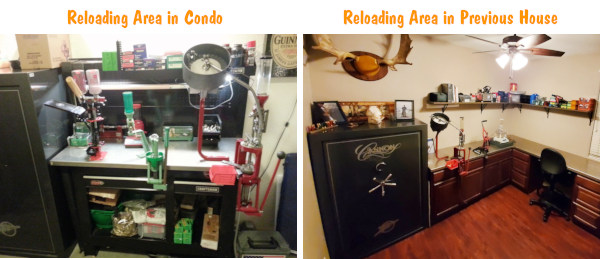
Jeff recently moved with his family into a great new house. One bonus of this move was that he upgraded from a cramped reloading area to a dedicated “Man Cave” that has ample space for his gun safes, multiple presses, and all his reloading components. Large upper and lower cabinets plus a dedicated “gun closet” provide plenty of storage. Read all about this move in this AccurateShooter Forum Thread.
Here is Jeff’s first reloading area years ago: “My first reloading setup was smashed in my two-bedroom condo so I had a very small bench that was very cluttered. I had to deal with the limited space I had but I made it work. Then in our first house I had a larger bench/cabinet, but it was still not ideal.”
Here is the new Man Cave in the new house — very open, spacious, with plenty of storage.
This animated GIF shows the new Man Cave move-in process start to finish:
How would you like to get rifle and pistol training from some of the best marksmen in the country for a modest charge and ammo included! This summer, the Civilian Marksmanship Program (CMP) will offer Small Arms Firing Schools (SAFS) at the Camp Perry National Guard Training Facility. Choose from pistol, smallbore rifle, rimfire sporter, or service rifle courses. No prior competition experience is required, and the CMP even supplies the guns. For more details on the Small Arms Firing SchoolsCLICK THIS LINK.
2021 Camp Perry Small Arms Firing School Dates:
Pistol: July 13
Smallbore (.22 LR) Rifle: July 20
Rimfire Sporter Rifle: July 24
Service Rifle: July 31 – August 1
REGISTRATION
Registration is now Open. You can register on-line on the CMP web site and make payment via credit card.
The SAFS courses have been a staple at the annual Camp Perry National Matches since 1918, educating over 1,000 pistol and rifle participants each year. Formulated specially to ease in those of who are new to marksmanship, the school is led by members of the U.S. Army Marksmanship Unit along with qualified civilian and military professionals. The minimum age for Pistol SAFS students is 14 while the minimum age for Rifle SAFS students is 12.
Currently, the CMP offers SAFS courses in smallbore rifle (.22 caliber), rimfire sporter rifle (.22 caliber), centerfire service rifle (M16), and centerfire pistol (M9). Since the schools are intended for beginners, no past firearm experience or gun ownership is required to participate. All ammo will be provided by the CMP along with the M9 pistols and M16 rifles. NOTE: Smallbore students can request to borrow a Walther KK300 for the class — send request to bdonoho@thecmp.org.
SAFS utilizes both classroom and live-fire training that covers basic instruction and firing practices as well as a scope of competition skills. Students in the Pistol (M9) and Rifle (M16) courses will also be entered into a true Excellence-In-Competition (EIC) Match. Though firing in the match is not required, it allows participants the chance to earn four EIC leg points toward a Distinguished Badge.
Small Arms Firing School COSTS
Pistol and Rifle: $50.00 for adults, $35.00 for juniors
Advanced Pistol School: $20.00 for adults ($15.00 for juniors)
Smallbore School: $35.00 for juniors
Rimfire School: $35 for adults, $25 for juniors
WHAT YOU GET
For the entry fee(s), students receive:
All instruction
All needed ammunition for the school
Use of an M9 9mm service pistol or an M-16 service rifle (with Walther KK300 for smallbore on request).
USAMU Guidebook for the particular program
SAFS T-shirt
SAFS certificate
NOTE: All Pistol and Rifle SAFS students also receive automatic entry in the M9 Pistol EIC or M16 Rifle EIC Matches at no additional cost, a special EIC match pin and an opportunity to win four EIC credit points.
National Matches 2021 Full Schedule
To view the full schedule of the 2021 National Matches at CLICK this SCHEDULE LINK.
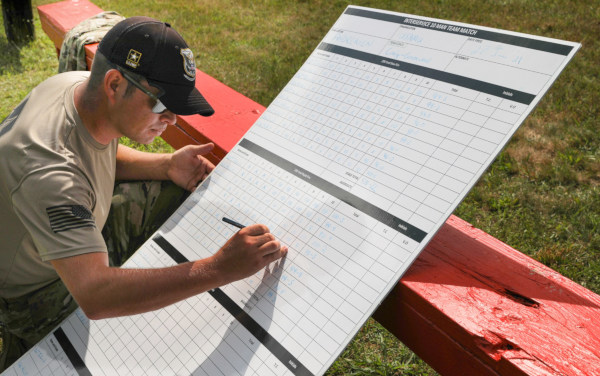
This past weekend, the U.S. Army Marksmanship Unit (USAMU) Service Rifle Team won the 2021 Interservice Rifle Team Championship Match held in Quantico, Virginia. The USAMU squad finished with an impressive score of 4918-185X! This competition features 10-person teams. All the shooters have to perform well to secure the team victory.
This is a tough match, shot with multiple positions at 200, 300, and 600 yards. In this course of fire, all members of a 10-person team complete the following stages:
Stage 1 at 200 yards — 10 standing, slow fire shots with a total time of 66 minutes.
Stage 2 at 200 yards — 10 sitting from standing, rapid fire shots within 60 seconds per shooter.
Stage 3 at 300 yards — 10 prone from standing, rapid fire shots within 70 seconds per shooter.
Stage 4 at 600 yards — 20 prone, slow fire shots with a total time of 126 minutes.
Team members were: Sgt. 1st Class Walter Craig (coach), Lt. Col. Erik Andreasen (captain), Staff Sgt. Erin McNeil (497-21X), Sgt. Brandon Muske (495-22X), Sgt. Jarrod McGaffic (495-18X), Sgt. 1st Class Brandon Green (494-20X), Sgt. Jared Desrosiers (494-15x), Staff Sgt. David Bahten (492-19X), Spc. Kade Jackovich (492-17X), Spc. Luke Rettmer (489-16X) Staff Sgt. Verne Conant (487-13X) and Sgt. Lane Ichord (483-24x).
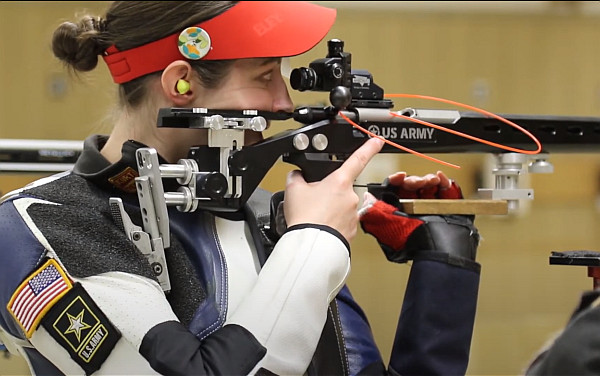
By earning the top score in this match, SSG Erin McNeil (shown above) also earned the Lt. Col. Reynolds Trophy. SGT Muske placed second in this category. The 2021 Interservice Match at Quantico concludes today with the well-known Infantry Trophy Team Match. See more Interservice match photos at: USAMU Flickr Archive (742 images).
The U.S. Armed Services’ new champion is a young lady. U.S. Army Staff Sergeant (SSG) Erin McNeil claimed the 2021 Interservice Individual Rifle Champion title with an impressive score of 996-52X, beating out 86 other service members. That score also earned Erin the title of High Woman. The 2021 Interservice Rifle Championships (IRC) continued with other events, including the 1000-yard match. Shown below is SSG McNeil competing in the IRC 1K Match.
Staff Sgt. Erin McNeil hails from Fort Wayne, Indiana. She has a B.S. in Mathematics from Texas Christian University (TCU), and holds the military occupational specialty of battle management system operator. With the USAMU, SSG McNeil has served on the International Shooting Team and the Service Rifle Team. As a USAMU team member, SSG McNeil has earned the President’s 100 Tab, Rifleman’s EIC Badge, and Bronze Medal at the 2014 World Championship in 3-Position/50m Smallbore Rifle.
McNeil started shooting through a 4-H program while in the 8th grade and then shot in college with the TCU Rifle Team. Now, she serves as a shooter/instructor on the USAMU International Rifle Team. In the video below, SSG McNeil talks about her career in competitive shooting, and what she enjoys most about rifle competition — both smallbore and High Power. She notes she gets enjoys instructing young high school and collegiate shooters.
Erin enjoys shooting competition because “It’s really between you and the gun. It’s a very mental game. I think shooting is a great sport… as long as you are able to compete within yourself.”
Like Father, Like Daughter — Both Great Shooters
Erin noted: “My father was very influential in my shooting career. As a child, I looked up to him. I knew that he had been a world-class shooter in his youth. He asked me a few times if I would be interested in starting the 4H Rifle program He was excited when I started showing interest in the program. Although he never coached me for fear of crossing the father/daughter relationship with the athlete/coach relationship, but he was always my biggest supporter and even gave assistance when I asked for it. I had a natural talent for shooting and ended up joining my high school’s Army JROTC. I was given a NCAA scholarship; to TCU during my senior year. After completing college, I was accepted into the USAMU. My dad [was] the quiet, proud encourager of my shooting career[.]”
Words of Praise for SSG Erin McNeil from Facebook
“The nice thing about shooting sports is men and women can compete against each other and be on equal footing. Congratulations on the win!” — Doug Fraser
“Congrats Sergeant McNeil from an old shooter from the 1964 ARADCOM Interservice Rattle Battle matches at Fort Carson Colorado, Ft. Campbell, Ft Sheridan, et cetera. You make me proud of all you folks who carry on the tradition.” — Walter Colbert
“I’ve watched Erin shoot while I was calling the matches from the Tower at the Camp Perry smallbore championships. [She was] never bothered and never ruffled. Just keeps shooting those Xs.” — Ken Kelley
For those of us in the Western USA facing drought, heat waves, and forest fires, it is a bit amazing to see a shooting range with verdant green fields, and lush vegetation. Well that is the environment in far-away Queensland, Australia. Here is a photo essay from Aussie Zac Link Cameron who hails from Cairns, Queensland, up near the Great Barrier Reef. On June 20, 2021, Zac was at a scenic range, shooting out to 1000 yards. He posted on Facebook: “Beautiful morning for it at a beautiful range!”
Zac was competing at 1000 yards with his lovely “missus” Morgan Crisp at the Atherton Rifle Club range, situated west of Cairns in Queensland. Zac and Morgan are members of the Cairns Rifle Club, which also has an 800m range north of Cairns, located inland from Wangetti Beach (see map below). Posting on Facebook, Zac wrote: “First time at 1000 yards for the Missus today with her factory Howa 1500 in .223 Remington. Conditions couldn’t have been more perfect other then the swirling wind not making up its mind! But the little .223 did bloody good for its first outing past 800m. 1000 yards today and my gosh Atherton is a beautiful range!”
Zac wrote: “Dropped 2 points on my first target and didn’t drop any on my second. I definitely need to work on my wind reading though.”
Zac Cameron: “Beautiful morning for it at a beautiful range!”
Indeed, this is a beautiful range. It’s great to see all that greenery. Here is a fly-over video from the Atherton Tableland Gun Club Range, west of Cairns, another popular Queensland shooting venue. You can see other Queensland shooting ranges on Zac Cameron’s Long Range Australia FNQ Facebook page.
Australia Rifle Competition Disciplines
As stated on the Cairns Rifle Club website, there are multiple disciplines sanctioned by the National Rifle Association of Australia (NRAA) which are shot by Cairns Rifle Club:
Target Rifle: This discipline is shot with a .308 or .223 caliber rifle, and held by the shooter using peep sights and a sling. Target Rifle has been actively contested since before World War I. The Cairns Rifle Club has operated continuously since 1893 — 128 years.
F-Class: This discipline is contested with optical sights (scopes) and the use of bipods or rests. Three categories of F-Class exist. Two are shot from an adjustable rest being F-Standard which is limited to either .308 Win or .223 Rem caliber rifles and F-Open which is unlimited up to a maximum of 8mm. The other discipline is F-TR which is shot from a bipod and limited to .308 Win caliber. [Editor’s Note — This is different than in the USA which has F-TR (bipod .223 Rem or .308 Win) and F-Open (front rest, open caliber) only.]
Sporting/Hunting Class: The most recent addition to the disciplines is the Sporting/Hunting Class.
The disciplines are contested at distances from 300m through to 800m at Wangetti and up to 1000 yards elsewhere. Here is a MAP for Wangetti, 40km north of Cairns.
Zac and Morgan are members of the Cairns Rifle Club, an organization with a rich history, going back to 1893. Here are Cairns Rifle Club members in 1903:


 Right Click and “Save as” to download printable PDF versions of target.




 The
The 
 Certification Procedure: Students must complete all six lessons and a short electronically administered test in order to become a certified Range Safety Officer. Once the test has been passed, newly certified Range Safety Officers will receive an electronic completion certificate that can be printed or saved to a computer.




 The
The