The NRA Blog ran an feature on Silhouette shooting by NRA Silhouette Program Coordinator Jonathan Leighton. Here are selections from Leighton’s story:
NRA Silhouette Shooting
The loud crack from the bullet exiting the muzzle followed by an even louder ‘clang’ as you watch your target fly off the railing is really a true addiction for most Silhouette shooters. There is nothing better than shooting a game where you actually get to see your target react to the bullet. In my opinion, this is truly what makes this game so much fun.
Metallic Silhouette — A Mexican Import
Silhouette shooting came to this country from Mexico in the 1960s. It is speculated that sport had its origins in shooting contests between Pancho Villa’s men around 1914. After the Mexican Revolution the sport spread quickly throughout Mexico. ‘Siluetas Metalicas’ uses steel silhouettes shaped like game animals. Chickens up front followed by rows of pigs, turkeys, and furthest away, rams. Being that ‘Siluetas Metalicas’ was originally a Mexican sport, it is common to hear the targets referred to by their Spanish names Gallina (chicken), Javelina (pig), Guajalote (turkey) and Borrego (ram). Depending on the discipline one is shooting, these animals are set at different distances from the firing line, but always in the same order.
Before Steel There Was… Barbeque
In the very beginnings of the sport, live farm animals were used as targets, and afterwards, the shooters would have a barbeque with all the livestock and/or game that was shot during the match. The first Silhouette match that used steel targets instead of livestock was conducted in 1948 in Mexico City, Mexico by Don Gonzalo Aguilar. [Some matches hosted by wealthy Mexicans included high-ranking politicians and military leaders].
As the sport spread and gained popularity during the 1950s, shooters from the Southwestern USA started crossing the Mexican border to compete. Silhouette shooting came into the US in 1968 at the Tucson Rifle Club in Arizona. The rules have stayed pretty much the same since the sport has been shot in the US. NRA officially recognized Silhouette as a shooting discipline in 1972, and conducted its first NRA Silhouette Nationals in November of 1972.
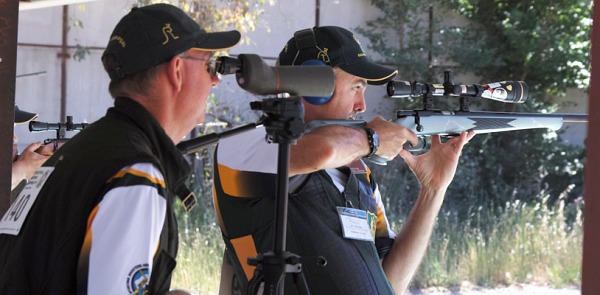
Silhouette Ace Eric Mietenkorte Shooting Smallbore Silhouette — Perfect Form:
Now There Are Multiple Disciplines
The actual sport of Silhouette is broken into several different disciplines. High Power Rifle, Smallbore Rifle, Cowboy Lever Action Rifle, Black Powder Cartridge Rifle, Air Rifle, Air Pistol, and Hunter’s Pistol are the basic disciplines. Cowboy Lever Action is broken into three sub-categories to include Smallbore Cowboy Rifle, Pistol Cartridge Cowboy Lever Action, and regular Cowboy Lever Action. Black Powder Cartridge Rifle also has a ‘Scope’ class, and Hunter’s Pistol is broken into four sub-categories. Some clubs also offer Military Rifle Silhouette comps.
Where to Shoot Silhouette
NRA-Sanctioned matches are found at gun clubs nation-wide. There are also many State, Regional, and National matches across the country as well. You can find match listings on the Shooting Sports USA website or contact the NRA Silhouette Department at (703) 267-1465. For more info, visit SteelChickens.com, the #1 website dedicated to Silhouette shooting sports.
When Bigger IS Better — The New .416 Colossus ELR Cartridge
John Pierce, founder of Pierce Engineering revealed an impressive new cartridge developed for the ELR (Extreme Long Range) game — the .416 Colossus. This has achieved 3300 fps shooting the Badlands Precision 525gr solid copper projectile (BC: 1.20 G1, .614 G7). Above is a “big rig” designed to shoot this cartridge. This rifle boasts a custom Eliseo chassis with 20X Pierce Engineering action and Krieger barrel. John Pierce noted: “Big thanks to Gary Eliseo for building this special chassis. Pete Contacos owns and tested the rifle and cartridge. He is ecstatic to say the least.”
John Pierce reported on Facebook: “After a long two years of development and waiting to see what results could be achieved, we are very pleased. The Colossus cartridge, designed by Mark Fox and myself, is showing great [results].”
The cartridge boasts impressive velocities. John reports: “Over 3300 fps shooting the Badlands Precision 525gr .416-caliber projectiles. Zero bolt-lift issues from RCC (Robertson Cartridge Co.) brass. [We have] 25 firings on one test piece and still good to go. Big thanks to Dan Warner [at Warner Tool] for making the special, awesome dies.”
More Capacity and Higher Efficiency than .416 Barrett and .416 Warner
One Facebook commenter wanted to know how the .416 Colossus compared to other big .416-caliber cartridges created for the ELR game: “Can you or Mark share the increase in powder capacity over a standard .416 Barrett and over a .416 Warner?” John replied: “I would rather not elaborate on details of cartridge just yet…however it has a bit more capacity and higher efficiency using a large magnum primer.”
Pete Contacos, the rifle’s owner, posted: “I would like to thank everyone who made this possible: John Pierce, Mark Fox, Gary Eliseo, Jeff at RRC Brass, Jason At Badlands Bullets, Dan Warner for dies. This is an AMAZING rifle made possible by all of the above People. THANK YOU ALL… looking forward to seeing you all at the matches this year.”
Gary Eliseo (Competition Machine) is making a similar big chassis for John Pierce. Gary posted: “Yours is almost finished”, to which John replied: “Thank you for the beautiful chassis, exciting to get my Big Red.” Gary has told us that this big new chassis is a scaled-up version of the Competition Machine UMR system. The large Pierce 20X action is epoxied in the chassis, which accepts a Rem-compatible trigger.
About RCC Brass — CNC Machined Quality
RCC manufactures brass cartridges on CNC lathes and mills starting with C272 solid bar stock. RCC reloading brass cartridges are manufactured to SAAMI, CIP, or customer specifications (yes custom cartridge and wildcats can be made). The brass does not use a conventional draw process. This allows the brass to be stronger, according to RCC:
“We machine all our cases on CNC lathes and mills and our case weight, case volume, and our case concentricity are the best available in the industry. We do not anneal the case head as it is hammer-forged to a high tensile strength which gives us the same hardness for each case. Since we use CNC equipment to manufacture our, case weight is nearly identical, the case volume is too, and our case concentricity is held to a 0.001”.
Since we are not held back by the limitations of a [traditional] draw system, we are able to use higher strength alloys to manufacture cartridges. Our C272 brass alloy has a much higher tensile strength and tighter molecular grain structure than C260 brass, without losing the needed elasticity. Test results have been very positive as we’ve had reports of increased in velocity and energy and lower shot deviations versus C260 drawn brass.
We manufacture high-quality reloading brass cartridges for vintage, obsolete, hard to find, and wildcat calibers. All cartridges are made to SAAMI, CIP, or tolerances provided to us. Our unique process allows us to manufacture over 1,500 different cartridges at tolerances up to 0.0005”. We manufacture reloading brass cartridges for any firearm.
We custom fit brass to the chamber of your firearm. Our custom fit program will give you the headspace and chamber dimensions best suited for your firearm. Customers can send us fire-formed brass, a chamber cast, or the firearm for the custom cartridge. We do Wildcats too. Send us a reamer drawing, or a dimensioned drawing and we will manufacture your wildcat cartridge. There is a one time set-up fee for all wildcats and a 100 piece minimum order. We do Custom Headstamps too. We use our CNC mills to engrave headstamps. We are able to do text and some graphics too.”
On August 9, 2021 the Vintage Sniper Team Match returns to Camp Perry, Ohio. We’re glad to see this popular match return after it (and other Nationals events) were cancelled in 2020 due to the Pandemic. This unique Sniper Team event is a two-man team competition using scoped rifles of WWI and WWII Vintage. This has become one of the most popular CMP rifle matches held at Camp Perry, with over 200 teams competing in recent years. Many competitors use some version of the M1903 Springfield, but you’ll also see scoped M1 Garands, M1917s, K31s, Mausers, and even a Lee-Enfield or two. There are both bolt action and semi-auto classifications, with each division being scored separately.
We expect 200+ teams to compete for the Vintage Sniper Trophy this summer. Two-person teams will fire 10 rounds in 20-second intervals from scoped vintage military rifles set on sand bags. One team marksman shoots from the prone position at 300 and 600 yards, while the other serves as a spotter to relay shot position. Marksman and spotter switch positions on the firing lines, allowing each teammate to play both roles. Scores are then combined for an Aggregate team total.
Who can identify this rifle, with its unusual scope mount?
“Walking down the … line one can find a plethora of various rifle models. Although 1903A4 and USMC M1941 builds made up a significant majority of the rifles on the line, other models such as the K98, M1C, M1D, M91/30, Swedish Mausers, and the No4 Mk1 (T) had their place in the hands of various shooters.” — Criterion Barrels Article
Our friends at Criterion Barrels have published a great article about the Vintage Sniper Rifle Match. This story offers a fascinating “insider’s perspective” on the Match, plus Vintage Sniper gunsmithing tips, Anyone considering shooting the Vintage Sniper match for the first time should definitely read this article.
About the Match and the Rifles
The Vintage Sniper Match was the brainchild of Hornady’s Dave Emary. The competition was inspired by his father, a World War II scout sniper, who carried a rifle similar to the 1903A4 rifle builds that can be found today on the Camp Perry firing line. Bob Schanen worked alongside Dave and the CMP staff in establishing the various competition rules prior to the first official Vintage Sniper Match in 2011. The match developers made a point to offer some level of flexibility in rifle configuration, allowing specific types of non-issue optics and rifle rebuilds. This helped make the match more inclusive.
Hornady’s Dave Emary and “Gunny” R. Lee Ermey (RIP):
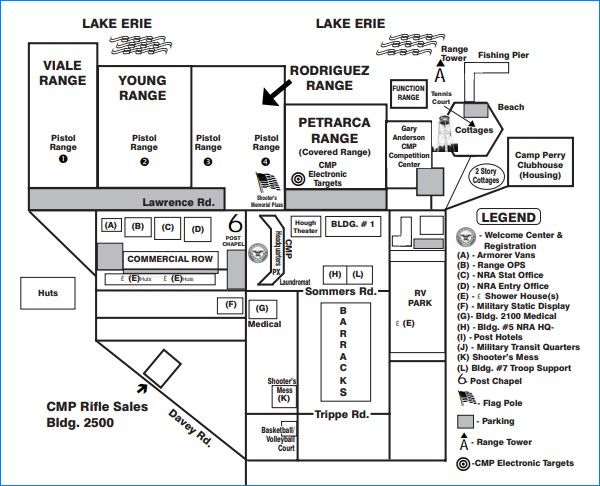
Camp Perry — The Venue
The hallowed grounds of Camp Perry have hosted some of the nation’s finest shooters each summer for more than a century. Some of the world’s greatest marksmen have accomplished remarkable feats on the ranges of this lakeside military outpost. Located on the coast of Lake Erie, Camp Perry is positioned just outside of the scenic town of Port Clinton, Ohio. It is our firm belief that every shooter should make the pilgrimage to the Camp Perry at least once in their lifetime. If not participating in an event, visitors should at least make an attempt to meet the competitors, witness the wide selection of firearms used by participants, and pay a visit to the various vendors on base.
The 2021 NRA National Rifle and Pistol Championships will be held July 6 through August 28, 2021 at Camp Atterbury, Indiana. Registration for the 2021 NRA National Championships for Smallbore Rifle, High Power Rifle, F-Class, and Precision Pistol is now open. Competitors can REGISTER ONLINE for the 2021 NRA National Championships via the NRA Competitive Shooting Web Portal.
The following 2021 NRA Rifle and Pistol Championships will be held at Camp Atterbury this summer, starting with Smallbore Rifle. Camp Atterbury has hosted the High Power Rifle Nationals since 2017. Here is the schedule for the Major events. NOTE: There is NO ELR event this year:
Smallbore Rifle Championship: 6-18 July, 2021
Precision Pistol Championship: 20-25 July, 2021
F-Class Mid-Range Championship: 22-26 July, 2021
F-Class Long Range Championship: 27-30 July, 2021
Fullbore Championship: 1-7 August, 2021
High Power Mid-Range Championship: 9-13 August, 2021
High Power Long Range Championship: 14-19 August, 2021
Over-the-Course (OTC) Competition: 22-28 August, 2021
View Latest Match Calendar (6/18/21) — CLICK TO ZOOM!
Note, this year the Smallbore Nationals will include Rimfire F-Class, starting on July 11th. Among notable specific rifle matches include: Fullbore America Match (August 7); Palma Team Match (August 15); Wimbleton Cup Match (August 18). For 2021, the NRA will NOT host an Extreme Long-Range Championship. Specific start dates are listed at end of article.
In addition to the main NRA matches, there are Indiana State Rifle and Pistol Association (ISRPA) events including: Junior Intermediate Smallbore Clinic, Ladies’ Day on the Range, Family Day on the Range, Basic Safety Class, Introduction to Shooting Sports Class, Laser Range.
Lodging Options at Camp Atterbury — Summer 2021
Shooting Sports USA (SSUSA) recently released information on the NRA Championships at Camp Atterbru. The SSUSA article states: “As for lodging, there are several options. The most convenient are on-base, with Camp Atterbury offering hotel-style buildings with suites, along with standard rooms, and ‘open military squad bay’-style quarters available by reservation. Camp Atterbury also offers a limited number of RV spots, plus the MWR campground and cabins. NOTE: Lodging is controlled by the Camp Atterbury Lodging Office, not the NRA.
Click Photo for Large Map of Camp Atterbury, Indiana
Key NRA Championship Start Dates by Discipline
6 July — Smallbore Nationals 3-Position
11 July — Smallbore Nationals Prone and Rimfire F-Class
17 July — Metric Smallbore Prone and Rimfire F-Class
20 July — Precision Pistol (including Revolver)
22 July — F-Class Mid-Range Individual
26 July — F-Class Mid-Range Team Match
27 July — F-Class Long-Range Individual
29 July — F-Class Long-Range Team Match
1 August — Fullbore Match
7 August — Fullbore America Match
9 August — Midrange Cycle
14 August — Long Range Cycle
15 August — Palma Team Match
16 August — Palma Individual Match
18 August — Wimbleton Cup Match
22 August — OTC (Over the Course) Week
Long Range Competition at Camp Perry
For rifle shooters, the ability to shoot out to 1000 yards on the historic ranges of Camp Perry is a definite “bucket list” item. The CMP invites competitors to test their skills in the CMP’s Long Range events at the National Matches. The series features five full days of competition — all from 1000 yards. To learn more, visit the CMP’s Long Range Info Page.
Camp Perry has been a sought-after destination for marksmen since 1907, when the National Rifle and Pistol Matches moved to the Ohio facility. Since then, it has become a coveted journey for hundreds of thousands of guests through the generations. Learn more about the 2021 Camp Perry National Matches through the CMP website: https://thecmp.org/nationals.
Smallbore Training Provided by USAMU Experts
This summer, the CMP will offer a Smallbore Rifle Small Arms Firing School during the 2021 National Matches. The course, taught by members of the Army Marksmanship Unit, will cover .22 LR rimfire competition and fundamentals. This should be a great opportunity for young smallbore competitors.
Camp Perry’s famous Commercial Row has long been a big attraction at the National Matches. Take a stroll down Commercial Row and check out a wide variety of products and gear for a variety of disciplines, all in one location. CLICK HERE for a list of all 2021 Commercial Row Vendors.
25 Days and Counting…
The 2021 CMP National Matches will get underway very soon. You can get more info, view the Official Match Programs, and Register Online at the CMP National Matches homepage. If you have questions or need assistance with registration, call the CMP at (419) 635-2141.
114 Years of National Match History at Camp Perry
The National Matches have been hosted at Camp Perry since 1907. The National Matches, which have now spanned 114 years and five generations of Americans, have a rich history. Here are two covers of the American Rifleman magazine, from 1931 on the left and 1971 on the right.
History of Camp Perry
Federal legislation originally launched the National Matches. The 1903 legislation also established the National Matches, commissioned the National Trophy and provided funding to support the Matches. The National Matches have been held at Camp Perry since 1907. The range is located along the shores of Lake Erie in northern Ohio near Port Clinton. The site was first acquired in 1906, in response to the need for a larger facility for military training and the NRA’s shooting programs. In 1906 Gen. Ammon B. Crichfield, Adjutant General of Ohio, ordered construction of a new shooting facility on the shores of Lake Erie, 45 miles east of Toledo, Ohio. The original land for Camp Perry was purchased in 1906, and the reservation was named after Commodore Oliver Hazard Perry, the American naval commander who won the Battle of Put-in-Bay during the War of 1812.
On August 19, 1907, Cpl. L. B. Jarrett fired the first shot at the new Camp Perry Training Site. And that year, 1907, Camp Perry held its first National Pistol and Rifle Championship events. This location has hosted the annual National Matches ever since (though they were cancelled in 2020 due to COVID). Typically over 4,000 competitors attend the National Matches each year, making it the most popular shooting competition in the western hemisphere.
The Civilian Marksmanship Program (CMP) has added Mid-Range 3×600 events to its list of local club matches that can be CMP-sanctioned. For the new sanctioned Mid-Range 3×600 matches, clubs may choose to have service rifle and/or match rifle categories. The match and service rifle classifications will be the same used in across-the-course competitions. The rifles used can include Service Rifles, High Power Match Rifles, AR Tactical Rifles, and F-Class Rifles (both F-TR and F-Open).
The CMP notes: “With the 3×600 match, various rifles can compete side by side. Service rifles, match rifles and AR tactical rifles shoot at the regular MR1 600-yard targets. F-Class rifles shoot at the MR-1FC, which is an F-Class target. Scoring rings are similar, making it more difficult, with individuals shooting off of rests and/or bipods.”
Match sanctioning allows CMP Affiliated Clubs to host a number of competitions and clinics, including air rifle, High Power rifle, pistol, rimfire, smallbore rifle and long range disciplines, on their own ranges. CMP’s Long Range program is one of the latest installments to the safety-and-education-based organization and is rapidly growing in popularity.
To sanction a CMP Mid-Range 3×600 event, Affiliated Clubs should visit the CMP Competition Tracker Page. Then click the “Clubs > Sanction Your Club’s Match” option to start a request.
Rifle Specifications for the Mid-Range 3×600 Program:
F-TR (Target Rifle) Classification:
— Rifles chambered for unmodified .223 Rem or .308 Winchester (or NATO equivalents) are permitted.*
— Maximum rifle weight is 18.25 pounds (w/the bipod attached).
— The only front support allowed is a bipod. A sandbag may be used under the rear of the stock.
— Rifles with a 24-inch barrel or longer will suffice. Heavy-barreled factory guns are allowed.
F-Open Classification:
— Open rifles can be chambered for any cartridge up to .35 caliber.
— Rifles must weigh no more than 22 pounds, have a maximum fore-end width of three inches and can be shot using a front tripod rest and separate rear sandbag.
— Rifles may be fired from an adjustable front rest (such as benchrest shooters use), plus a rear sandbag.
— Rifles must be fired from the shoulder, and rail guns are not allowed.
AR Tactical Rifle:
— .223 Rem or .308 Win AR-platform only
— 20-inch max barrel length
— 15-power scope
— Bi-pod or ruck-sack rear rest may be a bag without ears (tactical front rests, such as Harris-type bipods and limited rear rests one might find used in military or police tactical situations).
— There are additional requirements for the AR Stock and grip. **
Other CMP-Sanctioned Match Offerings
The CMP also offers match sanctioning for Long Range 1000-Yard Match, Long Range Palma Match, F-Class Long Range Match, F-Class Palma Match and F-Class 3×600 Match. Learn more about CMP sanctioned matches and clinics at https://thecmp.org/clubs/clinics/.
* The CMP Press release also includes this reference for F-TR: “Rifles may be chambered for any cartridge, not exceeding .308 inches in diameter and not less than .224 inches in diameter.” We don’t know what to make of that statement. Normally F-TR is limited to .223 Rem (5.56x45mm) or .308 Win (7.62x51mm) only. And this would contradict the first part of the CMP class specification.
** The “Tactical” (Military or Police) butt-stock and cheek-piece must be symmetrical (ambidextrous) and in line with the centerline of the bore. The butt-plate must be vertical (perpendicular to the centerline of the bore). The length-of-pull of the stock may be adjustable. Butt-stocks that allow other adjustments, such as the cheek-piece height or butt-plate location, will be allowed. The stock may or may not have a pistol grip. If the stock has a pistol grip, it may not be designed to support the bottom of the trigger hand (hand rest) or extend more than six inches below the centerline of the bore.
The .375 EnABELR cartridge is slightly shorter than a .375 CheyTac so it allows the round to mag-feed. Applied Ballistics is currently using brass made by Peterson. The .375 EnABELR has achieved impressive velocities — 2990 FPS — with prototype Berger 379-grain solid bullets fired from a 1:7″-twist 30″ barrel. Applied Ballistics may also test 1:8″-twist and 1:9″-twist barrels. READ Bullet Testing Report.
The .375 EnABELR cartridge was designed to offer .375 CheyTac performance in a slightly shorter package: “The problem with the .375 CheyTac is that, when loaded with the highest performance .375 caliber bullets (379-407 gr Berger Solids, and the 400-425 grain Cutting Edge Lazers) the round is not magazine feed-able in any action that’s sized for CheyTac cartridges.
“Knowing the .375 CheyTac produced substantial performance, and that it was just too long for magazine feeding, made it easy to converge on a design for the .375 EnABELR. We just had to make the case short enough to achieve magazine length with the desired bullets, while adding a little more diameter to keep the case capacity similar to the .375 CheyTac. The resulting basic shape is quite similar in proportions to the successful .338 Norma Magnum Cartridge which, interestingly, was selected as the cartridge for General Dynamics Lightweight Medium Machine Gun (LWMMG).”
Here is Mitchell Fitzpatrick, shooting the 375 EnABELR in an ELR Competition.
The first Annual V² Finale, held this weekend in Tennessee, has concluded. This new-format match pitted F-Class competitors against each other in a bracket-style double elimination match. This was a very elite field, selected via a Points series. All targets were placed at 1000 yards, with a Euro-Style 5V target. In something unusual for an American F-Class match, ALL shooting was done via PAIR FIRING, with shooters going head-to-head with alternating shots, 15 per shooter in the brackets and then 10 per shooter in the final two-man showdowns for F-TR and F-Open divisions.
The competition was fierce but we have final results of this tough F-Class tournament. Congratulations to the V² Finale 2021 winners who earned fame, glory, and large cash pay-outs: Tracy Hogg (F-TR) and William (Bill) Kolodziej (F-Open). Additional top finishers are listed below, with links for FULL RESULTS below the table.
The event, hosted at the modern Dead Zero Shooting Park in Tennessee, was sponsored by Vihtavuori and Vortex Optics. Along with helping to defray the range costs, these sponsors provided prizes to top shooters. In 2021 shooters qualified for the event through a nationwide points series, with 32 slots for F-Open and 32 slots for F-TR. The match organizers encourage F-Class competitors to shoot points series matches in the future, to qualify for next year’s event: “Earn some points so you can be part of V² Finale II in 2022.”
Big Pay-Outs for Participants
The V² Finale was first and foremost a money match. This event offered the highest payout ever for F-Class competition. Cash awards are distributed to the top 8 shooters for each equipment category, as a percentage of the overall match fee pool. The actual amounts will depend on match fees and attendance. We don’t have final numbers yet but payouts for positions 1-8 in each class were estimated to be:
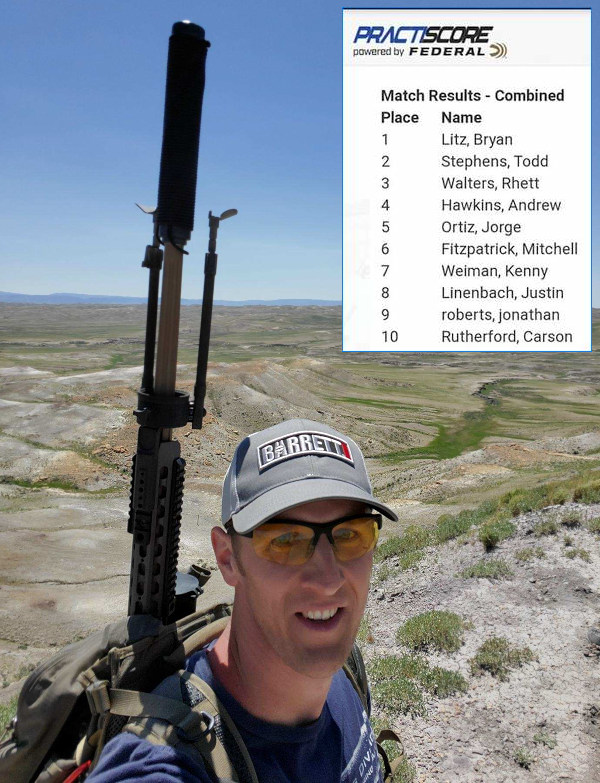
A major ELR match took place this past weekend in Wyoming, the Nightforce ELR Steel Challenge. A familiar name finished first — Applied Ballistics founder Bryan Litz. Bryan had a convincing victory over some 220 other shooters. Bryan earned praise from his colleague and past K02M winner Mitchell Fitzpatrick: “Congrats to Bryan Litz on winning the 2021 Nightforce ELR Steel Challenge! This match is tough, and winning it is no small feat… especially considering there were 221 competitors this year. Bryan and I were both shooting Barrett MRADs in .300 Norma with Nightforce 5-25 ATACR scopes, shooting Berger Bullets 245gr Elite Hunters pushed by VV N565. Absolutely killer combination.”
The match was held June 12-13 2021, at the Tillard 55 Ranch near Casper, Wyoming. This major ELR competition feature some amazing terrain, plus targets out to 2100 yards.
After the match, Bryan told us: “I learned a lot shooting this match last year. Came back with a better plan and more suitable equipment (stock Barrett MRAD in .300 Norma Magnum, Berger 245gr Hybrids, Vihtavuori N565). I also got a lot of great advice from my team-mates who are more experienced in this kind of competition. For ballistics I ran the Garmin Tactix with the Personal Drag Model (PDM) from Radar testing on Friday — it was SPOT ON.
Thanks to Scott Satterlee and his awesome crew of ROs. This match takes a lot of work to set up. Also thank Nick Setting and all the sponsors… especially title sponsor Nightforce. Looking forward to coming back next year!”
Here’s Bryan taping data to his rifle — a tip he got from Chase Stroud.
Personal Drag Models Set with Doppler Radar
Bryan Litz wasn’t just there to compete. Prior to the match Bryan and his Applied Ballistics Team helped competitors develop custom Long Range Ballistics curves for their loads and rifles. This was done with sophisticated Doppler Radar units. As Bryan noted: “Doesn’t get any better than a [ballistics] model built from a Radar track of YOUR bullets from YOUR rifle, the day before the match.”
During Personal Drag Model testing, participants would shot 10 rounds under the Radar. Once the PDM data was gathered, Bryan explained to the testers how to use the custom curve with Applied Ballistics software.
Match Was a Sell-Out with Huge Prize Table
Was this a popular event? Does this ELR stuff generate interest among commercial sponsors?
Absolutely. With 221 shooters, the event was a “sell-out”, with many folks who had to be turned away. The list of sponsors is staggering — over 60 companies — so the prize tables were over-flowing with gear. With great scenery and this treasure trove of prizes, we understand why the match is so popular.
2021 Nightforce ELR Steel Challenge Sponsors
Accuracy International USA
Alamo Precision Rifles
American Precision Arms
American Rifle Company, Inc.
Applied Ballistics LLC
BadRock Rifles
Barrett
Bartlein Barrels, Inc
Bison Tactical
Bix’n Andy USA
Blue Mountain Precision
Brux Barrels
Bullet Central
Burris Optics
Cole-Tac
Cutting Edge Bullets
Defiance Machine
Elite Iron
Foundation Stocks
Garmin
GRAYBOE
Gunwerks
Hawkins Precision
Hawk Hill Custom
Hornady
H-S Precision
Impact Shooting
Kahles North America
Kelbly’s Actions
Kestrel Ballistics
KMW Long Range Solutions
Kreiger Barrels
Leupold Optics
Lilja Precision Rifle Barrels
Lone Peak Arms
Magnetospeed LLC
Modular Driven Technologies – MDT
Mile High Shooting Accessories
Nightforce Optics
Precision Rifle Works
PROOF Research
Really Right Stuff SOAR
Reasor Precision
Sako
Sawtooth Rifles
SilencerCo
SPUHR
SWAROVSKI OPTIK Hunting
Revic
Terminus Actions
Tikka
Timney Triggers
Triggertech
U.S. Optics
Vapor Trails
Warhorse Development
Warner Tool Company
West Texas Ordnance
WieBad.com
XLR Industries
Zermatt Arms
ZRO Delta
Many notable shooting matches are being held this month. As Pandemic restrictions recede, competitive shooters are getting back to the range, and that’s definitely a good thing. F-Classers are competing in Tennessee this weekend (see V² Finale Report), and PRS/NRL aces will be competing in Colorado.
The Colorado tactical match is something new — the inaugural Koenig Shooting Sports Precision Rifle Competition. This challenging event takes place this weekend, June 12-13, at the Cameo Shooting and Education Complex outside Grand Junction, Colorado. Doug Koenig will serve as the match director.
This two-day event is expected to attract some of the best precision rifle competitors in the nation, all vying for points to earn an exclusive spot at the year-end PRS Pro Series Finale. Utilizing the picturesque landscape and natural terrain props found at the Cameo Shooting Complex, each competitor’s skills will be put to the test while engaging an assortment of steel, reactive, and automated moving targets at distances from 300 to over 1000 yards.
“I want to thank Ruger not only for their support but also for their continued commitment to this sport,” commented Koenig. “The introduction of the Ruger Precision Rifle disrupted the world of PRS by making it a much more affordable discipline to participate in, so it is only fitting that they are the presenting sponsor of this exciting event.”
Doug Koenig and the Ruger Precision Rifle
“Koenig” (or König) means “king” in German. That is indeed appropriate for Doug Koenig, 19-Time Bianchi Cup winner, who is now starting to conquer the rifle world as well. Koenig, considered by many to be the best action pistol shooter on the planet, proved he’s an ace with rifles too, as he has had multiple PRS Production Division victories. Koenig, Captain of Team Ruger, shoots a Ruger Precision Rifle (RPR), chambered in 6mm Creedmoor. Notably, Production Division limits rifles to $2000.00 for the gun ($4000.00 overall with scope). You can buy an RPR for around $1350.00 typically ($1320.99 at KyGunCo).
In this video, Gavin Gear Shows How to Accurize a Ruger Precision Rifle:
This Interesting Cut-Away Animation Shows How the Ruger Precision Rifle Functions:


 The NRA Blog ran an feature on Silhouette shooting by NRA Silhouette Program Coordinator Jonathan Leighton. Here are selections from Leighton’s story:
 Metallic Silhouette — A Mexican Import
 Before Steel There Was… Barbeque