V² Finale Double Elimination Tournament at 1000 Yards
A new kind of F-Class Tournament is being held in Tennessee over the next three days. The V² (“V-Squared”) Finale, sponsored by Vihtavuori and Vortex Optics, is a double-elimination shooting match, conducted much like a basketball tournament. There are 32 competitor places each in F-Open Division and F-TR — for 64 places total. In each round there is “pair firing”. Two shooters compete head-to-head with three, 15-round strings, all at 1000 yards. The winner of each two-person match-up proceeds, while the loser goes into a loser’s bracket… so everyone has a second change to win some of the prizes. This event is about more than trophies and glory — it is also about winning big piles of cash — $28,000 in total.
64 shooters, who earned entry with points garnered in previous matches, have been invited to compete for $28,000 in prize monies. The V² Finale is held at the Dead Zero Shooting Park in Tennessee, an impressive, modern facility. The Dead Zero 1000-yard range is equipped with ShotMarker electronic targets. That means that scoring is quick, there is no waiting for targets to be marked, and, importantly, no pit duties for the competitors.
This video, created last year explains the V² Finale Rules and Course of Fire.
The V² Finale itself is conducted over three (3) days. It’s a double-elimination tournament — this means that everybody has the opportunity to shoot at least two matchups. A loss in the primary bracket will seed you into the elimination bracket, where you will have the opportunity to continue on and potentially work your way back to shoot for the overall Championship.
The V² Finale is a pair-fire, best two of three format, with 15-shot strings (45 rounds max per person per bracket). If one shooter wins the first TWO strings, the third string is not fired. The idea behind this pair-firing is to have both competitors for each stage shooting at the exact same time, in the exact same conditions, on the exact same target. The only person you are competing against is the person next to you. The competitors who wins two out of three matches in the matchup will advance.
V² Finale Bracket Match Results
READ THIS!! You can scroll UP and Down with your mouse, and thereby see the Loser’s bracket for both F-Open and F-TR.
READ THIS!! You can use the BRACKET Pull-Down Menu (Upper Right) to select Winner’s and Loser’s Brackets, or choose Top 16 and Top 8.
READ THIS!! You can pull box to left to see more on the right side, using mouse (or finger on smartphone).
READ THIS!! The boxes below are live feeds from the Match Website. Click links below to view Bracket Results on FULL SCREEN.
READ THIS!! This is NOT a static image, it will change as results are filled in. You can come back to this page and see more results as the event progresses.
F-Open Event Results in Real Time — Use Mouse to Scroll!
F-TR Event Results in Real Time — Use Mouse to Scroll!
The V² Finale match, sponsored by Vihtavuori Powders and Vortex Optics, takes place June 11-13 at the Dead Zero Shooting Park in Tennessee. This is a limited-field event for the top 32 F-Open and 32 F-TR competitors who have accrued the most points for the 2020-2021 season. The match will be a double-elimination bracket system (e.g. NCAA March Madness) where shooters are matched up against a single opponent for each round. As opposed to a typical match where you shoot against the entire field, this type of competition allows for two shooters to go head to head pair-fire style, competing under the exact same conditions. No wind alibis. No relay roulette. No excuses. Keep advancing and you will find yourself in the finals where you’ll have a chance to win the prestige of being the best F-Open or F-TR shooter in the country plus some serious prize money and awards.
The V² Finale firing line on 6/11 at the Dead Zero Shooting Park.
Thanks to the generous support from Vihtavuori Powders and Vortex Optics, more than 85% of the entry fees are awarded back to the shooters in the form of cash prizes, awarded all the way down to 8th place for each category. The creators of the V² points series noted: “This type of reward for performance is one of the core reasons why we created the V² Finale and why you won’t find any prize tables.”
Vihtavouri Supports Innovative V² Finale Match Format
“Vihtavuori is honored to partner with Vortex Optics for the inaugural V2 F-Class Point Series Finale. We’re excited to be onsite and support the world’s best long range shooters who will compete in a match they designed themselves,” stated Geoff Esterline, Marketing Director for Capstone Precision Group.
Why Was the F-Class Points Series Created? (Official Statement)
Everyone in the F-Class world knows about their local, state and regional matches and many of those shooters attend the Southwest Nationals and F-Class National Championship each year. These matches are often challenging and feature some of the best shooters in the country at any given time. As great and exciting as those matches are, they have some key limitations – they don’t answer the question of consistency over peak performance. They allow for random chance to play a role in results, in the form of target service, conditions, or “relay roulette”, among other factors. Basically, they don’t allow for a true measure of shooter performance over time, and more specifically, in a true test of head-to-head competition. It was partly with this in mind that we created the F-Class Points Series to collect and award points with the ultimate goal of putting on a one-of-a-kind, limited-field, matchup-style event that will give competitors a format to prove that the best indicator of skill is reliable consistency, not peak performance. A points system will allow us to track consistent performance over the course of a yearlong FPS season, culminating in an invitation to join the limited field of the V² Finale for the top 64 qualifying competitors.
Congratulations to Lapua’s Rimfire Performance Center Manager, Luke Johnson, on winning the Lapua Silhouette Super Shoot. Johnson won the Standard Rifle class with a score of 176 out of a possible 200 and a shot a perfect 40 out of 40 in the Hunter Rifle to win the class with an aggregate score of 185.
With Johnson’s perfect score in Hunter Rifle, he joins the elite 4-member club of registered masters who have shot a perfect score in both Standard and Hunter Rifle silhouette disciplines. Johnson obtained his perfect score in Standard Rifle at the 2017 National Silhouette Championship.
The Lapua Super Shoot took place May 29-30, 2021 at the “Silhouette Capital” of the USA, Ridgway Rifle Club in Ridgway, PA. It consisted of 3 x 120 round relays, all fired from the standing position. For each relay, shooters engage ten chickens at 40 meters, ten pigs at 60 meters, ten turkeys at 77 meters and ten rams at 100 meters.
“This was my 3rd perfect 40/40 of my silhouette career, all have been shot with tested Lapua Center-X,” stated Johnson, “There have only been 10 different competitors to ever fire a perfect score in registered competition. This was a special 40/40 with it being my first in Hunter Rifle class.”
Choosing the Perfect Ammo for His Rifle
Johnson’s Lapua Center-X .22 LR ammunition is matched to his firearms at Lapua’s Rimfire Performance Center indoor facility. Unique lots of ammunition are tested at 50 and 100 meters simultaneously, identifying the best performing ammunition for purchase. This service is available to all shooters who wish to gain a competitive advantage. Readers take note — you can do this type of ammo testing for your own rimfire rifles. CLICK HERE to schedule ammo testing at either of Lapua’s Rimfire Performance Centers located in Mesa, AZ or Marengo, OH.
About Luke Johnson — Past National Silhouette Champion and All-American
Johnson, a native of Marysville, PA, brings a long background of competitive shooting and hunting to Capstone. Johnson is a graduate of the University of Alaska-Fairbanks. While pursuing his Bachelor of Science degree, Luke was a 4-year letterman for the University’s D1 Rifle Team. In addition to his 3P/Prone shooting pedigree, Luke is a High Master rifle silhouette competitor. Highlights of his competitive background include: NRA Smallbore Rifle Silhouette Champion, NCAA & CRCA All-American, USA Junior National Champion (50 meter rifle).
About Lapua Bullets, Brass, and Ammunition
Lapua produces the highest-quality, small-caliber cartridges and components for civilian and professional use. Lapua is a part of the Capstone Precision Group, exclusive U.S. distributor for Berger, Lapua, Vihtavuori and SK-Rimfire products. For more information, visit Lapua.com.
Good news — there is still time to register for the National Matches at Camp Perry, Ohio. Visit the National Matches Registration Page today. These historic matches include High Power Rifle, Long Range Rifle, Vintage Military, Smallbore Rifle, Rimfire Sporter, and Pistol matches. The National Rifle and Pistol Matches have been part of Camp Perry tradition since 1907. After being cancelled in 2020 due to the COVID-19 pandemic, the National Matches will be held again, but with some important changes:
— No First Shot Ceremony
— Squadding Reduced to Half Maximum Capacity
— Limiting Firing Points
— Social Distancing and Mask Wearing
— No Public Awards Ceremonies
About the National Matches
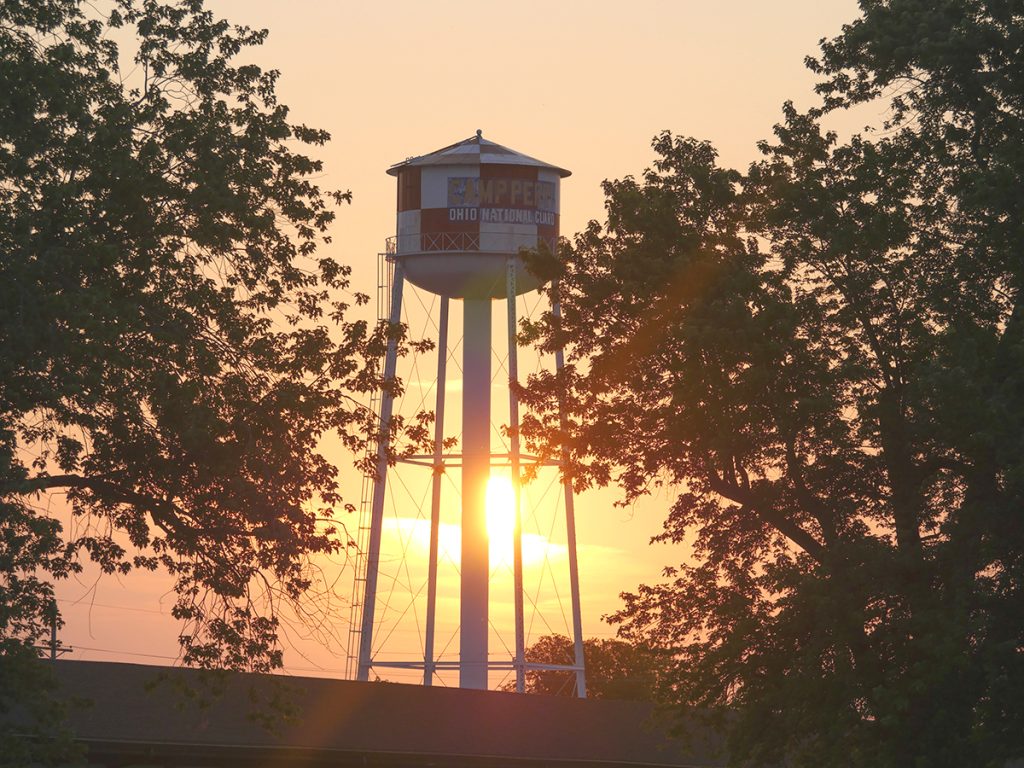
Held annually at Camp Perry, the National Matches include the CMP National Trophy Pistol and Rifle Matches, the Pistol and Rifle Small Arms Firing Schools, the National Games Rifle Matches, the National Smallbore Matches and the National Long Range Matches. These matches are conducted by a partnership of the CMP and Ohio National Guard.
Since their inception, the National Matches have become a huge, national shooting sports festival with well over 4,500 annual participants. Training participants and competitors range from novices to many of the world’s best. This year the CMP National Matches commence July 12, 2021 and conclude August 14, 2021.
National Matches Registration Links and Entry Forums
Housing and Lodging — In the summer of 2021, Camp Perry on-base housing and RV spaces WILL be available. Visit the Camp Perry Lodging Conference Center website for more details and reservation links. This offers very affordable lodging and/or camping options. A barracks bed starts at $16.10/night. Reserve a 4-person hut for $58.65 per night.
Small Arms Firing Schools — We’re informed that the Small Arms Firing Schools (SAFS) are still on the schedule for 2021, with a reduced number of spots available. The CMP suggests you sign up early if you wish to participate.
FIREARM INSPECTIONS
All firearms, to be used in any CMP Games or CMP Service Rifle event, are required to be inspected by a CMP sanctioned armorer prior to any live fire at every event. Competitors will be required to present all applicable scorecards to the CMP Armorer in order to complete the inspection process. Upon completion of the firearm inspection process, each scorecard will receive a stamp of approval from the CMP Armorer, indicating that no safety violations or rules compliance issues were observed at the time of inspection. Each rifle will also receive an inspection tag, verifying participation in the inspection process.
Hornady’s 2021 Zombies in the Heartland 3-Gun Match
Nearly 400 zombie hunters armed with handguns, shotguns, and rifles converged in Grand Island, Nebraska, June 4-6, 2021 to battle the “undead” during the 9th Annual, Zombies in the Heartland 3-Gun Match hosted by Hornady and the Heartland Public Shooting Park.
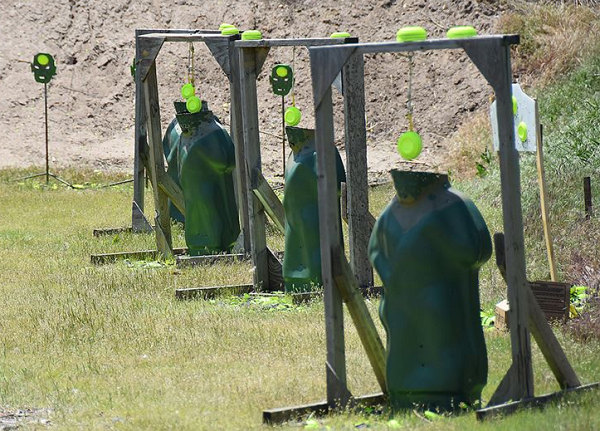
Shooters from 20 different states tested their talent in the 10-stage match. Specially developed reactive zombie targets kept shooters engaged and entertained. Participants shot from a suspended motorcycle, through a burned-out auto yard, and while sitting in a parked pickup truck where shooters were required to turn the wheel to see targets.
The top shooters in each class were:
Open: Jon Wiedell, 1st overall
Tactical: Riley Kropff, 2nd overall
Amateur: Jeremiah Ochsner
PCC: Kelly Neal
Lady: Dakota Overland
Junior: Logan Toland
Senior: Tony Holmes
Super Senior: Jerry Miculek, 3rd overall
“We look forward to this match every year,” said Jeremy Millard, Hornady Engineer and Match Director. “Competitors from many different states travel to this match because they enjoy the environment, stages and camaraderie,” Millard added.
“The Zombie Match would simply not be possible without the help of our amazing volunteers” said Steve Hornady, President. “In addition, all of the sponsors that donate to this match – thank you. We had a prize table valued at $130,000 this year, that’s incredible,” Hornady added.
Zombies in the Heartland Highlights Video. This well-made 2017 video is worth watching! This video offers Shooter’s POV views of many stages including full auto:
Ace silhouette shooter Erich Mietenkorte (Team SK/Lapua) offers this report from Montana. Erich took top honors in Centerfire Silhouette (both standard and hunter rifle), while earning a first and second in the rimfire classes. Here is Erich’s report:
There’s a reason they call it the “Iron Man” Regional Silhouette Championship — shooting eight rifle matches over two days is no easy task! The four smallbore matches on Saturday were met with very windy conditions but I was able to shoot through it to finish 1st in standard rifle and 2nd in hunter rifle.
Great Conditions for Centerfire Matches
The wind died down on Sunday and we had great conditions for the High Power rifle events (bolt-action centerfire). Four matches later I finished first in both standard and hunter rifle classes. After the scores from all eight matches were totaled up, I finished first overall and won the “Iron Man” Aggregate trophy.
These results wouldn’t be possible without the amazing products from SK Ammunition, Lapua, Berger Bullets, and Vihtavuori Powders. Thank you for your support!
Thanks to all of the people who put on a great match at the beautiful Deep Creek Range in Missoula, Montana. All of your hard work is truly appreciated!
Fans of PRS/NRL competition should check out this Armageddon Cup show. Shooting USA offers a special hour-long edition devoted to the second Armageddon Gear AG Cup Invitational. The show airs today, Wednesday 6/9/21 at 9:00 PM Eastern/Pacific (8:00 PM Central) on the Outdoor Channel. You can also stream the show anytime on Vimeo.
The 2020 AG Cup showcased an all-star line-up of tactical talent. 42 of the nation’s top PRS/NRL marksmen were invited to the three-day match at the Arena Training Facility in Georgia. $90,000 was up for grabs at this event — the highest cash payout in the history of rifle competition. There’s $1,000 for the winner of each stage and $50,000 for the overall winner of the Cup.
Watch Video for Highlights of Armageddon Gear Cup Tactical Match:
This full, 48-minute AG CUP episode can be streamed on Vimeo for $0.99. Or you can watch an unlimited number of Shooting USA shows for a $3.99 per month subscription. Click the video above to preview the broadcast.
2020 was the second year of the Armageddon Gear Cup match. With $90,000 in total prizes (and $50K for the Cup Winner) there couldn’t be more excitement or more pressure as the field of 42 competitors is cut down to 12 finalists. Those dozen finalists started Day Three with a clean record in their quest for the Cup title and huge pay-out.
Armageddon Gear Founder Tom Fuller competes in PRS and supervised the 2020 AG Cup.
In this hour-long Shooting USA special, John Scoutten and Armageddon Gear’s Tom Fuller report the action and interview top competitors. The winner of each of the 20 stages received a $1000 cash prize. During the show, you can watch the competitors adapt to challenging stage set-ups and weather conditions. With $1000 at stake for each stage, a single miss can cost serious money!
Arena Training Facility — 2300 Acres
The 2300-acre Arena Training Facility is a premier shooting facility with multiple shooting ranges from 50m to 2100m. Arena’s 1000-yard covered Known Distance range offers multiple benches, steel and paper targets out to 1000 yards. On Arena’s UKD (unknown distance) range shooters can engage steel out to 2300 yards. This 2100m UKD range boasts a 3-Story Shooting Tower, Air-Conditioned Shoot House, and multiple Positional Challenges.
Armageddon Gear — Tactical Accessories Armageddon Gear, founded by former U.S. Army Ranger Tom Fuller, sells support bags, gun cases, slings, suppressor covers, scope covers, and other accessories popular with the PRS/NRL crowd. Armageddon Gear now provides products to the U.S. Military, Law Enforcement, as well as PRS/NRL competitors.
Armageddon Gear Game-Changer Bag
Shooting USA is available On Demand via Vimeo.com. Watch a single episode for $0.99, or get a full-month subscription for $3.99 and watch as many shows as you like with limited commercial interruptions.
It’s great to see normalcy return to our shooting facilities, including Camp Perry. COVID is still a concern, but the ranges are opening up at long last. On May 22, 2021, the CMP hosted a Garand/Springfield/Vintage and Modern Military Rifle (GSMM) Match on the electronic targets of Petrarca Range at Camp Perry.
The CMP’s recreational-style events, like the GSMM Match, are designed to ease interested individuals into the sport. On the firing line are a mix of seasoned competitors and those getting started in marksmanship. They all come together to share a common interest. The match allows shooters to meet old friends and enjoy the company of fellow shooters. And of course there is the fun and challenge of the course of fire.
GSMM matches attract new shooters as well as older competitors. You don’t need to make a huge investment in rifles or optics. We have friends who have done well with a “box stock” 1903 A3 Springfield they acquired from the CMP decades ago
During Petrarca GSMM matches, CMP staff members are always on hand to ensure safety on the firing line and answer questions. This match is fun and efficient. The electronic targets, with monitors at each station, show shot location/score instantly. And there is no pit duty. Competitors never have to venture downrange to change or retrieve targets.
Twenty-five competitors participated in Camp Perry’s May GSMM Rifle event. Similar GSSM matches will be held at the Petrarca Range on June 26 and September 25, 2021. Here are the May Match “Top Guns” by class, with their scores:
M1 Garand: Jeffrey Beierke, Blissfield, Michigan – 277-3X
Springfield: Andy Welter, Westerville, Ohio – 262-6X
Modern Military: Scott Whiteman, Fort Wayne, Indiana – 280-5X
CLICK HERE to learn about the Petrarca Range electronic target system at Camp Perry, Ohio.
The 600-yard target has an X-Ring 6 inches (1 MOA) across, while the 10-Ring spans 12 inches (2 MOA).
The following article is about reloading for NRA/CMP Highpower Rifle competition and is geared toward competitors shooting the AR15 Service Rifle. In Highpower Rifle competition, shooters fire in four stages: Standing slow-fire at 200 yards, Sitting rapid-fire at 200 yards, Prone rapid-fire at 300 yards, and Prone slow-fire at 600 yards. Competitors use a sling for support in all positions but standing. A typical AR15 Service Rifle sports a 20″ free-floated barrel and a 4.5-pound trigger. Service Rifle scopes are limited to maximum power of 4.5X.
Thoughts on Loading for Service Rifles, Particularly for 600 Yards
by Danny Arnold, Team CMP Article originally published in CMP Shooting News
Before we get started, I want to stress that all of the information that follows is geared toward the .223/5.56 Service Rifle. That doesn’t mean that there’s nothing here for anyone else, but the .223/5.56 Service Rifle platform is where I’ve spent the majority of my time, so here we go.
There is only one “Perfect” 600–yard load for my rifle, True or False? This example is more anecdotal than scientific, but it provides some food for thought….
Team CMP spent the early part of March competing in the Orange Blossom Regional. As soon as we got on the range, Sara Rozanski (Team CMP member) started having problems with her 600-yard ammunition. Nearly 1/3 of her cases were exiting the chamber minus the primers. I offered to swap my ammunition for hers, suspecting that my Wylde chamber would be more forgiving than her CLE chamber — a solution that seemed to solve the problem. At least neither of us was blowing primers!
Sara’s ammunition was a factory load using a well-known 80+ grain bullet with an unknown primer and powder, using brass from a respected manufacturer. My load was a different brand of 80-grain bullet, with my choice of powder and primer, all in brass made by someone else. Given the color of the primers, the only thing that our ammunition could possibly have had in common was the brand of powder… maybe. So, how did we shoot?
Sara and I shot the two-person team together and the entire 2,400 Aggregate, although on different relays. Sara’s combined 600-yard score was 780-28X (97.5%). Mine was a 783-24X (97.87%). Our scores were never more than two points apart on any of the four days. Keep in mind that we were using each other’s ammunition the entire time.
So, we had different barrels, chambers and ammunition, but similar results. That goes back to the idea that a good load will perform similarly if fired in a good barrel.
Are We Too Focused on Ballistic Coefficients (BCs)?
The revailing wisdom has always trended toward loading the highest-BC bullet we could find and pushing it as fast as possible. Back in the early ’90s when I got started with the AR15, the 80-grain Sierra was state of the art. Actually, I picked up all of my Leg points with it, although today it looks a bit dated — kinda like me.
So, the question I’ll pose is this: Would you rather shoot a high-BC bullet that groups 3/4-MOA (minute of angle) or a lower-BC bullet that groups into one-half-MOA traveling 50 feet-per-second faster? The reason that I posed this question is a situation I found myself in a decade ago. Our coach decided that he wanted us to pair-fire some 600-yard for practice. Unfortunately, I hadn’t gotten the memo and all that I had available was my normal short-line ammunition, loaded with a 77-grain bullet. The shooter I was paired with was using a higher-BC bullet than I was, but in the end, we both shot 198s.
Admittedly, using 77-grainers meant that coach had to work a little harder to keep us together on target, but it was a teaching moment for me. I knew that my upper shot 77s better than the available bullets in the 80-grain range, so I cranked out a windage table for the 77-grain bullet at 600 yards and shot those for the rest of the season. After all, the wind blows ALL bullets around. It’s just a matter of knowing what YOUR bullet is doing.
With the shortages that we’re experiencing right now, a lighter bullet may be all that you have available for the 2021 season. That doesn’t mean that you’re disadvantaged though.
Danny Arnold teaching Highpower Clinic at 2021 CMP Eastern Games
Loading High-BC Bullets
In the past decade, several bullets have appeared that weigh 80-grains or more. One thing that many of them have in common is a very sharp nose profile, whether metal or polymer. The question is: Are you using the right seating stem?
The jacket material in the bullet’s nose is very thin. If you section a bullet, you’ll find that there is a surprising amount of air space in the nose. If you’re using older seating dies, your seating stem may be contacting the bullet nose too close to the tip, where the jacket is the both thinnest and is unsupported by the lead core. This can manifest itself either as a deformation at the very tip of the bullet or as a circular dent around the bullet nose that you can see and feel with your thumbnail. I think we can all agree that denting a bullet is usually considered a bad thing.
One company goes so far as to recommend their proprietary seating stem for use with their high-BC bullets. Other companies leave it up to you to find a seating stem that will allow the bullet nose to go deeper into the seating stem, moving the contact point further down the bullet where the jacket is thicker and supported by the core material.
Seating Depth and Bullet Preferences
Some bullets don’t mind some “jump” into the lands, but some really do. Unfortunately, manufacturers don’t tell you much about that. Your chamber configuration (Wylde, CLE, or some hybrid of the two) and the bullet that you choose will determine your optimal seating depth. Long and short of it, a quality measuring tool to determine seating depth is a necessity these days. Keep in mind that if you’re doing this with a brand new barrel, the throat is likely going to change slightly in the first 200 rounds and may need to be re-measured. Actually, since all of your short range ammunition has to be loaded to magazine length, you’re probably better off developing your short range loads before starting on long range load development. That gives the throat a chance to wear in a bit on a new barrel.
Brass Prep — Why It Is Important
When match-grade AR15s first arrived on the scene, it was amazing how little it took to get them to shoot well. Other than making sure that I had brass from the same lot and running it through a set of match-grade dies, I did nothing. Of course, we were also using a post front sight. Was the occasional bad shot me, the rifle, the load or just an archaic sighting system?
Transitioning to optics has caused me to reconsider how and what I do in my reloading process: That, and having some extra time on my hands to experiment.
A little (or a lot) of time spent with a neck turning tool, a primer-pocket uniformer and a flash-hole reamer will quickly show you how consistent brass is by manufacturer and even by individual lot. That exercise also makes the prices charged for high-quality brass seem ridiculously cheap. That doesn’t mean that I advocate neck-turning or other uniforming practices, nor do I advocate spending scandalous amounts of money on long-range brass. However, our sport is about consistency. The consistency of your brass is a matter of choice, whether you choose to simply segregate cases by weight (cheap option), neck turn (labor intensive) or open your wallet a little wider for premium brass.
Weighing Charges vs. Throwing with Powder Measure
To measure or weigh? For a long time, I used a powder measure to throw all of my 600-yard loads. The powder I was using metered well, and the results downrange didn’t justify the extra time spent with a scale. That was in the day of iron sights though. Nowadays, I’m throwing my charges and trickling up to the desired weight as measured on a scale that weighs to a 100th of a grain.
To quantify the difference between individually weighing each charge versus throwing charges with a powder measure, I weighed six kernels of powder that I trickled into the pan and then dumped them into the hopper. Going through that process 10 times, I came up with an average weight of .08 grains for six kernels. Next, I threw 50 charges for weighing using my powder measure. If I felt the measure hanging up as it cut kernels, I put the charge back into the hopper without weighing it.
That’s six kernels of powder sitting in the pan — average weight .08 grains.
Those 50 smoothly-thrown charges varied .26 grains from lowest to highest, with the majority varying no more than .16 grains from highest to lowest. If the desired weight was exactly in the middle, at worst you’d be .13 grains (9-10 kernels) low or high, with the majority being off no more than .08 grains (6 kernels) above or below the desired charge weight. Is that enough to send a shot outside the 2-MOA 10-Ring? Probably not.
Has more consistent brass and weighing charges to one-hundredth (0.01) of a grain added up to higher scores? Honestly, this question is hard to answer. Looking at the results on paper at 200 yards, using a powder that meters well combined with a consistent touch on the loading lever doesn’t appear measurably different than meticulously weighing each and every powder charge. Looking back over my 600-yard plots however, I can see a trend toward a group that is closer to X-Ring height.
Since the bullseye is widest at the center, shooting groups that are the height of the X-ring gives you more room for error when the wind is blowing. That can translate into higher 600-yard scores.
How You Load Your Ammunition vs. How You Load Your Rifle
The loading/chambering cycle of the AR-15 is, in a word, violent. You have a relatively heavy bolt and carrier assembly under power of a stout buffer spring slamming forward to chamber each round of ammunition. By design, those rounds were supposed to be held securely by the magazine feed lips until the bolt stripped them off the follower. Obviously, due to their overall length, 600-yard loads can’t be chambered that way. Although the barrel extension is funnel-shaped, it’s also got a lot of “teeth” ringing the inside of it (see below).
Whether you’re using a standard magazine or a single-round loading device (SLED), dropping a round in the loading port and releasing the bolt is an act of faith in that you’re trusting the bullet to arrive in the chamber undamaged.
Ask yourself, how many times have you seen someone drop a round on the follower, press the bolt release and watch as the bolt jammed on a cockeyed round? If that happens once every 100 tries, how many times did the bolt close on a scratched, dented, or misaligned bullet? Could that be the cause of the occasional errant shot?
My technique is to drop each round on top of the SLED and then push it slightly forward with my finger, partially chambering it before releasing the bolt. Admittedly, some people may be unable to do this due to body configuration or left-handedness, but why go to all the trouble of loading “perfect” ammunition and then damage it on the way into the chamber?
Now that we’ve covered bullets, brass, and assorted errata we can move on to discussing loads for 600 Yards…
The NRA Highpower 600-yard target has a 6-inch (1 MOA) X-Ring, and a 12-inch (2 MOA) 10-Ring.
Load Development for 600 Yards
Finding a load for 600 yards is a lot like finding a load for short range. Once I decide on a bullet, powder, primer, velocity range and a measured guesstimate of seating depth, I load 10 rounds of each test load, increasing in 0.2 (2/10) grain increments. I test them from the prone position at 200 yards. Ideally, I want to see two loads that are 0.2 (2/10) of a grain apart that shoot almost identical groups. The load that I choose will fall in between the two best shooting loads that I tested. If the first load is XX.2 grains and the second is XX.4 grains, my chosen load will be XX.3 grains.
Why develop loads in 0.2-grain (tenths) increments if I have a scale that measures in 0.01-grain (hundredths) increments? Or, why not test in 0.1-grain increments?
For me, working in 0.2-grain increments gets me to the results quicker. Also, there is a difference between accuracy and consistency in this scenario. Developing loads in 0.2-grain increments gets me to an accurate load. Producing that load using a scale that accurately measures to .01-grain insures a consistent load, assuming that I do my part.
Once I’ve settled on a load, it’s time to play with seating depth, if I choose to. If I’m lucky and the groups are acceptable as-is, I won’t do anything. If I think there’s room for improvement, I’ll experiment a little. Depending on the bullet, changing the seating depth by a couple of thousandths one way or the other may change the group size. During this phase of testing, it’s a good idea to chamber a round and see if the entire round will then extract. If you leave a bullet stuck in the throat, your rounds are too long. Finding that out at a match can ruin an otherwise good day.
Danny Arnold shooting his AR15 Service Rifle, standing position at 2021 CMP Eastern Games.
Another thing to keep in mind is that your barrel is not static. Every round fired has an effect on the throat, vaporizing and scouring away metal until the distance the bullet travels before meeting the rifling measurably increases. If you have chosen a bullet that shoots best when close to the lands, you’ll need to periodically re-measure and possibly change your bullet seating depth to maintain that optimal relationship.
The Elephant in the Room — User Skill Level
There’s really not a delicate way to put this, so I won’t try. There’s little point in spending time and effort developing a load that shoots into half-MOA off the bench if you’re only capable of shooting 2 MOA using a sling right now.
That doesn’t mean that there’s no hope. On the contrary, it just means that your time and effort is better spent practicing with some good short-range ammunition on reduced targets at a 100 or 200-yard range. At that distance, wind is not a factor and your technique can be improved more quickly so you’re in a position to benefit from that ½ MOA ammunition.
About Team CMP
CMP has created a Highpower Team with top competitors. Team CMP competes at several events throughout the year and most importantly, helps to teach Highpower Clinics at CMP Competition Events. Learn from Team CMP at Camp Perry during the Advanced Highpower Clinic, scheduled this year for July 30 through August 1, 2021. Visit the Highpower Clinic Web Page for more information.
The Civilian Marksmanship Program is a federally-chartered 501(c)(3) non-profit corporation. It is dedicated to firearm safety and marksmanship training and to the promotion of marksmanship competition for citizens of the United States. For more information about the CMP and its programs, visit www.TheCMP.org.
Want to instantly measure your shot groups with precision, just by using your smartphone? You can do this with the excellent, proven Ballistic-X program, which has versions for both Android and Apple (iOS) devices. Ballistic-X is handy, relatively precise, and easy to use. But it does cost $7.99.
If you want to try a group measuring App that is completely FREE, there is a good new Android App called My Shooting from Bokili Production software. This new My Shooting App was created by a match shooter in Europe. It actually offers some cool features not available with most other group-measuring Apps. For example you can measure and display MULTIPLE group sizes on the same screen and keep them all in one file so you can quickly compare group size. There is a radius value in addition to group size (center to center of farthest shots). The App also includes an INFO box where you can display rifle type, sights/optics, ammo caliber, target distance, date, and even wind values and temperature. That’s handy.
FREE APP — You can download My Shooting App from the Google Play Store for FREE. Sorry there is NO Apple iOS/iPhone version at this time.
My Shooting lets you take images and perform all measurements internally within the application. To use the My Shooting App, simply take a photo of the target(s) with your smartphone. Then enter a known dimension on the target (such as the diameter of 10 Ring). Next click a circle on each shot-hole, and then mark the aiming point on the target. The App then does all the calculations, listing the group size in inches or mm (as you prefer). The App also list the Radius of the group, and the group’s Point of Impact (POI) separation from the Point of Aim.*
NOTE: If you enter bullet caliber and target distance, My Shooting App will display the angular measurement in MOA or Milliradians. That can be VERY handy when shooting at long ranges. The “smart” App shows the group’s actual dimension PLUS the equivalent MOA or Mils at your shooting distance. The App lets you choose either imperial (inches/yards) or metric measurements (millimeters/meters).
Bojan Radović, the creator of My Shooting App, is a shooter himself and an AccurateShooter.com visitor. He told us: “I am a shooter and a programmer from Europe. I recently created an Android App that works very precisely to measure a group of hits. The application is free!” NOTE, however, like most free Apps, the My Shooting App does contain small advertisements.
* POI (indicated with “X”) is precisely calculated as the mean value of all hits in relation to the center of the target — i.e. the mean distance from Point of Aim. The POI location reference (e.g. “down-left”) states a directional angle for which you can make a correction on your optical sight. POI displays with an actual distance (mm or inches) and the equivalent MOA or MRAD.
Koenig Triumphs for 19th Time
Team Ruger Captain Doug Koenig has just won the Bianchi Cup (NRA Action Pistol Championship) for the 19th time in his career. That is a remarkable accomplishment, as the the Bianchi Cup is considered by many to be the most unforgiving and difficult pistol competition on the planet. This legendary competition draws the top pistoleros from around the world. The Bianchi is Tough — for a chance to win overall, you basically have to “shoot clean”, with perfect stages.
Koenig won the Open Division and finished First Overall, capturing the title with a final 1920-182 Aggregate — truly impressive. Koenig took the win shooting a Ruger Custom Shop SR1911 Competition pistol. This championship was held at the Green Valley Rifle & Pistol Club in Hallsville, MO.
Koenig nailed perfect scores of 480 on all four Bianchi Cup events: Practical, Barricade, Moving Target and Falling Plates. That quadruple perfect performance earned Koenig an Aggregate score of 1920. In addition he completed the match with 182 total X-Ring hits, six more than the nearest competitor. By the way, Koenig (aka König) means “King” in the German language. There is no question that Koenig is King of the Bianchi Cup.
“Winning the Bianchi Cup title for the 19th time in my career is very special on its own,” said Koenig. “But to do so after the difficult year we’ve all faced, and to do so wearing a Team Ruger jersey, has made this win that much more meaningful for me.”
What skills does it take to win a Bianchi Cup? You need speed, accuracy, control, and discipline. Koenig explains some of these techniques in these two videos below. You’ll find 30 more Doug Koenig Videos on the NSSF YouTube Channel:






 Great Conditions for Centerfire Matches


 Koenig Triumphs for 19th Time


