With spring soon changing to summer, we are in peak varmint season in many parts of the country. In an area with a high number of critters, a semi-auto varmint rifle is a good choice. You get quick follow-up shots, with reliable 20-rd and 30-rd magazines.
For this Saturday at the Movies Showcase we feature a variety of semi-auto, AR-platform rifles chambered for efficient, high-velocity varmint ammo. Cartridges include: .17 WSM, .17 Remington, .20 Practical, .204 Ruger, .22 Grendel, .223 Rem, and 6mm ARC. We conclude with a video that reviews a variety of lead-free .223 Rem ammo types.
Rock Chuck Hunting in Eastern Oregon
This video has some great backcountry footage. The host nails a number of rockchucks with his .223 Rem-chambered AR-15. The shooter says that the default AR-15 cartridge works great for varmints: “The .223 Remington becomes a rockchuck hunter’s friend with the right load: Nosler 40gr Ballistic Tip loaded over a stuffed case of H335 powder. This achieves 3800 FPS with excellent accuracy.”
.17 Remington AR-15 — Small Bullet, Ultra-High Velocity
The .17 Remington wildcat is based on the .223 Remington case necked down to .172″, with the shoulder moved back. High muzzle velocity (4000+ FPS), flat trajectory, and very low recoil are the .17 Remington’s primary attributes. It has a maximum effective range of about 440 yards on prairie dog-sized animals, but the low BCs of the small .17-cal bullets makes them quite susceptible to crosswinds at such distances.
This Varminter.com video was created in spring 2022, just in time for Rockchuck and Thermal Coyote hunts. The host noted: “This was my first experience with the .17 Remington, but I was not unaware of its history and steady popularity among varmint and predator hunters. Although finding an available and affordable .17 Remington bolt-action rifle is nearly impossible nowadays, building one in an AR-15 was simple and straight-forward.” The video has full description of all the components for the build. The .17 Rem is fast — the 25gr bullet runs 3777 FPS from an 18″ barrel (see 01:42 time-mark). READ Full Story.
.17 WSM Rimfire in Franklin Armory F17-L
What’s the ultimate rimfire varmint rifle? An AR chambered for the .17 WSM could be the answer. Eric Mayer of Varminter.com states: “The Franklin Armory F17-L in .17 Winchester Super Magnum (WSM) has a lot of firsts. It is the first semi-automatic rifle in .17 WSM now available to the general public. It is the first gas-piston system, AR-15 rimfire rifle built in partnership between Franklin Armory and Osprey Defense.”
Eric has used the .17 WSM AR shooting ground squirrels, rock squirrels, prairie dogs, and rabbits. Eric notes: “The report of the .17 WSM is nowhere near as loud as most of the centerfire [varmint] cartridges. I found that when I shot the FA-17, it did not cause the other ground squirrels… to run for cover. The lack of recoil … allowed me to see right where I hit [and] if I happened to miss, [low recoil] made for quick corrections for wind, or distance.” READ Full Report
The .17 WSM is a much larger, more powerful round than the .17 HMR. See the size difference above.
Eric Mayer created his own custom .17 WSM AR-15 varmint rifle, built with a Franklin Armory F17-V4 Upper, Aero Precision Lower, and Magpul stock. This was used in California and Arizona. READ Full Story.
.20 Practical — Fast, Accurate, Easy to Form
The .20 Practical cartridge is simply a .223 Rem necked down to .20 caliber. This is a great choice for prairie dogs — and probably our favorite wildcat for the AR-15. Just neck down your .223 Rem brass, fit a .20-Cal barrel and you’re good to go. Robert Whitley notes the the .20 Practical “is a perfect cartridge for varmint hunting and general shooting — very accurate and fast! It functions 100% out of an AR-15.”
The .20 Practical offers some notable advantages for high-volume varmint shooters. The .20 Practical delivers very high velocity with very low recoil while still providing outstanding accuracy. The .20 Practical is great option for folks who favor “fast and light” — smaller, lower-mass bullets traveling at very high velocities. This little cartridge can launch 40-grainers at over 3900 FPS, and 32-grainers even faster. This makes the .20 Practical a great choice for an AR-based varmint rifle.
.20 Practical Ultimate AR Varminter
A decade ago AccurateShooter.com created a .20 Practical AR15 Ultimate Varminter with a custom 20-caliber upper from Robert Whitley of AR-X Enterprises, LLC. That project rifle was ultra-accurate — every 5-shot group out of the gun was less than the size of a dime. That gun was auctioned off, but Robert Whitley continues to produce custom 20 Practical AR-15 uppers.
You make .20 Practical cases by simply necking down .223 Rem brass to .20 caliber. You can start with standard .223 Rem brass and even load with standard .223 Rem dies. Just swap in a smaller expander and use smaller neck bushings.
Prairie Dog Hunt with .204 Ruger AR — Watch The P-Dogs Fly
The video was created during a 2018 prairie dog safari. It has stunning footage of hits on P-Dogs at multiple distances. You can see over FIFTY hits with some amazing P-Dog aerials. Watch the first flyin’ dog at 00:20 time-mark and there’s a truly spectacular gut-busting hit at 3:13. That shows the potency of a high-speed .20-cal projectile. The shooter was using a custom-built AR-15 chambered in a .204 Ruger. That cartridge was driving 35gr Berger hollow point bullets at a stunning 4050 FPS! The rifle was fitted with a Dakota silencer suppressor and many other custom components. If you’ve never tried prairie dog hunting, watch this video start to finish and you may be hooked.
6mm ARC AR-15 Varmint Rig
This Varminter.com video examines the 6mm ARC cartridge from a varmint hunter’s perspective. Created by Hornady, the 6mm ARC was designed for target shooting and medium-sized game both in bolt guns and Modern Sporting Rifles. Hornady states: “The 6mm ARC … fits in an AR-15-pattern action, functions reliably out of standard-capacity 24- or 17-round magazines. It delivers substantially better ballistics than the .223 Rem[.]” This video examines how the 6mm ARC performs in an AR-15 for varmint and predator hunting. The host reviews available factory varmint loads. The video also examines reloading components for the 6mm ARC — brass and bullets. CLICK HERE for full article.
Cottontail Rabbit Hunting with Suppressed .204 Ruger AR-15
As a varmint hunting tool, the .204 Ruger in an AR-15 is a versatile, worthy cartridge/rifle combo for the job. This video covers a cottontail rabbit hunt. The host states that “We were contacted by a farmer who was being slammed with cottontail rabbits eating out huge portions of his alfalfa fields.” This suppressed .204 Ruger AR-15 proved seriously effective on the rabbits, driving high-velocity rounds with impressive accuracy. See more details on the Varminter.com website.
The .22 Grendel is an extremely accurate and efficient cartridge based on the 6.5 Grendel necked down to .22 caliber. The case can drive 55gr varmint bullets at high velocities — over 3500 FPS. With a faster-twist barrel you can load up to 90gr bullets at 2500 FPS. The tester achieved velocities close to a 22-250. The short, fat case fits in AR-15 magazines, but may not feed as reliably during rapid fire. The tester did experience one double-feed.
Lead-Free Ammo Offerings Tested in .223 Rem AR-15
Some states — such as California — prohibit hunting with bullets that contain lead. If you plan to hunt in an area with such restrictions, you’ll need to find a lead-free substitute. Thankfully a number of manufacturers produce ammo with solid brass projectiles or other lead-free bullet designs. This Varminter.com video reviews .223 Remington no-lead ammunition from Cor-Bon, Hornady, Nosler and Winchester. These ammo types were tested in a AR-15 varmint rifle, used in a coyote hunt featured at the end of the video. SEE Full Story on Varminter.com.
Would you like to show your patriotism and honor America with the color scheme of your firearms? Well gun-makers Howa and Citadel now offer patriotic colors for rifles, shotguns, and pistols. A variety of Howa rifles and Citadel guns are offered with a handsome red, white, and blue USA Flag pattern. In addition, there is a grayscale USA flag option for these arms. That grayscale flag is still patriotic, yet less dramatic.
Howa’s USA Flag pattern firearms line-up includes the APC Steel and Carbon Fiber Flag Chassis rifle, the Mini Action Excl Lite, and the TSPX Chassis rifle. On the Howas and the Citadel Trakr rifles, the flag patterns are a rugged, protective Cerakote finish. The Citadel handgun collection offers the USA Flag pattern in the Citadel CP9 9mm series, the Citadel .45 ACP full size 1911, and the Citadel compact .380 Auto 1911. Citadel Trakr .22 LR rimfire rifles are also available with USA Flag and Grayscale options for both semi-auto and bolt-action models.
HOWA Flag Collection
• APC Chassis Series including Steel & Carbon models – 6.5 Creedmoor / .308 Win
• Mini Excl Lite – .223 / 6.5 Grendel / 7.62 x 39 / 6mm ARC / 350 Legend
• TSP X Chassis – 6.5 Creedmoor / .308 Win
CITADEL Flag Collection
• Trakr – .22 LR in Semi Auto & Bolt
• BOSS 25 12-Gauge Shotguns
• 1911 .45 ACP
• 1911 .380 AUTO
• CP9 9mm Series
PDF Product Catalog Available CLICK HERE to view full Howa/Citadel Product Catalog with all patriotic color options. The Citadel Trakr .22 LR Rimfires and Boss 25 shotgun are also available in the USA Flag and Grayscale options. Cerakoted ammo cans in the USA Flag and Grayscale Flag are available with the Citadel handguns.
PMA Tool offers lightweight yet sturdy cleaning cradles that are handy, affordable, and easy to transport. PMA’s popular single-gun cradle, priced at $99.95, is ideal for benchrest and F-Class rigs. It measures about 17″ in length and weighs about one pound. You can choose among 2.25″, 3″, 4″, 5″, and 6″-wide saddles (U-shaped padded supports) to match your forearm width.
PMA also offers an excellent double cradles for $149.95. These twin cradles have 2.5″, 3″, or 4″ saddles, or a combo of 3″ / 2.25″ front saddles. All these cradle types secure your rifle(s) in a muzzle-down position that allows easy cleaning and prevents solvents from running back into the action. The front saddles and all contact surfaces are covered by thick silicone rubber padding which grips the rifle securely yet protects the stock and components from scratches.
These cradles are most commonly sold with a 3″-wide front saddle for Benchrest and F-Open style stocks, or a 2.25″-wide front saddle for rifles with narrower fore-ends such as those found on F-TR, Hunter Class, and varmint stocks. In addition, you can get 4″-wide, 5″-wide, and even 6″-wide saddles for the big, long range benchrest rifles.
Double Rifle Cradle is a Smart, Versatile Design
PMA’s double rifle cleaning cradle was was designed from the ground up to work perfectly for two rifles side-by-side. Using the same tie bar and protective saddles found on the single cradel, PMA widened the base and created new uprights to support the saddles, making the cradle as narrow and light as possible, while retaining all the protective and non-slip features from our single unit.
This PMA Tool double cradle unit is available with twin 3″ front saddles, double 2.5″ front saddles or combination 3″ / 2.25″ front saddle configurations to accommodate different classes of benchrest rifles.
The 6.5 Creedmoor is now one of the most popular cartridges chambered in factory rifles. It found favor among hunters and PRS competitors, but then its little brother the 6mm Creedmoor became widely adopted because the 6mm version delivered less recoil, equivalent or better ballistics, and lower bullet cost.
There’s another Creedmoor cousin, the 22 Creedmoor, basically a 6mm Creedmoor necked down to .224 caliber. While this certainly can be used for PRS and tactical competition, the 22 Creedmoor seems to be ideally suited as a high velocity varmint round — something to replace the 22-250. You get 22-250 class velocities with a more modern cartridge design, and high-quality brass.
LEARN MORE about the 22 Creedmoor
There is an excellent write-up in the GunsAmerica Digest about the 22 Creedmoor cartridge. Reviewer Jeff Cramblit built a 22 Creedmoor rifle and tested it with a variety of bullet weights. He concluded it worked best as a varminter, but could also do PRS duty, provided it is loaded under the 3200 fps velocity limit common in PRS matches. CLICK HERE to read full GunsAmerica 22 Creedmoor test report.
Since there is not yet a SAAMI spec for the 22 Creedmoor, the cartridge is officially still a wildcat. However some ammo-makers have produced 22 Creedmoor loaded ammo: Copper Creek, Gunwerks, and Spark Munitions. Copper Creek has produced the most 22 Creedmoor loaded ammo varieties, with 18 different bullet options from 68 grains to 95 grains, including two lead-free bullet types. However, most everything is “out of stock” right now. Copper Creek also offers load development packs with either Peterson or Hornady brass. Here are five Cooper Creek options with Sierra and Berger bullets:
In addition, multiple companies have offered 22 Creedmoor cartridge brass: Alpha Munitions, Atlas ADG, Hornady, and Peterson Cartridge. The Peterson 22 Creedmoor brass is excellent.
Of course you can neck down high-quality Lapua 6mm Creedmoor brass. Lapua brass has outstanding consistency and durability. Choose from large primer or small primer types. Necking down is a relatively easy one-step operation with a neck-sizing or full-length sizing die. You’re just stepping down to .224 from .243 — not that big of a jump.
22 Creedmoor Brass from Peterson Cartridge
According to Derek Peterson, President of Peterson Cartridge, “We decided to build the tooling to make our .22 Creedmoor brass in response to the uptick in long-distance predator and varmint hunting. Plus the round is just straight-up fun to shoot. It is a low-recoil, flat shooting, wind-bucking round [that is] deadly accurate up to 800 yards.”
“When we designed the tooling for the .22 Creedmoor we set out to make casings with improved features”, Peterson added. “And we were successful. We increased the head hardness to tolerate higher pressures. And we increased our internal volume slightly to work better with the slow-burning powders [such as Reloder 26 or H1000].”
22 Creedmoor for Varmints — Video from the Varmint Fields of Eastern Oregon
Bullet Choices for 22 Creedmoor
If you have an appropriate twist-rate barrel, you can load the 22 Creedmoor with heavy 85-95 grain bullets. However, we think that, for varminting, the cartridge is better suited for lighter 65-80 grain bullets. This yields high velocities that provide explosive impacts on small varmints.
This GunsAmerica photo shows, L to R, 90gr Sierra MK, Hornady 88gr, 80gr, and 75gr .224 caliber bullets.
What is the Best Role for the 22 Creedmoor?
GunsAmerica tester Jeff Cramblit favors the 22 Creedmoor as a varmint round: “The performance of the 22 Creedmoor with 75-80 grain bullets makes it an outstanding varmint cartridge. I’ve seen claims of 80 grain Bergers at 3500 fps out of 26″ barrels, which would be devastating on any varmint. Loaded ammunition is available with bullets in the 70-75 range leaving 24” barrels at velocities around 3400+ fps, a bit more conservative than personal hand-loading, but still making it a very flat shooting, low recoiling round delivering impressive results.”
Jeff says the 22 Creedmoor will also work for PRS with heavier bullets: “I built the 22 CM to be a dual-purpose gun, or actually a 3-purpose gun. The first was for the coyotes and varmints previously mentioned. The second was for shooting PRS (Precision Rifle Series) style matches on occasion, and the third was for hunting deer-sized game. As with any multi-purpose tool there tends to be compromises.”
22 Creedmoor Cartridge Dimensions (No SAAMI Spec Yet)
More Efficient Alternatives — the 22 BR and 22 BRA
If you already have a 6mmBR rifle, and you want a higher velocity cartridge for varmint shooting, you may want to consider just necking down your brass. We’ve shot the 22 BR in the varmint fields and a steel match. This cartridge offers excellent accuracy, and is very flat shooting. We recommend getting a fairly fast-twist barrel so you can shoot the longer, high-BC bullets if you want to use your 22 BR in local matches. You’ll find that shorter 40gr to 66gr varmint bullets shoot great even in the faster-twist barrels.
For more information on the 22 BR for varminting and target shooting, with recommended loads for 40gr to 90gr bullets, read our Accurate Shooter 22 BR Cartridge Guide.
If you want more velocity than a 22 BR offers, you can have your barrel chambered for the 22 BRA (BR Ackley). With its 40-degree shoulder, the 22 BRA offers a few more grains capacity, so you can get more FPS with all classes of bullets. Fire-forming is easy — just use a normal 22 BR load with good bullets and shoot. We’ve fire-formed a 22 BRA in a varmint match and it showed excellent accuracy — there’s no need to waste bullets fire-forming. Go ahead and fire-form during a fun match.
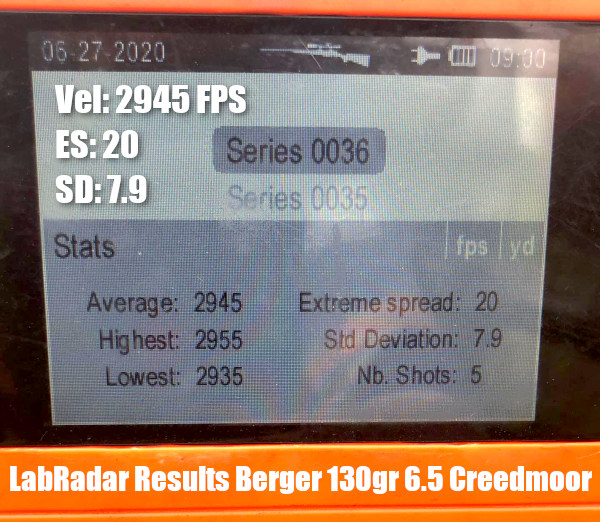
Is factory 6.5 Creedmoor ammunition good enough to win a PRS or NRL competition? The answer is a resounding “YES” if we’re talking about Berger ammunition. Produced with Berger match bullets and premium Lapua brass, this Berger 6.5 Creedmoor ammunition demonstrated excellent accuracy, impressive velocity, and very good ES/SD numbers. When tested at 1000 yards with an MPA-stocked PRS rig with Rem 700 action, this ammo showed just half-MOA of vertical, and produced a group that would have been a 50-1X in F-Class competition. That’s quite impressive for a PRS rig.
This ammo test was performed by our friend Erik Cortina from Texas. The reigning SW Nationals F-Open champion, Erik is a top F-Class competitor who also shoots tactical matches (for fun and glory). A couple seasons back, Erik built a new 6.5 Creedmoor with a Remington 700 action. Though this rifle sports a top-shelf MPA chassis and premium Kahles scope, Erik calls this his “budget build” because it has a plain Rem 700 factory action rather than the elite Borden actions he normally runs. Erik’s actions of choice are the Borden Mountaineer for PRS and Borden BRM-XD for F-Class.
Erik posted: “Shot my budget 6.5 Creedmoor … with Berger Bullets factory ammo. I shot five rounds over the chrono to get speed. I used BC info from the box and it all lined up properly. I adjusted my ECTuner to tune load and it took just 15 shots to get it shooting well. It’s simple with good components.”
This Berger factory ammo features Berger 130gr Hybrid OTM Tactical bullets. The Lapua 6.5 Creedmoor cases have a large rifle primer. You can see this ammo displays good velocity with Extreme Spread and Standard Deviation rivaling good hand-loads.
Cortina says the very accurate Brux barrel and razor-sharp 6-24x56mm Kahles scope help achieve this kind of outstanding performance at 1000 yards. Here are the key components for Erik’s latest PRS rig:
Barrel Tuner by Erik Cortina — Fits Behind Muzzle Brake
This rifle features a barrel tuner designed and crafted by Erik Cortina. You can the EC Barrel Tuner alone, or, as you can see, the EC Tuner can be fitted BEHIND a muzzle brake. Erik tells us: “The EC Tuner allowed me to tune the barrel to my ammo rather than tuning the ammo for barrel as is done when reloading. With the tuner, there is no need to try different brands of ammo as they can all be tuned to shoot as good as possible in my rifle.”
We like well-executed DIY (Do-It-Yourself) projects. You can save money with DIY projects, and often create something unique and special that can’t be purchased from any vendor. That’s the case with this very cool double shooting bench built by Jacob D., a pilot and 6.5 Creedmoor shooter. The design of the bench is smart — it allows two right-handed shooters, but it can also handle a right-hander and a left-hander. (The lefty sets up in the right half of the bench.)
Jacob, who flies for Arizona’s Mesa Airlines, built his own side-by-side benchrest shooting bench. He then posted photos of this on the 6.5 Creedmoor Group Facebook Page. We like this — very nice work Jacob!
Jacob writes: “Sighting in my new Ruger Precision Rifle with Leupold VX3i LRP 6.5-20x50mm and Burris tactical rings, using my benchrest table I built. Very happy with the combo!”
There is plenty of room for two shooters and two rifles on Jacob’s big and sturdy DIY shooting bench.
Do you own an RCBS electronic powder dispenser? If you do, take the time to watch this ChargeMaster Tuning video from 8541 Tactical. This nine-minute video demonstrates how to re-program your ChargeMaster to “tune” the dispensing process. The video shows the exact programming procedures to follow, step-by-step. Some folks want a faster powder flow — others tune their machines for a more reliable drop (with fewer over-runs). One cheap and popular modification is to insert a 1″-long section of a McDonald’s plastic straw in the ChargeMaster’s silver dispensing tube. This works surprisingly well to smooth kernel drop and prevent “clumping” that can cause an over-charge. The McDonald’s straw MOD is demonstrated in this video, starting at the 6:22 mark.
Large-Diameter Dispensing Tube Mod
Many folks have had success with the McDonald’s straw modification demonstrated in the above video. However, some folks would like to get even better flow performance (with virtually no clumping). Forum Member Frank B. has come up with a new option using a brass hose fitting with a large outside diameter. The hose fitting (with tape wrapped around the barbed nose section) is placed inside the RCBS dispensing tube (have some kind of wrap — you don’t want metal-on-metal). Here’s how the unit looks installed:
Frank tells us: “I have found a cure for the over-throw problem. It is a simple 1/4″ barbed hose nipple. I wrapped a couple layers of tape around the barbed end for a snug fit. With this in place, I have thrown 100+ charges of Varget without a single overthrow. The ID of the barbed end needs to be approximately 3/16″ to feed a steady flow. This works because of the larger ID at the drop.”
Frank adds: “You can see in the photo that the powder is not stacking up. You can watch it drop one grain at a time. Hope this will take the aggravation out of your case charging.” For best performance with this brass fitting MOD, we recommend de-burring and smoothing out the front edge of the brass fitting over which the kernels drop.
Brass fitting mod suggested by Boyd Allen. We welcome reader submissions.
ZEISS Announces Spring Binoculars Promotion
ZEISS, the respected German optics maker, has kicked off its “Spring into Savings” event through participating ZEISS authorized retailers. This promotion runs April 15 through May 15, 2023, offering major instant savings on high quality ZEISS Binoculars. And when you purchase ZEISS binoculars from EuroOptic.com, you get speedy RED Expedited Shipping. Here are the Spring Savings Instant Rebate offers on ZEISS Binoculars:
$150 Instant Rebate on ZEISS SFL 40 Binoculars
$100 Instant Rebate on ZEISS Conquest HD 42 and 22 Binoculars
$75 Instant Rebate on ZEISS Terra ED 42 and 32 Binoculars
Optimized to be lightweight and compact, ZEISS SFL 40 binoculars offer Ultra-High-Definition (UHD) glass for true-to-life color reproduction and the highest levels of detail. And with SmartFocus the focus wheel provides fast and precise focusing — even with gloves on. The lightweight magnesium housing provides long-lasting durability.
ZEISS Conquest HD 42 and 32 binoculars have an ergonomic design plus a rugged, lightweight magnesium body that is waterproof and fog-proof. The large focusing wheel is easy to operate. Conquest HD binoculars offer 90% light transmission and superior optical clarity for impressive dusk to dark performance. Conquest HD binoculars are a good choice for hunters for whom reduced size and weight are key.
ZEISS Terra ED binoculars are reliable, easy to use, and quite affordable (starting at $374.99 on sale). These have a sleek, light, compact design that still offers excellent clarity and sharpness. The Terra ED binoculars are waterproof and nitrogen-filled, making them ready for any adventure.
At the request of our readers, we provide select “Deals of the Week”. Every Sunday afternoon or Monday morning we offer our Best Bargain selections. Here are some of the best deals on firearms, hardware, reloading components, optics, and shooting accessories. Be aware that sale prices are subject to change, and once clearance inventory is sold, it’s gone for good. You snooze you lose.
NOTE: All listed products are for sale to persons 18 years of age or older. No products are intended for use by minors.
1. EuroOptic — Christensen Arms Precision Rifle, $1685.99 in cart
⏺ Excellent modern chassis rifle for PRS and NRL in 6mm Creedmoor
Here’s a rifle that’s ready-to-go for PRS/NRL competition out of the box. The Christensen Arms Modern Precision Rifle has an advanced aluminum chassis with folding buttstock. This black-finish version has a 24″ steel 1:8″-twist barrel chambered for 6mm Creedmoor — a good choice for competition. NOTE: This rifle has a listed $1899.99 MSRP. However, if you put the item in the shopping cart, the actual price is reduced to $1685.99, a $214 savings. That’s a good deal for a rifle of this quality, known to have excellent accuracy.
2. CMP eStore — .30-06 Springfield M2 Surplus Ammo SALE
⏺ Quality Lake City .30-06 Springfield ammo at great price
The Civilian Marksmanship Program (CMP) just released some U.S. Military Surplus ammunition at very attractive prices. You can get 400 rounds of .30-06 Springfield M2 Ball ammo for just $392.00 plus $21 shipping. This 150gr FMJ non-corrosive ammo was produced at the Lake City Ammunition Plant in the mid 60s to early 70s. This is quality ammo with excellent brass that works great for reloads once the primer crimp is removed. NOTE — there is a limit of ONE 400-round can per customer per year.
3. EuroOptic — Leica 6X Zoom Scopes, 40-42% Off
⏺ Great deal on superb long-range hunting/varminting scopes
Here are two very high-quality Leica riflescopes at big discounts. These are SFP optics with 0.1 Milrad clicks. With an amazing 6X zoom ration, there is a huge field of view at the 2.5X base magnification. Then you have 15X on the other end for long shots. The 56mm objective version is now $919.99 on sale, a 42% savings off the $1599.99 price, while the version with a 50mm objective is $899.99, a 40% discount off the regular $1499.99 price. With these deals you can save over $600 — enough to buy a rifle.
4. J&G Sales — Norma Tac-22 .22 LR 500rds, $38.95
⏺ Very good .22 LR ammo at extremely low price — GREAT VALUE
If you love .22 LR rimfires and want quality ammo at an ultra-low price, grab some Norma TAC-22. At $38.95 for 500 rounds (i.e. $3.89 per 50-ct box), this is a true bargain, yet the TAC-22 is good enough for NRL22 matches as well as fun target shooting. We’ve shot this Norma ammo and been very satisfied. You’ll be hard-pressed to find better .22 LR ammo at anywhere near this price. Don’t delay ordering — at this price, we expect this TAC-22 ammo will sell out soon.
⏺ Super deal on Hornady .224 bullets for ARs and varmint rifles
Need .224 bullets for a varmint safari or service rifle training? Here’ss a great deal on good quality Hornady .224 caliber bullets. Get 250 55gr FMJ BT bullets for $24.99. For varmint work, get the 250 55gr Soft Point bullets for $27.49. If you want a slightly higher BC, try the 62gr FMJ at $26.99 for 250. These prices are great — $24.99 for 250 works out to just $0.10 (ten cents) per bullet. You can’t beat that!
6. Amazon — MOZETO Shooting Mat, $39.99
⏺ Nice 78″-long padded nylon mat stows conveniently
Whether in the field or at the range, having a comfortable mat to keep you and your gear dry and clean is critical. The Mozeto XL Shooting Mat is made from durable 1000D nylon with EPE padding fabric for long-lasting durability. There is an extra-thick padded section for elbows and knees. This big 78″ x 28.5″ mat has convenient straps and carry handle, plus storage pockets. To transport, just roll it up, fold it over and attach the quick release plastic snap buckles.
7. Palmetto SA — Leupold Laser Rangefinder, Binoculars, and Carry Harness Kit, $279.99
⏺ Excellet combo bundle with laser RF, binoculars, and handy carry harness
Here’s a great combo package for hunters. A hunter in the field looking for deer and other large game needs a rangefinder, binoculars, and a way to transport them securely. A great option is this Leupold Bundle Trio featuring the RX-1400I TBR/W Rangefinder, BX-1 Timberline 10X42 Binoculars, and Go Afield Harness. The combo price for all three items, just $279.99, is a great value.
8. Natchez — Frankford Quick-N-Easy Case Tumbler Kit, $79.99
⏺ We’ve used this Combo Kit for many seasons — grab this super deal now
Keeping your brass clean is important (and essential if you anneal). If you’re looking for a new, affordable setup to clean cartridge brass, consider the Frankford Arsenal Quick-N-EZ Case Tumbler Master Kit. You get everything needed to dry-tumble your brass and remove the media. This is all available now for a very low $79.99. You could pay that much for a good vibratory tumbler alone, yet this combo kit includes tumbler, media separator, bucket, brass polish, and media. NOTE: This very same Tumbler Kit is currently $102.99 at MidwayUSA!
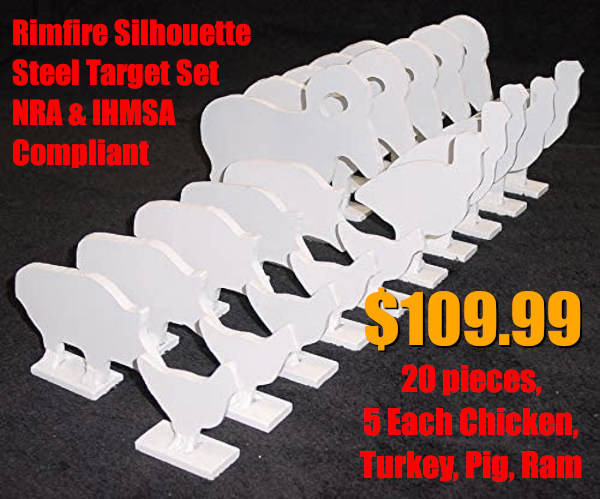
⏺ GREAT Deal on rimfire silhouette steel target 20-Pack
There are few things as fun as plinking with a .22 LR Rimfire rig at steel targets. It’s fun for kids and adults alike and right now you can grab a 20-ct pack of RIMFIRE animal targets in assorted sizes and shapes. They are 1/5 size and made from A36 steel plate. IMPORTANT: These small steel targets work great for rimfire shooting, but should NEVER be used with centerfire rifle cartridges.
10. EZ-AIM 12″x12″ Grid with Orange Bulls — $6.85 for 13-pack
⏺ High quality grid target at good price
We like this EZ-Aim Sight-in Grid Target for sighting-in, load development. and general practice. The full 12″x12″ target is covered with a precise black-lined grid on white background. There is a large center orange bullseye, plus four additional bulls, one in each corner. Right now this target is a bargain. You can get a 13-pack of targets for $6.85 — about 53 cents per target.
NRA Annual Meetings & Exhibits The NRA Annual Meetings & Exhibits in Indiana proved a popular and successful event. There were over 600 exhibitors showcasing a huge variety of firearms, optics, hunting gear, and other products.
NRA member attendance was excellent, with large crowds in the Exhibit Halls, and long lines to attend the major speaking events, which included an address by former President Donald Trump at the NRA-ILA Leadership Forum.
Forum members who attended said the “vibe” at the event was very positive, with strong attendance. That’s a good sign for the future. The 2024 NRA Annual Meetings & Exhibits will be held in Dallas, Texas. That should prove a very popular venue.
There were many new guns and optics on display. The GunsAmerica Digest team has reports on multiple new (or recently introduced) products. You can see a dozen videos from the 2023 NRA Show on the GunsAmerica YouTube Channel. GunsAmerica Digest Editor True Pearce was impressed with a new semi-auto rifle from IWI, which has some real advantages over AR-platform rifles. The new IWI Carmel Rifle has an adaptable chassis, and can switch between normal and suppressor modes.
“This new semiautomatic rifle [from IWI] features a short-stroke gas piston system and a locking, rotating bolt system for maximum safety…. The Carmel rifle is fully ambidextrous, making it easily customizable with MLOK rails at the 3, 6, and 9 positions for compatibility with various accessories. It also has a 2-position gas regulator, allowing the user to switch between regular and suppressor mode. The rifle’s cold hammer-forged, chrome-lined, free-floating barrel enhances accuracy and prolongs the life cycle of the weapon.” — GunsAmerica Digest, by S.H. Blannelberry.
GunsAmerica Digest Editor True Pearce also visited the CZ booth to check out the brand new Scorpion 3+, which is available in three versions. Micro with 4.2″; Pistol with 7.8″ barrel, and Carbine with 16.3″ barrel.
New Pistols and Colt Rifle on Display at NRA Show
The NRA’s American Rifleman magazine has also featured five new guns on display at the NRA Exhibit Hall: Colt CBX TacHunter rifle; FN America Reflex compact pistol; EAA Girsan MC 14T .380 ACP pistol; Henry Big Boy revolver; and Kimber KDS9 Double-Stack pistol.
Here is the new Colt CBX TacHunter rifle, the first rifle offering from Colt in many years. Price at $999 MSRP, the Colt CBX has some notable features:
“A flat-bottom receiver is designed to reduce flexing, which helps to aid precision shooting. The gun’s action features a short, 60-degree bolt throw for fast follow-up shots while also providing clearance for mounted optics. Users will also find an ambidextrous magazine-release latch, three sling-swivel studs, angled pistol-grip stock and textured gripping surfaces. The TacHunter is available in .308 Win.”– American Rifleman
Silencer Central Takes ATF eForm Applications at NRA Show The Silencer Central booth was swamped, and one staff member reported they expect to process the paperwork for anywhere from 500 to 700 suppressors. Photo by P. Erhardt.
Paul Erhardt of the Outdoor Wire Digital Network* was impressed by the turn-out of members at the NRA Meetings: “What many people don’t realize about the NRA Show is that it is actually not just a consumer expo but a real selling show. Obviously not for firearms or ammunition, but just about everything else that isn’t regulated or restricted is being sold, and most often at show special pricing. Several exhibitors that had retail operations in their booths were slammed with customers during the opening hours of the show.
But perhaps nothing compared to the frenzy at the Silencer Central booth where they were helping customers prepare and submit their ATF eForms for suppressor purchases. Customers were backed up into the booth as they waited their turn at the two banks of laptops and digital fingerprint scanners used to process paperwork which is now taking on average 270 days for the ATF to process.”
CLICK HERE for Full Shooting Wire NRA Show Report with 10 Show Photos and more products.
* The Shooting Wire is a free email newsletter that is published every Monday, Wednesday and Friday. The Shooting Wire is part of the Outdoor Wire Digital Network which is comprised of 10 individual wires, as well as a Spanish language edition of The Outdoor Wire.


 .20 Practical Ultimate AR Varminter


 • Trakr – .22 LR in Semi Auto & Bolt


 If you already have a 6mmBR rifle, and you want a higher velocity cartridge for varmint shooting, you may want to consider just necking down your brass. We’ve shot the 22 BR in the varmint fields and a steel match. This cartridge offers excellent accuracy, and is very flat shooting. We recommend getting a fairly fast-twist barrel so you can shoot the longer, high-BC bullets if you want to use your 22 BR in local matches. You’ll find that shorter 40gr to 66gr varmint bullets shoot great even in the faster-twist barrels.


 Cortina says the very accurate Brux barrel and razor-sharp 6-24x56mm Kahles scope help achieve this kind of outstanding performance at 1000 yards. Here are the key components for Erik’s latest PRS rig: