This photograph and all images for this story are by Bill White, aka “CT10Ring” in our Forum.
AccurateShooter Forum member Bill White (aka “CT10Ring”) is not your typical member. For 37 years, Bill worked in NYC as a studio photographer specializing in still lifes and products. A neighbor visiting Bill’s home in Connecticut with a .270 Sako inspired Bill to revive his interest (obsession?) with shooting after a 25-year drought. And he owns a few Sakos now! With his gun hobby renewed, for many years Bill drove to the Western USA to shoot long range steel and a LOT of prairie dogs in season. He loved the life of the varminter, so it made sense for him to move West after retiring. He choose Idaho as his new home.
From his Idaho base, Bill enjoys long-range target shooting. But his favorite gun pastime has been varmint hunting in nearby states — the Dakotas, Montana, and Wyoming. Bill found prairie dog shooting rewarding and mapped out a western circuit route of ranches and National Grasslands in SD, ND, MT, and WY. Every year he loads up his truck and hits the road, often doing a grand circle route, visiting prairie dog havens in multiple states. In this article we feature photos from Bill’s annual “grand circle” varmint safari.
For his many cartridge types, Bill learned about reloading methods, loads, and vendors (and more) primarily from AccurateShooter.com. We start today’s story with the biggest caliber rifle he shoots regularly, his 6.5-284 Winchester. Bill favors this rig for his long-range steel shooting. He also uses it for prairie dog shooting, but only “sparingly”, because he wants to preserve barrel life, and he has many other dedicated varmint rigs.
6.5-284 for Long Range Steel Targets (and Sometimes Varmints)
In his home state of Idaho, Bill likes to shoot steel at long range. For distance work, Bill favors his McMillan-stocked 6.5-284 Win. This rifle was crafted in 2012 by Bob Green of York, PA, using a 1:8″-twist 28″ Krieger HV barrel (.298″ neck). The trued Rem 700 action was purchased from Long Rifles in Sturgis, SD. Bill did the Cerakote and bedded the action. For his 6.5-284, Bill loads 139gr Lapua Scenars, H4831sc powder and BR2 primers. He shoots both steel and varmints with this rifle, but the varmint work is limited because the 6.5-284 cartridge tends to be a barrel burner. The photo below from an Idaho range was taken near a 500-yard target, looking back at the firing line.
In the Varmint Fields — Traveling Light
Once situated, Bill (shown above) prefers to walk to Prairie Dog towns with a shooting mat, two bipod-equipped rifles slung up, rear bag, water, and his trusty Leica 10X42 GeoVid binoculars. While he has used a portable bench, he prefers to shoot from bipod, firing down from a mound if possible. This allows him to set up a line-of-fire that minimizes cross-wind effects. Bill notes: “While I often start early, end-of-day shooting has worked worked well for me. A setting sun shows targets better, the wind is usually down, and it’s not so hot. Often you can spot the bullet trace and that’s fun.”
Eight Great Varmint Cartridge Types — .204, .224, .243 Calibers
Here is one of Bill Reid’s 6mmBR (6BR) rigs. Like his Sako 6 PPC, this is exceptionally accurate.
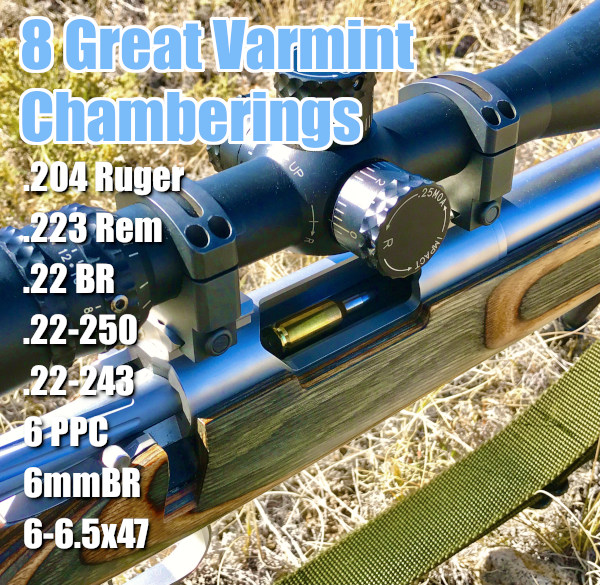
Bill has a large rifle collection, most of which see duty in the varmint fields of Montana, North Dakota, South Dakota, and Wyoming. Here are his key “take-aways” for his eight favorite varmint chamberings: .204 Ruger, .223 Rem, .22-250, .22 BR, .22-243, 6 PPC, 6mmBR, and 6-6.5×47 Lapua (aka 6×47).
.204 Ruger — This delivers great velocity with the little .20-caliber bullets, with mild recoil. The .204 Ruger easily reaches out to 400 yards, but heavier winds do move the tiny bullet around. Tremendous splat factor under 250 yards. I use Sierra 39gr bullets with IMR 8208 XBR in a Sako 75. Even now, .204 Ruger ammo is relatively easy to find.
.223 Remington — Probably the most popular centerfire rifle round in the USA, the .223 Rem offers inexpensive brass, and is a great choice for AR-15 owners. If you run short on ammo, you can find it nearly everywhere. I often bring one AR-15 and one .223 Rem bolt gun on varmint safaris. My Rem 700 5R 1:9″-twist barrel likes 53gr V-Max bullets.
.22 BR — My .22 BR is my first choice for most prairie dog missions. Accuracy is superb with necked-down 6mmBR Lapua brass — quarter-MOA and blazing fast. With the right twist rate, this chambering can shoot anything from 40gr FB bullets to 80gr VLDs. Load development is easy. Below is my .22 BR ammo for another varmint trip. I use 55gr Sierra BlitzKings with Varget in my 1:12″-twist Shilen-barreled rifle. 60gr Bergers are very accurate with a fairly flat trajectory for useful distances.
.22-250 Rem — A classic varmint cartridge, the .22-250 with 50gr V-Maxs delivers spectacular hits. If three P-Dogs happen to be lined up, I’ve witnessed one .22-250 shot take ‘em all out with a triple hit. I currently have five .22-250-chambered rifles: 3 Sako 75s, one Rem 700, and a single shot Nesika that shoots tiny groups. I favor the very deadly Berger 52gr Varmint HP. Making a custom .22-250? With a 1:8″-twist barrel you can use the full weight range of .22-cal bullets, while spinning the lighter bullets fast for “red mist” effect. Remember this cartridge can be a barrel burner. Don’t shoot too many rounds too quickly.
.22-243 Win — This wildcat is even more potent than the .22-250, delivering devastating results on P-Dogs. Run a .243 Win case slowly through a full-length .22-243 die, with plenty of lube to form the brass. I start with Lapua .243 Win brass. There can be some issues necking-down the brass. Watch for donuts forming at the neck-shoulder junction. I bought my .22-243 rifle not sure how it would perform. But now I love shooting it. My .22-243 delivers half-MOA groups with 41.0 grains RL-22 and Hornady 75gr Amax bullets. With those 75-grainers, it’s great in the wind and good to 600 yards easily.
6 PPC — You may consider the 6 PPC a benchrest competition cartridge only, requiring fire-forming. However I have an original Sako 75 single-shot 6 PPC rifle that I load with Sako-headstamp 6 PPC brass (see below) so no fire-forming is required. This Sako 75 came with a test target that measured 0.113″! With my 6 PPC Sako, I found that 58gr V-Maxs, pushed by Vihtavuori N133, are potent out to 300 yards.
6mmBR — The 6mmBR Norma (6BR) offers a nearly unbeatable combination of accuracy, efficiency, and tunability. With the 6BR and a fast twist barrel, you can shoot everything from 40gr flat-base bullets to the latest 105-110gr match bullets. I load Lapua brass, Vihtavuori N135, and Hornady 58, 65, and 75gr bullets for my Krieger 1:14″-twist HV barrel. While this cartridge is capable of long-range accuracy, I usually limit my 6BR shots to 350-400 yards.
6-6.5×47 Lapua — In this story’s lead photo is my 6-6.5×47 Lapua varmint rifle, with Surgeon action and Manners stock. I Cerakoted the barreled action and then bedded the action. Shown below is 6-6.5×47 ammo I loaded for recent testing. Note how I separated different bullets and powder loads into multiple, labeled bags. Hodgdon H4350 is a great choice for this cartridge — 39 grains H4350 with 105gr Amax was the winner here, but 88gr Bergers also shot well. This cartridge has tremendous “critter dismantling” abilities out to 600-700 yards.
Six Tips for Novice Long Range Varmint Hunters
1. Take twice as much ammo you think you may need. The fields could be particularly rich, or, because of wind or other variables, you may have far more misses than expected.
2. When possible, set up with the wind at your back (or, alternatively, directly ahead). This will minimize the effect of cross-winds. Set up a stake with a ribbon to show wind direction.
3. Bring at least two rifles. Ideally one would be a low-recoil rifle with cheaper components for the closer shots. Then bring a rifle with higher-BC bullets for longer shots where wind is a bigger factor.
4. Check the weather before you head out. Prairie dogs like sunshine and calm conditions. If a cloudy, very blustery day is predicted, considering staying in town and cleaning the rifles.
5. Bring plenty of water on a trip. An adult male should be drinking at least 64 ounces of water (or other liquid) every day — more if it’s very hot or you are sweating a lot.
6. Preferably always hunt with a companion. If you do go out solo, have a Garmin inReach SatComm/GPS for emergencies if there is no cell coverage in your location.
Veteran Varmint Hunter Shares his Secrets
Where to Find Abundant Prairie Dogs — Generally, black-tailed P-Dogs are found in the Western high desert, in the same states/areas where cattle are raised. You’ll find good hunting in Montana, North and South Dakota, Colorado, and Wyoming. There are good hunting grounds on private ranches, BLM tracts, and U.S. National Grasslands. To find specific locations, I’d suggest calling the USFS, BLM, and State Fish & Game. Some have lists of ranches that allow P-Dog shooting. Give the agencies a call before your trip and then check in with ranchers. IMPORTANT: You need a current hunting license in some states.
How to Connect with Ranch Owners– A good varmint adventure can begin with a local connection. Stop into the local Ag/feed store and the town breakfast spot. I bet you’ll find some retired ranchers having coffee together who may direct you to a place that needs rodents thinned out. Let’s say you’re in Roundup, Montana. Stop by a local store and ask what ranchers allow PD shooting. Keep in mind that ranchers may be wary of allowing a total stranger to sling lead on their place. Show respect and if you had a good experience, send a thank-you note. A guided shoot is worth considering — the outfitter will know where the P-Dogs are and he has arrangements with landowners. He may even supply benches. I’ve taken two guided trips, with excellent results, one near Sturgis, SD, and the other on Sioux tribal land near Rosebud, SD.
Getting Set Up — I start early in the a.m. to mitigate mirage. Plus there is usually less wind at that hour. I prefer to drive to within half mile or so of a PD town, then walk and shoot prone. Most shooters like to set up a rotating bench on a knoll. This is a tried-and-true way to shoot long distances accurately, especially if you are on top of a hill and can shoot 360 degrees. I once shot from a rotating bench, but I prefer walking now. Some country is quite stunning and that’s half the fun — being out in nature. But yes there are negatives to shooting prone — ground hazards and tall grass can impede your vision.
Equipment for a Serious P-Dog Safari — In the field, I normally carry two rifles with Harris 9-13″ bipods, backpack, a rolled-up shooting mat, at least two liters of water, food, ammo, two rear bags, and binoculars. A good laser rangefinder comes in handy. If you prefer shooting from a bench you may want to have a front rest and a spotting scope. Many guys will shoot prone from the bed of a truck. That gets you off the ground without the need to haul around a heavy bench. But some locations restrict vehicles. Before a P-Dog trip, I make a detailed pack list and check off as I load my truck and camper. I would suggest bringing waterproof rubber or muck boots. June in South Dakota can be cold and wet, and the mud there is not to be believed. Don’t attempt to drive off road in it!
It’s good insurance to bring an extra 5 gallons of fuel for your vehicle in a jerry can and 2 gallons of H20. There may be NO shade for miles and dehydration is a real possibility. Having a couple heavy duty tarps will provide a sun shade and cover your gear in a rainstorm. I bring a 16″ X 20″ plywood target backer, a stand, and paper targets. This allows me to check zero on each rifle before I head out to the Dog Town.
Western Varmint Country Vistas
Taking Photos on Shooting Adventures
Bill knows a thing or two about taking pictures, having been a professional photographer in NYC for many decades. He uses modern digital cameras for both his outdoor and indoor work. Most photos in this story were taken with a Canon EOS 5DSR MKIV. We asked Bill for some tips on taking good photos. Here are his FIVE Top Tips for Photography:
1. Take photos in the early a.m. and later p.m. when the light has definition. Mid-day results will not be so nice.
2. Use the highest-resolution camera available that fits your budget. Yes lens quality, focus, and exposure controls make a big difference.
3. When feasible, shoot using a manual setting with the lens wide open (for shallow focus). Set the focus on the most important object/subject in the frame.
4. Photoshop is useful, especially when RAW images need to be corrected to show the scene more faithfully, or enhance it.
5. After you take a picture, before you post it on social media, learn to crop the image, straighten the horizon, and do other basic fixes. This can make a big difference.
Running out of space in your gun safe? Here’s a clever product that will allow you to store more long guns in your current vault. The plastic Rifle Rods from Gun Storage Solutions slip in long-gun barrels and then grip the shelf above using Velcro pads. This allows you to nestle your rifles and shotguns much closer together than with the conventional racks provided with most gunsafes. The rods are offered in bright orange or basic black. We prefer the safety orange rods (shown above with the Velcro “receiver” shelf liner provided with the Rod Kit).
Rifles with narrow furniture (such as lever guns) can be placed very close together, saving lots of space. For benchrest or varmint rifles with wider fore-ends, you won’t benefit as much. Note that, in the photo above, all of the guns are fairly slim — none have wide fore-ends. Still we think these Rifle Rods could open up 12″ or more horizontal clearance in a medium-sized safe — that could easily allow you to store six (6) more guns in two rows, as shown.
Rifle Rod Kits Starting at $21.70
A kit with 5 Rifle Rods and fabric shelf liner costs $21.70 on Amazon.com, while the 10-Rod Kit with liner costs $34.70 on Amazon. That’s a lot cheaper than buying a new safe. A six-pack of additional rods is $19.95 from StoreMoreGuns.com. NOTE: Some Amazon kits have black rods. To get the bright orange rods you may have to pay a few dollars more and order directly from Gun Storage Solutions.
WARNING: Always REMOVE Rod from barrel before taking gun to the range. Never place live ammunition in a gun with storage Rod in the barrel!
Hardware Choices: Actions, Stocks, Barrels, Optics and More Tech Talk by Jeff Stover
This article was prepared by past IBS President Jeff Stover based on results from the 2019 IBS 100/200 Group Nationals held August 12-17, 2019 at the Holton Gun & Bow Club in western Michigan.
Let’s examine the Top Ten rifles from the 2019 IBS Group Nationals in the 10.5-lb Light Varmint Class. We’ll focus on the most popular rifle components — the choices for Actions, Stocks, Barrels, and Scopes.
Hall of Famer Jeff Gaidos taking aim at the 2018 IBS Group Nationals. He has a low-profile carbon-fiber stock with a Leupold fixed-power scope.
For some years now, BAT has been the predominant action. This year BAT actions held nearly 100% of the Top Ten places in all the Bag Gun equipment lists. Bruce Thom’s Idaho-crafted actions, except for a couple stray actions in Heavy Bench, swept the top rankings.
Next, look at barrels. Bartlein or Krieger seem to rule with upstate New York’s venerable Hart barrels as competitive. Shooters tend to go with winners, so Wayne Campbell and Jeff Peinhardt dominate as gunsmiths for the top benchrest shooters.
In stocks there seems to be variety, but there is some commonality. The Scoville and Scarbrough stocks, both Michigan-made, are laminated wood (balsa and other wood) with carbon fiber and wrapped in carbon fiber. The Scoville stock on my 10.5-lb rifle weighs 18 ounces but is full size with a nice long fore-end. Bob Scarbrough makes a very similar product. Both are winners — it’s a choice of Ferrari or Lamborghini. The Roy Hunter and Terry Leonard stocks among these top rifles take a different route to winner’s circle. Both are wood (cedar or other), but super high-tech as they are laminated with carbon fiber. They are beautiful to boot. High-magnification Leupold, March, and Nightforce scopes rule the roost among benchrest optics.
Bullets and Powder
Bullets are important. Really important. A hot bullet gives you “Teen Aggs” and lots of trophies. An average bullet does not. Most of these are 68 grain 6mm boattails. The Peinhardt (StaMoly Precision) bullet is well represented on this list, but some top shooters make their own as you can see. Bullet jackets are likely StaMoly or J4. For powder, nearly everyone shoots Vihtavouri N133 except a few guys running LT30/32 or surplus 8208.
Here’s a product we’re pleased to see on the market. Walker’s, a major supplier of hearing protection for shooters, offers smaller-sized NRR 23 ear muffs specifically designed for small children from six months to eight years of age. Walker’s basic Kid’s Folding Muffs provide protection for children against dangerous loud noises. The muffs are designed to fit smaller heads properly, and protect the sensitive hearing of youngsters. Priced under $15.00 on Amazon, these are very affordable so there’s no excuse not to protect your childrens’ hearing.
The adjustable headband on these muffs is designed for the smaller heads of kids up to age 8. These Kids’ Folding Muffs have a 23 NRR noise reduction rating. We wish that were at least 25 NRR, but this can be supplemented with foam plugs for extra protection (plugs under the muffs). The important thing is that these muffs are sized right for youngsters and fit properly (for a good sound-seal). Walker’s Kids’ Folding Muffs start at $14.99 MSRP and come in seven color choices: Coral, Highlighter Yellow, NEXT Camo, Blue, Green, Orange, and Pink. (Other colors are offered on Amazon including Purple and Black.)
In addition, Walker’s has a new series of Youth and Infant Muffs, designed expressly for smaller kids. These fit the smaller heads of youngsters and have comfortable padding so the young ones will tolerate them for longer periods. There is an Infant Muff for children 0-2 years, and a larger Youth Muff for kids 3-7 years. CLICK HERE for Product Info.
Baby BANZ for Children 0-2 Years Parents of very young infants should consider Baby BANZ Muffs, which are designed for infants 0-2 years. These small-sized muffs can protect toddlers’ hearing during rock concerts, when loud machinery is running, during fireworks displays, or other noisy activities. With an impressive NRR 31 dB rating, these really work for tiny tots and toddlers.
One mother reports: “I bought these for my two-month old and they work great! He’s never fought us putting them on. He’s now falling asleep with them. He’s slept through a demolition derby and a rowdy wedding reception. I’m ordering another pair for my nephew.” Another mom says: “We bought these when we took our four month-old to a loud event. They fit her head well and were well-padded. She looked very comfortable, so comfortable in fact that she slept for most of her first rock concert. I’d say they worked exceptionally well!”
We like the swivel (“S”) version of the Harris bipod. The swivel (actually tilting) capability of the bipod allows you to tilt (cant) your rifle around the bore axis to level the rifle on a side slope or uneven ground. Unfortunately, the swivel tensioner (friction knob) that comes standard with a Harris swivel bipod leaves much to be desired. The tensioning knob is hard to adjust with your fingers. The small knurled ring doesn’t offer enough leverage. When it’s tight enough to prevent movement it’s hard to release. For this reason, many folks replace the standard knurled ring with a rotating adjustment lever with push-button release. This works great and is easy to install.
While you can buy levers from various sources, EABCO.com has a tried-and-true system that works with both Harris and Caldwell XLA-S swivel bipods: “Our S-Lever Tension Lever is an economical replacement for the friction tensioning knob to give you much better control and leverage.” For just $16.95, Eabco.com delivers all the parts you need for the upgrade to your swivel bipod. Shown below are instructions for installing the EABCO S-Lever.
What is the most popular pistol chambering in the USA? It is the 9mm Luger (aka 9x19mm Parabellum). And nothing else is very close. Four out of every 10 pistols made from 2010-2020 were 9mms. And the percentage of 9mm is on the rise. In the year 2010, 27.9% of all handguns produced were 9mms. But in the year 2019, 9mm pistols represented 56.8% of all handguns made in the USA. For the entire decade, 9mm pistols made up 42.8% of all pistols produced domestically (15,111,566 of 35,315,097).
Based on data collected by the ATF, we can compare production numbers for the entire decade 2010 through 2020. During this 10-year span 15,111,566 9mm pistols were produced. That’s roughly twice as many as the next largest category, .40 up to .50 caliber, with 7,661,896 produced. Americans also liked their .22-caliber handguns, with 4,605,411 “up to .22″ handguns produced.
According to Shooting Industry Magazine: “9mm pistols were the most prolifically produced caliber in the 2010s. Thanks to the ATF’s Annual Firearms Manufacturing & Export Report (AFMER) … we’re able to able to quantify the scope of [the 9mm caliber’s] dominance.”
Smith & Wesson is Now America’s Top 9mm Pistol Manufacturer
Among 9mm pistol producers, Smith & Wesson (S&W) tops the field, with the M&P line leading the way. In second place is SIG Sauer, followed by Ruger (3rd), and Glock (4th). Notably, Glock seems to have lost market share over the past decade. S&W produced nearly four times as many 9mm pistols as Glock.
This YouTube Video Compares the SIG P365 and the S&W Shield
SIG Sauer made a big jump in the last decade: “The second-largest 9mm producer, SIG Sauer grew at an impressive rate during the 2010s — no doubt led by its P320 Modular Handgun Series and high-capacity, micro-compact P365.” (Shooting Industry.) Notably, SIG Sauer also secured the U.S. Military contract for the M17/M18 9mm pistol.
At the request of our readers, we provide select “Deals of the Week”. Every Sunday afternoon or Monday morning we offer our Best Bargain selections. Here are some of the best deals on firearms, hardware, reloading components, optics, and shooting accessories. Be aware that sale prices are subject to change, and once clearance inventory is sold, it’s gone for good. You snooze you lose.
1. Amazon — Teslong Borescope w/ Monitor
⏺ Chose Rigid or Flexible model — every rifle shooter needs a good borescope
Seeing inside your barrel can provide clues to how well you’re cleaning and the bore’s overall health. One of the best tools we’ve found is the Teslong Rigid Borescope. This features a solid rod for easy use in barrels. It comes with an self-contained high-definition viewing monitor so no phones or pads are needed. In the 7/3/21 video below, Gavin Gear reviews a Teslong Rigid Borescope. This is a “must-see” video if you’re considering buying a borescope:
If you’re looking for something more portable and a bit more versatile, try the Teslong Flexible Borescope, $99.99 including monitor. This can also perform a variety of inspection duties for your home or business.
1. Bullet Central — Lapua .284 Win Brass In Stock
⏺ Ultra-High Quality .284 Win brass in very high demand
It’s been almost eight months since Lapua announced its all-new .284 Winchester brass. Now Lapua .284 brass is finally in stock and ready to ship. The best part is that there is currently no limit so if you need to replace your supply you can order enough to do so. NOTE: Bullet Central also has Lapua .308 Winchester and 6mm Creedmoor in stock currently.
3. Palmetto SA — AR15 Complete Stealth Lower (Blem), $149.99
⏺ GREAT deal on complete lower with full trigger group and adjustable stock
With changes to Federal law looming on the horizon, it may be wise to get your Black Rifle now. Here is a great deal on a complete lower with stock. The PSA AR-15 MOE Stealth Lowers include full trigger group, plus a nice adjustable. The price is just $149.99 simply because these lowers may have a small scratch or blemish on them somewhere. This is an outstanding bargain.
4. EuroOptics — Vortex Closeout Sale
⏺ Save hundreds on a wide variety of fine Vortex scopes
We like Vortex Optics products for good reason. Vortex delivers great optic value for the money and Vortex offers one of the best lifetime warranties in the business. EuroOptic.com is running Vortex Closeout Sale right you. You will find a wide variety of good scopes at very significant discounts. This is a great place to get a varmint scope or PRS FFP optic for under $500.00.
5. Brownells — Made In America Sale
⏺ Good values and use Coupon Codes for extras savings
Brownell’s is doing something great for the 4th of July. They’re running a huge Made in America sale featuring tons of US manufacturers at sale prices. Best of all is that you can enter to win a Daniel Defense MK18 plus use code FJ2 for Free Shipping on orders $200 or more, FJ3 for $30 PLUS Free Shipping or FJ4 to same $50 plus Free Shipping.
6. Amazon — Lyman Electronic Digital Pull Gauge, $47.99
⏺ Reliable, user-friendly Lyman Trigger Pull Guage is a top choice
Most of the better triggers have adjustable pull weight, but you need a precise, reliable tool to measure that pull weight during the adjustment process. The Lyman Electronic Digital Trigger Pull Gauge measures a wide range of pull weights and boasts an easy-to-read screen. This one gauge will let you set the triggers on everything you own — pistols, hunting rifles and even delicate benchrest triggers.
7. Amazon — Caldwell E-Max Electronic Bluetooth Plugs, $110.83
⏺ Electronic plugs are much lighter and more comfortable than big muffs
Caldwell E-Max Shadows are bluetooth-enabled, rechargeable electronic ear plugs that can integrate with your phone, play your music, AND protect your hearing. If you’re looking for something more versatile and sophisticated than than disposable foam, ear plugs, consider the Caldwell E-Max Shadows Electronic Plugs. These compact, easy-to-use NRR 23 ear channel inserts are comfortable and boast a pretty good 23 dB NRR. These E-Max Shadows ship with a carry case that doubles as a charger, so they’ll always be ready to go whenever you need them.
8. Amazon — XAegis Tactical Eyewear, $18.99
⏺ Very good deal for multi-lens Eye Protection
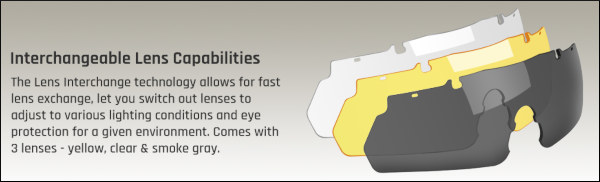
Having proper Eye Protection is absolutely critical when operating firearms. A great choice is the XAegis Tactical Eyewear 3 Lens Shooting Glasses. These come with three different interchangeable lenses (Clear, Yellow, Gray). You also get a transport case, lanyard, and cleaning cloth. Choose from three frame colors, each for $18.99: Black, Khaki, or Green. For under $20 these are hard to beat. It’s nice to have the color lens options for different shooting sports and different weather conditions.
9. Amazon — Mack’s Ear Plugs and Banded Plugs, $16.99/$9.99
⏺ Hi-Viz NRR 32 earplugs and handy banded plugs
You’ve bought the eye protection, now grab some ear protection, and stay safe. The Mack’s Hi Viz Soft Foam Shooting Earplugs are bright high-viz yellow/green so everyone knows you’re in compliance at the range. These plugs boast a very high 32 dB NRR. Get 50 pairs for $16.99. For hunting, and when watching matches behind the firing line, we like Mack’s NRR 22 Ear Band. This unit fits comfortably on the neck and can be put in place very rapidly. If you’re on a tighter budget, we recommend the comfortable Howard Leight MAX-1 orange NRR 33 plugs. You can get 50 pairs for $9.50 or 200 pairs for $19.99.
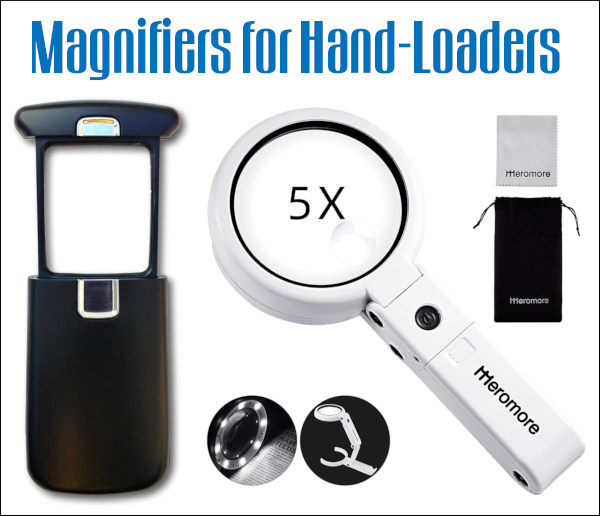
What is the most-used piece of equipment on this Editor’s reloading bench? No it’s not my Rock-Chucker press, my priming tool, or even my calipers. The one item in near-constant use is a small, folding magnifying glass. Mine folds into a square case and offers 4X viewing with an 8X bifocal insert. With this handy tool I can inspect case mouths for burrs, check primer pockets, inspect meplats, and look for flaws on bullet jackets. I also use the magnifier to see rifling marks on bullets seated into the rifling, or check my bolt for galling. The number of uses is nearly endless. I keep one magnifier at my reloading bench and another in my range kit.
Folding magnifiers are so handy yet inexpensive that you should own a couple spares (including one in the range box). I bought my magnifier in a book-store, but you can also find them on Amazon.com and FoldingMagnifier.com starting at under $2.00. To see inside cases and dies and view fine details, consider the 5X Meromore Folding Magnifier with a built-in, battery-powered LED light, plus a 11X high-magnification insert.
With a decent small magnifier, you can easily see any minute flaws in your barrel crowns. That’s important because crown damage can cause hard-to-diagnose accuracy issues. We’ve known guys who spend weeks tinkering with loads, when the real problem was a worn-out or damaged crown.
The slide-out iLumen8, shown at left in top photo, offers 3X power with built-in illumination. An “Amazon’s Choice” item, this palm-sized magnifier is $18.95 on Amazon.
Sako, and its subsidiary Tikka, make some of the finest hunting rifles you can buy. These offer smooth actions, and very good out-of-the-box accuracy for factory rifles. In addition, Sako and Tikka now offer high-tech carbon fiber stocks, along with Sako’s handsome wood stocks. With the three videos showcased today, you get a virtual tour of the Sako/Tikka production facilities in Finland.
In this informative video, the Canada in the Rough team tours the Sako/Tikka factory in Riihimäki, Finland. All aspects of the production process are covered — crafting actions, barrel-making, stock fitting and more. It was interesting to see the hammer-forging process for barrels, and the exacting measurements that are performed on the actions and bolt assemblies. If you have an interest in rifle production and the type of modern, computer-controlled machinery now being used, definitely watch this video.
Visit to SAKO/Tikka Carbon Fiber Stock Factory
This Sako-produced video shows how the company’s modern carbon-fiber stocks are produced. The stock production process is highly automated, to ensure that the finished stocks have very precise dimensions. These carbon Sakos are some of the nicest carbon-fiber stocks we’ve ever seen.
SAKO Factory Tour in Riihimäki Finland
In this segment, huntress and outdoor video host Mia Anstine tours the Sako manufacturing facility in Riihimäki, Finland. This video covers both firearms production and ammunition manufacturing. In a follow-up video Mia tests Sako rifles and Sako ammunition at a Finland range. Mia also reported on her Sako factory tour in the Beretta Blog. She notes: “Sako built its original manufacturing facility during World War I. To this day they still utilize the original buildings but have also grown over the years to include larger production areas and updated equipment.”
Canada in the Rough Video Tip from Boyd Allen — we welcome reader submissions
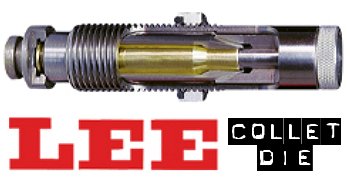
Editor’s NOTE: We generally recommend full-length sizing your cases. But there may be some situations where you may want to body-size your brass in one operation, and then neck-size the case as a final operation for reduced run-out. Or, perhaps you have a non-bushing FL sizing die and you want to modify the neck sizing. This article explains how to use a Lee Collet Die to size case-necks.
For those who prefer to neck-size their brass (rather than full-length-size), the LEE Collet Die is a popular, inexpensive option. It works by having collet tangs or “fingers” press the neck against a central mandrel. A collet squeezes the case neck against a precision mandrel for a perfect fit with minimum run-out. The benefit is that you get a very straight neck, which is sized consistently from top to bottom. Canadian shooter Jerry Teo explains: “LEE Collet Dies produce sized cases with very low runout (measured runout is under .001″ using a Sinclair concentricity gauge). You also don’t get the build-up of brass at the base of the neck, as can happen with bushing neck dies. The neck-shoulder junction stays nice and crisp.”
Here’s a good video that explains how to use a Lee Collet Die to Neck-Size .243 Win brass:
UPDATE to LEE Collet Dies — Neck Protrusion Change
The Lee Precision website notes a small design change: “If you’re a long-time user of Lee Collet Neck Sizing Die you may notice we have modified the Collet so a small portion of the neck protrudes through the end of the Collet-sizing portion. This often-requested modification was implemented in 2019. This change allows the portion of the neck that protrudes above the Collet to remain in its fire-formed condition. This provides a natural flare to the case neck allowing easy and concentric seating of bullets. This is especially important when seating cast bullets or low-drag coated bullets.”
TIP ONE — Adjusting Tension
LEE Collet dies don’t have a specific mechanical adjustment for neck tension. But you CAN easily modify the die to provide more or less tension. If you want to adjust the neck tension using a Lee Collet die, you can simply chuck the mandrel in a drill and reduce the diameter with some sand-paper (to increase neck tension) or you can order a mandrel the next caliber larger and turn it to whatever diameter you want (the larger the mandrel diameter, the less the neck tension). You can also order custom mandrels from Lee sized to any diameter you want.
Regarding neck tension, Boyd Allen makes an important point: “The only way to properly get more neck tension with collet dies is to either reduce the diameter of the mandrel, or order a smaller-diameter mandrel from Lee. I remind folks that adjusting the die position to have more toggle at the top of the ram stroke (not the factory recommended method), or leaning on the press handle with more force than recommended will NOT increase neck tension.”
No Custom Lee Collet Dies For Now
In years past, Lee also offered Custom Collet Dies, made from two fired cases. Hopefully these will be available in the future. However, earlier this year, Lee announced it had suspended sale of most custom dies including Collet Dies: “March 17, 2021: Due to unprecedented order volume, we have suspended custom services for Collet Necksizing Dies, Full-Length Sizing Die Sets, Quick Trim Dies, Case Length Gauges, Factory Crimp Dies, and Bullet Molds until we are able to meet the required volume of our standard products.”
TIP TWO — Polish and Tune for Easy Case Removal
Some users have complained that their Collet Dies grab the case-neck too firmly, making the case hard to remove. There are solutions to this problem. First inspect the collet fingers and smooth the inner surface up a bit with polishing compound or an extra-fine sanding pad. Second, you can open up the fingers a little bit. LEE recommends that if your Collet Die is sticking, take a steel punch and tap the fingers apart a little bit so that the natural “unloaded” position is wider. Lastly, you should lightly lubricate the outside of the collet fingers (see arrows) before you re-assemble the die. This will ensure they slide smoothly. Also, to prevent the collet fingers from closing too tight, never load up the die with your press without putting a case in place first. Without a case neck between the collet fingers and the mandrel, the collet can clamp itself too tight as you raise the ram.
TIP THREE — Always Have a Case Inside When Operating Collet Die
Our friend Boyd Allen tells us that you need to follow directions and NEVER operate the die without a case inside. Boyd explains: “This is because doing so will spring the quadrents of the collet inward so that they interfere with the insertion of a case, and the user will have to figure out how to undo the damage if the die is to operate properly. This advice would not be needed if everyone read the instructions before using the die…. but many times, they don’t. Another thing that I tell new users is to take the die apart so that they will have a better chance of understanding how it works.”
TIP FOUR — Size Twice and Spin Your Case 1/8th Turn
After reaching fully “down” on your press handle, withdraw the case about an inch and manually rotate it about 1/8th (NOT 1/4 or 1/2) turn while still in the shell-holder, then size again. This will place the die’s collet petals on the four “high spots” of the case neck and will result in a rounder, more evenly-sized neck with slightly more bullet tension. This takes only about one second more per case and is well worth the slight extra effort. (We thank reader Stonecreek for this smart tip).


 AccurateShooter Forum member Bill White (aka “CT10Ring”) is not your typical member. For 37 years, Bill worked in NYC as a studio photographer specializing in still lifes and products. A neighbor visiting Bill’s home in Connecticut with a .270 Sako inspired Bill to revive his interest (obsession?) with shooting after a 25-year drought. And he owns a few Sakos now! With his gun hobby renewed, for many years Bill drove to the Western USA to shoot long range steel and a LOT of prairie dogs in season. He loved the life of the varminter, so it made sense for him to move West after retiring. He choose Idaho as his new home.




Bill knows a thing or two about taking pictures, having been a professional photographer in NYC for many decades. He uses modern digital cameras for both his outdoor and indoor work. Most photos in this story were taken with a Canon EOS 5DSR MKIV. We asked Bill for some tips on taking good photos. Here are his FIVE Top Tips for Photography:








 Based on data collected by the ATF, we can compare production numbers for the entire decade 2010 through 2020. During this 10-year span 15,111,566 9mm pistols were produced. That’s roughly twice as many as the next largest category, .40 up to .50 caliber, with 7,661,896 produced. Americans also liked their .22-caliber handguns, with 4,605,411 “up to .22″ handguns produced.



 What is the most-used piece of equipment on this Editor’s reloading bench? No it’s not my Rock-Chucker press, my priming tool, or even my calipers. The one item in near-constant use is a small, folding magnifying glass. Mine folds into a square case and offers 4X viewing with an 8X bifocal insert. With this handy tool I can inspect case mouths for burrs, check primer pockets, inspect meplats, and look for flaws on bullet jackets. I also use the magnifier to see rifling marks on bullets seated into the rifling, or check my bolt for galling. The number of uses is nearly endless. I keep one magnifier at my reloading bench and another in my range kit.


 TIP ONE — Adjusting Tension
 TIP TWO — Polish and Tune for Easy Case Removal


