Many shooters prefer to deprime their brass before resizing. That way they can tumble cases or keep primer debris off their main press. To deprime cases before sizing or cleaning you can use a Depriming Die (aka “decapping die”). This pushes out the spent primer without changing the neck or body of a case. Such decapping dies work fine, but they do require the use of a press. Here is a handy alternative — a cool tool that allows you to deprime brass anywhere — no press needed.
Handheld Primer Removal Tool From Frankford Arsenal
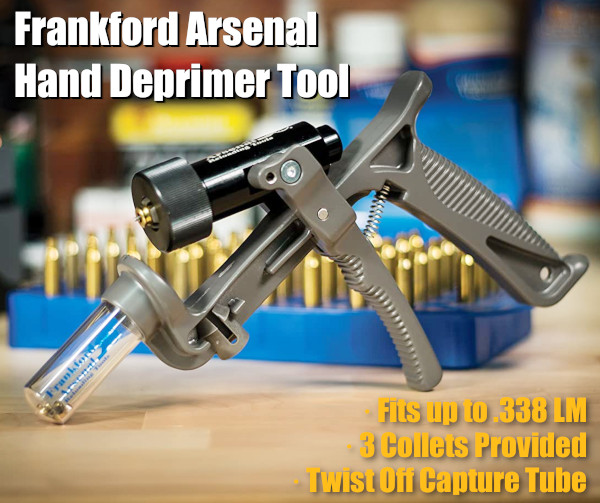
This cleverly-designed Hand Deprimer Tool allows you to deprime cartridge cases without a press. This hand-tool from Frankford Arsenal will deprime brass and capture primers conveniently. You can deprime your cases while watching TV or relaxing in your favorite chair.
This device lets you remove spent primers anywhere — no press needed and all the mess (cups/anvils/residue) stays in the capture chamber. This tool comes works with nearly all common case types up to .338 Lapua Magnum. With good leverage, this tool does the job quicklyi and efficiently. Forum members have praised this handy tool, but recommend wearing a thick glove if doing more than 100 cases in a sesssion.
This handy depriming tool is very versatile. With a universal, cylinder-style cartridge-holder, the tool can deprime a wide variety of cartridge types from .20 caliber up to .338 caliber. Three different plastic collets are provided to handle for different diameter cases. Spent primers are captured in a removable spent primer catch tube. Simply twist off the clear catch tube to dump the spent primers. With die-cast metal construction, this tool should last through many thousands of depriming cycles. MSRP is $54.99. Right now it is $44.99 on Amazon with 82% 5-star ratings.
User Modifications — Grip Padding and High-Volume Capture
Many users recommended putting some kind of padding on the grip and front lever to reduce pressure on the fingers. This can be done with a wrap or a rubber covering. In addition, users have adapted the unit with an attached hose and large primer capture jug. If you depriming hundreds of cases at a time, this hose conversion may make sense.
Review from actual owner: “I have owned one of these for about eight years and deprimed over 10,000 cases with this tool. I have never had to replace a single part on it. You will have to adjust the return spring every so often, but that is a very easy task. If you are depriming a LOT of brass, the handle can tear up your hand a bit. Solution: Wear a Mechanics Glove. Easy Peasy! You will NOT regret this purchase.”
How to Adapt Tool for Small Flash Hole Brass
The Frankford Arsenal Deprimer Tool was designed for LARGE flash-hole brass. To deprime brass with small (1.5mm/0.59″) small flash-holes, as found on Lapua .220 Russian and 6mmBR cases, you will need to reduce the pin diameter. A smaller pin is “in development” according to the manufacturer. Frankford Arsenal currently recommends purchasing a replacement pin and “sanding it down” to the smaller diameter. NOTE: This is NOT difficult — simply spin the stock pin in some sandpaper.
Sako Ltd. was founded on April 1, 1921. This year Sako celebrates its 100th birthday. Now part of the Beretta firearms family, this prestigious Finnish firearms manufacturer has a rich history of producing quality rifles constructed by skilled master craftsmen.
The original Sako factory was established as part of the Finnish Civil Guard and was designed to meet its gun repair needs. The workshop became an independent financial unit on April 1, 1921. Sako marks that date as its moment of establishment. The workshop was initially called Suojeluskuntain Ase-ja Konepaja Osakeyhtiö (Civil Guard Firearm and Engineering Co Ltd). In 1927, it became a limited company with its name abbreviated to the acronym Sako.
Sako is manufacturing a limited edition of numbered Sako TRG 22 “Finland 100″ rifles with white camouflage, inspired by Sako’s 100-year anniversary.
The TRG 22 “Finland 100″ Jubilee model is offered in .308 Win caliber. The white snow camouflage coloring of the stock and barreled action of this collector’s item reflects the severity of the Finnish winter, and pays homage to the heroes of the Winter War. The Sako TRG 22 “Finland 100″ rifle has the text “Finland 100″ and the gun’s serial number laser-engraved on its frame. The rifle is packaged in a carry case with an engraved Jubilee knife.
Gear Review by Mark LaFevers With its innovative “moving die/static cartridge” design, the RCBS Summit Press definitely demonstrates “out of the box” thinking. Unlike other presses, the case does not move. Rather, the reloading die comes down to the case. We are happy to report that this unique “upside-down” reloading press works great.
We have tested the RCBS Summit Press in the workshop and in the field. We’ve now loaded hundreds of rounds with the press. It is smooth, solid, and easy to use. The spent primer ejection/capture system works great (our testers preferred the Summit’s simple, foolproof primer capture to the Rockchucker’s capture system). Most importantly, the Summit produces very straight ammo that gave excellent results on the target in actual matches.
We compared ammo loaded with the Summit with ammo loaded on an RCBS Rockchucker press. The Summit gave up nothing to the bigger press. Cartridge base-to-ogive measurements of Summit-loaded ammo were just as tight as with ammo loaded on the Rockchucker. Run-out, measured with a concentricity gauge, was the same or better (about .002 or less on bullet nose). Most importantly, the Summit loads accurate ammo. In fact, at one match, scores shot with Summit-loaded .284 Win ammo were actually better than scores shot (in the same gun) with ammo loaded on a Rockchucker:
Despite its small footprint, the Summit is very stable — it doesn’t tip, wobble, or rock. The two front mounting bolts hold it firmly in place — the Summit doesn’t need a rear anchor. This, combined with the fact that the Summit has no overhang, makes this press ideal for a mobile application. For field use (at the range), our tester Mark LaFevers mounted the Summit press on a small platform secured to his trailer hitch (on top of a steel post). This set-up worked great, as you can see in the video below:
Watch Reloading (Sizing/Decapping, Expanding, Bullet Seating) with Summit Press
Photo shows Redding Micrometer Seating Die and .284 Win Cartridge
Mark tells us: “I think the Summit press worked out sweet mounted on the hitch pedestal. The receiver hitch pedestal I made will switch tools between a heavy barrel vise I made and the Summit press. Instead of securing the pedestal with a standard 5/8″ hitch pin, I drilled and tapped for 1/2″-13 bolt to draw the insert up tight against the receiver, eliminating wobble. For charging rounds, I bought 150 plastic test tubes with caps and racks so I can avoid weighing powder charges in the field, unless I want to make changes on the fly.”
The RCBS Summit Press features a rugged cast-iron frame with all-steel linkages. The press is very strong with minimal flex and slop. This allows you to “bump” your case shoulders and seat bullets with great precision and repeatability. The handle can be switched from right to left side (good for southpaws), and the open-front design provides good access, facilitating quick die changes*. The 4.5-inch opening allows you to work with tall cases. Beneath the shell-holder is a spent primer catcher (not shown in photos). The Summit press has a beefy 2-inch diameter ram, with compound linkages for plenty of leverage. A Zerk fitting is included for easy lubrication. The press will accept larger bushings for oversize 1-inch dies.
Summit Press Retails for $238.99
The RCBS Summit Press (RCBS item #09290) lists for $269.95. However, Midsouth currently has the Summit Press on SALE for $238.99. Yes it is IN STOCK and available. An optional short handle from RCBS costs $17.99 at MidwayUSA. ($19.95 MSRP).
This useful video explains the special features of the Summit press — ambidextrous handle, primer catcher, Zerk lube fitting — and shows the press operation.
*To permit his dies to be swapped from Rockchucker to Summit (and back again), with no locking ring adjustments, Mark LaFevers fabricated a new shell-holder base which positions the shell-holder .088″ higher relative to the Summit’s die port. This keeps Summit-mounted dies in the same position relative to the shell-holder as dies mounted in a Rockchucker. So, Mark can swap dies from his Rockchucker to his Summit and maintain exact COAL (when seating) and correct shoulder bump (when sizing). While Mark’s custom shell-holder base lets him swap dies quickly from one press to another, this is NOT a necessary modification. Most folks will simply re-set the locking rings.
A while back, we featured a portable reloading bench built on a Black & Decker Workmate. That proved a VERY popular do-it-yourself project so we’re showing it again, in case you missed it the first time.
Texan Robert Lewis made himself a great portable reloading bench from plywood mounted to a Black & Decker Workmate. The bench, roughly 22″ x 19″ on top, folds up to fit easily in your car’s trunk or behind the seats in a pick-up truck cab. Four recessed bolts hold the wood top section to the collapsible B&D Workmate. The sides and back of the unit are attached to the base with small nails. There is a small shelf (also nailed in place) which can be used to clamp a powder measure or hold a scale. Shown in the photo is a Harrell’s Benchrest measure and Harrell’s single-stage “C” press.
The whole unit can be built for about $65.00 with pine, or $80.00 with oak (as shown). Robert explained: “The Workmate was $40. If someone bought a 2’x4′ sheet of 3/4″ oak plywood, I think it is around $30. Using pine plywood would be about half that. Fasteners were $3. Spar Urethane would be $5.”
Robert told us: “I used a couple ideas I found on the web. The Larry Willis website gave me the idea to use the Black and Decker Workmate as a base. I found the Workmate on sale for $40 and the top is made from oak plywood I had in my shop. I sealed the wood with three coats of Spar Urethane. The whole thing folds into a nice package for transportation to and from the range.”
NOTE: Since we first ran this story, the price of a Black & Decker Workmate WM225 has increased. However you can still pick a WM225 Workmate for under $60.00. Amazon is currently selling WM225 Workmates for $59.58. The next best price we found was $69.61 at Home Depot, still a good price (Lowe’s is charging $94.98).
Are you a High Power or F-Class marksman looking for official bullseye paper targets? Here are bulk sets of 25, 50 and 100 targets from Creedmoor Sports. All these can can be used for general practice, fun matches, or official sanctioned events. Choose the official 200-yard SR target with all scoring rings (X,10,9,8,7,6,5), priced at $49.95 for 50. For long-range practice, try the NRA Official 600-yard High Power Target ($58.95 for 25ct), or the Official “Full Face” MR-65 500-Yard F-Class Target ($31.95 for 50ct). Creedmoor also offers a variety of Repair Centers, including the 300-Yard SR-3C Target Repair Center ($34.95), or the 600-yard MR-1 Target Repair Center ($64.95). These target centers can be used on top of full targets, or by themselves for practice on smaller target frames.
Creedmoor Sports also offers match-grade spotter discs. These are used to mark shot locations. They are offered in three diameters: 1.5″, 3.0″, and 5.0″. In addition, you can purchase the spindles used with spotter discs along with orange Golf Tees also employed to mark shots. These are placed in the shot holes by pit workers.
Frankly for practice, we recommend a target cam, or ShotMarker system.
S&W Model 617 now has a 10-round cylinder, but early models were six-shooters.
Over the past year and a half, the ranks of first-time gun buyers have grown dramatically. Millions of Americans have purchased their first-ever handgun. With so many handgun options (from derringers to Desert Eagles) many first-time buyers have trouble making a choice. What should those millions of new gun buyers have acquired first? Perhaps it should have been a rimfire revolver. Here is why…
The Argument for a Rimfire Revolver
Some years back, a close relative contacted this Editor. Wanting to get started in handgunning, he sought my advice on purchasing his very first handgun. “Should I get a Glock?”, he asked. “No” was my response. “Well how about an M&P?” he inquired. “Better ergos” I said, “but ‘No’ is still my reply.” “OK, how about a KelTec, they’re cheap…” “Absolutely not”, I replied.
I could tell he was getting annoyed, when he said “OK, Mr. know-it-all, so what handgun should I get?” Calmly, I replied: “Get a .22-caliber rimfire revolver. You will never out-grow it. You will learn sight alignment and trigger control. You can practice with inexpensive ammunition. A good .22 revolver will be considerably more accurate than 90% of the self-loading pistols you could buy. If you get a Smith & Wesson, you will keep the gun for the rest of your life and pass it on to your kids. If you or your heirs ever wear out the barrel or cylinder, Smith & Wesson will replace the parts for free, forever.”
First Handgun Choice — Consider a .22 LR Wheelgun
A very good choice for a first handgun is a Smith & Wesson .22 LR revolver, such as the S&W Model 617. The model 617 is extremely accurate, with a crisp trigger and good sights. Choose either a 4″ or 6″ barrel. The current model has a handy, 10-round cylinder.
This Editor’s first really accurate handgun was a .22 LR Smith & Wesson Model 617 that could easily stack ten shots in a dime at 10 yards. It remains my favorite and most-used handgun. What can we say about the Model 617? The single-action trigger pull is superb, and the accuracy surpasses most any semi-auto rimfire pistol, except for a few, very expensive target pistols. We like the 6″ version for the longer sight radius, but the 4″-barrel 617 is also very accurate, and it balances better.
You can learn all the fundamentals with this ultra-reliable handgun, shooting inexpensive .22 LR ammo. The model 617 is rugged, durable, and can give you a lifetime of shooting fun. Once you have mastered the basics of shooting with a .22 LR, you can move on to larger caliber handguns suitable for self-defense. Below is a slide-show illustrating a S&W model 617 ten-shot, with 6″ barrel. S&W also makes a 4″-barrel version of this revolver. (See: Shooting Demo Video with 4″ model 617.)
Another .22 Revolver Option, the Smith & Wesson Model 63
The current S&W Model 63 is a J-Frame .22 LR with 3″ barrel and fiber optic front sight. The Model 63 is compact enough for comfortable carry and well-balanced. The older Model 63, aka the “Kit Gun”, is an appreciating classic.
There’s a chap in Poland named Łukasz Pietruszka, who is a bonafide “Wizard of Wood”. Lukasz handcrafts unique custom stocks, selling them through his LP Gunstocks company. Many of his most eye-catching stocks are for airguns (particularly Field Target rifles), but he also produces fine stocks for rimfire and centerfire hunting rifles. Lukasz is a master carver who includes exquisite details on many of his stocks. Some of these designs, crafted from exotic hardwoods, raise stock-crafting to an art form.
Check out the figure on this Turkish Walnut stock by Łukasz Pietruszka.
You can see a variety of Lukasz’s stocks in a video sampler. If you’re a fan of fine wood, you’ll love this video. So pull up a chair, grab your favorite beverage, and enjoy this 16-minute video interlude.
Watch Video in High Definition
We recommend you view this video in high definition, in wide screen format. This will let you seen the rich details of the wood. To view HIGH-DEF, start the video, then click on the gear-shaped icon at the lower right-hand corner of the video frame (located just to the right of the clock icon). Then select 720P or 1080P from the pop-up menu. (1080P is the highest resolution.) Now select theater mode or full-screen mode using the small icons on the lower right of the frame.
Radical ‘Shockwave’ from LP Gunstocks
Here is a truly amazing bit of craftmanship. The images below show a one-of-a-kind Shockwave stock created by Łukasz for a Steyr Field Target air rifle. Over the top? Perhaps… but you have to admire the imaginative design and exquisite worksmanship.
Current Production with Laminated Wood, Many Colors
Łukasz Pietruszka also creates more affordable gunstocks with laminated, colored woods. See recent creations on the LP Gunstocks Facebook page. CLICK HERE for video on Facebook showing many stocks.
Q: What is the most popular gun book in the history of the planet?
A: That distinction goes to the Shooter’s Bible, which has sold over 7 MILLION copies since it was first published over 80 years ago.
Released in October 2020, the 112th Edition of this respected resource is bigger and better than ever. This latest Shooter’s Bible boasts 608 pages with 275 color photos and more than 1000 black-and-white photos. The new 112th Edition features many new firearms as well as new optics.
Published annually for more than eighty years, the Shooter’s Bible is one of the most comprehensive firearms reference guides in print. The publishers claim that “nearly every firearms manufacturer in the world” is included. The 112th Edition also contains new and/or enhanced sections on ammunition, optics, and accessories, along with updated handgun and rifle ballistic tables. There are also extensive charts of currently available hunting and match bullets for hand-loaders.
While many shooters are now using the internet to get reloading data and equipment specifications, the Shooter’s Bible remains a valuable resource with a great legacy. As one recent Shooter’s Bible purchaser explains: “While it’s true that much of the information contained in the Shooter’s Bible can be found on the Internet, there are many of us who would first rather relax in our easy chair and page through the book at our leisure. If you find an item that catches your fancy, you can then follow up by going to their Web site.”
Another buyer observed: “This latest edition is proof that, even with all the attacks on our 2nd Amendment right over the years, the industry has persevered and grown. I hope the day never comes when there will no longer be a reason to publish the Shooter’s Bible.”
Sample Page from Shooter’s Bible, 112th Edition
Here is a sample product description page from the Shooter’s Bible. Hundreds of firearms are listed with specifications and photos. Products from nearly all commercial gun makers on the planet are included.
More Great Gun Books From Shooter’s Bible Publishers
Here are three other books from the publishers of the Shooter’s Bible that you may want to add to your library: Guide to Cartridges; Gun Trader’s Guide; and Guide to Firearms Assembly, Disassembly & Cleaning. These are all available in softback print and Kindle (digital) editions:
Summer is coming soon, and it’s already getting quite warm in many areas of the country. You never want your barrels to get too hot, which can happen more quickly in summertime. Accuracy suffers when barrels over-heat, and excessive heat is not good for barrel life. So how do you monitor your barrel’s temperature? You can check if the barrel is “warm to the touch” — but that method is not particularly precise. There is a better way — using temperature-sensitive strips. McMaster.com (an industrial supply house) offers stick-on temp strips with values from 86° F to 140° F. A pack of ten (10) of these horizontal strips (item 59535K13) costs $13.16. That’s a mere $1.32 per barrel for strips — cheap insurance for your precious barrels. For best barrel life, try to stay under 120 degrees F.
NOTE: On the McMaster.com website, you’ll need to scroll down to the multi-use “Temperature Indicating Labels”. Then click on the horizontal label and select item 59535K13, as shown below.
Forum member Nomad47 says: “I have temperature strips (bought at McMaster-Carr) on all my barrels. I try not to shoot when the barrel gets to 122 degrees or higher[.]” Here are photos of the McMaster-Carr temp strips on Nomad47’s customized Savage.
Bad things can happen if your barrel gets too hot. First, with some barrels, the point of impact (POI) will shift or “walk” as the barrel heats up excessively. Second, even if the POI doesn’t change, the groups can open up dramatically when the barrel gets too hot. Third, if the barrel is very hot, the chamber will transfer heat to your loaded cartridge, which can lead to pressure issues. Finally, there’s considerable evidence that hot barrels wear out faster. This is a very real concern, particularly for varmint shooters who may shoot hundreds of rounds in a day. For this reason, many varminters switch among various guns, never letting a particular barrel get too hot.
Neconos.com offers BAR-L Temp Strips that visually display heat readings from 86 to 140 degrees. Think of these strips as compact, unbreakable thermometers that monitor barrel heating.
Put a strip on the side of the barrel and the barrel’s temp will be indicated by a stripe that changes from black to green. There is also a “general purpose” strip that reads to 196 degrees (see bottom row). The Benchrest model strip (86°F to 140°F) is in the middle. These Bar-L temp strips cost $12.70 each, or $25.00 for a 3-pack.
NOTE: These strips can be permanently fixed to the barrel with the heavy-duty clear plastic tape strip provided with the BAR-L Temp strip.
John Weber, born 80 years ago in England, was given a metal mug by his grandfather in 1945. Though his grandfather had a “good eye” for antiques, John never thought the metal mug was worth much. He played with it as a child, and even used it as a target for his air rifle. The mug, assumed to be brass, languished in a shoe box under Weber’s bed for decades.
Well, it turns out Weber’s old mug may be the world’s most expensive plinking target! The cup is actually made of solid gold, and is a rare, ancient artwork, crafted over 2300 years ago. The unusual mug, decorated with twin, opposite-facing female heads, was appraised with a value exceeding one-quarter million dollars ($250,000)!
According to news reports, Weber decided to have the old mug (thought to be brass) appraised when he moved from his house. He was shocked to learn that the mug is a Persian gold treasure, beaten out from a single sheet of gold before the time of Alexander the Great. Experts said the type of gold and the way the cup was hammered was “consistent with Achaemenid gold and gold smithing” dating back to the third or fourth century BC. The Achaemenid Empire ruled most of the Middle East and was conquered by Alexander the Great in 330 BC. Could this cup be one of Alexander’s war trophies? What stories could it tell from the past 2300 years?
Ancient Gold Cup Brings $99,000 at Auction in 2008
The rare cup was sold at auction by Duke’s Auction house in southwest England in June, 2008. Though the Cup was valued much higher by experts, it only fetched £50,000, or roughly $99,000 U.S. Dollars (at 2008 exchange rates, $75,769 today). John Webber said he was still very pleased with that result.




 With its innovative “moving die/static cartridge” design, the RCBS Summit Press definitely demonstrates “out of the box” thinking. Unlike other presses, the case does not move. Rather, the reloading die comes down to the case. We are happy to report that this unique “upside-down” reloading press works great.

 A while back, we featured a portable reloading bench built on a Black & Decker Workmate. That proved a VERY popular do-it-yourself project so we’re showing it again, in case you missed it the first time.


 Watch Video in High Definition


