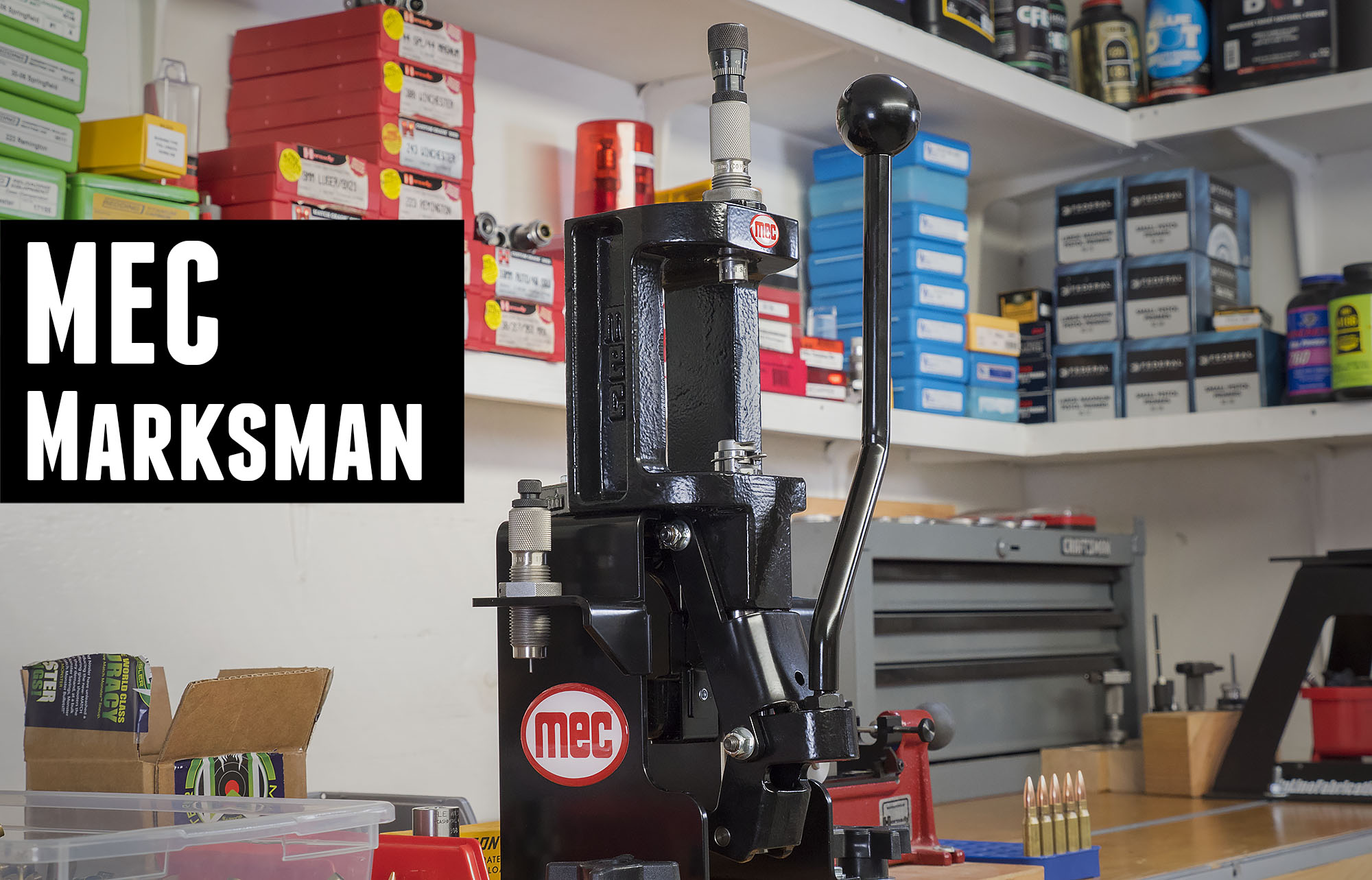
If you need a heavy-duty, single-stage reloading press, definitely look at the MEC Marksman, a beefy black single-stage unit with many impressive features. MEC, noted for its shotshell reloading machines, now offers the cast-iron MEC Marksman press, offering many features we really like. First, the rugged, cast-iron frame is strong enough for the toughest reloading jobs. Second, the Marksman features an OPEN front — that smart design makes it easier to insert and remove cartridge cases. It also makes it much easier to place your bullets during the seating stage.
This open-front design makes good sense — note that Hornady’s LNL single-stage press also has an open-front layout. Importantly, the MEC Marksman has an innovative, self-centering shell-holder. This patented design should help hand-loaders reload more efficiently.
We were impressed when we first saw the MEC Marksman press. The Marksman combines a sturdy cast-iron frame with a smart, user-friendly open-front design. With a $255.00 MSRP it is more expensive than an RCBS Rock Chucker ($214.16 MSRP), but the MEC Marksman offers some distinct advantages — such as the open front plus the patented floating shell-holder system.
MEC Marksman Press Review by Ultimate Reloader
Our friend Gavin Gear got his hands on a MEC Marksman press and put it through its paces. He came away impressed with the product, saying it delivers excellent performance, and has many impressive features. Gavin tells us: “Cast iron tools and machines are a lifetime investment. The made-in-USA MEC Marksman features ductile cast-iron construction, an open-front frame design for easy cartridge access, a new floating shell-holder design with a unique retention system, and ambidextrous handle setup.”
Gavin liked the Marksman’s system for holding spent primers. A tray sits behind the ram to catch spent primers exiting from a hole near the bottom of the ram. This is more foolproof than the plastic primer cups on some other single-stage presses. Expect less spent primer “spillage”.
The Marksman is sold as a stand-alone unit. However MEC also offers a very nice steel mount/riser for the Marksman. Gavin tested the Marksman with this riser, and he says it was sturdy and well-built. Gavin liked the riser. He said that elevating the Markman press up above the benchtop made it easier to handle cases and to operate the handle. You also get extra left- and right-side die-holders.
Manufacturer’s Product description: The MEC Marksman® is made from ductile cast iron for superior quality and durability. Our patented shell holder self-centers each cartridge. The MEC Marksman® is compatible with all 7/8-14 thread dies to change calibers quickly. Reloading .22 Hornet to .416 Rigby can all be done with one convenient machine.
Here’s something all shooters need — a smartphone App that calculates bullet-hole group sizes from your own photos. The Ballistic-X App is simple to use. Take a photo of your target, set some values (such as bullet diameter and distance to target), then use the touchscreen to place circles around each hole. The App will calculate group size (in MOA or Mils), distance to point of aim, and provide all the info in an overlay. Then click “save” to record your group for posterity!
This App works well, is relatively easy to set-up, and costs just $7.99. It is available for both Android devices and iOS (Apple) devices. There are other ways to measure group sizes from target images, such as the excellent On-Target program, which we have used for years. However On-Target requires a software installation on a Windows platform desktop or laptop. Ballistic-X is a simple, easy-to-install App with versions for both Android and iOS (Apple) Mobile devices.
The Ballistic-X App has a relatively easy-to-use interface. Of course you can choose either MOA or Milrad group values, and Inch or Metric dimensions. There are various labeling options that provide useful info for Load Development. There is even an ATZ (Adjustment To Zero) feature for adjusting your turrets.
How to Use Ballistic-X App
1. Select Photo Source — Choose Camera to take new photo or get image from Photo Library.
2. Set Reference Values — Select Bullet Diameter and enter Distance to Target.
3. Establish Scale on Image — Mark two points on target photo to set scale. For example, if the target has a 1″-square grid lines, mark two points on grid for 1″ distance.
4. Mark Point Of Aim — Put the central X on the aim point.
5. Designate Shot Locations — Place the green circles around each shot.
6. Finalize Data Display — Position Overlay, select size/color options, and export file.
Android Options — Range Buddy FREE App
Along with Ballistic-X, there is another Mobile App, Range Buddy, that also measures shot groups. Range Buddy is currently offered for Android devices only. It is FREE, but has adverts. Range Buddy isn’t bad, but users complained about the program crashing, and there are compatibility issues with newer phones. We recommend you pay $7.99 and stick with Ballistic-X.
The 6mm Dasher wildcat cartridge is very popular among competitive benchrest shooters, varminters, and even PRS competitors. So this Sunday we thought we’d showcase a matched Duo of Dasher rifles belonging to a Forum member Chuck L. (aka “Ridgeway”). The 6mm Dasher began as a wildcat improved version of the 6mmBR Norma cartridge. The Dasher has been very successful in competition, and now factory Peterson 6mm Dasher brass is sold by Grafs.com. And Alpha Munitions also offers high-quality 6mm Dasher cartridge brass.
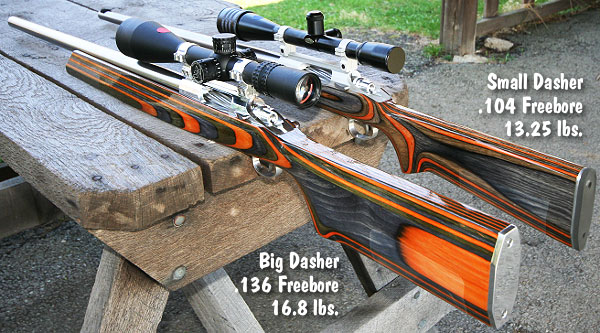
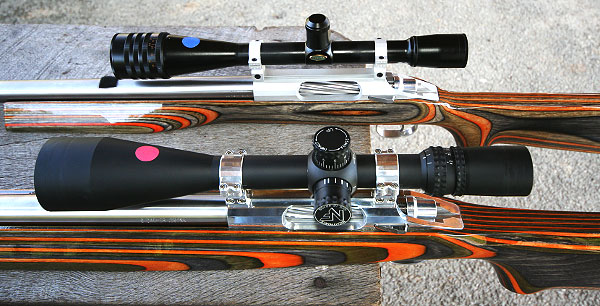
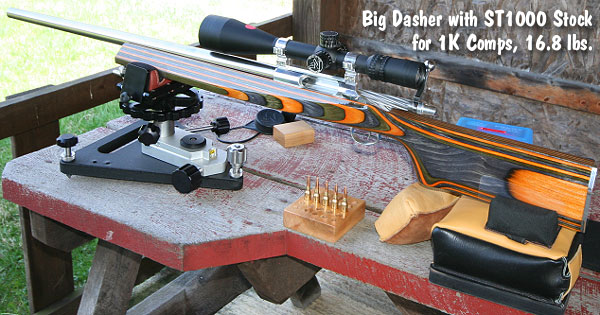
Chuck has a prize pair of 6mm Dashers for competitive benchrest and varmint matches in Pennsylvania. Both guns feature Kelbly Panda RBLP actions, Bartlein 8-twist barrels, and Shehane Laminated Tracker Stocks. However, the two rifles are not exact twins, as you can see. One, which we’ll call the Big Dasher, is built on a Shehane ST1000 Tracker stock. The other gun, the Small Dasher, sports Shehane’s “Baby Tracker” stock — a design used with great success by Richard Schatz. The Big Dasher, optimized for 1000-yard competition, has a slightly longer freebore — 0.136″ vs. 0.104″ for the Small Dasher.
Specifications for the Dasher Duo:
Small Dasher (13.5-pounder): Chambered for 6mm Dasher with approximately .104 freebore and a .264 NK. (No way of knowing exactly since its freebore was set in a separate operation by Kelbly.) Components are: Shehane Baby Tracker laminated stock, Kelbly Panda RPLB action, Bartlein 1:8″ LV barrel at 26 ¾”, Kelbly Rings, Weaver T36, Jewell trigger. The barrel was chambered by Kelblys and the stock was bedded, glued and balanced by a shooting buddy (Forum Member johara1). Chuck clear-coated the stock with auto urethane. Total weight is 13 lbs., 4 ounces.
Big Dasher (1K Light Gun, 17-pounder): Chambered for 6mm Dasher with a .136 freebore and .264 neck (PTG Reamer). Components are: Shehane ST-1000 laminated stock, Kelbly Panda RPLB action, Bartlein 1:8″ HV 5R barrel at 28″, Shehane +20-MOA rings, Nightforce NXS 12-42x56mm, Jewell trigger. The barrel work, pillar installation, and bedding was done by Dave Bruno. The stock was clear-coated by Chuck with auto urethane. Chuck also made the rear butt plate and balanced the rifle. Total weight: 16 lbs., 13 ounces.
Chuck tells us: “I don’t get out shooting competition as much as I want due to time and family, but when I do compete, I shoot a Groundhog match at Southfork Rifle Club in Beaverdale, PA. Info on Southfork Club events can be found at Southforkrifleclub.com. The Southfork match is basically a 100-, 300- and 500-yard match with one sighter the entire match and 5 shots at each yardage for score. The Small Dasher, with the shorter ‘Baby Tracker’ stock, was set up for the Southfork Rifle Club’s ‘Light Unlimited’ class which has a 13.5-lb max weight.” (Editor: ‘unlimited’ is a misnomer for a weight-limited category.)
Chuck adds: “The Big Dasher with the heavy ST-1000 stock is set up for 1000-yard benchrest matches in Light Gun class. I shoot 1K matches with it at Reade Range in southwest Pennsylvania. One ironic thing is, it shoots the same load I’m shooting out of the lighter gun rather well. The only difference between the two chambers is the freebore is roughly thirty thousandths longer on the 1K gun (Large Dasher). I will also shoot this at Southfork in the ‘Heavy Unlimited’ class.”
Both Dashers Group in the Ones at 100 Yards
Chuck favors 107gr Sierra MK bullets in both Dashers. Other components are: Reloder 15 powder, Lapua cases, and CCI 450 primers. His main load for the Small Dasher is 33.0 grains of Reloder 15. This load shoots in the ones at 100 yards. For the Big Dasher Chuck reported: “I’m still working on a load, although the same 33.0 grain load shoots in the ones in the heavier gun as well. I’m still looking for more velocity and my ‘max’ node.”
Dasher Brass — Three Options
1. Buy Peterson 6mm Dasher Brass
In years past, you had to create your own Dasher brass, by fire-forming (with or without projectiles), or by hydro-forming. However, Peterson Cartridge now offers factory-made 6mm Dasher brass.
If you do not want to waste time with fire-forming or hydro-forming, you can look for Peterson 6mm Dasher brass. This is excellent quality brass that has earned high praise from purchasers. The price — $62.99 for 50 cases at Graf’s (i.e. $1.26 per case) — is less than what you’d pay for Lapua 6mmBR brass, which is $149.99 for 100 cases or $1.50 per case. The advantage is that you save time, barrel life, and you won’t lose any cases to split necks. Peterson brass can be ordered from Grafs.com.
2. Fire-Form Dasher Brass with Bullets Hard in Lands
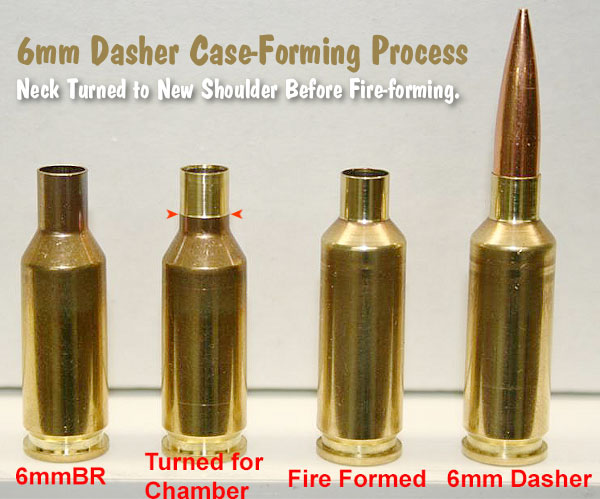
Chuck fireforms his Dasher brass for both rifles. Because he has a tighter-neck chamber, he neck-turns the brass first: “To fireform, I turn my cases down to fit the chamber and stop where the false shoulder makes snug contact with the chamber. Fire-forming rounds are loaded up with a 29-grain charge of H4895 or Varget and a 108gr Berger bullet seated hard into the lands about 0.020″ past initial contact with the rifling. It takes about three firings to make a nice clean Dasher case with a sharp shoulder.”
Chuck anneals his Dasher brass regularly to help maintain consistency: “I anneal about every 3-4 firings. I have many cases that have about 10+ firings on them and they are still shooting well. The primer pockets are a little looser, but still hold a primer.”
3. Have Darrell Jones Hydro-Form Your 6BR Brass to 6mm Dasher
DJ’s Brass can hydro-form a wide variety of cases for a modest fee
Fire-forming all your own 6mm Dasher brass takes time, costs money (in bullets and powder), and consumes precious barrel life. Well there IS a better solution — you can have your new brass hydro-formed by DJ’s Brass to your exact specifications for a $60.00 per hundred, which includes annealing.
DJ’s Brass Service now offers custom case hydro-forming to your exact specs. Darrell Jones offers this service for a variety of popular cartridges: 6 PPC, 30 PPC, 30 BR, 6 BRA (BR Ackley), 6mm Grinch, 6 BRDX, 6 BRX, .260 Ackley, .284 Shehane and of course the very popular 6mm Dasher. After hydro-forming your brass, Darrell can also neck-up or neck-down the cases to meet your needs. He can also turn the necks to your specs for an additional $0.60 per case.
This deluxe, roll-out Rush Creek Creations 42-0000 69″ x 16″ gun cleaning mat (with pockets), is available from Tractor Supply for $79.99.
We normally use a gun cradle when cleaning or adjusting our rifles. But there are situations, such as when working on a barreled action, when it’s nice to use a pad that lies flat. Many work pads are too small — they’re nothing more than oversize mouse pads. Here are three gun pads that are big enough to work well with rifles and/or barreled actions.
DryMate Gun Cleaning Pad
The Drymate Gun Cleaning Pad is a full 59″ x 16″. That’s nearly five FEET from end to end — longer than most rifles, so you have plenty of surface area for working. Conveniently, this product can be washed with soap and water. It is offered in three versions: Green, Blaze Orange, and Charcoal Gray. We like the Blaze orange version because the bright color makes it easier to see small parts such as screws and springs.
Boyt Harness Counter Pad
The 48″ x 12″ Boyt Harness Counter Pad was originally designed more for display purposes than for serious work sessions, but we like this product. It is useful if you want to lay your gun on a bench to make small adjustments. The Boyt Counter Pad, $21.99 at MidwayUSA, is nice and big, a full four feet from end to end. The back side is canvas while the top-size is a quilted cotton fabric. This product has received high praise from buyers. Here are actual owner reviews:
Worth every penny. I bought three of them because I want to have at least one always around. I use one for a shooting bench or tailgate mat and another for my primary gun cleaning workbench mat. Awesome for both purposes. This one was perfect for my array of needs. — Joe D.
This mat is great for cleaning guns and keeping your surfaces clear of oil or solvent. The mat has plenty of space for a rifle or handgun and the padding is thick enough[.] I would definitely buy again and have recommended this to my friends and family. — Safety Guy
I bring this to the rifle range with me every time, to rest my rifle on the table without worrying about scratches. It fits nicely in my soft rifle case. One side is a tough canvas material that doesn’t show scratches, and the other side is a soft fleece material that protects the finish of your gun. — MACPSU
Hoppes Gun Cleaning Pad
The Hoppes Gun Cleaning Pad is 36″ wide x 12″. That’s big enough for many barreled actions (unless you have a really long barrel). This pad has a non-slip nylon backing, and Hoppes claims that the “Soft acrylic material absorbs 8 times its weight in fluids.” This Hoppes Cleaning Pad is very affordable. It costs just $9.99 at Amazon.
The Firearms Guide is a comprehensive guns and ammo reference guide, available online or on a flash drive. Published since 2009, this Guide offers gun prices, gun schematics, blueprints, and manuals. Guns are cross-referenced with the ammunition database. Guns and ammo are presented with prices, tech specifications, features, ballistic information and high-resolution color pictures. The Firearms Guide also includes a wide selection of printable targets.
The 12th Edition of the Firearms Guide has just been released. If you’d like to have instant access to 15,000+ gun schematics and descriptions of 80,000 types of guns and ammo from 1,500 manufacturers, then check this out. The basic annual subscription is on sale right now for just $49.94. A six-month subscription is $29.94. Or for just $8.80 per month you can get a recurring monthly membership which can be cancelled at any time.
You can also get a Flash Drive add-on that lets you access the database even without a web connection. The 1-year Online Edition PLUS Firearms Guide 12th Ed. Flash Drive for Windows is $99.90. CLICK HERE. This lets you directly access the data from laptops and tablets with a USB port — no WiFi needed.
Database Includes Printable Targets: This resource even includes printable targets. You’ll find practice targets, sight-in targets, silhouette targets, special shapes and, yes, even Zombie targets.
The 12th Edition Firearms Guide is a fully interactive, subscription-based online database of firearms and ammo. The database also includes global gun values. The amount of imagery is amazing — there are tens of thousands of photos and over 18,500 schematics, which help you identify key components/parts.
Guns and ammo are presented with prices, specifications, features, ballistics, and up to 12 high-rez color pictures. NOTE: The Ammo information includes bullet BCs and velocities. GUN VALUES are provided for dealers and gun collectors. You can access 18,500+ printable and zoom-able GUN SCHEMATICS (diagrams or exploded views) with parts lists and blueprints for professional gunsmiths. The Firearms Guide permits detailed searches of antique and modern guns and side by side comparisons. Guns are cross-referenced with the ammunition database.
Firearms Guide Sample Schematic
The online database’s comprehensive search capability lets you search by gun caliber, manufacturer, and key features (e.g. “.223 Rem, Colt, folding stock”). There are 14 different search criteria — allowing you to find the exact gun you want in seconds. Shown below are typical profiles of listed products:
If you are a gun collector, or just an information junkie, you’ll find the Firearms Guide to be an invaluable resource. The scope is truly worldwide, with coverage of gun makers in Western Europe, Eastern Europe, South America, South Africa, and Asia as well as North America.
The Henry AR-7 Survival rifle is a unique rifle. Weighing just 3.5 pounds, this little semi-auto rimfire can perform pest-control duties for a farmer or rancher, or serve as a utility rifle carried in a truck or ATV. The cleverly-designed AR-7 is affordably priced, just $269.99 at Sportsman’s Warehouse.
We think most gun-owners would enjoy adding an AR-7 to their collection. The Henry AR-7 breaks down for easy carry in a backpack or a vehicle. The barrel, receiver, and magazines all fit INSIDE the buttstock. That’s handy. And this little 3.5-pound rifle offers surprisingly good accuracy.
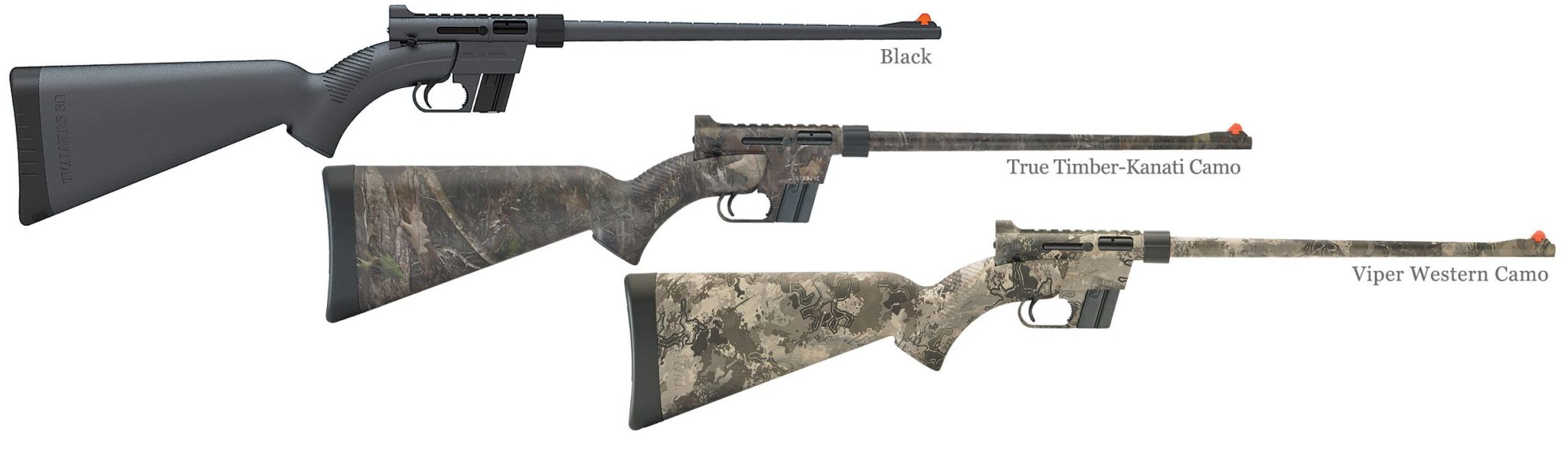
If you don’t like basic black, Henry offers two camo versions from the factory: True-Timber Kanati Camo, and Viper Western Camo. Click the photo below for full-screen (2048 pixel wide) image:
Or, if you have artistic skills (and confidence with spray cans), you can paint your AR-7 yourself, as this owner did. The talented gun-painter reports: “[This is a] great little gun that is accurate and I love how it packs away. I paint all my black guns. Already took a grouse at 16 yards.”
History of the Henry AR-7 Rifle
Starting in 1959 the AR-7 was provided to U.S. Air Force fliers as a survival rifle to use if they were stranded in a remote area. Today the AR-7 is a favorite of bush pilots, backpackers, and backcountry adventurers who, like their Air Force counterparts, need a rifle that’s easy to carry yet can take down small game. Like the original Henry U.S. Survival Rifle, this innovative, semi-automatic rimfire rig is lightweight (3.5 lbs.) and highly portable. At just 16.5″ long, with all components stowed, it easily fits into a backpack, or the cargo area of an ATV, truck, boat. or plane. The AR-7 is chambered in .22 LR so you can carry plenty of ammo without adding much weight to your gear. When disassembled, all the pieces fit inside the impact-resistant, water-resistant stock.
Assembly is as easy as attaching the receiver to the stock, inserting the barrel, and screwing on the barrel nut. In a few seconds, without any tools, the Henry U.S. Survival AR-7 is ready for action. It now comes standard with a steel barrel covered in tough ABS plastic with a protective coating for corrosion resistance. The Henry U.S. Survival AR-7 is available in three finishes; Black, True Timber Kanati Camo Pattern, and True Timber Viper Western Camo Pattern. All models are equipped with an adjustable rear sight and a blade front sight. As you can see below, the built-in storage can be used to hold magazines and ammunition as well as the rifle components.
Another AR-7 owner posted this review:
Simple Goodness: Henry AR-7 — Fun Modern Version of a Classic
Henry got this modern take of the AR-7 right. Gentle finger-tighten is all it takes to assemble. The funky orange plastic sight on the end of the barrel is kind of loud, but was also easy to target with. Brand spanking new, I was getting grapefruit-sized patterns out of each 8-round mag at 50 feet. For a compact take-down, was surprised that length-of-pull was satisfactory for a six-foot guy. It didn’t feel cramped.
For realistic backpack, bail-out, or bug-out situations this would be a smart choice. It was fussy with a single Rem Golden in the first mag… but after that no problems, and no issues at all with Federal and CCI. The safety is right-handed but large and easy to get used to. The charge handle retracts so [you must] pull it up before pulling back, but that motion seemed to become reflexive pretty quickly. The mag eject is in front of the trigger and pushes forward. All in all, [the AR-7 offers a] really nice, compact form factor. [It is] light, perfect for backpack plinking and … low-rent varmint sniping.
Power Trimming Technology Saves Time
Trimming and chamfering brass are tasks hand-loaders grow to hate. Those chores are time-consuming and tiresome. Thankfully there are faster, better alternatives to manual trimming/chamfering. In this article, Forum member Erik Cortina shows how to use the Giraud tool which trims and chamfers in one operation. Erik has his own YouTube Channel dedicated to precision reloading and accurizing. Here we feature Erik’s video about the “mother of all brass trimmers”, the Giraud powered case trimmer. Erik says: “If you do volume reloading… this is the only trimmer to get. It not only trims to length but it also chamfers your case mouth inside and out.” In his video, Erik offers some very clever and useful tips that will help you get the most from your Giraud.
This is a manufacturer’s photo showing an older model.
The Giraud trimmer is very precise. When set up correctly, it can trim brass with amazing consistency. In the video, Erik trims five pieces of brass in 15 seconds (6:32 mark). He then measures all five with precision calipers (7:00-8:08). All lengths are exact within .0005 (half a thousandth). Erik notes that the Giraud trimmer indexes off the case shoulder. As long as you have fire-formed brass with consistent base-to-shoulder dimensions, you should get very consistent trim lengths.
The secret to the system is a 3-way cutting head. This cutter can be swapped in and out in a couple minutes with wrenches provided with the kit. Erik has three different heads; one each for 6.5mm, 7mm, and .30 caliber. The video shows how to adjust the cutting heads to match caliber diameter (and to get the desired amount of inside/outside chamfer).
To trim and chamfer cases, you simply insert them nose-first into the cartridge-specific case-holder. Erik offers a smart tip — He uses a die locking ring to position the cartridge holder (3:15). This can be locked in place. Erik says die locking rings work much better than the hex-nuts provided by Giraud (with the hex-nut, one must re-set cut length each time you change case-holders.)
The Giraud can be used in either horizontal or vertical modes. Erik prefers to have the trimmer aligned vertically, allowing him to push cases down on the trimmer head. But the trimming unit has twin sets of rubber feet, allowing horizontal or vertical orientation.
Improved Case-Holder Made with Chamber Reamer:
For his .284 Shehane, Erik had to create his own case-holder (Giraud does not make one for that wildcat cartridge). Erik used his chamber reamer. To his surprise, Erik found that the brass was easier to trim in the custom case holder (compared to the Giraud-made spring-loaded holders). With a perfect fit, trimming and case extraction went more smoothly and the process was easier on his hands. (See 9:00-10:00). Based on Erik’s experience, you may want to create your own custom case-holder.
Trim Bullet Meplats Also
With a special bullet-holder fitting and meplat cutter head, the Giraud power trimmer can be used to trim bullet meplats. Trimming meplats can help make the Ballistic Coefficents of a batch of bullets more consistent. Uniforming meplats is also often done as a first step in the process of “tipping” bullets to improve BC.
Meet the new T-Rex front rest from Rodzilla. In the world of front rests there have been many innovations over the past decade, but this new front rest from Rodzilla really represents significant innovation. The new T-Rex offers impressive capabilities that can truly take your shooting experience to the next level.
At first glance the new T-Rex may resemble some other coaxial front rests. The T-Rex has a joystick, three points of ground contact, and a platform for the rifle. But look closer and you’ll see this isn’t your typical rest. Designer/builder Rod Brakhage (the Rod in Rodzilla) has started from the ground up to create the most user-friendly, match-ready, modular front rest on the market. The new T-Rex is already in high demand, but currently Rodzilla has been fulfilling orders in about 8 weeks. T-Rex MSRP ranges from $1895.00 to $2305.00 depending on options.
The T-Rex weighs just over 21 pounds — about the same as many mid-sized rests. However the T-Rex has a large footprint, rivaling the largest rests on the market. Rod tells us: “The T-Rex has a similar footprint to the SEB MAX… 12.5″ wide X 11.25″ front to back. However, at just over 21 lbs. my rest weighs less than a SEB NEO.” This combination (wide base with moderate weight) allows for an incredibly stable platform that is still quite portable.
Rugged Carry Case Makes Transport Easy
Rodzilla delivers the T-Rex in a custom-designed hard carry case that fits it perfectly and still has room for additional feet and accessories. This sturdy case makes taking the T-Rex to matches easy. The case is strong enough that I can stack things on top of it in my truck. One side note, if you plan on storing your rest in the case between matches, it’s wise to put a desiccant pack in the case to absorb moisture.
The T-Rex boasts an adjustable joystick that extends from 15.5″ to 21″ in length. With this adjustability, no matter what your stock length or design, you can find a comfortable position without having to stretch uncomfortably. And you won’t have to shop for a joystick extension.
Using the T-Rex is a pure pleasure when shooting prone F-Class or from the bench. That’s because of its revolutionary ability to make large vertical adjustments without getting out of position. This is accomplished with a detachable arm/handle you can actuate while behind the gun. (This is the long T-handle on the right side of the rest).
The simplest way to show why this is a game changer is to consider when you’ve just left the 800-yard line during a match. You head up to the 900-yard line, get all set up, the range officer calls a hot line and suddenly realize you didn’t adjust your elevation for the new yardage. Normally you’d have to turn your scope dials then get up from your position to adjust your front rest, or at best stretch uncomfortably in hopes of reaching your rest adjustments. With the T-Rex, you simply turn the right-side gross elevation handle while still in position, move to your new hold point, and begin firing.
This same principal applies to other situations that require adjusting vertical without breaking your shooting position. All of this is accomplished in conjunction with an incredibly sensitive, yet easy-to-adjust counterbalance system. Once set, the counterbalance ensures that smooth and fluid motion occurs in any direction without any resistance or fear of backlash that might affect your shots.
Very Wide Horizontal Range is Useful in Matches
When it comes to looking downrange, the T-Rex can deliver nearly twice the range of horizontal motion as that of some other rests. (In high ratio mode, there is about 70 MOA of horizontal travel.) This means you can quickly scan a wide expanse of targets/flags without having to change magnification or go to your spotting scope. The huge field of view is a great help when shooting in a condition that is switching and you want to view targets on either side.
Rodzilla offers a number of options for the T-Rex. The first choice is the top. Select the Rodzilla 5-Axis roller top or the new 5-Axis IBS-legal sandbag top. Or, if your budget permits, you can order both — they are easily interchangeable in minutes. The video below shows the easy top-swap procedure:
This video explains how to exchange tops on the Rodzilla T-Rex
5-Axis Top Advantages
Rod Brakhage tells us: “This innovative new 5-Axis top rotates independently of the base plate so no matter how the rest is set on the line you only need to move your rear bag to pan across the row of targets with no binding of the rifle. Also, the sides of the rifle run against vertical Delrin rollers.”
Color Choices for Rodzilla T-Rex Base
In addition to the choice of tops, there are four (4) standard colors on the website, but for an additional fee you can have it made in just about any color you want, which is pretty cool.
Choose Standard Feet, Sand Feet, or Both
When you order a T-Rex, you can choose standard bench feet or large, gorgeous sand/dirt feet. Or order them both, as I did. I use the bench feet at my regular club where I shoot from wood and concrete platforms, but the sand feet are great for matches held on dirt, gravel, sand, or grass. These sand feet provide an incredibly stable platform on the ground.
Linear Bearings Allow Ultra-Smooth and Precise Adjustments
Rodzilla’s Rod Brakhage is a smart, innovative designer committed to improving the shooter’s experience. One of Rod’s key innovations in the T-Rex is the use of linear ball bearings for both X and Y axis: “The horizontal/vertical assembly, or X-Y block, moves on 6 double-sealed ball bearings that travel on hardened shafts for effortless movement”.* This system delivers a smooth, fluidity of movement that lets you aim quickly and efficiently. Gone are the days of having to move PAST your aim point and then come back (to get the aim right), or resetting your joystick position after every shot. With the T-Rex, you make one smooth, precise move and your aim is set. And it stays set after the shot.
The T-Rex allows you to position your crosshairs with pinpoint precision every time and if you need to move them just a hair, you can do it with ease. In F-Class, we often hold between the target’s scoring lines to correct for wind variations (without touching the scope’s windage knob). With the T-Rex, I could make those holds quickly and precisely without wasting time bouncing back and forth.
Overall, I’ve come to really enjoy the repeatable confidence the T-Rex has given me whether I’m doing load development, practicing at the range, or shooting a match. So, if you’re in the market for a superb front rest that just might give you an edge or, at minimum, make your life easier, head over to TheRodzilla.com and learn all about the impressive, new T-Rex Front Rest.
* Rod Brakhage explains: “The bridge travels up and down on double-sealed ball bearings on 1” hardened shafts. My design utilizes a rack and pinion with an 18″-long drive shaft for adjusting the height of the bridge. This system allows you to stay in shooting position and looking through the scope while adjusting the vertical placement of your crosshairs. Precisely dial your vertical to the center of your target with the joy stick at the exact height you prefer. A 1/4 MOA movement is very easy to accomplish with this design. Also, there is no need to lock the bridge as there is an adjustable clutch to hold the vertical position. The long drive shaft utilizes a scalloped hand wheel on the shooters side and a quick coupling adapter on the rest side. Once adjusted you merely pull back on the drive shaft and remove it or just set it on your shooting mat out of the way. The geared rack and pinion can be placed on the right for right-handed shooters or on the left.”
Three-Position Air Rifle (3PAR) shooting is the most popular and fastest-growing form of shooting sports competition for junior shooters (High School age and younger). The Civilian Marksmanship Program (CMP) conducts two primary Three-Position Air Rifle events. First, Precision Air Rifle is modeled after Olympic-style shooting and allows the use of specialized target rifles and equipment. Second, Sporter Air Rifle is designed for new competitors or those who desire to compete with a minimum of equipment and expense.
In both types of shooting, competitors fire at targets at a distance of 10 meters in three different positions, prone, standing and kneeling. Three-Position Air Rifle provides young competitors with competitive shooting sports opportunities that can be offered on a wide variety of easily accessible or easily constructed ranges, with equipment that is commonly available at affordable costs.
The CMP actively promotes Three-Position Air Rifle shooting as a premier youth marksmanship competition by providing low-cost equipment and pellets as well as training materials and competition activities. In addition, other air gun events for juniors and adults are hosted by CMP throughout the year. CMP facilities have Open Public Shooting evenings, and matches for air rifle and air pistol take place at the CMP Marksmanship Centers. CMP ranges are equipped with OpticScore Targets featuring technology by Kongsberg Target Systems.
The Challenger PCP (pre-charged pneumatic) Air Rifle is the preferred .177 sporter class air rifle for competitive marksmanship programs throughout the country, including the Marine Corps JROTC, Army JROTC, Air Force JROTC, Navy JROTC, American Legion, and 4-H. The Challenger is a three-position competition rifle that features a fully adjustable stock, a two-stage, adjustable match grade trigger, a hooded front aperture sight, a micro click, adjustable diopter rear sight, a patented ambidextrous pull bolt, and a floating Lothar Walther™ barrel.
Smith & Wesson Brands, Inc. (NASDAQ: SWBI) plans to divest (sell off) its Thompson/Center Arms (T/C) brand. This T/C divestiture as part of a “broader strategic plan” by Smith & Wesson to focus on its core S&W brands. So soon Thompson/Center rifles, muzzleloaders, and single-shot pistols will no longer be produced by Smith and Wesson. Accordingly, if you’ve been thinking about getting a T/C gun, now may be a good time to buy. We predict inventories will be sold off at discounted prices. NOTE: S&W remains committed to providing customer service to current T/C gun owners.
Smith & Wesson President/CEO Mark Smith declared: “Thompson/Center is a beloved hunting brand with a longstanding heritage, and we are committed to ensuring a smooth transition. Thompson/Center Arms’ loyal consumers should rest assured that they will continue to receive the world-class firearms, accessories, and customer service support that the brand has been known for since its founding in 1965. We remain fully committed to the hunting and long-range shooting market, and with this divestiture we will be able to now focus on these categories under our iconic Smith & Wesson brand. Additionally, this will allow us to immediately redirect manufacturing capacity to increase overall production volumes, allowing us to gain additional market share[.]”
No Buyer Currently for Thompson/Center Arms
At this time, a buyer for the Thompson/Center Arms brand has not been identified. However, the divestiture is not expected to have a material financial impact on S&W’s first quarter fiscal year 2022 results. S&W expects the divestiture “to be accretive to the Company’s full year fiscal 2022 through higher overall production levels, increased margins, and lower marketing costs”. The Company states that this decision will NOT result in a workforce reduction as it will “repurpose capacity immediately” to other areas.
Thompson/Center Arms — Types of Firearms Currently Produced
Thompson/Center Arms produces a wide range of firearms including bolt-action rifles, semi-auto rimfire rifles, muzzle-loaders, plus T/C Encore rifles and pistols. Expect all these firearms to be discounted heavily in the months ahead. CLICK HERE to see the full line-up of T/C firearms at TCArms.com.
About Smith & Wesson Brands Smith & Wesson Brands is a leader in firearm manufacturing and design, delivering a broad portfolio of handgun, long gun, and suppressor products to the global consumer and professional markets under the iconic Smith & Wesson, M&P, and Gemtech brands. The Company also provides manufacturing services, including forging, machining, and precision plastic injection molding services.


 If you need a heavy-duty, single-stage reloading press, definitely look at the MEC Marksman, a beefy black single-stage unit with many impressive features. MEC, noted for its shotshell reloading machines, now offers the cast-iron MEC Marksman press, offering many features we really like. First, the rugged, cast-iron frame is strong enough for the toughest reloading jobs. Second, the Marksman features an OPEN front — that smart design makes it easier to insert and remove cartridge cases. It also makes it much easier to place your bullets during the seating stage.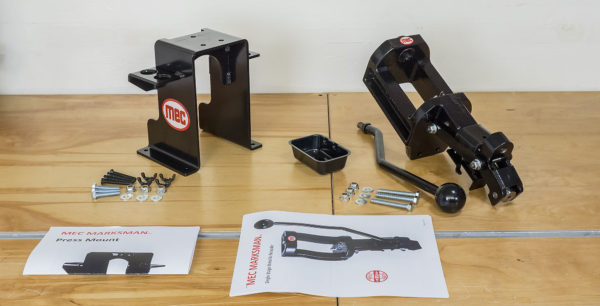





 Fire-forming all your own 6mm Dasher brass takes time, costs money (in bullets and powder), and consumes precious barrel life. Well there IS a better solution — you can have your new brass hydro-formed by DJ’s Brass to your exact specifications for a $60.00 per hundred, which includes annealing.

 The
The 


 The
The