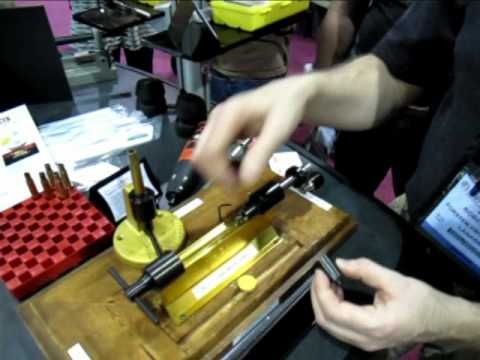
The tool-makers at 21st Century Shooting have come up with a very slick new Precision Hand-Priming Tool. This extremely well-made, benchrest-grade unit raises the bar among single-primer seating tools. Feel is great, changing shell-holders is simple, and nothing else on the market offers better control over primer seating depth. The tool’s precision-adjusting head provides clicks in .0025″ increments for precise seating depth. The tool’s body, internals, and shell-holders are stainless, while the handle is anodized aluminum. Price is $118.00 for the tool itself. Shell-holders (sizes from 17 Remington up to .338 Lapua Magnum) cost $7.99 each.
21st Century Priming Tool Review By Boyd Allen
I have been priming cases, with various hand-priming tools, for about three decades, and in the process have pretty much tried them all, from least to most expensive. When I found out that this new 21st Century tool was adjustable for seating depth, I wondered about that. After all, what do I, who believes in seating by feel, need with adjustable seating depth? Well…..I was wrong. Let me explain.
Why Adjustment for Primer Seating Depth Is Important
Most hand-seating tools do not have an adjustment for how far up the priming punch comes up into the shell holder. As a result, when priming a case with a deep pocket, especially if there has been some wear of the tool’s linkage, the finger/thumb lever may contact the tool’s body before the primer is fully seated. Having a primer seated too high can cause a myriad of problems. Prior to this, the only seater that I had used that had an adjustable linkage was the Sinclair tool, and adjusting its linkage requires disassembly — regular disassembly if you want to keep it perfect. That’s not convenient. The Sinclair is good tool, but a pain in the neck to adjust.
Precision Control Over Seating Depth — With Click Adjustment
The 21st Century Priming Tool offers quick and easy depth adjustment (unlike its rival from Sinclair). The 21st Century unit can be adjusted in precise increments (.0025”) more quickly than you can read this sentence. The knurled head of the tool is threaded onto the body, which has a very sturdy ball and spring detent indexing system that is easy to adjust and precise. Clicks are secure and positive. With this feature, you can set the tool so that the handle is in any position (distance from the tool body) that you find convenient, when the primer is fully seated. Additionally, since leverage increases as the handle approaches the tool body, different stopping points afford differing mechanical advantages (more or less effort required) and sensitivity. By doing a little experimenting, I have found a point of adjustment that give me better feel for when the primer hits the bottom of the pocket, without overshooting the mark, while keeping the force requirement within a range that is comfortable when priming a large number of cases.
Quick and Easy Shell-Holder Changing
Changing shell holders is easily accomplished. No extra hex-wrenches or tools are needed, and there are no tiny set screws to roll of the desk, to be lost forever in the carpet, never to be heard from again until you hear them rattling up the vacuum cleaner hose. To swap shell-holders, simply screw the head off of the body, lift off the one that you one that you are replacing, set the one that you intend to use in place (assuming that it used the same size primer) and screw the head back down to the setting that you want. Changing primer sizes is equally easy. NOTE: The tool requires 21st Century-made shell holders. These may be turned (relative to the handle) so that the loading slot opening faces whatever direction you prefer.
Fit, Finish, and Feel
The body and head of the tool, as well as the internal linkages, are all made from stainless steel. These closely-fitted parts are precisely machined, with an smooth, attractive finish. The handle is black anodized aluminum. Overall, the tool is well-shaped, and built like a stainless/aluminum brick.
Bottom Line: Great Tool That Works Exceptionally Well I can’t imagine anyone, who uses a single-primer tool of this type, not liking this tool. When it comes to hand reloading tools, I can afford to have pretty much whatever I want (within reason). After testing and using this tool, I pulled my Sinclair tool from its case, and replaced it with this one. That should say it all. After using this tool, I will have to give serious consideration to other 21st Century reloading products the next time I need a new tool. One thing is for sure — we have an important new player in the design and manufacture of top end of reloading equipment. 21st Century’s Precision Priming Tool “raises the bar” among single-primer seating tools.
Tool Size Considerations
I wrote the review and then took the pictures, which, upon reflection, make the tool look smaller than it is, because of the size of my hands. I thought about putting a ruler in the pictures, but rejected that as visual clutter, so I will simply tell you that from tip of thumb to that of my little finger, my right hand measures a little over 10 inches, and the palm is 4 inches wide. The size of the tool is just right.
Review by James D. Mock
Around the first of November, I received a call from Boyd Allen. During one our conversations about all things Benchrest, he mentioned that Barnes made conventional match bullets. This I did not know. Most hunters are familiar with the excellent Barnes premium hunting bullets, but many like me did not know that they make match bullets also, marketed as “Match Burners”.
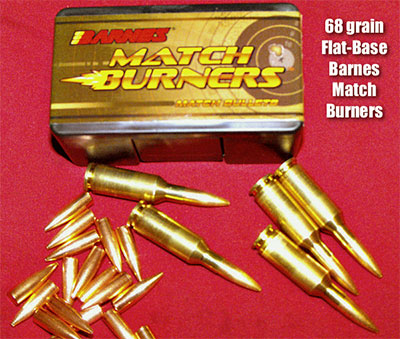
After contacting the good folks Barnes to request some Match Burners for a review in Precision Shooting Magazine, I received a box of 6mm 68gr match bullets and a box of 6mm 105gr VLDs. By the time I got these, I learned that Precision Shooting would no longer print a magazine.
These bullets sat around the house for quite some time, but I finally got around to testing them. First of all I weighed many of the bullets and found that the nominal 68gr bullets averaged 68.07 grains and the 105s averaged 105.08 grain. The 68gr bullets were .845 inches long and measured .2432 on the body and .2435 on the pressure ring of these flat-base bullets. The VLDs measured 1.192 inches long with a diameter of .2433 at the largest point and the boat tail measured .180 long with a diameter at the base of .210.
Flat-Base 68gr Match Burners Prove Very Accurate
Although I shot the 68gr bullets in some fairly “strong” conditions, they performed well as you can see below. I loaded the rounds with 28.4 grains of the new Accurate LT-32 powder (from Western Powders).
Above is a target with three 3-shot groups shot with the 68-grainers. I chose the following seating depths: (from left to right) .020 off jam*; .010 off jam; and .005 off jam. Since then I have shot a few more groups, and have been pleasantly surprised.
Barnes Match Burner 105gr VLDs Perform Well
For the 105 VLDs I chose my Dasher with a 26.5″ Bartlein gain twist (1:8.25″ to 1:7.75″). Like the 68gr bullets, these VLDs were a pleasant surprise. I plan to shoot these bullets again as soon as the weather improves.
*Editor’s Note: The term “Jam” (or “Jam Length”) is used to describe a maximum practical bullet seating dimension, typically measured from base to bullet ogive. As James uses the term, “Jam” means the maximum functional length to which he can seat a bullet in his brass, with his selected neck tension, before the bullet starts to move backwards in the case (in the direction of casehead) when he closes the bolt. Thus, if James specifies a load that is “.010 off Jam”, this means that James has seated the bullet ten-thousandths shorter than maximum functional length in his gun. His bullets are still engaged in the rifling at “.010 off Jam”, and probably still touching the rifling at “.020 off Jam”. The “Jam” length is specific to James’ barrel and brass. In different barrels, “Jam Length” can vary according to numerous factors — bore dimensions, land configuration, neck tension, bullet geometry et cetera.
Nightforce Benchrest Model vs. NXS by Jason Baney, AccurateShooter.com Asst. Editor
Anyone who has considered purchasing a Nightforce scope inevitably asks: “Which one best suits my application — NXS or Benchrest model?” Shooters also ask: “Why is there such a price difference between the NXS and Benchrest (BR) models?” This article compares the features of the two models (NXS and BR), and provides some guidelines for choosing the right Nightforce scope for your needs.
The NXS line is priced a bit higher, costing about 40% more than the comparable Benchrest model. NXS scopes are also a bit more robust, and feature a side parallax adjustment (side-focus), whereas the BR scopes have an adjustable front objective for correcting parallax. Another main difference is click value, as the BR scopes have 1/8 MOA clicks while the NXS scopes currently feature 1/4 MOA clicks. The “zero-stop” feature is something to consider as well, as it is only available on the NXS models and allows the shooter to quickly spin the elevation turret back down to a close range zero, usually 100 yards, without counting clicks.
Click Value: 1/4 MOA vs. 1/8 MOA
The tighter 1/8 MOA click value is generally more desirable for long range shooting as eighth-minute clicks allow the shooter to adjust Point of Impact more precisely than quarter-minute clicks. The 1/4 MOA clicks are worth about 2.6″ at 1000 yards, while a 1/8 MOA click will move your POI only 1.3″ at 1000. It is easy to see why the 1/8 MOA click value may be preferable when trying to dial in on a 3-5 inch X-Ring or 10-Ring. This is one reason why so many F-Classers favor eighth-minute clicks. The F-Class X-ring is just 5″ in diameter.
If you wanted 1/8 MOA clicks, it used to be that you had to choose the Nightforce BR model. That has changed. Nightforce now offers 8-32X and 12-42X NXS models with 1/8 MOA clicks. The 1/8 MOA-click NXS lineup is ideal for those who prefer side-parallax control AND more precise click values. Another consideration regarding click value is the availability of milrad clicks. “Mil” clicks are desirable when the scope has a mildot or MLR reticle, or similar reticle based on a milradian scale. Mil clicks are only available on NXS scopes at this time.
Ruggedness — NXS has the Edge Durability is not usually an issue with target shooters as the scope will mainly be used in benign environment on a fixed-distance range. So, as long as a scope tracks and performs reliably, most target shooters won’t fret about durability. For those that may use their rifles in a tactical or field situation, or when hunting, the added robustness of the NXS scope may prove quite important. Now the BR scopes are no slouch as far as durability compared to similar scopes, but, in my experience, they cannot take quite the abuse that the NXS scopes can.
Side-Focus Parallax vs. Front Adjustable Objective
As far as the side parallax adjust vs. adjustable objective, this usually boils down to personal preference. The side-focus parallax adjustment NXS model fits one additional focus lens in the scope body — a lens not required in the front-adjusting Benchrest model. According to Nightforce, this one extra lens in the NXS can reduce potential light transmission by 1.0 to 1.5 percent in the NXS compared to the BR model. However, most human eyes will not notice the difference, and overall resolution should be virtually the same. The side-focus NXS models will be much more convenient from a prone position than will the BR scopes as it is not necessary to reach out of position to correct parallax. The BR scopes tend to be more convenient in fixed distance environments like benchrest or F-class, where there tends to be multiple shots at a similar distance, or there is plenty of time to adjust parallax. Compared to the NXS models, the BR scopes use more movement to produce the same amount of parallax adjustment — so you can say the BR offers “finer” adjustment. By contrast, the NXS side-focus delivers a coarser yet quicker adjustment requiring less movement to “dial-in” minimal parallax.
Zero-Stop Feature on NXS Only Another point of consideration is the availability of a “zero-stop.” This is particularly useful in the same situations that the NXS scopes make the most sense. Namely, tactical or field situations where there may be stress combined with longer shots where dialing the turrets is required. The zero stop allows the shooter to set a stop point, usually a 100-yard zero. Then no matter where the turret is positioned in its span of travel, the zero can be quickly re-established by spinning the turret down until it stops at the pre-set zero.
At present, the Zero-stop is available on all Nightforce variable NXS models except the 12-42×56. So you CAN get the zero-stop on the 8-32 NXS, but not the 12-42 NXS.
CONCLUSION
With the new 1/8 MOA NXS models now available, the decision on which Nightforce scope to buy, will come down to focus/parallax adjustment, field hardiness, and price. Though it may still be a hard decision in certain situations, hopefully this discussion has made the decision a bit easier. All in all, Nightforce scopes are a great value and they offer enough choices to satisfy nearly all shooting situations. Nightforce Scopes can be purchased through EuroOptic.com and other Nightforce dealers.
Up in Wisconsin, a gentleman named Joe Maisto crafts some exceptionally nice competition cartridge boxes. Each box is hand-machined (no molds, no CNC), with the holes precisely fitted to the cartridge you shoot. Joe has been building his boxes since 1996, first from wood, and now from more durable (and easier-to-clean) polymers. Joe started with a hinge-top 25-round box (with magnetic latch) for short-range benchresters. He still makes that box, but now he also offers 40-round boxes, high-top boxes (for bigger, taller cartridges), open top cartridge blocks, and combo blocks with holes for cases and a built-in tray. Our buddies in the short-range benchrest game say the Maisto boxes are perfect for carrying rounds from the loading bench to the firing line. GO TO Joseph Maisto website.
25-Round Cartridge Boxes
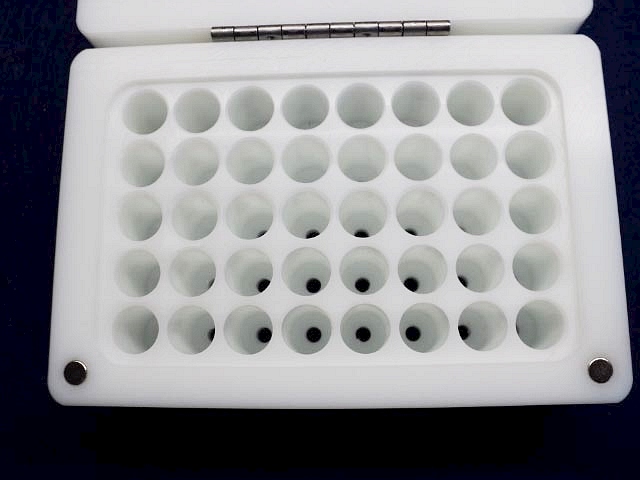
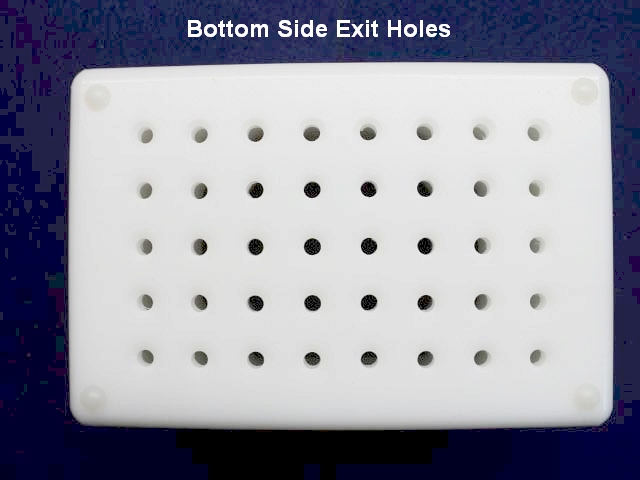
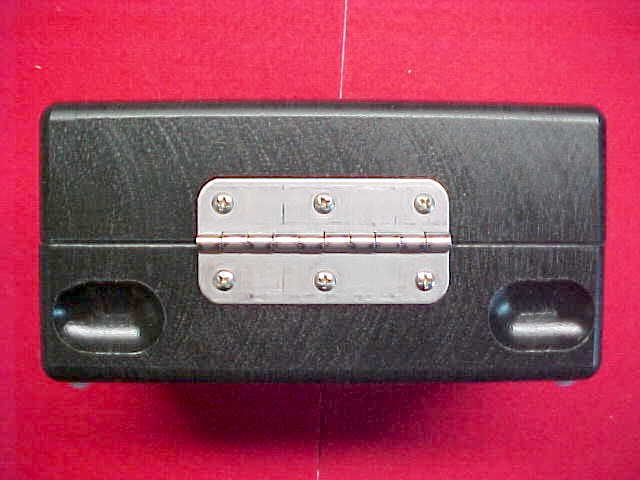
These units were designed in 1996. The originals were machined of Walnut, Cherry, or Birch. They were lovely, laborious, and expensive. To make the price more affordable, the wood units have since been retired in favor of high density polyethylene (HDPE). The front holes are separated for “record rounds”. Holes are bored with a minimum of clearance, and up to the shoulder. Additionally, each cartridge slot has a smaller hole in the bottom to allow debris to exist. These $60.00 boxes feature a quality stainless steel hinge with small but strong magnets that provide secure closure. While these were originally crafted for PPC cases, Joe offers various hole diameters for different-sized small cartridges.
40-Round Cartridge Boxes
For those who want more capacity (for longer strings of fire), Joe offers 40-round cartridge boxes. These allow shooters to change loads on the line, or simply have more rounds in a single box. With finger grooves front and back, the 40-rd boxes work for both left and right handers. Just like the 25-rd boxes, the 40s have a stainless hinge and magnetic closure. Price is $130.00.
Large Cartridge Box
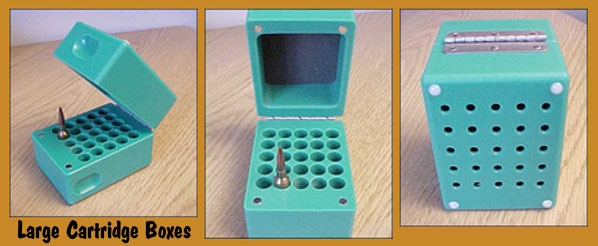
Joe’s Large Cartridge Boxes are taller to accommodate the bigger cartridges used for long-range shooting. These feature magnetic latching and and bottom exit holes, just like the Joe’s original PPC boxes. Joe notes that, for some cartridges, the Large Boxes “have 20 holes instead of 25 because of the larger cartridge head size”. When ordering the Large Boxes, you need to specify cartridge dimensions and cartridge overall loaded length (COAL). Price is $65.00 per box.
Cartridge Blocks
These cartridge “blocks” are made from the same material as Joe’s cartridge boxes. Each has finger grooves and exit holes. Joe says: “The size of the block is perfect for manipulating primed cases under a powder measure where space is a factor.” The 20-round block costs $19.00. Joe also offers a version with a recess on one side for empties. These have either 10 or 14 holes and cost $28.00.
Joseph A. Maisto www.benchrest.com/maisto
3647 Debby Lane
Franksville, Wl 53126
PH: (262) 886-1610
Email: jmaisto [at] wi.rr.com
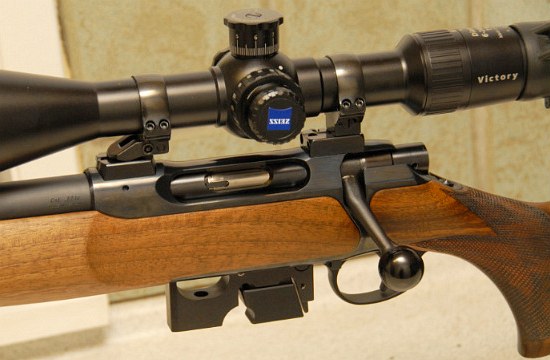
Forum member “Tooms” sent us a report on his very special Sauer 202 with a 22LR conversion kit. Sauer 202 rifles feature a “Quick-change barrel system”. The barrel is clamped into the receiver with crossbolts providing tension. This allows barrels to be swapped in a few minutes with simple tools. Tooms, from Denmark, explains: “The rifle began as a Sauer 202 Avantgarde Gold in .308 Win. I have added a 6.5×55 match barrel, plus a wide flat-bottom match fore-arm with rail for handstop and bipod. The 22LR system [originally] cost $1000.00 [including] barrel, bolt, magazine well assembly, and magazine. The barrel is attached by three cross-bolts and the magazine well assembly is attached by one screw that fits into the barrel.”
Using this “Quick-change system”, Tooms can easily remove his centerfire barrel and swap in a .22 LR barrel. Then he places the factory conversion kit into the magazine well. This kit provides a rimfire bolt, a fitted sleeve for the rimfire bolt, and a track for the magazine. This is a full Sauer factory-designed system so it works flawlessly. With the bolt closed, you can see the “new” 22LR chamber in the front section of the loading port. On the silver section of the bolt you can see the rimfire extractor on the side.
The 22LR Conversion Really Works
The Sauer 202 Varmint rifle shoots very well with the 22LR conversion, as the 50m target at right shows. Though quite expensive, the conversion kit essentially transforms your centerfire rifle into fully functional, mag-fed precision rimfire. That makes the Sauer 202 much more versatile as a hunting platform. It also allows you to cross-train with inexpensive ammo. You don’t have to purchase another scope, trigger, or stock. And you enjoy the exact same stock fit and ergonomics whether you’re shooting centerfire or rimfire. In some countries where gun ownership is severely restricted, it may be easier, from a legal standpoint, to purchase a 22LR conversion kit than to obtain a permit for a second rifle.
To learn more about the complete line of Sauer 202 rifles visit the J.P. Sauer USA website. You’ll also find more information on the primary J.P. Sauer & Sohn German website, www.Sauer.de.
We recently reported on the new Jennings F-TR stock with integrated bipod. When we first saw this rig we thought, “OK, it looks cool, but how does it shoot?” Well, we had a chance to test a .308 Win F-TR rifle built by Chesebro Rifles using the Jennings stock, Barnard action, and 32″ Bartlein barrel. With the gun on the bench, we first shot a few rounds to confirm zero and test for function.
Then gun-builder Mark Chesebro set the rifle on the shooting mat, opened up a box of Federal 168gr Gold Medal Match (GMM) .308 Win ammo, and got down to business — from the ground. What happened next can only be described as “shock and awe”. Mark nailed three successive groups that left us shaking our heads in amazement. The Jennings stock works. Does it ever. This gun hammers.
All groups were shot from the ground, bipod-supported, with Federal factory GMM ammo.
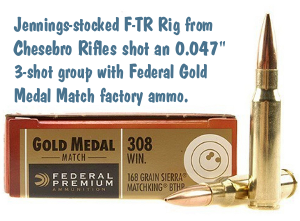
Mark’s first three-shot group had two shots in one hole, then the third leaked a bit high for a 0.184″ group. Then Mark dialed down 2 MOA elevation, and drilled an astonishing 3-shot .047″ group. (For reference, the black diamond in the orange paster is 1/4″ from point to point.)
I was watching through a Swarovski spotting scope and I saw all three shots track into one hole that just got a little whiter in the middle with each successive round. I yelled out “Stop shooting!” because I wanted to measure the group. It was an easy mid-zero — and honestly it looked like just one bullet hole from a pistol. That is amazing with factory .308 Win ammo, particularly in a barrel throated for 185s, not the 168gr SMKs Federal uses in its Gold Medal Match .308 ammunition.
After measuring Mark’s 3-shot bughole, we walked back to the firing line and Mark shot a full 5-shot group. This would have been a two-flat, but he flinched a bit and his third shot went a little high to open the group to a 0.233″. Still darn impressive with factory ammo…
Editor’s Comment: This Gun is Ultra-Stable and Tracks Straight Back
I had a chance to shoot the gun from the ground. I can tell you this — the stock design really works. With the wide-track bipod, the gun is incredibly stable. As you’re aiming there is virtually zero horizontal movement in the crosshairs. All you need to do is squeeze the ears to set your vertical Point of Aim and pull the trigger. This thing is one of the easiest guns to shoot accurately (from the ground) that I’ve ever tried. You don’t have to struggle for stability at all — the gun wants to stay dead calm.
With the large, cylindrical Delrin feet placed on a mat, the gun tracks straight back. And there is no hop, no bounce, no roll. In fact, the gun tracked so well that I could see my bullets impact on the paper target. That’s surprising for a .308 Win with no muzzle brake. After a shot I could slide the gun forward and the crosshairs were right where they should be — the only thing I had to do is squeeze the ears to re-set my vertical. All I can tell you is the thing is very easy to shoot well.
I don’t know whether it is because of the forward-angle geometry of the legs, or the Delrin feet, or the properties of the carbon fiber tube that supports the front end, but the gun seems to have more damping than other metal-chassis stocks I’ve tried. Some metal-stocked guns seem to “ring” and transmit a sharp pulse to the shooter. This Jennings stock doesn’t do that — it seems to soak up vibration somehow. And the recoil is very mild, I think because the Delrin feet slow the gun down as they slide back smoothly.
Bottom Line:We came away very, very impressed with this rifle and the Jennings stock. I have never experienced a bipod-equipped rifle (in any caliber) that is easier to aim and hold steady, or which is easier to return to precise point of aim after each shot. And, without question, this is one of the most accurate .308 Win rifles we have ever shot from the ground. And that was with factory ammo, not tuned handloads!
Making a Great Design Even Better
Could the rifle be improved? Yes. While there is some rear elevation adjustment (via an eccentric bag-rider that rotates) we would like to see more rear-end elevation adjustment, so the gun could better adapt to uphill and downhill target placements. Also we’d like to see a higher mounting point for the bag-rider so you could use a taller, beefier rear bag. We discussed these points with Mark Chesebro, and he’s agreed to start prototyping some upgrades. This may include a thumbwheel-adjustable bag-rider (sort of like an upside-down adjustable cheekpiece). At our suggestion, the vertically adjustable bag-rider may be offered in two versions — straight and angled. With an angled bag-rider (i.e. with a slight amount of drop front to rear), you could adjust your vertical point of aim by sliding the gun forward or aft in the rear bag.
We will supplement this test report with more photos and video in a few days. We know you want to see how well it tracks. The video tells the story better than words can…
For decades shooters have used brass jags attached to brass-tipped cleaning rods. These work effectively. But there is one problem. Many bore solvents will react with the brass metal to give “false positives”. You can get bluish-green patches even when there is no copper fouling in your bore.
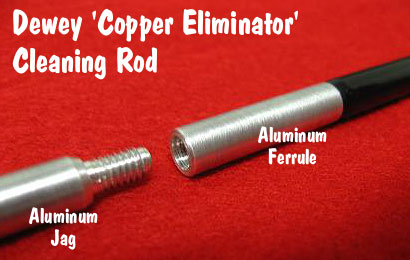
To solve this problem DeweyRods.com offers a full line of aluminum jags, aluminum brush adapters, and nylon-coated cleaning rods with aluminum tips. Dewey explains: “Ammonia-based solvents attack copper & brass but also leave your patches a blue-green color so you are never sure if your bore is truly clean of copper. Our aircraft-grade aluminum has the same hardness of brass, it will not embed impurities or harm your bore, and ammonia will not attack it.” As shown below, along with caliber-specific aluminum jags (center), Dewey now offers aluminum thread adaptors (left) and aluminum-shaft brushes (right).
New Dewey ‘Copper Eliminator’ Cleaning Rods
These new rods have the same nylon coating and handle assembly as Dewey’s standard coated rods, but they feature a chemical-resistant, 8/32 female-threaded, aluminum ferrule. No brush adapters are required. Each rod is supplied with a male-threaded aluminum jag. Dewey charges $39.95 for these rods, but you may find them slightly cheaper at other vendors.
Copper Eliminator Rods are currently offered in two diameters (.22-.26 Cal, or .27+ Cal), and three lengths: 36″, 40″, 44″. Listed rod lengths do NOT include handle assembly. One last note: Dewey cautions users to avoid TM Solution, because this solvent may harm Dewey’s nylon rod-coatings.
Christmas is coming up soon, so today we’re featuring a hand-picked collection of “stocking stuffers” for precision shooters. You can order most of these items online, and if you get your orders in soon, your selections should arrive before December 25th. So as not to bust your holiday budget, all of our selections are priced under $10.00. These items are handy tools that you’ll use over and over again at the range and/or at your loading bench (so you’re allowed to buy them for yourself, even after Christmas).
Gifts $1 to $5
Surveyors Tape
$1.99
Hood Kwik Estimator
$2.50
Bifocal 3X/6X Magnifier
$2.75
Barrel Mirage Shade
$4.95
Surveyors’ Tape. Always watch the wind when you shoot. Inexpensive, Day-Glo Surveyors’ Tape (aka “Flagging Tape”), attached to a stake or target frame, makes a good wind indicator. It will flutter even in mild breezes, alerting you to both angle and velocity shifts. This should be part of every range kit. Don’t leave home without it.
Hood Kwik Estimator. Here’s a very handy tool to measure your 6mm groups. Bracket the group within the diverging lines of the Kwik Estimator and you’ll instantly get a good approximation of the actual group size. No more trips to the tool box for calipers. The inexpensive Kwik Estimator fits in a shirt pocket. (Thanks to Boyd Allen for this suggestion.)
Bifocal 3X/6X magnifier. This handy, inexpensive dual-power magnifier is always close at hand on our loading bench, because it helps with so many task. We use a compact magnifier to inspect bullet tips, to check brass chamfers, and inspect the internals of triggers and other parts. Priced at just $2.75, a magnifier like this (or the folding variety) is a “must-have” item for every hand-loader.
Sinclair Barrel Mirage Shade. For high-volume varminters, and competitors who shoot fast in warm weather, a mirage shield is absolutely essential. This prevents hot air rising off the barrel from distorting the image in your scope. The aluminum Sinclair shield can be trimmed to fit, and comes with stick-on Velcro attachments. Two lengths are available: 18″ for short BR barrels, and 24″ for longer barrels.
Gifts $6 to $10
Dewey Crocogator
$6.50
Ballistol Aerosol Lube
$8.99
Sinclair Barrel Bag
$9.95
Sinclair Load Block
$9.99
Dewey Crocogator. The Crocogator tool, with knurled “teeth” at both ends, is simple, inexpensive, and compact. Yet nothing zips though primer-pocket gunk faster or better. Unlike some cutter-tipped primer pocket tools, the Crocogator removes the carbon quick and easy without shaving brass. One end is sized for large primer pockets, the other for small.
Ballistol Aerosol Lube. Ballistol is a versatile, non-toxic product with many uses in the reloading room. We have found it is ideal for lubricating cases for normal full-length sizing. It is clear, not gooey or chalky like other lubes. It is very, very slippery, yet is easy to apply and just as easy to wipe off. As you lube your cases, the Ballistol will also clean powder fouling off the case necks. For heavy-duty case forming and neck expansion, we’ll still use Imperial die wax, but for every-day case sizing, Ballistol is our first choice. It also helps prevent your dies from rusting and it even conditions leather. Ballistol is a favored bore cleaner for Black Powder shooters because it neutralizes acidic powder residues.
Sinclair Barrel Bag. If you run a switch-barrel rig, or take spare barrels to a big match, this simple but effective barrel bag will protect your valuable steel. The bag is moisture-resistant vinyl on the outside with a soft, quilted interior to protect the barrel’s finish and delicate crown. There are two sizes: one for barrels up to 26 inches, the other for barrels up to 31 inches. Both sizes are priced at $9.95 per bag. That’s cheap insurance for those priceless barrels.
Sinclair ‘Poly’ Loading Block. We’ve tried wood and injection-molded loading trays, and we prefer Sinclair’s white polyethylene loading blocks. They featured chamfered holes properly sized for the particular case you reload. The blocks are heavy enough to be stable on the bench, and the “dishwasher-friendly” material is easy to clean. The standard Poly Loading Block holds 50 cases, while the Competition Loading Block holds 25 cases with a tray for empties. For a bit more money, there’s also a Heavy-Duty 50-case model with an extra-thick 1″ base.
We are organizing our crew for the 2013 SHOT Show, which runs January 15-18 in Las Vegas, at the Sands Expo Center. To whet your appetite, here is a product report from SHOT Show 2010 that you may have missed the first time around. In this video Robert Ruch, CFO of Forster Products, shows off the Forster’s 3-in-1 Case Trimming Tool. This is a very smart tool that can dramatically speed up your case prep operations.
Tool Cuts Brass to Length, and Chamfers Inside and Outside
Forster’s new 3-in-1 Carbide cutting tool works with all existing Forster case trimmers. This unit does three jobs at the same time. It trims the case to length, it puts a 14-degree chamfer on the INSIDE of the neck, AND (last but not least), it cuts a 30-degree chamfer on the OUTSIDE of the neck. It does this all quickly and efficiently — in a matter of a few seconds. We tested the new tool ourselves on a few cases. The tool is solid and well made. The carbide cutting tips do perform a very clean cut. Be aware, however, if you have turned your necks already, you may have to reset the blade positions before you start trimming your brass.
Forster’s CFO, Robert Ruch, demonstrates the 3-in-1 case trimming/chamfering tool in the video below. As you can see, the tool turns very smoothly (no chatter) and the job is finished in a few seconds. The actual cutting time, per case, is just a few second. The tool has an MSRP of $70.00, but we expect it to sell for around $50.00 at major vendors. It can be fitted on Forster trimmers and other hand lathes with a .490″ shaft diameter.
John Whidden Demonstrates Forster Co-Ax Press and Trimmer
In this promo video, produced for the Outdoor Adventure ‘What-the-Stuff’ TV show, John Whidden of Whidden Gunsworks, talks about the benefits of precision case trimming and demonstrates how to use the unique Forster Co-Ax Press.
[haiku url=”http://accurateshooter.net/Video/samhallmax.mp3″]Click PLAY to hear Sam TALK about SEB MAX coaxial joystick rest.
“It’s a keeper” — that’s what Sam Hall, 4-time IBS 600-yard Shooter of the Year, told us after he test-drove the new SEB MAX coaxial front rest. Over the past two months, Sam has been testing the new SEB MAX with his competition benchrest rifles, with a variety of forearm widths from three inches to eight inches, and weights from 17 to 61 pounds.
Did Sam like the SEB MAX? He did indeed — in fact he was so impressed with the MAX rest that he is selling his current front rest and he will be using the SEB MAX for both LG and HG matches.
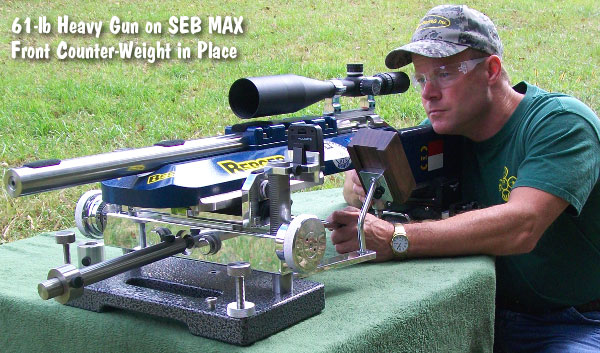
In designing the SEB MAX rest, Sebastian (“Seb”) Lambang set out to build a rest that would handle true heavy guns up to 45kg and also adapt to lighter rifles with a variety of forearm widths. This was quite a challenge, but he pulled it off. The SEB MAX quickly adapts to fit narrow, medium, and wide forearms, with a simple adjustment of the side plates on the three-piece front bag. You can change from 3″ to 5″ to 8″ width in seconds. If you prefer a conventional one-piece front sand-bag, SEB offers one-piece bags sized to fit various forearm widths from 2.5″ to 8″.
The SEB MAX also adapts to different rifle weights through the use of a front counter-weight for the heavy big boomers. With a standard 17-lb Light Gun, you can run the MAX with no counterweight. The joystick control movement is very smooth and with the internal springs tuned right, you can shoot with your hand off the joystick. When you want to switch to a true Heavy Gun, simply attach the counterweight arm to the front of the gun. SEB can supply custom counter-weight “donuts” tuned to your specific Heavy Gun. Sam Hall reviews the features of the SEB MAX in the video below.
Watch SEB MAX Video Review (Part 1 — Light Gun)
Does the SEB MAX retain its smooth movement even with a true Heavy Gun on the front bags? Absolutely. Sam reports that “When shooting my 61-pounder, with the counter-weight in place, the joystick movement is smooth and predictable — it feels just like the Light Gun”.
To prove how well the counter-balancer works with a true Heavy Gun, Sam put his 61-lb Maxi-Tracker on the SEB MAX, attached the appropriate counterweight, and then shot a group at 600 yards without touching the joystick during a four-shot string. To Sam’s amazement, the gun produced a 4-shot group under 1.5″. Sam says: “That was in mid-day with some mirage. That’s about the best this gun can do in those conditions. It was impressive to be able to run a string with a 61-pounder and not touch the joystick.” You can see this in the Part 2 Video below.
Watch SEB MAX Video Review (Part 2 — Heavy Gun)
Superior Build Quality, Unique Versatility, and Outstanding Performance
Sam had high praise for the workmanship, fit, and finish of the SEB MAX: “This rest is a work of art. I’m not easily impressed by most products, but this is one fine machine.” Sam added that the SEB MAX is not just pretty — everything functions very well: “The sideplates have quick-release handles so you can change widths quickly. The course elevation control is very smooth and easy to use. With the course elevation locked, there is plenty of vertical travel (elevation) and plenty of side-to-side travel with just the joystick.” Sam was also impressed with how well the 61-pounder tracked on the SEB MAX: “I’ve been playing with it… and the gun seems to track perfect.”
Sam also praised the micro-fiber fabric SEB uses for both the three-piece and conventional one-piece front bags: “This micro-fiber is great. You don’t need to use any silicon or powder or anything to slick it up, yet the forearm slides on it better than anything I’ve ever seen.”
Sam likes the modular construction of the SEB MAX. Sam found that, when he was just shooting a Light Gun, he could remove the rear foot, making the rest easier to move around. Like the SEB NEO rest, the MAX rest breaks down into flat modules so it packs more compactly for shipping.
SEB MAX rests are currently in the final stages of production. Price for the USA market has not yet been set. You can get on the pre-order waiting list by contacting Ernie Bishop in Gillette, Wyoming. Call (307) 257-7431, or email ernieemily [at] yahoo.com. For other markets consult dealer list on www.SebCoax.com.
Weight: The MAX weighs approximately 18.4 kg (40.5 lbs) without the counter-weight, with bags empty. Sam’s rest with full bags and counter-weight is about 45 pounds.
Rest Size: Side to side footprint (center to center of leveling screws) is approximately 13.78″. Dimension from back to front is about 14.17″.


 The tool-makers at 21st Century Shooting have come up with a very slick new Precision Hand-Priming Tool. This extremely well-made, benchrest-grade unit raises the bar among single-primer seating tools. Feel is great, changing shell-holders is simple, and nothing else on the market offers better control over primer seating depth. The tool’s precision-adjusting head provides clicks in .0025″ increments for precise seating depth. The tool’s body, internals, and shell-holders are stainless, while the handle is anodized aluminum. Price is $118.00 for the tool itself. Shell-holders (sizes from 17 Remington up to .338 Lapua Magnum) cost $7.99 each.

 I can’t imagine anyone, who uses a single-primer tool of this type, not liking this tool. When it comes to hand reloading tools, I can afford to have pretty much whatever I want (within reason). After testing and using this tool, I pulled my Sinclair tool from its case, and replaced it with this one. That should say it all. After using this tool, I will have to give serious consideration to other 21st Century reloading products the next time I need a new tool. One thing is for sure — we have an important new player in the design and manufacture of top end of reloading equipment. 21st Century’s Precision Priming Tool “raises the bar” among single-primer seating tools.
 After contacting the good folks Barnes to request some Match Burners for a review in Precision Shooting Magazine, I received a box of 6mm 68gr match bullets and a box of 6mm 105gr VLDs. By the time I got these, I learned that Precision Shooting would no longer print a magazine.


 Durability is not usually an issue with target shooters as the scope will mainly be used in benign environment on a fixed-distance range. So, as long as a scope tracks and performs reliably, most target shooters won’t fret about durability. For those that may use their rifles in a tactical or field situation, or when hunting, the added robustness of the NXS scope may prove quite important. Now the BR scopes are no slouch as far as durability compared to similar scopes, but, in my experience, they cannot take quite the abuse that the NXS scopes can.
 Another point of consideration is the availability of a “zero-stop.” This is particularly useful in the same situations that the NXS scopes make the most sense. Namely, tactical or field situations where there may be stress combined with longer shots where dialing the turrets is required. The zero stop allows the shooter to set a stop point, usually a 100-yard zero. Then no matter where the turret is positioned in its span of travel, the zero can be quickly re-established by spinning the turret down until it stops at the pre-set zero.








 The 22LR Conversion Really Works


 Mark’s first three-shot group had two shots in one hole, then the third leaked a bit high for a 0.184″ group. Then Mark dialed down 2 MOA elevation, and drilled an astonishing 3-shot .047″ group. (For reference, the black diamond in the orange paster is 1/4″ from point to point.)

 I don’t know whether it is because of the forward-angle geometry of the legs, or the Delrin feet, or the properties of the carbon fiber tube that supports the front end, but the gun seems to have more damping than other metal-chassis stocks I’ve tried. Some metal-stocked guns seem to “ring” and transmit a sharp pulse to the shooter. This Jennings stock doesn’t do that — it seems to soak up vibration somehow. And the recoil is very mild, I think because the Delrin feet slow the gun down as they slide back smoothly.
 Christmas is coming up soon, so today we’re featuring a hand-picked collection of “stocking stuffers” for precision shooters. You can order most of these items online, and if you get your orders in soon, your selections should arrive before December 25th. So as not to bust your holiday budget, all of our selections are priced under $10.00. These items are handy tools that you’ll use over and over again at the range and/or at your loading bench (so you’re allowed to buy them for yourself, even after Christmas).