Here’s a simple tool that may benefit you AR15 and AR10 shooters out there. The G&G Tools’ Bolt Cleaner and Polisher uses a radiused scraper with a cleaning pad to remove stubborn carbon from the tail of your AR bolts. The G&G Tool is offered in both a .223 version and a .308 version, both priced at $29.99. There is also a more basic (scraper only) unit for $19.99.
There are other ways to remove carbon (soaking in solvent and scraping with a knife), but G&G’s tools make the job quick and easy. Credit The Firearm Blog for finding this device. Watch the video below to see the tool in action.
Got gun gear? Need mobile storage? Here are three handy storage solutions that can haul your stuff safely without breaking your budget. In fact, our first recommended item costs less than a buck. How can you argue with that!
The 99¢ Compact Tool Box — Fits inside a Backpack
Here’s a great item for hunters and tactical guys. Right now, the 99¢ Store is selling a small, 11″x5″x4″ plastic tool box. The price — you guessed it — is just ninety-nine cents. Hey that’s less than the cost of a cup of coffee. We like this unit because it is small enough to fit in a backpack or large duffle bag. It can keep your pointy tools from poking holes in your pack, or provide hardshell protection for pricey items such as range-finders, cameras, and Kestrels. As you’d expect, the box isn’t perfect — the snap closure could be tighter. But the tool box does the job. It’s a very handy size, and the price is so cheap you can hardly go wrong. I bought two — one for gun stuff and the other for emergency gear in my vehicle. Note: This item is not listed online at 99only.com — availability may vary from store to store.
Lockable Utility Boxes — Good for Guns, Ammo, Tools
Northern Tool sells a versatile, lockable Utility Box for just $10.99. This is available in Green (Item# 26169) or Orange (Item# 26171). There is also a larger version with a top tray for $15.99 (Green, Item# 26170 or Orange, Item# 26172). We like these storage boxes. They have a rubber weather-seal, and the tupperware-type plastic is gentle on your tools or firearms. The sturdy locking system lets you use these boxes to transport handguns in jurisdictions (such as California) where a locked container is required. The smaller box can easily hold two medium-sized handguns, plus ammo and shooting glasses. It’s also nice to have a lockable box to hold expensive accessories such as wind-meters and cameras. The big box (15″L x 8″W x 11.5″H) is strong enough to sit on and holds plenty of gear. We have a few of these boxes (both large and small) and they’ve held up through years of service.
Wheeled, Lockable Mobile Chest Can Haul It All
If you need to haul a ton of gear, consider the Stanley Pro Mobile Chest (model 033026R). The main compartment of this thing is big enough to hold a front pedestal rest, a couple sand-bags, plus muffs and more. There’s also a small, see-through, pop-top parts caddy on top. Use that for stowing small tools, jags, patches, brushes and other supplies. Right now you can get this (#033026R) Mobile Chest at Ace Hardware for just $49.99. You can order online and Ace will ship the unit for free to your nearest Ace Hardware Outlet.
Forum Member Rod V (aka Nodak7mm) commissioned a full-bling “Extreme Make-Over” of his Bald Eagle Slingshot Front Rest. The visual change was dramatic — a benchrest version of “Pimp My Ride”. But Rod’s old Bald Eagle was also fitted out with new controls and new, large-diameter F-Class foot pads. Those hardware additions add more than flash — they improve function too.
Plain Jane Rest Becomes Black and Gold Beauty
The whole rest body was powder-coated black and the controls were finished in gold-tone. This has got to be the best-looking Bald Eagle in the galaxy. Rod says: “I had Bob Pastor of Viper Rests make me some F-Class feet for my Bald Eagle Slingshot rest. Since Bob does powder coating and such, I gave him the go ahead to make it look sweet. And he sure did!”
Rod adds: “Man do I have a ‘kick-butt’, hot looking rest for F-class now! Pastor did a great job and I really owe him a thanks for exceeding my expectations and for his craftsmanship. Bob is a great guy to work with. He is a top-shelf shooter too, so he knows what he wants in a rest and why.”
What’s involved in an “Extreme Make-Over” by Bob Pastor?
Here’s the description on Bob’s Website, www.ViperBench-rest.com:
Each rest is customized for the individual shooter. All the brass knobs and handles are melted down rifle cases from my foundry.
(Aluminum knobs and handles can be substituted of weight is a concern.)
Each knob and handle is individually knurled and turned on my lathe.
All threaded stainless steel rods, knob screws and knob extensions are used. These are all highly polished before installation.
The Viper Double-Edge F-Class Feet are 4″ wide, with a large tapered spike turned concentric to the center hole.
All corner stainless steel rods are ½ x 13 threads per inch for added stability.
All corner stainless steel rods have concentric points turned on the ends for use on a shooting bench.
All corner holes in base are drilled and tapped for ½ x 13 tpi., from 3/8 x 16 tpi. For better stability.
The base is stripped of any paint and all sharp edges and burrs are removed prior to powder coating.
The entire rest is either powder-coated or painted according to the material.
All threaded rods are burnished to remove any small burrs, before applying synthetic grease and assembly.
All brass is highly polished, unless a matte finish is desired.
Each rest is then packed in liquid hardening foam for safety during shipping.
To order an “Extreme-Makeover” visit www.ViperBench-rest.com, call Bob Pastor at (269) 521-3671, or email robpas [at] btc-bci.com . Bob says the Make-Over price “depends on the customer’s desires and is quoted before the rest is shipped to me.”
Bushnell recently released its new Fusion 1600 ARC range-finding binoculars. With a “low street price” under $799.00, Bushnell’s 1600 ARC binoculars are less than one third the price of Leica Geovids (10×42, $2399.00) or Zeiss Victory RF Binoculars (10×45, $2,799.00).
That huge price advantage makes the Fusion very tempting — but can Bushnell’s 1600 ARC binos perform as advertised?
Forum Member Reviews Fusion 1600 ARC
Forum Member Stan (aka BigBamBoom) acquired the Fusion 1600 ARC RF binoculars and has posted a video review. Stan was favorably impressed with the quality of the glass and the exterior ruggedness of the unit. He was able to range very large objects (water-tower, trees) beyond 1200 yards. He also praised the speed of the unit, saying it ranged faster than his Leica CRF 1200. Consider however, that the very small CRF1200 is harder to aim precisely, simply because it is so small and light and held in a vertical orientation. Most people can aim the larger, heavier LRFs with more steadiness using a normal two-handed horizontal grip. In the real world, if you can hold the LRF more steady, you can get a true range on a small object more quickly.
Don’t Expect to Range a WhiteTail at 1600 yards
We also caution that, in our Laser rangefinder comparison tests, we learned that there is BIG difference between ranging a water tower, and ranging a deer-sized animal. We found that some units that could range a water tower at 1300+ yards could NOT reliably range an actual deer (stuffed by taxidermist) at 700 yards. Note that Bushnell lists three different effective ranging distances for the Fusion 1600, and Bushnell claims only 500-yard effectiveness on deer-sized objects. This is fairly consistent with our LRF comparison tests:
It can be fun to range buildings at a mile, but for the hunter, that may not have much practical utility. You want to be able to range deer-sized game at all practical distances. For the tactical shooter, you need a narrowly focused beam (with minimal beam divergence) that can range a gong or metallic silhouette reliably at 1000 yards. If an LRF can’t do that, it may not be all that useful, even if it the sales price is attractive. Fusion 1600 ARC Features
The 10×42 roof prism binoculars feature built-in battery life indicator, twist-up eye pieces, and multi-coated optics with RainGuard. The Fusion 1600 is fully waterproof and submersible, meeting IPX7 “waterproof” specification. As Stan observed, the Fusion 1600 has good glass, and the red readouts are easy to see. Bushnell employs Vivid Display Technology™ (with four display brightness settings) to enhance display readability in all lighting conditions.
The built-in laser rangefinder features ARC (Angle Range Compensating) technology, which calculates the angle to the target (-90 to +90 degrees). ARC also and gives the hold-over range for the rifle shooter, and true horizontal distance for bow hunters. We like the fact that you can choose between Inches and MOA for holdover. There is a brush mode for measuring distances in heavy cover and a bullseye mode for ranging in open areas. The brush mode can filter out false returns from closer objects. This IS a useful feature that actually does work.
The Fusion 1600 ARC laser rangefinder binoculars come with battery, neck-strap, and carrying case. MSRP is $899.00. It pays to shop around as we’ve seen advertised prices from $789.00 to $899.00. For more info, visit www.bushnell.com or call 800-423-3537 for consumer inquiries.
The popular BulletFlight Ballistics Program, is now available for Android OS smart phones and mobile devices. BulletFlight (from Knights Armament) has emerged over the past couple of years as one of the very best balllistics programs for iPhones and iPods. And now Android device users can enjoy the same functionality and features.
BulletFlight Android OS software comes in three different versions, all available through the Android Market. BulletFlight L1 (Level 1, $3.99) is a fast-running ballistics App with a host of features, including: user-selectable BC models (G1, G7, G8 etc.); output in inches, cm, MOA, Mils, and scope clicks; 360° wind drift calculation. BulletFlight includes a large database of bullet types (with weights, BCs etc.)
BulletFlight L2 (Level-2, $11.99) adds a full calculation screen where you may enter exact range and atmospheric details. The Level-2 version can also generate range-cards, perform cosine-angle calculations, handle mil-dot range estimations, and calculate impact energy, velocity, and flight time. What’s more, Level-2 offers GPS functionality so you can geo-locate your position, and/or download local weather information. The $11.99 L2 software package is what we recommend for most users.
BulletFlight L2 Screen Shots
Level M is Ideal for Ultra-Long-Range Shooting
Priced at $29.99, BulletFlight Level-M (Military) version further adds the ability to calculate an actual BC based on bullet drop, two velocities, or flight time. This can be useful if you make your own bullets, do extensive experimental work, or shoot at extreme long range. If you do regularly shoot beyond 1000 yards, BulletFlight Level-M is probably the best choice. The Level-M software factors bullet spin drift and Coriolis effect into the ballistics solution — making this a super-sophisticated tool. In addition, the Level-M software can calculate bullet stability based on MV, barrel twist rate, and bullet specs.
With all versions of BulletFlight, you can also create your own custom ammo profiles (with velocity, BC, bullet type), allowing you to easily output ballistic plots for multiple firearms, without having to enter the rifle/bullet profile each session.
Successful long-range shooting demands very uniform ammo. Weighing charges carefully can make shot velocities more uniform within a shot string. Uniformity of velocities is good, because lower ES translates to less vertical dispersion of the shots at long range. Many competitive shooters today try to load charges that are consistent within one-tenth of a grain. Some exacting reloaders, in the relentless pursuit of perfection, go even further — they try to maintain charge weight uniformity down to the equivalent of just one or two kernels of powder.
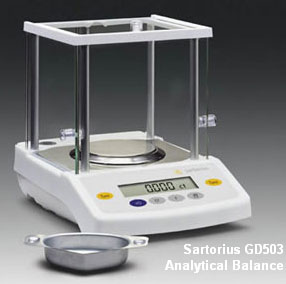
To weigh charges with this kind of precision, you need a very high-quality scale. Even the $400.00-grade balances (such as the Acculab VIC-123), struggle to maintain single-kernel precision with their conventional strain-gauge load cell technology. But there is a new class of electronic lab scales which employ magnetic force restoration technology. These force restoration balances can reliably (and repeatably) weigh a single grain of powder. In normal use, lab-grade force restoration scales also deliver a stable reading more quickly than strain-gauge type scales. This is a boon for reloaders who like to trickle the final few kernels of a load. But the enhanced speed and precision of force restoration (magnetic) scales come with a stiff price — these technological marvels cost $900.00 and up. That could buy a custom action, or three new barrels.
Trickling Kernel by Kernel with GD503 and Omega Trickler
Do the advanced force restoration scales perform as advertised? Can they reliably recognize a single kernel of powder quickly enough to make trickling practical? Well, thanks to Forum member A.J. (aka AJ), we have a video that answers those questions. Using a Sartorius GD503 Class II force restoration balance with an Omega two-speed powder trickler, A.J. demonstrates how he can weigh charges that are consistent within a single kernel’s weight, i.e. 20-25 thousandths of a grain.
When you watch the video, note how (at 3:45 time mark) the RCBS electronic scale reads 41.7 grains, when in fact the correct charge weight was 41.830 grains, as measured by the GB503. That’s a one-tenth grain (four kernel) error right there. You will also see that the Omega Trickler from Dandy Products really can drop one kernel at a time. It takes some careful adjusting of the drop tube to achieve this sensitivity, but the Omega really is up to the task.
A.J. recently acquired his Sartorius GD503 digital scale from Balances.com. Retail price is $899.99. A.J. reports: “I have to say the [GD503] is one awesome unit. I was loading my 260 with 42 grains of H4350. The GD503 is accurate to .005 (5 thousandths) of a grain. My Acculab was supposed to be accurate to .020 of a grain but couldn’t do that on a good day. This new scale can actually weigh an individual kernel of H4350, it weighs right at .025 per kernel. I weighed a small screw about 20 times throughout one day and every time I got the same exact reading. My load for my 260 now has a SD in the single digits and an ES of 10 fps is not uncommon for 5-shot groups.”
Having seen an actual reduction in his velocity ES and SD, A.J. is sold on his $900.00 GD503: “This thing is amazingly accurate. It repeats every time. The weight does not keep changing or growing like my Acculab VIC 123 or my RCBS Chargemaster. My loads have never been so accurate. Now I don’t have to wait for a Prometheus as I have something better for a fraction of the cost.”
If you’re interested in the Sartorius GD503, below is a video from Balances.com that explains the features of the GD503 and shows how to set up and operate the unit to achieve the best results.
Strain-Gauge Scale vs. Force Restoration Scale — Responsiveness Test
This final video also shows the difference in performance between a strain gauge scale and magnetic force restoration scale (GD503). In the video, both scales are tasked with measuring tiny grains of salt, which are much smaller than extruded powder kernels. You can see that the GD503 responds more quickly when a few grains of salt are added.
In our Shooters’ Forum, you’ll find a lengthy thread about accuracy problems with a Savage LRPV, chambered in 6mmBR. The gun would repeatedly split groups at 100 yards, and at 300 yards, the “flyers” would open up the groups to 1.5 MOA or larger. Interestingly, the factory test target (at right) showed a split group — not a good sign.
The gun’s owner, forum member LR_Shooter, tried a variety of tweaks: “I did this, done that… [changed] torque, tang floated, bedded action, recut chamber, and [adjusted firing pin]”. But nothing really helped. Frustrated, LR_Shooter asked his fellow Forum members for help. Much advice was proffered, including the novel idea of removing the middle action screw in the Savage 3-screw target action. Some of the advice proved helpful, but none of the suggested remedies produced a major improvement. This rifle, out of the box, tossed flyers and no amount of tweaking (or changes in shooting technique) really cured the basic problem. That is, until, the factory barrel got replaced…
New Criterion Pre-Fit Barrel Works Wonders
LR_Shooter acquired a Criterion pre-fit barrel from Jim Briggs at Northland Shooters Supply (NSS). These pre-fits are designed for easy installation with the standard Savage barrel nut. Wouldn’t you know it, with a new 30″ heavy-contour barrel on the LRPV, the gun started shooting way better. No more crazy fliers, no more split groups, no more excessive vertical. And the improvement came without any other major modifications. LR_Shooter reports: “I got a replacement barrel from Jim at NSS. It is a 30″ bull Criterion barrel. So far, without playing with torque screws and having my old setup… I’m very satisfied with the barrel I got. Now I have no problem getting [groups] under 0.25 MOA. Finally this thing can shoot!” The targets below, shot with the new Criterion barrel, speak for themselves. The left target was shot at 100 yards, while the target on the right was shot at 300 yards (very impressive).
Targets Shot with Savage LRPV Fitted with Criterion Barrel
Moral of the Story — Sometimes A New Barrel Really Is the Right Solution
All of us have struggled at times with a rifle that won’t live up to expectations. This Editor personally struggled for over a year with a .260 Rem Savage with a factory tube. The gun tended to split groups and the POI walked as the barrel heated. I tried one powder/primer combination after another, working through a variety of seating depths over many months. I was persistent. Out of stubbornness, I just believed that sooner or later I’d find the magic load.
Well folks, sometimes there’s really nothing you can do about a sub-par barrel. It is what it is. To really improve a gun’s accuracy (particularly a gun with a factory tube), you may need to open your wallet and get a quality aftermarket barrel. Spending months trying one recipe after another may simply be an overwhelming waste of powder, bullets, and your precious time.
Albert Einstein supposedly said: “Insanity is defined as doing the same thing over and over again, and expecting different results.” Well that sort of describes my efforts with my .260 Rem. Once I had enough evidence that my barrel split groups no matter what load combo (and seating depth) I tried, it was time to pony up for a new barrel. When I did finally screw on a nice PacNor 3-groove Supermatch, that Savage suddenly became a true tack-driver. As re-chambered in 6mmBR with the Pac-Nor, in calm conditions, my Savage will now consistently shoot in the twos with heavy bullets, and it can sometimes dip down into the ones with Berger 80gr flat-base bullets. The moral of the story here is simple — don’t waste weeks or months chasing your tail with a barrel that just won’t deliver (after a reasonable amount of testing). Save up for a custom barrel, get it chambered properly, and stop your cycle of frustration.
Contact Information for Northland Shooters Supply:
E-mail: briggs.j-b@q.com (that is Q.com not G.com)
Phone: (763) 682-4296
Fax: (763) 682-6098
Mailing address:
P.O. Box 333
Buffalo, MN 55313
One cannot discuss one of the most useful tools for long range shooters, The Slope Doper, without saying something about its inventor, David Rolls. David was a bold man, bigger than life, who dedicated his life to the service of others. Yet, he was full of fun and a little mischief. He had little tolerance of fools (a man after my own heart), but had great respect for those who deserved respect. It was a loss to all when he passed away in August 2008 at the young age of 61. That being said let me tell you of how he lived and what he accomplished with The Slope Doper.
David Rolls’ Background
David worked for years with the Baltimore City Fire Department as a firefighter and paramedic, retiring at 45. Not being content to sit around, he applied for a job with the Sheriff’s Department of Mineral County, West Virginia and graduated from the state police academy. No small feat for a man of any age, let alone one in his forties. David rose to the rank of Sergeant and held that rank until his passing. As a firefighter, paramedic and police officer, he was the kind of man you would want if you were in a tight spot. He never backed down when it came to helping others. Throughout his life he was active in the Boy Scouts and community activities. He was a lifetime member of the NRA holding the status of Golden Eagle and Certified Firearms Instructor.
As a shooter, David was intensely interested in tactical competitions and was a member of the American Sniper Association. Long distance tactical shooters are frequently faced with the problem of making adjustments when shooting uphill or downhill, as well as windage and normal bullet drop. Chucks Hawks provided a superb discussion of the effects of uphill/downhill shooting for the hunter. I strongly urge every reader to look up Chuck’s article to better understand the problem.
Even knowing that we will be shooting over our target (or at best higher than our aiming point), most hunters do not know how to make the required adjustments in the field. Something had to be devised that could be used quickly in the field by the average hunter. Enter David P. Rolls!
Slope Doper Debuts in 1998 at Storm Mountain
After a great deal of thought, David showed up at the Carlos N. Hathcock II Charity Sniper Competition at the Storm Mountain Training Center in 1998 with a prototype of his Slope Doper. It was somewhat crude by comparison to the current day production model, consisting of a laminated paper protractor with a weight and string, but it worked. It allowed a shooter to determine the impact point of his bullet when shooting at any angle. David had succeeded in combining the science of mathematics with the practicality required for field use. It should be noted that military shooters have used protractors for years, but they had to subtract numbers to arrive at the correct angle. Dave’s invention placed the zero degree point at the top of the arc, virtually eliminating the possibility of error. Ever the perfectionist, with an eye to the future, he asked his best friend, Fred Fischer to design a “professional” version with AutoCad, which Fred gladly did. Fred also had contacts with a manufacturer who happened to be a shooter and they were off. Fred still chuckles when he remembers all of the last minute changes that Dave came up with, but at least they had the basic artwork locked into the AutoCad program to go into production. The rest is history.
The Quantico marine sniper instructor who was the first military member to see a production version of the Slope Doper (and incidentally a member of the two-man team who won the Carlos Hathcock Sniper Competition) was impressed enough by it to remove his personal protractor from his data book and replace it with the Slope Doper David gave him. The Slope Doper is now standard issue with the Marine Corp sniper weapon system; The Slope Doper is packed with each rifle and its accessories. The pointer is easily replaceable with string and a weight if it is lost and the printing on both sides is actually fire resistant. It is mil spec and made to withstand combat conditions. It is aluminum rather than plastic, so that it will not break in cold conditions.
To understand how the Slope Doper works, it is best for me to let David tell you in his own words:
To begin with, you must understand that when you shoot up or downhill, gravity has a diminished effect on your projectile such that if you do not make any adjustment for angle, you will likely shoot over your target. This applies at long distances (greater than 300 yards) at slight angles and at severe angles (greater than 30 degrees) at lesser distances. With slight angles at short distances the adjustment may not be enough to worry about. The Slope Doper is a photo etched, anodized, aluminum plate that has two scales inscribed along an arc. The first scale tells you the angle in degrees, the inner scale gives you the cosine of the angle (what I call the “Slope Angle Factor”) at 10 degree intervals.
To use the Slope Doper, you must first know the range to your target. Next you have your partner (guide) hold the Slope Doper along side the bore centerline of your rifle while you take aim and read the Slope Angle Factor. If you are alone, you can sight your target along the top edge of the Slope Doper and capture the pointer with your thumb and then read the Slope Angle Factor. If you are not at an exact Slope Angle Factor, it is easy to interpolate. Now take the known distance and multiply that by the Slope Angle Factor. The answer you get is the effective range. You should now shoot as if the actual distance is the lesser distance (at 30 degrees, a Slope Angle Factor of 0.87, 500 yards becomes 435 yards). All other environmental factors, like wind, are still in effect at the actual distance (500 yards of wind is still 500 yards of wind).
To make my life easier, I attached some Velcro to the back of my Slope Doper and on the forend of my rifle. After using my rangefinder for distance, I simply point my rifle at the target, capture the pointer with my thumb, read the Slope Angle Factor, make a quick mental calculation and shoot. If you are an experienced shooter with a scope that has a mil dot reticule, the back of the slope doper has your ranging formulas. The Slope Doper is a must-have for every person who hunts in mountainous country, from the Appalachians to the Rockies. It will help prevent you from missing your quarry. It is a bargain when compared to the $300 – $500 we pay for our rangefinders and binoculars. You can purchase the Slope Doper directly from the Slope Doper Website for $24.95 plus $5.00 shipping (PayPal or mail-order). U.S. Tactical Supply also sells the Slope Doper for $24.95.
A final note: I was watching the Outdoor Channel last week and watched a hunter on a ridge shoot over a 6×6 bull elk in the valley below. The elk disappeared, and the show ended with the hunter and guide talking about the thrill of the chase, even though they missed the elk. Good for public relations, but not so good for the freezer. They should have had The Slope Doper!
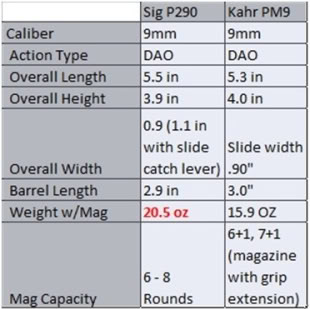
Small, light-weight carry pistols and revolvers are the hottest selling handguns on the market right now. Ruger’s .380 ACP and 9mm carry guns have been hugely successful, generating revenues that have helped push Ruger’s stock price up 500% since 2009. Now Sig-Sauer is getting on the bandwagon. We had a chance to look at Sig’s new-for-2011, P290 compact 9mm carry pistol. Overall, our reaction was generally favorable. The P290’s fit and finish are excellent — as you’d expect from Sig. Keltec’s PF-9 compact 9mm seems downright junky by comparison to the Sig P290. And the machining and fit of the slide and barrel on the Sig seem superior to the hot-selling Ruger LC9. In a nutshell, here’s how the new Sig P290 stacks up to the competition — it is better crafted and more reliable than the Keltec PF-9, it is more reliable than the Ruger LC9 (which has had recall issues), and, with its optional integrated laser, it is a more complete package than the Kahr CM9 and PM9.
However, the P290 is not without its flaws. We wish the grip was a little longer — and other reviewers agree. Also the trigger pull, listed at “9.0 lbs. average”, is just too heavy in our opinion. We know that Double-Action-Only (DAO) carry pistols like this need high pull weights to satisfy the lawyers, but the P290 pull weight is extreme. Most people will have trouble getting best accuracy out of the gun because of the heavy trigger, which one tester measured at 12.5 pounds.
Rich Grassi, Tactical Wire: “According to factory specifications, the trigger is supposed to average 9 pounds. The guns [we tested were] 1st Edition models and could have been underachievers. While some participants thought the triggers were a bit extreme, I found them manageable. The sample that arrived at headquarters on my return is an overachiever; my Timney scale ran out of weights at 10 pounds. Getting my old Brownells trigger pull gauge, I was able to get an average of around 12 ½ pounds(!) before bending the trigger hook! This is 12 ½ pounds to fire a gun that weighs just over a pound. You hold it still through a trigger stroke. I’ll watch.”
Paul Scarlata, PoliceMag: “The trigger pull was rather heavy with a definite staging about halfway through the stroke, although I assumed this would smooth out with use. My other concern was that the attenuated grip left the little finger of my shooting hand dangling in the air. Because of its short grip, frame recoil control was not what one would have hoped for and I actually found the pistol more comfortable to fire with an unsupported grip. [Sig informed me] that future plans call for the P290 to come with a spare eight-round magazine with a sleeve that approximates the external contour of the grip. Such magazines will provide a full, three-finger grip without compromising concealability[.]”
CONCLUSION: The Sig P290 is a well-designed, nicely-made pistol in the super-small 9mm carry pistol category. However, for this writer, I wouldn’t want to carry the gun unless the trigger pull could be reduced to a reasonable weight for a DAO application (the trigger pull on the Kahr PM9 is much better). I would also wait until the optional magazine with grip extension is available. In the meantime, when the situation calls for a very small, light carry gun, I’ll stick with my older S&W model 638 revolver. We do suspect that, despite its shortcomings, the P290 will attract many buyers based on Sig Sauer’s reputation for quality. But the P290 costs more than most other small, polymer-framed 9mms, and price may be the deciding factor for many buyers.
There are many ways to store handguns in gun safe. including hanging your handguns on the inside door panel with Velcro straps or Velcro-equipped sleeves. Some folks try wood pegs for the triggerguards. The problem with these methods is that it’s just too easy for Velcro to work loose, or a peg to come out. End result is a dropped pistol. Also, placing your handguns on a door makes them highly visible. That’s a bad idea if your safe is placed in an open area such as a garage or game room.
Our first choice is to place handguns in lockable, sliding drawers inside the safe. Tucked inside silicon-treated Bore-Store bags, and then laid flat inside a drawer, handguns are safe, secure and out of sight. Unfortunately, few safe-makers offer sliding drawer options. If you have a large-enough safe, you can fit your own lockable drawer unit or small file cabinet with locks. These can be purchased at office supply stores or Home Depot type outlets.
If you have limited space in your safe, we recommended the vinyl-covered metal handgun racks from Versatile Rack Company. The 4-Gun rack has approximately the same footprint as a single handgun laying flat. These racks have a strong, welded-steel frame, vinyl-coated to protect the finish of your pistols. We’ve found these work for virtually all size handguns, both semi-autos and revolvers, even when the guns are placed in Bore-Store bags. In fact the fit is just about perfect if you first place a handgun in a Bore-Store bag, which provides about 1/4″ of padding all around the gun.
Versatile now offers multiple models, with capacities from a single handgun up to 10 pistols. These can be purchased directly from Versatile, starting at $69.99, but other vendors sell them for less. MidwayUSAhas Versatile racks at these price: $12.49 (2-gun, item 953403) $19.99 (4-gun, item 953075), $24.49 (6-gun, item 275638), $32.99 (8-gun, item 111468). Click HERE for a 360-degree view of the 4-gun unit. There is also an optional stacking unit, shown below.
One of the better “on-door” solutions is “The Holster”, a door-top rack from Rack ‘Em Racks. The top bracket secures to the door edge with self-tapping screws. Handguns are held muzzle-down in a plastic-coated wire frame. The installation is quite secure and this system gives you very fast access to your handguns. However, this unit requires that you adjust the top shelf of your safe to fit below your longest-barreled handgun. And, unless you have a very deep safe, you have to clear off most of the items on one side of the top shelf, to avoid interference when you close the safe door. Still, Rack Em’s vertical door rack is a smart design, one that uses space much more efficiently than a door full of separate wire brackets or pegs. Price is $39.99 at Cabelas.com.
One other interesting design is the rotary handgun rack. Hyskore offers a 9-Gun Rotary Pistol Rack (item IJ-229069) that looks well-built, and is fairly compact. Like a carousel, it spins to allow easy access to your handguns. It features foam-padded cradles, and an oak-verneer finish. The price is $45.99 at MidwayUSA,. Unfortunately, with a compact 12″-diameter base, there is not enough clearance for scoped revolvers or pistols with red-dot sights. And, from a safety standpoint, we’d rather see the pistols stored muzzle-down than muzzle-up. Still it looks like a clever, compact design that will work with most handguns.
Hyskore 9-Gun Rotary Pistol Rack
An even more efficient use of space is achieved with a two-tier “bunkbed-style” pistol rack. This will hold a large collection of pistols in a relatively compact space. Gun-Racks.com offers two-tier pistol racks with 10-gun ($104.00), 12-gun ($115.00), or 16-gun ($125.00) capacities. For five ollars more (per size) you can get an elevated model with mag storage. These racks are crafted from wood, with soft Rayon fabric on the sections contacting your guns. These well-made racks pack a lot of guns in a small space. However, the barrel slots are only 2.5″ apart. So you do get a very compact footprint, but the trade-off is a tight fit on larger handguns.
If you have large hunting handguns with top-mounted scopes, or bullseye pistols with fat target grips, consider the Hyskore Modular Rack which holds guns with the barrel on top and level, so there is plenty of clearance for scopes. Hyskore racks are made of soft, closed-cell foam that won’t scratch metal and won’t absorb moisture. Guns are stored in individual foam bins that can be connected together horizontally.The width of each individual bin can be adjusted to fit even very wide target grips. Hyskore racks come in sets of three foam bins. Using 3/16″ threaded crosspins, you can combine the bins into one, long secure unit running the full width of a shelf.


 Here’s a simple tool that may benefit you AR15 and AR10 shooters out there. The G&G Tools’ Bolt Cleaner and Polisher uses a radiused scraper with a cleaning pad to remove stubborn carbon from the tail of your AR bolts. The G&G Tool is offered in both a .223 version and a .308 version, both priced at $29.99. There is also a more basic (scraper only) unit for $19.99.


 Plain Jane Rest Becomes
 Bushnell recently released its new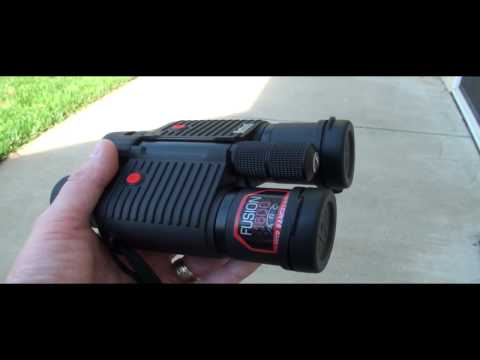


 Successful long-range shooting demands very uniform ammo. Weighing charges carefully can make shot velocities more uniform within a shot string. Uniformity of velocities is good, because lower ES translates to less vertical dispersion of the shots at long range. Many competitive shooters today try to load charges that are consistent within one-tenth of a grain. Some exacting reloaders, in the relentless pursuit of perfection, go even further — they try to maintain charge weight uniformity down to the equivalent of just one or two kernels of powder.
 In our

 One cannot discuss one of the most useful tools for long range shooters,


 SIG P290 Online Reviews
 CONCLUSION: The Sig P290 is a well-designed, nicely-made pistol in the super-small 9mm carry pistol category. However, for this writer, I wouldn’t want to carry the gun unless the trigger pull could be reduced to a reasonable weight for a DAO application (the trigger pull on the Kahr PM9 is much better). I would also wait until the optional magazine with grip extension is available. In the meantime, when the situation calls for a very small, light carry gun, I’ll stick with my older S&W model 638 revolver. We do suspect that, despite its shortcomings, the P290 will attract many buyers based on Sig Sauer’s reputation for quality. But the P290 costs more than most other small, polymer-framed 9mms, and price may be the deciding factor for many buyers.
 There are many ways to store handguns in gun safe. including hanging your handguns on the inside door panel with Velcro straps or Velcro-equipped sleeves. Some folks try wood pegs for the triggerguards. The problem with these methods is that it’s just too easy for Velcro to work loose, or a peg to come out. End result is a dropped pistol. Also, placing your handguns on a door makes them highly visible. That’s a bad idea if your safe is placed in an open area such as a garage or game room.
 Our first choice is to place handguns in lockable, sliding drawers inside the safe. Tucked inside silicon-treated Bore-Store bags, and then laid flat inside a drawer, handguns are safe, secure and out of sight. Unfortunately, few safe-makers offer sliding drawer options. If you have a large-enough safe, you can fit your own lockable drawer unit or small file cabinet with locks. These can be purchased at office supply stores or Home Depot type outlets.


