With the price of some premium scopes approaching $3000.00 (and beyond), it’s more important than ever to provide extra protection for your expensive optics. ScopeCoat produces covers that shield scopes with a layer of neoprene rubber (wetsuit material) sandwiched between nylon. In addition to its basic covers, sold in a variety of sizes and colors, ScopeCoat has a line of heavy-duty 6mm products that provide added security.
Triple-Thickness XP-6 Model for Added Protection
The XP-6 Flak Jacket™ is specifically designed for extra protection and special applications. The 6mm-thick layer of neoprene is three times thicker than the standard ScopeCoat. XP-6 Flak Jackets are designed for tall turrets, with sizes that accommodate either two or three adjustment knobs (for both side-focus and front-focus parallax models). To shield an expensive NightForce, March, or Schmidt & Bender scope, this a good choice. XP-6 covers come in black color only, and are available for both rifle-scopes and spotting scopes.
The heavily padded XP-6 Flak Jacket is also offered in a Zippered version, shown at right. This is designed for removable optics that need protection when in storage. The full-length, zippered closure goes on quick-and-easy and provides more complete protection against dust, shock, and moisture. MSRP is $30.00.
Special Covers for Binos and Red-Dots
ScopeCoat offers many specialized products, including oversize covers for spotting scopes, protective “Bino-Bibs” for binoculars, rangefinder covers, even sleeves for small pistol scopes and red-dot optics. There are also custom-designed covers for the popular Eotech and Trijicon tactical optics. Watch the Shooting USA video below to see some of ScopeCoat’s latest specialty covers.
GunVault has unveiled a new, affordable security system for AR-platform rifles. The patent-pending AR MagVault ($24.95 MSRP) is a key-lock-controlled bright orange nylon block that fits in AR magwells. When engaged, the AR MagVault blocks magazine access, and more importantly, prevents the bolt from cycling. Once the AR MagVault is locked into place, a round cannot be inserted or chambered.
According to the manufacturer, the AR MagVault fits virtually all .223/5.56 AR-platform rifles. We like this well-designed product. The fiberglass-reinforced nylon block seems sturdy. It can supplement the use of a chamber safety flag at the range (the hi-viz orange color makes it easy to see the block is in place). In addition the AR MagVault can provide added security when an AR is transported or stored in a gun safe. Our only concern is the key system — we’d rather see a combination lock. As blogger Robert Farago cautions: “Don’t lose that key!” For additional info, visit GunVault.com.
We’re often asked: “What’s the best way to set up a spotting scope for shooting from a bench?” Some guys have spotting scopes set on big full-size tripods positioned to the side of the bench. That will work, but it normally requires you to move way out of position to look through your scope. Also, if you place the tripod as close to the bench as possible, one of the tripod legs will extend down close to your foot. It is all too easy to jostle the tripod with your foot or knee and move the scope off your target. We’ve also seen folks with spotting scopes mounted on compact camera tripods set directly on the bench. Again, this is not a very good solution. These small tripods position the spotting scope too high. Small camera tripods are also really too light and flimsy to hold a big, heavy spotter, with a 65mm or larger front objective. You really need a better set-up. You want to mount the spotting scope so, when you are in shooting positino, the eyepiece is close to your head — allowing easy viewing without moving your whole body away from the rifle.
Scope Stands for Bench Use
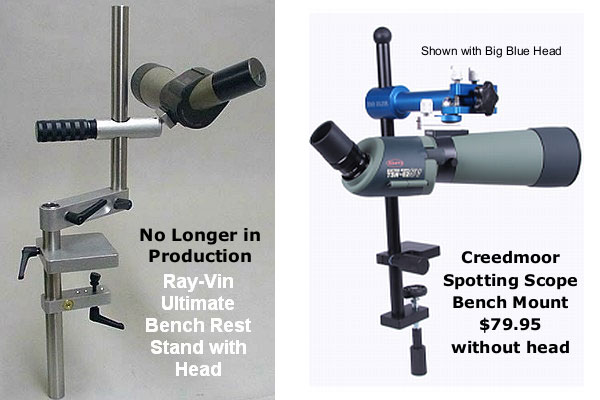
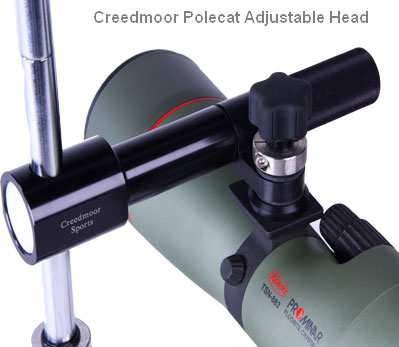
The best system for mounting a spotting scope to a bench was the Ray-Vin Ultimate Benchrest Stand. This clamped securely to the side of the bench and was a very high-quality piece of gear. Unfortunately, Ray Brandes of Ray-Vin has retired and his clamping benchrest scope stand is currently out of production. If you can find one for sale second-hand — snag it. If you can’t locate a Ray-Vin clamping stand, don’t despair, Creedmoor Sports has come out with a clamping-type Spotting Scope Bench-mount that is only $79.95 without head. This features 1″-diam vertical shaft so it can be used with most scope-holding heads that can adapt to a 1″ tube, such as a Ray-Vin head, Big Blue head, or Creedmoor’s new Polecat head. The clamp mount secures the rig anywhere you want along the side of the bench. You can easily adjust the scope height and fore/aft position relative to the shooter. The Ray-Vin head, now sold by Creedmoor, features a twist handle with a ball joint on the end. This then lets you set the scope (and angled eyepiece) to any angle you want. It’s a very slick system.
The Creedmoor Bench-mount is currently back-ordered, but Creedmoor expects to receive product before the end of the year. The Polecat head is available now for $139.95. Creedmoor, which has taken over production of the Ray-Vin scope stand head, is taking orders for the Ray-Vin head currently. No release date is offered. However, there should be some 1″ Ray-Vin heads on the used market.
As part of MidwayUSA’s Black Friday Week Sale, which ends today, Nov. 29th, MidwayUSA has discounted its popular Competition Series range bags. Both the compact version and the full-size range bags are deeply discounted for the remainder of today. The Compact Range Bag is just $29.99 in either black or olive drab, and the Large Range Bag, which is almost the size of a travel duffle, is $39.99 in black or OD. We think you’ll be very satisfied with either product (we like the OD color best). In April we field-tested the compact model and we were very impressed with the design and the quality. Below are highlights from our field-test. CLICK HERE for FULL TEST STORY.
MidwayUSA Compact Competition Range Bag
Measuring 16″L x 12″W x 10″H, this Compact Range Bag is definitely smaller than MidwayUSA’s popular Large Range Bag (22″L x 15″W x 10″H). However, the “Compact” version will hold plenty of gear — pretty much all a pistol shooter will need at the range. For a rifle shooter, it will haul ammo boxes, earmuffs, magazines, and other miscellaneous gear. The bag is made from a strong, heavy-duty PVC-coated polyester, with high-quality, large-toothed zippers. A comfortable, curved carry strap is secured by sturdy, all-metal clips. The “build quality” is visibly much better than most range bags on the market.
Deceptively Large Capacity for a ‘Compact’ Bag
To test the carrying capacity of the MidwayUSA bag, we loaded it up with 100 rounds of rifle ammo, 600 rounds of centerfire pistol ammo, 500 rounds rimfire, earmuffs and FOUR pistols tucked in the padded side sleeves. All that gear fit nicely with room to spare. (We recommend putting handguns in protective sleeves if you load two per side). The padded, full-width, zippered main pocket keeps seven spare magazines organized and protected. On the reverse side of the bag, a similar, full-length padded pocket provides undivided storage space. The bag’s many pockets make it easy to organize miscellaneous gear such as staple gun, target stickers, small binoculars, timers, and radios.
Here’s a good deal for a hunter or a tactical competitor who needs a solid, no-BS rucksack with tough construction, good stitching, and sturdy metal fasteners. Sportsman’s Guide is selling genuine U.S. Military Medium ALICE packs for $17.97. These are USED packs, but in good to very good condition. These are the same ALICE (“All-Purpose Lightweight Individual Carrying Equipment”) packs carried by U.S. soldiers prior to the introduction of MOLLE system packs.
Note, the $17.97 surplus ALICE packs come without frames. They have adjustable 2 3/4″ shoulder straps with twin 4 1/2 x 11″ shoulder pads, plus lower and upper back pads. The central storage area is enclosed with a drawstring and 2-strap top flap. On the outside are three 5″ x 10″ outer gear pouches secured with metal buckles and web straps. These surplus ALICE Packs are available for $17.97 in either Olive Drab (OD) or Woodland Camo.
ALICE Packs with Frames at ArmyGear.net
If you need an ALICE pack with metal frame, ArmyGear.net has surplus ALICE packs with frames at super-low prices. A Large (2200 cubic-inch capacity) ALICE with frame is just $26.98. This big pack MUST be used with an ALICE Frame — you cannot attach shoulder straps alone. These $26.98 large ALICE packs include frame, shoulder straps, and kidney belt. The 1500-cubic-inch Medium ALICE pack with frame is also $26.98, in woodland camo. The medium pack can be used with or without a frame. ArmyGear.net sells the Medium ALICE without frame in OD for $18.98 with shoulder straps ($19.98 Woodland), or $12.98 without shoulder straps.
21st Century Shooting has just introduced what may be the most advanced powder funnel on the market. It has everything you could want. The top section is precision ground and polished for a smooth flow. The center has a see-through tube so you can watch the progress of your powder dropping into the case. At the bottom of each funnel is a precision brass collar insert that allows the funnel to stand on the case without tipping off. The collars are offered in nine, caliber-specific sizes: 17cal, 20cal, 22cal, 30cal, 5mm, 5.5mm, 6mm, 6.5mm, and 7mm. In addition, 21st Century offers custom-milled collar inserts fitted precisely to your cases. That way you can get a perfect fit on neck-turned brass. Just mic your casenecks and 21st Century will craft a custom insert.
Each funnel, with one caliber-specific insert, costs $21.75. Additional standard inserts are $5.75. Call 260-273-9909 for pricing on custom inserts.
Gear Reviewby Germán A. Salazar, Contributing Editor
All of us have at one time or another struggled with glare in the front sight at certain ranges and certain times of year. There are a lot of ways to deal with glare, shade tubes being the most commonly seen. I prefer to avoid any type of extension on the front or rear sight, especially anything that hangs past the muzzle where the muzzle blast can cause damage and in any event, I haven’t found those tubes to be very effective. However, the need to do something about the glare at our south-facing range at the Phoenix Rod & Gun Club has become essential for me. At this time of year, the sun is directly in front at this range and I really struggle to get a clear sight picture.
The photo above, taken on 10/16/2010 clearly illustrates the problem at PRGC as the early morning sun is from the left and front. Note the backlit flag and the direction of the shadows. As the sun continues to rise, it aligns itself right down the range towards the shooters. Apart from the glare, the bull is hard to see on the targets once they’re up because the light is coming from behind the target, not from the front. A very challenging set of light conditions which will worsen from now through February as the sun stays lower in the sky month by month.
Anti-Glare Filters from Art Neergaard
I recently spoke to Art Neergaard about this problem. Art manufactures a number of innovative products for rifle sights through his company ShootingSight LLC and he had an idea for me. The idea was simple in concept, a “donut” filter for the front sight with a hole in the middle so as not to darken the already dim bull and yet, it would cut the glare that otherwise enters the front sight. The picture at left shows the filter mounted on the sight. When you’re looking through the sights, there isn’t the large gap around the aperture, it’s actually a very close match. Sticking the camera right into the sight obviously changes the perspective a bit.
I wanted to evaluate the Centra Goliath 30mm sight on my new Palma tubegun. Since Art intended to make the filters for the 30mm size, this was a good time to begin that evaluation as well. My last match score with this rifle, five weeks ago before the light got bad, was a 600-42X, since then, I’ve had a couple of poor matches with other rifles as the light and glare have really troubled me. With the 600-42 as a “good condition baseline” with this rifle I was eager to see how the filters would work.
Art sent me a few items: two filters (one gray, one orange), and one filter-holder for them, as well as a fixed aperture cut in the same material as the filters, with a beveled edge like the ones available for many years for smaller sights. The filters are interchangeable in the holder and can be changed in a minute or so. The aperture, however, is fixed as the hole is drilled in a lathe after mounting the disc in the holder — this ensures perfect concentricity for the aperture.
Gray Filter Preferred
Arriving at the range, I mounted the high-contrast orange filter first and looked through it. Frankly, although it cut glare well, I hate the look of an orange world! A quick change of filter and another look through the sights showed a good, glare-free and natural-looking sight picture with the gray filter. At right is a photo that shows the relative glare-cutting effect of the gray filter.
Scores Improved with Anti-Glare Filtration
Shooting a good mid-range .308 load with Winchester brass, Federal primers, IMR 4064 (manufactured in 1960, just like me) and moly-coated Sierra 190 gr. bullets, the rifle showed it’s good breeding giving me a 200-12X, 200-15X and 200-14X for a 600-41X, my 22nd score of 600! Well, quite a dramatic improvement over the last couple of weeks when I struggled to shoot 590, and back to the score I shot five weeks ago when the light was still good. Hooray! So yes, I’m very satisfied with the concept of the filter with a hole in it. All the extraneous glare that was hurting my sight picture was gone and the bull remained unimpaired. Not that the bull was too good to begin with as all I can see is a fuzzy gray blob out there, but keeping the center unfiltered was better than some solid filters I’ve tried in the past.
Clear Rain Filters for Front Sights
Art plans to make clear donut filters to use as rain shields for shooters with a front lens in their sight. That would keep raindrops off the lens — especially the middle of the lens where a drop could destroy the shooter’s ability to see the bull properly.
Filter Works with Fixed & Variable Apertures
Although I intended to try the fixed aperture also, I ended up shooting the entire match with the filter and the Centra variable aperture. I’ll try to use the fixed aperture (photo at left) next week. The value of a fixed aperture shouldn’t be underestimated. It provides a lower cost way to use a 30mm sight, an important consideration given the current $175 price of the adjustable aperture. Perhaps just as important, the fixed aperture is something that should be in every high-end shooter’s kit in case of failure of the adjustable, which has been known to happen. If I were traveling across the country or around the world to a match, you can be sure there would be a set of fixed apertures of various sizes in my kit to back up the adjustable iris.
Art Neergaard
ShootingSight LLC www.ShootingSight.com
eMail: shootingsight@nuvox.net
Phone: 513-702-4879
Monitor Barrel Heat with Pocket InfraRed Gauges
You never want to run the barrel of a precision rifle too hot. Excessive barrel heat kills accuracy, increases copper fouling, and can cause rapid barrel throat wear. Over the years people have devised various means to cool their barrels — from electric fans to dunking in tubs of ice water.
But how do you know if your barrel is too hot? Consider a “non-contact” thermometer that reads your barrel’s “infrared signature”. The Kintrex or Actron pocket-sized, non-contact IR thermometers are ideal for shooters at the range or in the prairie dog fields. Both are handy and inexpensive — costing about twenty bucks (on sale).
Pen-Sized Kintrex
Just 3.2″ long, and weighing a mere 1.3 ounces, the waterproof Kintrex IRT0401 (IP67) is small enough to carry in your pocket, and will easily stow in any range bag/box. The unit measures from -67 to 428 °F (-55 to 220 °C). Kintrex is a respected manufacturer that also makes larger hand-held IR thermometers for industrial and shop applications. Priced at just $21.11 on Amazon.com, the tiny Kintrex is one gadget that every serious shooter should have. Given the cost of replacing barrels these days, can you afford NOT to have a temp gauge for your match or varmint barrel?
Actron PocketTherm for just $18.22
The compact Actron CP7875 PocketTherm Infrared Thermometer is on sale right now on Amazon.com for just $18.22. Roughly 4″ x 1.5″ in size, it is slightly larger than the Kintrex, but still small enough to carry in a pocket. It features an angled head and may be easier to hold than the Kintrex for some users. It works instantly with intuitive one-button operation, measuring temp ranges from -27º to 428º F (-33º to 220º C). Rated battery life is 20-25 hours. The backlit display is easy to read. However, you need to place the Actron PocketTherm close to the “target”. Most larger “industrial” spot thermometers (both laser and infrared), have beam ratios from 6:1 to 10:1, allowing them to measure a 1″ circle at 6″-10″. The CP7875 has a 1:1 ratio, so it measures a 10″ circle at 10″ distance. To get an accurate temp on a barrel, you must hold the thermometer within an inch or so. That’s not a big deal when measuring barrel heat, but the beam ratio may limit the usefulness of the PocketTherm for other tasks.
If you don’t have a portable GPS yet, here is a great deal. The very popular Garmin Nüvi 260W with voice instructions is on sale for the next few days for just $99.99, with FREE shipping. This unit is easy to program, and instantly switches from Map view to a Trip Info view that provides current speed, average speed, miles to destination, and more. Click the lower right corner of the Map view at any time to bring up Next Turn info.
This Editor has been using a Garmin Nüvi for a year now and it works marvelously. I now take it on any long trip, and it has also been very useful when navigating to local locations. If you miss a turn, it will usually recalculate within seconds. The spoken turn-by-turn instructions are easy to follow — it’s like having a human navigator by your side. Click the link below right for best pricing and FREE Shipping.
North American Maps are Pre-Loaded
The Garmin Nüvi 260W comes preloaded with City Navigator NT North America–road coverage for the U.S., Canada and Puerto Rico and nearly 6 million points of interest. City Navigator North America NT gives you everything you need to travel North America. Powered by NAVTEQ, a world leader in premium-quality digital map data, City Navigator brings you the most detailed street maps available so you can navigate with exact, turn-by-turn directions to any address or intersection.
The battery will run a few hours, but I recommend keeping the unit plugged in via your cigarette lighter outlet or other DC power port. When the unit is not in use for a few days, I also recommend removing the battery. Even with the unit switched “off” Garmin maintains a “fast access” mode that draws a small amount of current.
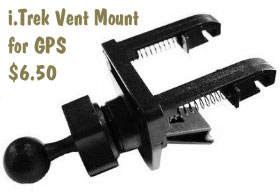
Handy Vent Mount Secures GPS I’ve experimented with a half dozen GPS mounts and my favorite is the i.Trek Vent Mount. This snaps on quickly and places your GPS in an ideal position to the right of the steering wheel. It is a little tricky to remove, but otherwise works great and only costs $6.50 at Amazon.com. The Vent Mount can jiggle a bit on big bumps, but the GPS is normally plenty stable, and it is easy to adjust viewing angle. It’s a great little device — much better in my opinion than windshield mounts (which are illegal in some states).
South African Pieter L.R. (aka “Baboonstalker” in our Shooters’ Forum), has crafted an impressive single-torch annealing machine with a compact footprint. Pieter’s new KinetiX Precision Annealer holds cartridge brass cases in a dished carousel (wheel) machined from billet. An electric motor advances the carousel while a separate belt-driven spindel rotates each case when it in positioned in the flame. The standard wheel holds cases up to .308 bolt-face in diameter, and Magnum wheels are available.
Precision Mount for Torch-Head
One of the most impressive features of the new machine is the 4-way mount that holds the torch tip. This adjusts for height, flame angle (up/down), and flame distance to case. It can also rotate around a vertical axis. The mount looks like something NASA would produce for vectoring rocket thrusters.
Compared to some other annealers, Pieter’s KinetiX unit is quite compact, with a small footprint. The entire unit (less torch) would fit in a large hat-box. Pieter kept the footprint small by placing all the drive motors and gears under the carousel, rather than off to the side. Pieter optimized his machine for a single torch: “Dual torches are good on some other models to distribute the heat around the neck or to get longer exposure time on the constant-motion models. On this model the case turns in the flame so i do not see a real need for a secondary torch. However, if you want two or more torches i would be more than happy to add brackets for them.”
Basic KinetiX Annealer Will Cost $540.00
Pieter plans to put his KinetiX annealer into production: “I will be selling these units for $540 USD not including shipping, which is about $105 USD for airmail and $35 USD for surface mail. I hope to have my own website up and running soon but you can reach me on gokinetix[at]telkomsa.net in the meantime.” The $540.00 price includes the annealing machine, speed controller, power supply (100-260V) and standard wheel which up to .308-rim-diameter cartridges (including 284s). Pieter tells us: “I have tested [the standard wheel] down to .22 Hornet, but anything that sticks out above the plate (7/8″) should work fine. If you have a specific case in mind that does not fit, i can just make up a special wheel for you.” Pieter also plans to offer Magnum wheels for cases up to .338 Lapua, and Super Magnum wheels for cases up to .50 BMG.


 With the price of some premium scopes approaching $3000.00 (and beyond), it’s more important than ever to provide extra protection for your expensive optics. ScopeCoat produces covers that shield scopes with a layer of neoprene rubber (wetsuit material) sandwiched between nylon. In addition to its basic covers, sold in a variety of sizes and colors, ScopeCoat has a line of heavy-duty 6mm products that provide added security.
 The heavily padded XP-6 Flak Jacket is also offered in a Zippered version, shown at right. This is designed for removable optics that need protection when in storage. The full-length, zippered closure goes on quick-and-easy and provides more complete protection against dust, shock, and moisture. MSRP is $30.00.




 Anti-Glare Filters from Art Neergaard
 Gray Filter Preferred
 Filter Works with Fixed & Variable Apertures
 But how do you know if your barrel is too hot? Consider a “non-contact” thermometer that reads your barrel’s “infrared signature”. The Kintrex or Actron pocket-sized, non-contact IR thermometers are ideal for shooters at the range or in the prairie dog fields. Both are handy and inexpensive — costing about twenty bucks (on sale).

 If you don’t have a portable GPS yet, here is a great deal. The very popular Garmin Nüvi 260W with voice instructions is on sale for the next few days for just $99.99, with FREE shipping. This unit is easy to program, and instantly switches from Map view to a Trip Info view that provides current speed, average speed, miles to destination, and more. Click the lower right corner of the Map view at any time to bring up Next Turn info.
 I’ve experimented with a half dozen GPS mounts and my favorite is the i.Trek Vent Mount. This snaps on quickly and places your GPS in an ideal position to the right of the steering wheel. It is a little tricky to remove, but otherwise works great and only costs $6.50 at Amazon.com. The Vent Mount can jiggle a bit on big bumps, but the GPS is normally plenty stable, and it is easy to adjust viewing angle. It’s a great little device — much better in my opinion than windshield mounts (which are illegal in some states).


