|
|
January 20th, 2010
 At the request of AccurateShooter.com, respected Benchrest ace Lou Murdica tested the brand new, early production Norma 6PPC brass. Lou shot 30 cases (both turned and unturned) over the past few days, and he endorses the Norma brass without hesitation. Lou says “the Norma PPC brass is great brass. Without a doubt this will be highly competitive brass in the short-range benchrest group”. Lou did observe that the necks on the Norma brass were slightly thinner than on Lapua 220 Russian brass, but that really doesn’t matter. With a slight neck turn, Lou declares, “the Norma PPC brass is as good as any out there.” At the request of AccurateShooter.com, respected Benchrest ace Lou Murdica tested the brand new, early production Norma 6PPC brass. Lou shot 30 cases (both turned and unturned) over the past few days, and he endorses the Norma brass without hesitation. Lou says “the Norma PPC brass is great brass. Without a doubt this will be highly competitive brass in the short-range benchrest group”. Lou did observe that the necks on the Norma brass were slightly thinner than on Lapua 220 Russian brass, but that really doesn’t matter. With a slight neck turn, Lou declares, “the Norma PPC brass is as good as any out there.”
Lou said, based on his testing, the Norma brass holds pressure well, and the accuracy is outstanding. Lou shot five 5-round groups, as in a match course of fire, and his largest group was “around 0.148″ at 100 yards.
If you’re a short-range benchrester, definitely watch this video and listen to Lou. He thinks this new Norma brass will “change the game”. Note — Lou said most PPC shooters can shoot the Norma cases with no change in their powder recipes. So you won’t lose any velocity using Norma’s new brass. Lou was very impressed with Norma’s new offering, enough so that he declared: “I would go right for the Norma right now if I could put a bunch in my hand.”

January 20th, 2010
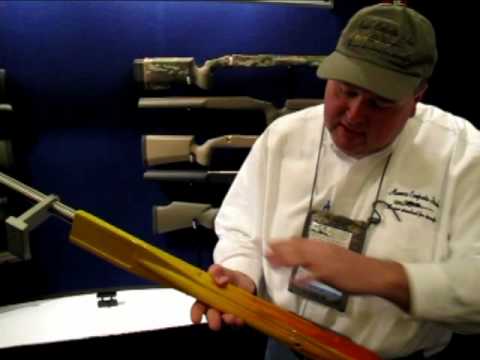
Manners Composite Stocks builds very strong, stiff stocks employing advanced manufacturing methods and high tech carbon fiber materials. In this video, stock-maker Tom Manners showcases his new products for 2010. These include the handsome new MCST 5A Tactical stock, composed of 30% carbon fiber, 65% fiberglass. Though as strong as any comparable stock on the market, the MCST 5A weighs just 4.1 pounds. Tom also displayed his impressive “long wheelbase” F-Class stock. A full 7″ longer than any other F-Class stock on the market, the Manners F-Class stock features all-carbon construction and a unique “fish-belly” design that provides extra rigidity so the stock tracks smoothly without the “springboard effect” common to some other low profile stock designs.


Tom also previewed the new Manners Mini Chassis, an integrated v-block/bottom metal/mag carriage. Manners’ Mini Chassis can be installed in one of Manners stocks or other designs, and it provides a rock-solid, “bolt-in and go” mount for a Rem-700 footprint action. The Mini Chassis takes both 5-round and 10-round AI magazines.
January 19th, 2010
At the Media Day rifle venues, “Tactical” rifles were definitely the featured attraction. There were, of course, many AR-based black rifle offerings, but the purpose-built, precision bolt guns really were the stars of Media Day this year. Savage has a new .338 Lapua Magnum, its first ever. SAKO unveiled an impressive new .338 TRG with front rails and a very sophisticated folding stock (more on that later). Barrett had some thundering big boomers on display. You could feel the compression from the muzzle blast on the new .416 Barrett a dozen feet away. JP Enterprises had its handsome new MOR-07 on display. This features an aluminum chassis with either tubular or square 2×4-style fore-arm, plus a buttstock that looks like the Magpul AR stock. JP’s new MOR (Manually Operated Rifle) is offered either as a chassis to fit Rem footprint receivers, or as a $4499.00 complete rifle.

Though there were many impressive domestic tactical bolt guns, one of the nicest overall designs, in this Editor’s opinion, came from Austria’s Steyr Arms. The new Steyr SSG 08, shown below, features an advanced folding stock that is solid in the locked position while offering full adjustability of comb height and length of pull. The pistol grip was one of the most comfortable I’ve tried. The SSG 08 features a unique, 3-position triggersafety. In the “full safe” position, a positive pop-up selector locks the safety in place and actually blocks the firing pin. The detachable box magazine can be secured in two positions. In the first, the magazine is fully retained in the gun but you can cycle the bolt without picking up or extracting a round.

While the SSG 08 had all the tactical bells and whistles (such as forearm rails and 10-round magazine), it was the overall execution and competence of the weapon that impressed me. The design was well thought out — there were no “rough edges”, and everything, from the buttstock hinge to the mag release, functioned smoothly (and quietly). What separated the SSG 08 from most of the competition was the quality of the trigger. Many of the tactical rifles had very, very heavy trigger pulls with lots of over-travel. The Steyr SSG 08’s trigger was crisp and light. Shooting this gun was a pleasure. One noticed the attention to detail in every element of the rifle. We are told that Steyr received input from Austria’s Special Forces on this rifle. We aren’t surprised. With the SSG 08, one can see that real marksmen were involved in the design.

January 19th, 2010
Savage Arms was well represented today at the SHOT Show’s “Media Day as the Range.” We saw and shot several new offerings from Savage (including a tactical rifle in 338 Lapua Magnum and a hunting weight 6.5-284). We’ll cover these centerfire Savages later this week. One of the new Savages we really liked was the model 93R17 TR, a slick little 17 HMR. It looks and feels like a full-sized centerfire tactical bolt-gun, it comes with an excellent stock and nice trigger, and it is both affordable and very accurate. (NOTE:v Savage is also offering 22LRs rimfires in the same stock, the MK II TR and TRR.)

 This rifle features an all-new, texture-painted wood stock with a very sound “tactical” design. It is well thought out, with good ergonomics, and offers options and design details that most rimfires do not. The stock features a moderate beavertail fore-end, a fairly vertical grip and a shallow butt-hook at the rear for support using the non-shooting hand. The black textured paint is very similar to the black painted finish on McMillan stocks (notice the texture in the photo). This rifle features an all-new, texture-painted wood stock with a very sound “tactical” design. It is well thought out, with good ergonomics, and offers options and design details that most rimfires do not. The stock features a moderate beavertail fore-end, a fairly vertical grip and a shallow butt-hook at the rear for support using the non-shooting hand. The black textured paint is very similar to the black painted finish on McMillan stocks (notice the texture in the photo).
The “look and feel” of the model 93 TR is similar to the popular Rem 700 PSS, and that’s good news for tactical shooters. With the new m93 TR, you feel like you are shooting a full-size tactical rifle. It feels solid and comfortable. And this rifle features with an optional factory-installed picatinny rail — a very nice feature on a rimfire rifle. You can easily move your scope back and forth between the model 93 and a Picatinny equipped centerfire bolt-gun. The model 93 should prove very popular with shooters who want to train with an economical rimfire that has very similar ergonomics to a centerfire bolt gun. For training duties only you may prefer the 22LR version. But the 17 HMR would be our pick for a “working” varmint rifle.

With CCI hollowpoint 17 HMR ammo, the m93 proved very accurate — we hit everything we shot at with ease, even in rainy, gusty conditions. Targets were mostly clay pigeons at 50-100 yards; we could break a clay, then easily hit the smaller pieces. Clearly this gun can be a very effective short-range varminter.
Overall, we really liked the feel and ergonomics of this rifle. It is a good choice for those seeking a rimfire trainer that handles like an “adult-sized” centerfire rifle. We are confident this will make a great varmint rifle as well as a economical tactical trainer. Your Editor expects that this rifle will be a hot seller for Savage.

Savage m93 17 TR Specs: Cal 17HMR; barrel 21″; overall-length 40″; weight about 7.5 lbs.
January 13th, 2010
Blaser, popular German builder of deluxe straight-pull hunting rifles, has released a new rifle with a unique, to say the least, detachable magazine system. The magazine is integrated with what would be the trigger guard/bottom metal on a conventional rifle. Pull out the R8’s magazine and the trigger guard and trigger shoe come with it — it’s all one unit.

This short video illustrates how the unique magazine/trigger works:

Presumably, combining the external trigger linkage with the magazine offers a safety advantage. This way, if you have a round still in the chamber, even after removing the magazine, you can’t pull the trigger to fire the round. Blaser states: “When removing the magazine, the R8 automatically de-cocks and once the magazine is removed, the cocking slide cannot engage anymore. Today, this is a very important safety feature securing the rifle against misuse by unauthorized persons.” It sounds like a good idea, but we wonder how practical this system is. Murphy’s law dictates that some hunter will travel half way around the world for his “hunt of a lifetime” only to find he forgot his magazine and now he has a rifle without a trigger. Most conventional rifles with detachable magazines can still be used as single shots even without the magazine.

The one real advantage we see to the R8 design is that the whole action/receiver is extremely short, allowing a more compact rifle length. Blaser claims: “The design of the R8 magazine above the trigger allows the overall length of the rifle to be 9 cm (3.5 inches) shorter than conventional bolt action rifles.” Another nice thing about the R8 is that the trigger pull is crisp and light right out of the box. The Blaser R8’s trigger breaks at just 1 5/8 pounds, and lock time is extremely fast. And the R8’s cocking mechanism is something new. According to Blaser, the R8 does not rely on a spring to reset the trigger after firing. Instead it uses a “desmodromic trigger mechanism” for improved reliability in wet or dusty conditions. (For those of you who don’t ride desmo-valved Ducati motorcycles, a “desmodromic” design typically employs a rocker arm and cam lobe to achieve reset.)
All the interesting new features of the Blaser R8 are illustrated on Blaser’s German website via an interactive Product Gallery. CLICK HERE to view the Product Gallery.
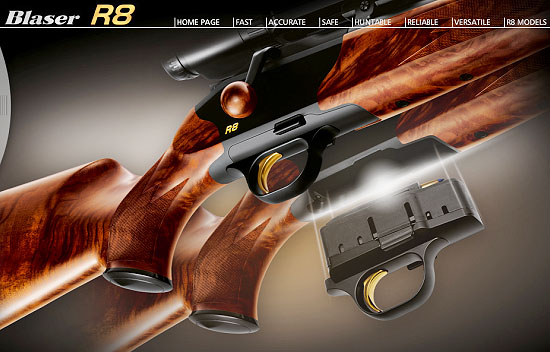
Starting in February 2010, the Blaser R8 will be available from Blaser dealers in a variety of models: Professional, Jaeger, Luxus, Attaché, Baronesse, Safari PH and Safari Luxus. In addition a custom-engraved R8 Custom class model will be offered. For more information, visit Blaser-usa.com.
December 31st, 2009
If you use mass-production ring sets, other than Burris Signature Rings or SAKO Optilock Rings (which both feature polymer inserts), you can benefit from lapping your scope rings. Lapping your rings, when done properly, with the right tools, can improve the fit of the rings, reducing bending forces and stress on the scope. Properly-lapped rings are also less likely to leave prominent marks on your scope tubes.
Forum member Boyd Allen is a strong advocate of ring lapping for factory-produced ring sets. He’s tried various lapping tools and he believes that the Kokopelli system is one of the best available. Custom crafted in Kalispell, Montana by John Werre, the Kokopelli lapping system combines a specially-machined lapping rod with patented flat-ended scope alignment bars.
Kokopelli Lapping Tool
John Werre, Kokopelli’s owner, explains why his lapping tool works better than most others: “No one was making a lapping bar that would lap anything more than the bottom half of the rings and they were made of rolled stock and only a very short stroke was possible, rapidly wearing out the bar due to the limited area of use. I did something entirely different. I designed the bar to be used with the top halves of the rings in place and utilizing a long stroke thereby distributing the wear over the entire 12″ length of the bar. Why just do half a job?”

John adds: “Another problem was that the lapping compound would readily scrape off the bar, slide around and wear the bar out as fast as the rings. I added the spiral groove to stop the scraping off of the compound and later changed to a much softer steel and put a very rough, but carefully designed, finish to accept the lapping compound, actually allowing the grit to be driven into the surface of the bar. The nasty, scruffy rough finish is full of grooves and valleys of a depth designed to ‘catch’ the very sharp lapping compound, imbedding it into the bar. You then will wear out what you’re trying to lap rather than wear out the bar at the same time. The spiral grooves also cannot catch on the edge of the scope rings as can one which has annular grooves cut perpendicular to the axis of the bar in separate rings. I have very good reasons for every unique feature of my tools. Every aspect has a valid design behind it.”
Kokopelli Scope Alignment Bars
Kokopelli’s patented scope alignment bars have flat ends and work differently than alignment bars which use pointed tips. Kokopelli came up with a flat-ended design because alignment bars with pointed tips can yield a “false positive”, meaning the points can touch when the scope rings are out of alignment. To demonstrate, try this simple experiment. Take two ordinary pencils. With one pencil in each hand, hold them parallel with the pointed (lead) tips touching. Now simply move the outboard end of each pencil, while keeping the tips touching. You can see instantly that the tips can touch even if the pencils are way out of alignment. The same thing can be true of scope alignment bars.
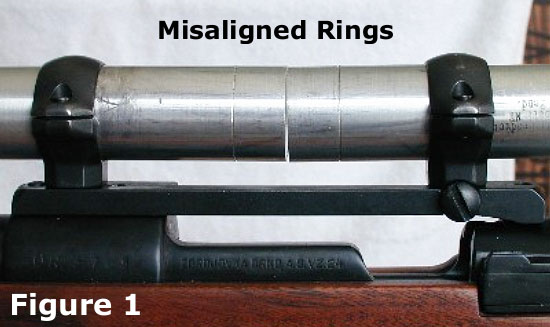
With the Kokopelli scope alignment bars, each bar is an exact cylindrical projection of the interior of each ring. When you bring the bars together, if they don’t mate perfectly, i.e. if there is any gap between the flat ends when the bars are touching, then you know you have an alignment problem. Kokopelli claims that misalignments as small as .002″ can be detected. John Werre explains: “The bars actually are a three-dimensional projection of each ring ‘hole’. You’re looking at a solid representation of the hole through the ring. Put one bar in each ring and you can then compare the axial alignment of the ‘ring holes’ to each other. If the ends match and are flat together you have reconstructed the bars into one [cylinder] and the alignment is PERFECT.” Below, in Figure 1, you can see rings that are out of alignment. In Figure 2 you can see rings that are properly aligned. Interestingly, the misalignment illustrated in Figure 1 did NOT show up with pointed ring alignment bars. This amount of misalignment can create up to 3/16″ of scope tube bending (depending on ring spacing).

The function of the Kokopelli lapping tool and alignment bars are described in greater detail on the Kokopelli website. The lapping tool and alignment bars are sold separately, or as part of Kokopelli’s complete Accurizing Kit shown below. The kit, which combines Scope Alignment Bars, Lapping Bar, pointer rod, and lapping compound in a fitted box, costs $84.50 for 1″ rings, or $91.00 for 30mm rings. For more info, contact John Werre at Kokopelli Products, 3820 Foothill Rd., Kalispell, MT 59901; phone (406) 755-3220. NOTE: Kokopelli has maintained the same prices since 2003. However, due to increased costs of materials, John Werre plans to raise his prices by mid-January, 2010. You can get current pricing by ordering soon.

December 20th, 2009
Portable GPS vehicle navigation systems are hot items this shopping season. It’s easy to understand why. Top-rated units that sold for nearly $300.00 a year ago, are now offered for under $125.00. The 4.3″ Garmin Nüvi 255W is now on sale again on Amazon.com for just $119.00 plus $6.27 shipping. The similar, but older, 4.3″ Garmin Nüvi 260W model is $119.99 with FREE SHIPPING.

The Garmin 260W was rated best in its class by Consumer Reports, and it is a “Top 10″ selling item on Amazon. The 255W has newer software, and may actually be a bit better. (Consumer Reports did not test the newer 255W model). Our Assistant Editor Jason Baney owns and uses a Garmin 255W and recommends it highly. One reviewer noted: “I own both and the 255W is the one to buy. It is faster and has some new features. The 2X0 and 7X0 model [may] soon be discontinued. The 2X5 and the 7X5 are the newest. Go with the newer model.”
LINKS for Best Prices
Garmin nüvi 255W 4.3-Inch Widescreen Portable GPS Navigator
Garmin nüvi 260W 4.3-Inch Widescreen Portable GPS Navigator
Bluetooth and Voice Navigation on Higher-Priced Garmins
Other Garmin Nüvi models to consider are the 265WT and the 855 (both 4.3″). The 265WT comes with blue-tooth connectivity so you can use it to make phone calls when you drive. The model 855 has voice-activated commands. That’s a very nice feature that lets you keep both hands on the wheel. The model 855 also has the “Lane Assist” feature. As shown below, Lane Assist zooms in to show the lane you need when exiting freeways, or navigating through large interchanges. UPDATE: The Garmin 855 is Amazon’s “Deal of the Day” for December 22 — Price dropped from $189.99 to $159.00 — that’s by far the lowest price on the web.
Garmin nüvi 855 4.3-Inch Widescreen Portable GPS Navigator with Speech Recognition

December 17th, 2009
IMR 8208 XBR is a new powder to be released by Hodgdon in January, 2010. The powder is said to be extremely accurate, and Hodgdon believes it will set new standards for stability across a wide temperature range. We spoke to Chris Hodgdon last week and he confirmed that “the 8208 XBR is packaged and ready to go. We plan to start shipping in quantity starting January 4th”.
Schmidt Tests IMR 8208 XBR with 6 PPC Railgun
Is the new powder as good as early reports have suggested? Ace Benchrest shooter Jackie Schmidt recently tested IMR 8208 XBR with his 6PPC rail gun. The results were very impressive. (Test observer 333 Smitty said: “This was the best testing session I have ever witnessed — It looks like the new 8208 is a huge success!”)

Shooting five, 5-shot groups, Jackie put together an .0976 Agg. His last two groups, both using weighed 8208 XBR loads, were in the zeros. (See target photo.) Jackie was shooting his Unlimited Rail with 65gr “Bartail” bullets, Fed 205 primers. The barrel was a 23.5″ straight-contour Kreiger with a 1:13.5″ twist. Conditions were “were really nice, just a gentle ebb and flow” with temps in the 50s and about 60% humidity.
Here is Jackie’s report, originally posted in the Benchrest Central Forum:
“I first started out with my ’08 Vihtavuori N133, just to see if the Rail was on its game. After a few 3-shot groups to find the window, I settled in on 30.4 grains with a 65gr Barts Boattail. I then nailed a nice 5-shot ‘zero’ that you can see on the far left, second row up. Average velocity was 3470 fps.
I then switched over to the 8208 XBR. I started with a load that Tom Libby recommended, 31.3 grains. While it did not nail a ‘zero’, you can see it shot pretty well. The average velocity for the five record shots was 3430 fps.
I then decided to drop the load down into another window, a flat 30.0 grains. The average velocity was 3320, and as you can see, the group opened up. I felt like I hit the condition just right on each shot. Maybe a little cool for this light of a load.


We then decided to up the charge until it matched the velocity of the N133. This took 31.8 grains. With a slow trickle this was just about half-way up into the neck. The group was really nice, so I decided to try the load again, only weighing each charge. The results were the group you see on the far right. That is really probably about a .040″, pretty darned small. The average velocity on both groups was about 3470 fps.
I then decided to go back to the 31.3 grain charge, but weighing each charge this time. The results were another nice “zero”. The velocity was the same as before, but the total spread on this group was only 12 fps.”
IMR 8208 Also Shoots Well in Sporter Rifle
Jackie reports: “I then pulled out my Sporter, and put the 31.8 grain XBR load in. I shot a couple of 3-shot groups that were about .110, then shot a 5-shot group that was a ‘zero’ for the first four. But I missed the last condition, and opened it up to about a .180, straight to the right.”

Observations and Conclusions
Jackie writes: “So, what did I find out? First, this stuff is more dense than N133. I can barely get the 30.4 grain N133 load in the case, but there is no problem at all getting the XBR in at darned near 32.0 grains. This shows that, by weight, XBR is slower than the ’08 N133.
The 8208 XBR also burned just as clean as N133. I could not tell the difference in the patches that came out after shooting N133 and the XBR. Also, this stuff meters VERY WELL. Much more consistant than N133. While I started weighing charges, I could count on the XBR out of my Hensler Measure to be within ± 0.1 grain. I simply cannot do this with N133.
An added note, the Rail Gun has a 23 1/2 inch barrel, the Sporter a 21 1/2. With the same load, I saw an average 70 to 80 fps slower velocity out of the shorter barrel. These two barrels are just about identical in the land and groove diameter, both .237 4-groove Kriegers[.] I guess this shows that some of the powder is still burning at 21 1/2 inches.
I showed that yes, at 52 degrees overcast and dreary, I made the stuff shoot pretty darned good. But, I do not have a clue what will happen when the weather changes. Only time will tell.
That about covers it. This new powder will shoot, and velocity is certainly not a problem. I had zero problems with any pressure signs, the handle on the Diamondback on the Rail and the Bat action on the Sporter lifted really easy on all loads, and the primers looked nice, with a generous radius still on the outside edge.”
| General Comments — Can 8208 XBR Live Up to Expectations?
Jackie offered these general thoughts about IMR 8208 XBR and how it stacks up versus Vihtavuori N133:
 “I have been shooting Benchrest since the mid ’90s, and I can’t think of a single product causing this much excitement, or generating this much hype. Just what are everyone’s expectations? Being able to arrive at a competitive tune, and have it stay there all day? Being able to shoot in the upper window without wrecking the brass? Being able to concentrate on the actual ‘shooting’ rather than worrying about the rifle going ‘vertical’ at any moment? “I have been shooting Benchrest since the mid ’90s, and I can’t think of a single product causing this much excitement, or generating this much hype. Just what are everyone’s expectations? Being able to arrive at a competitive tune, and have it stay there all day? Being able to shoot in the upper window without wrecking the brass? Being able to concentrate on the actual ‘shooting’ rather than worrying about the rifle going ‘vertical’ at any moment?
As of now, a few shooters have been able to test this new powder and found it to be capable of producing good velocity, and great groups. But, the realities of the ‘Competitive Arena’ can be very harsh. Nothing is more aggravating than trying to keep up with the pack when your rifle is locked into a .300 tune, and try as you do, nothing seems to work. We have all been there.
My expectations are that the new powder will be more stable in the perameters that govern that all important ‘Agging Capability’. By that I mean that if the rifle does get a little ragged, just a little tweek one way or another will get it back. Or even better, that the rifle will stay reasonably competitive over a day’s worth of aggregates without fear of getting so ragged that your entire day is ruined by two bullet holes worth of vertical.
This is a tough sell. But then, this is a tough game. I, for one, really hope that this new powder is more ‘user friendly’, so Benchrest can get back to being more about shooting, rather than chasing loads all day long.
N133 is probably the most used powder in 100-200 yard Benchrest today. It is also, at the same time, the biggest source of aggravation. If it is right, nothing can beat it. But, as we all know, if it isn’t quite right, the fun can go away real quick. One of the Holy Grails of Benchrest has always been how to make N133 shoot over an entire Aggregate.” |
Photos Courtesy G.A. Villarreal, used with permission.
December 15th, 2009
 On the GunsandHunting.com (Shooting Illustrated) website, you’ll find a well-written, in-depth review of the updated Accuracy International AE MKII rifle in .308 Winchester. (The MKII title means the rifle has a threaded barrel with brake.) The reviewer, Steve Adelmann, is a former Army sniper, so he certainly knows his tactical rifles. Adelmann praised the rifle’s ergonomics and folding stock. He also said the detachable mag system is one of the best available: “AI’s rifles also allow the magazine to be pushed straight into and dropped from the magazine well[.] The feeding and function of the five- and 10-round magazines were flawless during my evaluation, totaling 230 rounds.” On the GunsandHunting.com (Shooting Illustrated) website, you’ll find a well-written, in-depth review of the updated Accuracy International AE MKII rifle in .308 Winchester. (The MKII title means the rifle has a threaded barrel with brake.) The reviewer, Steve Adelmann, is a former Army sniper, so he certainly knows his tactical rifles. Adelmann praised the rifle’s ergonomics and folding stock. He also said the detachable mag system is one of the best available: “AI’s rifles also allow the magazine to be pushed straight into and dropped from the magazine well[.] The feeding and function of the five- and 10-round magazines were flawless during my evaluation, totaling 230 rounds.”
We often hear claims about tactical rifles delivering “benchrest-quality accuracy” when shot from bipod with factory ammo. We always take such reports with a grain of salt. For this article, at 100 yards, Adelmann tested two types of factory ammo, and three sets of handloaded ammo. The average accuracy of ALL the ammunition, based on five, 5-shot groups for each type, was right around one MOA (see chart).

We’re pleased Adelmann published honest results with five groups per load. Some testers will only shoot one or two 3-shot groups, which can give a false impression of the rifle’s true accuracy. Adelman writes: “The rifle still managed sub-MOA performance with the best factory ammo and handloads averaged together for all distances.”
CLICK HERE for full Accuracy Int’l AE MK II Review
Photos and Charts © 2009 National Rifle Association
December 14th, 2009
There are a variety of ballistics programs that can be used with handheld PDAs, and even Apple iPhones. But Bryan Litz, author of the new Applied Ballistics for Long Range Shooting book, has come up with something bigger and better. Employing the powerful Texas Instruments (TI) Voyage 200 graphing calculator, Bryan has created a Mobile Ballistics Solution (MOBALL) that is more sophisticated (and accurate) than typical PDA-based programs.

MOBALL includes TI graphing calculator and ballistics software. Kestrel windmeter NOT included.
Bryan tells us: “The Mobile Ballistics Computer (MOBALL) was created for one purpose: to provide shooters with the most accurate and complete ballistic firing solution possible for application in the field.” MOBALL runs on a TI graphing calculator — a sturdy, stand-alone, non-network device. That means you don’t need long-term cell phone contracts, expensive data plans, or weekly OS “updates” and patches. The TI also delivers long run-time on ordinary AAA batteries. That’s a big advantage over most laptop computers, which run out of “juice” after only 4-5 hours in the field.
According to Bryan, what sets MOBALL apart from other “deployable” ballistics calculators is that: “MOBALL provides a complete ballistic solution, with the ability to account for every major and minor variable affecting a bullets trajectory. In addition to the standard variables like atmospherics, uphill/downhill angles and wind, MOBALL also has the ability to account for more subtle ballistic effects like spin drift, Coriolis effect, and multiple winds in up to 3 zones.”
Importantly, Bryan’s MOBALL device can employ Ballistic Coefficients (BCs) referenced to the G7 standard. Compared to the older G1 BC model, the G7 BC standard better matches the characterics of the long, boat-tail bullets actually used by long-range shooters. Trajectories calculated using the G7 BC are more accurate for long-range bullets because the G7 BC doesn’t vary with velocity like the conventional G1 BC.
 
The difference between G1 and G7 BCs is explained online in the Berger Blog article A Better Ballistic Coefficient. The subject is also discussed in detail in Chapter 2 of Bryan’s Applied Ballistics book.
 At $290.00, MOBALL isn’t the least expensive option for a mobile ballistics device, but that price includes the TI Voyage 200 graphing calculator, worth $180.00 by itself. Bryan adds: “As already mentioned, the feature set is extensive, and the software is much more sophisticated than most ballistics programs designed for PDAs. The solution is VERY accurate (CLICK to download MOBALL Accuracy Report). Also, the TI Voyage 200 is an impressive device itself, capable of solving advanced engineering and math problems. If you’re a high school/college student, engineer, etc, the TI Voyage 200 can be used for many school and work tasks unrelated to ballistics.” At $290.00, MOBALL isn’t the least expensive option for a mobile ballistics device, but that price includes the TI Voyage 200 graphing calculator, worth $180.00 by itself. Bryan adds: “As already mentioned, the feature set is extensive, and the software is much more sophisticated than most ballistics programs designed for PDAs. The solution is VERY accurate (CLICK to download MOBALL Accuracy Report). Also, the TI Voyage 200 is an impressive device itself, capable of solving advanced engineering and math problems. If you’re a high school/college student, engineer, etc, the TI Voyage 200 can be used for many school and work tasks unrelated to ballistics.”
Save $20 on MOBALL and Ballistics Book Combo
As a special Holiday Offer valid through December 31, 2009, you can save money when purchasing MOBALL and Bryan’s Applied Ballistics book together. The book and MOBALL unit are being offered as a Holiday Combo Set for $309.95. That’s a $20 savings over the $329.95 cost of purchasing both book and MOBALL unit separately.
|


