|
|
June 9th, 2009
Capitalizing on the strong consumer interest in AR15-style rifles, Remington Arms recently introduced its 597-VTR, a semi-automatic 22LR with AR-style ergonomics. Inside the matte black, slab-sided “upper” is the venerable Remington 597 receiver, updated with a nickel-Teflon® plated bolt, hammer and sear. On the outside, the 597-VTR features a AR-15 pistol grip, and AR collapsible stock, and a round AR-style float tube/handguard. On top of the receiver is a 1913 Picatinny-spec scope rail. Street price for the new rifle is about $450.00, complete with compact 10-round magazine. A standard Remington 597, without the tactical goodies and black paint, costs under $200.00.

Good for 3-Gun Cross-Training and Tactical Rimfire
While we snicker a bit at an older rimfire design tarted up in new tactical clothing, the 597-VTR makes sense for some users. Three-gun competitors should like this rifle. Most multi-gun match shooters use ARs for the rifle stages. With the 597-VTR, they can cross-train using inexpensive 22LR ammo, while maintaining the same basic ergonomics. For 3-gun shooters, who engage targets from a wide variety of shooting positions (often behind barriers), the collapsible stock has utility. It will allow the shooter to make his rifle more compact when practicing CQB or house-clearing stages.

With mods, the 597-VTR should also work well for the tactical rimfire discipline. The Picatinny rail makes it easy to swap over good optics from your centerfire gun. The tubular forearm should provide a strong mount for a bipod. However, for the tactical rimfire game, which is shot mostly prone, we don’t like the collapsible stock at all. Junk it. The LOP is too short, the bottom of the stock is terrible with sandbags, and the cheek weld is wrong. Tactical rimfire shooters would be wise to replace the collapsible stock with an upgraded design with longer length of pull and a proper cheekpiece. (The 597-VTR will accept most AR15 stocks). And, in reality, with a bedding job, a basic 597 in a laminated stock (see below) would probably work just as well.

May 7th, 2009
Butch Lambert sent his new ShadeTree Engineering F-Class rest base to German Salazar in Phoenix for testing and evaluation. The Daily Bulletin previewed a prototype rest base last month. (CLICK HERE for previous report.)
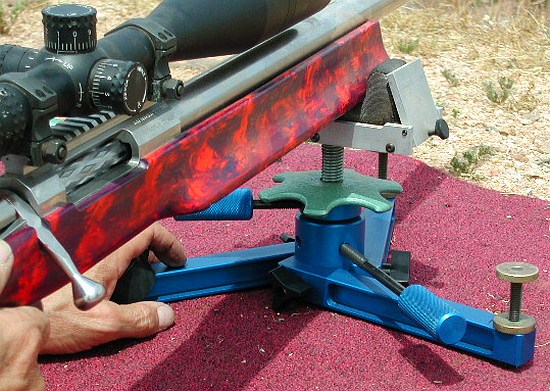
ShadeTree Rest is Lightweight and Easily Assembled
Designed to be light for air travel and easy carrying at the range, the anodized aluminum rest base weighs just 3 pounds without the top or feet. Once fully assembled, this rest base is lighter than anything else on the market, but provides all the stability needed on the range. The legs attach with thumbscrews and the center section slides right in. Assembly was a matter of a minute or two and can be done at the range without any tools. The legs have an I-beam section for light weight and rigidity, the anodizing is well-executed. Almost any currently-made top assembly will fit the base as will the leg screws. We found the rest to be well designed and manufactured.

Bruno Wins Match Using ShadeTree Rest Base
Well-known benchrester Lester Bruno of Bruno Shooters’ Supply also shoots F-Class in matches at the Ben Avery Shooting Facility. Lester volunteered to give the rest a workout. Lester used the rest in a local 600-yard match May 2nd. Lester’s first comment was that the ShadeTree rest was a lot easer to carry on and off the firing line than a heavy cast iron rest. After shooting the match, Lester confirmed the rest’s ease of use and stability. Given that Lester won the match, we can surmise that the rest was an effective tool for the job and a worthwhile product for any F-Class shooter, particularly one who travels by air. To learn more about price and availability of the F-Class rest base, call Butch Lambert at (972) 524-2247 or email papawlambert [at] starband.net.

May 7th, 2009
 Last year, the Cornell Ornithology Lab conducted ScopeQuest 2008, a detailed comparison test of 36 spotting scopes. Optics (ranging in price from $220.00 to $4500.00) were viewed side-by-side and rated according to sharpness, color fidelity, edge-to-edge focus, brightness, distortion, and general optical quality. The testing team also considered ease of handling/focus, and eye relief (scopes with longer eye relief are better for eyeglass wearers). Two of the finest spotting scopes AccurateShooter.com has used, the Zeiss Diascope 85 T FL, and the Swarovski APS 80 HD, performed very well as expected, and ended up near the top of the list. The TeleVue-85 APO, a very large refractor, received the highest ratings for image quality (both at 20X and 60X), but lost points for easy of use and general “feel”. The overall winner among the 36 spotting scopes tested was the Kowa TSN-883 Prominar, a new-generation spotter with a huge 88mm objective, dual focusing knobs, and spectacular flourite glass. The results of Cornell’s spotting scope test are found on the LivingBird.org website. Click the link below for a charrt ranking all 36 scopes according to their overall ratings. Last year, the Cornell Ornithology Lab conducted ScopeQuest 2008, a detailed comparison test of 36 spotting scopes. Optics (ranging in price from $220.00 to $4500.00) were viewed side-by-side and rated according to sharpness, color fidelity, edge-to-edge focus, brightness, distortion, and general optical quality. The testing team also considered ease of handling/focus, and eye relief (scopes with longer eye relief are better for eyeglass wearers). Two of the finest spotting scopes AccurateShooter.com has used, the Zeiss Diascope 85 T FL, and the Swarovski APS 80 HD, performed very well as expected, and ended up near the top of the list. The TeleVue-85 APO, a very large refractor, received the highest ratings for image quality (both at 20X and 60X), but lost points for easy of use and general “feel”. The overall winner among the 36 spotting scopes tested was the Kowa TSN-883 Prominar, a new-generation spotter with a huge 88mm objective, dual focusing knobs, and spectacular flourite glass. The results of Cornell’s spotting scope test are found on the LivingBird.org website. Click the link below for a charrt ranking all 36 scopes according to their overall ratings.
CLICK HERE for Spotting Scope Test Summary (.pdf file)

CLICK HERE for large photo of Kowa TSN-883 on Tripod.
Ken Rosenberg, summarizing the findings of Cornell’s ScopeQuest testers, named the Kowa TSN-883 the big winner. Rosenberg writes: “Fifteen models competed in the most expensive category, including 12 conventional zoom scopes and three astronomy “cross-overs”[.] Among the conventional scopes, the surprising (to us) and virtually unanimous top-of-the-line ranking went to the Kowa TSN-883 Prominar. In side-by-side comparisons with Swarovski, Leica, Zeiss, and Nikon, both Kowa scopes provided a slightly, but noticeably, brighter and crisper image at 60x than any other scope. The three-dimensional detail visible … with these scopes, even in dim light, is simply phenomenal.”
 Rosenberg also gave high praise to the Swarovski ATS 65 HD, noting that it was much lighter and compact than the Kowa 883, while offering nearly the image quality. Rosenberg concludes: “For birders willing to take the plunge for the very best optics at whatever cost, the top choices, in my view, are either the Kowa 883/884 or 773/774 or the Swarovski HD 80mm or 65mm scopes. Any of these top scopes will give you years of pure birding pleasure. Although the larger Kowa offers the brightest, sharpest image available from a conventional zoom scope under the toughest birding conditions, the small Swarovski still delivers the best image per ounce of any scope.” Rosenberg also gave high praise to the Swarovski ATS 65 HD, noting that it was much lighter and compact than the Kowa 883, while offering nearly the image quality. Rosenberg concludes: “For birders willing to take the plunge for the very best optics at whatever cost, the top choices, in my view, are either the Kowa 883/884 or 773/774 or the Swarovski HD 80mm or 65mm scopes. Any of these top scopes will give you years of pure birding pleasure. Although the larger Kowa offers the brightest, sharpest image available from a conventional zoom scope under the toughest birding conditions, the small Swarovski still delivers the best image per ounce of any scope.”
More Products Worth Considering
The Cornell Test did NOT include some premium spotting scopes, including Pentax’s top-of-the-line PF-100ED, or the new Leica 82mm Televid APO HD. The big Leica APO is considered by many experts to be the new benchmark for spotting scope quality. However, it is enormously expensive. The 82mm Leica APO HD retails for $3200 for the body only. That’s nearly $900 more than the Kowa TSN-883 Prominar body only.

May 3rd, 2009
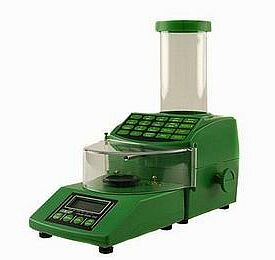 The RCBS Chargemaster 1500 Combo is the #1-selling electronic powder dispenser/scale system on the market. It was the top-performing unit in the Powder Dispenser Comparison Report we did a couple years back, and it still probably offers the best combination of features, speed, and weighing precision. Since its introduction, the RCBS Chargemaster has received a number of refinements. The internal software has been updated, the timing (of the powder drop) has been adjusted, the keypad has been upgraded and other smaller “tweaks” have been made. The RCBS Chargemaster 1500 Combo is the #1-selling electronic powder dispenser/scale system on the market. It was the top-performing unit in the Powder Dispenser Comparison Report we did a couple years back, and it still probably offers the best combination of features, speed, and weighing precision. Since its introduction, the RCBS Chargemaster has received a number of refinements. The internal software has been updated, the timing (of the powder drop) has been adjusted, the keypad has been upgraded and other smaller “tweaks” have been made.
If you haven’t tried one of these machines yet, you should. Provided you set it up correctly, making sure it’s level, and away from drafts, the Chargemaster will normally throw charges to ± 0.1 grains. That’s better accuracy than most persons can achieve using a manual powder measure and a balance beam scale (we know… we’ve checked on that.)
Video of RCBS Chargemaster in Slow-Motion
This video, created by a shooter in Norway, shows an RCBS Chargemaster dispensing 43.0 grains of Vihtavuori N140 powder. Using a Casio EX-F1 camera, the video was recorded at a high frame rate — up to 1200 frames per second. This allows very cool “Slow-Motion” playback. Check it out… you can see individual kernels of powder as they drop into the pan. At the end of the video you can watch the charge being thrown in “real-time”. Note how it slows down to trickle the last few tenths of a grain.

May 1st, 2009
Forum Member Mark E. (Shooter65) is the proud owner of a handsome, very accurate SAKO Finnfire ‘Range’ 22LR rimfire. Fitted with a full-size stock that replicates Tikka’s Master Sporter stocks, SAKO’s Range model has the look and feel of a centerfire gun. The size and ergonomics of the Finnfire Range makes this an excellent cross-training rifle. If you want to train with inexpensive rimfire ammo with a rifle that duplicates the feel of a centerfire, the Finnfire Range is hard to beat. Mark has competed successfully with this rifle in Southern California Rimfire Tactical matches.


Mark recently replaced the factory tube with a hand-lapped Lilja barrel. The Lilja barrel has demonstrated superb accuracy. Below is a 10-shot group at 50 yards (left), and a “dot-drill” tactical target shot at 100 yards (right).
In the video below, Mark explains the features of his SAKO Finnfire ‘Range’. This video was produced before the addition of the Lilja barrel, but the gun still shot extremely well. Unfortunately, as Mark notes, SAKO has halted production of the Finnfire Range. As a result, prices are rising for this highly desirable rimfire — guns that sold for $850 two years ago are now fetching $1100.00 or more.

April 26th, 2009
A good range box is a truly essential piece of kit. Among the many range boxes available, the MTM model RBMC-11 Range Box leads the pack in terms of versatility. It is rugged, it has plenty of storage space, plus it doubles as a handy cleaning station. This Editor has used the MTM Range Box to clean rifles and as a “range expedient” rifle holder when adjusting scopes and tensioning action screws. It’s a good product that does the job.

Fitted Cleaning Cradles
The key feature setting the RBMC-11 apart from most range boxes is the rubber-coated cradle system. Wide enough to fit a 3″-wide fore-arm, the cradles slide into vertical slots on either end of the box. This allows your range box to serve as a stable maintenance station. The RBMC-11 is really pretty stable in this role, and the cradles won’t mark your stock. The cradles even feature slots on each side to hold your cleaning rods when not in use. The MTM Range Box is secure enough to stay in place when you’re brushing the barrel. However, if you’re working on a carpeted bench top, you may want to keep one hand on the box when running a cleaning rod through the bore, just to ensure the box doesn’t slide.

Versatile Upper Tray with Dividers
The MTM Range Box has two major components — the box base (with cradles), and a large upper tray with hinged top and carry handle. This large upper tray clamps securely to the bottom unit for transport. The top tray has a long section that holds cleaning rod guides, long brushes, grease syringes and the like. There are two, clear-plastic fitted divider trays. These will hold your patches and jags, plus comparators, ring wrenches, and other small tools.
 What Might Be Improved What Might Be Improved
Though we really like the MTM Range Box, it’s not perfect. First, we wish the box was a bit deeper, to have added carrying capacity. The dimensions of the MTM Range Box are: 25″ long x 11.5″ wide x 8.75″ high. We’d like to see it 12″ high/deep to allow larger solvent bottles to stand upright and to provide more space to carry tools and shooting muffs. However, it is deep enough to hold the large 100-round MTM cartridge boxes that are popular with many shooters (see photo at right).
The cradles are very nicely designed, and will hold your rifle securely without marking the stock. However, we’ve found that sometimes the rear cradle grips the gun so well that the cradle slides out as you lift the gun up. This is not a big deal, but it does demand a little extra attention when you’ve finished cleaning. We really like the twin clear plastic dividers that fit into the large removeable top-tray, but we wish the dividers had individual hinged tops. This would keep patches and small parts more secure.
The MTM Range Box costs about $50.00 at most vendors. CLICK THIS LINK to order from Amazon.com for $48.95: MTM® Shooting Range Box . .
(FYI, Amazon.com rebates a portion of the purchase price from each sale to AccurateShooter.com. This helps support this website.)
March 29th, 2009
Review by LARRY BANEY
The Sightron 6-24×50mm Mildot is the latest in Sightron’s SIII line-up of side-focus, 30mm riflescopes. This follows the hot-selling 8-32×56mm SIII, which we reviewed last fall. While our 6-24x50mm test sample has a Mildot reticle, Sightron’s new 6-24x50mm scope is also offered with a fine cross-hair (FCH) with target dot reticle. Both Mildot and FCH versions are 14.96″ overall with a near-constant 3.6-3.8 inches of eye relief. Clicks are 1/4 MOA (15 MOA per revolution), and total elevation (and windage) adjustment is listed as 100 MOA (50 MOA on either side of center). That’s a class-leading amount of elevation, which should make the new 6-24×50mm popular with long-range shooters.

Shown above is the Sightron 6-24×50mm Mildot, flanked by a Leupold 8-25×50mm LRT and the Sightron 8-32×56mm. The controls on the 6-24 Sightron are identical to those of its big brother, but it is shorter, with a smaller objective. The shorter length and 50mm front objective allow a 2.8 ounce weight savings over the larger model (21.9 oz. vs. 24.7 oz.).

Sightron 6-24x50mm Quick Review
Assistant Editor Jason Baney has been evaluating the optical qualities of the new Sightron 6-24 Mildot scope. Jason also had a chance to test the scope’s real-world performance in a tactical match. Here is Jason’s report:
“When the new 6-24x50mm mil-dot Sightron SIII arrived, it looked like the little brother of the Sightron 8-32x56mm. Controls and “styling” are similar. This family relationship was made clear as my review of its performance progressed. It shared the same ergonomics, same superior glass, and same unbeatable tracking.
 I had a Leupold 8.5-25x50mm LRT for comparison purposes. The Leupold, which is actually 24.3x at max power, is a popular scope with a good reputation for clarity and sharpness. However, the new 6-24x50mm Sightron seemed better in many respects than the Leupold LRT. The Sightron’s glass appeared superior, giving better color rendition, a brighter field of view, and better contrast. I had a Leupold 8.5-25x50mm LRT for comparison purposes. The Leupold, which is actually 24.3x at max power, is a popular scope with a good reputation for clarity and sharpness. However, the new 6-24x50mm Sightron seemed better in many respects than the Leupold LRT. The Sightron’s glass appeared superior, giving better color rendition, a brighter field of view, and better contrast.
Also, with the Sightron, there was no noticeable parallax lash in the side-focus system. There was no need to start the side-focus at a travel stop every time. You could simply dial the side parallax adjustment and get the observed target in sharp focus with minimal parallax. This has been a problem with some Leupolds (i.e. you can’t get minimal parallax and best focus at the same time.) While observing bullet holes in different colored targets at 300 yards, the Sightron also appeared to show slightly better resolution than the Leupold and therefore better ability to locate individual bullet holes in the paper.”
Field Testing at the Allegheny Sniper Challenge (ASC)
In any competition riflescope, precise, repeatable tracking is absolutely vital. When you crank-in elevation and/or windage you want the reticle to move the exact value you dialed. Then you want the scope to repeat exactly when you return to the original zero. To test the Sightron’s tracking, Jason did more than a simple range test. He tested the scope’s tracking in the “real world”, during a two-day tactical comp.
Jason reports: “The 6-24 was thrown into action right away at the Allegheny Sniper Challenge (ASC) in Seneca Rocks, WV in August 2008. This was a team match that I shot with my father. ASC entails interesting weather, and even more interesting shots. In a matter of two days, over 100 shots are expended and a scope’s adjustments are REALLY put to the test. Maintaining zero is very important, because there are no sighters to check your zero. Shots range from less than 100 yards to nearly 1200 yards, and in the end, everyone has clicked their scope up-and-down 40 times or more. This means 40+ up/down repetitions on the elevation knob. This is as tough a test of a scope’s tracking ability as you’ll find.”
Great Tracking Ability, Excellent Value
So how did the Sightron’s tracking rate? The new Sightron 6-24×50 returned from ASC with the EXACT same 100-yard zero as when it started. This scope maintained its zero as well or better than any other scope out there, including those costing $3000.00+. The scope’s great elevation range was also much appreciated. Jason reports: “With 100+ MOA of elevation available and a 20 MOA base on the rifle, I had enough ‘up’ to shoot all the way out to 1200 yards with no problem.”

In Jason’s opinion this scope will be very hard if not impossible to beat in its price range in many aspects. The new Sightron 6-24 certainly rivals the overall optical quality of the Sightron 8-32×56, and that’s saying a lot. But since it is a Mildot scope there is another level of scrutiny needed. This scope is not a purpose-built tactical scope, but it represents a good base on which to build if Sightron offers enhancements in the future. If a shooter wishes only to use the mil-dots for holdover, he will be well served, but a Front Focal Plane (FFP) reticle would be more useful for serious tactical work. An illuminated reticle would also be welcome, and Jason would like to see a different reticle design with half-mil markings.
Also, some tactical shooters would prefer to have mil-based click values, rather than 1/4 MOA clicks. In raising these points, we need to stress that the $800.00 Sightron 6-24x50mm Mildot is affordable and works well as a general-purpose scope with reticle marks that allow hold-overs. This scope was not designed to compete with a $2700.00 Schmidt & Bender PMII. Jason explains: “I just want the serious tactical guys to understand that the Sightron won’t give you all the features of a dedicated FFP mildot optic with mil-based clicks. However, at about $800.00 average retail, the Sightron 6-24x50mm costs less than a third of what you’ll pay for high-end tactical scopes from S&B or U.S. Optics.”
March 18th, 2009
John Loh produces some of the most beautifully-machined shooting hardware on the planet. The Loh pedestal from JJ Industries is truly the “Rolls-Royce” of conventional (non-joystick) front rests. This editor has tried all the premium joystick (co-axial) rests, and numerous windage-top conventional rests. The Loh has the smoothest, steadiest horizontal tracking of any rest I’ve ever tried. F-classers who prefer to “hold-off” rather than dial clicks for windage changes will absolutely love the Loh. The vertical controls are extremely precise and allow you to make very minute movements of the cross-hairs with none of the “notchiness” or jumping you’ll find with some other models.

Sinclair International now offers the Loh front rest for $879.95. Sinclair says: “The windage control system is built directly onto the baseplate so the entire top, post, and handwheel assembly moves as one complete unit. If you are looking for a premium made front rest that functions smoothly and is rock solid, then look no further.” Here are key features of the Loh rest:
– Weighing 17.7 lbs., the Loh is rock solid, with a very low center of gravity
– Full 100″ of windage travel at 100 yards
– A 3″-wide filled Edgewood front bag is included
– Large bubble level installed in easy-to-view position
– Large-diameter fluted mariner wheel for major elevation changes
– Solid brass speed screw
– All stainless hardware
– Durable black satin finish
February 19th, 2009
Mark Trope, Webmaster of the Gun Owner Network website, has written a very thorough review of the SEB Coaxial front rest. Mark’s SEB Rest Review covers all the bases, showing how the rest works with a variety of rifle types, including both wide-forearm match rifles and narrow-forearm sporter rifles. Mark provides dozens of clear photos of the rest, showing many of the fine points of SEB’s impressive design. The review shows how to set-up and level the rest, and how to tune the “feel” of the joystick to suit your preferences. Some rest users prefer the joystick to move quite freely, while others prefer to dial in some resistance so there is no chance of movement when you remove your hand from the joystick.

 After covering the features and performance of the SEB Rest, Trope turns his attention to the SEB “BigFoot” rear bag. He explains why it’s a super-stable choice in rear bags, one of the best products available. You’ll note we acquired a SEB BigFoot rear bag for our latest AccurateShooter.com Project Rifle (see story above). After providing tips on how to fill the bag with heavy sand, Trope shows how to adapt a RubberMaid “ActionPacker” plastic storage bin to carry both the SEB Front Rest and the BigFoot Bag. After covering the features and performance of the SEB Rest, Trope turns his attention to the SEB “BigFoot” rear bag. He explains why it’s a super-stable choice in rear bags, one of the best products available. You’ll note we acquired a SEB BigFoot rear bag for our latest AccurateShooter.com Project Rifle (see story above). After providing tips on how to fill the bag with heavy sand, Trope shows how to adapt a RubberMaid “ActionPacker” plastic storage bin to carry both the SEB Front Rest and the BigFoot Bag.
If you are considering the purchase of a joystick-style front rest, or joystick-style rest top, you should definitely read Trope’s Rest Review. It will definitely help you identify the features you need, so you can make an informed decision, whatever brand you ultimately choose. To learn more about the SEB coaxial rest, or to place an order, contact Sebastian Lambang’s American dealer, Ernie Bishop:
Ernie Bishop
306 West Flying Circle Drive
Gillette, WY 82716
(307) 257-7431
ernieemily [at] yahoo.com
February 12th, 2009
Just how accurate can a 6BR Tubegun be, when shot from the bench with bag-riding attachments? Would you believe 0.170 MOA at 200 yards? Yep, that’s benchrest-grade accuracy out of an across-the-course rifle.

 Forum member Milan recently tested his new Eliseo R5 6BR tubegun with Berger 80gr Varmint bullets. We’ve found the Berger 80s to be extraordinarily accurate, and Milan confirmed that fact. His R5 features a Krieger barrel, Pierce action, and Jewell trigger. At right is his first 5-shot group, with the size calculated with On-Target software. The calculated group size is 0.355″, or 0.170 MOA at 200 yards. (Measured by Milan with calipers, it was slightly smaller, 0.350″.) Forum member Milan recently tested his new Eliseo R5 6BR tubegun with Berger 80gr Varmint bullets. We’ve found the Berger 80s to be extraordinarily accurate, and Milan confirmed that fact. His R5 features a Krieger barrel, Pierce action, and Jewell trigger. At right is his first 5-shot group, with the size calculated with On-Target software. The calculated group size is 0.355″, or 0.170 MOA at 200 yards. (Measured by Milan with calipers, it was slightly smaller, 0.350″.)
Milan reports: “Today, I took my brand new R5 rifle (stock made by Gary Eliseo with Pierce Engineering Action and gunsmithing, and Krieger barrel) to a shooting range for the first time. I was shooting at 200 yards and my very first shot was on target. I shot one more time in the same spot and cleaned my rifle. I shot another three shots to find the center of the target. I cleaned the rifle again and shot my first 5-shot group. Looking through my scope, it all looked like one hole. I got a big smile on my face and could not get any happier. When I got home and measured the group, it measured less than 0.350″. Bummer… I was looking forward to the challenge of finding a good load for this rifle but it seems like now I will have to look for another challenge. My load was Berger 80gr Varmint Bullets, 31.0 grains of Varget, Remington 6.5 primer, and bullet was seated 0.015″ in lands.”

Milan added: “The silver rear bag rider attachment came from CSS. I only modified it a little. I lowered my rifle about 1″. I also made my own design, shown below, which allows me to make fine height adjustment on my rear bag when shooting from a bipod and to keep the front of my rifle as low as possible. I would like to thank to Gary Eliseo and John Pierce (Pierce Engineering) for a great job. I highly recommend the services of both these guys.”

|


