|
|
December 13th, 2008
Serious marksmen know the benefits of shooting hats, shooting coats, and shooting glasses, but less thought seems to be given to the rest of the wardrobe — pants. Jeans are OK for bench shooting, but they are less than ideal for prone work or tactical matches. Typical jeans provide little room for anything but loose change, car keys and a thin wallet. They tend to be restrictive in the wrong places, and heavy denim can be too hot in summer weather.
 By contrast, cargo pants or “tactical trousers” offer many advantages for the shooter. Many designs feature a small pocket that’s ideal for a cell phone or Kestrel wind meter. The large lower “bellows” pockets can hold a medium-sized log-book, empty chamber indicator (ECI), digital timer, a small camera, or ammo magazines. The upper slash pockets make it easy to access earplugs, come-up cards, or other small items. Some of the better cargo pants have double knees. This can provide a little more comfort and protection while shooting prone. Overall the cargo pant design is more practical, and in my opinion, more comfortable, than a pair of denim jeans.
This Editor was recently looking to replace a much-used pair of cargo pants that had finally worn out after two years. The cheap “no-name” cargo pants didn’t fit well and the stitching was poor. I looked at the military-style BDUs. They are durable, but I didn’t like the pocket options or the feel of the ripstop-type fabric. In addition, I wanted something “neutral” rather than camo. As I often wear field pants in business settings, such as banks and the post office, I didn’t need Tiger-stripes screaming “urban commando wannabee”.
I checked out various styles ranging from $15.00 to $65.00 and settled on the Propper F5220, 9-pocket “Tactical Pants”. Priced at $29.99, these have a myriad of features I really like. The elasticized waist band eases movement when you’re shooting from a prone or kneeling position. The double knees are great when you’re shooting a tactical match off bare ground. The front “cellphone pocket” is big enough to hold a Kestrel securely. The seat area is double thickness (nice when sitting on wet grass). There’s a clever double-level rear pocket that lets you position your wallet high for easy access or a low for extra security.
I also ride a motorcycle and I found the Propper tactical pants work well on a two-wheeler. Again the stretch waistband is a big plus. The front slash pockets are not cut so low that I have to worry about stuff falling out when riding. The large side cargo pockets allow me to carry checkbook, PDA, and digital camera securely on the sides of my legs. My cellphone is easily accessible and I like the extra D-ring for holding keys on a carabiner while off the machine.

Propper F5220 “Tactical” trousers are made from a durable 65% polyester / 35% cotton canvas blend. They are shrink-resitant and a DuPont Teflon coating makes them stain-resistant. For my purposes, the F5220 pants are every bit as good as Royal Robbins’ 5.11 pants (maybe better), and they cost at least ten bucks (25%) less. Propper F5220s are available in Khaki (tan), Black, Olive and Navy Blue from BDU.com or USPatriotstore.com.
Never heard of Propper? Propper International is a 37-year-old manufacturing company that produces uniforms for the U.S. Armed Services and police agencies. Propper has been ISO 9001-certified since 1996 and operates factories in Puerto Rico and the Dominican Republic.
December 11th, 2008
 There are many tools for cleaning the carbon out of primer pockets. We’ve tried most of them, and Dewey’s handy double-ended “Baby Crocogator” is our current favorite for normal carbon/primer residue removal. This Editor keeps one in the range box and one in the loading room. The Baby Croc will get your primer pockets clean without shaving brass or slightly enlarging the primer pocket. Priced at $5-$7 (depending on vendor), the Baby Croc cleans faster than metal brushes, and you’ll never have to worry about bent or broken bristles. It also seems to clean the edges of the primer pocket better than the wire brush tools. Some folks prefer to use primer-pocket uniforming tools (such as the carbide Whitetail Tool) for removing carbon. These tools work really well, but they are extremely sharp and you have to be careful not to shave brass while removing the carbon. Most serious primer pocket uniformers are also much more expensive than the Baby Croc, and only have one working end.

The Baby Croc has cleaning tips on both ends — one for small primer pockets and the other for large pockets. The tool uses diamond shaped teeth to remove the carbon, without shaving brass. Made of hardened tool steel, Dewey’s Baby Crocogator will outlast a half-dozen wire brush tips. Order from DeweyRods.com ($6.50, item 55374), or Lock, Stock & Barrel ($5.10, item DWYCROC).
December 8th, 2008
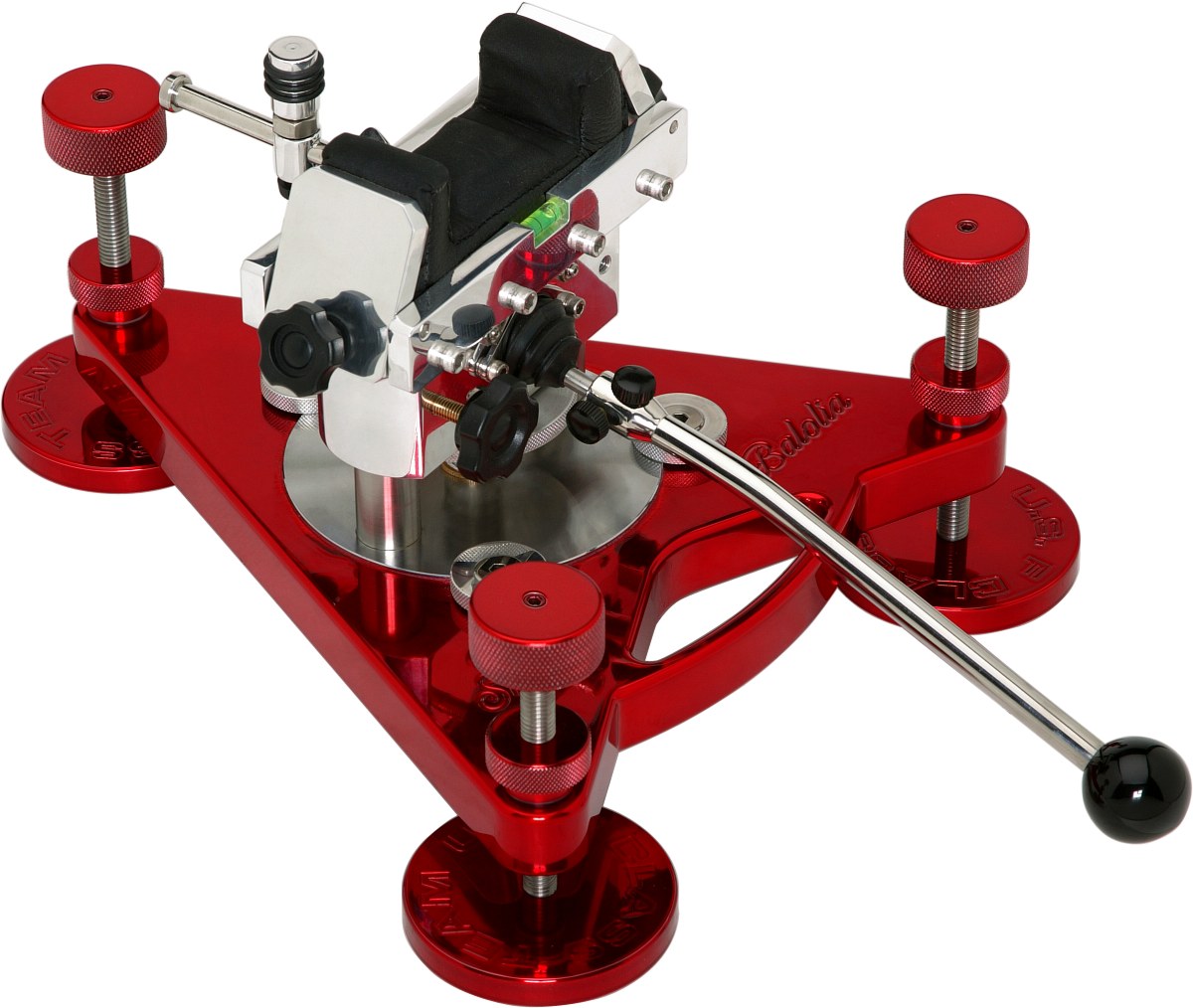
 Right out of the box, the SEB Coaxial Rest is already one of the slickest pieces of hardware in the shooting game. The SEB joystick rest functions smoothly and is beautifully machined.
But Americans always like to “hot-rod” their gear, and this SEB rest enjoyed some very special customization by Grizzly Industrial’s Shiraz Balolia. Shiraz, who the Vice Captain of the USA F-Class Open Team, teamed up with Bob Pastor of Viper Rests to create what may be the “Ultimate” SEB rest. This candy-apple-red beauty features a new CNC-machined base with integral carry handle. The base was finished mirror-smooth then treated to a stunning bake-on red finish. The base started as a solid block of aluminum which was milled out on the underside to save a bit of weight. The rest now also boasts large-diameter custom footpads fabricated by Bob Pastor. These aluminum pads feature wide conical “spikes” in the bottom. “US F-Class Team” is engraved in the top of each pad.


The base required many hours of expert machine work by Shiraz to complete. Sorry, for now, the base is a one-of-a-kind, so you can’t buy one. Shiraz says “It would be way too expensive to produce these one at a time.” But, you can get the large-diameter footpads from Bob Pastor. Call Bob at (269) 521-3671 for specs and prices.
November 29th, 2008
We believe that every serious gun collector should have at least one falling block rifle in his or her collection. This classic design allows a very short, compact action. Falling blocks can be extremely accurate. Remember that the finest, long-range target rifles of the 19th Century were falling blocks. And the more modern BSA Martini designs were very successful rimfire target rifles in their heydey.
Compared to shooting a semi-automatic rifle, or even a modern bolt gun, using a falling block is a very different experience. It seems old-fashioned, but in a reassuring kind of way. The pace is slower, and there is something calm and purposeful about working the smooth under-lever and loading the case by hand. You “work” a bolt gun… but you “caress” a falling block.

Right now there is a very nice Browning B-78 High Wall falling block for sale in our Shooters’ Forum Classifieds. Chambered in 22-250, it features a full octagon barrel and superbly-figured wood. The seller reports this rifle: “Is in 99% condition [and] shoots under 1” at 100 yards with factory ammo.” The $1,100 asking price includes a 6-12×44 Simmons Aetec scope, rings and bases, 125 pieces once-fired brass, and a Sinclair 22-250 bore guide.
This Editor has shot one of the older Miroku-built Browning B-78 falling blocks and it was beautifully built, with a butter-smooth action and gorgeous blueing. (Japan’s Miroku, which also builds Citori shotguns for Browning, is renowned for the superb metal-work and finish of their rifles and shotguns.) The B-78 was produced by Miroku from 1973 to 1982. This single shot rifle was initially offered in .22-250, 6 mm Remington, .25-06, and .30-06. .243 and 7mm Rem Mag was added to the standard rifle line and a .45-70 version was added on a heavier frame. The B-78 was discontinued in 1982, and then reintroduced in 1985 as the Model 1885 High Wall. The more recent 1885s feature a more traditional stock with a straight wrist and no roll-over comb.

Chuck Hawks is also a fan of the Browning falling blocks: “The Browning 1885 High Wall is a modern version of the John Browning designed classic, widely regarded as the strongest and best of the American single-shot rifles. It is a very simple yet elegant looking rifle. It has an exposed rebounding hammer that cocks automatically when the ‘S’-shaped underlever is operated. The automatic ejector can be user set to throw the empty case out to the right or left, or extracted for convenient removal by hand.”
November 27th, 2008
We first featured Henry Remple’s Canadian-made F-Class bipod last winter and we still receive many questions about this product. Nick-named the “Ski Bipod”, this impressive unit offers unrivaled stability from an ultra-wide footprint. The height of the bipod is adjustable as is the distance between the runners or “skis” that contact the ground. And there is a cant adjustment allowing the rifle to be leveled on uneven ground. The reason Henry used ski-like runners rather than flat pads is that this allows the rifle to slide slightly reward during recoil. That eliminates much of the hop and rotation associated with conventional bipods.

Forum member Keith Skjerdal reports: “A lot of F-CLass guys in Canada are using the Ski Bipod made by Henry Remple out of Calgary. It is very well made and steady as a conventional pedestal rest. Even some guys in the USA and Britain have them now. If you want the best, this is it, in my opinion. This makes the trip to the mound easier than with a big pedestal rest. Downside? Well, since the Ski Bipod attaches to your rifle, it counts in your total weight under the rules. The Ski Bipod adds roughly 3.5 pounds to your gun’s weight. The cost is around $400-420 Cdn (this basically covers the cost of materials and all that milling work.)
To get one, contact Henry Rempel from Calgary. He does not have a web site. His home phone number (after 7 pm) is 1-403-272-8416. I think his email is henry.rempel [at] hotmail.com.”


Photos Copyright © Richard Dreger, used by permission.
November 22nd, 2008
Lee reloading products have always represented good “bang for the buck”. The Lee Classic Cast “O”-style press is no exception — it works as well as some other presses costing twice as much. One well-known “boutique” bullet maker has recently switched to Lee presses because the tolerances and lack of slop were actually superior to more expensive presses.
Though relatively inexpensive, the Lee Classic is a well-designed unit with a strong, cast-iron frame and all-steel linkage. It has important (and very cool) features you won’t find on an RCBS RockChucker. First, the ram is drilled in the center and fitted with a plastic drop tube so spent primers drop right out the bottom (where you position your trash can). Second, the handle adjusts for length and “attack angle”. This allows you to change the leverage to suit your task. As Lee explains: “The start and stop position is adjustable with a 48-tooth, ratchet-type handle clamp. In addition, the handle length is completely adjustable. Shorten when you’re loading handgun and short rifle cases.” As you can see from the photos, you can also mount the handle on either side, left or right.
 
You can purchase the Lee Classic Cast Press for under $75.00 at major vendors. MidwayUSA sells the Lee Classic (item 317831) for $72.99. Natchez Shooters Supply also offers the Lee Classic for $72.99, item LEE90998.
 Mark Trope of SurplusRifle.com has written a detailed Review of the Lee Classic Press. He notes that the press is “southpaw friendly” and he praises the priming system. Mark found that the spent primer drop tube worked very well and that the press “works perfect and has great sensitivity” when seating primers.
Not yet convinced? CLICK HERE to read comments from actual Lee Classic owners. Here are some highlights:
“It has a large, heavy-duty 1-1/8″ diameter ram that has been drilled out for spent primers … and a long clear plastic hose attached to it so you can route it to a trash can. [This is] a VERY well thought-out way to collect ALL primers to your trash can when you’re decapping.” –D. Oldham
“Fit and finish are impeccable. The spent primer disposal system is simple and neat. There is no spring or flexing of any kind. There is virtually no play in the ram, which is a good tight fit in the frame. Operation is totally smooth.” –R. Smith
“Totally outclasses any other press in its price range. Runs with presses in the $100-$120 range.”–W. Rose
“I like…the position of the ram at priming. The Lee seats the primer with the ram at the bottom of the stroke vs. the RC II, which seats in the middle of the stroke. Priming at the bottom of the stroke gives you a much better ‘feel’.” –M. Gallagher
November 16th, 2008
 Forum member Russ T. is an experienced High Power shooter, with a Tennessee LR State championship to his credit among other excellent performances. He recently reviewed the performance of his Eliseo Tubegun chambered in 6mmBR. Russ writes:
“Got a good chance to shoot my tube gun today at 600 yards. I put a new Bartlein barrel on it chambered in 6BR. I had to do VERY little load develpment to find a good load. In fact all loads I tried would have shot a 200 out 200 possible at 600 yards. The winner load is a classic 6BR recipe right from the pages of this web site: 30.0 grains Hodgdon Varget, CCI 450 primers, 105gr Berger VLD seated .010″ into the lands, Norma brass with two-thousandths (.002) neck tension.
The gun, built on an Eliseo B1/R1 (single shot) tube stock*, has a trued Remington action with Dave Kiff (PT&G), fluted, coned bolt with Sako extractor, GTR firing pin, spring and shroud, and Rifle Basix trigger. The barrel is a 30″ Bartlein, 1:8″ twist 5R heavy Palma. My reamer is a .272 neck for Norma brass and .104 Freebore. Centra rear iron sights are fitted.
Weather was very dark and cloudy but there was very little wind. On the MR-1, 600-yard target I squeeked out a 200-16X. This little case is a flippin’ hammer at 600 yards! What a lot of fun to shoot. Lynwood Harrell just sent me a die in the mail so I’m ready for the season. I can see why the Europeans shoot this case at the very demanding 300-meter target!
This little case is a real winner at 600 yards. The nice thing about it is there is no false-shoulder/fire-forming hassle, and no necks to turn. Just load it and shoot it. I have two rifles that have turned necks and that is a lot of work when you’re doing 200 pieces of brass per rifle. The 6BR is just not picky. In fact the bullets just seem to know where to go.
My 6BR was built by Wald Precision Rifles. Call (701) 527-6447 and ask for Steve. Steve has produced Three National Championship quality rifles for me. I really have to thank Steve for doing such great work, he really stands behind his product. I know every one reading this can appreciate a good craftsmen when you’re putting your hard-earned money into a project such as this. So who deserves the credit — the Archer or the arrow-maker?”

*The B1 is the original Eliseo single-shot Tubegun stock, designed for the Barnard action. The newer R1 has a similar design, but is configured for a Remington 700 or Rem-clone actions.
November 13th, 2008
If you are looking for a very solid, beautifully fabricated, loading press that can do double-duty at home as well as the range, consider the Harrell’s Combo Press. Though it is very compact, it has plenty of leverage to full-length size cases. As you can see in the photo, the Harrell’s combo works BOTH as an arbor press and as a standard press that functions with shell-holder and conventional screw-in dies. The arbor section on the left is tall enough to hold a Wilson micrometer-top seater. The threaded die section on the right has enough clearance for .308-sized cases.

One of the best features of the Combo Press from Harrell’s Precision is its sturdy clamp. This mounts solidly to a wood loading bench or table top. It also has enough vertical clearance between the jaws to work with most range benches. Forum member Boyd Allen has written a detailed review of the Harrell’s press, with additional photos by Paal Erik Jensen of Norway.
CLICK HERE to read COMBO PRESS REVIEW

November 8th, 2008
Some months ago, AccurateShooter.com and Robert Whitley teamed up to build a new 20-caliber AR15-based rifle. Our project goal was to create the “ultimate” semi-automatic prairie dog rifle. We wanted a low-recoiling, flat-shooting AR that worked great with a front rest and rear sandbag on a transportable field bench (such as the Coyote Jakes bench). We knew the basic AR15 design needed some “upgrades”, so Robert developed Delrin bag-riders for the forearm and buttstock. But we wanted the bag-riding components to be removable so the gun could be easily returned to standard configuration for shooting with sling or bipod. Robert worked with EGW to develop machined Delrin bag-riding units front and rear. The 3″-wide front “sled” attaches to the threaded anchor for the sling swivel stud, while the rear bag-rider mounts in place of the standard rear sling loop.

 
Our Ultimate Prairie Dog Rifle (PDR) features a 24″ Bartlein 11-twist cut-rifled barrel, DPMS side-charging upper, and a Jewell trigger. It is chambered in “20 Practical”, a cartridge popularized by Warren “Fireball” Brookman. This is simply the .223 Remington necked down to .204. You can use your existing .223 brass — no special case-forming required! The 20 Practical is accurate, flat-shooting, and has almost no recoil. The advantage over the standard .223 Remington is that, grain for grain, the bullets have a higher BC and travel at a higher velocity for more dramatic effect on a small varmint. The ultra-low recoil allows you to easily see your hits, even without a muzzle brake. The 20 Practical, launching 40-grainers at about 3750 fps, shoots flatter than a .223 Rem with 55gr hollowpoints.

Robert has lots of experience building AR15 uppers and he has developed advanced features that make the gun much more ergonomic and easier to shoot from a prone position or from the bench. First, Robert offers a side charging handle. This lets you keep your head in shooting position while charging the gun or retracting the bolt. Second, he has fitted a GG&G extended scope rail. This permits the scope to be mounted far enough forward to allow proper eye relief while using a high-magnification scope. Without an extended scope rail you typically have to move way back on the gun to get enough eye relief and then you can’t seat the buttpad properly on your shoulder.

 In the video above, Robert shoots the Ultimate PDR with Berger 40gr BTHP bullets. Robert is using the Caldwell Fire Control front rest and rear sandbag. The Fire Control Rest is an affordable, joystick-style mechanical rest that allows you to easily adjust windage and elevation with a single movement of the joystick. The rest is solid and sturdy; Robert says it worked well.
In this session, Robert shot three five-shot groups. Each group could be covered by a dime, which measures 0.705″ in diameter. Subtract the 0.204″ bullet diameter, and you can see this rifle easily shoots under half-MOA, even rapid fire (groups 1 & 2). For the third (and last group), Robert slowed down the pace, aimed more precisely, and put five shots in 0.257″. Not bad for shooting off a wooden bench without wind flags! Like what you see? As soon as accuracy testing is complete, this rifle will be auctioned off to benefit this website. EGW will be offering the front and rear Delrin bag-riders. They will cost $40 each or both front and rear for $75.00 total. Robert will also be offering 20 Practical uppers for your AR15. Email rcw3 [at] erols.com or visit 6mmAR.com for upper specs, options, and prices.

October 27th, 2008
 SEB Coaxial Rests are premium joystick-style front rests favored by many leading Benchrest shooters. The movement of the front support (both horizontally and vertically) is smooth and positive, and the rest can be easily adjusted so the arm won’t “droop” even if you remove your hand after adjustment. The base is beefy and stable, and the quality of machining is excellent. This Editor shoots off a SEB rest. I can testify that it helps me get on target faster and shoot smaller groups.
Until recently, Paul Schmid has been the U.S.A. dealer for SEB Rests and other products from innovative designer Sebastian Lambang. Sadly, however, Schmid passed away in late August. SEB Products has secured a new dealer for the American market: Ernie Bishop of Gillette, Wyoming, phone: 307-257-7431, email: ernieemily [at] yahoo.com
Seb Lambang tells us: “I have a new USA dealer for the SEB products now…Ernie Bishop in Gillette, WY. I am trully sorry that Paul Schmid, my mentor and the last US dealer for my products, passed away last August 30. He died suddenly several days after hip surgery. Paul was a man of honor, very trustworthy, and a great friend in the same time. He was truly a great loss for me! He and his family will always be in my heart and prayers….
Just like Paul, Ernie Bishop is a man of honor, trustworthy, and a very friendly guy, too. Ernie and I became close friends during a visit (for prairie dog shooting) to Wyoming after the 2008 Super Shoot. I asked Ernie to be the new US dealer because I know he can handle the dealership well and he will provide good service. Ernie will have rests, bags, ammo holder sets (etc) around mid-November, next month. I am preparing the items at this moment.
Please feel free to contact/email me anytime, or Ernie, if you have any questions, or problems, with SEB products. Email me at sebastianlambang [at] yahoo.com or visi [at] telkom.net.
All the best, Seb”
For more info, visit www.SebCoax.com

|