|
|
June 4th, 2008
In the short-range benchrest game, most of the attention goes to the 10.5-lb Light Varmint Class, and the 13.5-lb Heavy Varmint Class. But there’s another class that is enjoying increased popularity–Hunter Benchrest. In some ways, Hunter BR is more challenging, because you shoot a 10-pounder with a narrower (2.25″ forearm) and a 6-power scope (both LV and HV allow 3″-wide forearms and high-magnification scopes). It takes skilled gun-handling and careful aim to get the most from a Hunter Benchrest rig.

The modern Hunter BR rifle is a far cry from a typical deer rifle, or even a walk-around varminter. Jackie Schmidt explains: “Do not be fooled by that title ‘Hunter Benchrest’, or HBR. The typical HBR Rifle has, like its cousin the Group Rifle, evolved into a very singular-purpose piece of equipment, suited to do one thing very well — namely to shoot Xs in the competitive arena, governed by rather strict sets of rules promulgated by the IBS or the NBRSA.
The two defining factors in HBR are the minimum case capacity, and the 6-power scope. Everything else is just window dressing.
Can one shoot a real factory gun in Hunter BR Class? The answer is yes, IF your factory rifle meets these qualifications:
■ Total gun weight no more than 10 pounds.
■ Stock forearm must be convex (at least slightly) on the bottom, and no more than 2.25″ wide.
■ Gun must have magazine capable of holding at least two cartridges. (Normally, however, Hunter BR shooters don’t feed from the magazine.)
■ Gun must shoot a cartridge with at least 45 grains of water capacity (the equivalent of a 30-30).
■ Scope must be a 6-power or capable of being set and used at 6X magnification.
If you go to the IBS website, you will see that there are a couple of exceptions, but in the end, to compete for the prize, you must have a legal Hunter BR rifle. But even if you’re not completely within the rules, most match directors will let a newcomer shoot along, for the fun of it, and to see what the game is really all about.”
Top Hunter BR shooter Al Nyhus tells us: “As Jackie has pointed out, the Hunter class in Benchrest has mutated into full race BR rigs…much like NASCAR ‘stock cars’ or NHRA ‘Pro Stock’. The original intent of Hunter was for a class where the average person with an interest in accuracy could bring a good shooting hunting rifle and give BR a try. Still a darn good idea, to me.

Here’s a photo of my Hunter Benchrest rig, which is pretty typical of what’s being used at this point in time. My Hunter BR rig is pretty standard stuff except for the chambering. It features a Stolle R/L Kodiak action tweaked a bit by Stan Ware, Kostyshyn 1:17 four groove, chambered for the 30 WolfPup (30BR .240″ long/.085″ neck length). The photo below shows a Leupold 6X scope but I’ve been using a Sightron 6X lately.

This stock is an old Speedy/McMillan pattern HBR stock. I had it dipped (externally coated) with a carbon fiber pattern. By the rules, Hunter rifles cannot be glue-ins, so pillar bedding is the norm. I guess the forearm is about as ‘convex’ on the bottom as any other stock currently in use. This is another area where the guns have evolved and the rulebook(s) haven’t exactly kept pace with the current state of what’s being used.”
May 27th, 2008
 Site Contributor Danny Reever has tested the bargain-priced PRVI Partizan .223 factory ammo in his 7-twist Sig 556 and AR15. He gives it a definite “thumbs-up”. Danny reports: “You should try some of the PRVI Partizan 75gr Match ammo. I was really surprised. This stuff shoots great. At 100 yards it delivered one MOA, easy, with my Sig 556. With a custom match rifle it might do even better. This is great ammo for the price. I’m going to buy more before the price goes up.”
Danny was also impressed with the brass: “This is quality brass, all boxer-primed and reloadable. For varminting and general-purpose use, I wouldn’t hesitate to stack it up against more expensive brands.”
PRVI Partizan G75gr HPBT Match .223 ammo, item PPA223MATCH, is available from Grafs.com for $10.99 per 20-round box, including shipping. Graf’s also stocks PRVI .223 ammo in other bullet weights: 55gr FMJBT (M193), 55gr SP, 223 REM 62gr FMJBT, and 69gr HPBT-MATCH.
PRVI Partizan 75gr Match ON SALE for $8.99/box
Now through May 31, 2008, MidwayUSA has the PRVI 75gr Match Ammo on sale (ITEM 790565). This is the same stuff that worked so well for Danny. The sale price is just $8.99 per 20-rd box, marked down from $11.99. You may want to jump on this deal before the price goes back up June 1st. (NOTE: 1:7″ or faster twist required.) Midway customers who have tried this ammo agree with Danny — this is quality 1 MOA or better ammo:
In my RRA Predator Pursuit rifle this ammo produces consistent 1 inch groups at 100 yards. Burns clean with no funky powder odors, no feed problems were encountered. Brass is clean and shiny, good practice and hunting round. Get it now before the price goes up. — Juan S., TX
Comparable to MUCH more expensive ammo in both accuracy, and terminal performance. EASILY shoots sub-MOA groups @ 200 yards from my RRA A4 Varmint. Stock up while you can! — Paul J., AL
I shot this ammo out of my Colt H-Bar AR 1-7 twist and got 1″, 5-shot groups at 100 yards. I doubt you’ll do better than that for this price. I will be ordering more. — David A., AL

Wideners has PRVI Partizan 75gr .223 Bulk Packs
Wideners.com also has large supplies of the PRVI Partisan 75gr .223 Match ammo. Price is $82.00 for 200 rounds (10 x 20-ct boxes), or $399.00 for 1000 rounds. The 1000-round price works out to $7.98 per 20 rounds.
Stan Widener tested the ammo and reports: “After firing, the brass was very clean and there was very little residue on the bolt carrier. Very clean powder. The ammo is made with MILAN BLAGOJEVIC powder and GINEX primers. There were no failures or misfeeds of any kind. All rounds functioned perfectly. The cases are very bright and shiny with military anneal mark. With no primer crimp to deal with, the brass should reload well. CONCLUSION: This is truly the best buy you can get in match 223 ammo.”
Great Price at AIM Surplus
Forum member Graymist notes that AIM Surplus has the PRVI Partizan 75gr BTHP Match for $8.25 per 20-rd box or $7.95 per box for 10 or more boxes (200 rounds or more.) Compare shipping costs with other vendors, however, to determine if this is the best deal, given your location. Remember Grafs.com includes shipping in their price.

May 25th, 2008
 Two new, very small and light reloading scales have recently been introduced. These are small enough to fit in a shirt pocket. While not as precise as a bench-top unit, they can deliver read-outs to within 0.2 grains. These ultra-compact scales should prove very useful for any shooter that needs to load at the range. Additionally, they are affordable enough to be used as a back-up to a larger electronic or balance beam scale.
We knew readers would want to learn about these brand new products. However, both these scales are so NEW that we haven’t yet been able to comparison-test them with a laboratory scale to confirm the claimed levels of weighing precision and see if there are any calibration or “drift” issues. Stay tuned for future test reports.
MTM Mini Reloading Scale — $30
 The new DS-1200 weighs up to 1200 grains. MTM claims accuracy (resolution) to plus or minus 0.1 (one-tenth) grain. You can switch measurements among grains, grams, ounces and carats .The unit features a high-impact, plastic sensor cover that doubles as a large powder pan. The DS-1200 comes with a calibration weight, two (2) CR2032 Batteries, and a foam lined storage/travel case. Up to 1200 grain capacity with To save battery power, the large, backlit display shuts off automatically after 3 minutes. Here are sources for this bargain-priced new scale:
PrecisionReloading.com Item MTDS1200 | $29.99
Grafs.com Item MTMDS1250 | $29.99 — Coming Soon

Acculab Pocket Pro Mini Scale — $112
Sartorius, makers of the popular Acculab-123 scale and its Denver Instrument clone, the MXX-123, has introduced a new, portable reloading scale that is truly pocket-sized. The compact model PP-62 will work as a portable scale or a back-up for a benchscale. It measures 3.5″ long, 3″ wide, and just 7/8″ thick.

The Pocket Pro can handle a maximum weight of 1000 grains. Acculab claims resolution down to 0.1 (one-tenth) GRAM, which provides readability to 0.20 GRAINS. We like the fact that the unit runs on a single, easy-to-purchase AA battery. Battery life is up to 20 hours, if you turn off the back lighting on the LCD display. A sliding cover also protects the weighing mechanism during transport. The PP-62 offers easy one-button calibration with the supplied check weight.
Sinclair Int’l sells the new Acculab PP-62, for $111.50 (Item 10-6200). This includes battery, weighing pan, and 50 gram calibration weight.


CONSUMER ALERT: On the web you’ll find other versions of the Acculab Pocket-Pro® Scales, priced at $45-$60.00. These are the PP-201 (photo above) and PP-401. Though these scales appear identical to the PP-62 (Sinclair item 10-6200), they are NOT the SAME. The cheaper PP-201 and PP-401 are only rated to one-TENTH of a GRAM. The PP-62 is RATED to one-HUNDRETH of a GRAM — that gives you an 0.2 GRAIN precision.
May 17th, 2008
MidwayUSA has Bore-Store synthetic fleece rifle storage bags on sale. We can say, unequivocally, that Bore-Stores are a great product. Every gun in this editor’s safe rests in a Bore-Store. Bore-Stores cushion your guns against dings and scratches while the breathable fabric wicks away moisture and fights rust with a special anti-corrosion coating. The fabric is coated with pure silicon and an extra rust-inhibiting chemical. Bore-Stores are relatively inexpensive and last forever. Unlike cotton, wool, leather or canvas bags, the fibers do not absorb and retain moisture. You really can’t beat them for storage in a safe because they cushion the gun as well as fight rust and aluminum corrosion.

MidwayUSA has the full line of Bore-Store cases on sale. We’ve found that the latest examples run on the roomy side, so the 46″ scoped rifle case, item SRC-1, will fit guns up to 48″ overall, with plenty of clearance for a big scope. The 46″ case is now $9.99 marked down from $11.49. The 40″ Scoped Rifle Case, item SRC-3 ($9.49 on sale), will fit most short-range BR guns up to 42″ in length. There are also models for shotguns, carbines, and pistols.
May 14th, 2008
Just this week, Sightron sent us one of the new Sightron SIII 8-32×56 LR D rifle scopes for evaluation. This new optic features a 30mm main tube and weighs 24.7 ounces. Clicks are set in 1/4-MOA increments. The reticle is a fine cross hair with 1/4-MOA dot. The scope comes with a 3″ sunshade, turret covers, and rubber-connected, see-thru lens caps. Jason Baney had a chance to test the scope and give his initial impressions of its optical qualities. We will follow this “First Look” report with more extensive testing of the scope’s mechanical tracking and long-range resolution.

Overall, Jason was extremely impressed with the new scope. It was very bright, with excellent color rendition and contrast. The image remained bright and sharp out all the way out to the edges, with no shadowing or distortion. Compared to a Nightforce 12-42×56 BR scope set at 32-power, Jason thought the Sightron had better contrast and more vivid colors. Jason concluded: “At this point, the new Sightron seems like a good value, and compares well with the Nightforce BR model.”
Parallax and Focus
Importantly, the Sightron’s parallax control worked perfectly. There was no lash issue and Jason was able to attain minimal parallax with the target at maximum sharpness. With some other scopes, if you set the scope to have the target in best focus, you’ll still have too much parallax.

Elevation and Windage
This is a scope you can use to 1000 yards. Jason ran the adjustments top to bottom and recorded 75 MOA of both Elevation and Windage, based on the stated 1/4-MOA click Value. (That’s 75 total MOA available from one extreme to the other.) The target knobs have 15 MOA per turn and operate VERY smoothly and positively. Jason said the clicks “feel similar to Nightforce NXS clicks, but the Sightron clicks engage with a slightly softer feel, with less resistance.”
 Resolution Tests
Jason used two resolution charts, the USAF 1951 Optical Chart, and a line-width/text size chart. To judge resolution, Jason did a comparison test of the new Sightron 8-32×56 and a Nightforce 12-42×56 BR, with both scopes set at 32x with their sunshade attached. Jason looked through both scopes at the resolution test targets at 100 yards, and then at target frames, grass, and flowers at 300 yards. Viewing was done late in the day, with some shadows on the range. Keep in mind these were less than ideal conditions for viewing.
The test charts have incrementally smaller focus lines and text. Both scopes were able to resolve down to the same line/text level on the two resolution charts. The new Sightron showed comparable, but VERY slightly less resolution than the NF. Both could identify the same size of text, but the NF saw it just a bit more crisply. Jason reports: “I could go to the same resolution level with both scopes, but the last line was just a touch more crisp with the Nightforce. Still, the Sightron is very close in resolution.”
Contrast and Color Fidelity
The Sightron was the winner in this category. In fading light, the Sightron delivered better contrast. Green, yellow, red, and white colors showed more differentiation and all the colors were more vivid. Weathered target backer boards also showed more contrast through the Sightron. Jason checked this several times nearing dusk, and the Sightron always seemed more vivid and showed more contrast looking at a patch of grass and colored vegetation. In terms of color temp, the Nightforce has a more whitish tone, whereas the Sightron seemed “warmer” with more vivid colors.
Brightness/Light Transmission
Along with its superior color and contrast, the Sightron seemed to be consistently brighter through the fading light. We note, however, that manufacturers’ published light transmission factors are nearly identical for the Sightron 8-32 and the Nightforce 12-42. The greater brightness of the Sightron is Jason’s subjective perception, but he said “the Sightron definitely seemed brighter.”
View to Edge
With many zoom scopes, at high magnification, the center of the “circle of light” is bright and sharp, but the edges are faded or shadowy. The brightness attenuates (fades out) on the edges. In addition, you sometimes see some image distortion or focus loss at the edges. The Sightron showed none of these issues. At SHOT show, this editor looked through a prototype 8-32 Sightron and it was bright and sharp all the way out to the edges. Jason observed the same thing: “The Sightron was noticeably clear edge to edge, where the Nightforce showed some fading or darkening at the edges. This point was quite surprising to me.” Jason also noted that the Sightron had about a 3-4″ wider field of view at 100 yards.

Fringe Effect with Highly Reflective Subjects
With the Sightron, when looking at extremely bright, reflective objects, such as a car’s chrome trim, Jason did observe some minor fringing–what he called a “thin halo”. This also appeared around the edge of a white target paper viewed in bright light. A through-the-lens photo appeared to show edging colors (purple fringe), so this may be Chromatic Aberration*. It wasn’t a major issue and it did not affect the sharpness or contrast of the viewed object itself. This was visible only on the periphery of very bright objects.
Conclusion–Impressive Optics for $825.00
We only were able to comparison-test one sample of each scope, Sightron vs. Nightforce. As noted, the performance was very close, and it is possible that different samples might perform slightly better or worse in each optical category. In this test the Nightforce had a very slight edge in resolution, while the Sightron was brighter. We plan to do more testing, with bullet-hole targets set at long ranges. That should give us a better sense of how the Sightron can resolve bullet holes and target lines out past 300 yards. Jason will also do a box-test to check the tracking and repeatability of the Sightron. Based on what we’ve seen so far, however, the Sightron, with a “street price” of about $825.00, is a very good value. Jason concludes: “Given the 8-32 Sightron’s price point, I’d say most people will feel it is a great scope for the money.”
*Chromatic aberration occurs in a riflescope when white light, bent by the objective lens, separates into different colors (wavelengths), each color bending at a slightly different angle. When that occurs, the colors don’t focus at the same point. This most often appears as a deep blue/purple or yellow edge on the image, particularly straight black and white edges.
May 8th, 2008
Newcon Optik, based in Toronto, Ontario, Canada, produces many optics products for the Canadian military including laser rangefinders, image stabilizers, and night-vision gear. Newcon Optik also sells a line of laser rangefinders for consumers. Newcon claims that its rangefinders offer performance comparable to Leica, but at a much lower cost. The Newcon Optik LRM2000 Pro is designed to function out to 2000 meters, with a “reliable, all-conditions range” of at least 1500 yards. The LRM2000 Pro sells for $499.95 at SWFA.com, making it considerably cheaper than comparable models from Leica and Swarovski.

AccurateShooter.com has not been able to field test the LRM2000 Pro ourselves. For that reason it was not included in our Review of Laser Rangefinders done in 2007. However, we’ve handled the unit at SHOT Show and there are many features we like. First, it has a selectable reticle, offering a choice between a small rectangle and a cross-hair. By contrast, the $890.00 Swarovski Laser-Guide only offers a rather large aiming circle. Some hunters have complained the Swaro’s reticle is just too big for deer-sized animals out past 600 yards or so.

FEATURES
1 – Measurement result
2 – Units of measurement (Yards, Meters, Mils, Degrees)
3 – Low battery indicator
4 – Over 100m indicator (LRM 2500, LRM 2500CI Models only)
5 – Laser active indicator
6 – Target quality indicator (optional)
7 – Reticle (cross or rectangular selectable)
We also like the Newcon Optik’s shape and ergonomics. Sized 4.72″ x 4.8″ x 2.36″, the Newcon is flat and easy to hold, with non-slip rubber grip sections on both left and right sides. You can hold the brick shape securely with two hands, horizontally, like using binoculars.
 By contrast, Leica went to an ultra-compact, vertical design for its latest CRF1200 rangefinder. The CRF’s small size makes the Leica easy to carry, but it is more difficult to hold the Leica stable when precise aiming is needed. With the Newcon Optik, you can set it flat on top of a case or rucksack and it’s easier to maintain a solid grip. The LRM2000 Pro also offers a built-in digital compass, a nice feature for anyone in the outdoors.
In the video below, Alex Rudi of Newcon Optik explains the features of the LRM2000 Pro model:

CLICK HERE to watch NEWCON OPTIK VIDEO
How do the Newcon Optik rangefinders perform in the field? Do they live up to the claims of Leica-class performance? We invite our readers who own or use Newcon Optik rangefinders to add their comments.
CLICK HERE for LRM2000 PRO SPECS SHEET (.pdf file)
May 1st, 2008
Now through May 31, 2008, MidwayUSA has the Howard Leight Impact Sport Earmuffs on sale for $49.99, $10.00 off the regular price. That’s a heck of a deal. These electronic muffs (item 671923) perform as well as some other noise-cancelling muffs that cost two or three times the price.
Because the Howard Leight Impact Sport muffs only carry a Noise Reduction Rating (NRR) of 22 db, we recommend you use these OVER foam ear plugs. When you do that, the electronic noise circuit still allows you to hear range commands. Forum member Danny Reever has a pair of the Leight Impacts. He reports: “Off the firing line, while others are shooting, you can easily carry on a conversation while the electronics cancel out the gunfire. Amplification is crisp and clear even at the highest setting. On the firing line, the slim profile of the muffs does not interfere with cheek weld and are comfortable.
The 22-decibel noise reduction rating (NRR) is a bit low for my liking, but I have found using 29-db plugs coupled with a slight gain in the electronics allows me to get maximum protection and still hear range commands. In fact, by increasing the volume further I could still hear conversations up and down the firing line.”
Assistant Editor Jason Baney also has a pair of the Howard Leight electronic muffs. He says: “They are comfortable and work great if you wear plugs underneath. You can even plug an iPod into them.”
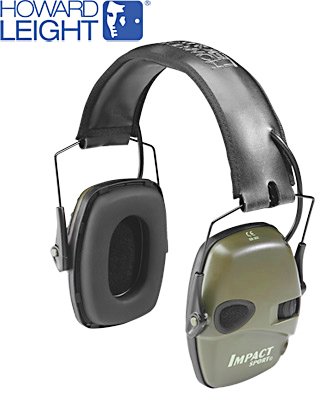
Both Cabela’s buyers and MidwayUSA customers have praised these units:
“I am a firearms instructor/SWAT instructor, active on two SWAT teams. [I] have burned through too many pairs of Peltors due to their poor battery set up. These are cheaper price-wise, but [have] better controls and battery storage. Amazing sound quality. In reality to beat the performance you need to spend four to five times the money. If I could give ten stars I would…” ZM, Cabelas customer.
“I have a set of Peltors that I paid triple the price for and they aren’t half as good. These [Leights] have nice smooth attenuation unlike the Peltor that snap on and off in a very annoying fashion. These fit tight, have good noise reduction and good sound quality. The low profile works well with rifles and shotguns. Don’t bother spending more, these are great!” Paul D., MidwayUSA Customer.
April 23rd, 2008
Now through April 30, 2008, MidwayUSA has H-S Precision stocks on sale for $259.99. These stocks regularly sell for $307.99 at MidwayUSA, and are priced at $350.00-$370.00 on the H-S Precision website. These H-S Precision stocks feature Kevlar- or carbon fiber-reinforced shells, plus a CNC-milled aluminum bedding block. The integral aluminum block provides a solid attachment for the action. Many shooters report that the H-S stock, even without conventional bedding, delivers better accuracy than a typical factory Remington stock. Most smiths, however, believe that the H-S aluminum bedding block works even better when skim-bedded.

Six different H&S stocks are available for $259.99: the sporter-style model PSS003 (short) or PSS010 (long) for Rem 700s, tactical-style model PST012 (short) or PST087 (long) for Rem 700 actions with varmint contour barrels, the PSC100 benchrest style with 3″-wide fore-end for Rem 700 short actions, and the sporter-style PSS021 for post-64 Winchester Model 70 actions. In addition, the PSC027 Silhouette Thumbhole stock for Rem 700 short actions is offered for $269.99. All H&S sale stocks come in black only, glossy black for the PSC100 and matte black for everything else.


M. Weaver of Chandler, OK, who purchased the model PST087 stock (tactical long action), gave this review: “Great stock. Easy to change out. The aluminum full length bedding block takes away the need for any gunsmithing and allows the action to be torqued to proper specifications[.]”
April 22nd, 2008
 Many readers have asked where they can find a high-quality, extremely light-weight hunting stock suitable for a “walk-around” varminter. One impressive option is Tom Manners’ Carbon Fiber MCS-UL (UltraLight). Weighing just 1.55 pounds, the Manners’ UltraLight is built to Benchrest standards. Despite its minimal weight, the stock is strong and very rigid–because it is basically a seamless shell. The only cuts in the shell are for the action pillars and bolt handle. Both the 1.75″-wide fore-arm and pistol grip area have a molded-in textured surface for better grip.

The MCS-UL is priced at $495 (before options), and is currently available only with a Rem 700 inlet. This will fit Rem 700 actions or clones such as the Lawton 7000 and Stiller Predator. Available finishes include clear-coat or polyurethane paint in black, gray, or olive. If you want to “show off” that handsome carbon shell, go with the clear-coat. For more details, contact Manners Composite Stocks, (816) 210-8108.
April 20th, 2008
Readers often ask: “What priming tool should I use?” There is no simple, clear-cut answer. Different tools have different advantages and disadvantages. Many short-range benchresters like the Sinclair one-at-a-time priming tool. They believe this unit has the best “feel” for seating primers.
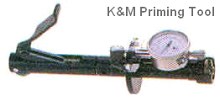 Others prefer the K&M tool, another “single-loader”, because it can be fitted with a seating depth gauge, for the ultimate in precision. On the other hand, one top shooter with a couple National Championships under his belt favors the modest $19.00 Lee Autoprime tool: “It’s simple, efficient and has served me well for years–I’m not convinced the fancy, expensive tools do a better job.”
This editor has tried all of these tools, and personally I favor the RCBS APS hand priming tool. It has two important advantages. Number one, primers are held in color-coded plastic strips so you never have to touch the primers. If you buy the pre-loaded strips, there is no chance of getting an upside-down primer, and you never have to fool with flipping primers in a tray. Second, the APS tool has a “universal” shell-holder. This employs spring-loaded jaws so it can fit any size cartridge, from a 17 Fireball to large magnums. The unit has a comfortable grip and plenty of leverage. Each time you seat a primer, the strip automatically advances.

Currently, only CCI primers can be purchased pre-loaded into strips. But there is an inexpensive tool that allows you to load Federal, Winchester, or Wolf primers into the strips. The strips come in a variety of colors (Red, White, Blue, Orange, Yellow, and Black), so you can sort your primers by color.

The RCBS APS hand primer is ideal when doing primer comparison testing. You can slide one strip of 25 primers in the tool, seat 5 or 10, then easily remove the strip with the remaining primers, and slide in a second strip with another primer type. You can slip the first strip back in a storage box and the primers remain ready to use.
As contained in the strips, primers can also be used in an RCBS 2000 progressive press, a bench-mounted priming unit, and a special device that fits into the top of a Rockchucker or similar press. I have loaded over 20,000 pistol rounds with an RCBS progressive press and I have had not a single flipped primer. Not one. The strip-priming system also makes it easy to switch from small to large primers on the progressive–this can literally be done in under 20 seconds.

The bench-mounted unit is ideal for priming large quantities of cases. The long handle provides plenty of leverage, and you can work fast, as the primers automatically feed through the system. When I load large quantities of varmint rounds, I use the bench-mounted APS system.
|


