|
|
June 2nd, 2007
The new ONIX 400 GPS from Bushnell, slated for summer 2007 release, offers live weather feeds utilizing XM Satellite broadcasts (XM NavWeather subscription required). In addition, this portable GPS can store aerial photos and topo maps, with GPS info and way points layered on top. Along with Latitude/Longitude and UTM, other internal map data and grid systems can be selected.
The ONIX 400/400CR is the first handheld GPS to integrate satellite weather information with GPS maps and navigation data. While the Bushnell ONIX 200 also offers layering of topo maps and satellite photos, only the ONIX 400 series has the ability to layer weather information on the screen. This could be a real boon for hunters, as well as match shooters looking to predict incoming weather patterns. The compact, waterproof ONIX 400 is powered by a rechargeable Li-Ion battery, with a sleep mode allowing up to 32 hours run-time. An embedded 64 or 128 MB micro SD card holds weather data, maps, photos, and saved locations. Internal memory will store up to 1000 waypoints, 20 trails and 20 routes. (A limited number of map/image downloads are included with each ONIX 400. You can download more photos/maps for a fee.) Models come with a USB cable for connecting to a laptop or home computer. Suggested retail is $499.99. (NOTE–This is just a preview; test units haven’t shipped yet.)
 
Click HERE and HERE for more ONIX 400 product previews.
June 1st, 2007
RCBS recently introduced a handy new product. No longer will you have to rummage through multiple boxes to find the shell holder you need. The new RCBS Shell Holder Rack has twelve positions that hold two shell holders on each post. There is also room to store six Trim Pro® Shell Holders. The clear cover keeps out dust and dirt while allowing you to quickly select the shell-holder you need. Most folks will place the Rack on their bench, but the Shell Holder Rack can also be wall-mounted with standard 1” pegboard hooks. In addition, support legs can raise the rear for bench use, or, when wall-mounted, the legs can angle the bottom out. Several Shell Holder Racks can be snapped together for more storage, and stickers are included to label shell holder posts. The new Rack, RCBS product 9461, retails for about $10.00.

May 29th, 2007
Highpower shooters have a bunch of gear to carry to the firing line–pad, shooting jacket, scope stand, spotting scope, ammo, log-book and rifle(s). If you’re shooting F-Class, add a heavy front rest and 15-lb sand-bag to the list. A range cart makes life much easier, particularly if the shooting area’s a long way from the parking lot. Creedmoor Sports makes a folding range cart that is very popular with the iron sights crowd. This unit features 14″ ball-bearing wheels and the frame is made from solid aluminum–not lightweight tubing that can bend or crack. Lift a simple locking lever and the cart folds. The cart can be completely dis-assembled, without tools, to fit in a suitcase (collapsed size 30″ x 17″ x 8″). The Creedmoor cart retails for $499.00, and that includes a rifle case, tray, and rain-cover. The rifle case doubles as a rack/holster.


If $499.00 isn’t in the budget, or you’d like to build your own range cart with a lockable storage compartment, you should look at the carts used by Cowboy Action shooters. These wooden carts are heavy, but they provide a stable platform for multiple guns and a nice, solid perch for sitting. There are many do-it-yourself designs available. One of our favorites is the GateSlinger cart shown below. This well-balanced design breaks down into two pieces for transport. Click Here for cart plans, and read this “How-to Article” for complete instructions with many photos.

 The least expensive way to go is to purchase a Dolly (Hand Truck) at Harbor Freight, or a large warehouse store such as Home Depot. Make sure to get one with wheels at least 10″ in diameter, or you’ll have problems in rough terrain. The bigger the wheels the better. Normally you can find dollies for under $30.00. Just bolt a large box or milk crate to the bottom, and voilà, instant range cart. You can clamp a piece of wood at the top with slots for barrels on one side and a flat tray for ammo on the other. Use bungee cord or leather straps to hold the barrels in place. Having built a couple all-wood range carts (both collapsible and one-piece), this editor can assure you that starting with an inexpensive welded hand truck is the cheapest, simplest way to go overall. You can buy oversize, spoked wheels from NorthernTool.com. (From the Northern Tool home page, search for “spoked wheels”.)
May 24th, 2007
Kowa, a favored brand among Highpower shooters, has started shipping two new lines of spotting scopes, the Kowa Prominar TSN-880 and TSN-770 series. These scopes feature 88mm and 77mm objectives respectively. Multiple interchangeable eyepieces are available including 20x-60x, Zoom; 30x, Wide; and 25x, LER (Long Eye Relief).

The key feature with these new Kowas, compared to previous models, is the quality of the glass and the size of the front objectives. All TSN-series scopes feature C3 fully multi-coated lens systems. The TSN-773/774 models have XD (extra low dispersion) objectives, while the premium TSN-883/884 models feature pure Flourite Glass lenses for reduced chromatic aberration and improved long-range resolution. The Flourite lenses add about $600 to the price of the scopes.
The new Kowas are quite compact compared to most other spotting scopes with similar objective sizes. The highly achromatized objective lens makes the 88mm Kowa as compact as a 60mm class scope, with the light-gathering ability of a much bigger lens. A new internal dual-focusing system also reduces overall length. With large “fast-focus” knob you can focus from 5m to infinity in just two quick revolutions. Kowa also claims the internal focus keeps the image steadier during the focusing process.

Both the TSN-880 and TSN-770 series scopes are offered with either straight or angled bodies. Bodies are magnesium alloy, and the nitrogen-charged housings are fully waterproof–meeting the rigorous standards of JIS Protection Class 7. The new Kowas are sold by Creedmoor Sports, Cabelas.com, and other major retailers. The TSN-771/772s (body only) cost $1,195 at Creedmoor, while the top-of-the-line TSN-883/884s with Flourite glass, run $2000.00.
We hope to test these new Kowas, head to head, against other premium spotting scopes, such as the Zeiss 85mm. Click HERE for a review from a UK birding magazine that concludes the Flourite-glass TSN-883 is nothing sort of outstanding–that it will compete with anything on the market: “With the launch of the TSN-880 series Kowa has clearly thrown down the gauntlet to challenge the Austro-German supremacy that has become widely recognised within the current optics market….This telescope offers almost everything: user friendliness, a large, light-gathering objective combined with a short body…and an image that is apparently second to none.”
Large Photo Side View | Large Photo on Tripod
May 20th, 2007
 Every varmint shooter needs a good, light-weight “walk-around” 22LR. It’s a nice bonus if the rifle is accurate enough to be competitive in a club-level rimfire silhouette match or “fun shoot.” The Izhmash Biathlon Basic, a Russian-made toggle-bolt rimfire repeater, fills the bill. Our friend Mac Tilton of MTGuns recently obtained a few dozen of these interesting little rifles–brand new. He invited us to test one out at the scenic Winchester Canyon Gun Range in the coastal mountains overlooking Santa Barbara, CA. With the help of Mac’s assistant Bruce, we took a new Biathlon Basic right out of the box, fitted a Sightron 6-24X scope, and put it through its paces at 25 and 50 yards.

Click HERE for Three Large Photos.
Previous testers have noted the quality of the Biathlon Basic’s trigger. While it won’t rival an Anschutz, the trigger is very smooth, breaking at just over 2 pounds (just right for hunter-class silhouette). It has a rather long, but smooth and fluid take-up, followed by a crisp, predictable let-off. In the length of the take-up it reminded me of a pistol trigger. You can easily modulate the trigger to complete the take-up and then hold it right at the break point, like a two-stage trigger.
The rifle is comfortable to hold off-hand, though a long-armed shooter could benefit from a little more length of pull. The gun balances very well just forward of the action and swings naturally. The rounded fore-arm is easy to hold with either a split-finger or conventional grip.

Once the gun was sighted-in, Bruce shot some 5-round groups at 25 yards, using a Caldwell front rest and rear bag. With the very narrow fore-arm, the Izhmash was a bit wobbly. Still, the gun produced a number of 5-shot groups right at 1/4″ with three different kinds of ammo (Federal Gold Match, Remington/Ely, and Winchester target). The gun seemed to prefer Remington/Ely, which has a fairly fat, heavily-lubed bullet with wide driving band.
The Fortner-style toggle action is touted as being extremely fast and efficient. We found that the action, right out of the box, was pretty stiff. It eased up once we applied some light lube (Eezox), but it still required a good, hard push on the toggle to close the bolt, particularly on the fat Remington/Eley rounds. No doubt, with more break-in and a bit of bolt grease in the right places, the action would smooth up. This writer tried a couple other Biathlon Basics in Tilton’s shop. On these the toggle bolts could indeed be snapped open and closed with just a quick thumb motion.
We did manage to shoot some groups at 50 yards, but in the late afternoon we had a swirling 10 mph wind gusting to 15, and the groups opened up considerably, averaging about 3/4″. Bruce hopes to take the gun back to the range when conditions are better and do some further testing for accuracy. Based on what we saw at 25 yards in calmer conditions, I wouldn’t doubt the gun can shoot 1/2″ or better groups at 50 yards with the right ammo. We just couldn’t hold that well in the conditions. We noted that the gun likes to be shot fairly fast–our best groups at 50 were shot rapid-fire.

Is the gun worth $300? It will outshoot most rimfires in the price range, it has a very smooth trigger, it comes with a built-in Weaver-style scope rail, and the toggle action is fun to use, if a little stiff at first. This writer concluded that the gun would be an nice short-range varminter, and would be accurate enough to use in club-level silhouette matches. It is, without question, a great gun for a junior at the price. The Biathlon Basic is offered by MTGuns, (805) 720-7720, for $300.00. The current U.S. distributor is Russian-American Armory, RAACFirearms.com, (877) 752-2894.
May 19th, 2007
 Noted gun writer Craig Boddington reviews QuickLOAD reloading software in the June 2007 issue of Guns and Ammo magazine. Boddington was impressed with the wealth of information on powders, cartridges, and bullets stored by the program. He was able to quickly find powders and bullets for his favorite calibers and generate reloading “recipes” that matched his goals for pressure, barrel time (of bullet), and velocity. Boddington also used the program’s powerful search/sort features. QuickLOAD, as we explain in the comprehensive QuickLOAD REVIEW on this website, allows you to specify cartridge fill density and maximum pressure. Then, with one click, the program will sort and rank all the available propellants by max achievable velocity, from fastest to slowest. We use this feature all the time to chose propellants for a new cartridge, such as the 6.5×47 Lapua. Boddington observed: “There are many ways to sort the data. I did a search at 62,000 psi–a bit warm but well under SAMMI maximum for the 8mm Remington Magnum. This gave me 35 powders and charges that would yield this exact pressures. This search suggested I could increase velocity quite dramatically with a half-dozen propellants, with acceptable load density as well as pressure. I found several more loads I’d like to try.”
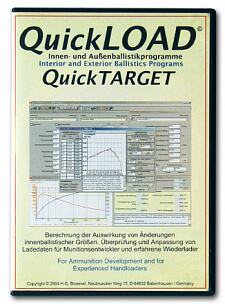
QuickLOAD and QuickTARGET Ballistic software are sold exclusively by Neconos.com. The latest version 3.2 costs $149.95 plus S/H. Click HERE for a full product description, and be sure to read our QuickLOAD Review and Users Guide.
May 15th, 2007
 Gary Eliseo of Competition Shooting Stuff, has come up with a cool new product for prone and F-Class shooters–a complete wind station (with digital display), that mounts on a spotting scope stand. It provides a constant, real-time output of wind velocity with an indicator of wind direction. At the top of the stand, a spinner measures velocity and sends its readings via wire to a remote display. A balanced plastic wind vane shows the wind angle. This is clamp-mounted so you can adjust the vane’s height–low for easy viewing, or high to avoid “ground effect” variations.
A small digital display clips on to the front bell of your spotting scope so you can see wind velocity without changing your shooting position. The display also has a stopwatch function. Gary tells us his Vortex 1200 anemometer is great for prone or smallbore competitors or team coaches. The unit offers 0.5 mph resultion and the battery should last up to one year according to Gary. A tripod mounted version of the shooter’s wind station is also available for benchrest shooters. This mounts to any camera tripod.
Note: Shooters should check competition rules for their discipline to see if this wind station can be used during actual matches. See comments. If match rules prohibit such devices, the wind station is still a valuable tool for practice days between matches.


May 14th, 2007
Top Silhouette shooter Mark Pharr has developed a pair of advanced silhouette stocks, suitable for both centerfire and rimfire competition. There is a full-forend R/T model for those who prefer to rest the forearm on the palm of their hand or fingertips. Mark has also created an innovative narrow-forend R/T-S model for shooters who prefer a “split-finger” hold.
Mark sent us photos of the handsome stocks, built by Robertson Composites in Canada. Mark notes: “A full range of colors is available, including granites and fades. You can go to Robertson’s website or a print shop to view a pantone ink chart and send me the numbers of the colors you pick. The stocks are made with black carbon fiber and will be harder to cover the seam on the bottom of stock with the light colors so please keep that in mind. A base color and one granite color is $285 for a flat top (non-inletted). Two-color granites (my favorites) are $30 extra. There are two different fades. A true fade has the solid color in the forend on the bottom, and costs an extra $60, while a granite fade is available for the base $285 price. We can do a camo dip now or texture paint for an additional $80. Go to BellandCarson.com to see the camo/texture finishes.

For more information, contact Mark Pharr at Tumbleweeds Custom Rifles, (512) 246-7563. Mark also smiths custom silhouette and precision rifles, both rimfire and centerfire. You can also order Pharr/Robertson stocks and other silhouette gear from Chicken’s Shooting Supply.
May 11th, 2007
Premium front pedestal rests for “pure” Benchrest competition keep getting bigger and heavier. The Farley Co-Ax, SEB Rest, and John Loh rest are impressively massive. That’s a good thing when you need maximum stability, but varminters and field shooters may be willing to sacrifice a little stability for a handier, more portable front rest.
There are a variety of relatively inexpensive light-weight front rests on the market, such as the Shooters Ridge Steady Point , but frankly, their controls leave much to be desired, and the rest tops tend to be flimsy or wobbly. On this writer’s personal “high-mileage” old-model blue Midway rest, the rest top had to be epoxied to the elevation post to eliminate annoying wobble.

Sinclair Int’l has a new front rest that offers high-quality controls and stout construction in a light-weight (6-pound) format. The components are strong and rust-resistant: machined billet aluminum body, stainless steel mariner handwheel, stainless steel center post, and stainless steel leg screws. The legs are low and straight–this is good when you want to place conventional sandbags on the legs for extra stability. Sandbags lay nice and flat when draped over the legs of the rest.
Sinclair tells us: “We have had numerous requests to produce a high-quality lightweight shooting rest for shooters needing more portability. Varmint shooters, hunters, and F-Class shooters have all been asking for a quality-built lightweight rest. Our latest Sinclair rifle rest weighs under 6 lbs. with top and filled bag. Our larger Sinclair rests weigh over 17 lbs. in comparison. We also had customers asking us for a more economical rest with the same Sinclair quality we put into all of our rests.” The Sinclair lightweight front rest costs $119.00 with basic top, or $147.00 with either multi-purpose top (shown in photo), or RT-3 top (for sporter fore-ends.)
May 10th, 2007
Robert Whitley provides this report on Lapua’s new factory-loaded 6.5×47 ammunition:
Lapua (through Grafs.com) sent me some 6.5×47 factory ammo to test out. Recently, I’ve tested it for velocity and accuracy in my MAK repeater Tube Gun (with 1:8.5″ Brux barrel). I can affirm this ammo is outstanding.
Chrono Testing:
100 gr BTHP Scenar, 2846 fps, ES 54, SD 21 (Very mild)
108 gr BTHP Scenar, 3020 fps, ES 12, SD 5
123 gr BTHP Scenar, 2903 fps, ES 11, SD 5
139 gr BTHP Scenar, 2780 fps, ES 25, SD 9
The two bullets that I feel are best for the 6.5×47 Lapua are the 108 and the 123 Scenar. They both gave excellent velocity and chrono numbers, as well as excellent accuracy. With the 139s running close to 2800 fps, that’s a lot of velocity for that big of a bullet in that small of a case. The picture below shows the four different loadings. Left to Right, the 100 gr BTHP Scenar, the 108 gr BTHP Scenar, the 123 gr BTHP Scenar, and the 139 gr BTHP Scenar.

Accuracy Testing:
After the chrono testing, I shot one 10-shot test group (prone with sling and scope) using the Lapua 123gr factory ammo. This produced a 10X clean. For factory ammo, it does not get any better than this! At 2903 fps with an ES of 11 and an SD of 5, this is great. When I can shoot a group like that prone with sling, it tells me the gun is shooting better than 0.5 MOA.

Powder Inspection:
I pulled down some rounds for inspection and measuring. Here’s what I found:
100gr Scenar Ammo: OAL 2.728″, 29.3 gr. of powder
139gr Scenar Ammo: OAL 2.728″, 35.8 gr. of powder
123gr Scenar Ammo: OAL 2.725″, 36.1 gr. of powder
108gr Scenar Ammo: OAL 2.719″, 34.2 gr. of powder
I am not sure what powders Lapua is using in the ammo. The powder in the 100gr and 108gr ammo had a finer grain than that used in the 123gr and 139gr ammo. All of the ammo, from 100 to 139 grains, worked well in my chamber, which was cut with the .160″ freebore reamer listed on the 6mmHOT.com website. The 100gr bullets need to jump a fair amount, but the others only jump around .015″.

|


