|
|
July 13th, 2007
Here’s a smart, simple item that will come in handy during hot summer weather. The Solarstop elastic hatband will fit over the crown of any baseball-style cap. (Yep, you’ve probably got dozens of baseball caps, right?). The draped fabric provides 30+ UPF protection for your neck and ears. When things heat up, dunk the soft microfiber fabric in the water for relief–it cools you down fast and dries quickly.

 This smart accessory is sold by Cabelas.com, CampMor.com, and Great Outdoors Depot, for $9 to $12.00. Campmor also offers the similar “Sunday Afternoons Solarweave Cap Curtain”, featuring 50+ UPF quick-drying supplex nylon that blocks 97% of UVA and UVB rays. The Cap Curtain features decorative webbing in the front with a velcro sizing adjuster in the back.
These designs are simple enough that anyone with basic sewing skills could make their own cap-top neck drape in a few minutes. (If the wife has a sewing machine this would be a snap). If you make your own unit, be sure to use sun-blocking fabric. Plain cotton or polyester won’t work as well. UV protection is key.
[Editor’s Note: Why, you may ask, am I recommending this somewhat goofy-looking product, and why have I featured sunhats previously in the Bulletin? Well, the risk of skin cancer is very, very real. I was at the dermatologist yesterday, and my Doctor removed two small “anomalies”. And I had a basel cell carcinoma removed two years ago. Trust me, sunscreen and ear/neck protection is a lot cheaper than going to the doctor. Folks who spend much time in the sun really need to watch this stuff–get yourself examined every year. I have a family member who would be dead right now if a melanoma wasn’t caught very early in the game. Enough said–protect your skin and live longer.]
July 3rd, 2007
Sinclair Int’l has a new product that can make your front rest more secure, and easier to level on a bench. The Sinclair Superfeet, item 04-190, are 2″-diameter stainless disks with a layer of neoprene on the bottom side. The top dimple holds the rest foot point with no wobble, and the neoprene underside is secure on bench surfaces of concrete, wood or glaze-coated concrete. Your rest won’t shift or slide when you push the rifle forward. Sinclair tells us “With the Superfeet, you don’t need to hammer the rest screws into the bench top. And most shooters find that their speedscrews or elevation cams work better with Superfeet”. Sinclair’s Superfeet come in a set of three for $19.95.

The Sinclair design is similar to the Match Superfeet created by Dave Dohrmann. Dave’s Match Superfeet are also 2″-diameter stainless disks with neoprene on the bottom. But Dave’s Match Superfeet also have spring attachments, which connect the feet to the rest. This makes it easier to pick up the entire rest and reposition it. The spring attachments also ensure that the system is completely legal in IR 50/50, NBRSA and IBS Competition. A set with 3 discs and 3 spring retainers is $29.95, while a set with 3 discs and 2 retainers is $27.95. Contact Dave at (864) 884-0155 or via email dbugholes [at] aol [dot] com to order his Match Superfeet.

July 1st, 2007
 Germany’s Werner Mehl is the talented engineer who created the PVM-21 infrared chronograph, in many respects the most sophisticated ballistic speed-measuring system currently available to the general public. Werner runs a company, Kurzzeitmesstechnik, which specializes in high-tech ballistic measuring systems and ultra-high-speed photography. Werner has engineered camera and lighting systems that can literally track a bullet in flight, millimeter by millimeter, with eye-popping resolution. Werner employs digital cameras that record up to 1 million frames per second, with effective shutter speeds as fast as 1.5 nano-seconds. The videos produced by Werner’s systems are amazing. Below are two short samples. The first shows a 7mm bullet penetrating cardboard. Note you can clearly see the engraving of the rifling on the bullet. CLICK HERE to watch VIDEO. (Right click and “save as” to download video.)

The second sample shows a lead 22LR bullet hitting a steel silhouette and disintegrating. Below is a low-frame-count version (for quicker page-load). But CLICK HERE to watch the full 1.9 megabyte version with a higher frame rate. It is much more impressive, as it reveals the complete bullet disintegration in great detail.

To view more videos and learn more about the impressive PVM-21 chronograph, visit Kurzzeit.com. More of Werner’s high-speed gun videos can be accessed via this LINK. In the USA, Werner’s PVM-21 chonograph, which works even in complete darkness, is sold by Neconos.com. The PVM-21 offers a unique combination of compact size and superior performance. It even comes with a TV-style remote control and a complete software package allowing you to track PVM-21 chrono data with a personal computer.
July 1st, 2007
Every precision reloader should have a quality tool for measuring case-neck wall thickness. This is essential for those who turn necks–to check the results of your turning. Even if you prefer no-turn necks, a case neck gauge lets you check your neck dimensions and sort cases by neck wall thickness and uniformity. Consistent neck tension is critical for accuracy–but without uniform neck-wall thickness neck tension is hard to control. The new Redding Case Neck Gauge, released in late April, has many notable features. First, it has an integral base. This can be screwed to a bench-top, placed in a vise, or simply held in place with a clamp.

The pilots are stainless steel with a smart design. First, on the inboard end, the pilot is slightly under-cut so it doesn’t give a false reading based on slight imperfections in the case mouth. On the other end, there is a step-down (i.e. reduced radius). This provides extra clearance around the neck-shoulder junction, where a doughnut may exist.
 With this “smart shape”, the pilot ensures you are getting accurate read-outs of the critical area of the neck-wall. The pilot also rides on a shaft with pins on each end that fit in the case flashhole. This keeps the case centured on the pilot. The Redding Case Neck Gauge (item 26400) ships with two pilot stops, #06121, for .22 caliber and #06130, for .30 caliber. If you use this with a 6mm you’ll need to order pilot #06122 for BR style small flashholes, or pilot #06124 for large flashholes (e.g. with 243 Win brass). The new Redding Case Neck Gauge is available from Grafs.com, Midsouth Shooters Supply, and other vendors for about $65.00, including .001″ dial indicator.
June 29th, 2007
At the request of Larry Bartholome, current member and former captain of the U.S. F-Class team, Butch Lambert of Shadetree Engineering & Accuracy (S.E.A.), has designed and fabricated a lightweight yet stable front rest prototype. Larry wanted a unit that was less burdensome to haul between firing lines than the typical cast-iron or “heavy metal” front pedestal. If all goes well, the new aluminum Lambert design will replace the rest shown in the photo below. (That’s Larry with his spectacular “Captain America” Shehane red, white, and blue MBR Tracker stock.)

Other than the steel center hub, the rest is built from aircraft-grade 6061 T-6 aluminum, which can be TIG-welded and hard-anodized. To keep weight down, the three horizontal legs are hollow tubes with flutes or slots milled top and bottom. Butch sent us these photos of the new rest, noting: “It weighs 2.25 lbs without the top. I set one of our unfinished rest tops on it. I moved the back leg to the front to get it out of the way. Larry is ‘wrong handed’, so I made it left-handed. I hope to get it TIG-welded together next week and plated. It is definitely easy to lug around, but I do consider it too light for benchrest shooting. For F-Class, under a 22-lb rifle, Larry believes it should work well.”


June 24th, 2007
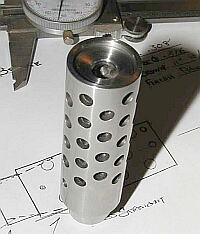 We love the recoil reduction we get from muzzle brakes, but we don’t like the added noise and blast. And we’d rather not blow dust and dirt at our neighbors on the firing line. Chris Spera (Cowpuncher) of CP Muzzlebrakes has the answer to that–a brake that can be “turned off” with a simple twist of the brake housing. When the ports on the sleeve are aligned with the ports on inner section tube it works like any other muzzle brake. When the outer sleeve is turned 36°, this blocks the ports on the tube. That shuts off the brake, dramatically reducing the noise/blast it produces. CP Muzzlebrakes offers an unique and very precisely-machined product. Each brake is custom-fitted to the rifle, and Chris builds both straight and tapered versions, for $180.00 (blued or black finish). Stainless brakes, either straight or tapered, are $220.00.
Jody Calhoun of SavageShooters.com tested one of the brakes, and gave it high marks: “The effect it had on recoil was very noticeable. [My 30-06] performed very much like a medium load .308. Needless to say, I was impressed. I also liked the way it has the detent ball that allows you to go from “ON” to “OFF” in a split second without even looking. The brake stayed in position until I moved it. Operation is smooth with no slack between parts. It does have that typical muzzle brake flash and noise. Fortunately, its ports are angled in a much better fashion than most other brakes, making it less offensive[.]”

June 18th, 2007
Here’s an excellent product for the home gunsmith at a good price. Now through the end of June, MidwayUSA has the DPMS AR15 Upper Receiver Holding Fixture on sale for $30.00–twenty bucks off the regular price. This precisely-milled Delrin unit holds an AR15 upper securely during smithing or cleaning operations, without denting or scratching the surface. Just put the Holding Fixture (Midway item #730930) in a bench vise, pop in the pins front and rear, and you’re good to go. While designed primarily for assembly/disassembly, the fixture is also ideal for cleaning AR15 uppers. Here’s a user review by C. Ogle of California: “The DPMS Upper receiver holder works perfect. It is well-designed and very easy to use. It held the receiver in very sturdy with no play or wiggle. You can have piece of mind using this product and not worry about damaging your receiver while torquing down your barrel.”

June 16th, 2007
Sinclair Int’l now sells the Tubb Shooting Hat, in three colors, Tan (#47-900), Green (#47-925), and Blue (#47-950). Designed by 11-time Nat’l Highpower Champ David Tubb, this $29.50 product has many features that benefit prone and position shooters. Large, folding panels on either side of the brim block unwanted light and glare. In the rear, an extended flap protects your neck from sun (and hot brass from other shooters). The crown, which can be adjusted to any head size, features an integral sweatband, and mesh vent panels on both sides for cooling.


When you consider the money Highpower shooters invest in rifles, sights, and ammo, not to mention the costs of attending major matches, it makes sense to purchase a hat of this type. Side shades definitely help when using iron sights, and this hat will protect you from blazing summer sun.
June 7th, 2007
Forum member Robert S. recently acquired one of the new Denny Phillips cleaning rods to use for his 22-caliber rifle. We’ve noticed that many of the rods sold for 22s and 20s are very flexy and can easily take a “set” or slight bend in the middle. A bent rod can drag on the rifling. You don’t have to worry about that with the Phillips rod according to Robert.
Robert says he is very impressed with the Phillips rod: “It’s nice and stiff, straight, and very well polished. I’ve really grown to like these nice slim handles and this one also turns very easily. It almost makes me want to clean my .22–well, not really.” Denny is charging $30.00 plus actual shipping for these rods. That’s cheaper than many of the commercial brands. You can contact Denny via email: denphillips2 at earthlink dot net.
Rod-maker Phillips reports: “Lengths over 44″ are additional. The stock that I have right now is the .156, .1875, .1925, and .2035. I can put 8-32 threads in everything but the .156, it has to have 5-40. The .187 stuff is what is hot right now. I am working on some harder stuff than what I have, but that will be later on. If you would like to order, let me know the length, diameter, and rod end you want (threads or jag).”

June 5th, 2007
Robertson Composites today unveiled final production CAD-CAM drawings of its new MK IV “GBF” F-Class stock. According to Ian Robertson, “this new design evolved with considerable input from the British F-Class team, hence the ‘GBF’ name. We’ve refined the grip area, and the fore-end is completely new, with a stepped design for a lower center of gravity and improved tracking. The front of the fore-end is also relieved on the underside. This effectively lets the stock run on two integral rails. We’ve learned that this also improves tracking and reduces rocking since the stock doesn’t contact the hump in the middle of the front sandbag.” Click for BIG PHOTOs.

Stocks intended for F-Class shooters will have a solid, high-strength fore-end fill for increased rigidity, improved balance, and to eliminate the need to add external weight to bring guns up to the 22-lb (10 kg) F-Class Open weight limit. However, Ian noted, the stock can also be built lighter to “make weight” in 16.5-lb and 17-lb benchrest classes.


Ian expects the first completed “GBF” stocks to ship within three weeks. The price of the stock will be $799.00 US through July 4, 2007 as a promotion for AccurateShooter.com readers. After that, the price will be $825.00 US. As delivered the stock includes the following:
- Two-color high-grade gelcoat finish (customer choice of colors including granite).
– Full inletting for Rem-style actions and most popular custom actions.
– 3-way adjustable buttplate and pad, installed with all hardware.
– Adjustable integral cheek-piece, with magnetic clamp and all hardware.
If you want one of the new Robertson MK IV F-Class stocks, call Ian soon at 1 + (613) 228-7543. Robertson Composites already has numerous advance orders for this outstanding new stock.
Click HERE for large PHOTOS.
|


