This Gun Digest book has become a “go-to” resource for NRL22 and PRS Rimfire (RF) shooters. Key topics included in this 2021 Edition full-color Gun Digest book include: rimfire semi-autos and how they work; bolt-action accuracy; match shooting skills; DIY precision gunsmithing; hunting with rimfires; and the future of the rimfire market.
With the growth of rimfire tactical competition, the .22-Caliber rimfire rifle is more popular than ever. Every major gun manufacturer has brought at least one new .22 LR rimfire rifle to the market in the last two years. Gun Digest’s Rimfire Revolution has extensive coverage of new models from major manufacturers.
The .22 Long Rifle (.22 LR) is the planet’s most popular ammunition type and firearm chambering. The .22 LR is used in the Olympics by 3P marksmen, but it also serves benchrest competitors, NRL22 shooters, backyard plinkers, small-game hunters, and tactical trainers. With the expansion of NRL22 matches (and the PRS equivalent), the humble .22 LR is undergoing a major resurgence in the USA. And with centerfire reloading components being so costly and difficult to find, many folks are shooting less centerfire, but way more rimfire.
This 272-page book also covers .17-caliber rimfire cartridges: 17 HM2 (Mach 2), 17 HMR, and 17 WSM. These are all excellent varmint rounds, with the 17 WSM effective out to 250 yards. The 17 HM2 will run in a normal .22 LR action and feed from standard .22 LR magazines. So, for most rifles, all you need to do a .22 LR to 17 HM2 conversion is a barrel switch. That gives your rimfire rig twice the versatility. Shoot .22s and .17s with the same gun.
NRL22 — Challenging Practical Competition with .22 LR Rifles
The USA has seen a big growth in rimfire tactical matches over the last five years. Right now there are probably ten times as many rimfire tactical matches as sanctioned PRS and NRL centerfire matches. The reason is simple — rimfire ammo is much less costly, and clubs can run challenging rimfire tactical matches at nearly any outdoor gun range that allows shooting out to 200+ yards.
NRL22 Competition — Tactical Rimfire Matches
The NRL22 match format is a great shooting discipline. NRL22 offers a high fun factor at relatively low cost. You don’t have to reload match ammo. A couple of 50-round boxes of .22 LR ammo will get you through the match. While some people bring lots of gear to matches, that’s by choice and not by necessity. You can keep it simple and still be competitive (and win).
Tips for NRL22 Competitors by Jonathan Ocab
I am a match director at my gun club and run our local NRL22 matches. People often ask me for tips for competing in NRL22. First, I recommend getting the course of fire for the month in advance and practicing those stages at the range. Here are other specific tips that should help NRL22 competitors improve their gun-handling and match results.
1. Dry Fire Practice — If you are not able to do live fire practice at the range, I encourage shooters to practice their shooting positions at home via dry fire. Setup props or barricades with pasters or other faux targets on a wall in the garage or inside the house and run through each stage.
2. Scope Magnification Level — The most common issue I see with newer shooters in NRL22 is the tendency to maximize their scope magnification. The timer will start, and the shooter gets into position on a target, but the scope is set to 15x or higher and the shooter can’t find the target. The shooter lowers the magnification, locates the target, and then increases the magnification again, takes the shot, transitions to another target, and repeats the process of decreasing magnification, locating target, etc. Novice NRL22 shooters should try using the mid-range magnification. Try shooting 7x-12x and learn to balance field of view and target image.
At the request of our readers, we provide select “Deals of the Week”. Every Sunday afternoon or Monday morning we offer our Best Bargain selections. Here are some of the best deals on firearms, hardware, reloading components, optics, and shooting accessories. Be aware that sale prices are subject to change, and once clearance inventory is sold, it’s gone for good. You snooze you lose.
NOTE: All listed products are for sale to persons 18 years of age or older. No products are intended for use by minors.
1. Natchez — Hodgdon H4350 and Varget On Sale
⏺️ Get popular H4350 and Varget powders now in stock
Hodgdon powders are top choices for many shooting disciplines, offering great accuracy, good velocity, and consistently low ES/SD. Consequently many of the most popular Hodgdon powders have been hard to find. But right now H4350 and Varget are in stock and on sale at Natchez. Get Varget one-pounders, and choose 1-lb or 8-lb jugs of H4350. Plus Hodgdon H4198 is also available now at Natchez. Stock up now while these popular powders are available.
2. Graf & Sons — ATN Optics Sale
⏺️ Good prices on night vision scopes, binocs and other products
Have you been considering a night vision scope but not sure where to start? Check out the ATN Optics Sale where you can find a wide range of night vision scopes, binoculars, and IR units all on sale. Grab one now and head out and learn why legal night hunting has become so popular.
3. Creedmoor Sports — Starline Brass Sale
⏺️ Starline makes great pistol brass and good value rifle brass
Starline Brass is high-quality yet affordably priced. We have had great luck with Starline pistol brass and the rifle brass is consistent and very affordable. Currently Creedmoor Sports has a big inventory of Starline pistol and rifle brass. Starline brass is quality, SAAMI spec with the ability to be reloaded many times.
4. Amazon — Derraco PCPS Priming Tool, $199.95
⏺️ Innovative precision priming tool mounts to press
Turn your 7/8-14 standard single-stage reloading press into a precision priming system with the Derraco PCPS Precision Priming die/Primer Seating Tool (#ad). This advanced tool is compatible with any reloading press that accommodates 7/8-14 reloading dies and standard T-shaped shell holders. For a wide variety of single-stage presses, this unique precision priming tool will consistently deliver high-precision results thanks to the precision adjuster and micrometer hard stop.
5. Natchez — Leupold Optics Sale
⏺️ Good prices on Leupold scopes, binoculars, and Red Dot sights
Leupold has long been a leading American optics maker, and Leupold offers great customer service and a fantastic lifetime warranty on scopes. If you need a new scope or binoculars, check out the Leupold Optics Sale at Natchez. A wide selection of Leupold scopes and binoculars are discounted 15% or more, while Red Dot and Reflex optics are $100 off. Plus, with this Leupold Sale, Natchez is offering FREE Shipping.
6. Sportsman’s WH — Bergara B-14 Hunter 6.5 CM, $659.97
⏺️ Nice, affordable deer rifle with good camo stock
If you need a new hunting rifle consider the Bergara B-14 Hunter in 6.5 Creedmoor. The B-14 Hunter features a molded synthetic stock made of glass fiber reinforced polymer. As with the entire B-14 Series, the Hunter model delivers impressive function and accuracy with an attractive price that will appeal to serious big-game hunters. Made in Spain, this rifle delivers excellent quality and performance for the under-$700 price.
7. Amazon — Plano 52″ Wheeled Rustrictor Case, $193.47
⏺️ Excellent big weather-proof case with wheels for easy movement
When traveling by air or in a vehicle, having a quality rifle case keeps your rifle and optics safe and secure. A great option is the Plano All Weather Rustrictor Tactical Gun Case(#ad). This rugged rifle case’s Rustrictor technology protects firearms against rust and corrosion caused by moisture or humidity. A VCI-infused resin and foam emitter blocks rust and corrosion 5x longer than competing products and the TSA rating means you can take it anywhere safely and securely.
⏺️ With Crimson Trace Scopes Get FREE Rest and FREE Shipping
This is a nice promo. The Crimson Trace scopes are on sale PLUS you get FREE Shipping. These scopes offer great value for the price. And here’s the real bonus — you get a handy shooting rest. Use the full Caldwell rest for for long guns. Or, for pistol shooting separate the rest and use just the front section. The Caldwell Steady Rest NXT MSRP is $37.99.
9. Amazon — Digital Trigger Pull Gauge, $17.99
⏺️ Cool sub-$20 tool that works really well — great buy
The Pridefend Professional Digital Trigger Pull Gauge (#ad) offers great performance for a very low price. We’ve used this “smart” pull gauge with success on match rifle triggers. This gauge measures in 1 oz. increments from 0 to 12 pounds. The gauge display is easy to read and you can choose ounce, pound, or Kg units. Though it costs just $17.99, this digital gauge offers better consistency than many conventional spring-type gauges. Plus, when you do a sequence of multiple pull tests on one gun, the unit automatically calculates maximum, minimum, and average pull weights.
10. Amazon — Lyman BrassSmith Funnel with Inserts, $31.99
⏺️ Very useful kit we use — avoids powder spills
Having a good powder funnel really helps precision reloading. The Lyman Products Brass Smith Pro Powder Funnel System (#ad) is a great little system. Unlike plastic powder funnels, the aluminum DIE cast body and CNC-turned aluminum caliber-specific inserts are static-free to eliminate powder cling. The precision fit to your case necks eliminates spilled powder. The kit includes six laser-marked, caliber-specific aluminum inserts to fit calibers 22 to 338: .22, .243/6mm, .25/6.5mm, .270/7mm, .30, and .338. The inserts can be quickly and easily interchanged when changing cartridge types.
As an Amazon affiliate, this site can earn revenues through sales commissions.
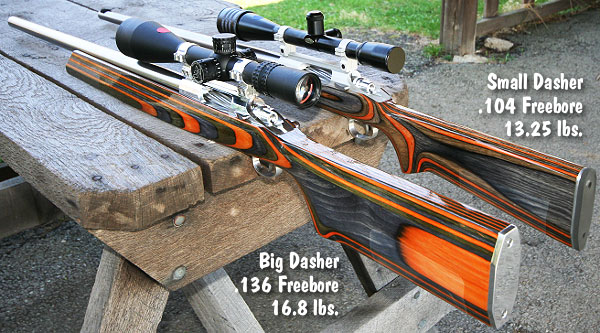
The 6mm Dasher wildcat cartridge is very popular among competitive benchrest shooters, varminters, and even PRS competitors. So this Sunday we thought we’d showcase a matched Duo of Dasher rifles belonging to a Forum member Chuck L. (aka “Ridgeway”). The 6mm Dasher began as a wildcat improved version of the 6mmBR Norma cartridge. The Dasher has been very successful in competition, and now factory Peterson 6mm Dasher brass is sold by Grafs.com. And Alpha Munitions also offers high-quality 6mm Dasher cartridge brass.
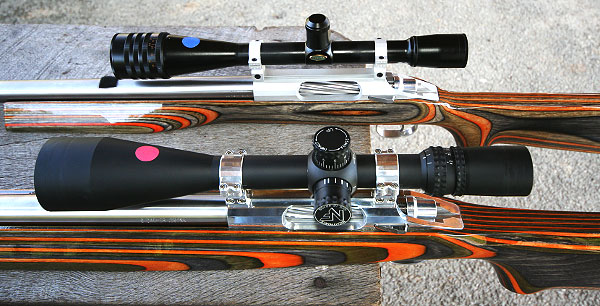
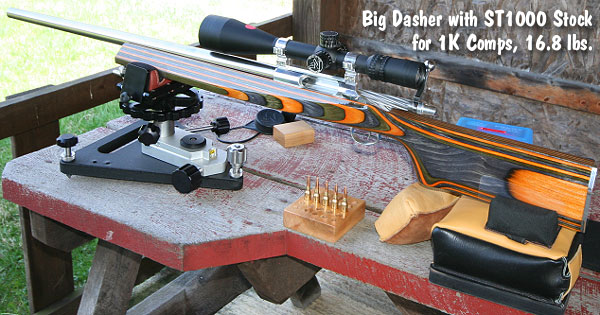
Chuck has a prize pair of 6mm Dashers for competitive benchrest and varmint matches in Pennsylvania. Both guns feature Kelbly Panda RBLP actions, Bartlein 8-twist barrels, and Shehane Laminated Tracker Stocks. However, the two rifles are not exact twins, as you can see. One, which we’ll call the Big Dasher, is built on a Shehane ST1000 Tracker stock. The other gun, the Small Dasher, sports Shehane’s “Baby Tracker” stock — a design used with great success by Richard Schatz. The Big Dasher, optimized for 1000-yard competition, has a slightly longer freebore — 0.136″ vs. 0.104″ for the Small Dasher.
Specifications for the Dasher Duo:
Small Dasher (13.5-pounder): Chambered for 6mm Dasher with approximately .104 freebore and a .264 NK. (No way of knowing exactly since its freebore was set in a separate operation by Kelbly.) Components are: Shehane Baby Tracker laminated stock, Kelbly Panda RPLB action, Bartlein 1:8″ LV barrel at 26 ¾”, Kelbly Rings, Weaver T36, Jewell trigger. The barrel was chambered by Kelblys and the stock was bedded, glued and balanced by a shooting buddy (Forum Member johara1). Chuck clear-coated the stock with auto urethane. Total weight is 13 lbs., 4 ounces.
Big Dasher (1K Light Gun, 17-pounder): Chambered for 6mm Dasher with a .136 freebore and .264 neck (PTG Reamer). Components are: Shehane ST-1000 laminated stock, Kelbly Panda RPLB action, Bartlein 1:8″ HV 5R barrel at 28″, Shehane +20-MOA rings, Nightforce NXS 12-42x56mm, Jewell trigger. The barrel work, pillar installation, and bedding was done by Dave Bruno. The stock was clear-coated by Chuck with auto urethane. Chuck also made the rear butt plate and balanced the rifle. Total weight: 16 lbs., 13 ounces.
Chuck tells us: “I don’t get out shooting competition as much as I want due to time and family, but when I do compete, I shoot a Groundhog match at Southfork Rifle Club in Beaverdale, PA. Info on Southfork Club events can be found at Southforkrifleclub.com. The Southfork match is basically a 100-, 300- and 500-yard match with one sighter the entire match and 5 shots at each yardage for score. The Small Dasher, with the shorter ‘Baby Tracker’ stock, was set up for the Southfork Rifle Club’s ‘Light Unlimited’ class which has a 13.5-lb max weight.” (Editor: ‘unlimited’ is a misnomer for a weight-limited category.)
Chuck adds: “The Big Dasher with the heavy ST-1000 stock is set up for 1000-yard benchrest matches in Light Gun class. I shoot 1K matches with it at Reade Range in southwest Pennsylvania. One ironic thing is, it shoots the same load I’m shooting out of the lighter gun rather well. The only difference between the two chambers is the freebore is roughly thirty thousandths longer on the 1K gun (Large Dasher). I will also shoot this at Southfork in the ‘Heavy Unlimited’ class.”
Both Dashers Group in the Ones at 100 Yards
Chuck favors 107gr Sierra MK bullets in both Dashers. Other components are: Reloder 15 powder, Lapua cases, and CCI 450 primers. His main load for the Small Dasher is 33.0 grains of Reloder 15. This load shoots in the ones at 100 yards. For the Big Dasher Chuck reported: “I’m still working on a load, although the same 33.0 grain load shoots in the ones in the heavier gun as well. I’m still looking for more velocity and my ‘max’ node.”
Dasher Brass — Four Options
1. Buy Peterson 6mm Dasher Brass
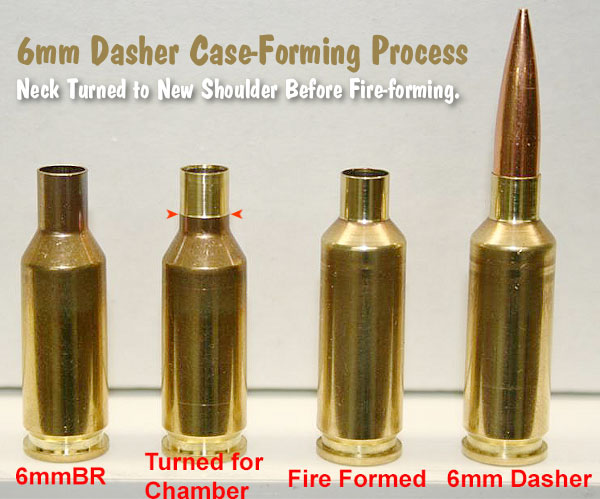
In years past, you had to create your own Dasher brass, by fire-forming (with or without projectiles), or by hydro-forming. However, Peterson Cartridge now offers quality factory-made 6mm Dasher brass. This brass is available right now at Grafs.com.
If you do not want to waste time with fire-forming or hydro-forming, you can look for Peterson 6mm Dasher brass. This is excellent quality brass that has earned high praise from purchasers. The price — $62.99 for 50 cases at Graf’s (i.e. $1.26 per case) — is less than what you’d pay for Lapua 6mmBR brass, which is $143.28 for 100 cases or $1.43 per case. The advantage is that you save time, barrel life, and you won’t lose any cases to split necks. Peterson brass can be ordered from Grafs.com.
2. Buy Alpha Munitions 6mm Dasher Brass
Another great source for ready-to-run 6mm Dasher cartridge brass is Alpha Munitions. The made-in-USA Alpha 6mm Dasher brass is long-lasting and has been very popular with Benchrest and PRS/NRL competitors. Alpha 6mm Dasher brass costs $135.00 per hundred, or $1.35 per case. Unfortunately, as of 2/23/2025, this Alpha 6mm Dasher brass is out of stock, but it should be available later this spring.
One tip — as the capacity may vary slightly from Lapua 6mmBR brass fire-formed to 6mm Dasher, you should work up your load. Also, if you are chambering a new barrel you should get a chamber reamer that is optimized for the Alpha 6mm Dasher brass dimensions. User reviews of the Alpha 6mm Dasher brass have been highly positive: “Fantastic packaging and fantastic brass! It’s pricier than some other brands but there is a reason for that. It’s a quality product worth every penny.” — Chris Vaughn.
3. Fire-Form Dasher Brass with Bullets Hard in Lands
Chuck fireforms his Dasher brass for both rifles. Because he has a tighter-neck chamber, he neck-turns the brass first: “To fireform, I turn my cases down to fit the chamber and stop where the false shoulder makes snug contact with the chamber. Fire-forming rounds are loaded up with a 29-grain charge of H4895 or Varget and a 108gr Berger bullet seated hard into the lands about 0.020″ past initial contact with the rifling. It takes about three firings to make a nice clean Dasher case with a sharp shoulder.”
Chuck anneals his Dasher brass regularly to help maintain consistency: “I anneal about every 3-4 firings. I have many cases that have about 10+ firings on them and they are still shooting well. The primer pockets are a little looser, but still hold a primer.”
4. Have Darrell Jones Hydro-Form Your 6BR Brass to 6mm Dasher
DJ’s Brass can hydro-form a wide variety of cases for a modest fee
Fire-forming all your own 6mm Dasher brass takes time, costs money (in bullets and powder), and consumes precious barrel life. Well there IS a better solution — you can have your new brass hydro-formed by DJ’s Brass to your exact specifications for a $60.00 per hundred, which includes annealing.
DJ’s Brass Service now offers custom case hydro-forming to your exact specs. Darrell Jones offers this service for a variety of popular cartridges: 6 PPC, 30 PPC, 30 BR, 6 BRA (BR Ackley), 6mm Grinch, 6 BRDX, 6 BRX, .260 Ackley, .284 Shehane and of course the very popular 6mm Dasher. After hydro-forming your brass, Darrell can also neck-up or neck-down the cases to meet your needs. He can also turn the necks to your specs for an additional $0.60 per case.
Editor: Many new barrels will deliver higher velocities with the same load after 100-150 rounds through the bore. The exact reasons for this speed-up are not 100% certain, and velocity increases (if any) will vary from one barrel to the next. But this “speeding up” phenomenon is common, so be prepared if this happens with your next barrel. If you do experience a significant velocity increase you should probably re-tune your load AFTER the velocity stabilizes at the higher level.
From the Sierra Bullets Newsletter Article by Mark Walker, Sierra New Product Development Director
In a previous post, I discussed a couple of methods to tune a load to your barrel to help achieve the best accuracy possible. People most often work on load tuning if they get a new rifle or have a different barrel installed. In both instances, the barrel is new and has not been fired very much. According to most competitive shooters, this is the most accurate your barrel will ever be, so getting it tuned and shooting accurately is a priority.
The Speed Up Phenomenon After 100-150 Rounds
Even though after you work up a load and your new barrel is shooting great, a lot of shooters notice that at around 100 to 150 rounds their rifle may stop shooting as accurately. I had this happen to a rifle and I was confused as to why something that worked so well to begin with would all of a sudden quit shooting. I decided to break out the chronograph to do another load work up to see what was going on. To my surprise, the velocity had increased around 80 fps over the original velocity! After performing another ladder test and adjusting the seating depth, the rifle was once again shooting well.
There are several thoughts on why this may happen, however, you can rest assured that it does happen. One thought is that as the barrel breaks in, the tooling marks in the throat of the chamber smooth out and allow less resistance to the bullet as it exits the bore thereby increasing speed. Another idea is that the throat area starts to get a little rough which in turn causes more resistance which increases pressure and therefore more velocity. I’m sure there are some out there who have a better understanding as to why this happens, but it can definitely affect the accuracy of your rifle. So be aware and never be afraid to rework a load to keep your rifle in tune.
Experts Confirm That Barrel Speed-Up Is Common Two respected shooters have observed an increase in velocity with new barrels, typically after 100 rounds. Gunsmith and Hall-of-Fame benchrest shooter Thomas “Speedy” Gonzalez has documented barrel speed-up with testing. Moreover, Speedy’s bore-scope barrel inspections revealed a smoothing of the barrel lands. Jim See, a top PRS competitor, has encountered barrel speed-up many times. Accordingly, he re-tunes his load at 150 rounds.
“Alex Lipworth and I documented this phenomenon about four years ago and I have told all my customers about this. My son Mikee would shoot 100 rounds through all new barrels we planned on shooting before we would begin to do load development. We had a shooting snail that caught all the bullets set up in front of an indoor bench. We called it a wear-in process because upon careful examination of the bore when the ‘Speed Up’ takes place the cut-rifled bore resembles that more of a button-rifled barrels with the lands taking on more the softer look of a buttoned bore.” — Speedy Gonzalez
“Seen it [barrel velocity increase] too many times to count. All my match barrels get a ‘generic round’ loaded for them, which has worked well in barrels historically. After I hit 150 rounds I fine-tune the load and never look back, until the tube starts to slow down at it’s life end.” — Jim See
With the increase in crime in major cities, home security is more important than ever. A large, heavy conventional safe is still the best way to store your full firearms collection. However, when seconds count, a rapid-access system may be a smart option. Using RFiD technology, and a spring-loaded door, this kind of rapid-access vault lets you instantly get your hands on your primary defensive rifle or shotgun.
For home use, we like this RAPiD Safe AR Gunlocker from Hornady. The spring-loaded door opens instantly when activated by the owner’s personal RFID devices. The AR Gunlocker ($389.99 on Amazon) also has a keypad so you can enter a combination if your RFID “key” is not around. Or you can use the supplied manual barrel-style metal key. Watch the video to see how the system works:
The RAPiD Safe AR Gunlocker RFID safe secures long guns in a steel-walled vault that can be stored in a closet, under a bed, or even in your vehicle. This will hold an AR and a shotgun with foam inserts. There are several options for entry: 1) Radio Frequency IDentification (RFID) tag system; 2) KeyPad; 3) Manual barrel-style metal key.
Provided Access Devices
For the AR Gunlocker, Hornady provides one RFID Wristband, one RFID Key Fob, and two RFID “stickers”. As a secondary entry method, you can program a four- to six-digit security code. Finally, you can use a manual lock if all power fails.
RAPiD Safe AR Gunlocker Specifications:
Exterior: 42″ Wide x 15.25″ Deep x 6.75″ High
Interior: 40.5″ Wide x 13.5″ Deep x 5.5″ High
Weight: 55 pounds
Power: 12-volt DC (with transformer from AC wall outlet) or four (4) AA batteries.
At the request of our readers, we provide select “Deals of the Week”. Every Sunday afternoon or Monday morning we offer our Best Bargain selections. Here are some of the best deals on firearms, hardware, reloading components, optics, and shooting accessories. Be aware that sale prices are subject to change, and once clearance inventory is sold, it’s gone for good. You snooze you lose.
NOTE: All listed products are for sale to persons 18 years of age or older. No products are intended for use by minors.
1. Brownells — President’s Day Sale, 15% Off on Uppers, Lowers, Barreled Actions, Optics, Triggers and more
⏺️ Get 15% off orders of $250+ with code PRES15
You can get major savings on a vast variety of products with Brownell’s President’s Day Sale. If you spend at least $250, you can get 15% off with Code PRES15. This 15% savings applies to thousands of products site-wide on Brownells.com. On top of that 15% savings, many popular items have additional discounts including Crimson Trace Scopes, Geissele Triggers, Bergara Rifles, Colt Revolvers, and SIG Sauer Scopes.
2. Palmetto SA — SAR9T Sport 9mm Pistol, $199.99
⏺️ Save $300 off MSRP on good full-size 9mm pistol
This is a great deal for a modern, reliable 9mm pistol with better ergonomics than a Glock (at 40% of the price). The lightweight polymer-framed, striker-fired SAR9T pistol points naturally and has three interchangeable back straps to customize fit. We like the 20-degree grip angle which points well for most users. This version with 4.4″ barrel is a good choice for personal defense and IDPA-type matches. The listed $199.99 sale price is $300.00 off the original $499.99 MSRP. The slide has two threaded holes that allow an optic to be attached, but it does NOT have a removable plate like some newer pistols.
⏺️ Pre-order new Athlon compact Doppler Radar Chrono for April Delivery
Athlon’s new compact Rangecraft Velocity Pro Radar Chronograph costs $250 less than the popular Garmin Xero C1 Chrono. This new Athlon Chrono employs Doppler radar which offers many advantages. And since the unit is not attached to your rifle, it won’t affect tuning or harmonics. The new Athlon Rangecraft Velocity Pro measures bullet velocities from 65 FPS to 5000 FPS. This Athlon Doppler radar chrono should rival the Garmin chrono at a much lower price — $349.99 at EuroOptic vs. $599.99 for the Garmin Xero C1 Pro. The new Athlon Rangecraft Chrono should arrive in April 2025. You can pre-order now from EuroOptic.
4. MidwayUSA — Burris Fullfield E1 Scopes 30-40% Off
⏺️ Good, very affordable choice for varmint rifles
Here are good, reliable SFP 1/4-MOA scopes for hunting or varmint shooting. And you can get these optics for under $180 — a steal! Choose either the Burris E1 6.5-20x50mm SFP for $179.99 (40% Off) or the slightly smaller Burris Fullfield E1 4.5-14x42mm for $167.99 (30% Off). The 6.5-20X would be best for longer range, while the 4.5-14X would be lighter and more compact for field carry on a game hunting rifle. Both E1 scopes have a 1″ main tube and are protected by the rock-solid Burris “Forever Warranty”.
5. Midsouth — Hornady V-Max Bullet Sale, $19.99/100 and up
⏺️ Great tipped varmint bullet on sale in many sizes/calibers
Hornady makes some of our favorite tipped varmint bullets. These Hornady V-Max projectiles work great on prairie dogs, releasing high energy on impact — creating quite a show compared to ordinary jacketed projectiles. Right now Midsouth is running a big V-Max Bullet Sale with discounts up to 20%. V-Max bullets are offered in a wide range of bullet weights and calibers. Current caliber offerings include: .17, .20, .22, .257, .243 (6mm), .264 (6.5mm), .270, .284 (7mm), and .308. If you’re loading up for a spring varmint hunt, definitely grab some V-Max bullets now at a major discount.
6. Powder Valley — Primers in Stock, Small and Large Rifle
⏺️ Grab some top-quality match-grade primers now — large and small
7. Midsouth — Factory Brass Clearance Sale, Primed & Unprimed
⏺️ Great deals on unprimed pistol brass and primed pistol and rifle brass
Midsouth has great deals on pistol and rifle cartridge brass. Prices start as low as $0.12 per unit for Norma-brand .380 ACP. And there is a large selection of brass already primed — priced less than you might pay for unprimed cases. For example, PRIMED 6.5 Creedmoor brass is now just $61.99 per hundred! Unprimed brass on sale includes: .380 Auto, 9mm Luger (9x19mm), .38 Special, .44 Magnum, .45 ACP. PRIMED brass on sale includes: 9mm Luger, .357 Magnum, .45 ACP, .220 Swift, 6.5 Creedmoor, 6.8 SPC, 300 Blackout, .300 WinMag, and .338 Lapua Magnum. NOTE: Some brass types come with FREE Delivery.
8. Amazon — Caldwell Stable Table Deluxe, $212.99
⏺️ Many positive user reviews — good set-up for varminting and home ranges
Need a good platform for shooting in areas other than organized ranges? Check out the Caldwell Stable Table Deluxe. A bolt in the base allows position adjustment of a single leg, aligning the tabletop so that it is parallel with the horizon. The central shaft, seat, and tabletop are able to pivot (rotate) around a center axis as a single unit while keeping the tabletop parallel to the horizon. This is great for varmint hunting. Owner reviews have been very positive.
9. MidwayUSA — Electronic Muffs with Walkie-Talkie, $59.99
⏺️ Dual-function electronic muffs — great for range communications
Electronic earmuffs protect your hearing while allowing you to hear range commands. With these Walkie-Talkie muffs you also get 2-way communication capabilities. The Walker Razor Slim Low Profile Electronic Earmuffs (NRR 23dB) with Walkie Talkie allows you to communicate with other radios. Range is 2-3 miles with 22 channels. These are now just $59.99 (40% Off). If you don’t need the two-way functionality, you can get Walker’s NRR 23 Razor Slim Electronic Muffs for $33.85 (#ad) — 58% off the list price.
10. Amazon — Scope Turret Magnifying Glass with Level, $12.95
Making rapid, yet precise scope turret adjustments can be challenging, especially during fast, timed stages. Most scope turrets have small, thin markings that can be tough to see (particularly with older eyes). To see your elevation turret markings better, try the Monstrum Scope Turret Magnifying Glass with Level (#ad). This simple but effective tool places a magnifier on the shooter’s side of the turret allowing easy viewing. In addition, this handy unit includes a built-in bubble level to help the shooter avoid canting his rifle.
As an Amazon affiliate, this site can earn revenues through sales commissions.
Spring is coming soon, and that means it’s time to get ready for early varmint season. Here are eight great rifles from our Shooters’ Forum Favorite Varmint Rifles Thread. You’ll see a variety of action types and stock designs, both custom and factory. And we’ve featured a wide range of chamberings, from 17 Fireball up to a .243 Super Rock Chucker (aka 6mm-06). The common factor is serious accuracy. All these rigs are great shooters that have brought smiles to their owners while bringing doom to varmints.
1. Rem 700 in 20-222 — with Birthday Gift Barrel from Dad
This is proof that you don’t have to spend a fortune to have a great varmint rig. Forum member JDS Holler posted: “Here’s my baby, ‘Plain Jane’. I took a $500 birthday check that my Dad gave me, and ordered a great barrel from PacNor, chambered in 20-222. I got busted up in a fall, and had four months down time to accumulate the components to add to my old .222 Rem 700 donor action. I couldn’t be happier with the outcome. That old Bushnell has been replaced by a Vortex Viper, and this rifle just flat shoots.”
2. 6 BRA with Krieger Barrel from Alex Wheeler
Alex Wheeler of Wheeler Accuracy knows a thing or two about accurate rifles, having built many match-winning benchrest rifles. For varmint work he likes the 6 BRA (BR Ackley) wildcat cartridge: “My favorite varmint setup is this 6mm rifle with BAT SV action in a Nesika bay varmint stock with a 1:8″-twist Krieger HV contour barrel chambered for 6 BRA. I like the 6mmBR and variants (Dasher, BRX, 6BRA) with zero freebores.” He gets great results with 55-60 grain Sierras and Noslers with H322 powder: “I shot 55 Sierra Blitzking, 55 Nosler Ballistic Tip, and 60gr Sierra Varminter HP. H322 was the best powder. Jam ‘em 10 thou in the rifling — and of them — and man they were like magic.” Alex also feels the 6mm rifles are easier to tune than 22-caliber varmint rigs and the 6mm barrel throats last longer. He often puts an older 6mm match barrel on a varmint gun and it still holds quarter-MOA.
Alex recommends sticking with a 1:8″-twist even when shooting light 6mm bullets. The extra RPM makes the bullets MUCH more explosive on critters: “I’ve done one 1:13.5″-twist and I’ll never do that again. I’m not kidding, with the 8-twist it’s twice as energetic. It can lift those ground squirrels 20 feet in the air. With the 13.5-twist it’s not half that.”
About the Suppressor — The rifle is wearing a “can” in the photo. However, Alex tells us that he now avoids suppressors for most varmint work: “I didn’t like the suppressor — it put off so much heat that the mirage was terrible. With the heat mirage, after 5-10 shots you couldn’t see. I learned my lesson. I pulled that sucker off after the first time I shot it.”
3. 6mm Dasher in Convertible Laminated Stock
The 6mm Dasher has won many benchest matches, and it’s also an ultra-accurate varminting cartridge. This Dasher belong to Forum member MTLager who posted: “Here’s my baby — 6 Dasher with BAT SV action. First one built. Serial number PT1.” This impressive rig features a tack-driving, 1:8″-twist Brux Heavy Varmint contour barrel. This rig is “Smokin the 75gr V-Maxs” reports MTLager. The stock is very interesting. MTLager explains: “This is a Richard Franklin laminated blank made into a stock by J.T. Barber. It has a 3″-wide fore-end for varmint shooting. But I can change the front to 4″-width and a rear section can be removed.” The angled rear “toe” of the buttstock can be taken off, allowing a flat, straight bottom for benchrest competition.
4. Slick 17 Fireball with BAT Action and Stunning Stock
This rifle is almost too pretty to carry out into the varmint fields. Look at that wood! This handsome small-caliber varminter belongs to Forum member “20 TAC”. Chambered for the 17 Fireball wildcat (.221 Fireball necked down), this rig features a BAT Action, Jewell Trigger, and a custom exhibition-grade walnut stock sporting a true ebony fore-end cap. The checkering is exceptional. Owner 20 Tac report this rig “shoots 20 grain V-Max bullets with H4198 very well.” That’s a Nightforce scope on top.
5. 6mmBR in McMillan Stock with Krieger Barrel
This website stated 17 years ago as 6mmBR.com, so we had to include a classic 6mmBR Norma in today’s varmint rifle line-up. Forum member Powderbrake posted: “Here is my favorite varmint rifle — [a 6BR with] Stiller Predator V RBLP action, bedded in a McMillan stock.” This accurate varminter features a 1:8″-twist 6mm Krieger barrel and Jewell trigger. Up top is a Nightforce NXS 8-32x56mm scope. Below are the owner’s key gear items: Leica Laser-Rangefinding Binoculars, Smartphone with Applied Ballistics software, and Kestrel Weather Meter. Powderbrake told us he recently upgraded to a Model 5700 Kestrel with ballistics software and LiNK. (Editor: The $399.00 Kestrel 5700 has ballistics software, but if you want the full Applied Ballistics suite, order the $699.00 Kestrel 5700 Elite).
6. Efficient 20 Vartarg for Prairie Dog Adventures
The .20 Vartarg is based on the .221 Fireball case, necked down to .204 and slightly modified for extra capacity. This very efficient cartridge offers low recoil and great accuracy. It’s one of our first choices for ground squirrels and P-dogs out to 300 yards. 20 Vartarg here belongs to Forum Member DogBuster, an avid varminter based in Utah. He posted: “If I recall, I had a hot spot in this location — probably kilt 150+ prairie dogs that morning. The hay wagon helped too, offering added elevation.”
7. AR-10 Custom in .243 Winchester
Forum Member Urban Rifleman calls this .243 AR10-platform rifle the “Goblin Killer”. This Gen 2 DPMS rifle features a Craddock Precision Bartlein 1:8″-twist 5R barrel chambered in .243 Winchester with a Tubb assymmetrical muzzle brake. Up front is the unique Tubb Bipod which reduces hop. The buttstock is a Magpul PRS Gen 2. The scope is a Leupold VX-3i LRP 6.5-20x50mm FFP TMR. We’re told this rig “will easily shoot 1/2 MOA, sometimes much smaller”.
Urban Rifleman produces a variety of great gun accessories sold through TheUrbanRiflemanStore.com. That green grip is his Urban Rifleman/Tubb ergonomic grip.
8. Savage 20 BR Varmint Rifle with Hart Barrel
This rifle is owned by Forum member VolDoc. The action is a Savage Dual Port, with an aftermarket Sharp Shooter Supply (SSS) 4 oz. Evolution trigger. The stock is a modified Savage factory unit that has been pillar-bedded. The factory barrel was replaced with a 28″ Hart stainless, 1:9″ twist barrel fitted with a Rayhill muzzle brake. The gun is chambered in 20 BR with a 0.235″ no-turn neck. Kevin Rayhill did the smithing. To provide enough elevation to shoot at 1,000 yards plus, Ray fitted a +20 MOA Bench Source scope base. This +20 rail is very well-crafted, and made especially for the Savage Model 12. VolDoc reports: “The mild recoil of the 20 BR, along with a very good muzzle brake (Rayhill’s design) enables me to spot every hit or miss myself. Kevin also re-contoured the underside of the Savage stock so it tracks straight back on recoil, also making seeing hits easier. My 55gr Berger load with runs about 3590 fps. Varget was very accurate with the 55s.”
The 20 Caliber 1000-Yard Prairie Dog Quest
Making the 1032-Yard Shot with a 20 BR by Dr. John S. (aka “VolDoc”)
Here’s my account of a successful quest for a 20-caliber varmint kill past 1,000 yards. This may be a first — I couldn’t find anyone else with a confirmed 20-Cal Prairie Dog kill at 1000+. Well, folks, I can tell you, hitting a Prairie Dog at 1000 yards isn’t easy — but it IS possible. Here’s how it was done….
Gale-Force Winds and High Temps
At our Prairie Dog Ranch in Colorado, I soon realized my quest was going to be especially difficult because we had 40+ mph winds and 100° heat every day. We had a special place where Birdog and I had made many 1,000-yard+ kills in years past, so I knew the ideal location but needed a small window of opportunity either early morning or late afternoon. Based on past experience, I knew I needed about 21 MOA from my 100-yard zero to get to 1,000 yards. On the first day of the Safari, I shot the 20 BR in the 45 mph brutal winds and heat of 97°. But after about 20 shots, I connected on a dog and lifted him about three feet high. Well, that’s a start.
Winds Subside — Here’s Our Chance …
On the second day of our shoot, I had listened to the early weather forecast, so I knew that there was to be a brief period of light winds early in the morning. We were out on the Colorado prairie at daylight and the conditions were perfect. The sunrise was at my back and we had about a 10 mph tailwind. I looked through my Leica Geovid Rangefinder Binos and the Prairie Dogs were out for breakfast. I quickly ranged the targets and found a group at about 1,050 yards. The technique is to find the dogs, range them, click-up according to your ballistic chart and shoot.
My first shot was very, very close. I added about four clicks up and a couple of clicks left for windage and let another go. That shot threw dirt all over, but the dog didn’t even flinch. This is another good point to remember about long-range Prairie Dog hunting. To be successful, the dogs can’t be too skittish, because if they have been shot at even a few times, they will go down and stay down. So, you should have an agreement with those in your party as to where each member is going to be shooting and respect this boundary. Drive-by shooting style is OK if that’s your thing, it’s just not mine.
Hitting the Mark — Dead Dog at 1032 Yards
On the fourth shot, I saw the dog go belly up and kick its final throws. My quest for the 20-Caliber 1,000-yard Prairie Dog had become a reality. We confirmed the distance with our lasers at 1,032 yards. Our technique for retrieving a dead dog at that range is worth mentioning. When I killed that dog, I left it in the crosshairs of my Nightforce scope. My shooting buddy kept looking through the scope (of my gun) and guided me to the deceased dog using Motorola walkie-talkies.
When I got to the dog I was jubilant. I marked it with my tripod and orange jacket, and we took some pictures. The 55gr Bergers require a center mass hit as they will not expand, especially at that range. I centered this dog in the head — his BAD LUCK, my GOOD.
After making the 1,032-yard kill, I shot many many other Prairie Dogs with the Savage 20 BR using the 40gr V-Maxs. The dog flights were spectacular — red mist and helicopters, counter-clockwise or clockwise on demand. I killed at least five at over 500 yards. I will not use the 55 Bergers on Prairie Dogs again since the quest is over. I will use the 40gr V-Maxs and 39gr Sierra BlitzKings for next trip’s 20 BR fodder.
Parting Shot from Groundhog Country, SW Pennsylvania
This nice tripod with rifle mount (and Rem 40XB 22-250 on top) belongs to Forum Member Snert.
Ever wish you could look inside your rifle, to see how the trigger and fire-control system work? Well now that is possible with the magic of 3D computer graphics. Modern software allows detailed “cutaway” side-views (see below), as well as 3D views with 360° rotation. The software can also provide X-Ray-type views into the gun’s internals — as you can see above. And computer animation can show the complete firing process from trigger pull to chambering of the next round.
Rem 700 Cutaway View from Right Side
This article provides some very cool 3-D “Cutaway View” animations of the popular Remington 700 action, probably the most successful American bolt-action ever created.
READERS — Take the time to watch the video! The Rem 700 animation is really outstanding! EVERY bolt-action shooter should watch this video all the way through.
Cutaway 3D Animation of Rem 700 Action — Watch Video
The Model 700 series of bolt-action rifles have been manufactured by Remington Arms since 1962. All are based on basically the same centerfire bolt action. They are typically sold with an internal magazine depending on caliber, some of which have a floor-plate for quick-unloading, and some of which are “blind” (no floor-plate). The rifle can also be ordered with a detachable box magazine. The Model 700 is a development of the Remington 721 and 722 series of rifles, which were introduced in 1948.
The Remington 700 is a manually-operated bolt action with forward, dual opposed lugs. It features “Cock On Opening”, meaning the upward rotation of the bolt when the rifle is opened cocks the firing pin. A cam mechanism pushes the firing pin’s cocking piece backward. The bolt face is recessed, fully enclosing the base of the cartridge. The extractor is a C-clip sitting within the bolt face. The ejector is a plunger on the bolt face actuated by a coil spring. The bolt is of 3-piece construction, brazed together (head, body. and bolt handle). The receiver is milled from round cross-section steel.
This video was made with the help of the World of Guns: Gun Disassembly interactive encyclopedia with 3D rendering. This remarkable web-based software allows users to view the inner workings of hundreds of different rifles and pistols — everything from a .22 LR Ruger to a .55-caliber Boys Anti-Tank rifle. There are also 25,000+ parts diagrams. This is a remarkable technical resource. SEE MORE HERE.
Do you have trouble seeing your bullet holes (on paper) when shooting past 400 yards? That’s a common issue even with premium ($2000+) high-magnification scopes. Here’s a target that solves that problem. A hit creates a larger black circle that’s much more visible than a plain bullet hole, making this target ideal for use at longer range (500 yards and beyond).
The 12″ square Birchwood Casey white background Sight-In Target displays a black “halo” around each hit (like the yellow circle on a conventional Shoot-N-C). Larger than bullet diameter, the “halos” can be easily seen with a high-magnification scope at long range (see video below). The self-adhesive target features four diamonds with contrasting red box centers. For precise aiming, you can position your cross-hairs to align with the corners of the boxes. Or, you can put a target dot sticker in the middle.
This video shows Black Shot Halos on white background:
While we envision using this target with optics at long range, Birchwood Casey says that open sights show up well against the white background, making these targets well-suited for indoor ranges or use in low light conditions.
This white background grid target has five aiming points and a 1-inch grid overlay for quick and easy sight adjustments. It comes with target pasters that allow shooters to cover up bullet holes and continue using the target for added value. The White/Black Shoot-N-C 12″ Sight-In Targets come in 5-packs with target pasters for $11.89 from MidwayUSA or $9.99 at Ramsey Outdoor. If you prefer circle targets, there is a larger 17.5″ Shoot-N-C target with one large bull with red diamond center (photo right).
High-Viz Option — Yellow on Black Grid with Yellow Halos
If you prefer seeing ultra-high-contrast yellow/green “halos” for your hits, Birchwood Casey also makes adhesive grid targets with five yellow-edged diamonds. Red circles provide precise aiming points in the middle of each box. You can quickly estimate group size or dial-in your zero using the hi-viz yellow 1″ grid lines. These yellow-on-black targets are available in three sizes: 8″ square, 12″ square, and 17.25″ square. These yellow-on-black grid targets start at $7.60 for an 8″ six-pack.
As an Amazon affiliate, this site can earn revenues through sales commissions.
Right now the 2025 Southwest Nationals 1000-yard individual competition is underway at the Ben Avery range outside Phoenix. Along with the F-Class matches (for F-TR and F-Open), there is a “hard-hold” division with competitors shooting rifles with sling in prone position. At the SWN this sling division has two sub-classes: “A” for “Any Rifle, Any Sight” and “P” for Palma rifles. These Palma rifles must shoot with iron sights, and they are limited to two chamberings: .223 Remington (5.56×45) and .308 Winchester (7.62×51). These Palma rifles typically feature long barrels for enhanced velocity, and a sophisticated stock that offers multiple adjustments.
Palma rifle division shooter at the Southwest Nationals a few seasons back.
Today’s Saturday showcase we features six videos showing key features of modern Palma rifles. In addition, we offer insight into loading the .308 Win cartridge for long-range accuracy. Even with iron sights, modern top-tier Palma rifles are capable of shooting exceptional scores at 600 to 1000 yards.
About Palma Rifle Competition
The Palma discipline is a prone Iron Sight competition that originated in 1876, making it the second oldest continuing rifle match in the world. Except for a hiatus in the late 1900s, there is a nearly 150-year history of Palma matches. The Palma Course of Fire includes stages at 800, 900, and 1000 yards. At each yard-line you get two (2) sighting shots followed by 15 shots for record, for a grand total of 51 shots.
Under U.S.A. Palma rules the gun must be a rifle with metallic sights chambered for .308 Win (7.62×51) or .223 Rem (5.56×45). Most of the rifles featured in these videos are chambered for .308 Winchester, but we do have a video of John Whidden shooting his .223 Rem Palma gun — you’ll notice the significantly reduced recoil. CLICK HERE for more information on Palma Rules.
Here is Bryan Litz, creator of Applied Ballistics software, with his .308 win Palma rig.
Components of Modern Palma Rifle and Palma Competition Basics
We definitely recommend you watch this video. Hosted by SSG Robert Germanelo of the U.S. Marine Corps Shooting Team, this video explains the basic rules of Palma competition and covers the key features of a modern, tubegun-style Palma rifle. The featured rifle has a Eliseo Competition Machine stock, Krieger 30″ 1:13″-twist barrel, Defiance Machine single-shot Rem 700-compatible action, Jewell trigger, Warner Tool Aperture Rear Sight, and Stallings Machine “Right Sight” in the front.
John Whidden Shoots His Modern .223 Rem Palma Rifle
With the latest bullets, long barrels, and strong Lapua brass, the .223 Rem CAN compete successfully in modern Palma competition. Here we feature a .223 Rem Palma rig belonging to 5-time NRA Long Range Champion John Whidden. Watch video at 00:25 and you’ll see the recoil of Whidden’s .223 Rem Palma rifle is significantly less than a .308 Win Palma rig. John joked: “With the .223 Rem there is just a pop and a wiggle after the shot.” CLICK HERE for full 1200-word report on this rifle with many more photos.
Modern .308 Win Palma Rifle with Custom Anschutz-style Stock
Here a Palma competitor showcases his modern .308 Win Palma rifle built with an custom-made, Anschutz 1913 model-style stock with the main frame crafted by the host’s father. This rig has a 30″ barrel chambered for 155gr bullets. The video explains how the components were chosen, why the barrel is so long, and how the stock adjusts in numerous ways to fit the shooter’s particular prone style. Below is a diagram of the sight picture. This is covered at 1:56 in the video.
Palma Rifles Shooting 1000 Yards at Bisley in the UK
This UK-produced video features Palma matches at the Stickledown Range at Bisley. This video showcases the Inter-Counties match, where competitors use iron-sighted Palma rifles on targets at 1000 yards. This video provides a good introduction to the Palma discipline as practiced in Great Britain.
Canadian Palma Fun — Nova Scotia Shooters at 900 Yards
In this video, filmed at a beautiful range in Nova Scotia, two Canadian shooters compete at 900 yards with their iron sighted .308 Win Palma rifles. The video combines three different views into one frame, so you can simultaneously see downrange, see the shooters, and see the shot impact on the electronic target display. The shooters fired .308 Win cartridges loaded with Vihtavuori N140 powder and 155gr Sierra #2156 PALMA bullets.
Ballistics Guru Shoots Palma at 800 Yards
The talented Bryan Litz, head honcho of Applied Ballistics LLC, demonstrates his shooting skills in this video. Watch Byran complete the 800-yard phase of the Palma course shot at Camp Atterbury, Indiana in the summer of 2008.
Palma Chambering and Bullet Weight Limits
There is, understandably, quite a bit of confusion concerning caliber limitations for Palma rifles and Palma competition. Some folks say you can shoot a .308 Winchester (or 7.62×51) with a bullet weight up to 156 grains. Others say you can shoot a .308 Win (or 7.62×51) with any bullet weight. Still others opine that you can shoot EITHER a .223 Rem (5.56×45) or a .308 Win (or 7.62 NATO).
So who is right? Well, all these viewpoints are correct in part. That’s because different rules apply in different venues. In most, but not all United States Palma competitions, you can shoot either a .223 Rem or .308 Win with no restriction on bullet weights. But in some U.S. Matches, most notably the Spirit of America, certain prizes are limited to .308s with 156gr max bullet weights OR .223s with 81gr max bullet weights. What’s the bottom line? In most USA Palma competitions you can shoot either a .308 or a .223 with no limit on bullet weight. In International Palma competitions you can shoot either a .308 or a .223 but the max bullet weight is limited.






 Fire-forming all your own 6mm Dasher brass takes time, costs money (in bullets and powder), and consumes precious barrel life. Well there IS a better solution — you can have your new brass hydro-formed by DJ’s Brass to your exact specifications for a $60.00 per hundred, which includes annealing.

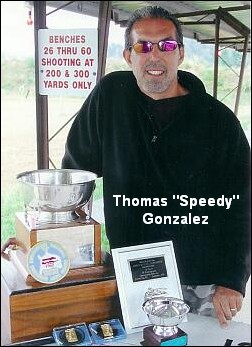 Two respected shooters have observed an increase in velocity with new barrels, typically after 100 rounds. Gunsmith and Hall-of-Fame benchrest shooter Thomas “Speedy” Gonzalez has documented barrel speed-up with testing. Moreover, Speedy’s bore-scope barrel inspections revealed a smoothing of the barrel lands. Jim See, a top PRS competitor, has encountered barrel speed-up many times. Accordingly, he re-tunes his load at 150 rounds.


 Making the 1032-Yard Shot with a 20 BR
 Hitting the Mark — Dead Dog at 1032 Yards


 This video was made with the help of the


