For most larger centerfire cartridges, increased barrel length augments muzzle velocity. That’s why you see F-Open rifles with 30″ and even 32″ barrels. But there is a limit — at some point, increased barrel length may not yield any additional velocity. And in the case of rimfire, too much barrel length can reduce MV. Today’s showcase explores how barrel length affects muzzle velocity, both in centerfire and rimfire rifles.
In the photo above you can see a test rifle fitted with what may currently be the longest barrel fitted to a conventional rifle. This was created by the team at MDT (Modular Driven Technologies) to test how velocity varies with barrel length.
You can see the results of testing with this one-of-a-kind rifle in the MDT video below, the first in our Saturday video showcase. This is followed with an MDT rimfire barrel length/velocity test, and additional tests for the .308 Winchester, 6.5 Creedmoor, and .223 Rem cartridge types.
World’s Longest Rifle Barrel Cut to Determine Velocity Change
This may be the most interesting velocity by barrel length test ever put on video. The MDT (Modular Driven Technologies) team started with a 69″-long barrel, chambered for .308 Winchester. The ammo was Federal Gold Medal match with 175gr Sierra HPBT Bullets (Video 3:30). This barrel had actually been fabricated from multiple sections, a challenge in itself.
Velocity was measured in one-inch increments starting at 69″ and going down to 19″. The speed at 69″ was 2778 FPS while the final speed, at 19″ barrel length, was 2567 FPS. “That is a difference of 211 FPS from the longest point to the shortest point”, observed MDT’s tester. Note that, the velocity did show fairly constant change per inch from 19″ to 45″. So going beyond 36″ inches can actually increase velocity. However, from 45″ to 61″ inches the velocity actually declined a bit. SEE VIDEO at 6:55 time-mark, and check out the chart below.
Ultra-Long .22 LR Rimfire Barrel Cut-Down Velocity Test
This video features Part 2 of MDT’s “Cutting the World’s Longest Rifle” test. This time the team shoots the diminutive .22 LR cartridge from an ultra-long barrel. The results may surprise you: “Get ready to have your assumptions shattered as the MDT team chopped a .22 LR rimfire barrel away inch by inch, recording velocities at each barrel length. In this test, the MDT team looked to determine the optimal length for a .22 LR barrel, from the standpoint of velocity. How long is too long? How short is too short? Does shorter always mean faster? Does longer always mean slower?”
In fact, MDT’s testers determined that, with standard rimfire ammunition, the velocity started to decline after 16″ length. That surprised some of the testers. So with the small .22 LR cartridge, more barrel length can actually reduce muzzle velocity from increased in-barrel friction.
6.5 Creedmoor Barrel Length Test (24″ to 16″)
For this video, testers for Western Powders took a standard test barrel chambered for 6.5 Creedmoor and cut it down one inch at a time. The velocity for five rounds at each length was then measured with a chronograph to determine velocity loss per inch of barrel reduction. Overall the recorded velocity loss from 24″ to 16″ was 197 FPS, almost exactly 25 FPS per inch of length. The velocity loss rate was fairly constant inch by inch, as you can see from the graph displayed at the 4:00-minute mark in the video.
.223 Rem (5.56×45) Velocity Tests (9 Guns, 7.5″ to 20″ Barrels)
In this video, the team from Classic Firearms tests a variety of firearms chambered for .223 Rem (5.56×45). This starts with an Springfield Saint Victor AR-type pistol with a very short 7.5″ barrel. This yielded a 2183 FPS average. Then the team tested eight more guns with increasingly long barrel lengths, adding barrel length with each gun in sequence. The test concluded with a Colt XM16E1 rig with 20″ barrel. That Colt AR averaged 3052 FPS. The guns used (and barrel lengths) are listed below.
The overall results are discussed at the 13:45 Time-Mark.
Test Lengths at Video Time — 7.5″ to 20″
2:11 — 7.5″ Springfield St.V. AR Pistol, 2183 FPS
3:23 — 10.3″ DD MK18 SBR, 2513 FPS
4:34 — 11.8″ PWS MK111 AR Pistol, 2644 FPS
5:35 — 12.5″ IWI Zion AR Pistol, 2789 FPS
.308 Winchester — 16″ Barrel vs. 24″ Barrel Velocity
With the .308 Win cartridge, many hunters prefer a shorter barrel for lighter carry weight. In this video, Gavin Gear of UltimateReloader.com compares .308 Win velocities with a 16″ barrel and a 24″ barrel, shooting the same ammo. Gavin notes: “We asked for input on our .308 build. Overwhelmingly, you all wanted a 16″ barrel, so ‘Shorty’ was born! Looking to compare velocities, I brought out my match .308 Win with a 24″ barrel to compare the results with some Hodgdon data.” CLICK HERE to read full report on UltimateReloader.com.
RifleShooter.com Barrel Cut-Down Testing
Along with these videos, our friends at RifleShooter.com have conducted a number of barrel cut-down tests, starting with fairly long barrels. Velocities were measured with each inch reduction
Most of us own a .223 Rem rifle. Now, thanks to our friends at Rifleshooter.com we can assess exactly how velocity changes with barrel length for this popular cartridge.
Rifleshooter.com performed an interesting test, cutting the barrel of a .223 Rem rifle from 26″ all the way down to 16.5″. The cuts were made in one-inch intervals with a rotary saw. At each cut length, velocity was measured with a Magnetospeed chronograph. To make the test even more interesting, four different types of .223 Rem/5.56 ammo were chron’d at each barrel length. The Rifleshooter.com team that conducts these tests has a full-service gun shop, 782 Custom Gunworks — visit 782guns.com.
Test Barrel Lost 25.34 FPS Per Inch (.223 Rem Chambering)
How much velocity do you think was lost, on average, for each 1″ reduction in barrel length? The answer may surprise you. The average speed loss of the four types of .223/5.56 ammo, with a 9.5″ shortening of barrel length, was 240.75 fps total (from start to finish). That works out to an average loss of 25.34 fps per inch.
5.56/.223 Barrel Cut-Down Speed Test 26″ to 16.5″
Start FPS at 26″
End FPS at 16.5″
Total Loss
Average Loss Per Inch
UMC .223 55gr
3182*
2968
214
22.5 FPS
Federal M193 55gr
3431
3187
244
25.7 FPS
Win m855 62gr
3280
2992
288
30.3 FPS
Blk Hills .223 68gr
2849
2632
217
22.8 FPS
*There may have been an error. The 25″ velocity was higher at 3221 fps.
Rifleshooter.com observed: “Cutting the barrel from 26″ to 16.5″ resulted in a velocity reduction of 214 ft/sec with the UMC 223 55-grain cartridge, 244 ft/sec with the Federal M-193 cartridge, 288 ft/sec with the Winchester M855 cartridge and 217 ft/sec with the Back Hills 223 68-grain match cartridge.”
How the Test Was Done
The testers described their procedure as follows: “Ballistic data was gathered using a Magnetospeed barrel-mounted ballistic chronograph. At each barrel length, the rifle was fired from a front rest with rear bags, with five rounds of each type of ammunition. Average velocity and standard deviation were logged for each round. Once data was gathered for each cartridge at a given barrel length, the rifle was cleared and the bolt was removed. The barrel was cut off using a cold saw. The test protocol was repeated for the next length. Temperature was 45.7° F.”
See More Barrel Cut-Down Tests on Rifleshooter.com
Rifleshooter.com has performed barrel cut-down tests for many other calibers/chamberings including 6mm Creedmoor, .308 Winchester, and .338 Lapua Magnum. See these test results at Rifleshooter.com.
Looking for an Xmas gift for a shooting buddy? We found a dozen great deals on compact gifts that can easily be gift-wrapped, packed, and shipped. Typically there are 25-35% savings on these gift selections, but some are as much as 70% off. That will help your gift-giving dollars stretch farther this year.
12 GREAT GIFTS for Shooters and Hunters — All on SALE
CLICK each photo to access product sale page.
BONUS — More Gift Ideas for Gun Aficionados
If you want more suggestions for affordable gifts for your shooting buddies or family members who enjoy hunting and target shooting, here is a video that can provide some inspiration for the holidays:
The U.S. Army Marksmanship Unit regularly publishes reloading “how-to” articles on the USAMU Facebook page. One very good article, part 5 of a 6-part series, focused on Progressive Presses. This article explains proper procedures for Auto-Indexing Progressives, which advance the shell-plate with every pull of the handle. Auto Progressives are very efficient, but they also require special attention and focus, because so many things are happening at once. You need to train yourself to watch every station. If you run a progressive press now, or are considering getting a progressive, we recommend you read this article. Visit the USAMU Facebook page for other helpful handloading guidance.
Progressive Loading Presses — Self-Advancing Shellplate Type
Recently, we addressed manually-operated progressive presses for the beginning handloader. This type press requires one to manually advance the shellplate after each handle stroke. An advantage for beginners is that nothing happens at any station until the loader wants it to. This helps users avoid problems from clearing malfunctions without noticing that the shellplate has advanced itself. (Read Previous USAMU Article on Manual Progressives.)
The next, more luxurious type progressive press advances the shellplate automatically whenever the handle is cycled. [Editor: This is also called an “Auto-Indexing” Progressive Press.] Typically, each stroke automatically sizes and primes a case, operates the powder measure (if used) and seats a bullet. Some also have case feeders that automatically put a new case in the shellplate with every cycle. Others require the loader to insert a case each cycle. With both types, the loader usually puts a bullet on each sized/primed/charged case.
[CAVEAT: While our Handloading Shop has several progressive presses, ALL of our powder charges are thrown/weighed by hand. We do not use powder measures on our presses. Our progressives are used for brass preparation, priming, seating, etc., but not for fully-progressive loading.]
The manually-advanced press can be a boon to beginners, but as one gains experience it can be a mixed blessing, depending on one’s style. If one pays close attention to every operation and loads without distractions, the manual press is very reliable and allows full scrutiny of each round as it is loaded. However, if one easily drifts into day-dreaming, or isn’t focused on paying careful attention at all times, the manual progressive can be a bit of a liability. The opportunity for forgetting a powder charge, leading to a squib load, is ever-present. [Editor: A lock-out die can help reduce the risk of a squib load, or a double-charge. See below.]
The automatically-advancing progressives help prevent this by ensuring a powder charge will be dropped each time the handle is operated. Experienced handloaders often appreciate this feature due to the savings of time and effort. Individual preferences between the two press styles are influenced by several factors. These include one’s comfort with more- vs. less-complicated mechanisms, how often one changes calibers (case feeders often must be converted, in addition to dies and shellplates), how many rounds one loads annually, relative ease of changing primer mechanisms from small to large, etc. Automatic progressives and their caliber conversion kits tend to be significantly more expensive than manual progressives and caliber conversions from the same maker.
One USAMU handloader, who likes simple, bullet-proof machines and maximum efficiency when converting presses, owns two manually-advanced progressives. One is set up for large primers, and the other for small primers. He can change calibers in the twinkling of an eye. As he loads for many different calibers, this fits his style. Another handloader here is just the opposite. He loads for a few calibers, but in larger quantities. He much prefers his self-advancing press with case-feeder for its speed. He makes large lots of ammo in a given caliber before switching, to improve overall efficiency. His caliber conversion kits are more expensive than those for the manually-advanced progressive, but he uses fewer of them.
Whichever type one chooses, it is VERY important to buy quality gear from a manufacturer with a long, well-established track record for quality, durability and good customer support. Avoid jumping on the “latest, greatest” model until it has a proven track record. For example, this writer knows a loader who got a brand-new, expensive, self-advancing model press some years back, shortly after its introduction. As is too often the case these days, the manufacturer released it before all the “bugs” were worked out.
Better Safe Than Sorry — the RCBS Lock-Out Die
RCBS Makes a “Lock-Out Die” that senses the powder charge. This will halt the Progressive press if you have a double charge, or an undercharge. Your Editor has the Lock-Out Die on his RCBS Pro 2000. It has “saved his bacon” a half-dozen times over the years. It can be used on Dillon and Hornady progressives as well as RCBS machines.
It would not fully seat primers to the correct depth. No amount of adjustment, extra force, or fiddling would do better than to seat primers barely flush with the case head. Any inattention could result in a slightly “high” primer, protruding above the case head. It created a risk for slam-fires, particularly in semi-autos without spring-retracted firing pins, such as the M1 or M1A. In desperation, he had a machinist buddy study the problem and machine a new part to correct it. No dice. Its engineering didn’t permit full primer seating, even with extended parts. He now wishes he’d heeded his shooting buddies’ advice to stick with the “tried and true,” reliable performer they all used.
Whichever press one selects, see if the maker has a kit or list of commonly-replaced parts. Having needed springs, pins, etc. on hand in the rare event that one breaks or “goes missing” can save the day when one is busy loading for a match! Another tip for improving one’s overall loading efficiency (rounds loaded with minimal set-up/tear-down time) is to plan one’s handloading by primer size. For example, if your machine is set to use small primers, load all the calibers that you intend to that take small primers, before converting the press to load large-primer calibers.
In our next chapter, we’ll discuss peculiarities of progressive loading for rifle cartridges, with remedies for problems such as excessive cartridge-case headspace variation when sizing, tips for ensuring best powder charge consistency, and so on. Until then, be safe, and good shooting!
A fire in the home is always to be feared. And a fire in your reloading room can be disastrous. Near your reloading bench you probably have flammable solvents, and maybe gunpowder. What would happen if an electrical fire started in your reloading room? Would you be alerted? Do you have a proper fire extinguisher at hand?
Here’s a true story from Forum Member Joe O. (aka “Joecob”) that provides a valuable safety lesson. After Joe started up his old tumbler, an internal connector worked loose, causing an arc which started a FIRE in his basement reloading area. Luckily Joe had a functioning smoke detector, and a fire extinguisher.
Very few of us would worry about fire when we plug in a tumbler or other AC-powered reloading tool. But there is always the possibility of a malfunction and a fire. Quick thinking (and a handy extinguisher) prevented serious damage to Joe’s reloading room and house — but things could have been worse (much worse), had Joe not responded quickly.
Fire in the Reloading Room — Report by Joecob
The day before ‘Sandy’ hit I was cleaning brass the way I always have. I set the vibratory tumbler on the back of my reloading bench in the basement. I loaded the media hopper with 40 fired empty brass cases (and walnut media), plugged the cord in, turned the tumbler on and went back upstairs to watch TV. I could hear the tumbler running in the background.
About half an hour later I heard the basement smoke alarm go off. I ran downstairs. Flames were licking from the melting plastic of the tumbler.
I grabbed the nearby ABC cannister extinguisher and squirted out the fire and soaked the charred bench areas with water. Good thing I had the extinguisher! And I was glad I religiously store powder and primers properly — away from the bench (and everything else).
What caused the fire? It looks like an internal AC connector finally vibrated loose enough to arc and ignite the plastic. WHEH! I had been using that thing for 25 years the same way without mishap. Guess I should have known to periodically check the guts of a thing that plugs in and vibrates for a living?
Today I went out and bought a new even bigger ‘Pro’ ABC extinguisher, plus a dual-detector smoke alarm, and an ultrasonic cleaner. That experience was scarier than the storm. I hope this true account might help someone else to avoid a bad experience.
In his account, Joe refers to an “ABC” cannister fire extinguisher. The “ABC” refers to the fire classification rating: Class A (trash, wood, and paper), Class B (liquids and gases), and Class C (energized electrical equipment) fires. There are many brands of ABC-rated extinguishers.
The rechargeable Kidde 210 unit (sku 21005779, #ad) contains four pounds of a multipurpose monoammonium phosphate dry chemical extinguishing agent. It has a discharge time of 13 to 15 seconds, a discharge range of 10 to 15 feet, and an operating pressure of 100 PSI. The seamless aluminum cylinder measures 4.5 inches in diameter and 15.7 inches tall. The Kidde 210 has a 6-year limited warranty. This is Amazon’s #1 Best Seller among Fire Extinguishers.
As an Amazon Associate, this site earns from qualifying purchases.
SIG Sauer has a new .22 LR rimfire handgun — the P322-COMP pistol. Designed for speed, accuracy, and flat shooting (low muzzle flip), this new rimfire pistol from SIG SAUER is ready for competition right out of the box. It comes with a red dot optic, barrel-mounted compensator, slide-mounted racker, good trigger, and high-capacity (20- and 25-rd) magazines. READ P322 Manual.
We think this would be a good choice for fun action pistol matches. One YouTube viewer noted: “I applaud SIG… basically [the P322-COMP is] the first RFPO (Rimfire Pistol Open) factory option for Steel Challenge. Every other gun on the market you have to buy the optic, thumb rest, and compensator.”
SIG P322-COMP — Components and Features Video
NOTE: This 44-second video from SIG Sauer has detailed illustrations of all components with 3D rotation of the pistol so you can see it from all angles.
SIG Sauer states: “The P322-COMP ships with a factory-installed ROMEO Zero ELITE Red Dot optic for fast target acquisition, is designed with a slide mounted racker and sport takedown lever as value-added fun features. It has a barrel-mounted compensator to reduce muzzle rise making the P322-COMP a fast, fun, and [flat-shooting pistol].
The SIG SAUER P322-COMP is a competition-ready .22 LR rimfire pistol with class-leading 25+1-round and 20+1-round capacity. It has a threaded barrel equipped with a 2-port compensator and comes with a factory-installed ROMEO Zero Elite Red Dot Optic. The polymer grip features an extended magazine catch, adjustable trigger shoe, sport takedown lever, 1913 rail, and integrated magwell. The Single Action Only hammer-fired action on the P322-COMP is completely enclosed in a two-tone competition alloy slide with a high viz fiber-optic front sight, plus front, rear, and top cocking serrations. The ambidextrous, slide-mounted racker ensures easy slide manipulation. The pistol ships with (1) 20-round magazine and (1) 25-round magazine.
P322-COMP Specs:
Caliber: .22 LR
Capacity: 20+1, 25+1
Barrel length: 4 inches
Sight Radius: 6 inches
Weight (w/magazine): 19.8 oz.
22Plinkster Review of P322-COMP Pistol
Note how fast 22Plinkster can hit multiple targets with this new brake-equipped pistol. No question this rimfire pistol would be fun to shoot on steel targets.
TheHumbleMarksman Review of P322-COMP Pistol
This video starts with close-up, slow-motion footage of the pistol. Components and magazines are illustrated at 0:55-1:30 time segment, and there’s a good explanation of how the compensator works at the 6-minute mark.
Christmas is just 13 days away, so today we’re featuring a hand-picked collection of “stocking stuffers” for precision shooters. Some of these are recent inventions. All are handy items that you’ll use over and over again at the range, on your vehicle, and/or at your loading bench (so you’re allowed to buy them for yourself, even after Christmas).
Cabela’s Multi-Tool — $7.99
You won’t find a more versatile tool at this low price — just $7.99. The Cabela’s multi-tool performs many functions. The stainless steel frame features 8 tools: wire-cutting pliers with bolt grip, wire-stripper, knife, Phillips and flat-head screwdrivers, saw, bottle opener, and scissors. Closed length is 3″. This handy tool is available in five colors: Red, Teal, Orange, Silver, and Green. A durable nylon belt sheath protects and carries the multitool.
Lyman Pocket Touch Scale Kit with Funnel — $22.99
Lyman’s handy Pan/Funnel Combo Kit includes a small digital scale, powder pan/funnel, powder scoop, and check weight — all for just $22.99 at Midsouth. The black powder-receiving pan/funnel is one integrated unit so you don’t need a separate funnel. Weigh the powder on the scale in horizontal “pan mode” then use the same pan/funnel to put the powder into your cartridge case.
B&T Industries BT62 Determinator — $7.95
The acrylic BT62 Determinator measures groups with laser-cut concentric measuring rings. Check group size quick and easy — simply place the Determinator over shot group. Adjust until one of the circles crosses the center of the two outer-most holes. That gives you the center to center group measurement (1.5″ maximum). Alternatively, you can measure edge to edge (of the farthest shots) and then subtract the bullet diameter. Cool tool for gun guys. The supplied lanyard also glows in the dark.
Lyman Powder Scale Pan and Case Funnel — $8.95
The Lyman Powder Pan/Funnel saves reloaders time by combining the powder-receiving pan and funnel into one unit. With this combo tool reloaders can pour powder directly into the case without having to fumble with a separate funnel. That’s smart and efficient. RCBS makes a similar powder pan/funnel ($8.95 on Amazon) with a slightly different case-neck section. You may want to try both to determine which works best for your cartridge brass.
Wheeler Manual Trigger Pull Scale — $20.45
While we prefer a sensitive digital trigger pull gauge, it’s nice to have a manual back-up. And the Wheeler gauge is plenty accurate for pistols and most hunting rifles. The Wheeler trigger pull scale accurately measures trigger pull weight from 8 ounces to 8 pounds. It features an ergonomic handle for consistent direction of pull. The sliding indicator stays reliably on the maximum weight registered and high contrast pull weight increment marks are very easy to read. This spring-type trigger scale measures in 2-ounce increments and is accurate to +/- 2 ounces — plenty good for pistols and hunting rifles. Priced at just $20.45 on Amazon, this gauge has earned 89% four- or five-star owner reviews.
Surveyor’s Flagging Tape (for Wind Indicators) — $1.69 per Roll
Allen Camouflage/Black Neoprene Scope Cover — $9.98
Here’s a great gift item for a hunter. This reversible Camo-pattern Neoprene Scope Cover fits scopes up to 10″ long and 44mm lens diameter. The cover cushions your scope and protects against moisture and scratches. Along with the $9.98 10″ version, Allen makes a 12″ medium camo scope cover, $13.99 on Amazon. NOTE: These covers are reversible with Mossy Oak Break-Up Country camo on one side (as show), and black on the other side.
MagnetoSpeed — RifleKuhl Barrel Cooling Fan — $54.00
Cooling your barrel with a compact fan can extend barrel life. This bright red RifleKuhl from Magnetospeed is quite effective. The battery-powered impeller pushes cooling air down the barrel. It has a chamber seal for increased cooling efficiency while a neodymium magnet helps secure the device to your action. The RifleKuhl includes a belt/pocket clip and there is a Replaceable built-in 50 Micron air filter. The RifleKuhl costs $54.00 on Amazon.
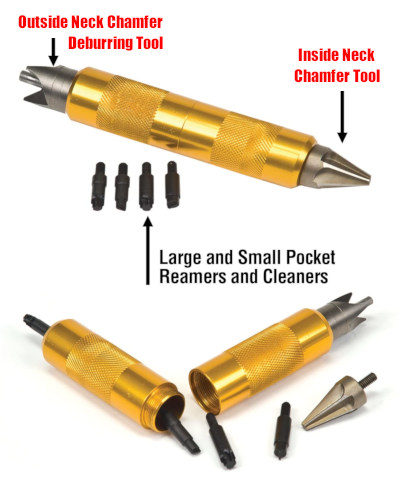
Lyman Case Prep Multi-Tool with Internal Storage — $27.99
This handy Lyman Case Prep Multi-Tool can perform multiple task. On one end is an inside neck chamferer, with the outside chamferer/deburrer on the opposite end. Stored inside the tool are four (4) uniforming attachments for large and small primer pockets. This tool with all the attachments is $27.99 at Midsouth.
Digital Display Timer with Big Buttons — $14.95
If you shoot in a discipline with time limits, or you time your firing strings during practice, having a reliable and easy-to-read timer is critical. We like this very affordable Digital Display Timer with both count-up and count-down functions. Just $14.95 on Amazon, this unit boasts an easy-to-read display and LARGE buttons making it perfect for F-Class, Palma, and other matches. This timer comes with both a built-in stand AND a strong magnet so you can position the timer conveniently.
Creedmoor Sports Leather 20 Rd +2 Ammo Holder — $24.95
This handsome red leather ammo holder secures twenty (20) rounds of .308 Win-size ammunition, in a handy plastic carrier. In addition there are loops for 2 more sighter rounds on the outside. This is a very nice gift for a target shooter or hunter. There is also a .223 Rem version in black leather. Both these leather ammo holders conveniently fit into a shooting coat pocket via a leather pocket flap.
Hoppes Pistol Cleaning Kit — $7.99
Right now, for just $7.99, you can get a nice Hoppes Pistol Cleaning Kit complete with solvents, cleaning rod with swivel handle, jags, patch holder, bore brush, and 50 patches. The fluids include 2 oz. of Hoppe’s No. 9 Cleaning Solvent, plus 2.25 ounces of Hoppe’s Lubricating Oil.
Sack-Ups 13.5″ Pistol Storage Sock — $7.99
Here’s an actual fabric sock that you can roll up and put in your Christmas stocking. Sack-Up knitted storage sacks are made from silicone-treated 100% natural cotton. The cotton’s wicking ability draws moisture off the gun, inhibiting corrosion. This $7.99 13.5″ Sack-Ups sock is a great choice for revolvers and metal-framed pistols. Midsouth also carries larger 36″, 42″, and 52″ Sack-Ups for shotguns and rifles.
Hornady Wireless Remote Hygrometer — $29.99
Is the temp and humidity OK inside your gunsafe? With Hornady’s Wireless Hygrometer, you can check that easily. The unit’s sensors measure temperature and humidity inside your safe, and shows that on the touch-screen display. The display unit has a built-in stand or you can mount it inside the safe with magnets, hanging hole, or Square-Lok mount. Get this Wireless Hygrometer for $29.99 at Midsouth.
BONUS — TACTICAL STOCKINGS for Your Stocking Stuffers
Don’t have a stocking to hold your small gift items? Then check out these cool, heavy-duty stockings. These Willbond Tactical Stockings are sold as a two-pack for just $17.99 on Amazon (#ad). You can choose a pair in three different styles: Tan and Green, Camo and Black, Tan and Black. These Willbond Tactical Stockings feature Hanging hook, MOLLE straps, carry handle, outside draw pocket, side zipper, and Velcro USA Flag Patch. Get all this for the low price of $17.99 for two. These stockings are sure to bring smiles to your tacticool family members and friends.
As an Amazon affiliate, this site can earn revenues through sales commissions.
As noted in Shooting Industry Magazine, “optics-ready” handguns have become increasingly popular. These pistols have slides configured to mount Red Dot optics. Some of these handguns are sold with Red Dot optics pre-installed, ready to go. For example, the Smith & Wesson Performance Center M&P 9 Shield Plus (above) is sold with a Crimson Trace Red Dot optic mounted on the slide.
The new FN Five-seveN MRD is an optics-ready pistol chambered in 5.7x28mm. (Image: FN America)
For IDPA and gun games, a Red Dot sight can definitely help with rapid target acquisition. And for a defense gun, the Red Dot assists aiming at night, even in the dark. And unlike a pistol-mounted laser, the Red Dot does not have a bright, visible beam that pinpoints the gun owner’s location.
The Shooting Industry article explains how optics-equipped pistols have become much more popular: “It wasn’t too long ago optics-ready handguns were little more than a novelty. But today, it’s difficult to talk about the handgun segment without delving into the increasing number of guns coming from the manufacturers with optics already installed, or ready to accept one.”
Massad Ayoob, a respected shooting instructor and gun writer, says optics-equipped pistols are now very popular: “Carry optics are burning up the handgun market today. Some of my fellow instructors tell me they have general defensive shooting classes where more than half the students show up with guns wearing carry optics, a compact version of Red Dot sights. Police departments are going to them [optics equipped pistols] in droves.” READ FULL Story.
If you are interested in a wide selection of optics-ready handguns, check out the Modern Carry: Best Optics-Ready Pistols article in the CheaperThanDirt Blog. This highlights ten production pistols from Canik, CZ, FN, Hechler & Koch, Keltec, SCCY, SIG Sauer, Smith & Wesson, Springfield Armory, and Taurus. Below is the Taurus G3 T.O.R.O (Taurus Optic Ready Option), a full-frame pistol with 17+1 9mm capacity.
Learn More about Red Dot and Reflex Sights for Pistols
Want to learn more about pistol optics? There is an excellent article on the NRA’s American Rifleman website that explains how Mini Reflex/Red Dot Sights function. The huge advantage is that the shooter can simply put the Red Dot on target. He does not have to align front and rear sights. That allows MUCH faster target acquisition: “Red-dot-style sights are faster than irons and better in low light. But they’re also more accurate, particularly at ranges past 50 yards, thanks to fine dots and triangles, generally representing 2 to 13 MOA, that are more precise than the front posts of modern pistols.” SEE AmericanRifleman.org article.
The first Red Dot sights were created by Aimpoint: “In the 1970s the reflex sight as we know it was brought to market by the Swedish firm Aimpoint. It contained a battery-powered, light-emitting diode (LED) that allowed these compact, tube-enclosed reflex sights to function in darkness. Its glowing ‘red dot’ soon became this sight’s nickname. It took a little while longer for a few cutting-edge handgunners to discover the red-dot sight’s advantages.”
While Accurateshooter.com concentrates on high-accuracy rifles, we know that many of our readers enjoy handguns. We are often asked “What is your favorite handgun — Glock? HK? SIG Sauer?” The answer to that question may be surprising. This Editor’s favorite handgun, at least the one that gets shot most often, is a rimfire revolver — that’s right, a wheelgun.
This Editor’s first really accurate handgun was a .22 LR Smith & Wesson Model 617 that could easily stack ten shots in a dime at 10 yards. It remains my favorite and most-used handgun. What can we say about the Model 617? The single-action trigger pull is superb, and the accuracy surpasses most any semi-auto rimfire pistol, except for a few, very expensive target pistols. We like the 6″ version for the longer sight radius, but the 4″-barrel 617 is also very accurate, and it balances better.
S&W Model 617 now has a 10-round cylinder, but early models were six-shooters.
We recommend that new pistol shooters start off with a .22 LR rimfire handgun. The .22 LR cartridge is accurate but has very low recoil, less “bark” than a centerfire, and very little smoke and muzzle flash. New shooters won’t have to fight muzzle flip, and won’t develop a flinch from the sharp recoil and muzzle blast common to larger calibers. With the .22 LR, the trainee can focus on sight alignment, breathing, and trigger pull.
Smith & Wesson Model 617 (6″ and 4″ Barrels)
CC-BY-SA-2.0 and photographs by Dennis van Zuijlekom.
Here are three video reviews of the Smith & Wesson Model 617, both 4″-barrel and 6″-barrel versions. All three videos demonstrate the 617’s great accuracy. The reviewers concede that this handgun is pretty expensive, but all agree that the Model 617 will last a lifetime, and hold its value.
Hickok 45 Demos “Wonderful revolver”, a 4″ Model 617. See also Hickok 45 m617 Part 2:
Popular YouTube Host 22 Plinkster Tests Model 617 with 6″ Barrel:
22 Plinkster loves the Model 617, “one of [his] favorite revolvers in the whole entire world — a great choice”. He reports it “shoots straight [and] functions pretty much flawlessly” with nearly any .22 LR ammo. In this video, 22 Plinkster tests a wide variety of rimfire ammo types including CCI .22 LR Std Velocity, .22 Shorts, .22 LR Shotshells, .22 Stingers, .22 Super Colibri, and .22 LR tracers.
This Video Features the Smaller 4″-Barrel Model 617:
Other Rimfire Revolvers — from Colt, Ruger, and S&W
If you’re considering a rimfire revolver but would like to see other options, read our Buyers Guide to Rimfire Revolvers. Along with the S&W Model 617, this covers the Ruger GP100 10-shot (5″ bbl), Ruger LCRx 8-shot (3″ bbl), Classic S&W Model 17 6-shot (blued 6″ bbl), and S&W Model 63 (3″ bbl).
Colt King Cobra Target .22 LR Revolver
At the NRA Annual Meetings in 2022, Colt Manufacturing introduced an impressive new rimfire revolver — the King Cobra Target 22 LR. Colt states: “From competition to plinking and small game hunting, this baby Cobra does it all and packs 10-rounds of .22 LR in its cylinder”. The King Cobra Target 22 LR is available with 4.25-inch and 6-inch barrel lengths, both with 1:16″ RH rifling twist. MSRP is $999.00.
This TFB Showtime episode examines the .22 LR rimfire Colt King Cobra Target. The King Cobra Target 22 LR boasts a 10-shot cylinder, and the same adjustable target sights as the .357 Magnum version.
The King Cobra Target 22 LR features USA-forged stainless steel construction. Designed and crafted for outstanding accuracy, new King Cobra Target 22 LR features a one-piece barrel/shroud with fiber optic front sight. The cylinder holds ten (10) rounds. The frame is fitted with an adjustable target rear sight and Hogue overmolded rubber grips.
Ruger GP100 .22 LR 10-Shot Revolver
Ruger offers a big stainless .22 LR wheelgun to compete with the S&W Model 617. This rimfire wheelgun is based on Ruger’s trusted GP100 platform. The Ruger GP100 chambered in .22 LR looks to be a good firearm — strong, versatile, and intelligently engineered. In the video above, the late Jeff Quinn of Gunblast.com tests the Ruger revolver and gives it high marks: “It’s a good hefty gun [42.6 oz.], but not overly large or heavy for a good trail gun. It’s just a really nice, well-made revolver from Sturm Ruger.” The gun Jeff tested had a 3.7-lb SA trigger pull and a 9.8-lb DA pull.
The .22 LR GP100 features a windage and elevation adjustable rear sight with a white outline, a light-gathering fiber optic front sight and the original full-size GP100 rubber grips with hardwood inserts. With all stainless-steel construction, the rimfire GP100 is easy to maintain. Just keep the cylinder chambers and barrel clean and this gun should run forever.
This Review of the .22 LR GP100 by Hickok45 has over 6.8 Million Views:
The 10-shot Ruger GP100 in .22 LR is a durable, well-engineered wheelgun. Ruger’s engineers optimized the GP100’s innards to deliver a smooth double-action pull: “The new GP100 has an improved fire-control system that uses a lighter mainspring than previous Ruger double-action .22 LR revolvers … we’ve done a lot of development on the firing pin location and geometries so that we’re able to put a lighter trigger pull in this gun than you would find in other .22 LR [handguns]. We’ve got a half-underlug barrel, and it’s a smaller diameter so the gun balances real well. We’ve added a narrow-spur hammer and a smooth trigger.”
Smith & Wesson Model 648 in .22 WMR
We love Smith & Wesson rimfire revolvers. We have put thousands of rounds through S&W Model 617 revolvers, with 4″ and 6″ barrels. These stainless .22 LR handguns are accurate, superbly reliable, and they hold their value. In general we’ve found that Smith & Wesson rimfire revolvers may be less fussy with ammo, and more trouble-free than typical semi-auto rimfires. Bottom line, we feel that everyone should have an S&W rimfire wheelgun in their collection.
Along with its .22 LR wheelguns, S&W now offers another very impressive Rimfire Revolver option — the “revived” Model 648 in .22 WMR (Winchester Magnum Rimfire). This stainless Model 648 brings a more powerful cartridge to S&W rimfire revolver fans.
Here’s a helpful, time-saving tool for handgun owners. MidwayUSA’s online Holster Finder lets you quickly find the right holsters for virtually all popular makes and models of pistols and revolvers. The wide variety of carry styles, materials, and features can make finding the right holster difficult or confusing. Drawing on a database of over 125,000 gun/holster combinations, the MidwayUSA Holster Finder turns that complex task into an easy three-step process.
The selection process is simple: 1. Choose Pistol or Revolver; 2. Select Make and Model of Handgun (and barrel type/length); 3. Click to view results. Just choose your gun type, select your make, model and barrel, then view the results. All major holster types are included: Ankle, Belly Band, Belt (outside waistband), Chest, Competition, Drop Leg, Inside Waistband (IWB), Paddle, Pocket, and Shoulder. Check out the MidwayUSA Holster Finder at MidwayUSA.com/holster-finder.
MidwayUSA’s Marketing VP Jeff Larkin says: “Our team built the Holster Finder so our customers could find all holsters we offer for their specific firearm without sorting through thousands of search results. Finding the perfect holster is now easier than ever — just a few clicks, and we’ll show you everything that fits!”
So you’re thinking of buying a suppressor (aka “moderator”, “silencer”). You can’t just get one off the shelf at Walmart. Acquiring a suppressor requires filling out paperwork and paying a Federal $200 Tax Stamp. Plus there is typically a pretty long wait. However, the good news is that suppressor ownership is now legal in 42 of the 50 American states — that’s 84%! For most American adults, getting a suppressor is legal, provided the buyer passes the required background checks (explained below). The 42 “suppressor-friendly” states are shown as RED in the illustration below.
States Where Suppressor Ownership is Allowed
These 42 states allow private ownership of suppressors: AL, AK, AZ, AR, CO, CT, FL, GA, ID, IN, IA, KS, KY, LA, ME, MD, MI, MN, MS, MO, MT, NE, NV, NH, NM, NC, ND, OH, OK, OR, PA, SC, SD, TN, TX, UT, VT, VA, WA, WV, WI, WY. Note: Even if you live in one of the states listed, you should still verify that owning a suppressor is legal in your area. Some states may have municipal- or county-based restrictions.
“Suppressor ownership [has] boomed in the 21st century. Thanks in part to companies like Silencer Central that streamline the purchasing process, the number of registered suppressors has grown from 285,000 in 2010 to over 2.6 million in 2020.” — GunsAmerica Digest
States Which Prohibit Suppressor Ownership
The eight states which prohibit suppressor ownership are: California, Delaware, Hawaii, Illinois, Massachusetts, New Jersey, New York, and Rhode Island. These states are shown in GRAY in the map.
Qualifications to Obtain a Suppressor
To legally obtain a suppressor, you must fill out Federal Forms and pay a $200 fee to the ATF. You must also pass BATFE background checks and otherwise comply with Federal and state laws. States can regulate suppressor ownership or use, so be sure to check the laws in your area. On the federal level, the process to acquire a suppressor is regulated under the National Firearms Act of 1934. According to the American Suppressor Association, to own a suppressor in the United States you must:
1. Be at least 21 years of age to purchase a suppressor from a dealer.
2. Be at least 18 years of age to purchase a suppressor from an individual on a Form 4 to Form 4 transfer (contingent on state laws).
3. Be at least 18 years of age to possess a suppressor as a beneficiary of a trust or as a member of a corporation (contingent on state laws).
4. Be a resident of the United States.
5. Be legally eligible to purchase a firearm.
6. Pass a BATFE background check with a typical process time of 8 to 10 months.
7. Pay a one time $200 Transfer Tax.
That fifth requirement, “be legally eligible to purchase a firearm”, involves a list of factors. The prohibitions are set forth in the “prohibited person” list found on ATF Form 4473.*







 A fire in the home is always to be feared. And a fire in your reloading room can be disastrous. Near your reloading bench you probably have flammable solvents, and maybe gunpowder. What would happen if an electrical fire started in your reloading room? Would you be alerted? Do you have a proper fire extinguisher at hand?
 I grabbed the nearby ABC cannister extinguisher and squirted out the fire and soaked the charred bench areas with water. Good thing I had the extinguisher! And I was glad I religiously store powder and primers properly — away from the bench (and everything else).