With days growing shorter and winter on its way — here’s a great audio “infotainment” resource to help fill those long winter nights. Leupold offers podcasts, 40-75 minutes in length, on a variety of topics of interest to hunters and precision shooters. A podcast is like a radio show that’s available 24/7, at your convenience. To “tune in” via your home computer or mobile devices, just visit the Leupold Podcast Page.
Oregon-based optics-maker Leupold & Stevens (“Leupold) offers the “Core Insider” podcast series. These podcasts deliver hunting advice and recount successful hunting trips — such as Caribou hunting in Alaska. Other Leupold podcasts provide optics info, industry intel, and tech tips. Leupold’s Core Insider podcasts can also be accessed directly from Leupold.com. From the Leupold Podcast Home Page, you can stream the podcasts live or download for later listening.
The Leupold Core Insider Podcasts cover a wide variety of shooting and hunting topics. One early episode features Leupold team members Kyle Lamb and Buck Doyle discussing long-range shooting, while recent Episode 55 explains how Binoculars and Rangefinders function. There are now 96 Leupold Podcasts available online for FREE.
Forum member F-Class John is an avid F-Class competitor and expert handloader. This week he won the NRA F-0pen Mid-Range National Championship. John reviews reloading hardware and shooting-related products for his popular F-Class John YouTube Channel, which now boasts 540+ videos. John also does product testing for AccurateShooter.com and his new FClassJohn.com website. On his YouTube channel, John has reviewed many of the latest and greatest reloading tools and accessories. Below are three interesting F-Class John tool and reloading product reviews.
If you like these informative videos, consider joining F-Class John’s Patreon Channel for live video meetings, more in-depth videos, and detailed explanations.
Here are three of John’s most interesting gear review videos for products that can benefit all serious handloaders.
21st Century Hydro Press and Standard Arbor Press
John notes: “You can’t really talk about precision reloading without taking about inline dies and arbor presses. For my money there’s nothing better than the lineup from 21st Century Shooting. They offer the Hydro Seater which is hands-down the best manual seater out there as well as their standard arbor press which is great for taking on the road to push back bullets as needed.”
Henderson and Giraud Power Trimmer Comparison Review
In this video John reviews two high-quality powered case trimmers that help handloaders rapidly process large volumes of brass. He says these are “arguably the two best trimmers on the market” and are “both worth the money if you do a lot of trimmming”. The Giraud Power Trimmer is rugged and popular with high-power shooters. The advanced, red Henderson Precision Gen 3 Trimmer offers some advantages for precision trimming and John likes the Henderson layout and ergonomics.
Concentricity Checking with Accuracy One Gauge
Every serious hand-loader needs a quality concentricity gauge. The Accuracy One Concentricity Gauge boasts a smart design that delivers precise, repeatable results. We like the unit’s easy adjustability and its ability to work in a variety of configurations. The Accuracy One Gauge measures internal and external neck runout of cartridge cases as well as seated bullet runout. It can also measure the runout of the ogive, bearing surface, and boat-tail of individual bullets. And it can even measure your primer pocket runout.
Bullet sorting station — quilted Maple with marble tile inlay, created by JVW2008.
We have a master woodworker in our Shooters’ Forum, Jerry from Colorado (aka JVW2008). In a Shooters’ Forum thread, Jerry showcases multiple examples of his handiwork — various wood projects for the reloading room. Beautifully made, these one-of-a-kind custom cabinets and tool stands deserve to be on display in a museum.
Jerry’s creations exhibit exquisite craftsmanship and some very clever design features. What is your favorite item among the Jerry’s wood wonders shown here? You can reveal your favorites in the comment section below.
Throne for a Sartorius Analytical Balance
Jerry built this “Throne” for his ultra-precise Sartorius Entris force restoration scale, which is linked to a V2 Auto-Trickler. This is a true state-of-the-art powder measuring system on a beautiful base unit.
Cabinet for Balance Beam Scale
Here is an oak balance beam scale cabinet and weighing surface. Note the mulitiple tiers, side wings, and other smart design features.
Custom Arbor Press Base
Below is a handsome, well-designed base for K&M Arbor Press and Wilson dies. Look at the fitted recesses for the hand dies — very nice!
Jumbo Walnut/Maple Loading Block
And here is a beautiful 100-cartridge reloading block, crafted from Walnut over Maple. It’s impressive to see 100 cartridges all lined up like that!
To see more impressive wood projects by our Shooters’ Forum members, visit the Wood Working Ideas Forum Thread. Along with Jerry’s reloading toom wonders, you’ll see cleaning cradles, shooting benches, transport boxes, and much more. Check out this amazing inlaid rifle case crafted by Forum member Nando-AS for his son.
Today, October 31st is Halloween (aka “All Hallows Eve”). There will be trick-or-treaters and Costume parties. Why not head to the range and shoot some Halloween-themed targets this October amidst the fall foliage. The folks at the NRA Blog have created a series of “spook-tastic” Halloween targets. Writer Kyle Jillson says, “In addition to stocking up on candy and finding great costumes, we thought you might like to have some fun at the range, so we created these spooky targets for you to use.”
Just click an image to launch its full-size version. You can then download the target and print it out on regular 8.5″x11″ paper. Now you have fun Halloween-themed targets to bring to the range this week.
22Plinkster runs of the most popular gun-centric YouTube channels. His videos have been watched by hundreds of thousands of firearms fans. Many of 22Plinkster’s videos involve trick shots, such as shooting a .22LR through 100 balloons, but he also does serious reviews. He’s actually a competent marksman who has shot a vast collection of .22 LR/22 WMR pistols and rifles, making him a qualified rimfire expert (as well as a trick-shot artist and showman). Today we feature five 22Plinkster Firearms Videos, plus a bonus Vudoo Gun Works video review from GunsandTactics.com.
Vudoo Gun Works Ravage Precision .22 LR Rifle
Last Sunday we featured an NRL22 rimfire competition rig built with a Vudoo Gun Works V-22 action. For this Sunday GunDay article, we showcase a complete Vudoo rifle, a mag-fed Ravage with Ridgeback stock. 22Plinkster declared: “It’s a Tack-Driver … this .22 LR Rifle is the most accurate .22 LR bolt-action rimfire rifle I have ever shot in my life.” And he notes that he has shot Anschutz, Lithgow and other quality rifles.
Firing from a Lead Sled, 22Plinkster starts out at 50 yards, and produced a 0.335″ group at 50 yards using Lapua Midas+ ammunition (4:00 time-mark). Then this session gets really impressive. Continuing with Lapua Midas+ ammo, this Vudoo Ravage produced a sub-half-inch group at 100 yards*. You can watch that Midas+ group form up from 7:20 to 8:25 in the video. Then, with ELEY Tenex ammo, he produced a 0.707″ group (10:30) and an even smaller group (11:55). This complete rifle is available from Vudoo Gun Works for $2545.00 without optics.
22Plinkster says Vudoo’s Ravage is a top choice for NRL22/PRS rimfire matches and Rimfire ELR competitions: “This is the cream of the crop. [Many] people who are winning PRS rimfire matches are shooting Vudoos. What sets this rifle apart from a lot of the other Match 22 rifles is what it does past 300 yards. A lot of rifles — Anschutz, Lithgow, CZ — shoot really good out to 300 yards. But after 300 yards, their accuracy diminishes big-time.”
Vudoo V22 Ravage with a fluted 18″ Kukri barrel in an Urban Camo Grayboe Ridgeback stock.
If you are interested in getting a Vudoo rimfire rifle, then definitely watch this 20-minute Guns & Tactics video. It provides extensive accuracy testing for multiple ammo types with verified group sizes. Then the reviewer shows the working details of the rifle, including the bolt, trigger system, and magazine. The video also includes field testing from bipod as well as competition-type practical stages out to nearly 400 yards.
Savage A22, 22 Magnum (WMR) Rifle Field Test
The Savage A22 is the .22 WMR “big brother” to Savage’s popular A17 17 HMR rifle. In this video, 22Plinkster demonstrates that the A22 is a very reliable semi-auto that can deliver near-1 MOA accuracy when the barrel is clean. This rifle retails for about $390.00.
Smith & Wesson Model 41 .22 LR Pistol Review
The S&W Model 41 is a classic American rimfire target pistol. Beautifully crafted, the Model 41 boasts a superb trigger, comfortable grip, and excellent accuracy. New or used, a Model 41 would be a fine addition to any firearms collection.
Volquartsen Scorpion .22 LR Pistol Review
The Scorpion demonstrated exceptional accuracy in the hands of 22Plinkster. It comes with a large target-style grip. With a built-in compensator, the Scorpion stays on target with almost no muzzle rise. The comp can be easily switched out with a suppressor (See video at 3:00 time-mark).
S&W Victory Vs. Ruger Mark IV Pistol Shoot-Off
22Plinkster liked both pistols. He favored the grips on the Ruger while preferring the S&W’s trigger. He felt the Ruger’s iron sights were best for precision work, but he noted that the green dot fiber optic sights on the S&W Victory worked better for speed work.
*Footnote regarding 22Plinkster Measured Groups: At least one of the measured groups (in close-up view) does NOT show the exact same group which formed in the preceding video sequence. You can tell from the shot placements relative to the center of the target — it’s a different group. Still we believe that 22Plinkster did shoot very small groups with this rifle at 50 and 100 yards. We just think 22Plinkster’s video editing may have been out of sequence. You can tell the group measured with calipers is not the same as the group shown forming top right in the preceding live video.
Kevin Muramatsu’s black rifle book, the Gun Digest Guide to Customizing Your AR-15, is a great resource for fans of AR-platform rifles. All the AR options you can imagine are covered: suppressors, premium barrels, adjustable stocks, free-float handguards, ergonomic grips, buffer systems, tactical lights and much more. Those planning an AR rifle build will find application-specific suggestions for 3-Gun, Service Rifle, High Power (Space Gun), Hunting, and Self-Defense use.
Firearms expert Muramatsu offers advice on choosing the right stock/barrel/optics configuration for your particular game. He also discusses the wide variety of options for slings, grips, magazines and other accessories. With over 520 photos, the book includes a large photo gallery of customized ARs, and includes bonus coverage of the FAL and other “tactical” firearms. The Gun Digest Guide to Customizing Your AR-15 is available from Amazon.com (#ad) for $35.95, and a Kindle eBook version is offered for $14.99. The book is also sold by Barnes & Noble, and most other major booksellers.
As an Amazon Associate, this site earns from qualifying purchases.
Hardware Choices: Actions, Stocks, Barrels, Optics and More Tech Talk by Jeff Stover
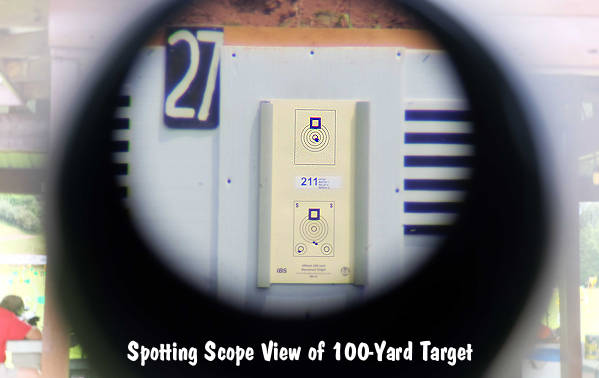
This article was prepared by past IBS President Jeff Stover based on results from the 2019 IBS 100/200 Group Nationals held August 12-17, 2019 at the Holton Gun & Bow Club in western Michigan.
Let’s examine the Top Ten rifles from the IBS Group Nationals in the 10.5-lb Light Varmint Class. We’ll focus on the most popular rifle components — the choices for Actions, Stocks, Barrels, and Scopes.
Hall of Famer Jeff Gaidos taking aim at the 2018 IBS Group Nationals. He has a low-profile carbon-fiber stock with a Leupold fixed-power scope.
For some years now, BAT has been the predominant action. This year BAT actions held nearly 100% of the Top Ten places in all the Bag Gun equipment lists. Bruce Thom’s Idaho-crafted actions, except for a couple stray actions in Heavy Bench, swept the top rankings.
Next, look at barrels. Bartlein or Krieger seem to rule with upstate New York’s venerable Hart barrels as competitive. Shooters tend to go with winners, so Wayne Campbell and Jeff Peinhardt dominate as gunsmiths for the top benchrest shooters.
In stocks there seems to be variety, but there is some commonality. The Scoville and Scarbrough stocks, both Michigan-made, are laminated wood (balsa and other wood) with carbon fiber and wrapped in carbon fiber. The Scoville stock on my 10.5-lb rifle weighs 18 ounces but is full size with a nice long fore-end. Bob Scarbrough makes a very similar product. Both are winners — it’s a choice of Ferrari or Lamborghini. The Roy Hunter and Terry Leonard stocks among these top rifles take a different route to winner’s circle. Both are wood (cedar or other), but super high-tech as they are laminated with carbon fiber. They are beautiful to boot. High-magnification Leupold, March, and Nightforce scopes rule the roost among benchrest optics.
Bullets and Powder
Bullets are important. Really important. A hot bullet gives you “Teen Aggs” and lots of trophies. An average bullet does not. Most of these are 68 grain 6mm boattails. The Peinhardt (StaMoly Precision) bullet is well represented on this list, but some top shooters make their own as you can see. Bullet jackets are likely StaMoly or J4. For powder, nearly everyone shoots Vihtavouri N133 except a few guys running LT30/32 or surplus 8208.
The new Garmin Xero® C1 Pro chronograph has hit the market and it has been making a splash. Initial reports have been very positive, and the price is attractive — $599.99. Accordingly, many LabRadar owners are putting their orange radar chronos up for sale. Check out the features of this new compact radar chrono in this official product launch video from Garmin:
The new Xero C1 Pro radar chronograph, measuring just 3.03″x2.38″x1.36″, is compact and easy to transport. Using Doppler radar, the Xero C1 Pro accurately records projectile velocities from 100 fps to 5,000 fps, so it works with all kinds of projectiles. Setup is simple and intuitive, thanks to the button-operated design. SEE FULL RecoilWeb Review (many photos).
Garmin offers a modern ShotView™ smartphone app and lets you compare velocities for all shots fired, track ES/SD, and record total sessions. The rugged Xero C1 Pro chrono has a IPX7 water-resistant rating and boasts up to 6 hours of battery life. The unit ships with a compact tripod mount, and the screen is described as “sunlight-visible, transflective, monochrome” so it is easy to view in all conditions. There is no need to attach anything to your firearm, so this Garmin chrono won’t affect rifle zero or barrel harmonics.
Garmin Xero C1 Pro Features:
— Measures projectiles from 100 fps to 5,000 fps.
— Works with bullets, arrows, bolts, slugs, birdshot, paintballs, and airsoft BBs
— Easy to set up and use; turn it on, point it in the right direction, and shoot within 15″ of device
— Compact design is easy to transport — can even fit in a pocket
— Features an easy-to-read, backlit display
— Button-operated design is simple to use
— Up to 6 hours of battery life
— IPX7 water-resistant rating
Garmin Radar Chrono Works with Full-Featured Modern Smartphone App
Garmin offers a full-featured ShotView™ smartphone App for the Xero C1 Pro radar chronograph. This lets you compare velocity for every shot fired, calculate extreme spreads, keep track of different projectiles, track deviation and more.
The Garmin Xero C1 Pro ($599.99 MSRP) can be pre-ordered now from leading vendors including Midsouth, MidwayUSA, and Area419. In addition, Area419 offers an ARCALOCK Arm allowing the Xero C1 Pro to be mounted via an ARCA rail.
Garmin Xero C1 Pro Radar Chronograph Video Reviews:
Gun-maker Bear Creek Arsenal has a good article on its website about rifling barrels. The article explains four common methods of rifling the interior of barrels: Cut Rifling, Broach Rifling, Button Rifling, and Hammer Forging. In addition, the article describes a new (and somewhat radical) method, Cation Rifling, which employs acid to etch rifling. READ Full Article.
The main focus of the article is on Cold Hammer Forging of barrels. This requires massive, expensive tooling, but the results can be very consistent. Many top gun-makers, such as FN, HK, and Ruger, have used the hammer forging process. And now Bear Creek Arsenal also offers hammer-forged barrels. Bear Creek recently acquired two state-of-the-art cold hammer forging machines. With hammer forging, a chamber can be formed and barrel contour shaped at the same time. This process produces some of the most consistent barrels available today. Here is a summary of how Cold Hammer Forging works:
Cold Hammer Forging — Machinery and Process
A cold hammer-forged barrel starts life… as a short and fat blank with a polished hole running through the center. A hardened mandrel of proper width (caliber) and rifling pattern — again reversed/inverted — is placed into the smooth bore. The pair go into a forging machine that compresses the steel against the mandrel, hammering it into final shape. The barely detectable external spiral patterns that remain on some barrels are imprints from those hammers at work. Some companies polish them out, however.
Cold hammer forging machinery is very expensive, representing a significant investment for companies. However, when the hammer forging process is done and the mandrel removed, the resulting barrel is the proper length and profile with rifling that is consistent and butter smooth. No lapping is required — a time and expense saver — although a stress-relief step often follows.
The process takes place at room temperature, despite the misleading “cold” terminology. There is a hot hammer forging process, but the equipment is even more expensive and the slight improvement in grain consistency hasn’t proven advantageous enough for a return on that investment. Performance is impressive and consistent.
One of the biggest advantages of a cold hammer forged barrel is longevity. They… survive abuse and last longer. The manufacturing process adds those enviable virtues with each strike of those hammers — strengthening the metal in a work-hardening process employed by blacksmiths for centuries.
Comparing Popular Rifling Methods
What rifling process should you choose? If long-distance is your passion and you home brew custom cartridges to print tiny groups in the next zip code, cut rifling is the optimum choice. Button rifling is a solid second choice, but not always the Holy Grail long-distance shooters dream about. Cold hammer forged barrels, however, last longer and [offer great performance for the price.]
Barrel-maker Dan Lilja’s website, RifleBarrels.com has an excellent FAQ page that contains a wealth of useful information. On the Lilja FAQ Page you’ll find answers to many commonly-asked questions. For example, Dan’s FAQ addresses the question of barrel life. Dan looks at factors that affect barrel longevity, and provides some predictions for barrel life, based on caliber, chambering, and intended use.
NOTE: This article was very well-received when it was first published. We are reprising it for the benefit of readers who missed it the first time.
Dan cautions that “Predicting barrel life is a complicated, highly variable subject — there is not a simple answer. Signs of accurate barrel life on the wane are increased copper fouling, lengthened throat depth, and decreased accuracy.” Dan also notes that barrels can wear prematurely from heat: “Any fast varmint-type cartridge can burn out a barrel in just a few hundred rounds if those rounds are shot one after another without letting the barrel cool between groups.”
Q. What Barrel Life, in number of rounds fired, can I expect from my new barrel?
A: That is a good question, asked often by our customers. But again there is not a simple answer. In my opinion there are two distinct types of barrel life. Accurate barrel life is probably the type most of us are referencing when we ask the question. But there is also absolute barrel life too. That is the point where a barrel will no longer stabilize a bullet and accuracy is wild. The benchrest shooter and to a lesser extent other target shooters are looking at accurate barrel life only when asking this question. To a benchrest shooter firing in matches where group size is the only measure of precision, accuracy is everything. But to a score shooter firing at a target, or bull, that is larger than the potential group size of the rifle, it is less important. And to the varmint hunter shooting prairie dog-size animals, the difference between a .25 MOA rifle or one that has dropped in accuracy to .5 MOA may not be noticeable in the field.
The big enemy to barrel life is heat. A barrel looses most of its accuracy due to erosion of the throat area of the barrel. Although wear on the crown from cleaning can cause problems too. The throat erosion is accelerated by heat. Any fast varmint-type cartridge can burn out a barrel in just a few hundred rounds if those rounds are shot one after another without letting the barrel cool between groups. A cartridge burning less powder will last longer or increasing the bore size for a given powder volume helps too. For example a .243 Winchester and a .308 Winchester both are based on the same case but the .308 will last longer because it has a larger bore.
And stainless steel barrels will last longer than chrome-moly barrels. This is due to the ability of stainless steel to resist heat erosion better than the chrome-moly steel.
Barrel Life Guidelines by Caliber and Cartridge Type
As a very rough rule of thumb I would say that with cartridges of .222 Remington size you could expect an accurate barrel life of 3000-4000 rounds. And varmint-type accuracy should be quite a bit longer than this.
For medium-size cartridges, such as the .308 Winchester, 7×57 and even the 25-06, 2000-3000 rounds of accurate life is reasonable.
Hot .224 caliber-type cartridges will not do as well, and 1000-2500 rounds is to be expected.
Bigger magnum hunting-type rounds will shoot from 1500-3000 accurate rounds. But the bigger 30-378 Weatherby types won’t do as well, being closer to the 1500-round figure.
These numbers are based on the use of stainless steel barrels. For chrome-moly barrels I would reduce these by roughly 20%.
The .17 and .50 calibers are rules unto themselves and I’m pressed to predict a figure.
The best life can be expected from the 22 long rifle (.22 LR) barrels with 5000-10,000 accurate rounds to be expected. We have in our shop one our drop-in Anschutz barrels that has 200,000 rounds through it and the shooter, a competitive small-bore shooter reported that it had just quit shooting.
Remember that predicting barrel life is a complicated, highly variable subject. You are the best judge of this with your particular barrel. Signs of accurate barrel life on the wane are increased copper fouling, lengthened throat depth, and decreased accuracy.
Benchrest Barrel Life — You May Be Surprised
I thought it might be interesting to point out a few exceptional Aggregates that I’ve fired with 6PPC benchrest rifles with barrels that had thousands of rounds through them. I know benchrest shooters that would never fire barrels with over 1500 shots fired in them in registered benchrest matches.
I fired my smallest 100-yard 5-shot Aggregate ever in 1992 at a registered benchrest match in Lewiston, Idaho. It was a .1558″ aggregate fired in the Heavy Varmint class. And that barrel had about 2100 rounds through it at the time.
Another good aggregate was fired at the 1997 NBRSA Nationals in Phoenix, Arizona during the 200-yard Light Varmint event. I placed second at this yardage with a 6PPC barrel that had over 2700 rounds through it at the time. I retired this barrel after that match because it had started to copper-foul quite a bit. But accuracy was still good.


 Episode 94: Anyone’s Hunt Colorado Rifle Elk
 Forum member F-Class John is an avid F-Class competitor and expert handloader. This week he won the NRA F-0pen Mid-Range National Championship. John reviews reloading hardware and shooting-related products for his popular