On October 7th, Smith & Wesson, a leading American gunmaker for over 169 years, celebrates the Grand Opening of its new Tennessee Headquarters and production center. The Grand Opening event will feature a shooting day, product demonstrations, and fun events.
Since 1852, Smith & Wesson had been based in Springfield, Massachusetts. Now a big change is taking place. The company announced in September 2021 that it would relocate its headquarters from Massachusetts to East Tennessee, along with distribution, assembly, and other major operations. The Smith & Wesson Headquarters Grand Opening and Fall Festival event takes place Saturday, October 7 from noon to 8 p.m. at 1852 Proffitt Springs Road in Maryville, TN.
The Shooting Wire reports that: “The new Maryville facilities will house the company’s headquarters, plastic injection molding, pistol and long gun assembly and distribution centers. The company’s longtime home, Springfield, Massachusetts, will remain operational with all forging, machining, metal finishing, and revolver assembly staying behind. More than 1,000 S&W employees will still be employed there, but it’s a decided diminishment for the facilities that have been home to the company since 1832. More than 750 jobs are relocating from Springfield, Massachusetts, Deep River, Connecticut and Columbia, Missouri, to Maryville.”
Smith & Wesson’s President and CEO Mark Smith cited several key factors in the decision to move S&W’s corporate HQ from Massachusetts to Tennessee:
Support for the 2nd Amendment
Business friendly environment
Quality of life for employees
Cost of living and affordability
Access to higher education institutions
Availability of qualified labor for operations
Favorable location for efficiency of distribution
GunTalk Media Will Stream Live from the Grand Opening Gun Talk Media will broadcast LIVE from the Grand Opening of Smith & Wesson’s new facility on October 7, 2023. Beginning at 1:00 pm EST Ryan Gresham and Kevin Jarnagin host a LIVE broadcast throughout the day, giving viewers who might not be able to attend an inside look at the grand opening.
This broadcast provides an exclusive look at the new premises, interviews with key personnel, and insights into the latest offerings from one of the most renowned firearms manufacturers in the world.
Gun Talk LIVE Schedule on Saturday, October 7, 2023:
1:00 pm: S&W – Mark Smith, President & CEO
1:30 pm: S&W/Mighty Oaks Foundation – Chad Robichaux, Founder of Mighty
2:00 pm: USCCA – Maria Julianna
3:00 pm: S&W – Jerry Miculek, S&W Brand Ambassador
3:30 pm: Gatorz Eyewear – Scott Melton, Product Manager
4:00 pm: C&G Holsters –Chris Burns, Founder & President
4:30 pm: Rugged Rare – Travis Ferguson, VP of Sales & Marketing
5:00 pm: Black Rifle Coffee Company – Michael Shea
Grand Opening Silent Auction To Support Local Tennessee Charities
There is a special auction connected with Smith & Wesson’s TN Grand Opening. The Smith & Wesson Grand Opening Silent Auction is auctioning off over $20,000 worth of Smith & Wesson and partner products to support local East Tennessee charities. This Silent Auction is open to the public, and concludes 10/7/203 at 7:00 pm EST. CLICK HERE to see All Auction items.
They say that a man can never have too much money or too much time. Darrell Jones would add that a man can never have too many BR-based rifles. Darrell had a fleet of BRs, in 22 BR, 6mm BR, 6.5 BR, 7 BR, and 30 BR. But he was intrigued by the potential of a rifle in the .257 caliber. Could it shoot as well as a 6mm BR? Could it challenge the more popular calibers in the highly competitive 600-yard benchrest game? Through careful research and component selection, Darrell created a 25 BR rifle that proves the viability of the 25 BR as a competition round. Pushing 115gr high-BC Berger bullets at 2837 fps, Darrell’s 25 BR “Peppermint” won first place in its very first match.
The Barely Bigger BR — Exploring the .25 Caliber Option
Rifle Report by Darrell Jones
I decided to build a 25 BR after several weeks of deliberation and ruling out a .257 Ackley Improved. Part of my dilemma was that I wanted to shoot F-Class competition at 600 yards, and I was unsure about the accuracy potential of the 25 BR. However, I currently have several BRs chambered in 22 BR, 6BR, 6.5 BR, 7 BR, and 30 BR and they all shoot exceptionally well at 600 yards. This lead me to believe a 25 BR should deliver fine accuracy, just like its other BR siblings. Why wouldn’t a 25 BR shoot accurately provided that I built it with the right components? The feasibility saga began. I began searching diligently for custom 25-caliber bullets. Unfortunately, there are not many 25-caliber custom bullet makers. I actually found only two custom bulletsmiths who produce the 25s. I did look at Fowlers and then looked at Bergers. Both Jeff Fowler and Berger made 110-grain flat-base bullets when I was looking. [Editor — this 110gr bullet is no longer listed by Berger]. The Berger 110gr FB bullets (.414 ballistic coefficient) shot very well out of my 12-twist 25-06 Ackley. However, I wanted to shoot a heavier bullet if possible. Berger makes a 25-caliber 115gr VLD boat-tail with a high ballistic coefficient. This needs a 10-twist barrel.
Panda Action, McMillan Stock, Weaver T-36
As you can see, I went with a Panda polished action and a weighted McMillan BR stock painted metallic silver with red candy cane stripes thus the name “Peppermint”. This gun actually does double duty now as a 25 BR and 6 PPC switch barrel. When I want to run the gun as a 6 PPC for short range, I simply screw on the PPC barrel, then swap in a bolt (fitting the PPC bolt face) from another Panda action I own. That’s one advantage of owning custom Kelbly actions! Don’t even think about exchanging bolts between factory guns. Kelbly rings and a Weaver T-36 fixed-power scope handle the optical duties while a Jewell trigger set at one ounce takes care of the firing mechanism.
Chambering for the .25 Caliber BR Wildcat
I wanted a chamber that would let me shoot both the 110s and the 115s. I took some time surfing the net looking for rental reamers that had suitable throat dimensions. I found that Elk Ridge Reamer Rentals had a 25 BR pilot reamer available. I called and Elk Ridge faxed me a reamer diagram that indicated it was designed to tight SAMMI specs. I asked how often was the reamer used and was told “not very often”.
I did want a minimum no-turn neck optimized for Lapua brass. The drawing indicated that the reamer would cut a .281″ neck and a throat of 1.0315″. This was very close to ideal, though I did have to turn two thousandths off the necks of Lapua 6BR brass after I necked it up. I resized using a .277″ bushing and the loaded rounds came out to be .279″. Realizing that this was in the ball park, I decided to go with the Elk Ridge Reamer and build a 25 BR that could shoot 110gr or 115gr bullets. Now the question was where to get a match-grade 25-caliber barrel. I called quite a few of the custom barrel-makers, including BlackStar Barrels in Texas (no longer operating). I have had wonderful success with the BlackStar barrel on my 6BR “Chantilly” — it delivered great accuracy and impressive velocities. Since the 25 BR was so similar, I went with another BlackStar. I ordered a 10-twist, 6-groove, 1.250″-diameter straight-contour tube.
After chambering, the barrel finished at 1.245″ diameter and 27.5″ inches with an 11° crown. I actually had the throat lengthened to accept both Berger 110gr and 115gr bullets. The bases of the FB 110-grainers sit flush with the neck-shoulder junction, when they are seated .010″ into the lands. With the longer 115gr VLDs, the bottom of the bearing surface (i.e. start of boat-tail) is just about even with the neck-shoulder junction.
Accurate Load Development
The barrel broke in easily with just 10 shots, using a “shoot one and clean” process. The load I started with was 31.5 grains of Varget with CCI 450 primers. The Berger 110s and Berger 115s had the same Point of Impact (POI) at 100 yards. However, the 115s impacted two inches higher at 600 yards with the same load. That shows the benefits of a higher BC. Pushed by the CCI 450s and 31.5 grains of Varget, the 115-grainers were running about 2837 FPS. I boosted the load up to 32.0 grains but I noticed primer cratering, so I backed off, settling on 31.5 grains for the 115gr Berger VLD.
Peppermint Wins at 600 Yards
For her debut in competition, I took “Peppermint” to our local 600 yard F-class match. Shooting the Berger 115s with 31.5 grains Varget, she won with a perfect score of 200 with 14 Xs. At my club, we use a SR3 target. The X-Ring measures 3″ in diameter and the 10-Ring measures 7″. At the match there were some very good shooters with top-flight custom rifles in accurate calibers such as 6.5-284 and 22 Dasher. I was very fortunate to come out on top, but I give the credit to Peppermint’s good bench manners and outstanding accuracy.
As you can see from the target, “Peppermint” is a very accurate rifle that has proven herself in competition. It takes a good gun to finish “on top” in her very first match. So far, I’m very happy with the project, and more than satisfied with the accuracy of the 25 BR. This is definitely a worthy cartridge for Egg Shoots, 500m varmint matches, and the 600-yard F-Class game.
BR-Based Cartridge Comparison
CALIBER
22 BR
6mm BR
25 BR
6.5 BR
7 BR
30 BR
Bullet
80gr SMK
107gr SMK
115gr Berger
107gr SMK
130gr SMK
118gr BIB
BC
.420
.527
.522
.420
.391
na
Load Grains
31.0 H4350
30.0 Varget
31.5 Varget
32.0 Varget
34.0 AA2460
34.0 H4198
Barrel Length
27″
27″
27.5″
27.5″
28″
24″
Velocity
3100 fps
2880 fps
2837 fps
2851 fps
2719 fps
2970 fps
Comparing the BR-Based Variants
Now that I have several calibers in the BR cartridge family, (22 BR, 6mm BR, 6.5 BR, 7 BR, and a 30 BR), it is my humble opinion that they each have their own place. A varmint hunter’s dream, the 22 BR can push a bullet faster and more accurately than the 22-250. With an 8-Twist barrel, the 22 BR can send an 80gr SMK to 600 yards with extreme accuracy.
The 6 BR can do it all. The 6mm caliber offers a wide variety of quality bullets suitable for any shooting situation. All the major custom barrel makers produce outstanding 6mm barrels in a full range of twists. Moreover, since the 6 BR cartridge is so popular, there is a great store of knowledge about reloading for the 6 BR. It is easy to find a load that will shoot superbly in any bullet weight.
The 25 BR has proved to be easily tuneable, proficient and not fickle. You can obtain extreme accuracy without great effort in load development. The 115gr Berger offers a good high-BC projectile for this caliber, making the 25 BR a viable alternative to the 6 BR. As I’ve shown, it is competitive with a 6 BR in head to head competition.
Compared to the 25 BR, the 6.5 BR has a small edge in ballistics. However, there are not many light bullet choices available, especially from custom makers. The 123gr Lapua Scenar is an excellent bullet with a .547 stated BC, but it may be a bit heavy for the case capacity.
The 7 BR was designed for silhouette shooting, and it excels at that task. The 7 BR can push a 130 grain bullet fast enough to knock over the steel silhouettes at 500 meters with real consistency.
The 30 BR is nothing less than outstanding. The 30 BR is now the dominant cartridge on the benchrest Score-shooting circuit. It is also highly accurate for group shooting at 200 yards and very capable of winning a 600-yard F-Class match. Barrel life of over 6,000 rounds is realistic.
I like all the “flavors” of BR derived from the 6mm BR Norma case. However, if I could only have one BR in my safe, give me my 8-Twist, 6 BR “Chantilly” and I will be a happy camper. The final point I would make is if a cartridge is stamped BR on the case, it will shoot extremely accurately if you can.
AR owners know that their black rifles require regular cleaning and maintenance. And this modular platform allows many options for stocks, fore-arms, and optics mounting. That ability to customize is one of the AR’s major attractions, but customization requires solid understanding of the AR’s design and components.
To help AR owners optimize their rifles and maintain their rifles properly, Gun Digest Media offers an excellent 320-page illustrated book: AR-15 Setup, Maintenance and Repair. Authored by Patrick Sweeney, this book is a “one-stop guide to repairing, maintaining and modifying America’s favorite rifle.” The MSRP for the paperbook resource is $33.99 from Gun Digest, but it is available on Amazon starting at $25.13 with $3.99 shipping. Digital editions are offered by GunDigest for $31.99.
If you need to disassemble and maintain your AR rifle, swap barrels or handguards, add optics, or customize the stock, Gun Digest’s AR-15 Setup, Maintenance and Repair book tells you what you need to know. From field-stripping to barrel mounting and trigger installations, the book covers a wide range of topics. The book provides step-by-step instructions for set-up and maintenance, with hundreds of detailed photos. The book also includes AR gunsmithing chapters with reviews of recommended tools.
Author Patrick Sweeney is a certified master gunsmith and armorer instructor for police departments. Sweeney has also authored the notable 4-volume Gunsmithing the AR-15 series (Vol. 1, Vol. 2, Vol. 3, and Vol. 4) and 20+ other titles for Gun Digest Books.
Whether you want to learn about disassembling your AR for regular maintenance, field-stripping, swapping out parts, adding optics or customizing a stock, AR-15 Setup, Maintenance and Repair guides you through everything you need to know to keep your AR-platform rifle running well. There are also tips on how to improve accuracy, and maintain your bolt carrier group properly.
Authored by Patrick Sweeney
Published by Gun Digest Books
ISBN-13: 978-1951115470
320 pages, softcover, 8 ¼ x 10 7/8 inches
Editor’s NOTE: The key to keeping an AR running reliably is proper lubrication (in the RIGHT places), and regular cleaning of the bolt carrier and bolt, including ejector recess and extractor recess. The majority of non-functioning ARs we’ve seen had gunk, lube, carbon, and brass shavings in those recesses.
Other AR Books by Patrick Sweeney
Bonus Video — AR15 Maintenance with Jerry Miculek
In this helpful video, legendary shooting Jerry Miculek explains how he cleans and maintains his AR-platform rifles. Miculek shoots ARs in three-gun competitions.
This article is Copyright 2023 AccurateShooter.com. No republication is allowed without advance permisson and fees.
What would you do if you had a LIVE Round stuck in a chamber? Well, don’t hammer a wood dowel in the barrel, that’s for sure. Here is a tale of stupidity that could have injured the rifle owner. This account appeared on the Facebook Page of Brock & Norris Custom Rifles, a gunsmith shop in the United Kingdom.
Live, Loaded Round Stuck in Chamber — What NOT to Do!
Commentary by gunsmith Mike Norris
Here is a cautionary tale. A client came into the workshop with a problem which could have had very serious [even deadly] consequences. And it is not the first time we have seen this. Firing neck-sized-only ammunition, the client attempted to load a round which then jammed solid in the chamber. The bolt would not close and the round was unable to be extracted.
The problem was compounded by various attempts to push the loaded round from the chamber with cleaning rods and the assistance of a hammer (I kid you not!). All of which damaged the bore and the crown, culminating in a wooden dowel being hammered into the barrel which subsequently broke off in the bore. The end result was a barrel that was totally wrecked.
One Facebook friend posted: “Fortunate avoidance of a ‘Darwin Award’. I can hear it: ‘Go on hammer the bolt, she’ll go!’. We’re missing a ‘face palm’ emoji here.”
The Problem Started with a Neck-Sized Case
The moral of this story is DO NOT NECK SIZE cases. Mike advises: “Full-length size cases correctly. You only move the shoulder back 1 to 1.5 thousandths and the case will feed and extract EVERY TIME. Yes you will have to trim cases occasionally but it is one hell of a site cheaper and safer than jamming a live round in the barrel and wrecking the barrel trying to remove it. Not to mention the risk to life and limb!”
What Should Have Been Done in this Situation?
Mike was asked the best method for removing a stuck round. He stated: “The Grease Gun Method on a threaded barrel works*. However, in this case, this was not remotely possible due to 20 inches of wooden dowel being broken off in the bore as well. The live round (yes it was live!) was attempted to be removed by hammering on a brass cleaning rod (an actual hammer was used) to try to dislodge it. That brass rod broke, so then a wooden dowel was employed, and THAT broke as well.”
Mike cautions that, when a live, loaded round is involved you must be very careful: “Do not be taking chances with your own safety or others around you. When it is safe to do so, get the rifle to a professional. By the way he WILL [chide you] for being daft in the first place and then bringing the problem into his premises. Expect to be charged for the expertise to remove said obstruction, In the past I even had a client send me a loading die with a live .338 Lapua round in it through the Post no less!”
* This YouTube Video shows the successful removal of a jammed FIRED (not live) case from an AR15 barrel. You can see the fired case eject at 15:35 time-mark, after the primer pops out first. But note, this was NOT a live, loaded round. Extreme caution must be excercised with live rounds.
NOTE: The .375 CheyTac is a proprietary cartridge of CheyTac USA. CheyTac® is a registered trademark. CheyTac® bullets, brass, and ammunition are offered by CheyTac USA, which also produces a variety of high-quality firearms for civilian and military use. See all CheyTac® products at CheyTac.com.
This Extreme Long Range (“ELR”) rifle features a massive BAT “L” Round Action, McMillan Beast Stock, 38″ Bartlein 1:7″-twist Barrel, T5 Terminator Muzzle Brake, R.A.D. Recoil Reduction unit, and a customized Cheek Riser. The “Beast” stock name is appropriate — this rifle weighs a massive 38 pounds. Including the T5 brake, the finished barrel, chambered in .375 CheyTac, is 44″ long! All the work was done by Hall-of-Fame shooter and gunsmith Thomas “Speedy” Gonzales, of S.G. Precision LLC in San Antonio, Texas. To see other rifles crafted by Speedy, visit his Facebook page.
Speedy milled vents in the fore-end. He told us: “when you’re burning 150+ grains of powder you need all the ventilation you can get to help reduce the barrel heat.”
There are many good brakes out there, then there’s the “TERMINATOR”! — Speedy
The Phoenix Bipod employs a lowering modification.
About the .375 CheyTac Cartridge
Some of the most successful ELR cartridges are based on the CheyTac family, including the .375 CheyTac (9.5×77) and .408 CheyTac (10.36 x 77). This .375 CheyTac cartridge has proven to be tough and accurate. And it is capable of winning — our friend Derek Rodgers won the 2017 King of 2 Miles (K02M) event shooting a .375 CheyTac (9.5×77).
Derek Rodgers was the 2017 King of 2 Miles. He was also the first-ever human to ever hit the maximum distance target target at 3368 yards (1.91 miles). His cartridge choice? The .375 CheyTac. Derek ran Cutting Edge Bullets in Peterson brass with Hodgdon H50BMG powder.
Q: Why did you choose the .375 CheyTac cartridge?
Derek: When I was asked to join the Applied Ballistics Team, I needed to get an ELR rifle built in a short period of time. I was under a very tight time schedule to get the project complete. In an effort to eliminate variables, I decided to keep things standard and as simple as possible. I chose the .375 CheyTac for the ease of getting components. The larger rifles are more difficult to get components quickly and I felt like the .375 CheyTac had enough attributes to be competitive at ELR distances.
In 2020, Lyman released the updated Second Edition of its AR Reloading Handbook. The original AR Reloading Handbook was the first reloading manual dedicated exclusively to the most popular semi-auto rifle in the USA. The Second Edition of this comprehensive Lyman AR Reloading Handbook has been updated to include more cartridge types and significantly more load data. This provides AR shooters with reloading info for the vast majority of popular chamberings used in AR-platform firearms. CLICK HERE to order the book for just $12.49 on Amazon, a 31% savings off the $17.98 list price.
Reloaders will appreciate the extensive pressure-tested data covering a very wide selection of bullet types and powder types. The Second Edition provided data for newer cartridges such as the .224 Valkyrie, .22 Nosler, .24 Nosler, 350 Legend, as well as sub-sonic data. In addition, articles by well-known authorities are included, covering topics such as “Building An AR” and “AR15 Gas System Lengths”. This book is available direct from Lyman and from Amazon (at a discount).
Features of Lyman AR Reloading Handbook (Second Edition)
— Reloading data for popular AR-platform cartridge types, including the .223 Rem, .224 Valkyrie, 6.8 Rem, .300 AAC, 7.62×39, 350 Legend, 450 Bushmaster, .50 Beowulf and more.
— Many informative articles on specialty topics such as Reloading for Suppressors and Building ARs.
— Load Data covers all major brands of bullets and powders.
— Load Data for cast bullet data and sub-sonic loads.
AR-Platform Insights — Operation and Maintenance Tips
Here are two helpful videos for AR owners. The first uses 3D computer animation to show how AR-platform rifles work — from the inside. The Cutaway views show the operation of the gas system and bolt while cycling. The second video, by legendary competitive shooter Jerry Miculek, provide helpful guidance on AR disassembly and maintenance.
Book publishing tip from EdLongRange. We welcome reader submissions.
Here is beautiful F-Open rig crafted by Forum member CigarCop of KW Precision LLC. It features a laminated wood stock with stunning figured walnut on the outside.
One of the most popular items in our Shooters’ Forum is the ongoing “Pride and Joy” thread. Since 2009, Forum members have posted photos and descriptions of their most prized rifles. Here are some of the most popule “Pride and Joy” rifles showcased in our Forum. Do you have a gun you’d like to see featured there? Just Register for the Forum and you can add your favorite gun to the list. You’ll enjoy the Forum, which recently hit the 70,000-member mark!
600/1000 Benchrest Light Gun for Richard Schatz in 6 BRA
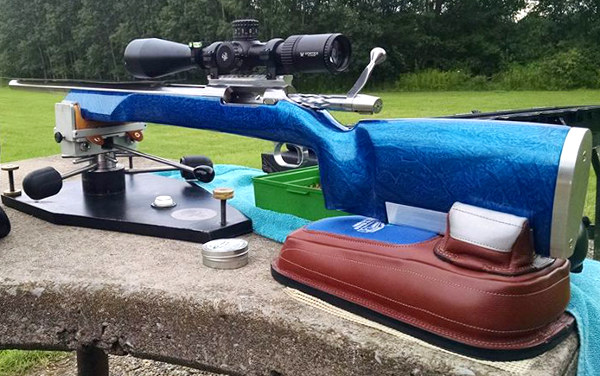
This blue benchrest rig was crafted by Alex Wheeler for ace benchrest competitor Richard Schatz, a past 600-yard IBS Shooter of the Year. Richard’s new 600/1000-yard Light Gun features a Krieger barrel chambered in 6 BRA (40° Ackley version of 6mmBR Norma). That Krieger is mated to a 1.550″ BAT B action, ignition-timed for smooth bolt close and increased accuracy. The trigger is the sophisticated Bix’n Andy. Schatz’s BAT is glued and screwed into a Wheeler LRB stock, with aluminum rails and adjustable metal “tracking rudder” on the toe of the stock. The rudder can be adjusted side to side to ensure optimal tracking, while the rudder’s vertical angle can be adjusted slightly with shims.
Hand-Crafted Thumbhole-Stocked Rifle Chambered in 6 PPC
Forum Member Grimstod offered this handsome 6 PPC custom with a beautiful, hand-made thumbhole stock: “This was fully accurized with Premier Accuracy recoil lug installed. Really makes these shoot a lot better. It features a Kelbly Panda action with Hart barrel and glass bedding. Trigger fall was perfect to start and we have to give Ian Kelbly big thumbs up for making every action perfectly timed.” On top is a March competition scope. See more photos at www.premieraccuracy.com.
A Wicked Accurate Big Dawg in 28 Nosler
This 28 Nosler Benchrest rifle looks good and shoots even better — check out that 20-shot target shot at 200 yards! You can’t argue with that…
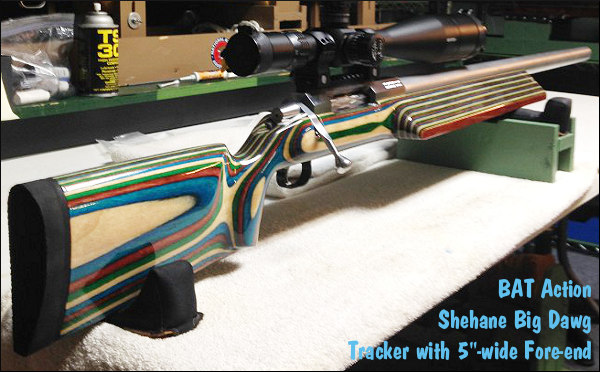
Belonging to Forum member LA50Shooter, this rig is chambered in 28 Nosler, with metal work by Gre-Tan Rifles. The action is a BAT Model “L” 1.650 Octagon with a 30 MOA scope rail, running a Jewell BR Trigger. The stock, from D&B Supply, is a Shehane Big Dawg Tracker with 5″ fore-end. Color scheme is “Field & Stream” Rutland laminate. This big rig boasts FOUR 34″ Benchmark barrels (1.5″ for seven inches tapering to 1.225″ at muzzle).
A Pair of Score Benchrest Beauties
Forum member JimPag showcased two new Benchrest-for-Score rifles. The rig on the left, smithed by Dwight Scott, features a Farley Black Widow RBLPRE (with Bix’n Andy trigger). It features Pistachio and Carbon Terry Leonard stock glued and screwed by Sid Goodling. The barrel is a Krieger 23.5″ chambered in 30BR with a Mike Ezell tuner. It’s topped with a Goodling-built 1-piece Davidson base and a Nightforce 42X Comp scope. The rifle on the right, smithed by Sid Goodling, features a Marsh Saguaro RBLPRE Action with Bix’n Andy trigger, and March 36-55X scope. This rifle boasts a rare Screwbean Mesquite and carbon stock by Terry Leonard. The 23″ Lilja bbl is chambered in 30 Thrasher with a Goodling tuner. (30 Thrasher is longer 30 BR case developed by Joe Entrekin). Jim also has two other barrels for this action in 30 BR and 6 BRAI. On top is a Sid Goodling-built one-piece Davidson base with a March 36-55X scope.
6BRA with BAT Action, Brux Barrel — The Blue Beauty
Next is a blue 6BRA beauty from Forum Member RiflePainter: “This is my brand new 6BRA Light Gun built by Jason Danley at Danley Precision! Jason did all of the work including paint. Brass was done by Darrel Jones at DJ’s brass service.” This features a Johnny Byers stock painted in HOK Custom Oriental Blue Candy mix. The action is a BAT DS Left-load, Right-eject, Right bolt fitted to a 1.5 oz. Jewell trigger. The barrel is a 28″ Brux HV 1:8″-twist chambered for the 6BRA (6mmBR Ackley) and fitted with a Harrell’s radial muzzle brake. On top is a Sightron SIII 10-50x60mm optic riding in BAT 1-piece scope rings.
Rem 700 in Manners Stock — .284 Winchester for Hunting
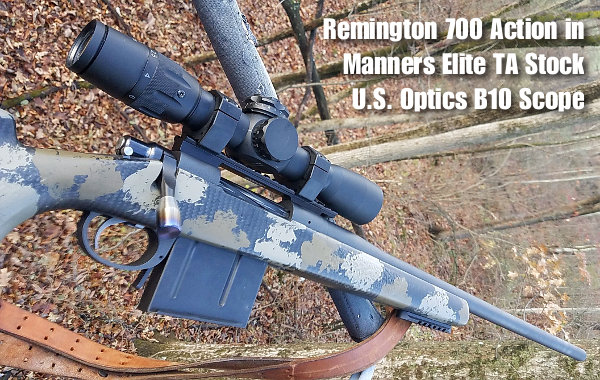
Here’s a Rem 700 enhanced with a Manners Elite TA stock and other upgrades. Forum Member NickB1075 says: “Here is a rifle I finished for hunting this year. It’s a bit heavy for New York woods carry but it just shoots great. Maybe I will have to get one of those fancy Proof Research barrels to lighten it up a bit.” Nick is running a Benchmark 1:8.5″-twist barrel chambered in .284 Win with 0.315 neck for shooting 150gr Barnes bullets. Nick added a Jewell trigger and on top is a U.S. Optics B10 Scope.
When Only the Biggest and Boldest Will Do — .50 BMG
No “Pride and Joy” feature would be complete without a Big Boomer. This impressive .50 BMG, “61 inches of big bore goodness”, weighs a whopping 49 pounds (95 lbs. complete with case and accessories). This rifle’s proud owner, forum member 6MT, says everything on this black beast is jumbo-sized: “Yes, I can stick my finger clear through the ports in the muzzle brake!” The rifle boasts a U.S. Ordnance 31″ heavy-contour barrel fitted to Barnard GP action. The stock is a “Big Mac” from McMillan. No optics yet — 6MT says he is “looking at an ATACR 7-35x56mm with a Spuhr mount… As soon as my wallet recovers!”
Put the same load in a variety of barrels (with the same length and chamberings) and you’ll see a wide variance in muzzle velocity. In fact, it’s not unusual to see up to 100 fps difference from one barrel to the next. We demonstrated this with a comparison test of Lapua factory ammo.
Chron Testing Lapua Factory Ammo
At our Southern California test range some years ago, we chronographed Lapua 105gr 6mmBR factory ammo in three different 8-twist barrels of similar length. The results were fascinating. Lapua specs this ammo at 2790 fps, based on Lapua’s testing with its own 26″ test barrel. We observed a speed variance of 67 fps based on tests with three aftermarket barrels.
Barrel Velocity Variance
Brand ‘S’ and Brand ‘PN’ were pre-fit barrels shot on Savage actions. Brand ‘K’ was fitted to a custom action. All test barrels were throated for the 100-108 grain bullets, though there may have been some slight variances in barrel freebore. With a COAL of 2.330″, the rounds were “jumping” to the rifling in all barrels.
Among the four barrels, Brand ‘PN’ was the fastest at 2824 fps average — 67 fps faster than the slowest barrel. Roughly 10 fps can be attributed to the slightly longer length (27″ vs. 26″), but otherwise this particular barrel was simply faster than the rest. (Click Here for results of 6mmBR Barrel Length Velocity Test).
IMPORTANT: Results Are Barrel-Specific, Not Brand-Specific
These tests demonstrate that the exact same load can perform very differently in different barrels. We aren’t publishing the barrel-makers’ names, because it would be wrong to assume that ‘Brand X’ is always going to be faster than ‘Brand Y’ based on test results from a single barrel. In fact, velocities can vary up to 100 fps with two identical-spec barrels from the SAME manufacturer. That’s right, you can have two 8-twist, 26″ barrels, with the same land-groove configuration and contour, from the same manufacturer, and one can be much faster than another.
Don’t Demand More Than Your Barrel Can Deliver
We often hear guys lament, “I don’t get it… how can you guys get 2900 fps with your 6BRs and I can only get 2840?” The answer may simply be that the barrel is slower than average. If you have a slow barrel, you can try using more powder, but there is a good chance it may never run as fast as an inherently fast barrel. You shouldn’t knock yourself out (and over-stress your brass) trying to duplicate the velocities someone else may be getting. You need to work within the limits of your barrel.
Factory Ammo Provides a Benchmark
If you have a .223 Rem, 6mmBR, .243 Win, 6.5×47 Lapua, 6.5 Creedmoor, 6.5×55, .308 Win, .30-06 Springfield, or .338 LM Rifle, we recommend you buy a box of Lapua factory-loaded ammo. This stuff will shoot great (typically around half-MOA), and it can give you a baseline to determine how your barrel stacks up speedwise. [Editor’s NOTE: The original test was conducted in 2008. The velocity of current-production Lapua factory ammo might be higher or lower, so your results may vary.]
When you complete a new 6mmBR rifle, it’s definitely smart to get a box of the factory ammo and chronograph it. That will immediately give you a good idea whether you have a slow, average, or fast barrel. Then you can set your velocity goals accordingly. For example, if the factory 6BR ammo runs about 2780-2790 fps in your gun, it has an average barrel. If it runs 2820+ in a 26″ barrel (or 2835 fps in a 28″), you’ve got a fast tube.
Gorgeous wood stock crafted by Joel Russo: “A customer from Texas commissioned me to make him a one-of-a-kind stock, so I pulled a slab out of inventory, and put it all together.”
One of the most popular items in our Shooters’ Forum is the ongoing “Pride and Joy” thread. Since 2009, Forum members have posted photos and descriptions of their most prized firearms. Here are some notable “Pride and Joy” rifles (and one wheelgun) showcased in our Forum. Do you have a gun you’d like to see featured there? Register for the Forum and you can add your favorite gun to the list.
Above is a nice field rifle built up by a father for his daughter. Forum member FrankZ explains: “This is my favorite rifle and it will become my daughter’s first centerfire. The action is from the first rifle I purchased with my own money 21 years ago (700VSS).” The rifle now sports a 24″ Brux barrel chambered in 6mm Creedmoor, with aftermarket PT&G Bolt and DBM metal.
Here is a 6BR Ackley Improved built by Alex Wheeler. This blue marble-painted beauty features a BAT “B” action timed by Alex, fitted with Jewell trigger, and Borden trigger guard. The barrel is a Hawk Hill HV contour finished at 28 inches. The stock is a Deep Creek Tracker with 4″ forearm and rudder system (the toe of the stock adjusts for angle, allowing better tracking). This scope is a Vortex 15-60x52mm Golden Eagle riding in Burris Signature Zee rings.
Forum member Grimstod posted this nice 6BRX in a scenic setting: “Bill Goad at Premier Accuracy crated this fantastic 6BRX. It shoots better then I do.” The rifle features a single-feed Alpin action, with Hart 26″ 1:8″-twist barrel, chambered for the 6BRX (6mmBR wildcat) with .269 neck. Grimstod currently runs 95gr Berger VLDs in Lapua brass. On top is a Leupold 40x45mm scope on a Picatinny rail that Grimstod machined himself. The stock is an HS Precision painted by Premier Accuracy.
Here’s a gorgeous green 6mm Dasher. Forum Member Gunnermhr states: “This is my new 12-lb Dasher for the 1000 Yard Benchrest silhouette matches. My good friend at CRS Custom Rifle Stocks in Aaronsburg, PA made and painted the stock. It’s similar to a Tooley MBR with a few modifications. It still supported on a 3″ forearm and is full length. Hard to imagine it still makes weight with a wood stock and a 36 power Leopold. Crossed the scale at 11.7lbs. The rifle features a BAT “B” Action. The paint is Candy Apple Green, the forearm has a white base-coat, center section is gray base coat and the buttstock is black base coat, all covered with five coats of clear. It’s the new pride of the fleet as it shoots as good as it looks. This gun hammers with 105gr Berger Hybrids.”
Here’s a state-of-the-art Benchrest rifle, finished proudly in bright red. Forum Member JimmyMac posted: “Picked up my new 6 PPC today. This red rig features a Borden B action (Jewell trigger) fitted with a Lederer 1:14″-twist barrel with a Loker tuner. The barrel action rides in a Roy Hunter stock. On top is a Nightforce 42x44mm Competition scope in BAT rights. The rifle was smithed by Dave Bruno.
This impressive rifle features an “antique” 1917 Enfield action chambered for the .338 Win Magnum cartridge. The lovely Maple stock was hand-carved by Forum member Spitfire_ER. He tells us: “I found this piece of wood as a return at a lumber yard about 7-8 years ago. I asked the guy in the yard about it and he said it had been returned because it had too much figure for the job the customer was working on. First thing I thought was, ‘That would make a nice stock’.”
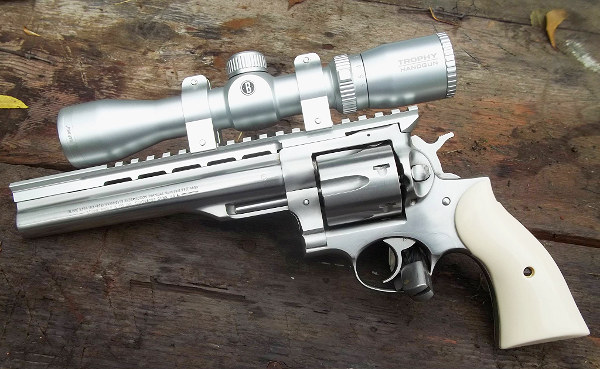
Not a Rifle But Still a Stunner…
Last but not least is one of the nicest stainless Ruger revolvers we’ve ever seen. Forum member Longcarbine says: “This is not a rifle, but it’s my favorite weapon”. The Ruger is fitted with a custom Picatinny scope rail with matching silver-tone Bushnell Trophy handgun scope, plus handsome faux Ivory grips. This wheelgun is almost too pretty to hunt with…
Emil Kovan is one of the top F-Class shooters in the world. He won the 2014 United States F-Open Championship, finished second at the 2015 USA Nationals, and then finished second at the 2016 Canadian F-Open Nationals. Most recently Emil was a member of the World Championship-winning F-Open Team USA that competed this spring in South Africa. He definitely knows what it takes to build top-tier F-Open rifles. Today’s feature story first ran a few seasons back, and today there are some more stock and optics options, but this is still a very impressive F-Open rig. To learn more about the latest F-0pen Magnum chambering options read Emil Kovan’s recent Daily Bulletin story, Cartridges for F-Class — Rise of the Magnums.
“What are the best components for an F-Open class rifle, and why?” That’s a question that I get asked all the time and will try to answer in this article. Two months ago, I was contacted by Duane, a gentleman I met at the 2015 F-Class Nationals. He was interested in building a rifle with the impressive Master Class Low Profile F-Open Stock, created by Carl Bernosky and Alex Sitman of Master Class Stocks.
I have known Alex Sitman for many years, and use his stocks exclusively, but was not very familiar with his new Low Profile F-Open stock. After a brief conversation with Alex, I placed an order, and had the stock inletted and bedded at my shop in a month. My first impression was “Wow that’s a long stock” — the forearm is significantly longer than on the original Master Class F-Class prone stock. I bolted the barreled action in, and squeezed the end of the forearm and barrel together, the stock flexed a little bit, but not as much as other designs that I have tested. I think that’s due to having “more meat” in the receiver area. The full stock depth continues farther forward that on some other “low profile” designs. That makes the stock stiffer in the vertical plane, reducing the hinging effect forward of the action. The stock was finished in gloss black per the customer’s request. Interestingly, I found that the multiple layers of paint and clearcoat stiffened the stock up quite a bit.
CLICK IMAGE below for full-screen version
Low Center of Gravity Tames Torque
Compared to the original Master Class F-Open stock, the barrel sits about an inch lower. Lower center of gravity equals less torque, and that is very important when shooting heavy bullets in fast twist barrels. Another significant improvement is that the toe of the stock is flat and parallel to the forearm. I added a 3/4″ track rail in the rear, and milled the underside of the fore-end to create two parallel “rails” in the front to help the stock track better.
One of the biggest reasons why I like Master Class stocks, is the pistol grip. I don’t shoot “free recoil” and a comfortable pistol grip is super important to me when selecting a stock. The new Master Class Low Profile stock shares the same grip as the old model. This allows the stock to accommodate either a “hard hold” style or a more free-recoil style of shooting — whatever the rifle’s owner prefers. This design versatility is one reason I recommend Master Class stocks. Shooters may experiment with either shooting style to find what suits them best.
Cartridge Choice — A 40° .284 Win Improved
Duane decided to have the barrel chambered for my 284 KMR IMP (Improved) wildcat. What is .284 KMR IMP and why choose it over the straight .284 Winchester? Improved by definition means “made better”, I took a great cartridge, and modified it to increase capacity, reduce pressure, and increase brass life.
There are many “improved” variants of the original .284 Winchester: 7mm Walker, .284 Shehane, .284 Ackley and so on. My version, the 284 KMR IMP, shares the .010″ blown-out sidewalls of the .284 Shehane, but I have further increased the case capacity by changing the shoulder angle from 35 to 40 degrees. The 284 KMR IMP allows you to almost match magnum cartridge velocity in a standard-bolt-face action. If you want to run 180gr-class 7mm bullets over 2900 FPS, it is cheaper and more convenient to have a barrel chambered in 284 KMR IMP than to spend $650 for a magnum bolt.
Tuning Loads for the .284 Win Improved Cartridges
The 284 KMR IMP seems to have two nodes, one around 2820 fps and other at 2940 fps. My match load clocks at 2935 fps with single-digit ES. Note –I selected that load based on accuracy, NOT raw speed. A lot of novice (or hard-headed) shooters make the mistake to push their cartridges to the max, and disregard more accurate loads at lower velocity.
The sport of F-Class is rapidly growing, and the equipment used is improving constantly. I remember that only few years ago, an F-Open rifle that could shoot sub-one-inch of vertical at 300 yards was considered competitive. Now, we are pursuing sub-one-inch vertical at 600 yards! It takes a great rifle to approach that goal, but it is also up to the shooter to learn and experiment as much as possible in order to achieve success.
Dies for an Improved .284 Win Cartridge
One of the biggest challenges in campaigning a wildcat cartridge has been obtaining great dies. When searching for custom dies, it almost seems like that the odds are stacked against us. The most common problem is wait-time — custom die orders can take months to be completed. Also, most custom die makers want you to send them two or three cases, each fire-formed three times. I find that funny because if could somehow properly size the cases for three fire-forming cycles, I would not need a sizing die.
Custom-made dies should size the case just right, but sometimes the die’s internal dimensions are slightly off, and this leads to problem number two: dies sizing too much (or even worse) too little. I had a one “custom” die that would not size the bottom of the case enough. This made the extraction of fired cases very difficult. I feel that the best option (if available) for shooters interested in wildcat chambers is to have their gunsmiths make the dies. I offer that die-making service in addition to barrel chambering.
BAT Machine “M” Action
Duane decided to use a BAT M action for this rifle, and I think that he could not have made a better choice. We are blessed with many good match-quality receivers: Barnard, BAT, Borden, Kelbly, Nesika, and Stiller just to mention a few. These are all very well-made and suitable for F-Class. Among BAT Machine Co.actions, I like BAT models M, MB, and 3LL best. I prefer these because because of their size (large bedding footprint) smoothness, timing, options available, and last but not least visual appearance.
Trigger: I recommend and use Jewell triggers. Other good options are: Kelbly, CG Jackson (good 2-Stage) Anschutz (best 2-Stage for Bat and Kelbly actions), Bix’N Andy, and David Tubb.
Barrel: Duane made another good choice here. He decided to go with a Brux 1:8.5″-twist, 4-groove cut-rifled barrel. If you look at the F-Class and Long Range benchrest equipment lists, you will see that cut-rifled barrels are currently dominating. Many records have been shot with both button-rifled, and cut-rifled barrels. I have shot both, and prefer cut-rifled barrels. I am not saying that button-rifled barrels are not capable of shooting as well as cut-rifled barrels, but on average, in my experience, four out of five cut-rifled barrels (from top makers) will shoot well, vs. three out of five buttoned barrels. YMMV, but this is what I’ve observed.
Scope: Duane’s rifle was fitted with a Nightforce 15-55x52mm Competition scope with DDR-2 reticle. This optic is ultra clear, reasonably lightweight (28 oz.), super reliable, and has 1/8 MOA clicks — what you want for long range F-Class competition. In this 15-55X NF model, I like the DDR-2 reticle best, because fine cross hairs (FCH) are hard to see in heavy mirage. The DDR-2 has a heavier horizontal line, with a center dot. March scopes are also very popular and very well-made.
Thanks for reading, and keep ‘em in the middle…
About Emil Kovan Along with being a skilled, respected gunsmith, Emil Kovan has been a very successful F-Class competitor. He was U.S. F-Open National Champion in 2014, and finished second at the U.S. F-Open Nationals in 2015. Most recently he was a member of the World Championship-winning F-Open Team USA that competed this spring in South Africa. He definitely knows what it takes to build top-tier F-Open rifles.
– 2014 F-Class Open National Champion
– 2015 F-Class Open National Championship, Silver Medal
– F-Class Open National Championship Teams, 2015, 2014, 2013, Shooting Team Member
– Over 15 wins in Regional and State Championships in Palma, F-TR, F-Open
– 2013 U.S. National Team Member
– 2023 F-Open Gold Medal Team USA Member, 2023 World Championship in South Africa
BONUS Reading: F-Open Magnum Cartridge Options
Thinking about building a new F-Open rifle? Not sure about the chambering choice ? CLICK HERE to read Emil Kovan’s recent July 2023 article outlining the most popular magnum cartridges for F-Open competition. The .284 Win is still a great option, but bigger magnums do have some advantages.


 I did want a minimum no-turn neck optimized for Lapua brass. The drawing indicated that the reamer would cut a .281″ neck and a throat of 1.0315″. This was very close to ideal, though I did have to turn two thousandths off the necks of Lapua 6BR brass after I necked it up. I resized using a .277″ bushing and the loaded rounds came out to be .279″. Realizing that this was in the ball park, I decided to go with the Elk Ridge Reamer and build a 25 BR that could shoot 110gr or 115gr bullets. Now the question was where to get a match-grade 25-caliber barrel. I called quite a few of the custom barrel-makers, including BlackStar Barrels in Texas (no longer operating). I have had wonderful success with the BlackStar barrel on my 6BR “Chantilly” — it delivered great accuracy and impressive velocities. Since the 25 BR was so similar, I went with another BlackStar. I ordered a 10-twist, 6-groove, 1.250″-diameter straight-contour tube.
 After chambering, the barrel finished at 1.245″ diameter and 27.5″ inches with an 11° crown. I actually had the throat lengthened to accept both Berger 110gr and 115gr bullets. The bases of the FB 110-grainers sit flush with the neck-shoulder junction, when they are seated .010″ into the lands. With the longer 115gr VLDs, the bottom of the bearing surface (i.e. start of boat-tail) is just about even with the neck-shoulder junction.
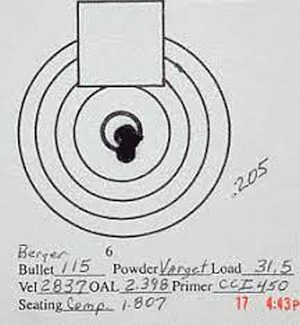 For her debut in competition, I took “Peppermint” to our local 600 yard F-class match. Shooting the Berger 115s with 31.5 grains Varget, she won with a perfect score of 200 with 14 Xs. At my club, we use a SR3 target. The X-Ring measures 3″ in diameter and the 10-Ring measures 7″. At the match there were some very good shooters with top-flight custom rifles in accurate calibers such as 6.5-284 and 22 Dasher. I was very fortunate to come out on top, but I give the credit to Peppermint’s good bench manners and outstanding accuracy.
 Now that I have several calibers in the BR cartridge family, (22 BR, 6mm BR, 6.5 BR, 7 BR, and a 30 BR), it is my humble opinion that they each have their own place. A varmint hunter’s dream, the 22 BR can push a bullet faster and more accurately than the 22-250. With an 8-Twist barrel, the 22 BR can send an 80gr SMK to 600 yards with extreme accuracy.






 Barrel Velocity Variance






 Along with being a skilled, respected gunsmith, Emil Kovan has been a very successful F-Class competitor. He was U.S. F-Open National Champion in 2014, and finished second at the U.S. F-Open Nationals in 2015. Most recently he was a member of the World Championship-winning F-Open Team USA that competed this spring in South Africa. He definitely knows what it takes to build top-tier F-Open rifles.


