Forum member Rardoin’s handsome F-Open rig features the new Borden BRM-XD action.
One of the most popular items in our Shooters’ Forum is the ongoing “Pride and Joy” thread. Since 2009, Forum members have posted photos and descriptions of their most prized rifles. Here are some of the most recent “Pride and Joy” rifles showcased in our Forum. Do you have a gun you’d like to see featured there? Just Register for the Forum and you can add your favorite gun to the list.
Bill Goad’s 6PPC Hunter “Ranch Rifle”
Forum member Grimstod tells us: “This is the personal rifle of Bill Goad. He has been experimenting with it on several levels. It is shooting great and has several matches on it now. Please enjoy these photos. More can be found on the website www.PremierAccuracy.com. We like the subtle barbed wire effect on the stock.
Twin-Upper AR with Custom Wood Furniture
This very unique AR belongs to Forum member Nuto-BR. He tells us: “Here are the two uppers I built. The top one is am X-caliber in 20 Practical with 24-inch, 1:11″-twist barrel. The bottom one is a WOA in .223 Rem, with 20″, 1-12″ twist barrel. They both shoot 1/2 MOA or better. Both stocks are laminated Maple and Walnut. I reversed the order of the two woods to tell them apart.”
Two Dashers and a Rimfire for Fun
Courtesy Forum member Dan H., here are two red-stocked Dashers plus an Anschutz 54.30 (Benchrest Stock) to make it a trio. Dan says: “The Anschutz provides good practice in trigger-pulling. It’s amazing what you can learn from a rifle that is as sensitive as this one.”
Dream Hunting Rifle with Custom Camo
Here is Forum member TyDaws’s “Dream Hunting Rifle” in 6.5-280 Ackley Improved. We love the custom paint work by by Melodie Yarbrough. Smithed by West Texas Ordnance, this rifle features a Rem 700 action with fluted bolt, PT&G tapered recoil lug, and Timney 510 2-lb trigger. The barrel is a fluted 26″ 1:8″-twist Bartlein 5R #3 contour. On top is a Huskemaw Blue Diamond 4-16x42mm optic in Warne Maxima rings. That’s an Atlas bipod up front.
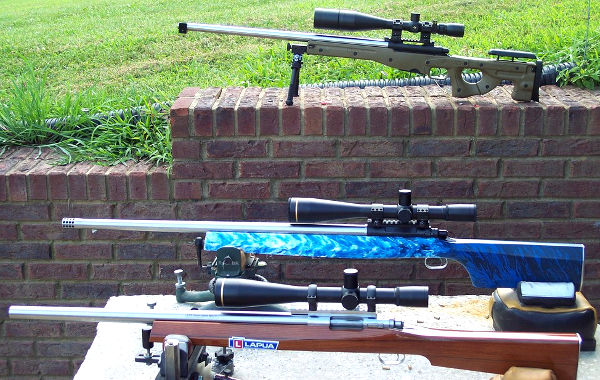
Three Guns for Mr. Big
Forum Member Mr. Big offered up another trio of rifles — two bench guns and a tactical rig. Mr. Big says: “Here are the rifles I shoot most: Farley 6mm PPC, Stiller .243 Win, and Rem 6.5×47 Lapua. They will do just about anything I ask them to…” Challenge: Can you identify the makers of the three different stocks shown in this picture (and the different materials used in each)?
Classic M1917 Enfield Action in Hand-Carved Maple Stock
This impressive rifle features an “antique” 1917 Enfield action chambered for the .338 Win Magnum cartridge. The lovely Maple stock was hand-carved by Forum member Spitfire_ER. He tells us: “I found this piece of wood as a return at a lumber yard about [many] years ago. I asked the guy in the yard about it and he said it had been returned because it had too much figure for the job the customer was working on. First thing I thought was, ‘That would make a nice stock’.”
6mm Dasher in Robertson Spider Web Stock
Here is Forum member Vahena’s 6mm Dasher. It has a no-turn-neck chamber in a 28″, 1:8″-twist barrel with 1.25″ straight contour. This has an original Robertson fiberglass stock with spider web graphics. This rifle was originally built as a 6.5×284 with a fluted barrel. Now it sports a bigger barrel for a smaller cartridge. The front rest is a SEB Neo with counterweight up front.
Sako Ltd. was founded on April 1, 1921. This year Sako celebrates its 100th birthday. Now part of the Beretta firearms family, this prestigious Finnish firearms manufacturer has a rich history of producing quality rifles constructed by skilled master craftsmen.
The original Sako factory was established as part of the Finnish Civil Guard and was designed to meet its gun repair needs. The workshop became an independent financial unit on April 1, 1921. Sako marks that date as its moment of establishment. The workshop was initially called Suojeluskuntain Ase-ja Konepaja Osakeyhtiö (Civil Guard Firearm and Engineering Co Ltd). In 1927, it became a limited company with its name abbreviated to the acronym Sako.
Sako is manufacturing a limited edition of numbered Sako TRG 22 “Finland 100″ rifles with white camouflage, inspired by Sako’s 100-year anniversary.
The TRG 22 “Finland 100″ Jubilee model is offered in .308 Win caliber. The white snow camouflage coloring of the stock and barreled action of this collector’s item reflects the severity of the Finnish winter, and pays homage to the heroes of the Winter War. The Sako TRG 22 “Finland 100″ rifle has the text “Finland 100″ and the gun’s serial number laser-engraved on its frame. The rifle is packaged in a carry case with an engraved Jubilee knife.
Brownells’ Do-It-Yourself (DIY) video series provides logical, step-by-step installation help for triggers, stocks, and springs. Nine separate videos cover Brownells various DIY Kits. Not sure if you’re up to the project? Just watch each video to see what’s involved. The nine DIY kits are:
This video shows Remington 700 after-market trigger installation:
In the Do-It-Yourself videos, Brownells’ Gun Techs proceed step-by-step, showing you exactly how to install the parts on your gun. Each kit also comes with complete, illustrated instructions you can take to the bench. To learn more, click the links above, or CLICK HERE to visit Brownells’ DIY Kit online page.
There’s a chap in Poland named Łukasz Pietruszka, who is a bonafide “Wizard of Wood”. Lukasz handcrafts unique custom stocks, selling them through his LP Gunstocks company. Many of his most eye-catching stocks are for airguns (particularly Field Target rifles), but he also produces fine stocks for rimfire and centerfire hunting rifles. Lukasz is a master carver who includes exquisite details on many of his stocks. Some of these designs, crafted from exotic hardwoods, raise stock-crafting to an art form.
Check out the figure on this Turkish Walnut stock by Łukasz Pietruszka.
You can see a variety of Lukasz’s stocks in a video sampler. If you’re a fan of fine wood, you’ll love this video. So pull up a chair, grab your favorite beverage, and enjoy this 16-minute video interlude.
Watch Video in High Definition
We recommend you view this video in high definition, in wide screen format. This will let you seen the rich details of the wood. To view HIGH-DEF, start the video, then click on the gear-shaped icon at the lower right-hand corner of the video frame (located just to the right of the clock icon). Then select 720P or 1080P from the pop-up menu. (1080P is the highest resolution.) Now select theater mode or full-screen mode using the small icons on the lower right of the frame.
Radical ‘Shockwave’ from LP Gunstocks
Here is a truly amazing bit of craftmanship. The images below show a one-of-a-kind Shockwave stock created by Łukasz for a Steyr Field Target air rifle. Over the top? Perhaps… but you have to admire the imaginative design and exquisite worksmanship.
Current Production with Laminated Wood, Many Colors
Łukasz Pietruszka also creates more affordable gunstocks with laminated, colored woods. See recent creations on the LP Gunstocks Facebook page. CLICK HERE for video on Facebook showing many stocks.
Above is a sectioned barrel showing an 80gr Sierra that was fired in a .223 bolt action with a cleaning rod in the bore. Both the bullet and the rod are still in the bore.
A Negligent Shooter Gets Lucky
“Here we have a story so filled with negligent acts that I can only marvel that the shooter survived the experience. The photo and narrative were provided by the gunsmith who took in the repair job, my comments are in italics. It’s worth reading, we can’t get enough safety warnings in our hobby.” — GS Arizona, Rifleman’s Journal
Description of Incident (with Commentary)
The shooter had a stuck case in his .223 chamber. The stuck case was actually a loaded round that didn’t fire. It wouldn’t extract because it was a .222 case that got mixed in with his .223 brass. [He had loaded the wrong brass.] I saw the loaded round with an 80gr bullet in it and a light primer strike. Negligent Act #1: Wrong brass was mixed in with the brass being reloaded.
The shooter removed the stuck case with a 3-piece aluminum rod. Negligent Act #2: Hammering out a loaded round with a cleaning rod. People have been killed doing this as the round can fire and drive the cleaning rod right into you. I remember one such incident about 5 years ago, the shooter was pounding out a stuck round, the cleaning rod went right through him, he didn’t survive.
The shooter didn’t notice only two segments of the cleaning rod came out when he removed it. Negligent Act #3: If you put anything at all down the barrel of a rifle you’d better make darn sure you got it all out before doing anything else!
He then chambered another round and fired it. Negligent act #4: If you’ve had a barrel obstruction of any kind, and if you’ve put something in the barrel, look through the barrel before proceeding! Within the past two years I know of an incident in which a benchrest shooter was killed in exactly this manner. The pressure built up and the rifle bolt came out of the receiver and into his chest.
The shooter is ‘OK’, but did not escape unscathed. He said there was a huge explosion and after regaining his senses found he was bleeding heavily from his forehead. The blood was thick enough that it ran in his eyes and he couldn’t see. In his words “I thought I was going to die”.
He has what looks like a pretty deep cut about an inch long on the side of his head, right in line with his right eye starting where the eye socket turns out to the side of the skull. And no telling what he’s got in the way of brass particles embedded in his forehead.
He was shooting on private property, and was alone when this happened. Negligent Act #5: Don’t shoot alone! Accidents happen, this is just one more example. If we could predict accidents, we wouldn’t have them. Always shoot with at least one other person.
He managed to get the bleeding stopped, or at least under control, packed his car and drove himself home without seeking immediate medical attention. Negligent Act #6: This one could have cost him his life after being lucky enough to survive the incident. There’s no way to know what’s happened just after an incident like this. He should have been at a hospital getting checked for shrapnel in the head.
The rod and slug could not be driven out. Since the barrel had a high round count there was no point in trying to salvage it. Note that the aluminum rod is expanded to a tight fit in the bore for the first couple inches. The base of the bullet is a little over 2″ from the mouth of the chamber.
What we’ve seen here is negligence and an absolute indifference to the established rules of safe reloading and gun handling, from start to finish, capped off with the shooter’s foolish avoidance of medical treatment. This shooter is lucky to be alive, but he’s surely used up all his luck. Don’t assume you’ll be so fortunate.
This article originally appeared in the Rifleman’s Journal website, which is no longer available.
The Firearms Guide is a comprehensive guns and ammo reference guide, available online or on a flash drive. Published since 2009, this Guide offers gun prices, gun schematics, blueprints, and manuals. Guns are cross-referenced with the ammunition database. Guns and ammo are presented with prices, tech specifications, features, ballistic information and high-resolution color pictures. The Firearms Guide also includes a wide selection of printable targets.
The 12th Edition of the Firearms Guide has just been released. If you’d like to have instant access to 15,000+ gun schematics and descriptions of 80,000 types of guns and ammo from 1,500 manufacturers, then check this out. The basic annual subscription is on sale right now for just $49.94. A six-month subscription is $29.94. Or for just $8.80 per month you can get a recurring monthly membership which can be cancelled at any time.
You can also get a Flash Drive add-on that lets you access the database even without a web connection. The 1-year Online Edition PLUS Firearms Guide 12th Ed. Flash Drive for Windows is $99.90. CLICK HERE. This lets you directly access the data from laptops and tablets with a USB port — no WiFi needed.
Database Includes Printable Targets: This resource even includes printable targets. You’ll find practice targets, sight-in targets, silhouette targets, special shapes and, yes, even Zombie targets.
The 12th Edition Firearms Guide is a fully interactive, subscription-based online database of firearms and ammo. The database also includes global gun values. The amount of imagery is amazing — there are tens of thousands of photos and over 18,500 schematics, which help you identify key components/parts.
Guns and ammo are presented with prices, specifications, features, ballistics, and up to 12 high-rez color pictures. NOTE: The Ammo information includes bullet BCs and velocities. GUN VALUES are provided for dealers and gun collectors. You can access 18,500+ printable and zoom-able GUN SCHEMATICS (diagrams or exploded views) with parts lists and blueprints for professional gunsmiths. The Firearms Guide permits detailed searches of antique and modern guns and side by side comparisons. Guns are cross-referenced with the ammunition database.
Firearms Guide Sample Schematic
The online database’s comprehensive search capability lets you search by gun caliber, manufacturer, and key features (e.g. “.223 Rem, Colt, folding stock”). There are 14 different search criteria — allowing you to find the exact gun you want in seconds. Shown below are typical profiles of listed products:
If you are a gun collector, or just an information junkie, you’ll find the Firearms Guide to be an invaluable resource. The scope is truly worldwide, with coverage of gun makers in Western Europe, Eastern Europe, South America, South Africa, and Asia as well as North America.
by James Mock
After owning three different rifles with BAT actions, I have become a loyal fan of BAT Machine quality and customer service. Back in 2009, I traded my BAT/Scoville for the BAT/Leonard that I currently shoot. This rifle has a long history and Terry Leonard told me that “Old 87″ (as I have named it) was one of the earlier BATs that he stocked. He wrapped the stock in fiberglass and used 2-part epoxy back then. I must say that this rifle has held up remarkably well since it dates back to the 1990s. The action is a RB/LP/RE octagon Model B with .308 bolt-face.
Rifle Has Multiple Barrels for Multiple Disciplines
With this gun, I have shot several barrels of different calibers (.22 PPC, .22 PPC-short .095, 6mm PPC, 6XC, 6mm Dasher, .30BR, and will soon have a 6 BR-AI). It has been an exceptionally accurate rifle in several disciplines. In the hands of previous owners, it earned several Hall-of-Fame (HOF) points, and a “middle-of-the-pack” shooter (me) even received a HOF point with this rifle.
For most of its life, Old 87 served as a short range benchrest rifle, but I have used it for the last few years as a 600-yard rifle with the 6mm Dasher barrel. I was lucky enough to earn the Shooter of the Year award at the Prince Memorial Range in Louisiana for 2016.
After shooting my two Dasher barrels for last eight years, I have noticed a drop-off in accuracy at 600 yards. A decision had to be made — get a new barrel or sell the rifle and retire from competition. I am in my late 70s and my competition days are limited due mainly to a chronic neck problem. After mulling over the decision to retire or not, I decided to give Old 87 one more year. Here is the story of how we upgraded the old war-horse.
Old 87 REBORN — Upgrading with New Components
I prefer cut-rifled barrels with four lands and grooves and have had success with .236 bore diameters and 1:8″ twist in long range rifles. I searched for barrels meeting those parameters and found a suitable BRUX at Bugholes.com (Southern Precision Rifles).
The 6BR-AI Option — Easy Fire Forming
I thought about having Billy Stevens chamber it for the Dasher, but decided to try something new. There seems to be a lot of interest in the 6BR-AI and I said, “Why not?” Well, I bought a shortened Dasher die from Harrell’s and will use my Wilson Dasher seating die. Bart Sauter was kind enough to let me use his reamer for chambering.
Fitting a New Roller-Type Cocking Piece on Older BAT Action
Since I was into the project this deep, I called Mike Ezell and ordered one of his Tungsten powder-dampened tuners. Since Old 87 had thousands of rounds since the firing pin spring has been replaced, I decided that it was probably needed. Well, I got to thinking (very dangerous) and asked Daryle Thom if it would be feasible to put a roller-type cocking piece and a new firing pin spring on such an old action.
The folks at BAT are very accommodating and they said that it would be no problem with such a conversion. While my bolt was in Idaho, the barrel with Ezell tuner arrived and I could not shoot it. However, my friend Jeff Turner loaned me his BAT bolt to see if it would work. Although the rifles differ in age by 15 or more years, the borrowed bolt worked perfectly in my rifle. This is a testimony to the great machine work performed at BAT Machine.
New Bolt Roller Tail-Piece Makes a Big Difference in Cocking Effort
With the borrowed bolt I managed to fire-form 50 rounds and get them ready for our 600-yard match on September 16. The folks at BAT quickly fixed my bolt by replacing the mainspring and ejector spring, polishing the ejector, and replacing the tail-piece with their roller type. Pictured below is this tail piece that makes a remarkable difference in the force needed to cock the action. It is amazing what this little wheel can do… even when placed in a 25+ year old action.
Working with the Ezell Barrel Tuner — Small Increments Work Best
Also, I would like to congratulate Mike Ezell on his new tuner which contains powdered Tungsten. It is easy to set up and Mike will help a buyer get maximum effectiveness from the unit. Just give him a call. Below is a picture of the tuner. I was lucky enough to have some time to “play” with it before the match.
Talking about the tuner, Mike writes: “Our new barrel tuners… PDT stands for particle dampening technology. The science is there, we just applied it to a barrel tuner. The advantages are a wider tune window and more efficient control of barrel harmonics…in a tuner design that actually looks good.”
Mike advised me to set the tuner by turning it all the way into the shoulder and then come out to zero or the second time zero comes up if there is not at least half of a turn between the shoulder and the first zero. It is best to start with a proven load and adjust the tuner from that load. As unlikely as it seems, a rifle can go from a good tune to a very poor tune with only 5 marks (.005”) and vice versa.
Mike cautions those who use his tuner to NOT make adjustments which are too large. As a matter of fact, he recommends adjustments of .001 inch at a time. Ezell’s tuners are screwed onto the barrel with .900” by 32 threads per inch and has 32 marks on the circumference of the tuner. Therefore, each mark moves the tuner in or out by .001 inch. There are three set screws with Teflon tips which provide friction for the tuner on the threads. Do not tighten the screws so tight as they damage the fine threads.
If you want the smoothest bolt possible for your BAT, call or e-mail Daryle or Bruce Thom at BAT Machine and discuss your needs with them. I am sure glad that I did. If you want a state-of-the-Art tuner for your barrel, give Mike Ezell a call or visit his Ezell Custom Rifles Facebook Page.
— Good shooting, James Mock
On 5/7/21, the U.S. Attorney General signed ATF proposed rule 2021R-05, Definition of “Frame or Receiver” and Identification of Firearms. The goal of the proposed rule is to ensure the proper marking, recordkeeping, and traceability of all firearms manufactured, imported, acquired and disposed by federal firearms licensees. This proposed rule would among others, provide new or amend previous definitions of terms related to or about “firearm frame or receivers” and “frame or receivers.” SEE ATF website.
ATF requests comments on the proposed rule, Definition of “Frame or Receiver” and Identification of Firearms, from all interested persons. ATF specifically requests comments on the feasibility of implementing the new definition of firearm “frame or receiver” in 27 CFR 478.11 and 27 CFR 479.11, and related definitions and amendments that ensure the proper marking, recordkeeping, and traceability of all firearms manufactured, imported, acquired and disposed by federal firearms licensees.
ATF also requests comments on the costs or benefits of the proposed rule and on the appropriate methodology and data for calculating those costs and benefits. To submit comments CLICK HERE: Frame or Receiver Submit Comment Page
Official Summary of New Fiream Frame or Receiver Rule
You May Submit a Comment
ATF is receiving comments on the proposed rule for 90 days from the date the proposed rule is posted in the Federal Register. You may submit comments by mail, fax or the Federal eRulemaking Portal at www.regulations.gov.
What does a three-time High Power National Champion choose for PRS comps? A set of twins. Twin rifles that is. SFC Brandon Green of the USAMU is one of America’s best marksmen. He’s excelled in Service Rifle and High Power disciplines, and now he’s getting very serious about the Precision Rifle Series (PRS). Brandon recently took delivery of “Twins” — two impressive rifles optimized for PRS competition. Green told us: “The Twins are ready for business! The silver one is a 6XC and the black one is a 6.5×47 Lapua”. Both rifles feature Impact Precision actions (with AICS-type mags), 24″ Proof stainless barrels, and Fat Bastard muzzle brakes. Rifle work was done by Stuteville Precision (Wade Stuteville) and Exodus Rifles (Joe Walls).
In the 6XC, Brandon runs Berger 105gr VLDs in Norma 6XC brass. For the 6.5×47 Lapua he shoots 140gr Berger Hybrids or 143gr Hornady ELD-Xs in Lapua brass. Both rifles have stainless steel Proof barrels, but the 6.5x47L has a matte black Cerakote finish.
Brandon loves his new Twins. He said he likes the “feel” of the guns with the Foundation stocks: “These rifles weigh around 17 pounds with optics. They feel very solid under recoil — without the ‘tuning fork’ vibration you can get with a metal-chassis gun. They feel like a good wood-stocked gun, but the material is stronger and more rigid than wood. I’ve heard that guys are having success with these Foundation stocks with the actions installed without pillars or conventional bedding.” Currently Brandon is running both guns without action-screw pillars. He did have one skim-bedded, but he doesn’t think that was really needed. “Both rifles hammer now”, Brandon tells us.
Green Runs Vortex Razor HD Gen II 4.5-27x56mm FFP scopes on both rifles:
High-Tech Micarta Stock Material
At first glance, those stocks may look like wood, but they are actually a special “Micarta” material that is strong, durable, and stable. Micarta, often used for knife handles, is a “a brand name for composites of fiberglass, carbon fiber, or other fabric in a thermosetting plastic.” The stock-maker, Foundation Stocks, says Micarta offers some distinct advantages over laminated wood or conventional fiberglass: “The solid block of material gives us a dense, homogenous material that is absent of any voids or air pockets commonly found in composite stocks. The high compression strength of the material allows us to build an action/DBM specific stock that requires no bedding or pillars. The material is very durable and stable in extreme environments. We use advanced CAD software to design and model our stocks, working in conjunction with action manufacturers and rifle builders to provide exact fitment.”
Here is a close-up of a Foundation Stock showing the distinctive Micarta texture:
Tactical Competition vs. NRA High Power Competition
Brandon says PRS competition is tough: “PRS can be pretty humbling, but it’s been a lot of fun and a great challenge. For a shooter (like me) with a Service Rifle/High Power background, the variations in stages combined with the time limits can be very challenging. And the unusual shooting positions put a new spin on things. PRS is definitely a different ball game, but I really enjoy it.”
SFC Brandon Green honored as the 2015 High Power National Champion. Brandon also won the HP Championship in 2013, and in 2018.
Life before the Twins… Here is Brandon, with his previous PRS rig, at the MasterPiece Arms Precision Rifle Shootout, a PRS event at the CORE Shooting Solutions Range in Florida:
Three-time National High Power Champion SFC Brandon Green (left above) set four new National Records at Camp Perry in 2017, when he won the Service Rifle Championship.
When He’s not Competing in PRS, Brandon Excels with his Service Rifle
This video shows SFC Brandon Green shooting his modern AR Service Rifle in the off-hand (standing), prone (2:20 time), and sitting (3:25 time) positions in competition.
SFC Brandon Green is a shooting superstar. Green won his third NRA National High Power Rifle Championship in 2018 at Camp Atterbury, Indiana. He dominated the High Power Championship cycle, finishing eight points and ten Xs ahead of his nearest competitor. Brandon also won High Power National Championships in 2015 and 2013. And in 2017 he set new records at the CMP’s National Trophy Matches at Camp Perry, winning the Service Rifle title. One of the greatest marksmen in the nation’s history, SFC Green excels at all positions, both rapid-fire and slow-fire.
Trigger images from PrimaryArms.com, which sells all the triggers reviewed here: Geissele, Elftmann, Timney, and ALG Defense.
Are you thinking of upgrading the trigger system for your AR-platform rifle? There are dozens of options available, from $45 up to $350. Thankfully, Brownells has created video reviews of some of the more popular AR trigger options from Timney, Geissele, and ALG Defense. And we included a video review of the highly-regarded Elftmann Match Trigger. If you want the best solution for Service Rifle competition, you might favor the Geissele. For ease of installation, it’s hard to beat the Timney, a “drop-in” module. Like the Timney, the super-smooth Elftmann is a drop-in module. At $249.99 from Brownells it’s pricey, but it is one of the best AR triggers out there. If you’re on a tight budget, the best “bang for your buck” may be the “Perfected Mil-Spec” ALG trigger at $49.00.
Multiple AR Triggers, including Elftmann and Geissele, Reviewed
Though pricey ($249.00 at PrimaryArms.com), we really like the Elftmann AR trigger. It combines the best of both worlds — the precision and smoothness of the Geissele with the Timney’s ease of installation. This single stage trigger is user-adjustable from 2.75 to 4 pounds pull weight. It is offered with either straight or curved trigger blade. Primary Arms says: “The amazingly short take-up, glass-rod crisp break and [near-zero] over-travel can be compared to the finest custom 1911 triggers.”
Geissele Enhanced Two-Stage Trigger
Geissele makes a variety of quality AR trigger sets both single-stage and two-stage. Many High Power competitors like the two-stage Geissele trigger. This delivers a repeatable, controlled pull through the first stage with a very clean break in the second stage. The Super Dynamic Enhanced Trigger, shown above, features a distinctive, trigger blade. Reviewer Thomas Conroy says: “The flat surface is very easy to press against. Both stages are light and very distinct.”
Timney Drop-In Trigger Module
This trigger module is available for both the AR15 and the AR10 platform (see above video). Timney triggers are easy to install and come with multiple pin size and pull-weight options. Reviewer Thomas Conroy confirms that the single-stage Timney “breaks cleanly and crisply. This trigger is modular, meaning that the trigger, sear, hammer, and spring are all encased in a bright, shiny yellow aluminum housing.”
ALG Defense Trigger — Higher-Quality Basic AR Trigger
According to Thomas Conroy, ALG triggers “are the perfected version of the standard, non-adjustable mil-spec original trigger. They have the same geometry, but are made to higher quality standards, and come with … hardened and smoothed-out sear contact surface to eliminate all grittiness.” These are also offered in a nickel-boron coated version. Available for under $56.00, the ALG is a well-made, low-cost option for shooters who want a better factory-type trigger system.
For More Information about These Triggers
Learn more about Geissele, Timney and ALG triggers, plus two more AR trigger options (CMMG and Rock River Arms) in a Trigger Comparison Review by Thomas Conroy on Ammoland.com.




 Watch Video in High Definition


 Trigger images from
 According to Thomas Conroy, ALG triggers “are the perfected version of the standard, non-adjustable mil-spec original trigger. They have the same geometry, but are made to higher quality standards, and come with … hardened and smoothed-out sear contact surface to eliminate all grittiness.” These are also offered in a nickel-boron coated version. Available for


ATF Proposed Rule Will Redefine Firearm “Frame or Receiver”
On 5/7/21, the U.S. Attorney General signed ATF proposed rule 2021R-05, Definition of “Frame or Receiver” and Identification of Firearms. The goal of the proposed rule is to ensure the proper marking, recordkeeping, and traceability of all firearms manufactured, imported, acquired and disposed by federal firearms licensees. This proposed rule would among others, provide new or amend previous definitions of terms related to or about “firearm frame or receivers” and “frame or receivers.” SEE ATF website.
» Download the Proposed New ATF Rule (PDF)
ATF requests comments on the proposed rule, Definition of “Frame or Receiver” and Identification of Firearms, from all interested persons. ATF specifically requests comments on the feasibility of implementing the new definition of firearm “frame or receiver” in 27 CFR 478.11 and 27 CFR 479.11, and related definitions and amendments that ensure the proper marking, recordkeeping, and traceability of all firearms manufactured, imported, acquired and disposed by federal firearms licensees.
ATF also requests comments on the costs or benefits of the proposed rule and on the appropriate methodology and data for calculating those costs and benefits. To submit comments CLICK HERE: Frame or Receiver Submit Comment Page
Official Summary of New Fiream Frame or Receiver Rule
You May Submit a Comment
ATF is receiving comments on the proposed rule for 90 days from the date the proposed rule is posted in the Federal Register. You may submit comments by mail, fax or the Federal eRulemaking Portal at www.regulations.gov.