Above is a sectioned barrel showing an 80gr Sierra that was fired in a .223 bolt action with a cleaning rod in the bore. Both the bullet and the rod are still in the bore.
A Negligent Shooter Gets Lucky
“Here we have a story so filled with negligent acts that I can only marvel that the shooter survived the experience. The photo and narrative were provided by the gunsmith who took in the repair job, my comments are in italics. It’s worth reading, we can’t get enough safety warnings in our hobby.” — GS Arizona, Rifleman’s Journal
Description of Incident (with Commentary)
The shooter had a stuck case in his .223 chamber. The stuck case was actually a loaded round that didn’t fire. It wouldn’t extract because it was a .222 case that got mixed in with his .223 brass. [He had loaded the wrong brass.] I saw the loaded round with an 80gr bullet in it and a light primer strike. Negligent Act #1: Wrong brass was mixed in with the brass being reloaded.
The shooter removed the stuck case with a 3-piece aluminum rod. Negligent Act #2: Hammering out a loaded round with a cleaning rod. People have been killed doing this as the round can fire and drive the cleaning rod right into you. I remember one such incident about 5 years ago, the shooter was pounding out a stuck round, the cleaning rod went right through him, he didn’t survive.
The shooter didn’t notice only two segments of the cleaning rod came out when he removed it. Negligent Act #3: If you put anything at all down the barrel of a rifle you’d better make darn sure you got it all out before doing anything else!
He then chambered another round and fired it. Negligent act #4: If you’ve had a barrel obstruction of any kind, and if you’ve put something in the barrel, look through the barrel before proceeding! Within the past two years I know of an incident in which a benchrest shooter was killed in exactly this manner. The pressure built up and the rifle bolt came out of the receiver and into his chest.
The shooter is ‘OK’, but did not escape unscathed. He said there was a huge explosion and after regaining his senses found he was bleeding heavily from his forehead. The blood was thick enough that it ran in his eyes and he couldn’t see. In his words “I thought I was going to die”.
He has what looks like a pretty deep cut about an inch long on the side of his head, right in line with his right eye starting where the eye socket turns out to the side of the skull. And no telling what he’s got in the way of brass particles embedded in his forehead.
He was shooting on private property, and was alone when this happened. Negligent Act #5: Don’t shoot alone! Accidents happen, this is just one more example. If we could predict accidents, we wouldn’t have them. Always shoot with at least one other person.
He managed to get the bleeding stopped, or at least under control, packed his car and drove himself home without seeking immediate medical attention. Negligent Act #6: This one could have cost him his life after being lucky enough to survive the incident. There’s no way to know what’s happened just after an incident like this. He should have been at a hospital getting checked for shrapnel in the head.
The rod and slug could not be driven out. Since the barrel had a high round count there was no point in trying to salvage it. Note that the aluminum rod is expanded to a tight fit in the bore for the first couple inches. The base of the bullet is a little over 2″ from the mouth of the chamber.
What we’ve seen here is negligence and an absolute indifference to the established rules of safe reloading and gun handling, from start to finish, capped off with the shooter’s foolish avoidance of medical treatment. This shooter is lucky to be alive, but he’s surely used up all his luck. Don’t assume you’ll be so fortunate.
This article originally appeared in the Rifleman’s Journal website, which is no longer available.
The Firearms Guide is a comprehensive guns and ammo reference guide, available online or on a flash drive. Published since 2009, this Guide offers gun prices, gun schematics, blueprints, and manuals. Guns are cross-referenced with the ammunition database. Guns and ammo are presented with prices, tech specifications, features, ballistic information and high-resolution color pictures. The Firearms Guide also includes a wide selection of printable targets.
The 12th Edition of the Firearms Guide has just been released. If you’d like to have instant access to 15,000+ gun schematics and descriptions of 80,000 types of guns and ammo from 1,500 manufacturers, then check this out. The basic annual subscription is on sale right now for just $49.94. A six-month subscription is $29.94. Or for just $8.80 per month you can get a recurring monthly membership which can be cancelled at any time.
You can also get a Flash Drive add-on that lets you access the database even without a web connection. The 1-year Online Edition PLUS Firearms Guide 12th Ed. Flash Drive for Windows is $99.90. CLICK HERE. This lets you directly access the data from laptops and tablets with a USB port — no WiFi needed.
Database Includes Printable Targets: This resource even includes printable targets. You’ll find practice targets, sight-in targets, silhouette targets, special shapes and, yes, even Zombie targets.
The 12th Edition Firearms Guide is a fully interactive, subscription-based online database of firearms and ammo. The database also includes global gun values. The amount of imagery is amazing — there are tens of thousands of photos and over 18,500 schematics, which help you identify key components/parts.
Guns and ammo are presented with prices, specifications, features, ballistics, and up to 12 high-rez color pictures. NOTE: The Ammo information includes bullet BCs and velocities. GUN VALUES are provided for dealers and gun collectors. You can access 18,500+ printable and zoom-able GUN SCHEMATICS (diagrams or exploded views) with parts lists and blueprints for professional gunsmiths. The Firearms Guide permits detailed searches of antique and modern guns and side by side comparisons. Guns are cross-referenced with the ammunition database.
Firearms Guide Sample Schematic
The online database’s comprehensive search capability lets you search by gun caliber, manufacturer, and key features (e.g. “.223 Rem, Colt, folding stock”). There are 14 different search criteria — allowing you to find the exact gun you want in seconds. Shown below are typical profiles of listed products:
If you are a gun collector, or just an information junkie, you’ll find the Firearms Guide to be an invaluable resource. The scope is truly worldwide, with coverage of gun makers in Western Europe, Eastern Europe, South America, South Africa, and Asia as well as North America.
by James Mock
After owning three different rifles with BAT actions, I have become a loyal fan of BAT Machine quality and customer service. Back in 2009, I traded my BAT/Scoville for the BAT/Leonard that I currently shoot. This rifle has a long history and Terry Leonard told me that “Old 87″ (as I have named it) was one of the earlier BATs that he stocked. He wrapped the stock in fiberglass and used 2-part epoxy back then. I must say that this rifle has held up remarkably well since it dates back to the 1990s. The action is a RB/LP/RE octagon Model B with .308 bolt-face.
Rifle Has Multiple Barrels for Multiple Disciplines
With this gun, I have shot several barrels of different calibers (.22 PPC, .22 PPC-short .095, 6mm PPC, 6XC, 6mm Dasher, .30BR, and will soon have a 6 BR-AI). It has been an exceptionally accurate rifle in several disciplines. In the hands of previous owners, it earned several Hall-of-Fame (HOF) points, and a “middle-of-the-pack” shooter (me) even received a HOF point with this rifle.
For most of its life, Old 87 served as a short range benchrest rifle, but I have used it for the last few years as a 600-yard rifle with the 6mm Dasher barrel. I was lucky enough to earn the Shooter of the Year award at the Prince Memorial Range in Louisiana for 2016.
After shooting my two Dasher barrels for last eight years, I have noticed a drop-off in accuracy at 600 yards. A decision had to be made — get a new barrel or sell the rifle and retire from competition. I am in my late 70s and my competition days are limited due mainly to a chronic neck problem. After mulling over the decision to retire or not, I decided to give Old 87 one more year. Here is the story of how we upgraded the old war-horse.
Old 87 REBORN — Upgrading with New Components
I prefer cut-rifled barrels with four lands and grooves and have had success with .236 bore diameters and 1:8″ twist in long range rifles. I searched for barrels meeting those parameters and found a suitable BRUX at Bugholes.com (Southern Precision Rifles).
The 6BR-AI Option — Easy Fire Forming
I thought about having Billy Stevens chamber it for the Dasher, but decided to try something new. There seems to be a lot of interest in the 6BR-AI and I said, “Why not?” Well, I bought a shortened Dasher die from Harrell’s and will use my Wilson Dasher seating die. Bart Sauter was kind enough to let me use his reamer for chambering.
Fitting a New Roller-Type Cocking Piece on Older BAT Action
Since I was into the project this deep, I called Mike Ezell and ordered one of his Tungsten powder-dampened tuners. Since Old 87 had thousands of rounds since the firing pin spring has been replaced, I decided that it was probably needed. Well, I got to thinking (very dangerous) and asked Daryle Thom if it would be feasible to put a roller-type cocking piece and a new firing pin spring on such an old action.
The folks at BAT are very accommodating and they said that it would be no problem with such a conversion. While my bolt was in Idaho, the barrel with Ezell tuner arrived and I could not shoot it. However, my friend Jeff Turner loaned me his BAT bolt to see if it would work. Although the rifles differ in age by 15 or more years, the borrowed bolt worked perfectly in my rifle. This is a testimony to the great machine work performed at BAT Machine.
New Bolt Roller Tail-Piece Makes a Big Difference in Cocking Effort
With the borrowed bolt I managed to fire-form 50 rounds and get them ready for our 600-yard match on September 16. The folks at BAT quickly fixed my bolt by replacing the mainspring and ejector spring, polishing the ejector, and replacing the tail-piece with their roller type. Pictured below is this tail piece that makes a remarkable difference in the force needed to cock the action. It is amazing what this little wheel can do… even when placed in a 25+ year old action.
Working with the Ezell Barrel Tuner — Small Increments Work Best
Also, I would like to congratulate Mike Ezell on his new tuner which contains powdered Tungsten. It is easy to set up and Mike will help a buyer get maximum effectiveness from the unit. Just give him a call. Below is a picture of the tuner. I was lucky enough to have some time to “play” with it before the match.
Talking about the tuner, Mike writes: “Our new barrel tuners… PDT stands for particle dampening technology. The science is there, we just applied it to a barrel tuner. The advantages are a wider tune window and more efficient control of barrel harmonics…in a tuner design that actually looks good.”
Mike advised me to set the tuner by turning it all the way into the shoulder and then come out to zero or the second time zero comes up if there is not at least half of a turn between the shoulder and the first zero. It is best to start with a proven load and adjust the tuner from that load. As unlikely as it seems, a rifle can go from a good tune to a very poor tune with only 5 marks (.005”) and vice versa.
Mike cautions those who use his tuner to NOT make adjustments which are too large. As a matter of fact, he recommends adjustments of .001 inch at a time. Ezell’s tuners are screwed onto the barrel with .900” by 32 threads per inch and has 32 marks on the circumference of the tuner. Therefore, each mark moves the tuner in or out by .001 inch. There are three set screws with Teflon tips which provide friction for the tuner on the threads. Do not tighten the screws so tight as they damage the fine threads.
If you want the smoothest bolt possible for your BAT, call or e-mail Daryle or Bruce Thom at BAT Machine and discuss your needs with them. I am sure glad that I did. If you want a state-of-the-Art tuner for your barrel, give Mike Ezell a call or visit his Ezell Custom Rifles Facebook Page.
— Good shooting, James Mock
On 5/7/21, the U.S. Attorney General signed ATF proposed rule 2021R-05, Definition of “Frame or Receiver” and Identification of Firearms. The goal of the proposed rule is to ensure the proper marking, recordkeeping, and traceability of all firearms manufactured, imported, acquired and disposed by federal firearms licensees. This proposed rule would among others, provide new or amend previous definitions of terms related to or about “firearm frame or receivers” and “frame or receivers.” SEE ATF website.
ATF requests comments on the proposed rule, Definition of “Frame or Receiver” and Identification of Firearms, from all interested persons. ATF specifically requests comments on the feasibility of implementing the new definition of firearm “frame or receiver” in 27 CFR 478.11 and 27 CFR 479.11, and related definitions and amendments that ensure the proper marking, recordkeeping, and traceability of all firearms manufactured, imported, acquired and disposed by federal firearms licensees.
ATF also requests comments on the costs or benefits of the proposed rule and on the appropriate methodology and data for calculating those costs and benefits. To submit comments CLICK HERE: Frame or Receiver Submit Comment Page
Official Summary of New Fiream Frame or Receiver Rule
You May Submit a Comment
ATF is receiving comments on the proposed rule for 90 days from the date the proposed rule is posted in the Federal Register. You may submit comments by mail, fax or the Federal eRulemaking Portal at www.regulations.gov.
What does a three-time High Power National Champion choose for PRS comps? A set of twins. Twin rifles that is. SFC Brandon Green of the USAMU is one of America’s best marksmen. He’s excelled in Service Rifle and High Power disciplines, and now he’s getting very serious about the Precision Rifle Series (PRS). Brandon recently took delivery of “Twins” — two impressive rifles optimized for PRS competition. Green told us: “The Twins are ready for business! The silver one is a 6XC and the black one is a 6.5×47 Lapua”. Both rifles feature Impact Precision actions (with AICS-type mags), 24″ Proof stainless barrels, and Fat Bastard muzzle brakes. Rifle work was done by Stuteville Precision (Wade Stuteville) and Exodus Rifles (Joe Walls).
In the 6XC, Brandon runs Berger 105gr VLDs in Norma 6XC brass. For the 6.5×47 Lapua he shoots 140gr Berger Hybrids or 143gr Hornady ELD-Xs in Lapua brass. Both rifles have stainless steel Proof barrels, but the 6.5x47L has a matte black Cerakote finish.
Brandon loves his new Twins. He said he likes the “feel” of the guns with the Foundation stocks: “These rifles weigh around 17 pounds with optics. They feel very solid under recoil — without the ‘tuning fork’ vibration you can get with a metal-chassis gun. They feel like a good wood-stocked gun, but the material is stronger and more rigid than wood. I’ve heard that guys are having success with these Foundation stocks with the actions installed without pillars or conventional bedding.” Currently Brandon is running both guns without action-screw pillars. He did have one skim-bedded, but he doesn’t think that was really needed. “Both rifles hammer now”, Brandon tells us.
Green Runs Vortex Razor HD Gen II 4.5-27x56mm FFP scopes on both rifles:
High-Tech Micarta Stock Material
At first glance, those stocks may look like wood, but they are actually a special “Micarta” material that is strong, durable, and stable. Micarta, often used for knife handles, is a “a brand name for composites of fiberglass, carbon fiber, or other fabric in a thermosetting plastic.” The stock-maker, Foundation Stocks, says Micarta offers some distinct advantages over laminated wood or conventional fiberglass: “The solid block of material gives us a dense, homogenous material that is absent of any voids or air pockets commonly found in composite stocks. The high compression strength of the material allows us to build an action/DBM specific stock that requires no bedding or pillars. The material is very durable and stable in extreme environments. We use advanced CAD software to design and model our stocks, working in conjunction with action manufacturers and rifle builders to provide exact fitment.”
Here is a close-up of a Foundation Stock showing the distinctive Micarta texture:
Tactical Competition vs. NRA High Power Competition
Brandon says PRS competition is tough: “PRS can be pretty humbling, but it’s been a lot of fun and a great challenge. For a shooter (like me) with a Service Rifle/High Power background, the variations in stages combined with the time limits can be very challenging. And the unusual shooting positions put a new spin on things. PRS is definitely a different ball game, but I really enjoy it.”
SFC Brandon Green honored as the 2015 High Power National Champion. Brandon also won the HP Championship in 2013, and in 2018.
Life before the Twins… Here is Brandon, with his previous PRS rig, at the MasterPiece Arms Precision Rifle Shootout, a PRS event at the CORE Shooting Solutions Range in Florida:
Three-time National High Power Champion SFC Brandon Green (left above) set four new National Records at Camp Perry in 2017, when he won the Service Rifle Championship.
When He’s not Competing in PRS, Brandon Excels with his Service Rifle
This video shows SFC Brandon Green shooting his modern AR Service Rifle in the off-hand (standing), prone (2:20 time), and sitting (3:25 time) positions in competition.
SFC Brandon Green is a shooting superstar. Green won his third NRA National High Power Rifle Championship in 2018 at Camp Atterbury, Indiana. He dominated the High Power Championship cycle, finishing eight points and ten Xs ahead of his nearest competitor. Brandon also won High Power National Championships in 2015 and 2013. And in 2017 he set new records at the CMP’s National Trophy Matches at Camp Perry, winning the Service Rifle title. One of the greatest marksmen in the nation’s history, SFC Green excels at all positions, both rapid-fire and slow-fire.
Trigger images from PrimaryArms.com, which sells all the triggers reviewed here: Geissele, Elftmann, Timney, and ALG Defense.
Are you thinking of upgrading the trigger system for your AR-platform rifle? There are dozens of options available, from $45 up to $350. Thankfully, Brownells has created video reviews of some of the more popular AR trigger options from Timney, Geissele, and ALG Defense. And we included a video review of the highly-regarded Elftmann Match Trigger. If you want the best solution for Service Rifle competition, you might favor the Geissele. For ease of installation, it’s hard to beat the Timney, a “drop-in” module. Like the Timney, the super-smooth Elftmann is a drop-in module. At $249.99 from Brownells it’s pricey, but it is one of the best AR triggers out there. If you’re on a tight budget, the best “bang for your buck” may be the “Perfected Mil-Spec” ALG trigger at $49.00.
Multiple AR Triggers, including Elftmann and Geissele, Reviewed
Though pricey ($249.00 at PrimaryArms.com), we really like the Elftmann AR trigger. It combines the best of both worlds — the precision and smoothness of the Geissele with the Timney’s ease of installation. This single stage trigger is user-adjustable from 2.75 to 4 pounds pull weight. It is offered with either straight or curved trigger blade. Primary Arms says: “The amazingly short take-up, glass-rod crisp break and [near-zero] over-travel can be compared to the finest custom 1911 triggers.”
Geissele Enhanced Two-Stage Trigger
Geissele makes a variety of quality AR trigger sets both single-stage and two-stage. Many High Power competitors like the two-stage Geissele trigger. This delivers a repeatable, controlled pull through the first stage with a very clean break in the second stage. The Super Dynamic Enhanced Trigger, shown above, features a distinctive, trigger blade. Reviewer Thomas Conroy says: “The flat surface is very easy to press against. Both stages are light and very distinct.”
Timney Drop-In Trigger Module
This trigger module is available for both the AR15 and the AR10 platform (see above video). Timney triggers are easy to install and come with multiple pin size and pull-weight options. Reviewer Thomas Conroy confirms that the single-stage Timney “breaks cleanly and crisply. This trigger is modular, meaning that the trigger, sear, hammer, and spring are all encased in a bright, shiny yellow aluminum housing.”
ALG Defense Trigger — Higher-Quality Basic AR Trigger
According to Thomas Conroy, ALG triggers “are the perfected version of the standard, non-adjustable mil-spec original trigger. They have the same geometry, but are made to higher quality standards, and come with … hardened and smoothed-out sear contact surface to eliminate all grittiness.” These are also offered in a nickel-boron coated version. Available for under $56.00, the ALG is a well-made, low-cost option for shooters who want a better factory-type trigger system.
For More Information about These Triggers
Learn more about Geissele, Timney and ALG triggers, plus two more AR trigger options (CMMG and Rock River Arms) in a Trigger Comparison Review by Thomas Conroy on Ammoland.com.
In today’s economy, Free is good. Here’s a list of classic, older shooting books that can be downloaded for FREE from Google Books. This list includes many classic treatises on marksmanship that still have value for today’s competitive shooters. In addition, we’ve included illustrated firearm histories, such as Townsend Whelen’s fascinating book, The American Rifle, and The Gun and its Development (9th Ed.), by William Wellington Greener.
In the list below, the title link will take you to the Google Books page for each book. You can read the entire book online, or (in most cases) you can download it to your computer as a PDF file* and save it (or print it). You can also create your own Google Library and save the books there for access from any computer.
*To download a book, first click the title from the list above. You can read immediately by clicking the blue “Read for Free” button. If you want to store the book for later reading, select the “Download PDF” button just to the right. This may bring up a security question to make sure you are a human. Respond to the security question correctly and the PDF file should appear. On most operating systems, this will launch in a scrolling PDF viewer. You will then need to click the download icon in the PDF viewer, at upper right. NOTE: When saving, be sure to select a destination on your hard drive that you can remember.
One of the most radical black rifles ever created wowed the crowd at the SHOT Show Range Day back in 2019. At the Boulder Rifle & Pistol Club outside Las Vegas, Battle Arms Development showcased a true “UltraLight AR”. With Titanium and carbon fiber components, the Battle Arms OIP Gen 2 AR-platform rifle weighs just 3.8 pounds unloaded. Compare that to 7.5 pounds (or more) for a typical AR-15.
Battle Arms 3.8-Lb Titanium/Carbon OIP 2 — World’s Lightest AR
At the Boulder City Range GunsAmerica Digest Managing Editor True Pearce talked with one of the Battle Arms gun designers who helped created this unique rifle, claimed to be the world’s lightest AR (yes it is lighter than ARs with polymer lowers). READ GunsAmerica Battle Arms OIP 2 Review HERE.
In the video below, True Pearce shows the key features of the $3290.00 Battle Arms OIP 2. Then he tests its function shooting offhand at steel targets. Despite its low mass, and exotic components, the Battle Arms OIP 2 AR carbine performed flawlessly.
The video above features the Battle Arms OIP GEN 2 AR that weighs just 3.8 pounds. To save weight, this carbine features a carbon fiber handguard and various titanium parts including a Titanium muzzle brake. Look carefully at how even small controls have been modified to save ounces.
GunsAmerica reported: “Battle Arms has done a lot of work to find all the ounces that can be spared to make this gun as light as possible.” Even at just 3.8 pounds, the gun is very controllable during rapid fire. Despite a steep $3290.00 MSRP, the first run of Battle Arms’ sub-4-lb GEN 2 OIP sold out. That proves that “light is right”, as least in the AR carbine market.
Pew-Pew Tactical Review of Battle Arms OIP 2
The team at Pew-Pew Tactical also field-tested the Battle Arms OIP Gen 2 rifle. The reviewers were impressed, finding that felt recoil was very manageable, even given the rifle’s very low 3.8-lb weight:
Pew-Pew Tactical Battle Arms OIP Gen 2 Review
The Concept Behind the OIP — Why Go Ultra-Light
Recoil Magazine featured an earlier model OIP rifle back in 2016 (Issue 21). This design was later refined into the current OIP Gen 2 version. Recoil’s writers explained the concept behind this unique design:
Battle Arms OIP Rifle — How Low Can You Go…
“The OIP had its genesis as a simple idea to build a lightweight gun that just plain worked. Dave Lake and Matt Babb of Bentwood Gunsmithing spent years perfecting the concept, incorporating the latest components where they existed and working with companies to customize parts that didn’t. They wanted a well-balanced gun with an optimized operating system and literally no excess — to be as light as humanly possible.
Bentwood didn’t want to utilize polymer receivers and worked with Battle Arms Development to develop a super lightweight receiver set with intricate machining to shave as much weight as they could. They investigated some more exotic material choices, but found them to be prohibitively expensive.”
— Source: RecoilWeb.com
Battle Arms OIP 2 Owner’s Review on TFB
Last year, The Firearm Blog (TFB) published an extensive review of the Battle Arms OIP 2. TFB writer/tester Rusty S. had purchased this OIP 2 rig with his own funds — making a serious $3290.00 investment.
After using the rifle in the field, Rusty concluded: “Objectively, the Battle Arms Development OIP 2 is a very well put together, reasonably accurate and very lightweight rifle. It has proven to be reliable, durable, and soft shooting despite its lightweight configuration. Subjectively, the OIP 2 has proven to be the rifle I most often bring with me into the backcountry with the exception of during deer and elk hunting season. It’s nice to have a 500-yard-capable rifle with me that weighs so little. All that being said, the amount that the OIP2 will lighten one’s wallet by will be a real sticking point for most prospective buyers.” Rusty added: “At this price point, I would appreciate some sort of ultra lightweight flip-up iron sights. I also don’t think the rear of the buttstock is as ergonomically optimal as it could be.”
Product Description from Battle Arms
[The Battle Arms OIP 2 is] the lightest, purpose-built, no compromise, production ultralight survival carbine[.] It took years in R&D, engineering and multiple U.S. Patents to create the most robust and reliable lightweight AR platform on the market. Building something that is not only lightweight but all the while not sacrificing strength and performance is the ultimate secret of the Battlearms OIP.
Every component, shy of a few detents and springs, are custom built and designed to work together as a complete system. No, you will not find a parts gun here….The OIP utilizes a patented OIP buffer system in conjunction with a lightweight titanium bolt carrier with ArmorTi finish for durability. It is balanced with a custom mid-length gas system and a specially designed titanium THUMPER compensator.
New in Gen 2 is the user-configurable M-LOK carbon fiber handguard and a carbon-fiber pistol grip that weighs barely one ounce. A new titanium billet CNC-machined bolt catch and a lightweight single-side Clutch charging handle are just a couple more of the new upgrades to the OIP. The rifle was designed to be an optics-ready carbine, providing a single stretch of Picatinny rail in the optimal spot for a red dot sight while eliminating the unnecessary weight of the rail elsewhere. The patented, lightweight 7075-T6 billet aluminum receivers are not simply skeletonized and hollowed out but is carefully engineered with structural consideration. The technology and engineering that foes into the OIP® Ultralight Rifle bring forth the next evolution of the AR platform.
Want to learn more? Check out this review of the Battle Arms OIP 2 Carbine on DefenseReview.com.
Look and be amazed. What you are seeing is the smallest 5-Shot group ever shot in 1000-yard competition. And it is also perfectly centered for a 50-5X max score, yes ALL Xs. Brilliant! This amazing group was shot by Mike Wilson in July of 2018 with his 17-lb Light Gun, chambered for a 6mmBR wildcat he calls the 6 BRAW (BR Ackley Improved Wilson). This spectacular feat of accuracy demonstrates the potential of the 6BR family of cartridges even at 1000 yards. For his record group, Mike shot Vapor Trail 103-grain bullets in Lapua 6mmBR fire-formed brass. He loaded Hodgdon H4895 powder with CCI 450 primers. The action was a BAT, the barrel a Brux.
The Best 5-Shot 1000-Yard Group in History
Story based on report by Sam Hall
Look at that target by Mike Wilson. This is one of the most remarkable displays of accuracy (and precision) in the history of long range shooting. This past weekend, Mike (aka “GA. Dawg” in our Forum) drilled a truly spectacular 1.087-inch, 5-shot group at 1000 yards, all centered up in the X-Ring. Yes, you read that right, a group barely over an inch at 1000, shot in competition at an official IBS benchrest match on July 21, 2018. Note, the group was measured at the range at an even smaller 1.068″ (see target). However, as certified by the IBS as a IBS Light Gun World Record, the group is listed as 1.087″.
How small is that in angular measurement? Well 1 MOA at 1000 yards is 10.47 inches, so Mike’s 50-5X masterpiece is 0.1038 MOA! Yes that is an IBS group size AND score World Record. And it is also smaller than the current NBRSA 1000-yard 5-shot LG world record, 1.473″ by Bill Schrader in 2002. This best-ever 1K group* was shot at an IBS registered 1000-yard match at Hawks Ridge Gun Club in North Carolina. Other records have been shot at Hawks Ridge in the past, but this is the most jaw-dropping.
Sam Hall (left, green shirt) holds record target by Mike Wilson (right, white shirt).
Sam Hall, past IBS National Champion and IBS 600-Yard Shooter of the Year, was stunned by Wilson’s accomplishment: “This is a truely awesome marksmanship feat — one of the best in history. I think I would trade all 14 of my 600-yard records for that one!”. Mike’s amazing target will be submitted for approval as new Group Size and Score IBS World Records. Official approval is pretty much a certainty. The previous 5-shot, 1000-yard IBS record is 1.397″ (50 score) by Tom Sarver in 2007. (The NBRSA 1000-Yard 5-shot LG record is 1.473″ by Bill Schrader in 2002.)
Posting on our Shooters’ Forum, Mike wrote: “Thanks everyone for the kind words. As humbling as this game is, when it comes together makes it all worthwhile! A very special THANK YOU to my traveling buddy, my son, Blake, and my wife Debra for allowing me to enjoy this crazy game.” Mike also wanted to thank his smiths and component suppliers.
Mike Wilson IBS 1000-Yard Light Gun Specifications
Action: BAT ‘B’ 1.550 Melonited Action with Jewell Trigger
Barrel: Brux HV 28″ Finished Length, 1:8″ Twist Rate
Chambering: 6 BRAW (6mmBR Ackley Improved Wilson), Chambered by Darrell Jones
Chamber Specs: 0.272″ No-turn Neck with 0.135″ Freebore
Stock: Shehane ST 1000 Fiberglass Stock (with stock work by Larry “Bullet” Archer)
Optics: Nightforce 12-42x56mm Benchrest NP-2 DD
LOAD Specs: Lapua 6mmBR brass (formed to 40° Ackley Improved), Vapor Trail 103gr bullets, Hodgdon H4895 powder, CCI 450 primers.
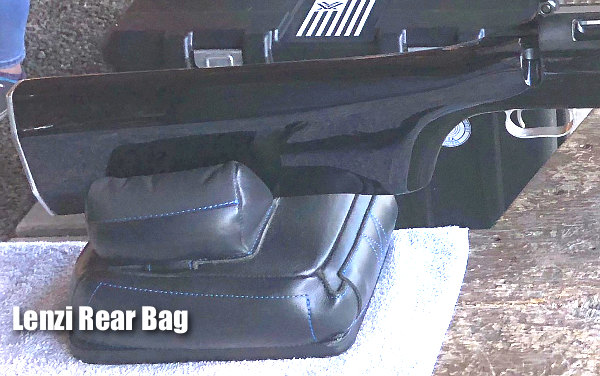
Leonard Baity front rest with Protektor Bag. Italian Lenzi bag in rear.
World Record-Setting Cartridge and Load
Mike was shooting a 40-degree Improved version of the 6mmBR Norma cartridge. Long popular with Benchrest and 300M shooters, the 6mmBR was the original inspiration for this website. Yep, we started as www.6mmBR.com. The Improved version has extra capacity, allowing about 100 FPS more velocity when chambered with a long throat. For his record group, Mike shot Vapor Trail 103-grain bullets in Lapua brass. He loaded Hodgdon H4895 powder with CCI 450 (small rifle magnum) primers.
Praise from Fellow Competitors
Here are some reactions to Mike’s amazing group by our Forum members:
“Amazing target Mike Wilson! Your group might last forever as ‘the goal’ of 1000-yard Benchrest! Heck that’s a great target even at 600 yards.” — Mike J.
“Think about this for a second. That group was barely larger than the size of your index finger’s first digit and he printed it at 1000 Yards.” — Carlos
“Unbelievable!! Doing that under chosen prime conditions is an amazing feat but to do that in competition and to have everything to come together is just unbelievable. Amazing how far skill, precision, knowledge, and the products of this sport have come. Never thought we would see a group this small and well placed especially in the hills of North Carolina where the wind always blows. Congratulations. A true lifetime achievement.” — Yote Hunter
“I think that one will stand for a while. Hard work does pay off, but it don’t hurt to be one of the givers in the sport. Mike, you are ‘The Man’!” — Bill Shehane
“Awesome, awesome. Now the goal is to shoot UNDER an inch!” — Alex Wheeler
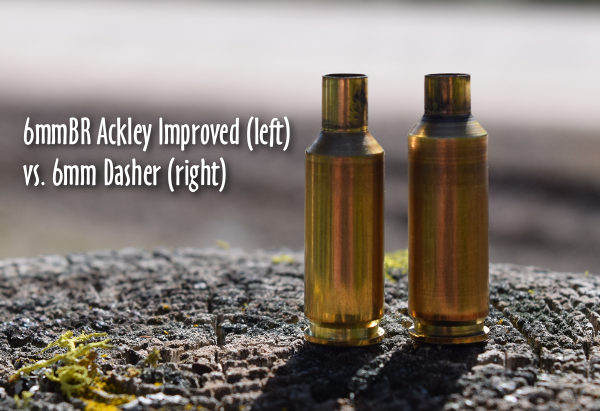
The 6mmBR Ackley Improved
Mike Wilson shot his spectacular group with a 40° Improved version of the 6mmBR cartridge with less body taper than a standard 6BR — the design is 0.463 at the body/shoulder junction (vs. 0.460 for standard 6BR). Mike calls his version of the 6BR Ackley a 6BRAW (“W” for Wilson). Sam Hall explained: “The 6BRAW is pretty much the same as a 6BRA or 6BR-AI (Ackley Improved). I sold the reamer to Mike last year. This has a 0.272 ‘No-Turn’ chamber with a 0.135 Freebore”.
This photo shows a 40° 6mmBR Ackley Improved (6BRA), as used by Tom Mousel in Deep Creek, Montana. Mike Wilson’s 6BRAW may be very slightly different. For Mousel’s 6BRA with 28″ Krieger barrel, the accuracy node is about 2980-2990 fps, so this gives up only 30-50 fps compared to typical Dasher velocities. Mike Wilson’s load runs about 2980 fps also.
In the past couple of years, the 6BR Ackley-type cartridges have been hugely successful in 600-yard and 1000-yard Benchrest. Sam Hall notes: “This year the little 6BR-AI has shot the smallest groups ever fired in 600-yard and 1000-yard competition. Back in April 2018, bullet-maker Bart Sauter, using a 6BRA, shot a 0.311″ 50-score 5-Shot group at 600 yards.” (Read Sauter Story). Bart’s stunning 0.05 MOA group is now the 600-yard IBS HG World Record.(Note: Bart’s target was originally measured at 0.282″ but was later IBS-certified at 0.311″.)
Mike used an Italian Lenzi rear bag. Mike says the super-slick nylon on the ears of this high quality rear bag make for better tracking. The ears provide support but don’t “grab” the stock, reports Mike.
More Comments by Fellow Shooters:
“Truly an amazing feat. The 5X was the icing on the cake! Many shooters would be very happy with that group size at 200 yards.” — Mr. Zero
“Words cannot adequately express how many of us feel about your magnificent accomplishment at 1000 yards. Congratulations — that is terrific!” — Gene Beggs
“Truly amazing … well done on a great achievement… RESPECT!” — Elardus
“Bravo Mike pour ce tir incroyable. Ton exploit est sur le forum de tir longue distance en France bonne continuation.” — Frederic Riso
* There are two North American sanctioning bodies for 1000-Yard Benchrest, the IBS and the NBRSA. The previous 5-shot, 1000-yard IBS record is 1.397″ (50 score) by Tom Sarver in 2007. The existing NBRSA 1000-Yard 5-shot Light Gun record is 1.473″, shot by Bill Schrader in 2002.
The Legal Brief is a feature of TheGuncollective.com that focuses on firearms rules and regulations. In this Legal Brief video, Attorney Adam Kraut explains key State and Federal regulations governing firearms, and explains how to ensure compliance with all applicable laws.
This five-minute video explains barrel length rules for rifles and shotguns, and also explains the best (and most fool-proof) methods to measure your barrel. In addition, the video explains how to measure firearm overall length. A rifle or shotgun which is less than 26 inches overall can also be classified as a “Short-barreled” rifle/shotgun subject to the NFA. NOTE: Under federal law “If the rifle or shotgun has a collapsible stock, the overall length is measured with the stock EXTENDED”.
Highlights of LEGAL BRIEF Discussion of Barrel Length and Firearm Overall Length
The ATF procedure to measure the length of a barrel is to measure from the closed bolt or breech face to the furthest end of the barrel or permanently attached muzzle device. ATF considers a muzzle device that has been permanently attached to be part of the barrel and therefore counts towards the length.
How to Measure Barrel Length: Drop [a] dowel or rod into the barrel until it touches the bolt or breech face, which has to be closed. Mark the outside of the rod at the end of the muzzle crown (if you don’t have a permanently attached muzzle device) or at the end of the muzzle device if it is permanently attached. Remove the rod and measure from the mark to the end of the rod. That is your barrel length[.]
Remember, if the barrel length is less than 16 inches, it is possible that the firearm could be a short barrel rifle (if you are building a rifle or it is already on a rifle) and if the barrel length is less than 18 inches, it is possible the firearm could be a short barrel shotgun (again if you are building a shotgun or it is already a shotgun). Both of these firearms would be subject to the purview of the National Firearms Act and would require the firearm to be registered accordingly.
How to Measure Overall Length:The overall length of your rifle or shotgun may also classify it as a Short Barrel Rifle or Short Barrel Shotgun. The overall length of a firearm is the distance between the muzzle of the barrel and the rearmost portion of the weapon measured on a line parallel to the axis of the bore. … If the rifle has a permanently attached muzzle device, that is part of the overall length. … If the rifle or shotgun has a collapsible stock, the overall length is measured with the stock extended.


 Trigger images from
  According to Thomas Conroy, ALG triggers “are the perfected version of the standard, non-adjustable mil-spec original trigger. They have the same geometry, but are made to higher quality standards, and come with … hardened and smoothed-out sear contact surface to eliminate all grittiness.” These are also offered in a nickel-boron coated version. Available for
 In today’s economy, Free is good. Here’s a list of classic, older shooting books that can be downloaded for FREE from Google Books. This list includes many classic treatises on marksmanship that still have value for today’s competitive shooters. In addition, we’ve included illustrated firearm histories, such as Townsend Whelen’s fascinating book, The American Rifle, and The Gun and its Development (9th Ed.), by William Wellington Greener.




ATF Proposed Rule Will Redefine Firearm “Frame or Receiver”
On 5/7/21, the U.S. Attorney General signed ATF proposed rule 2021R-05, Definition of “Frame or Receiver” and Identification of Firearms. The goal of the proposed rule is to ensure the proper marking, recordkeeping, and traceability of all firearms manufactured, imported, acquired and disposed by federal firearms licensees. This proposed rule would among others, provide new or amend previous definitions of terms related to or about “firearm frame or receivers” and “frame or receivers.” SEE ATF website.
» Download the Proposed New ATF Rule (PDF)
ATF requests comments on the proposed rule, Definition of “Frame or Receiver” and Identification of Firearms, from all interested persons. ATF specifically requests comments on the feasibility of implementing the new definition of firearm “frame or receiver” in 27 CFR 478.11 and 27 CFR 479.11, and related definitions and amendments that ensure the proper marking, recordkeeping, and traceability of all firearms manufactured, imported, acquired and disposed by federal firearms licensees.
ATF also requests comments on the costs or benefits of the proposed rule and on the appropriate methodology and data for calculating those costs and benefits. To submit comments CLICK HERE: Frame or Receiver Submit Comment Page
Official Summary of New Fiream Frame or Receiver Rule
You May Submit a Comment
ATF is receiving comments on the proposed rule for 90 days from the date the proposed rule is posted in the Federal Register. You may submit comments by mail, fax or the Federal eRulemaking Portal at www.regulations.gov.