Barrel-maker Dan Lilja’s website has an excellent FAQ page that contains a wealth of useful information. On the Lilja FAQ Page as you’ll find informed answers to many commonly-asked questions. For example, Dan’s FAQ addresses the question of barrel life. Dan looks at factors that affect barrel longevity, and provides some predictions for barrel life, based on caliber, chambering, and intended use.
NOTE: This article was very well-received when it was first published last year. We are reprising it for the benefit of readers who missed it the first time.
Dan cautions that “Predicting barrel life is a complicated, highly variable subject — there is not a simple answer. Signs of accurate barrel life on the wane are increased copper fouling, lengthened throat depth, and decreased accuracy.” Dan also notes that barrels can wear prematurely from heat: “Any fast varmint-type cartridge can burn out a barrel in just a few hundred rounds if those rounds are shot one after another without letting the barrel cool between groups.”
Q. What Barrel Life, in number of rounds fired, can I expect from my new barrel?
A: That is a good question, asked often by our customers. But again there is not a simple answer. In my opinion there are two distinct types of barrel life. Accurate barrel life is probably the type most of us are referencing when we ask the question. But there is also absolute barrel life too. That is the point where a barrel will no longer stabilize a bullet and accuracy is wild. The benchrest shooter and to a lesser extent other target shooters are looking at accurate barrel life only when asking this question. To a benchrest shooter firing in matches where group size is the only measure of precision, accuracy is everything. But to a score shooter firing at a target, or bull, that is larger than the potential group size of the rifle, it is less important. And to the varmint hunter shooting prairie dog-size animals, the difference between a .25 MOA rifle or one that has dropped in accuracy to .5 MOA may not be noticeable in the field.
The big enemy to barrel life is heat. A barrel looses most of its accuracy due to erosion of the throat area of the barrel. Although wear on the crown from cleaning can cause problems too. The throat erosion is accelerated by heat. Any fast varmint-type cartridge can burn out a barrel in just a few hundred rounds if those rounds are shot one after another without letting the barrel cool between groups. A cartridge burning less powder will last longer or increasing the bore size for a given powder volume helps too. For example a .243 Winchester and a .308 Winchester both are based on the same case but the .308 will last longer because it has a larger bore.
And stainless steel barrels will last longer than chrome-moly barrels. This is due to the ability of stainless steel to resist heat erosion better than the chrome-moly steel.
Barrel Life Guidelines by Caliber and Cartridge Type
As a very rough rule of thumb I would say that with cartridges of .222 Remington size you could expect an accurate barrel life of 3000-4000 rounds. And varmint-type accuracy should be quite a bit longer than this.
For medium-size cartridges, such as the .308 Winchester, 7×57 and even the 25-06, 2000-3000 rounds of accurate life is reasonable.
Hot .224 caliber-type cartridges will not do as well, and 1000-2500 rounds is to be expected.
Bigger magnum hunting-type rounds will shoot from 1500-3000 accurate rounds. But the bigger 30-378 Weatherby types won’t do as well, being closer to the 1500-round figure.
These numbers are based on the use of stainless steel barrels. For chrome-moly barrels I would reduce these by roughly 20%.
The .17 and .50 calibers are rules unto themselves and I’m pressed to predict a figure.
The best life can be expected from the 22 long rifle (.22 LR) barrels with 5000-10,000 accurate rounds to be expected. We have in our shop one our drop-in Anschutz barrels that has 200,000 rounds through it and the shooter, a competitive small-bore shooter reported that it had just quit shooting.
Remember that predicting barrel life is a complicated, highly variable subject. You are the best judge of this with your particular barrel. Signs of accurate barrel life on the wane are increased copper fouling, lengthened throat depth, and decreased accuracy.
Benchrest Barrel Life — You May Be Surprised
I thought it might be interesting to point out a few exceptional Aggregates that I’ve fired with 6PPC benchrest rifles with barrels that had thousands of rounds through them. I know benchrest shooters that would never fire barrels with over 1500 shots fired in them in registered benchrest matches.
I fired my smallest 100-yard 5-shot Aggregate ever in 1992 at a registered benchrest match in Lewiston, Idaho. It was a .1558″ aggregate fired in the Heavy Varmint class. And that barrel had about 2100 rounds through it at the time.
Another good aggregate was fired at the 1997 NBRSA Nationals in Phoenix, Arizona during the 200-yard Light Varmint event. I placed second at this yardage with a 6PPC barrel that had over 2700 rounds through it at the time. I retired this barrel after that match because it had started to copper-foul quite a bit. But accuracy was still good.
How and Why to Create a Dummy Round
When you have a new custom rifle built, or a new barrel fitted to an existing rifle, it makes sense to create a dummy round. This should have your preferred brass and bullet types, with the bullet positioned at optimal seating depth. A proper dummy round helps the gunsmith set the freebore correctly for your cartridge, and also ensure the proper chamber dimensions.
Respected machinist, tool-maker, and gunsmith Greg Tannel of Gre-Tan Rifles explains: “I use the dummy round as a gauge to finish cut the neck diameter and throat length and diameter so you have [optimal] clearance on the loaded neck and the ogive of the bullet just touches the rifling.” He recommends setting bullet so the full diameter is just forward of the case’s neck-shoulder junction. “From there”, Greg says, “I can build you the chamber you want… with all the proper clearances”.
Greg Tannel has created a very helpful video showing how to create a dummy round. Greg explains how to measure and assemble the dummy and how it will be used during the barrel chambering process. Greg notes — the dummy round should have NO Primer and No powder. We strongly recommend that every rifle shooter watch this video. Even if you won’t need a new barrel any time soon, you can learn important things about freebore, leade, and chamber geometry.
This has been a very popular video, with 244,000 views. Here are actual YouTube comments:
That is the best explanation I’ve ever seen. Thank you sir. — P. Pablo
Nice video. You do a very good job of making this easy for new reloaders to understand. I sure wish things like this were available when I started reloading and having custom rifles built. Once again, great job, and your work speaks for itself. — Brandon K.
Beautiful job explaining chambering clearances. — D. Giorgi
Another Cool Tool — The Stub Gauge
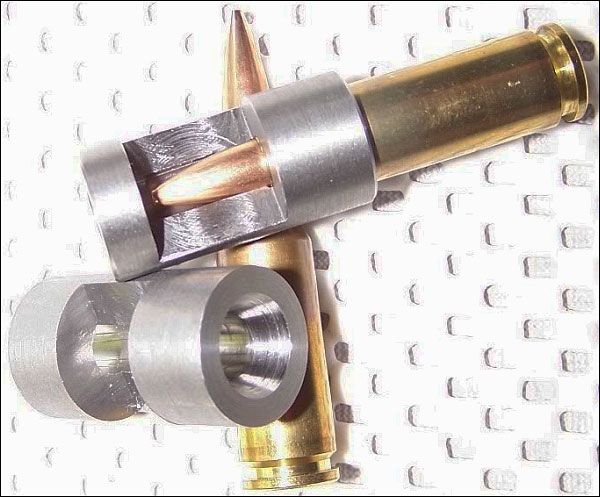
When you have your gunsmith chamber your barrel, you can also have him create a Stub Gauge, i.e. a cast-off barrel section chambered like your actual barrel. The stub gauge lets you measure the original length to lands and freebore when your barrel was new. This gives you a baseline to accurately assess how far your throat erodes with use. Of course, as the throat wears, to get true length-to-lands dimension, you need take your measurement using your actual barrel. The barrel stub gauge helps you set the initial bullet seating depth. Seating depth is then adjusted accordingly, based on observed throat erosion, or your preferred seating depth.
This Sunday we feature the German-crafted Merkel RX Helix with straight-pull bolt. We shot the Helix a few years back during Media Day at the Range. One notable difference between the German Merkel and the Austrian Strasser, another straight-pull rifle, is the bolt travel. During cycling, the Merkel bolt stays completely inside the action (see video below at 00:30). By contrast the Strasser bolt moves pretty far back, outside the action. For some folks that makes the Helix better for fast follow-up shots. All we can say is that Merkles and Strassers BOTH cycle way faster than conventional bolt-action rifles.
Merkel RX Helix Range Report
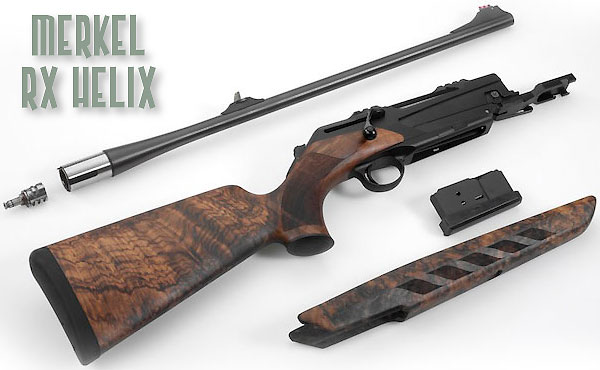
One of the most innovative rifles we have ever shot was the Merkel RX Helix, a very impressive piece of rifle engineering. Merkel claims the RX Helix is the fastest-cycling centerfire bolt action in the world. We can’t confirm that claim, but the Helix certainly cycles faster than any other centerfire bolt-gun this Editor has ever tried. (Yes, a Fortner biathlon action can be worked more rapidly, but that’s a rimfire). Both Jason and I really liked Merkel’s RX Helix. It balances well, the action is smooth, the wood is gorgeous, and the overall design thinking that went into this German-engineered take-down rifle is very impressive. The Helix’s universal-sized action lets you shoot anything from a .222 Rem to a .300 Win Mag with the same gun. And — get this — you can really swap barrels (and change bolt heads) in a couple of minutes with no tools, employing a dead-simple bolt-release lever concealed under the push-button-released removable forearm. (Watch VIDEO BELOW to see Barrel Swap procedure).
Rotary 7-Lug Bolt
While the RX Helix is a straight-pull rifle, it retains the strength and safety of a rotary bolt head with seven locking lugs that seat in a barrel extension. Unlike a Blaser, the RX Helix has a fully-enclosed action housing. That’s an important safety feature. Moreover, since the RX Helix employs a closed action, the bolt body doesn’t travel outside that action. This means the shooter can maintain his cheekweld with an eye on the target as he cycles the bolt.
The RX Helix’s linear (back and forth) bolt-handle motion is transmitted to the bolt head through a 1:2 ratio “transmission” gearing system. This allows smooth and fast cycling without the rotational or tipping movement found on other straight-pull, bolt-action rifles, such as the Blaser.
The Merkel linear-movement action cycles exceptionally fast, which allows for faster follow-up shots — a good thing if you’re hunting dangerous game. The RX Helix features a manual cocking lever on the tang and a direct trigger system. And here’s good news for southpaws — though Merkel does not make a dedicated left-hand version, lefties can very easily use their right hand to work the bolt while maintaining cheekweld. That may sound awkward, but with practice, it’s actually pretty efficient.
Fast, Easy Disassembly and Barrel Exchanges
The video below shows how the Helix can be disassembled (for cleaning or transport) in a matter of seconds WITHOUT TOOLS. The forearm slips off with the push of a button. A short lever on the left side of the action holds the barrel. Simply rotate the lever and the barrel (with bolt head) slips off. That’s it — in 30 seconds the rifle is apart, and you don’t even need an allen wrench as with a Blaser.
The RX Helix has a universal action length that covers calibers from .222 Rem to .300 Win Mag. Changing calibers (or chamberings) takes less than a minute with the appropriate barrel, bolt-head and magazine. Weaver rails are integrated into the action, and iron sights with three-dot rear and one-dot front fiber-optic inserts are standard.
The RX Helix is available with a standard black finish as well as four levels of design — Arabesque, Wild Boar, Spirit, and Deluxe. An all-carbon-fiber version was also available either with or without a carbon-wrapped barrel. The RX Helix comes in a wide range of calibers including .222 Rem, .223 Rem, .243 Win, 6.5×55 SE, .270 Win, 7×64, .308 Win, .30-06 Sprg., 8×57 IS, 9.3×62, 7mm Rem Mag and .300 Win Mag. Barrel lengths vary according to caliber, and barrels, bolt-heads and magazines are available for caliber changes. EuroOptic sells the Merkel RX Helix, but most models are back-ordered.
Forum member Keith W. (aka “Cigarcop”) of KW Precision LLC is a talented riflesmith whose projects display outstanding finish work and attention to detail. Keith does some of the best bedding work we’ve ever seen. Back in 2018, Keith built a stunning F-Class rig for a shooter in Delaware. It’s a beauty, that’s for sure. Keith has posted more details about this rifle in a Shooters’ Forum Thread.
This handsome rifle features a polished Stolle (Kelbly) Panda Action, and two (2) Brux barrels, both chambered for the .284 Winchester cartridge. The real eye-catching component of this rifle is the stunning Cerus F-Open stock. This features multiple laminations with highly-figured Walnut on the sides. This certainly ain’t your “off-the-shelf” laminated stock. This just shows the beauty that can be achieved with carefully-chosen lamination layers (plus 12 coats of clear).
This beautiful F-Open rig features a laminated wood stock with stunning figured walnut on the outside.
Keith of KW Precision LLC is renowned for his bedding work, and this rifle shows why. Keith takes great pride in his work, and his attention to detail is second to none. This bedding job is as good as it gets.
Bringing out the figure in the wood requires multiple finish coats (and careful sanding between coats). But the results are worth it. Shown below is the Cerus stock, BEFORE the finish coats were applied. It took time and effort to transform the “naked” Cerus stock into a true stunner. Keith applied twelve (12) coats of PPG Automotive Clear with wet sanding between each coat.
And Another Beauty — This One Built for Capstone’s Boss
CigarCop recently completed a handsome rifle for Bill Gravatt, President of the Capstone Precision Group, distributor for Berger, Lapua, Vihtavuori, and SK products. This F-TR rig is another example of beautiful craftsmanship. Look at that bedding job in the lower photo! To learn more about this rifle, which features a black Borden Rimrock BRM action (with fluted bolt), read this Shooters’ Forum Thread.
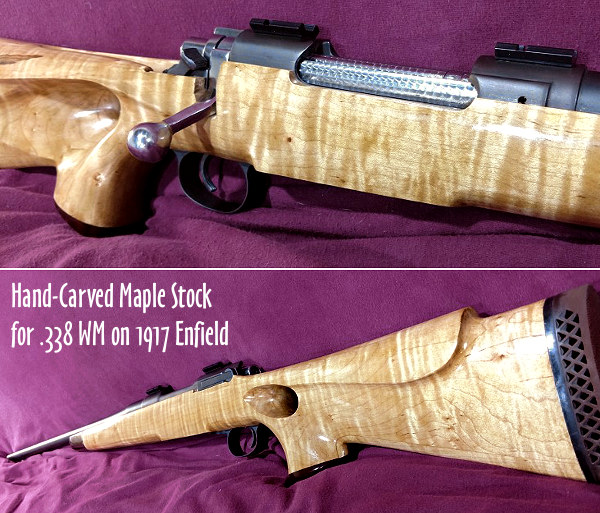
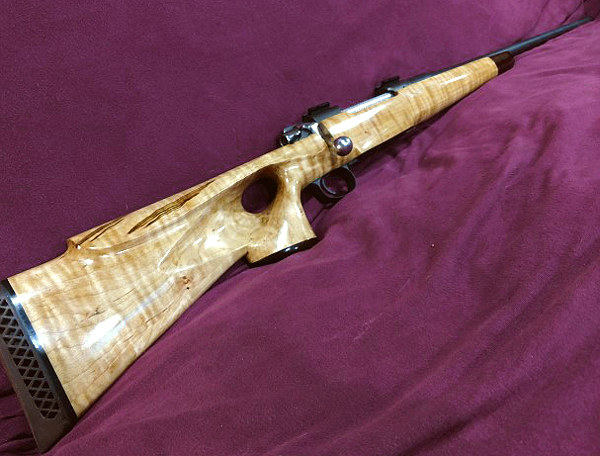
Believe it or not, this is the first stock Brett M. carved by hand. We’d say he did a darn good job!
AccurateShooter Forum member Brett M. from Minnesota (aka Spitfire_er) recently completed a handsome laminated maple gunstock. This beauty wasn’t produced with a stock duplicator. It was made the old-fashioned way — by hand. After laminating three sections, Brett carved the complete stock with hand tools. You can see the entire carving process, start to finish, in Brett’s time lapse video.
MUST-SEE time-lapse carving video. Every second is one minute in real time. This 15:54 video shows 15.9 hours of carving! Brett says the whole job took nearly 20 hours:
Handsome Maple Blank Was Lumber Yard Return!
Brett reports: “Here’s a stock I carved up over the past year or so. I found this wood as a return at a lumber yard about 7-8 years ago. I asked the guy in the yard about it and he said it had been returned because it had too much figure for the job the customer was working on. First thing I thought was “That would make a nice stock!” I finally got around to finishing it a couple months ago.
I fit it around a 1917 Enfield in .338 WM that I purchased a while back. I usually do all the work on the receiver and barrel, but this one was done up in an OK fashion already.
This stock was almost completely made using hand tools over the course of about a year. This is a piece of laminated 1x8x1″ maple that was glued together. After it sat for about eight years, I finally got around to carving it up. This stock design/shape was from my own ideas and was carved as I went along. It turned out pretty good.”
There’s a great new way to apply an eye-catching finish to fiberglass and synthetic stocks. Water Transfer Printing (aka Hydro-Dipping) can apply beautiful, stylized patterns to your stock, and the process costs less than a custom paint job. Hydro-dipping is ideal for applying amazing photo-realistic effects such as stone, wood burl, snakeskin, or faux carbon fiber. Hydro-dipping requires no harsh chemicals or high heat so there are no negative side effects. You just end up with an amazing, patterned finish on your stock.
Hundreds of different patterns are available. We like the carbon-look finish on benchrest guns and the snakeskin patterns on hunting and varmint rifles. Natural snakeskin designs, in this Editor’s opinion, are perhaps the most effective camouflage for the largely arrid backcountry in the American southwest.
Hydro-Dip of Idaho Does Great Work
While there are a half-dozen companies offering water transfer printing for rifle stocks, Forum member Francis B. recommends Hydro-Dip, LLC of Meridian, Idaho. Examples of Hydro-Dip’s work are shown above. Francis writes: “Scott, Adam, and old man Rod Springer own and run Hydro-Dip. This is a company that will ‘paint’ your rifle, tool box, trailer, airplane, whatever and will do an excellent job while doing it. Check out their archives of jobs done. You will be amazed. I’ve not had one of their jobs done for any of mine (yet) but I’m considering it. Those who have had their rifles done tell me the cost is very reasonable. I have seen a few stocks done and they are works of art.”
Hydro-dipping (water transfer printing) can be performed on virtually any metal or plastic surface. You can Hydro-dip car parts, archery gear, rifle stocks — you name it. Watch the process in the video:
Buell’s Beast with Massive 35 Inch Barrel
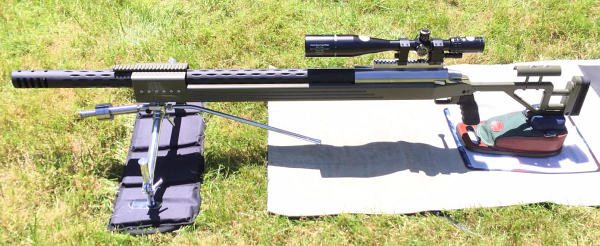
A few seasons back, Our friend Darrell Buell built a new Beast — a monster 64-inch-long .375 CheyTac that weighs more than 70 pounds! Designed for ultra-long-range shooting (two miles and beyond), this beast represents the state-of-the-art in extreme long-range rifles. NOTE: to see more details, click the two images above to open Full-Screen Photos.
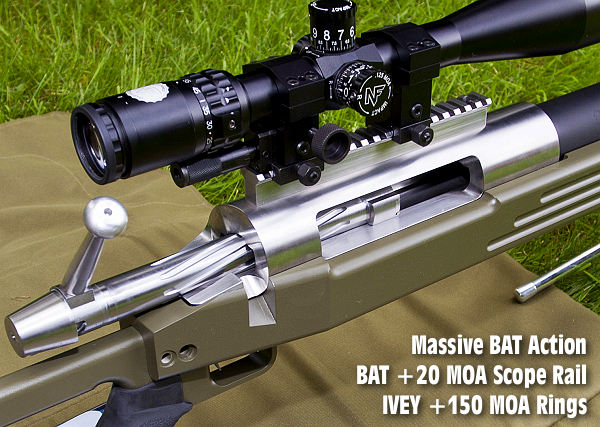
Darrell reports: “This rifle is pretty much purpose-built to shoot 2+ miles extremely accurately. It is a .375 CheyTac (lengthened) built on a BAT 2.5″ action. The custom 35″, 1:10″-twist Brux barrel is a fat, 2″-diameter ‘straight taper’ with fluting. A custom 5″-long muzzle brake is fitted at the end. All barreled action work was done by R.W. Snyder Custom Rifles. The stock was created to fit the build by PDC Custom, and the massive muzzle brake as well.” The “bridge” at the end may look like a barrel block, but it’s not — the barrel completely free-floats. (The Picatinny rail on top of the bridge allows use of an overhanging bipod as an alternative to the JoyPod).
Darrell has lots of elevation on tap: “With 150 MOA in the Ivey rings, another 20 MOA in the scope rail, 55 MOA in the Nightforce Competition scope, and 10 MOA in the FCR-1 reticle, there’s an impressive +235 MOA available.”
Counter-Weighted SEB Joy-Pod Up Front
The bipod Darrell will be using for his ELR sessions and the ‘King of 2 Miles’ match is a custom counter-weighted JoyPod crafted by Seb Lambang. With the counter-weight, Darrell says his monster 70-lb gun “adjusts as smoothly as an F-T/R rig”. The glass is a Nightforce 15-55x52mm Competition scope carried in Ivey +150 MOA rings, which in turn are mounted to a +20 MOA BAT scope rail. Darrell says: “It’s been a heck of a couple months, getting this monster built in time, thanks particularly to Southern Cerakote, which turned it around in less than 24 hours.”
Buell’s Beast runs 350gr solid bullets at approximately 3250 fps. Check out the massive .375 CheyTac cartridge compared to a .308 Winchester:
This one-of-a-kind “JoyPod” was produced by Seb Lambang specifically for Buell’s big .375 CheyTac rifle. Darrell needed a JoyPod that wouldn’t sink under a heavy load. Seb explains: “This is the world’s first JoyPod equipped with an adjustable counterweight, to balance his 75-lb gun. I did some experiments and put some weights ranging up to 60+ lbs on the top, and I found that the joystick action works like a regular one….it’s smooth, light, and precise. In addition, the counterweight can be bent down to not interfere with the bottom of the barrel. The counterweight is secured into the front center shaft by a thumb screw, and there is a tightly fitted pivotal joint on the counterweight to allow angle adjustment.”
Darrell is happy with his customized coaxial bipod: “In addition to the adjustable counterweight system on the front, this JoyPod comes with a longer, solid joystick. These additions will make for extremely smooth, precise adjustments, even if the rifle weighs in at 75 pounds or more. Not including the counterweight, the actual structure of this bipod weighs in at a mere 1.09 pounds — exactly what the standard JoyPod weighs. It is extremely strong, however. Seb has pictures of himself standing on the pod … and he weighs 150 pounds!”
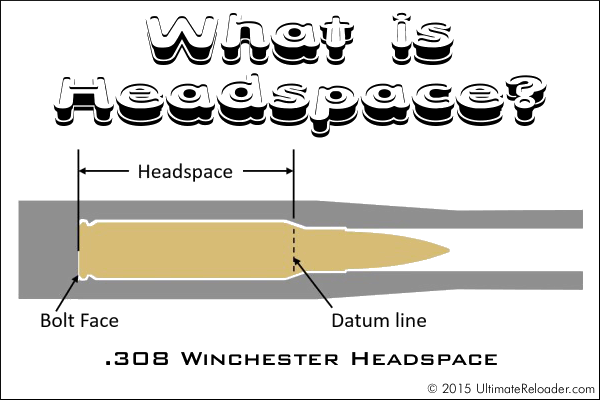
This illustration shows headspace measurement for the popular .308 Winchester cartridge, which headspaces on the shoulder. Image copyright 2015 Ultimate Reloader.
In this Brownells Tech Tip, Brownells gun tech Steve Ostrem explains what headspace is and why it’s one of the most critical measurements for nearly all firearms. Even if you’re an experienced rifle shooter, it’s worth watching this video to refresh your understanding of headspace measurements, and the correct use of “GO” and “NO-GO” gauges.
Headspace Definition
In firearms, headspace is the distance measured from the part of the chamber that stops forward motion of the cartridge (the datum reference) to the face of the bolt. Used as a verb, headspace refers to the interference created between this part of the chamber and the feature of the cartridge that achieves the correct positioning. Different cartridges have their datum lines in different positions in relation to the cartridge. For example, 5.56x45mm NATO ammunition headspaces off the shoulder of the cartridge, whereas .303 British headspaces off the forward rim of the cartridge.
If the headspace is too short, ammunition that is in specification may not chamber correctly. If headspace is too large, the ammunition may not fit as intended or designed and the cartridge case may rupture, possibly damaging the firearm and injuring the shooter. (Source: Wikipedia)
Headspace Gauges
Headspace is measured with a set of two headspace gauges: a “Go” gauge, and a “No-Go” gauge. Headspace gauges resemble the cartridges for the chambers they are designed to headspace, and are typically made of heat-treated tool steel. Both a “Go” and a “No-Go” gauge are required for a gunsmith to headspace a firearm properly. A third gauge, the “Field” gauge, is used (as the name implies) in the field to indicate the absolute maximum safe headspace. This gauge is used because, over time, the bolt and receiver will wear, the bolt and lugs compress, and the receiver may stretch, all causing the headspace to gradually increase from the “factory specs” measured by the “Go” and “No-Go” gauges. A bolt that closes on “No-Go” but not on “Field” is close to being unsafe to fire, and may malfunction on cartridges that are slightly out of spec. (Source: Wikipedia)
To learn more, read Brownell’s longer article Headspace Gauges and How to Use Them. Among other things, this explains the relative lengths of “Go”, “No-Go”, and “Field” gauges. The “Field” is actually the longest: “The GO gauge corresponds to the SAAMI (Sporting Arms & Ammunition Manufacturer’s Institute) minimum chamber length, while the FIELD gauge usually matches the maximum chamber depth, or slightly less. NO-GO gauges are an intermediate length between minimum and maximum, that, technically, is a voluntary dimension. A firearm that closes on a NO-GO gauge and does not close on a FIELD gauge may not give good accuracy and may have very short cartridge case life from the ammunition re-loader’s standpoint.”
BAT .50 BMG Model EX– Now That’s an Action!, by GS Arizona
A few seasons ago, I stopped into Bruno Shooters Supply for a jug of powder and looked into the display case where the new actions are kept. Amid the usual array of BAT Machine, Kelbly and other actions, there was something unlike any action I’d seen before — all I can call it is the BIG BAT (It’s officially the BAT Model EX 2.5). I wasn’t too surprised at the weight (a beefy 13.7 lbs.), but until you lift it it’s hard to appreciate how solid, chunky, hefty, massive (pick your favorite adjective) this thing really is.
The action is a 2.5″-diameter, 12″-long BAT for the .50 BMG cartridge. It is simply the biggest, slickest custom action on the planet. In order to give you some sense of scale, I photographed the action alongside a conventional BAT action for short-range Benchrest shooting and I put a .220 Russian case and a .30-06 case into the picture. I’ve handled and fired other .50 BMG actions/rifles before, but this BAT puts them all to shame, as far as fit and finish go.
The action is actually quite conventional in design and execution. The bolt is fluted and has two front lugs with a conventional, although super-sized, firing pin assembly. Any Remington-style trigger will mount by way of a normal trigger hanger, allowing for simplified maintenance or replacement in the field. The loading port is 5.5″ long and the barrel threads are 1.5″ x 16 tpi — nothing about this beast is small! There is a conventional rocker-type bolt release on the left side of the receiver body and a recoil lug is built into the bottom of the receiver. In reality, the action is very similar to any other BAT except for the size and it adheres to all of BAT’s high standards for quality of design, manufacture, fit, finish and just plain good looks. Slide that bolt back and it feels as tight as a small Benchrest action!
BAT Machine states: “Our model EX is our largest action we make. It was designed to work with the .50 BMG cartridges. This action is 12.00″ long and has two exterior shape options. Starting weight is 128 oz. and varies with options chosen. This action requires a 1.75 inch diameter barrel.”
Given the BIG BAT’s $3,200.00+ sticker price (before options), not many of us will ever have the opportunity to own or shoot one of these beauties (I certainly won’t). However, it is nice to know they exist and can be bought and enjoyed in many places. CLICK HERE for BAT EX configuration options and purchase details.
We like “outside of the box” thinking. And in the world of competitive shooting, it can’t get more unconventional than this. But this radical liquid-cooled benchrest rig wasn’t just a crazy experiment — it actually delivered the goods. This IBS Heavy Gun, built by Joel Pendergraft, produced a superb 10-shot, 3.044″ group that stood as an International Benchrest Shooters (IBS) 1000-Yard Heavy Gun record for seven years, not being broken until 2016.*
Using this water-cooled wondergun, Joel shot the record-breaking group in April 2009 at Hawks Ridge, NC. This monster features a .30-Caliber 12-twist, 4-groove Krieger barrel inside a water-filled sleeve (like on a liquid-cooled machine gun). Joel shot BIB 187gr flat-based bullets in Norma brass, pushed by a “generous amount” of Alliant Reloder 25 and Federal 210M primers. The cartridge was a big custom wildcat Joel listed as “.300 Ackley Improved”. That traditionally has been based on the .300 H&H Magnum parent case**. READ Forum Thread on .300 Ackley.
This 3.044″ 10-shot group was a remarkable accomplishment, breaking one of the longest-standing, 1000-yard IBS World Records. And Joel’s 3.044″ record stood for 10 years.
This 3.048″ 10-shot group was a remarkable accomplishment, breaking one of the longest standing 1000-yard World Records. Bill Shehane commented: “This tops the NBRSA, IBS, and Original Williamsport Clubs’ all-time 10-shot Heavy Gun group records. Took a long time to do it and I for one know Joel did not back into it — he worked harder than most… to break this record. And just like John Voneida of the Original Williamsport Club who held this most prestigous record for so long, Joel is a super nice guy and a great competitor.”
Pendergraft was modest after his notable achievement: “What makes this so very special is to be able to celebrate the accomplishment with all of my shooting friends[.] A good friend once said that records are shot when preparation and opportunity meet. I feel blessed to have personally had the opportunity. The preparation we can individually work on and achieve but the opportunity only comes to a few. Those of you that compete in long range competition will know what I mean.”
*On July 24, 2016, Michael Gaizauskas shot a 2.871″ ten-shot group that bettered Pendergraft’s record by 0.171″ (less than a quarter inch). Michael’s group was also all in the 10 ring, for a perfect 100 score. CLICK HERE for IBS Long-Range Records.
** Back in 2008, the .300 Ackley was the #1 Cartridge in 1000-yard competition at Hawks Ridge. SEE Results Chart. Forum member Cheechako explains: “The .300 Ackley Magnum is actually the .300 H&H case improved. Many shooters will start with the Weatherby brass because it is higher quality. There are several versions of the Ackley but the differences are minor until you get into the few, like the 300 Hart, that actually do increase the capacity. There is also a .300 Weatherby Improved which is sort of a misnomer because it’s almost impossible to improve that case except to eliminate the rounded corners.”




 Rotary 7-Lug Bolt



 Handsome Maple Blank Was Lumber Yard Return!





 Headspace Gauges


 This 3.048″ 10-shot group was a remarkable accomplishment, breaking one of the longest standing 1000-yard World Records. Bill Shehane commented: “This tops the NBRSA, IBS, and Original Williamsport Clubs’ all-time 10-shot Heavy Gun group records. Took a long time to do it and I for one know Joel did not back into it — he worked harder than most… to break this record. And just like John Voneida of the Original Williamsport Club who held this most prestigous record for so long, Joel is a super nice guy and a great competitor.”


