This unique Savage 99 rifle was created for Joseph V. Falcon, President of Savage Arms in the 1950s.
Presentation Engraved Savage 99 Rifle
When you run the company, you get some pretty nice stuff — in this case you get what may be the most elegant Savage ever made.
This rifle was created for Joseph V. Falcon, who served as President of Savage Arms in 1956. This highly embellished Savage 99 lever-action rifle is chambered for the .300 Savage cartridge. It features deluxe checkering and gold inlays. This presentation-grade rifle boast deep relief engraving with a golden elk on one side of the receiver and a stalking cougar on the other. This rifle was given to Joseph V. Falcon from his friends at Savage in December of 1967. Falcon later donated the rifle to the NRA. This impressive model 99 is currently showcased at the NRA National Firearms Museum in Fairfax, Virginia.
Savage 99 Quick History
Arthur Savage invented the first “hammerless” lever action rifle with the entire mechanism enclosed in a steel receiver. This rifle featured a rotary magazine with a unique counter that displayed the number of rounds remaining. The Model 99, as it became known, was the gun that launched a company. There is an interesting history of the company’s logo which features an Indian chief in feather head-dress. In 1919, Chief Lame Deer approached Arthur Savage to purchase lever-action rifles for his tribe’s reservation and the two men struck a deal. In return for discounted rifles and support, Savage received the tribe’s endorsement. By virtue of that association, Arthur Savage added the Indian head symbol to the company’s commercial trademark and letterhead.
Here is some serious Sunday “gun glamour” from the folks at Star Shooter Precision, a bipod-builder and stock-maker based in Montreal, Canada. This stunning .308 Win F-TR rifle features a carbon-wrapped Star Shooter stock, angle-adjustable tubular bag-rider, star-shaped escutcheons, and a Kelbly Panda action. Up front is Star Shooter’s signature lightweight bipod.
Click Each Image for Large, Full-Screen Version
About the Rifle Builders Star Shooter Precision is a company located on the south shore of Montreal, Quebec, Canada. Fred Harvey is the designer. Fred says: “Our goal is to perfect the art of competition shooting the best we can with our custom bipods. The Star Shooter bipod is designed for shooters in F-Class competition, varmint hunting, load testing, tactical shooting and sighting in rifles.”
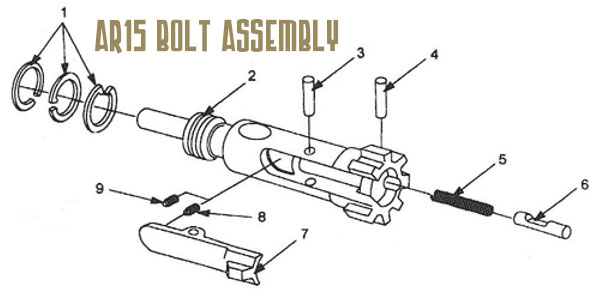
We call them “black rifles”, but that shouldn’t refer to all the carbon and gunk on the inside. AR-platform rifles can be maintenance-intensive beasts. But some AR owners make the situation worse by not regularly cleaning important small parts, or by using too much oily/greasy lubricants in the wrong places. A properly maintained and lubricated AR15 can shoot hundreds of rounds (between cleanings) without a problem. If you learn where (and where not) to apply lubricant, you’ll find that your AR will run more reliably and the task of cleaning the bolt and bolt carrier will be less of a burden.
Here is a good video that explains AR-15 Cleaning and Maintenance. In this 30-minute NSSF video, Gunsite Academy instructor and gunsmith Cory Trapp discusses the proper way to clean and maintain the AR-15 carbine. Very knowledgeable, Trapp provides rock-solid advice for AR owners. Along with cleaning producedures, this video explains how to inspect key components and how to function-test your AR before each shooting session.
GREAT DEAL — Complete Howa Barreled Actions (With Trigger) for $250.00
Howa makes excellent, smooth-running actions, and the Howa HACT 2-stage trigger is WAY better than most domestic factory triggers. Right now you can save big bucks on Howa 1500 barreled actions, complete with HACT trigger and trigger-guard. Pacific Tool & Gauge (PT&G) sourced a truckload of Howa barreled actions, which are now on sale. Available at $250.00 are: .204 Ruger, .223 Rem, .22-250. All these chamberings are offered with either light- or heavy-barrel contours. There is no extra charge for factory camo finishes.
Guys, this is an incredible deal — you can get a complete high-quality barreled action for less than the cost of a custom barrel. If you’re looking to put together a varmint rifle project this is a great option — just add the stock and scope of your choice.
These barreled actions would be great for custom hunting/varmint rifle projects — many have factory camo finishes. Howa barrels typically deliver easy sub-MOA accuracy (and often much better). NOTE: Some of these barreled actions may carry Weatherby or Nosler markings, but they were all made at the Howa factory in Japan.
Howa 1500 Barreled Actions Have Excellent 2-Stage Hact Triggers
PT&G’s Howa 1500 barreled actions feature the very nice Howa HACT trigger. This is an adjustable, two-stage trigger, set for about 3 pounds (combined stages). Crisp and repeatable, this is an excellent trigger for a factory gun. In our opinion, the HACT trigger is clearly superior to the trigger on the Ruger RPR, as well as the Savage AccuTrigger. And there is no annoying Glock-style safety lever in the middle of the trigger blade. The 2-stage design and pull weight range works well for a hunting rifle or a rig for PRS competition.
Writing for the Western Outdoor News, WONews.com, Steve Comus has field-tested the new HACT Trigger. Steve writes: “I always liked two-stage triggers, because of the way I could take-up the slack and then actually know when the rifle was going to go off. The take-up on the [HACT] trigger was fast and easy. The crisp, positive release when pressure was put on during the second stage [reminded me] of some of the target rifles I shot through the years.”
The Visalia Sportsman’s Association Dale Wimp Shooting Range — a great place to shoot.
Report by Boyd Allen | Photos and video by Pete Kitrinos
The IBS is in the West! The first International Benchrest Shooters (IBS) match at the Visalia, CA range was held over the recent Labor Day Weekend. Despite scorching 106° heat, many of the West’s top short-range benchrest shooters assembled for the first IBS-sanctioned match (after a 30-year history with the NBRSA) at the Visalia range. The mix of shooters included at least one Benchrest Hall of Fame member, as well as NBRSA record holders. Competitors were happy to return to Visalia, which had been closed for seven months while range improvements were made (some parts of the East berm were still under construction). With only two ranges in the entire state holding short range group matches, the temporary loss of Visalia had a significant impact. It was time to get back to business — the business of shooting tiny groups.
This video includes Aerial Drone footage of the range — worth watching!
Surrounded by fields, the Visalia Range is located in California’s Central Valley, a rich agricultural area.
For about thirty years the California 3-Gun Benchrest Championship match has been held at the Visalia Sportsman’s Association Dale Wimp Range over Labor Day weekend. For all those years, the matches have been put on by local shooter and current club president Dennis Thornbury. During a good part of that time, he has also managed to keep his name in the NBRSA record book, and pick up four Benchrest Hall of Fame points, as well as having recently done a tour as NBRSA president. This year’s match is sanctioned by the IBS, a first at Visalia.
Don “The Pumpkin” Nielson used an action he fabricated, a “fat bolt” aluminum 3-lug with steel insert.
Dennis Thornbury has been putting on registered matches at the Visalia range for 30 years. He holds an NBRSA record, and has 4 Hall of Fame points.
The format: On Saturday competitors shot 100 yards all day, Sporter in the morning, Light Varmint in the afternoon. The following day the morning competition was Heavy Varmint at 100 and at lunch the targets were moved to 200 yards with Heavy Varmint being shot that afternoon. On Monday, Labor Day, at 200 yards, Light Varmint was shot in the morning and Sporter in the afternoon. All three days consisted of five, 5-shot matches in the morning and five more in the afternoon.
Morning, Day 1 — Very few “daisy wheels”. This has been the trend for many years at this range.
Getting down to business. Shown, from right to left: Henry Pinkney, Joe Stanovich, Steve Epstein, Keith Cottrell (face obscured), Jim Nicolas (standing).
Sunday Top Shots: Jack Childers, Keith Cottrell, John Pierce, Lester Bruno, Dennis Thornbury, and Don Nielson. (Yes that’s a corn field in the background):
With the big temp changes between morning and afternoon, competitors were chasing powder loads all weekend. Small groups were hard to find, so only three “screamers” were recorded all weekend, and no teen Aggs. With the oppressive heat, attrition was also a factor: “We started with 30 shooters, and ended with just 21 competitors”.
Temperatures were in the triple digits for Saturday and Sunday, backing off to the high 90s on Monday. High humidity made it feel even hotter — heat stress was a definite issue. Even the rifles seemed to be at less than their best, causing very light wind conditions to produce Aggregates that were larger than the observed wind conditions would lead one to expect. Wind was generally light and switchy. Lighter mornings with wind increasing slightly through the days. Sunday saw more wind than the other two days after ten o’clock or so.
Loading benches with the usual clutter. Note the LabRadar chronograph on a bench at the firing line. Lawrence Weisdorn tracked his velocities during the match to know when a powder charge adjustment was needed.
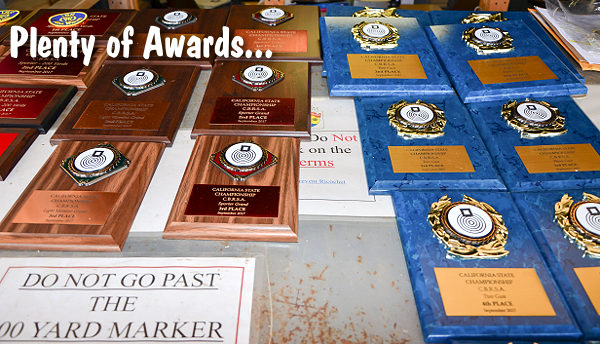
Top Shooters: The Top Five in the 3-Gun (HV, LV, and Sporter) Championship were: Keith Cottrell (.2534), John Pierce (.2695), Dennis Thornbury (.2714), Art Kawai (.2885), and Rich Shaw (.3016). Winners of the Class Grand Aggs were Dennis Thornbury (HV .2424), Lester Bruno (LV .2400), and Keith Cottrell (Sporter .2395). CLICK HERE for full Match Results.
Equipment List for Top Five Shooters
You can use a LabRadar during competition. This was Lawrence Weisdorn’s set-up at Visalia.
Benchrest Technique — How to Shoot at Visalia
This range is built a bit like a large bathtub, dug into a flat field with the excavated earth thrown up in steep berms on three sides. This configuration and the usual lack of strong winds creates a lot of thermal-generated switchiness with flags changing direction often and very little agreement within any shooter’s set. This places a high premium on visual memory and the ability to judge equivalent conditions, because duplicates are almost never seen. Although the opportunity to run groups can happen, this is mostly a “pickers” range, which places a high premium on visual memory.
Facilities at Visalia Sportsman’s Association Range
There are 28 monolithic, steel-reinforced, concrete benches (poured in place, base and top all one pour). The reloading area is behind the benches with most of it on the same level as the benches. There are permanent (fixed position) tables that have laminate tops, except for where the range house sits, mid-range, with a “wailing wall” along its east and north sides. The direction of fire is north. The benches are under a slightly pitched metal roof that has recently been extended so that it has a good amount of overhang in front of the benches. Electricity is available in the reloading area and there are a few electrical outlets in the parking lot for RVs. There are both steps and a wheelchair ramp connecting parking lot to the reloading level and the shooting level.
Field of (Benchrest) Dreams — Precision Shooting Among the California Corn Fields.
Check out that bolt assembly. It features a fluted stainless bolt body, laser-engraved Titanium shroud, and Titanium dragon-scale bolt knob with polished stainless handle.
You haven’t seen a Ruger Precision Rifle (RPR) like this before. Forum member TerryH has customized his Second-Gen 6.5 Creedmoor RPR with a wicked purple finish, snazzy stainless/titanium bolt, and slick HDPE (polymer) bag-riders front and rear. The mods on this Hot Rod Ruger don’t stop there. Terry added a Seekins hand rail, Timney trigger, ergonomic grip, and more…
For his Hot Rod Ruger, Terry has the right skill set, learned on the job: “I work in a body shop and have pretty much custom-painted all my stuff for many years. For this 6.5 CM RPR, colors of choice are House of Kolor PBC-65 Passion Purple and black covered with Cerakote MC-161 matte clear.” Terry even painted his Bald Eagle rest purple to match his Hot Rod RPR.
Terry reports: “I’m shooting an RPR in 6.5 CM. It has a Patriot Valley Arms 26″ barrel. Josh at PVA is making a thread protector for me so I can remove the Mad Scientist brake. The butt stock has a V-Tab adjustable butt plate and Wiebad check rest pad. Glass is a currently a Vortex Gen I PST 6-24x50mm but I have a Golden Eagle on layaway”. To learn more about this rifle or ask TerryH questions about the build, visit this Shooters’ FORUM THREAD.
Ruger Precision Rifle Modifications: Chassis and Hanguards Painted Passion Purple
Patriot Valley Arms 26″ Barrel with Brake
Timney Trigger with Ambi Safety
Custom HDPE (Polymer) Bag-Riders front and Rear
V-Tab adjustable butt plate and Wiebad cheek-pad
Seekins Rail
Good Accuracy with Factory Ammunition
Terry reports: “The RPR is shooting .3 MOA @ 100 with factory Fed American Eagle 140s.” Terry plans to start handloading for the rifle with the goal of shooting F-Class matches next year: “I’ve successfully shot steel out to 1140 yards on the range but [I don’t know] if that will actually translate well in a match. I’m committed to practicing as much as I can and starting to shoot some matches in 2018.”
Front and Rear Bag-Riders with Protektor Rear Bag and Upgraded Bald Eagle Rest
Terry has engineered a slick set-up for F-Open competition and load testing. Up front is a Bald Eagle rest upgraded with windage knob mod, stainless F-Class feet, and longer adjusters. Terry also “changed the hardware to all stainless and added a couple of levels”. In the rear, Terry runs a Protektor Doctor rear bag with 1″ ear spacing.
The really impressive additions are custom HDPE bag-riders Terry crafted himself: “I realized that the butt stock wasn’t going to cut it on the rear bag and even though I got the 2 1/4″ front bag and the Seekins rail is 2″ wide and flat that it wasn’t as stable or smooth as I’d like.” So Terry made his own front and rear bag-riders from HDPE, a material similar to Delrin. Currently the front unit is 2.25″ wide, but Terry will be changing that to a 3″-wide front sled: “I decided that I’d get a 3″-wide front bag and mill a new front bag-rider. I’m going to recess the center to fit around the hand guard and I’ll mill a recess on the bottom of that one.”
Shown below is the Hot Rod Ruger before Terry added the HPDE Bag-Riders front and rear. Terry says the rifle now handles much better with the bag riders, and he plans to upsize the front sled to 3″ width.
Bling’s the Thing. Below is the Hot Rod Ruger’s bolt assembly. It features a custom flat-fluted bolt shaft, laser-engraved Titanium shroud and Titanium dragon-scale knob with polished stainless handle. Terry confesses: “I simply can’t resist anything shiny!”
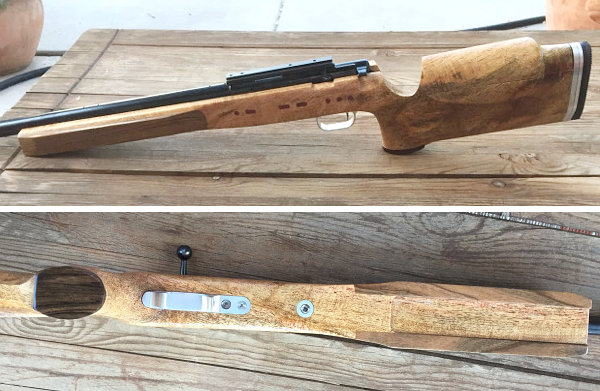
The dots and dashes are Morse Code for the shooter’s initials. The wood is Mango with Walnut fore-end wing inlays. The barreled action is an older Anschutz Model 54 that spent years in a prone stock.
Build Report by Doan Trevor
How do you build a stock for the grand-daughter of an award-winning shooter? Over the years I have built five or six rifles for this shooter, and now his grand-daughter had taken an interest in F-Class. He wanted her new rifle to mirror his own F-Class rifle, and he provided me with an old Anschutz Model 54 barreled action. Her new rifle would get her started in rimfire with the possibility of graduating to High Power (centerfire) shooting. The dots and dashes on the sides of the stock are Morse Code for his grand-daughter’s initials — “AMS”.
Rimfire F-Class Stock Design Factors
Typically when I build a rimfire F-Class stock I use the same pattern as I do for High Power stocks. The pattern has evolved from my prone stocks, as it has proven very successful with time. Also, there is a known issue of using wood for a stock in F-Class. The wood needs to be cured, and unfortunately, finding wood in the specific dimension for the stock is near to impossible. Therefore, I inlay pieces in the fore-end making sure that it is straight and on center. Other materials can be used for an F-Class stock, but keeping them straight and centered can be very difficult. Using cured wood during the build process, I continually check the centerline from fore-end to the rear slider, ensuring that the stock stays centered. This helps ensure good tracking and return to point of aim.
Adapting Prone Stock for F-Class Use
There is a current trend of older Palma and prone shooters to convert their rifles for F-TR and F-Open due to eyesight problems and other disabilities. The stocks that they have been using (and loving) can be recycled to their new shooting styles with a few design changes. I have been doing this successfully for the last several years. Whether it be a new shooter or an older one, you can either plan for the future or adapt older equipment so that all can shoot the style that they want. My philosophy in rifle building is to create every rifle with the potential to win a national or world championship. I am proud to say that I have build rifles for Derek Rodgers, Trudie Faye, Lige Harris, Barry Smith, Eric Rhodes, Kent Reeves, Terry Glen and many more award-winning shooters. And I look forward to many more.
What the Heck is .22 LR Rimfire F-Class?
There is no official NRA F-Class rimfire discipline (at least not yet). However, many F-Class shooters (both F-0pen and F-TR) employ .22 LR rifles for low-cost training. For example, James Crofts practices extensively with his 40X rimfire F-TR rig. In addition, many shooting clubs offer F-Class style rimfire fun matches, shot prone with front rest or match bipod. This rifle was built for an F-Class fun match hosted regularly by the Los Angeles Rifle & Revolver Club (LAR&R).
The photo below displays a different Doan Trevor-crafted rifle, a rimfire benchrest rig with Turbo action. This shows how Doan makes the 3-inch-wide fore-end. Outboard left- and right-side wings are bonded to the central stock material, then the wings are carefully shaped for straightness. Getting the geometry “just right” helps the rig track perfectly.
A while back we published an Introduction to .50-Caliber Shooting authored by James Patterson. James has written a companion piece for Sinclair’s Reloading Press that covers the “care and feeding” of the big .50 Cal match rifles.
Owning and Feeding ‘The Big Bore’
Is The Challenge Of Big Bore Extreme Range Shooting And Hunting Right For You? By James Patterson
Handling a 50 BMG
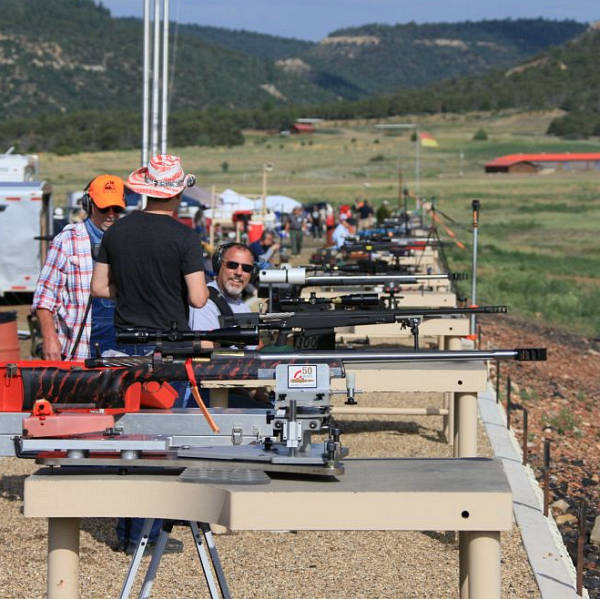
Is a 50 BMG caliber rifle difficult to shoot? Not at all. The relatively heavy weight of a standard rifle at 30 pounds or more combined with a very efficient muzzle brake makes it a pleasure to shoot. The typical recoil can be compared to a .243 rifle or a 12 gauge trap load. On the other hand, the burning of a typical load of 230 grains of powder combined with that muzzle brake makes the muzzle blast experience exhilarating. A first time shooter will fire, pause for a moment in awe at the muzzle blast, and then break out into what has become known as “The 50 caliber Grin”, almost impossible to wipe from ones face. My daughter started competing with the 50 BMG at 18 (115 lbs of tall skinny girl) and happily shoots 100+ rounds in the course of a match, her grin on the last round is as wide as on the first! Many members and competitors in the FCSA are women and many have distinguished themselves as excellent marksman having set world records on numerous occasions.
Cost of Big-Bore Shooting
Is owning and shooting a 50 BMG caliber rifle expensive? Relatively speaking yes, but one must put it into perspective. Rifles may run from $2500 to $7000, maybe even more for a top of the line custom rifle. A good scope will set you back $500 to $1500. And while excellent commercial ammo is available it runs from $3 to $5 a round. Most serious shooters start reloading for the rifle as soon as practical, not only for the economics of reloading but also for the ability to fine tune custom ammo for their specific rifle. It’s a very rare match that is won shooting commercial ammo. I recently compared the cost of my hobby — owning, shooting, and competing with the 50 BMG — with a friend whose hobby is snowmobiling. Factoring in the cost of equipment, licensing, gasoline, clothing, etc. it was soon obvious that my hobby was significantly less expensive than his.
Getting Started So how does one get started? You could do as I did, purchase a rifle not knowing what you were really getting into; or you could come out to a FCSA-sponsored event, shoot a number of different rifles, rub shoulders with those who have already taken the plunge, and see if this sport is right for you. While membership in the Fifty Caliber Shooters Association (FSCA) is required to compete at a FSCA event, membership is not required to come and experience first hand what is going on. If you have any inclination that you are interested in the extreme sport of long rang, big bore shooting then a year’s membership in the FCSA is only $60 ($20 for active duty military) a significant bargain if it helps you make just one well-informed equipment choice. In addition one of the primary functions of the FCSA is helping to identify active members near you who can help you understand just what is involved and help you ‘get your feet wet’ in this challenging sport.
by James Mock
After owning three different rifles with BAT actions, I have become a loyal fan of BAT Machine quality and customer service. Back in 2009, I traded my BAT/Scoville for the BAT/Leonard that I currently shoot. This rifle has a long history and Terry Leonard told me that “Old 87″ (as I have named it) was one of the earlier BATs that he stocked. He wrapped the stock in fiberglass and used 2-part epoxy back then. I must say that this rifle has held up remarkably well since it dates back to the 1990s. The action is a RB/LP/RE octagon Model B with .308 bolt-face.
With this gun, I have shot several barrels of different calibers (.22 PPC, .22 PPC-short .095, 6mm PPC, 6XC, 6mm Dasher, .30BR, and will soon have a 6 BR-AI). It has been an exceptionally accurate rifle in several disciplines. In the hands of previous owners, it earned several Hall-of-Fame (HOF) points, and a “middle-of-the-pack” shooter (me) even received a HOF point with this rifle.
For most of its life, Old 87 served as a short range benchrest rifle, but I have used it for the last few years as a 600-yard rifle with the 6mm Dasher barrel. I was lucky enough to earn the Shooter of the Year award at the Prince Memorial Range in Louisiana for 2016.
After shooting my two Dasher barrels for last eight years, I have noticed a drop-off in accuracy at 600 yards. A decision had to be made — get a new barrel or sell the rifle and retire from competition. I will be 74 years old in six months and my competition days are limited due mainly to a chronic neck problem. After mulling over the decision to retire or not, I decided to give Old 87 one more year. Here is the story of how we upgraded the old war-horse.
Old 87 REBORN — Upgrading with New Components
I prefer cut-rifled barrels with four lands and grooves and have had success with .236 bore diameters and 1:8″ twist in long range rifles. I searched for barrels meeting those parameters and found a suitable BRUX at Bugholes.com (Southern Precision Rifles).
The 6BR-AI Option — Easy Fire Forming
I thought about having Billy Stevens chamber it for the Dasher, but decided to try something new. There seems to be a lot of interest in the 6BR-AI and I said, “Why not?” Well, I bought a shortened Dasher die from Harrell’s and will use my Wilson Dasher seating die. Bart Sauter was kind enough to let me use his reamer for chambering.
Fitting a New Roller-Type Cocking Piece on Older BAT Action
Since I was into the project this deep, I called Mike Ezell and ordered one of his Tungsten powder-dampened tuners. Since Old 87 had thousands of rounds since the firing pin spring has been replaced, I decided that it was probably needed. Well, I got to thinking (very dangerous) and asked Daryle Thom if it would be feasible to put a roller-type cocking piece and a new firing pin spring on such an old action.
The folks at BAT are very accommodating and they said that it would be no problem with such a conversion. While my bolt was in Idaho, the barrel with Ezell tuner arrived and I could not shoot it. However, my friend Jeff Turner loaned me his BAT bolt to see if it would work. Although the rifles differ in age by 15 or more years, the borrowed bolt worked perfectly in my rifle. This is a testimony to the great machine work performed at BAT Machine.
New Bolt Roller Tail-Piece Makes a Big Difference in Cocking Effort
With the borrowed bolt I managed to fire-form 50 rounds and get them ready for our 600-yard match on September 16. The folks at BAT quickly fixed my bolt by replacing the mainspring and ejector spring, polishing the ejector, and replacing the tail-piece with their roller type. Pictured below is this tail piece that makes a remarkable difference in the force needed to cock the action. It is amazing what this little wheel can do… even when placed in a 20+ year old action.
Working with the Ezell Barrel Tuner — Small Increments Work Best
Also, I would like to congratulate Mike Ezell on his new tuner which contains powdered Tungsten. It is easy to set up and Mike will help a buyer get maximum effectiveness from the unit. Just give him a call. Below is a picture of the tuner. I was lucky enough to have some time to “play” with it before the match.
Talking about the tuner, Mike writes: “Our new barrel tuners…
PDT stands for particle dampening technology. The science is there, we just applied it to a barrel tuner. The advantages are a wider tune window and more efficient control of barrel harmonics…in a tuner design that actually looks good.”
Mike advised me to set the tuner by turning it all the way into the shoulder and then come out to zero or the second time zero comes up if there is not at least half of a turn between the shoulder and the first zero. It is best to start with a proven load and adjust the tuner from that load. As unlikely as it seems, a rifle can go from a good tune to a very poor tune with only 5 marks (.005”) and vice versa.
Mike cautions those who use his tuner to NOT make adjustments which are too large. As a matter of fact, he recommends adjustments of .001 inch at a time. Ezell’s tuners are screwed onto the barrel with .900” by 32 threads per inch and has 32 marks on the circumference of the tuner. Therefore, each mark moves the tuner in or out by .001 inch. There are three set screws with Teflon tips which provide friction for the tuner on the threads. Do not tighten the screws so tight as they damage the fine threads.
If you want the smoothest bolt possible for your BAT, call or e-mail Daryle or Bruce Thom at BAT Machine and discuss your needs with them. I am sure glad that I did. If you want a state-of-the-Art tuner for your barrel, give Mike Ezell a call or visit his Ezell Custom Rifles Facebook Page.
— Good shooting, James Mock
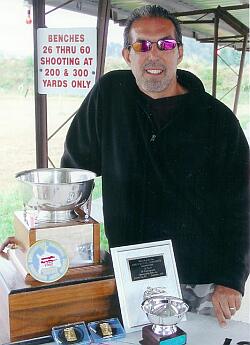
Today’s the day — you’ll want to tune in to Kelly McMillan’s Taking Stock Radio Show today, Friday, September 8, 2017. The broadcast will feature highly-respected gunsmith and Hall of Fame Benchrest Shooter Thomas ‘Speedy’ Gonzalez. The Radio Show, which streams on the internet, runs 9/31/2017 at 11:00 AM Pacific Time on VoiceAmerica Sports Channel.
Speedy and Kelly will discuss a variety of topics, including gunsmithing, stock design/manufacture, the past/present/future of Benchrest and F-Class competition, and how Benchrest reloading/tuning methods have influenced other disciplines. Speedy will also discuss how the standards for precision shooting have evolved in recent years. The quest for accuracy is never-ending. CLICK HERE to LISTEN.
Here’s an F-Open rifle Speedy built for a competitor at the recent F-Class World Championships in Canada.
Along with Speedy, this week Kelly McMillan interviews Phillip Naman, host of the Firing Line Radio Show, a California-based radio show covering a wide range of firearms topics, including hunting, gun rights, gun gear, shooting events, legislation, and gun safety.
You can also access last week’s episode, which features USA F-TR Team Captain Ray Gross, and Derek Rodgers, the newly-crowned F-TR World Champion.
About McMillan Fiberglass Stocks
Kelly McMillan is the president of McMillan Fiberglass Stocks (MFS). This company began in 1973 when Gale McMillan starting crafting benchrest stocks at home in his carport/garage. In 1975 MFS hired its first employee, Kelly McMillan. By 1979 Kelly was made a partner, and by 1984 Kelly was in charge of running the stock shop. Since that time MFS has continued to grow with innovation and design. Today McMillan Fiberglass Stocks has a 15,000 sq/ft facility and 65 employees.


 Presentation Engraved Savage 99 Rifle


 About the Rifle Builders



 PT&G’s Howa 1500 barreled actions feature the very nice Howa HACT trigger. This is an adjustable, two-stage trigger, set for about 3 pounds (combined stages). Crisp and repeatable, this is an excellent trigger for a factory gun. In our opinion, the HACT trigger is clearly superior to the trigger on the Ruger RPR, as well as the Savage AccuTrigger. And there is no annoying Glock-style safety lever in the middle of the trigger blade. The 2-stage design and pull weight range works well for a hunting rifle or a rig for PRS competition.








 So how does one get started? You could do as I did, purchase a rifle not knowing what you were really getting into; or you could come out to a FCSA-sponsored event, shoot a number of different rifles, rub shoulders with those who have already taken the plunge, and see if this sport is right for you. While membership in the


 Today’s the day — you’ll want to tune in to Kelly McMillan’s


