Tuners work. So do muzzle brakes. But until recently, you had the choice of one or the other. Now with combo tuner/brakes you can tune the harmonics of your rifle barrel while enjoying significantly reduced recoil (and torque). This is a “Win-Win” for shooters of heavy-recoiling rifles.
Rifle accuracy and precision have come a long way in the past 15 years, particularly for long-range applications. The most recent tool to significantly improve precision is the barrel tuning system. The Rifle Accuracy System (RAS) developed by Precision Rifle Systems, incorporates a precision muzzle brake with the tuner. CLICK HERE for Product INFO.
This system potentially offers meaningful group size reduction through control of barrel harmonics. The RAS tuner/brake system was the subject of a June 2012 Precision Shooting (PS) magazine article, titled “Improved Rifle Accuracy” and was also featured in an article in the November 2012 issue of PS titled “Tuning with Confidence”.
READ MORE about RAS Tuner Tests on .260 AI, .223 Rem, and 22LR rimfire rifles.
Copies of both articles and detailed instructions on RAS installation and tuning can be downloaded from www.bostromgunsmithing.com. Eric Bostrom is the distributor for the RAS.
For years, Timney triggers have been popular drop-in upgrades for hunting rifles, rimfire rifles, and AR platform rifles. To meet the demand for its many trigger products, Timney Triggers has expanded its operation, adding state-of-the-art CNC machines and other high-end, automated equipment. A far cry from the dank gun factories of the 1950s and 1960s, Timney’s Arizona production center now resembles the squeaky-clean, ultra-modern facilities where electronics are assembled.
Today’s Timney factory is all about computerized automation. Timney Triggers’ owner John Vehr states that it would take 60 or more trained machinists and metal-workers to produce as many triggers as can Timney’s modern machines. Timney does employ two dozen workers, but they are assigned tasks that the computerized machines can’t do as well or better.
If you want to see how Timney triggers are made this days, check out Tom McHale’s recent account of his visit to the Timney Factory in Scottsdale, Arizona. McHale explains how the triggers are designed and fabricated, and 20 high-rez photos illustrate the production process and machinery.
Here’s something you don’t see every day — a bolt-action, repeating, double rifle. This amazing twin-barreled bolt-gun has a closing mechanism that locks two separate bolt bodies into the chambers of the right and left barrels. Yes there are two firing pins, two ejectors, two extractors, and two triggers. We’re not sure how one jumbo camming system closes two bolts, but there might be a geared center shaft rotating both right and left bolt bodies at the same time (but in opposite directions). Perhaps one of our gunsmith readers can explain how this system works.
This Rifle Has TWO Barrels and TWO Bolts
Just $78,000 at “Half-off Pricing”
This unique firearm, chambered in .416 Remington, was sold a few years back on Gunbroker.com for $78,000. That astronomical sum is just half the original cost, according to the seller. Crafted by Fuchs, this double rifle has 22″ barrels and weighs 11.5 pounds. Deep-chiseled, full-coverage engraving decorates the receiver. So, if you have a cool $78 grand to burn you can acquire a very rare firearm — we doubt if you’ll find another one of these anytime soon.
A new cable television show, History of the Gun, debuts in October. The first episode, previewed in the videos below, features Ruger firearms. The show’s producers visit Ruger’s state-of-the-art manufacturing facility and show how Ruger handguns and rifles are crafted using “lean manufacturing” techniques and legions of CNC machines.
History of the Gun Episode One, Part ONE — Series Introduction.
Product casting at Ruger’s Foundry in Newport, New Hampshire.
History of the Gun Episode One, Part TWO — Inside the Ruger Factory.
Rifle readied for hydro-dipping process that applies camouflage finish.
The History of the Gun will be produced by Bill Rogers, the award-winning host/producer of the popular American Outdoors TV show. Every week History of the Gun will examine the firearms of yesterday and today, and take a peek at what’s on the drawing board for tomorrow. Factory tours will be regular highlights of the show.
History of the Gun airs on the Hunt Channel (Dish Network), Time Warner Cable, and is syndicated on a number of TV stations across America. History of the Gun also airs in Canada and Europe on WILD-TV.
Jonathan Ocab, a High Power shooter from California, had gunsmith Doan Trevor install a Sako-style extractor in the Rem 700 bolt in Ocab’s 6mmBR Eliseo R5 tubegun. Jonathan produced an excellent video showing how the Sako extractor improves the ejection of the short, fat 6mmBR cartridges in his rifle. Jonathan’s video demonstrates 6mmBR case ejection with an unmodified Rem 700 factory bolt versus a factory bolt fitted with a Sako-style extractor.
Johnathan explains: “Note how even when slowly operating the bolt, the bolt with the Sako extractor easily ‘kicks’ out the brass on ejection with minimal chance of operator error resulting in a failure to extract. While the unmodified bolt has issues ejecting brass on slow operation, it will eject if the operator pulls the bolt back quickly (fast and with some force).
While a Sako-style extractor isn’t an absolute necessity, this video shows the definite improvement this modification provides. For short cartridges like the 6mmBR, this is very useful. This modification is highly recommended for competition shooters, especially High Power competitors who seek improved function in rapid-fire stages. This modification is fairly inexpensive and any competent gunsmith should be able to perform the work (usually under $100 with parts and labor).”
EDITOR’s NOTE: In his video, Jonathan deliberately worked the unmodified Remington bolt slowly to show how the standard Rem extractor can struggle with short fat cases like the 6mmBR. In fact, when you work a standard, unmodified bolt more quickly, the extraction can be much more positive. Cycling the bolt with more “snap” provides more energy to eject the cases. We have run an R5 Tubegun chambered in 6mmBR with an unmodified Rem 700 bolt (no SAKO extractor), and the extraction was reliable, provided the bolt was worked quickly.
Larry Racine is a respected gunsmith based in New Hampshire. He is also a two-time member of the U.S. Palma Team, and a five-time New Hampshire State High Power rifle champion. Larry, who runs LPR Gunsmithing, has developed a brilliantly simple means of switching rifle barrels with an ordinary spanner or open-end wrench. With this set-up you can switch barrels in the field in seconds without the need for a barrel vise.
For most barrels, Larry mills a hex with six flats on the end of the barrel. This allows a shooter to change barrels quickly at home or on the line with a simple box-head wrench or a socket wrench. Larry says: “You don’t even have to take the barreled action out of the gun. Just set the buttstock on the ground, between your feet, put a wrench on it, hit it with the palm of your hand — and off comes the barrel.” For barrels fitted with a muzzle brake, Larry has a slightly different system. He mills two flats behind the brake so you can use an open-end wrench to do the job.
With either a hex on the end, or two flats for a brake-equipped rifle, the system works with any medium- to heavy-contour barrel with a muzzle-diameter of at least 0.700″. This will even work for high-power rigs using clamp-on sights or bloop tubes. Larry explains: “A lot of us here in New England use clamp-on front sights. The barrel will be turned to 0.750 for the sight, with the hex on the end. A bloop tube can go right over the end, no problem.”
Larry has used this system over the past few years to win a number of matches. In one 600-yard 3 by 20 prone match, Larry used three different barrels, with three different chamberings, on the same Savage rifle. Larry changed the barrels on the line.
Larry was able to do this because the system has little to no loss of zero from one installation of a given barrel to the next installation of that barrel. This lets the shooter start the match with confidence that the first sighter will be on paper. Larry reports that the simple system works great: “To date we have used this system on Savage, Remington, Winchester, RPA, and Nesika actions.”
Racine’s system is very affordable. If Larry does the chamber work on your barrel he charges $45.00 extra to mill a hex or two flats on your barrel. If you only want the hex or flats done, Larry charges $55.00. For more info, visit LPRGunsmith.com or call Larry at (603) 357-0055.
Can you really make a silk purse from a sow’s ear? Would you believe a winning benchrest rifle could be constructed with a stock fashioned from a cast-off log-splitter? Well it can.
Anyone who has attended an IBS benchrest match knows that this brotherhood of shooters includes some “backyard engineers” who can build amazing things with low-cost components. Consider Steve Jordan. He has built a winning Heavy Gun with a gunstock made out of a wood splitter. Check out the photo. The butt section is in the shape of a “V” like an ax. The “V” sits on an adjustable, flat rear sandbag. The flat shaft of the wood-splitter, running horizontally, serves as the main chassis and fore-end. The barrel block sits on top (with the action floated), while the flat, forward section of the shaft rides the front bag. Not only does this “log-splitter” stock work, but Jordan has won IBS matches with it! Sometimes simple and cheap beats expensive and fancy.
Sam Hall Says the Log-Splitter Has Been “Kicking Our Tails”
Sam Hall (multi-time IBS 600-yard champion) reports: “I was not at the first match where Steve Jordan debuted his barrel-blocked, Heavy Gun stock made out of a wood splitter. From what I heard he cleaned house with it that day. When I first heard about this log-splitter rig, I thought guys were pulling my leg. But the log-splitter Heavy Gun really exists. In fact, over the past two years at Piedmont, Steve’s home-built log-splitter HG has won numerous Heavy Gun matches, out-performing nearly all the other Heavy Guns on the line, even those that cost thousands more to build.
Steve made the rifle as economical as possible. Steve’s entire stock is made from a metal wood splitter. From what I understand, Ray Lowman gave him the barrel block. This rides on the shaft of the wood splitter. With this inexpensive, simple rig Steve has been kicking our tails! By the way, Steve’s Heavy Gun is chambered as a 6mm Dasher.”
Forum member Evan K. (aka “Katokoch”) has crafted a nice rimfire benchrest rig using a Suhl action fitted into a handsome home-built cedar and carbon fiber stock. This shows what a skilled hobbyist wood-worker can create in his garage. Evan tells us: “Here is my Suhl 150-1 with a factory 1:19″ twist barrel, Leupold 36X scope, Harrell tuner, and my handmade cedar/carbon fiber stock. I started working on the laminate blank a couple years ago and finally finished it earlier this year. I’ve been using it in my IR 50/50 matches this summer. I haven’t shot a 250 with it yet but I know the rifle is very capable — as usual, I am the weak link!”
We think Evan did a great job on his stock, though he has limited stock-building experience. Evan explained: “The stock is my first attempt at making a very lightweight laminate and also gluing both vertical and horizontal seams in a blank. The wood is Spanish and Red Cedar and I made the trigger guard and buttplate with carbon fiber too (great use for small scrap pieces). The finish is hand-rubbed spar urethane and the action is semi-glued-in with Devcon 10110 and stainless pillars.”
USRA-IR50/50 is a popular .22 rimfire benchrest discipline with three (3) classes: 13.5 lb., 10.5 lb., and 7.5 lb. (Sporter). The matches are shot at 50 yards and 50 meters.
One recent trend in F-TR competition is the use of low-profile, benchrest-type stocks shot with a light hand-hold and little or no face contact. For this method of F-TR shooting to work, you need the right equipment, and practice a “minimalist” shooting technique. One of the pioneers in this style of F-TR shooting is action-maker John Pierce of Pierce Engineering. Above you can see John shooting one of his F-TR rifles at the 2015 Canadian F-Class Championships. Note the straight-line stock and see how the adjustable bipod is set quite low to the ground (in fact the bipod’s arms are almost straight out).
Members of the Michigan F-TR Team, including Bryan Litz, have used similar rigs with success. Bryan said it took a while to adapt his shooting technique to this kind of rig, but there is a pay-off. Armed with a Pierce-built F-TR rifle, Bryan won his first-ever F-TR Match. Bryan explains the technique he uses when shooting this kind of rifle:
“Coming over from sling shooting, I knew there would be unique challenges to F-TR which I wanted to learn prior to (not during) a major tournament. I learned a new shooting position which doesn’t involve drawing the right knee up. For F-TR I get more straight behind the gun rather than at an angle. I found that the rifle shoots best with very light cheek, shoulder and grip pressure, approaching free recoil. This is how Eric Stecker shot his similar rifle into second place in the SW Nationals [with high X-Count by a large margin]. I learned the rifle’s sensitivity to different bipod and rear bag supports, and found the best buttplate position to allow the rifle to track and stay on target after recoil. This set-up shot best with a mostly free-recoil approach, that means ‘hovering’ over the comb, rather than resting your head on the stock. This took some ‘getting used to’ in terms of neck and back muscle tone. These are the kind of details I think it’s important to focus on when entering a new discipline.”
Bryan’s Pierce-built F-TR rig is a tack-driver: “I can certainly vouch for this set-up! In last weekend’s mid-range State Championship in Midland, MI, I shot my Pierce rifle into first place with a 598-44X (20 shots at 300, 500 and 600). Once you get used to the positioning and way of shooting these rifles, they just pour shots through the center of the target.”
Pierce F-TR Rifles with Scoville Stocks
Shown below are three complete Pierce F-TR rifles, along with a barreled action for comparison. The carbon-fiber/composite stocks are built by Bob Scoville. These Scoville stocks are very light, yet very strong and very stiff.
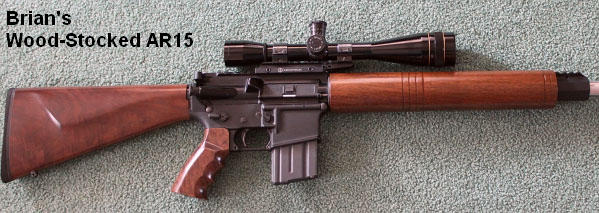
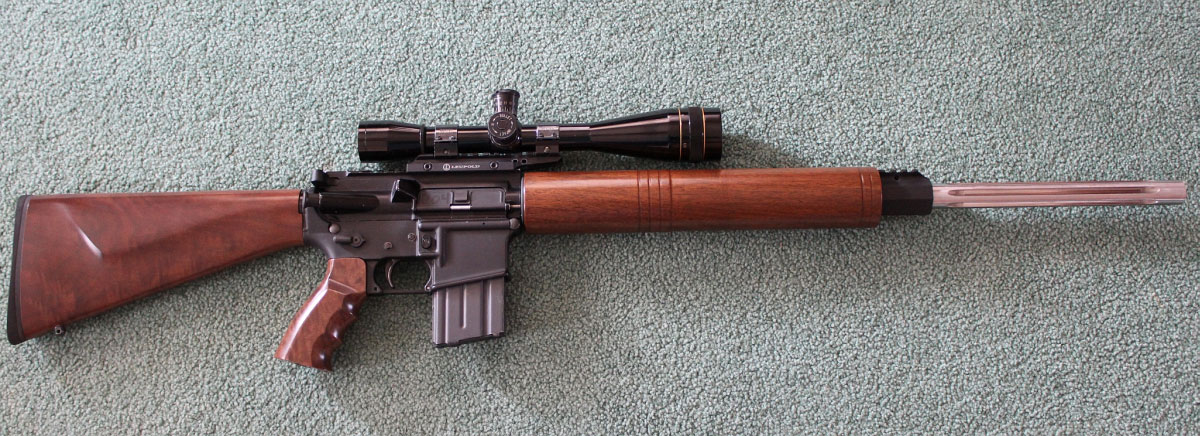
Forum member Brian V. (aka “Carbide”) wanted a new look for his “modern sporting rifle”. He was tired of looking at black plastic (or FDE, OD green) and aluminum components on his AR15. So he decided to fit wood “furniture” on the rifle. He ordered a wood butt-stock and fore-arm set made by Lucid, but he didn’t like the two-piece fore-arm of the Lucid stock set. He decided he could build something better than the commercially-available, Lucid-made wood fore-arm.
So Brian took his existing AR tubular fore-arm and epoxied a walnut sleeve to it. With a lathe, Brian then turned the walnut sleeve to his desired dimensions: 2.250″ diameter in back and 2.200″ diameter in front, so there’s a little taper. Brian says “I could have gone a little thinner.” The wood fore-end was then sanded and stained to match the Lucid-made rear section. Brian says “the stain is not quite a perfect match, but but it looks a lot better.”


 Tuners work. So do muzzle brakes. But until recently, you had the choice of one or the other. Now with combo tuner/brakes you can tune the harmonics of your rifle barrel while enjoying significantly reduced recoil (and torque). This is a “Win-Win” for shooters of heavy-recoiling rifles.


 Here’s something you don’t see every day — a bolt-action, repeating, double rifle. This amazing twin-barreled bolt-gun has a closing mechanism that locks two separate bolt bodies into the chambers of the right and left barrels. Yes there are two firing pins, two ejectors, two extractors, and two triggers. We’re not sure how one jumbo camming system closes two bolts, but there might be a geared center shaft rotating both right and left bolt bodies at the same time (but in opposite directions). Perhaps one of our gunsmith readers can explain how this system works.


 Larry Racine is a respected gunsmith based in New Hampshire. He is also a two-time member of the U.S. Palma Team, and a five-time New Hampshire State High Power rifle champion. Larry, who runs