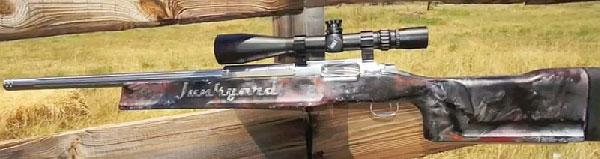
Benchrest shooter Ronnie Smith had the folks at S&S Precision craft a barrel block benchrest gun with a McMillan 50 LBR stock. While the metal work (and block installation) is impressive, the rig’s jaw-dropping feature is an amazing paint job applied by artist David Tidwell of Dallas Airbrush. Ronnie wanted a stock that didn’t look like anything else you’ve ever seen. Working from Ronnie’s concept of a junkyard-sourced rifle, Tidwell created a masterpiece of airbrushing. The finished stock looks like it was hammered from old beat-up metal, complete with dents, grind marks, hollows, Bondo, and wire-mesh patches. Watch the video below to see how this amazing paint job was applied, from start to finish. (Definitely worth watching!)
If you have a stock you’d like painted by David Tidwell, visit DallasAirbrush.com, call 214-529-4410 or email: david [at] dallasairbrush.com. Dallas Airbrush currently sprays out of Texas Body Works, 2415 Midway Rd Suite 111, Plano, TX 75025.
Shown above are bolts with TAC-6 Fluting and two-tone Vortex knobs. The fluting and knob installation are two different operations, priced separately.
Paul Fakenbridge of Pro Precision Rifles (PPR) is running a “Group Buy” promotion for AccurateShooter.com readers. For the next month, you can enjoy significant savings on a bolt-fluting job OR on the installation of a custom bolt knob. For Rem 700 bolts, the fluting is now $55 ($30 off), while a new custom PPR knob, installed, is $65 ($30 off). (NOTE: Knob installation does NOT include bolt fluting, and vice-versa.) Paul does excellent work, with a wide variety of fluting options. All fluting is done on a Haas TM1 with four-axis capability. Here is how the Group Buy, a limited-time offer, works:
For this Group Buy, PPR offers Bolt Fluting at $55.00 total (with $5.00/bolt going to AccurateShooter.com to help support the site.) The regular price for fluting Remington bolts was $85.00 so you save thirty bucks. You can choose from a variety of fluting styles for Remington bolts. While Group Buy terms apply to Rem bolts, ask about Savage and Tikka bolts — PPR has some options for them as well.
For this Group Buy, PPR offers a new bolt knob, installed, at $65.00 with $5.00 going to AccurateShooter.com. The $65.00 includeds the price of the new knob. The regular price was $95.00 including knob. Again, you save $30 with this Group Buy.
You never want your barrel to get too hot. Accuracy suffers when barrels over-heat, and excessive heat is not good for barrel life. So how do you monitor your barrel’s temperature? You can check if the barrel is “warm to the touch” — but that method is not particularly precise. There is a better way — using temperature-sensitive strips. McMaster.com (a large industrial supply house) offers stick-on temp strips with values from 86° F to 140° F. A pack of ten (10) of these strips (item 59535K13) costs $10.71. So figure it’ll cost you about a buck per barrel for strips. That’s cheap insurance for your precious barrels.
With barrels, one wonders “Can a little more length provide a meaningful velocity gain?” To answer that question, Rifleshooter.com performed an interesting test, cutting a .308 Win barrel from 28″ all the way down to 16.5″. The cuts were made in one-inch intervals with a rotary saw. At each cut length, velocity was measured with a Magnetospeed chronograph. To make the test even more interesting, four different types of .308 Win factory ammunition were chronographed at each barrel length.
Test Barrel Lost 22.7 FPS Per Inch (.308 Win Chambering)
How much velocity do you think was lost, on average, for each 1″ reduction in barrel length? The answer may surprise you. With a barrel reduction from 28″ to 16.5″, the average speed loss of the four types of .308 ammo was 261 fps total. That works out to an average loss of 22.7 fps per inch. This chart shows velocity changes for all four ammo varieties:
Summary of Findings: The average velocity loss per inch, for all four ammo types combined, was 22.7 FPS. By ammo type, the average loss per inch was: 24.6 (Win 147 FMJ), 22.8 (IMI 150 FMJ), 20.9 (Fed GMM 168gr), and 22.5 (Win 180PP).
Interestingly, these numbers jive pretty well with estimates found in reloading manuals. The testers observed: “The Berger Reloading manual says for the 308 Winchester, ‘muzzle velocity will increase (or decrease) by approximately 20 fps per inch from a standard 24″ barrel’.”
How the Test Was Done
The testers described their procedure as follows: “Ballistic data was gathered using a Magnetospeed barrel mounted ballistic chronograph. At each barrel length, the rifle was fired from a front rest with rear bags, with five rounds of each type of ammunition. Average velocity and standard deviation were logged for each round. Since we would be gathering data on 52 different barrel length and ammunition combinations and would not be crowning the barrel after each cut, we decided to eliminate gathering data on group sizes. Once data was gathered for each cartridge at a given barrel length, the rifle was cleared and the bolt was removed. The barrel was cut off using a cold saw. The test protocol was repeated for the next length. Temperature was 47° F.”
CLICK HERE to Read the Rifleshooter.com Test. This includes detailed charts with inch-by-inch velocity numbers, multiple line charts, and complete data sets for each type of ammo. Rifleshooter.com also offers ballistics graphs showing trajectories with different barrel lengths. All in all, this was a very thorough test by the folks at RifleShooter.com.
Much Different Results with 6mmBR and a Longer Barrel
The results from Rifleshooter.com’s .308 barrel cut-down test are quite different than the results we recorded some years ago with a barrel chambered for the 6mmBR cartridge. When we cut our 6mmBR barrel down from 33″ to 28″, we only lost about 8 FPS per inch. Obviously this is a different cartridge type, but also our 6mmBR barrel end length was 5″ longer than Rifleshooter.com’s .308 Win start length. Velocity loss can be more extreme with shorter barrel lengths (and bigger cartridges). Powder burn rates can also make a difference.
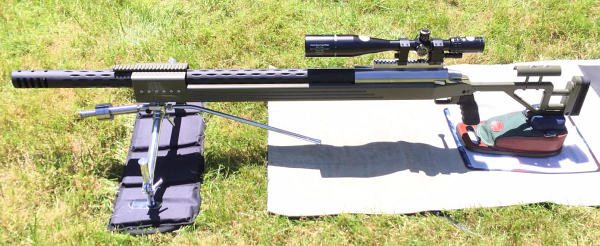
Our friend Darrell Buell has a new Beast — a monster 64-inch-long .375 CheyTac that weighs more than 70 pounds! Designed for ultra-long-range shooting (two miles and beyond), this beast represents the state-of-the-art in extreme long-range rifles.
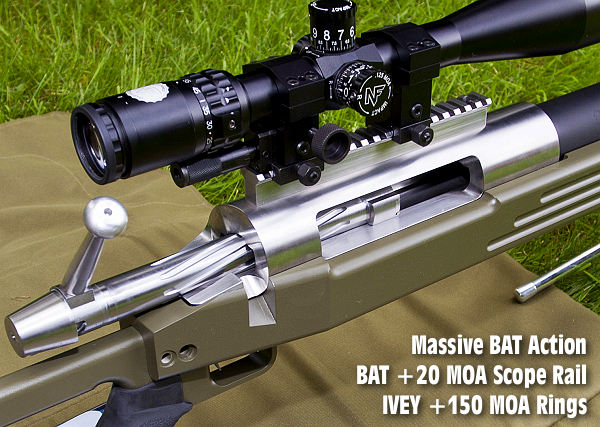
Darrell reports: “This rifle is pretty much purpose-built to shoot 2+ miles extremely accurately. It is a .375 CheyTac (lengthened) built on a BAT 2.5″ action. The custom 35″, 1:10″-twist Brux barrel is a fat, 2″-diameter ‘straight taper’ with fluting. A custom 5″-long muzzle brake is fitted at the end. All barreled action work was done by R.W. Snyder Custom Rifles. The stock was created to fit the build by PDC Custom, and the massive muzzle brake as well.” The “bridge” at the end may look like a barrel block, but it’s not — the barrel completely free-floats. (The Picatinny rail on top of the bridge allows use of an overhanging bipod as an alternative to the JoyPod).
Darrell has lots of elevation on tap: “With 150 MOA in the Ivey rings, another 20 MOA in the scope rail, 55 MOA in the Nightforce Competition scope, and 10 MOA in the FCR-1 reticle, there’s an impressive +235 MOA available.”
Machinist/gunsmith Paul Fakenbridge (aka “Boltfluter” on our Shooters’ Forum) recently completed an interesting upgrade to his favorite 22BR varmint rig. This rifle, Paul’s “Rock Chuck Killing Machine”, was originally fitted with an HS Precision fiberglass stock. Now Paul’s 22 BR sports new hardware — a sleek new Eberlestock M2 Cobra Chassis in “Dry Earth” color. The $995.00 M2 Cobra is a one-piece metal stock system that mounts a Rem-700 type action in a V-block. The cheekpad height and LOP are adjustable via spacers. The M2 Cobra uses AICS-type mags and can fit Picatinny rails on the side.
In our Shooters’ Forum, one member recently asked: “What makes an AR accurate? What parts on an AR can really affect accuracy — such as free-floating handguards, barrels, bolts, bolt carriers?” He wanted an honest, well-informed answer, not just sales pitches. Robert Whitley posted a very comprehensive answer to this question, based on his experience building and testing dozens of AR-platform rifles. Robert runs AR-X Enterprises, which produces match-grade uppers for High Power competitors, tactical shooters, and varminters.
Building an Accurate AR — What is Most Important
by Robert Whitley
There are a lot of things that can be done to an AR to enhance consistent accuracy, and I use the words “consistent accuracy” because consistency is a part of it (i.e. plenty of guns will give a couple great 5-shot groups, but won’t do a very good 10- or 20-shot groups, and some guns will shoot great one day and not so good on others).
Here are 14 key things we think are important to accuracy.
1. Great Barrel: You’ll want a premium match-grade barrel, well-machined with a good crown and a match-type chambering, true to the bore and well cut. The extension threads must also be cut true to the bore, with everything true and in proper alignment.
2. Rigid Upper: A rigid, heavy-walled upper receiver aids accuracy. The typical AR upper receiver was made for a lightweight carry rifle and they stripped all the metal they could off it to make it light to carry (which is advantageous for the military). The net result are upper receivers that are so thin you can flex them with your bare hands. These flexible uppers are “strong enough” for general use, but they are not ideal for accuracy. Accuracy improves with a more rigid upper receiver.
Brownells’ Do-It-Yourself (DIY) video series provides logical, step-by-step installation help for triggers, stocks, and springs. Nine separate videos cover Brownells various DIY Kits. Not sure if you’re up to the project? Just watch each video to see what’s involved. The nine DIY kits are:
Some folks think you need a new (or nearly-new) barrel to win a benchrest match. That may be true in the centerfire game, but in the world of rimfire benchrest, things are different. Good barrels can remain accurate for a long, long time. That was demonstrated by our friend Joe Friedrich who recently set a new ARA 4-target Aggregate record. Joe was shooting his trusty old “Sweet Pea” rifle with a very well-worn barrel. In fact, Joe’s record-setting Benchmark barrel has logged well over 100,000 rounds. That’s right, a barrel with over 100K rounds shot the best 4-target ARA Agg ever. Will wonders never cease…
In this video, Joe talks about his rifle, the amazing longevity of his Benchmark barrel, and the ELEY ammo he used to shoot two 2500s on the same day (with a 2475 average for four targets):
Here are exclusive “Spy Shots” of a soon-to-be released project, the all-new F-Open chassis system from Competition Machine (Gary Eliseo). Dubbed the “F1″ stock by Gary, this radical new chassis system is designed expressly for F-Open competition. With a super-low Center of Gravity (COG), the F1 boasts many innovative features including an epoxy-lined barrel block that allows the action to float. The F1’s length-of-pull is adjustable for length while the buttpad holder adjusts for height.
The stock, which will work with any type of action, should sell for about the same price as a fully-adjustable fiberglass stock. Competition Machine hopes to start shipping F1 stocks in summer 2015.
The F1 stock will accept any action, long or short, right-hand or left-hand. The F1 is shown below with a Pierce magnum long action.