|
|
April 5th, 2008
We’ve known some serious varminters who will invest $4,000.00 in a custom rifle, pay thousands more for spotting scope and laser rangefinder, and spend countless hours loading ultra-precise ammo. Yet, when they head off to the prairie dog fields, they’ll omit an essential piece of gear that will make the difference between a hit and a miss.
 We’re talking about windflags. Many casual shooters, varmint hunters, and even some “tactical” shooters disdain windflags as gadgets suited only for the accuracy-obsessed benchrest crowd. In fact, windflags are just as important for the varminter as for the benchrest competitor. We’re talking about windflags. Many casual shooters, varmint hunters, and even some “tactical” shooters disdain windflags as gadgets suited only for the accuracy-obsessed benchrest crowd. In fact, windflags are just as important for the varminter as for the benchrest competitor.
You may think that you can easily notice a major wind shift. But consider this, a change from a light 2.5 mph left breeze to a 2.5 mph right is a 5 mile per hour switch. That is enough to make you miss a prairie dog even at just 200 yards. Here’s a chart that shows the effect of a 5 mph full-value (i.e. 90-degree) wind change at various distances. The values assume a typical .250-BC varmint bullet launched at 3500 fps at a 3″-wide critter (center hold).

You don’t need to spend a lot of money on windflags. Even a bit of surveyors’ tape on a post is better than nothing. As Forum member Catshooter explains, a simple windflag, placed at your shooting station, helps minimize the effect of cross-winds. If you align your shooting position so the breeze is at your back you can shoot with greater confidence even in high winds. Watch the way the windflag blows, and shoot at the dog mounds that are directly downwind.
Our friend Boyd Allen offers another tip: “When you go varminting, be sure to bring some kind of portable target stand. Accuracy or zero problems are much easier to diagnose and remedy if you can set up a target at 100 yards. A simple wood, A-Frame design, hinged at the top, works well, stores flat, and is easy to build.”
Windflag photo courtesy Flying Fish Fundamentals, makers of single-and dual-vane wind flags.
March 24th, 2008
The Hickory Shoot, the nation’s most popular groundhog shooting competition, is slated for April 5th this year. Now in its 28th year, this is the biggest Varmint competition on the East Coast, with over $4000.00 worth of prizes awarded each year, including $1000.00 in cash. Compete individually or as part of three-man teams. The entry fee is $25 per person, plus (optional) $10 extra per team. The match will be held in Vale, North Carolina. For MapQuest or Google maps, use this address: 8216 Will Hudson Road, Lawndale, NC 28090.
This year, there will be three targets, set at 100, 300 and 500 yards. (No unknown distance). In the past, 6BRs, 6BR Improveds and the mid-size 6mms have been the calibers to beat. To see what it takes to win, read this article about Harold Seagroves’ Spencer-built 6BR, which has won the Hickory Shoot multiple times.

The range will be open Monday-Friday preceding the match for practice. The match will start 8 o’clock sharp Saturday morning the 5th. If you have any questions call Larry Willis, Bulls Eye Sporting Goods, (704) 462-1948. This year the targets will be at known distances, 100, 300, and 500 yards. That should be a cake walk for you 1000-yard shooters.
March 22nd, 2008
 On LongRangeHunting.com, you’ll find a good article about wind reading by Shawn Carlock. Shawn Carlock is a veteran law enforcement marksman and the current USPSA national precision rifle champion. Shawn offers good advice on how to estimate wind speeds and directions using a multitude of available indicators — not just your wind gauge: “Use anything at your disposal to accurately estimate the wind’s velocity. I keep and use a Kestrel for reading conditions….The Kestrel is very accurate but will only tell you what the conditions are where you are standing. I practice by looking at grass, brush, trees, dust, wind flags, mirage, rain, fog and anything else that will give me info on velocity and then estimate the speed.” On LongRangeHunting.com, you’ll find a good article about wind reading by Shawn Carlock. Shawn Carlock is a veteran law enforcement marksman and the current USPSA national precision rifle champion. Shawn offers good advice on how to estimate wind speeds and directions using a multitude of available indicators — not just your wind gauge: “Use anything at your disposal to accurately estimate the wind’s velocity. I keep and use a Kestrel for reading conditions….The Kestrel is very accurate but will only tell you what the conditions are where you are standing. I practice by looking at grass, brush, trees, dust, wind flags, mirage, rain, fog and anything else that will give me info on velocity and then estimate the speed.”

Shawn also explains how terrain features can cause vertical wind effects. A hunter positioned on a hilltop must account for bullet rise if there is a headwind blowing up the slope. Many shooters consider wind in only one plane — the horizontal. In fact wind has vertical components, both up and down. If you have ever piloted a small aircraft you know how important vertical wind vectors can be. Match shooters will also experience vertical rise when there is a strong tailwind blowing across an up-sloping berm ahead of the target emplacements. Overall, Shawn concludes: “The more time you spend studying the wind and its effect over varying terrain the more successful you will be as a long-range shooter and hunter.”
February 28th, 2008
Quite a few of our hunter friends have praised the DedNutz scope mounting system. This is a unitized one-piece base AND ring system. Because the rings are integral with the scope base, you won’t encounter any potential misalignment between the front and rear base. You also eliminate the need to keep the rings torqued securely to a separate base. The rigid DedNutz design has no moveable parts between the firearm and the scope.

Made of milled, anodized aluminum, the one-piece DedNutz scope mounting system is one-third the weight of most other one-piece base and ring mounts and it can’t rust. For target rifles with a Weaver or Picatinny-style base, we still advocate the use of Burris Signature Zee rings. However, if you are looking for a sturdy, more rugged scope-mounting set-up, the DedNutz system fits the bill. It would be a good choice for a walk-around varminter or a deer rifle. Because the front and rear rings are precision CNC-machined, DedNutz says that it’s not necessary to lap the rings. We still recommend you inspect the ring edges and lightly debur as necessary. If you choose to lap the rings, do it gently as the inside should be very concentric already and you don’t want to grind through the anodizing.
One DedNutz user, writing on huntingnet.com, comments: “I bought a pair of DedNutz for a Browning A-Bolt and a pair of Talley Lightweights for the same gun. I have to tell you that I think these DedNutz rings are some of the most rugged rings I have seen and yet are very lightweight. If you saw the length of the cap screws and the size of the base screw heads you would be amazed. The [DedNutz] have a superior finish to the talley lightweights … and they are better machined. I put a lapping bar on both and the talleys needed it but not the DNs.”

DedNutz scope mounts are available to fit dozens of different hunting rifles. They are offered in 1″ and 30mm sizes, in matte silver, matte black, or Realtree Camo finishes. DedNutz scope mounts start at about $50.00 and can be purchased from MidwayUSA.com, or direct from DedNutz.com.
CLICK HERE to watch VIDEO

February 22nd, 2008
Scott S., aka “Sunbuilder” in our Forum, recently completed an interesting project gun. This is a lightweight, compact “calling rifle” chambered in 6mmBR. The gun features a Stiller Predator Repeater action with Lilja 1:12″ twist, #4 contour barrel. To get the short, fat 6BR rounds to feed from the magazine, Scott did the Mike Bryant Mag Conversion. Scott reports the rifle now “feeds great.” This simple conversion involves blocking the rear of the magazine and shortening the follower.

Scott’s 6BR calling rifle wears a Zeiss Conquest 3.5-10×44 scope on top. This is a nice, bright optic with a sensible magnification range for game that is normally on the move. The rifle was built by Neil Jones in Saegertown, Pennsylvania. Along with his 6BR Lilja barrel, Scott has a second barrel chambered in 6.5×47 Lapua Improved, and Scott is “thinking about doing a 20 VarTarg barrel too.” That would give him a range of three calibers, with projectiles ranging from 30 grains to 130+ grains.

February 17th, 2008
The 17 HMR rimfire round has been a huge success since its introduction. Millions of rounds have been sold, the major rifle-makers all offer 17HMR rifles, and varminters worldwide have embraced this innovative, high-velocity rimfire cartridge.

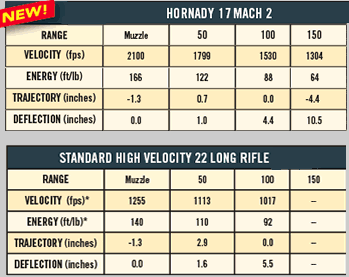
However, as 17 HMR costs climb steadily upward, many shooters are considering switching back to the 17 HMR’s little brother, the 17 Mach 2. Based on a 22 Stinger case necked down to 17 caliber, the 17 Mach 2 runs about 450 fps slower than the 17 HMR. However, the 17 Mach 2 still offers much-enhanced performance compared to a 22LR (See Chart.)

Ten Cents a Round vs. 26 Cents a Round
The big factor favoring the 17 Mach 2 is PRICE. You can shoot the 17 Mach 2 for $0.10 per round compared to $0.26 for the 17HMR. The Mach 2 is less than half the cost of 17HMR. Here is a chart showing current pricing of the 17 HMR vs. the 17 Mach 2.
| Cartridge |
Brand |
Bullet |
Price/box |
Vendor |
| 17 HMR |
CCI |
17gr Speer TNT |
$12.14 |
MidwayUSA |
| 17 HMR |
CCI |
20gr SpirePt |
$13.79 |
MidwayUSA |
| 17 HMR |
Hornady |
17gr V-Max |
$12.79 |
MidwayUSA |
| 17 HMR |
Hornady |
20gr XTP |
$12.99 |
MidwayUSA |
| 17 Mach 2 |
Eley |
17gr V-Max |
$4.89 |
MidwayUSA |
| 17 Mach 2 |
Hornady |
17gr V-Max |
$5.79 |
Midsouth |
| 17 Mach 2 |
Rem |
17gr V-Max |
$3.99 |
Natchez |
17 HMR Average Price = $12.93 (26 cents per round)
17 Mach 2 Average Price = $4.89 (10 cents per round)
We’ve done extensive testing with the 17 Mach 2 in a Hall-actioned benchrest rig built by Stan Ware of SGR Custom Rifles. With ammo sorted for length and concentricity (using a Nielson Brothers concentricity gauge), our little 17 Mach 2 has demonstrated remarkable accuracy–with many 1/4″ groups at 50 yards. Still, even with sorted ammo, don’t expect the 17 Mach 2 to run with the best (i.e. $14/box) 22LR match ammo. Typically, with the 17 Mach 2, you’ll get one shot out of five landing unpredictably out of the group. There are many reasons for this — excessive run-out, flawed bullet tips, bad crimps, even shaved jackets.

Our studies suggest that 17 Mach 2 ammo would be more consistent, and more accurate, if it was loaded to a lower muzzle velocity with the bullet seated longer. Crimping needs to be more uniform. We’d also like to see Hornady chamber the 20gr XTP bullet offered in the 17 HMR. Still, the 17 Mach 2 round has much to offer the varminter and club-level paper puncher. It runs 1000 fps faster than a 22LR, and bucks the wind much better than a 22LR at 100 yards. At $4.00 to $5.00 a box, it is less than half the cost of 17 HMR, and one-third the cost of the super-premium 22LR.

We let three top 22LR benchrest shooters try our 17 Mach 2 recently. To a man, they agreed this round is “fun to shoot” and “offers great promise”. If the ammo-makers can improve quality control, this round may, some day, have a place in target competition, particularly with the highest-grade 22LR ammo now topping $20.00/box (for new Lapua X-ACT ammo).
Here are ONE HUNDRED-Yard Groups Shot with Eley 17 Mach 2 Ammo. Note HUGE Effect of Concentricity Sorting. Top target shows 0.006″ Run-out ammo. Bottom Target displays 0.001″ Run-out ammo.

February 10th, 2008
Cooper Firearms is well-known for the quality and accuracy of its varmint, rimfire, and hunting rifles. At SHOT Show, Cooper’s Rob Behr was on hand to show us some of Cooper’s featured offerings, including a Montana Varminter chambered in 20 VarTarg, the TRP-3 rimfire benchrest gun, and the NEW model 52 big game repeater. New for 2008, the model 52 repeater is sized for the 30-06 class of cartridges and will be available in both basic and deluxe versions, starting at about $1600.00. The 20 VarTarg is based on the .221 Fireball case necked to .204. It is a very accurate and efficient cartridge as Rob explains in the video.
CLICK HERE to WATCH VIDEO

In addition to the 20 VarTarg Montana Varminter, Rob showed us the impressive TRP-3 rimfire benchrest rifle. Outfitted with a proper benchrest-style stock, this little rifle has proven to be a capable competitor, setting records in South Dakota rimfire matches. With an MSRP of $1298 (without scope), the TRP-3 is half the cost of a typical full-custom rimfire benchrest rig.

Built on the 57M action, the TRP-3 is a competitive, introductory rimfire BR rifle at a reasonable cost. The 8-lb., TRP-3 features a .875 straight-taper, 1:16″ twist, stainless steel barrel. The proprietary, competition stock from Bell and Carlson has a wide, flat forearm, with parallel geometry front and rear for excellent tracking in the bags. The TRP-3 is guaranteed to shoot 1/4″ or better groups at 50 yards with Lapua Midas ammunition.

POSTSCRIPT: Here’s an interesting side note — while this editor was visiting Cooper’s booth, a gunshop owner from Georgia came by the booth. He pulled Rob aside, shook his hand and said: “I just wanted to say, of all the companies at this show, Cooper is one of the few that still gives a darn about quality and accuracy. You guys build ‘em right and deliver what you promise.” That’s quite an endorsement.
January 27th, 2008
Last month we featured a new shooting platform from Alamo Four-Star in Texas. Alamo’s DCLW (for “Deros Compact Light Weight”) system featured an innovative, gimballed rifle cradle mounted to a special tripod. This cradle was attached with rocker arms to a rotary head, allowing the rifle to traverse 360 degrees and move up and down up to 75 degrees from horizontal. (READ Dec. 22 DCLW Report).
Equipped with its own dedicated ultralight tripod, the original DCLW system weighs just 4.1 pounds and can be used in all shooting positions: prone, sitting, kneeling and standing. The DCLW was built ultra-light because that’s what the military requested for its troops.
Today we feature a version of the DCLW designed to mount to commercial tripods. Called the “DCLW Head”, this unit can be mounted to virtually any tripod that has a quick-release or screw-on optic mount. The makers of the DCLW Head even offer a machined mounting piece that fits directly into Manfrotto-style tripod quick-attachment mounts. Below you can see the DCLW Head fitted to a photo tripod.
CLICK HERE for FLASH VIDEO showing DCLW Head.


 One of the best features of the DCLW gun support system is that it allows a spotting scope or laser rangefinder to be mounted close to the bore axis, inline with the barrel. So, when you elevate or traverse the rifle your scope or LRF moves right with it–following the movement of your muzzle. Put your crosshairs on a new target and your spotting scope or rangefinder will be centered on the target as well. That’s a great feature for varminters–or anyone shooting targets at unknown distances. One of the best features of the DCLW gun support system is that it allows a spotting scope or laser rangefinder to be mounted close to the bore axis, inline with the barrel. So, when you elevate or traverse the rifle your scope or LRF moves right with it–following the movement of your muzzle. Put your crosshairs on a new target and your spotting scope or rangefinder will be centered on the target as well. That’s a great feature for varminters–or anyone shooting targets at unknown distances.
Shown below is the DCLW Head mounted on a Manfrotto tripod. You can also see that a spotting scope is clamped on a Picatinny Rail just to the left of the rifle, in line with the barrel.

CLICK HERE for FLASH VIDEO showing DCLW Head.

CLICK HERE for SECOND VIDEO showing DCLW with original lightweight tripod.
January 19th, 2008
Blaser, maker of the innovative R93 straight-pull rifles, has created a new DVD, “Hunting in Motion — Shooting at Moving Game”, that will interest all game hunters. It provides helpful hints on aiming (showing how to “lead” your prey), with strategies for various species, including deer and wild boar. There’s good close-up footage showing the fast Blaser bolt in action on Driven Hunts. The DVD also includes important safety tips. In the sample video, Blaser demonstrates the hazards of ricochets and shows what happens to your bullet if it strikes a branch or obstruction between muzzle and target.
CLICK HERE (or on image) to watch INTRO VIDEO.

The DVD is available from select Blaser dealers, or contact:
Blaser USA
220-G Log Canoe Circle
Stevensville, MD 21666
Phone: (410) 604-1495
Email: info (at) blaser-usa.com

We noted one serious flaw in the Blaser Video. Many of the shooters in the video are not wearing eye protection. Big mistake. Shooters should ALWAYS use safety glasses, even when hunting.
January 11th, 2008
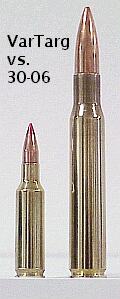 The 20 VarTarg is a popular wildcat based on the .221 Fireball case necked down to 20-caliber. Amazingly efficient, the little VarTarg will drive 32gr bullets at 3700 fps with just 18-19 grains of powder. This is an inherently accurate round that delivers impressive velocities with small powder charges. Burning less powder (compared to a .204 Ruger for example), translates to cooler barrels and longer barrel life. The 20 VarTarg is a popular wildcat based on the .221 Fireball case necked down to 20-caliber. Amazingly efficient, the little VarTarg will drive 32gr bullets at 3700 fps with just 18-19 grains of powder. This is an inherently accurate round that delivers impressive velocities with small powder charges. Burning less powder (compared to a .204 Ruger for example), translates to cooler barrels and longer barrel life.
In this FORUM THREAD, 20 VarTarg shooters list pet loads and praise the VarTarg’s performance:
“I’m using Hornady dies with Rem brass. 18.2 grains of H4198 gets me 3550 fps with a 32 V-Max. My rifle is a trued 700 with a Hart SS barrel and a Jewel trigger. This is one of the best shooting rifles I own. Less than 1/2-MOA is easy for my setup.” — BHodges
“The 20VT is a winner! I am now up to three Coopers in 20 VarTarg and they are all shooters. With 32gr V-Maxs and AA1680 I am getting great results. I am trying H4198 in one rifle. 20 VTs on Prairie Dogs are awesome!” — Claimbuster
“One of my buddies has a Cooper Phoenix in 20 VarTarg and he is shooting 32gr V-Max bullets using H4198 and N-120. He is getting consistant 3/8″ groups at 100 yards. Very easy to load for and I believe one of those inherently accurate cartridges.” — Phasor
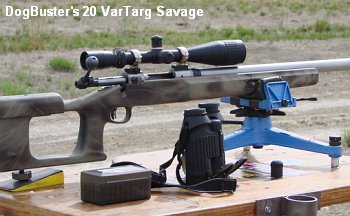
“I’ve gotta a 20 VT…cannot put it away…it’s a recycled 204 Pac-Nor barrel with 1:12″ twist and finished length of 24″ screwed into a single-shot Savage AccuTrigger action. [I get] 3636 fps with 40gr V-Max. I’ve tested the new 32 NBT, but the 40-grainer has more downrange effect. This little cartridge will pick p-dogs off the ground and flip them in the air, even at 400+ yards. I’ve run 500+ rounds down the VarTarg tube, so now this barrel is pushing 3000+ rounds. Load development using H4198 and H322 both produced .50″ or better for 5 shots @ 100 yards. But the weak link is the Rem 221 Fireball brass.” — Dogbuster (Rifle shown below).
Fireball Brass in Short Supply
Our Forum members report that .221 Fireball brass is very hard to find right now. This is related to Remington’s introduction of the 17 Fireball loaded ammunition. If you can find a stash of .221 Fireball brass, grab it while you can. It may be many more months before ample supplies of .221 Fireball brass make it to the retailers.
Trappst reports: “A quick look through the normal places to order (MidwayUSA, Cabelas, Bruno’s, Grafs etc.) shows everyone to be out of stock.” Claimshooter concurs: “221 brass is a problem. I’ve had 2000 pieces on back order at MidSouth since July. I had 1000 pieces on back order for 3 months at Cabela’s and they cancelled the order.”
To learn more about the 20 VarTarg, read our 20 Caliber Cartridge Guide.
|


