|
|
January 26th, 2015

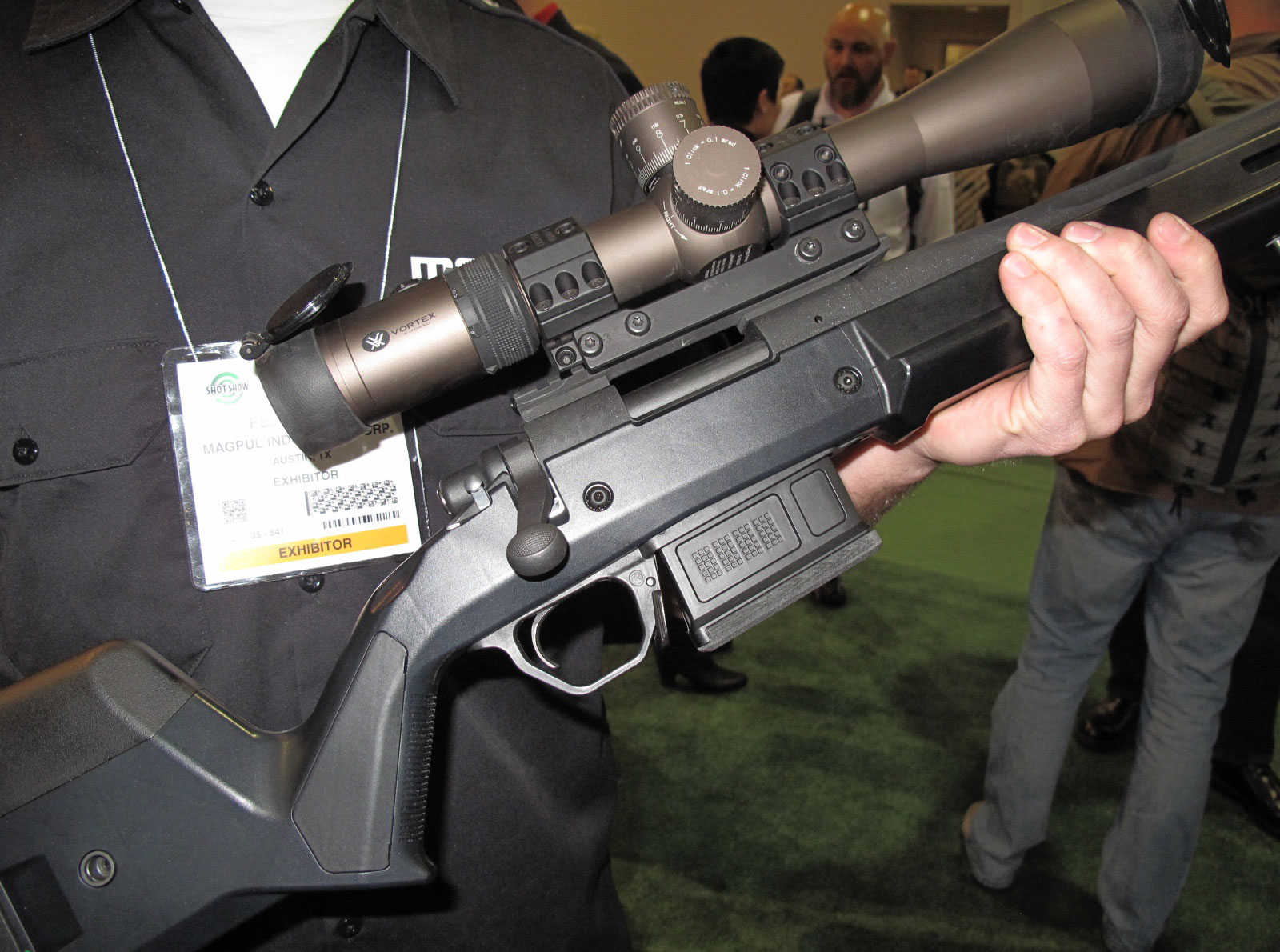
Our readers wanted more information on the $259.95 Magpul Hunter 700 stock, so here it is. We got our hands on the new product. The polymer shell is strong and stiff — not like the “Tupperware” plastic stocks you’ll find on some factory offerings. The stock comes standard with a flush bottom plate. However, for $70 more you can get a polymer magwell unit that allows use of new MagPul 5-round and 10-round magazines. The stock features an anodized aluminum V-block that allows easy installation of a Rem 700-footprint action.
CLICK Photo to See Full-Screen Image:

But perhaps the most important element of this stock can’t be shown in photos. INSIDE the stock is a metal “skeleton” that extends from the middle of the fore-end back into the grip. This skeleton, an important design innovation, gives the stock great strength and rigidity. It is sort of like a race car with a tube chassis under the body work. We suspect Magpul is working on a patent.

January 25th, 2015

Click Photo for full screen view of machine.
Forget flames — induction may be the future of cartridge annealing. Induction heating, using an electrical current passing through a coil, can be controlled with great precision (you can dial in the “dwell time” to a small fraction of a second). With a high-wattage power source, induction annealing is also very fast. A cartridge case can be done in two seconds or less. Combine that with an automatic case feeding system and you have a true assembly-line process capable of cranking out hundreds of precision-annealed cases per hour. Sound too good to be true? Well Giraud Tool recently announced its new Electro-Induction cartridge annealing system. This combines Giraud’s proven hopper-type case feeding system with a powerful Fluxeon Annealer. Watch the video below to see how it works.
Watch Giraud Induction Annealer Batch-Process Cases (900+ cases/hour)
Including case-shuttle time, a case is annealed and processed approximately every 4 seconds (rate based on the video demonstration). At that rate, if you keep the hopper full, you could anneal over 900 cases per hour. Even if you don’t need that production capacity, this system allows unattended annealing of your cartridge brass while you do other tasks — such as weighing powder charges or seating bullets.
We know some of you guys are now thinking “OK — I want one. What’s it going to cost?” Giraud has not listed a price yet for a complete induction annealing system. Giraud’s torch-equipped, hopper-fed annealing rig starts at $470.00. We expect that integrating the “Annie” induction unit by Fluxeon will add $500 to the price. By itself, the “Annie” induction annealer costs $449.00 on Fluxeon’s online store. But that $449.00 Fluxeon price does not include long-reach cables and adapters for the hopper feed.

Story Tip by EdLongrange. We welcome reader submissions.
January 24th, 2015
Our friends Ed and Steve, AKA the 6.5 Guys were in Las Vegas this week, checking out new products at SHOT Show. Ed and Steve visited some of our favorite gear-makers, including Nightforce Optics, Manners Composite Stocks, David Tubb, and G.A. Precision. Here are Ed and Steve’s Show reports for these important vendors. You can see more SHOT Show videos by Ed and Steve at 6.5Guys.com.
Nightforce Optics
Highlights include Nightforce’s new F1 First Focal Plane scopes. Our readers will probably be most interested in the new ATACR™ 5-25x56mm F1™ riflescope. With a beefy 34mm maintube, the new 5-25x56mm F1 boasts an impressive 30 MOA (or 12 Mil-Rads) of elevation per revolution, with 120 MOA (or 35 mils) of total elevation adjustment.

Manners Composite Stocks
There are about a half-dozen new stocks from Manners for 2015, both for precision long-range shooters as well as hunters. In the video Tom Manners shows a new tactical folder and the T7 Hybrid, an older design that Tom brought back by popular demand.

David Tubb
11-Time National High Power Champion David Tubb displayed his new T7T 2-stage trigger for Remington 700 actions. This is an impressive new component that is a major upgrade over the factory trigger. First stage and second stage are separately adjustable. Price is $350.00 for right- or left-hand versions at DavidTubb.com.

G.A. Precision
George Gardner, founder of G.A. Precision shows off the impressive new Tempest Action, and talks about trends in the world of tactical competition. Shown below is a black-finish Tempest in a rifle at G.A.P.’s booth.

January 24th, 2015
Our friend Dennis Santiago found two interesting rifles at SHOT Show. At first glance, these look just like the legendary M1 Garand and the M1A (civilian version of the M14). The size is right and the stocks look authentic. But take a closer look and you see these are NOT chambered for .30-06 (Garand) or 7.62×51 (M1A) cartridges. Rather, these Baby Battle Rifles are rimfire clones, chambered for the .22 LR. We like the concept — this gives Garand Match and M1A Match competitors the ability to cross-train with low-cost rimfire ammo. Plus, who wouldn’t want a rimfire Garand for a little low-recoil plinking fun? We bet these will produce smiles when folks at the range see them for the first time. And a .22 LR Garand is definitely going to be softer on the ears (and your shoulder)!

Dennis tells us: “These were kind of neat. The form factors and ergonomics are accurate. The weight is a pound or two lighter than the real deal. Trigger is Ruger’ish. It might be fun to show up with one of these at a CMP .22 Sporter match.”

The two Baby Battle Rifles are sold by Kingston Armory. You can visit KingstonArmory.com, but there’s really nothing to see yet — Kingston’s website is still “under construction. If you have questions you can call Kingston at 845-292-3222.
January 23rd, 2015

Gear Report by Kip Staton
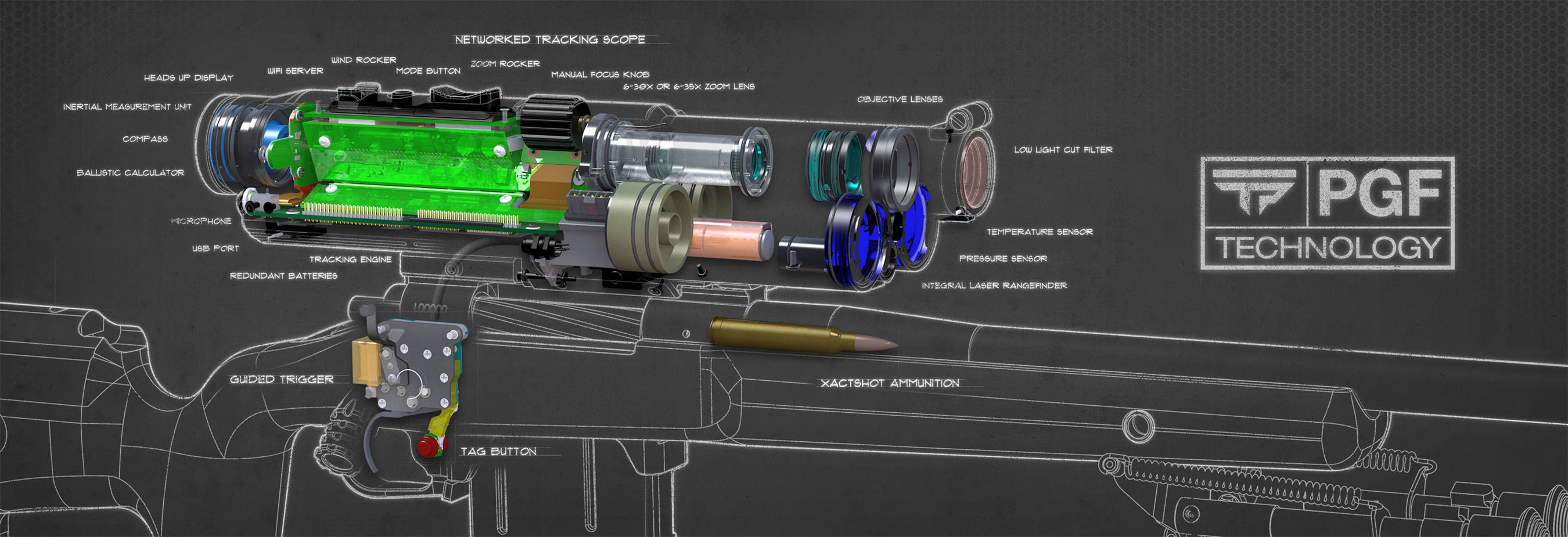
TrackingPoint’s innovative technology has been on the market for a number of years now, and has proven to be a valuable long-range shooting tool. TrackingPoint is a Texas-based, Austin-area applied technology company that developed a unique, precision-guided firearm (PGF) system in 2011. TrackingPoint’s ordinary rifles in common calibers, designated with the XS prefix, are equipped with high-tech “networked tracking” rifle scopes.
CLICK to view full-screen image:

These advanced optics are the heart of the company’s tag-and-shoot technology, and the entire setup is remarkably similar to the systems found in cutting-edge fighter jets. So, how does it work in the real world?
Pretty darn well, as it turns out. The shooter simply finds his or her target, centers his “X” reticle on it, and presses a “tag” button, which is usually integrated into the firearm’s trigger guard. This puts a digital “mark” on the target, and the optic remembers where that particular tag was placed for the duration of the shot. At this point, the system has already automatically performed all necessary distance and environmental calculations. The only other manual inputs needed on the shooter’s part are to enter the wind call, and press the trigger. And, the rifle even helps out with that part.

Because the tag was placed on a unique target, and is remembered by the system, the rifle won’t actually let the shot break until the shooter has lined up the crosshairs with the original tag. So the user may press the trigger, and nothing will happen… until the reticle is placed on the original tag. The rifle will then fire. For each Tracking Point shot, the elevation should be dead on. However the wind can still come into play — the TrackingPoint system does not sense the wind speed or direction. Wind values must be detected by the shooter and entered manually. Once wind speed/angle are entered, the TrackingPoint automatically calculates the needed windage correction (left or right).

The firing process (with the rifle’s brain doing the elevation calculation) can be somewhat disconcerting for shooters new to a PGF. But, this system holds promise, and can help shooters make difficult shots with greater confidence. In particular, the built-in ballistics solver means the trigger-puller no longer needs to worry about elevation clicks and/or hold-overs at any distance. The system calculates bullet drop at any rangeable distance and plots the correct point of aim. “X marks the spot”:

The TrackingPoint system does much more than make long range shots easier to accomplish. The networked tracking scope is also a WiFi server. This means that the image seen through the ocular lens (by the shooter) can be beamed to an Apple iPad, which is included with the rifle. Hunting guides can then see exactly what their clients are viewing through the optic, and make suggestions or provide pertinent advice to the shooter.
If that wasn’t enough, TrackingPoint recently integrated the high-tech Google Glass hardware into their shooting system. By using eyewear with built-in displays linked to the TrackingPoint optic, shooters can make successful shots without looking directly through a rifle-mounted scope. The eyewear has a small display that shows the target(s) “seen” by the rifle’s optic. The operator can then take the shot from any position. You can shoot around a corner, or keep your head and torso out of view. The possibilities for hunters, competitors and real-world tactical shooters are nearly endless.

TrackingPoint’s unique rifle systems are available in both semi-automatic and bolt-action formats, ranging in calibers from .223 (5.56 NATO) to a proprietary .338 of the company’s own design. What do these systems cost? Well high technology does not come cheap. Rifle systems range in price from $7,495 to a staggering $49,995. But, for the right client and the right mission, perhaps no price for this technology is too high. That’s what Tracking Point is counting on….

January 22nd, 2015

Gear Report by Kip Staton
Shooters in the market for an accurate anemometer that doesn’t break the bank need to take a hard look at the WeatherFlow Wind Meter, which retails on Amazon.com for just $34.95. Even though it is inexpensive, owner reviews have been overwhelmingly postive (so long as the software is compatible with your device). One Amazon reviewer says the WeatherFlow measures wind velocity as accurately as his expensive Kestrel.
A big part of the reason the WeatherFlow Wind Meter is so inexpensive is that you’ve probably already got the brains of the system in your pocket. Yes, it connects to and communicates with any standard smartphone or tablet, in either iOS or Android flavors. Users simply download the free WeatherFlow Wind Meter app to their smart device, insert the anemometer into the headphone jack, and can immediately start measuring the wind.
 Of course, the first question any serious shooter will ask is “How accurate is this thing?” Pretty dang accurate, as it turns out. The device was calibrated by the University of Florida’s Aerospace Engineering Department, and the unique design allows it to consistently report to within a half a percentage point of the true wind value, even if the breeze is up to 15 degrees off-axis to the meter.
Wind speeds are measurable from as slow as two miles per hour to as high as 125 MPH. The Wind Meter outputs average, lull, and gusts windspeed data to your phone, with velocities indicated in 0.1 MPH increments. Furthermore, a hard-sided protective case is included for safe transportation.
Naturally, since the WeatherFlow Wind Meter is App-based, it’s connectable to a variety of social media websites and distribution sources. This makes saving and sharing information about climate conditions a breeze.
 About the Writer
Kip Staton is a freelance gun writer based in North Texas, and loves to blog about news within the firearms industry and his perceptions on marksmanship at KipStaton.com. He served as the weekend range manager of the North Texas Shooter’s Association from 2010-2012, at which point he began performing sales consultations for a major online firearms retailer. Currently, Kip is a content marketer, copywriter and digital strategist for an award-winning Dallas marketing agency.
To read more gear reviews by Kip, visit KipStaton.com.
January 21st, 2015
Bullets.com has contracted with Norma to produce 1,000,000 pieces of .284 Winchester and 6mm Dasher brass (500,000 of each type). This is big news for competitive shooters. The .284 Win cartridge is a proven winner in F-Class competition and the 6 Dasher is a record-setting mid-range benchrest cartridge. It’s tough to beat the Dasher at 300-600 yards, and the .284 Win is probably the most successful cartridge for F-Open shooters.
Bullets.com President Shiraz Balolia (left) and Norma Managing Director Paul-Erik Toivo “ink the deal”.

Shooters should be excited about these new offerings. Bullets.com’s contract with Norma calls for advanced production methods to make sure the new brass is truly “match-grade” and long-lasting. To ensure that primer pockets stay tight for many firings, the caseheads on the new brass will be double-stamped for improved hardness and strength. Additionally the new brass will go through an additional draw stage to ensure ultra-uniform casewall thickness. With these extra manufacturing steps, this new 6mm Dasher and .284 Win brass should be the best brass Norma has ever produced, as Bullets.com President Shiraz Balolia explains in the video below:
Shiraz Balolia Explains the Qualities of the New Brass
Shiraz reports: “Normally, Norma has about 25 steps of quality control (QC) during the production process of brass. They told us that our first shipments will have almost 30 steps to make sure that the brass is absolutely flawless when it leaves the factory.”
| For illustration only — actual specifications may be slightly different. |
6mm Dasher

|
.284 Winchester

|
 6mm Dasher without Fire-Forming Hassles
Until now, if you wanted to shoot a Dasher, you had to go through the time-consuming and laborious process of forming brass from the parent 6mmBR Norma case. You had to blow the shoulder forward, either through fire-forming or hydro-forming. Now that’s all changed — you will soon be able to take perfect 6mm Dasher brass out of the box, and “load and shoot”.
The Deal is done. New Norma .284 Win brass will start arriving in the USA in March, 2015, while the new Dasher brass is expected in late summer 2015.

IMPORTANT — The above diagrams were made 4 years ago with QuickDESIGN. They are for illustration purposes ONLY. These are NOT reamer prints, and there may be small differences compared to the Norma .284 Win and 6mm Dasher brass ordered by Bullets.com. Do NOT spec reamers based on the above illustrations. Wait ’til we have the actual Norma brass to measure.
January 21st, 2015
The Kelbly clan had an impressive new action on display at SHOT Show. This new Kelbly Atlas Tactical action features a super-hard, durable black nitride external coating. This is a not a spray-on or bake-on finish. It is actually a surface layer treatment of the metal that increases the toughness of the finish to 84 Rockwell while making it super-smooth. This allows the action to work well with minimal lubrication.

Ian Kelbly says this action was designed with input from tactical gunsmiths and PRS competitors. The action comes standard with a fluted bolt, APA oversized bolt-knob, and a +20 MOA Picatinny rail on top. The fluted bolt helps keep channel dirt and dust out of the contact surfaces. Ian says this black nitride finish should provide superior function in sandy, dusty, or dirty environments because it can run with almost no lube/grease that attracts and retains grit. Visit Kelbly.com for action specifications and current pricing.

January 20th, 2015

 Meeting old friends, and shooting new guns. That’s what Monday was all about at the annual Industry Day at the Range, a “hands-on” preview the day before SHOT Show opens in Las Vegas. Your editor met with old buddy Jason Baney at the crack of dawn and headed out to the Boulder City (NV) range.
We were not disappointed — there was plenty to see this year. On display were a bunch of new precision rifles, a slew of new handguns, and some very exotic optics. But Jason and I both felt that the star of this 2015 Industry Range Day was a modestly-priced little Savage — the new A17 in 17 HMR. Both of us wanted to own one of these compact new rifles. With a strong steel action, the A17 is accurate, fun, and ultra-reliable.
There were big rifles on display. Here’s the new Barrett 98B Fieldcraft, a lighter-weight version of the 98B. The Fieldcraft weighs just over 9 pounds. This is definitely an accurate rifle — shooting a 7mm magnum version from bench with bipod support, Jason managed 5 straight hits at 960 yards.

Among the many new precision rifles, there was one particularly patriotic model. Dolled up in Stars and Stripes livery is Ashbury Precision Ordnance’s new competition rifle. This is designed for F-TR and PRS competition.

We saw small pistols, big pistols, and pretty pistols. Here’s a fashionable pair of 1911-style semi-autos from Kimber. Jason said he’s bought one of these for Mrs. Baney.

This editor is a fan of big, accurate revolvers, and you won’t find many that are bigger, or more accurate, than the new Korth competition revolver. This prototype features a 4-position quick-adjusting rear sight, plus a slick system that allows the cylinder to be completely removed from the gun in seconds. (Note the little lever to the right of the hammer). The production version of this wheelgun is guaranteed to shoot 1.5″ or better at 50 yards.


Kimber displayed an impressive tactical rifle featuring a folding Manners Composite stock. This was a nice piece of kit. The Kimber action is a Mauser style with controlled feed. The rifle is offered in three chamberings: 6.5 Creedmoor, .308 Winchester, and .300 Win Mag.


Last but certainly not least, we got a look at the final production version of the Leupold VX-6, 7-42x56mm scope. This is a winner folks. It has a nice, clear reticle with MOA-type hash marks on both cross-hairs. We zoomed it up to full 42X power and it was bright and sharp (all the way out to the edges). The main tube is 34mm allowing plenty of elevation adjustment. All controls worked smoothly. We think, once the word gets out about this scope (now at dealers), it will be very popular with F-Class shooters and long-range benchrest competitors. Street price is around $1900.00.

January 20th, 2015

Semi-auto 17 HMR — could this be the perfect light-recoiling fun gun and squirrel slayer? With its new A17, Savage has created a gun that should be hugely popular. If you like the Ruger 10/22, you’ll love the A17. It shoots a more powerful cartridge, and has a stronger action and a better trigger. With a beefy steel action that looks like it belongs on a centerfire, this gun is strong. With quality barrels (fitted, as you’d expect, with a barrel nut), the A17 is accurate. And with the capability to launch 17 HMR rounds as fast as you can pull the trigger this gun is a hoot to shoot. The ability to get a quick second shot (without disturbing the rifle by working the bolt) will be a game-changer in the varmint fields.

Watch Us Shoot the New A17 (Rapid-Fire at 1:50):
Star of the Show
Jason and I both felt that the star of this 2015 Industry Range Day was this modestly-priced little Savage A17 in 17 HMR. MSRP is $469.00 we were told. No one knows the “street price” yet but we expect that to be about $370.00. Both of us wanted to own one of these compact new rifles (Jason tried to buy one on the spot) — what does that tell you? With a strong steel action, the A17 is accurate, fun, and ultra-reliable.


Jason put the gun through three rapid fire drills — firing as fast as he could pull the trigger. We could not get the A17 to malfunction in any way. It just ripped through magazines like a sewing machine. Flawless operation. Bill Dermody of ATK says “this is one of the most thoroughly tested Savage rifles ever. We put over half a million test rounds through the rifle during development. That’s why it’s so reliable.”
The Magic Chicklet
Look below at the A17 bolt. The little black hardened metal piece (called a “chicklet” by the Savage engineers) is the secret ingredient. It works like a retracting lug, allowing the A17 to operate in delayed blow-back mode. That permits the A17 to function flawlessly with the energetic 17 HMR cartridge.

Optimized 17 HMR Ammo That’s 100 FPS Faster
CCI has developed new, higher-velocity 17 HMR ammo for the A17. Because Savage is now part of the ATK conglomerate, CCI is now Savage’s sister company. So, CCI and Savage cooperated during the development of the A17. CCI found a way to get more speed from the 17 HMR and Savage engineered an action and bolt that are strong enough to handle the new 17 HMR ammo, which runs 100 fps faster than other 17 HMR ammo on the market.

|