|
|
March 31st, 2010
Savage Arms has released a new line of Savage EDGE centerfire rifles. This new platform was built from the ground up as an affordable entry-level rifle. The EDGE features a new modern look, and while it shares key features with its older brother the Model 110, it has a different receiver design.

Though the basic model has a low, $329.00 MSRP, the EDGE includes some nice features: detachable box magazine, pillar bedding, and 2-position safety. For $379.00, you can get the EDGE XP, which includes a 3-9×40 scope (mounted and bore-sighted). Factory camo versions are also offered in both basic and XP configurations.

The EDGE action is apparently long enough to handle both short and long cartridges. This “one size fits all” approach has been used on some recent European rifles as well. We were pleased to see that Savage is offering a wide variety of chamberings: 223 Rem, 22-250, 243 Win, 25-06, 270 Win, 7mm-08, 308 Win, 30-06 Springfield.
An Affordable Gun for a Tough Economy
The EDGE was conceived in January of 2009. At the time, Savage observed heavy activity at the entry level pricepoint from consumers as well as manufacturers. The poor economy created more interest in pricepoint hunting guns and key manufacturers were cutting already low prices even lower.
“We wanted to not only maintain our market share, but to grow it,” Savage VP of Sales & Marketing Brian Herrick said. “We felt the only way to accomplish this was to develop a new rifle designed for this segment, rather than discount current models. We wanted a rifle that not only had a lower price, but one that had better features and was more aesthetically appealing than what was out there at the time.”
March 27th, 2010
 Lyman Products has introduced a new Universal Case Prep Tool Set that contains all the tools need for chamfering case-necks and uniforming primer pockets on all common sizes of brass. The new Tool Set features eight (8) separate tools, all with ergonomic handles with rubber inserts. A handy zippered case with elastic straps allows you to keep the tools organized on your loading bench. The Tool Set, Lyman product #7810212, includes large and small primer pocket reamers, large and small primer pocket cleaners, outside deburring tool, inside (VLD) chamfer tool, and large and small primer pocket uniformer tools.
MSRP for the Universal Case Prep Tool Set is $69.95, but we expect the Set to sell for about $55.00 retail. Currently, Midsouth Shooters Supply has the 8-piece Case Prep Tool Set in stock for $51.30 (Midsouth item 015-7810212).

March 25th, 2010
 Bryan Litz, author of Applied Ballistics for Long Range Shooting, informed us that sophisticated new ballistics software is now available for Android OS phones. While there are ballistics programs that run on iPhones, as well as programs for Palm or Windows PDAs (Personal Digital Assistants), Bryan believes that the new Ballistics App, called SHOOTER, is the first such program for Android operating system (OS) products — such as Motorola’s Droid phone and Google’s new Nexus phone.
Bryan explained: “The SHOOTER App can be found in the Google marketplace by searching for ‘Ballistics’. I became interested in this program when I got my Android phone. There are several good programs out there for iPhones and PDAs. But SHOOTER is the first program I know of for Android. In my opinion, it won’t be topped by anything else. If you have an Android smartphone, I highly recommend checking out this application. The program is easy to install and run. Outputs are available as a single-shot solution or as a table. There is a ‘Lite’ version of SHOOTER that you can download for free, and the ‘full’ version is $9.99.”
CLICK HERE for SHOOTER Android OS Ballistics Program.
CLICK HERE for SHOOTER LITE Android OS Ballistics Program.
The new “Shooter” Program for Android OS has an impressive list of features:
- G1 and G7 BC capability, with the option to input ‘velocity banded’ BCs.
- Angle Compensation (Up or Down Angle can be measured using the built-in inclinometer).
- Bullet Library which includes Litz-measured “true” BCs.
- Rifle and ammo profiles (for storing load info for all your guns).
- Atmosphere effects (pressure, temp, and humidity).
- Spin drift (requires bullet length and twist rate inputs).
- Coriolis effect (works best with GPS-equipped Android phones).
Bryan revealed: “I was heavily involved in the development of this program and can vouch for the accuracy of the solution. The actual solver is very similar to the one used in my programs and in the JBM online Ballistics Program. SHOOTER’s calculations normally match my numbers and JBM’s numbers within round-off error (0.1″ at 1000 yards).”
 |
| Single-Distance Ballistics Solution |
Multi-Distance Ballistics Table |
March 24th, 2010
If you have a older version of QuickLOAD that won’t run on a Vista or Windows 7 computer, take heart, Neconos.com now has the updated version 3.6 of QuickLOAD. Version 3.6 is fully compatible with XP, Vista, and Windows 7, AND the latest update has an upgraded database with MORE powders, bullets, and cartridges. In addition, G7 Ballistic Coefficients are now supplied for many bullets in the database.

If you are currently running an older version of QuickLOAD on an XP machine, and you plan to upgrade to Windows 7, you should order the new QuickLOAD v. 3.6, with disk exchange. You will need to send in your CD so it can be “personalized” with your serial number. Ed Dillon of Neconos.com explains: “If you have 3.0, 3.1 or 3.2 and are planning on using a VISTA or Windows 7 machine you must install a new, compatible QuickLOAD disk. Send in your old CD and we will replace it with a Vista/Windows 7 compatible CD for $14.95 plus S & H.” (Note — this latest version 3.6 disk is also backwards compatible with Windows ME, 2000 and XP). Call Neconos at 800-451-3550, for instructions on how to send in your disk for the upgrade.
Data-only Upgrade Also offered
If you own a more recent version of QuickLOAD that already works with Vista, or if you plan to stick with XP, you can can order a data-only version 3.6 upgrade. That is the simplest way to get the enhanced databases, with new powders, bullets, and cartridges. If you have CD versions 3.0, 3.1, 3.2, 3.3, 3.4, or 3.5, you can purchase a new data update that adds new powders, cartridges, and bullets to your existing QuickLOAD program. For the data-only update, you do NOT need to send in your original installation CD, or uninstall the program. The data-only upgrade should simply update your QuickLOAD databases and you can keep running your program as usual.
Read our QuickLOAD Review to Learn More
The full QuickLOAD program costs $149.95, bundled with the QuickTarget ballistics program as a FREE extra. The latest version of QuickLOAD has comprehensive data for more than 1200 cartridges, 225 powders, and 2500 bullets. QuickLOAD is a remarkably powerful software program that will help you choose the most efficient powders for your cartridge. It can predict the effect (on pressure and velocity) of small changes in seating depth, barrel length, and even ambient temperature. Check out our detailed QuickLOAD Review to learn why this software is an invaluable tool for the serious reloader.
March 17th, 2010
The Shooting USA TV show on the Outdoor Channel presents its Annual SHOT Show Special today. The one-hour broadcast airs three times on Wednesday, March 17, starting at 4:00 pm Eastern Time. SHOT Show is the shooting industry’s largest annual event, attracting thousands of exhibitors and over 25,000 dealers and media attendees. Shooting USA interviews representatives of many leading companies, including Barrett, DPMS, Les Baer, Smith & Wesson, STI, and U.S. Optics.

For the 4-day event, held in Las Vegas from Jan. 18-22, Shooting USA brought its entire reporting team: Jim Scotten, John Scoutten, Mike Irvine, Brian Speciale, and videographer Greg Simmons. To preview the new products covered in the SHOT Show Special broadcast, visit the Shooting USA website.
Shooting USA SHOT Show Special Broadcast times
* Eastern Time: 4:00 PM, 8:00PM, 12:00 Midnight
* Central Time: 3:00 PM, 7:00PM, 11:00 PM
* Mountain Time: 2:00 PM, 6:00PM, 10:00 PM
* Pacific Time: 1:00 PM, 5:00PM, 9:00 PM
SHOT DAILY Digital Editions Available
You can still download digital (PDF) editions of the SHOT Daily print magazines distributed to SHOT Show attendees. Each of the four (4) issues contains a major product review, and many other shorter features. The Day 1 Daily features new Rifles for 2010, while the Day 2 Daily features new Optics and Ammo. In addition, you’ll find many other items of interest to rifle shooters.
March 15th, 2010
We have a “Palma/Tactical” project gun in the works built with an Eliseo chassis, Borden action, and one of Krieger’s very first 5R barrels. Initial load testing with Hodgdon Varget showed excellent accuracy potential, but we weren’t achieving the velocity we hoped to get from the 30″ medium-Palma-contour barrel. With Lapua brass and Varget we ran short of case capacity when seating bullets to mag-length, and the best accuracy came at about 2860 fps, well under competitive Palma velocities.
Mark LaFevers with .308 Win Eliseo Tubegun on SEB NEO front coaxial rest. Mark made the wood front bag-rider.

Chris Hodgdon kindly shipped us some H4895 and some of the new IMR 8208 XBR powder, lot #1022510-4798. In beautiful 70° conditions yesterday, we did a quick pressure work-up with both powders to determine “practical max” loads with the Berger 155.5gr Fullbore bullets (#30416). The 155.5s were loaded in once-fired Lapua brass with CCI BR2 primers, to a COAL of 2.860″, which is about .010″ short of land contact.
Varget-beating Speeds from Both IMR 8208 XBR and H4895
We loaded up two rounds at each charge weight, starting with the Hodgdon’s recommended starter load for a 155gr Sierra HPBT, as found in Hodgdon’s online Reloading Data Center. (There was no load listed for the 155.5gr Berger). It’s good that we started low because we saw immediately that both the 8208 XBR and the H4895 were yielding much more velocity, grain for grain, than Varget. Though we were not shooting for groups, the 8208 XBR also seemed to have a very large accuracy load window. Moreover, the velocity spreads for each two-round 8208 charge (above 43.0 grains) were remarkably low — none were more than 6 fps, and the velocities on our two 44.0-grain shots were exactly the same — 2992 fps. (This was NOT an error — the chron registered both shots #7 and #8.)

Of course, you can’t conclude much about ES/SD from just two shots, but the speed consistency in the 8208 was notable as you can see from the chart above. By contrast, each pair of H4895 shots varied in speed much more. For example, the two-shot ES for 43.0 grains of H4895 was 14 fps, while the two-shot 8208 XBR spread (for 43.0 grains) was 4 fps. It will be interesting to see if further testing confirms the low ES/SD potential of IMR 8208 XBR in the .308 Winchester.
We dispensed charges with an RCBS ChargeMaster calibrated and leveled on a granite bed. The 8208 XBR has smaller kernels than either Varget or H4895 and, as we expected, 8208 XBR dispensed very easily. The H4895, with longer kernels, dispensed fine in the ChargeMaster, but it took the machine more time to trickle the H4895.
As noted, we didn’t shoot for groups, but the IMR 8208 looked like it would shoot really well at anywhere from 43.0 to 44.0 grains. The H4895 proved accurate as well, at least in the high pressure ranges. We need to do 5-shot testing, over flags, before drawing any real conclusions. But right now we can say that, if you’re shooting a .308 with 150-155 grain bullets, you should definitely try the IMR 8208 XBR. It looks like a near-perfect match for the Palma-class bullets. The velocity is great, it appears the ES will be very low, and 8208 XBR packs more densely than Varget so you won’t have to run compressed loads.

Our most important discovery was that both 8208 XBR and H4895 offered significant velocity gains over Varget, at least in this rifle. It looks like 8208 XBR can run 2990 fps in this gun without pressure issues, while H4895 may top 3000 fps. Varget struggled to get much past 2900 fps.
IMPORTANT WARNING: The stated max load for IMR 8208 XBR with a Sierra 155gr HPBT was 45.3 grains, while the stated max load for H4895 (same bullet) was 46.0 grains. Note that, in this rifle, which has a tight 0.298″ Palma bore, we hit pressure limits well before reaching Hodgdon’s “book max.” Read that again carefully folks. Our 44.0 grain “practical max” for 8208 XBR was a FULL GRAIN less than the stated max load with a Sierra 155-grainer. Likewise we started getting stiff bolt lift at 44.3 grains of H4895 — a long way from the 46.0 grain stated max. So, the combination of a different bullet, and a tighter-than-normal bore made a significant difference in pressures. This is why, if you change ANY component in a load recipe you MUST start low for safety. And never assume that a factory “Max Load” is safe or “conservative”.
March 10th, 2010
Knights Armament has developed a sophisticated yet easy-to-use ballistics program that runs on the Apple iPod Touch and Apple iPhone platforms. The KAC Bullet Flight 3.1.0 software contains all the features you would want, including: user-selectable BC models (G1, G7, G8 etc.); output in inches, cm, MOA, Mils, and scope clicks; 360° wind drift calculation; computation of actual BC from collected data; and built-in accelerometer for angle detection.

In addition, KAC Bullet Flight 3.1.0 comes with a large database of bullet types (including weights, BCs etc.). You can also create your own custom ammo profiles (with velocity, BC, bullet type), allowing you to easily output ballistic plots for multiple firearms, without having to enter the rifle/bullet profile every time.
KAC Bullet Flight 3.1.0 is a very sophisticated program that rivals anything you can run on your home computer. A version of Bullet Flight is already in use with the U.S. Military in Iraq and Afghanistan. The Apple iPod touch/iPhone platform was chosen because this is now the #1 hand-held computing platform in the world. (With the iPod Touch, you do NOT need a phone service contract.) Also the Apple operating system and “multi-touch” screen allows an extremely user-friendly, easy-to-operate interface. “Ruggedized” Otterbox carry cases are also available for both first- and second-generation I-pods.
 |
 |
Software Starts at Just $3.99
There are three versions of KAC Bullet Flight, all very affordable. The basic L1 version costs just $3.99. We recommend the L2 version ($11.99) which adds a full calculation screen, the ability to generate a range-card, cosine-angle calculation, and GPS functionality. Finally, the $29.99 Level ‘M’ (Military) version further adds the ability to calculate an actual BC based on bullet drop, two velocities, or flight time. With Level ‘M’ you can also correct for very subtle factors, such as the Coriolis Effects, which come into play at ultra-long ranges.

March 9th, 2010
Champion Target has introduced a new series of shooting eyewear with impact resistance rated four times greater than “industry standard” ANSI Z87.1 specifications. These glasses are offered in both clear and gray-tinted lenses, either full-frame or open frame. The new clear ballistic shooting glasses (item 40615, MSRP: $17.49) have an open frame with a wrap-around design offering enhanced temple protection. The clear lenses are good for iron sights shooting, offering high light transmission even while providing 99% UV protection.

Full Frame Glasses meet MIL-PRF-31013 Standards
The full-frame ballistic shooting glasses (item 40613, MSRP: $20.49) feature gray smoked lenses for reduced glare and enhanced image sharpness, and 99% UV protection. With impact protection that meets the tough military standard MIL-PRF-31013, these glasses are available in either red or black frames. NOTE: The new Champions are not the only shooting glasses that pass the MIL-PRF-31013 test. Many of the Wiley X products do so also (see video below).
You only have one set of eyes, and they are NOT replaceable. You should ALWAYS wear eye protection when shooting and it makes sense to use the best eyewear available. For more information on Shooting Eyewear, read our article on Eye Protection for Shooters.
MIL-PRF-31013 Certification vs. ANSI Z87.1
Safety glasses for US military applications must be certified with a ballistic Vo rating which exceeds ANSI Z87.1 requirements by a factor of four. ANSI Z87.1 testing checks for penetration with a .25 caliber projectile at 150 fps. The military MIL-PRF-31013 Vo protocol checks for penetration by a .15-caliber projectile moving at roughly 650 fps. See Video below, showing test of Wiley X eyewear.
MIL-PRF-31013 Test — .15 Cal Projectile at ~650 fps — Wiley X PT-1 Glasses

March 7th, 2010
Sinclair Int’l has added many new products to its catalog, including recently-introduced reloading products from Hornady: AutoCharge electronic powder measure ($249.95), Lock-N-Load Concentricity Gauge ($99.95), and the Lock-N-Load UltraSonic Cleaning machine ($99.95). In addition, Sinclair has rolled out some impressive new products of its own, such as the new fully-adjustable, quick-attach Tactical/Varmint Bipod.
Sinclair Int’l Tactical/Varmint Bipod
With a hefty $229.95 MSRP, the new Sinclair Tactical/Varmint Bipod (item 04-8500) is nearly three times the price of a Harris bipod. Is it worth the extra money? For a typical varmint hunter, the answer might be no. But for the tactical competitor, the enhanced performance (and extra features) of the Sinclair tactical/varmint bipod may well be worth the extra coin.
The new Sinclair Tactical/Varmint Bipod is a strong, rugged design with billet aluminum and stainless steel construction throughout. There are many enhanced features compared to a Harris. First, the Sinclair Bipod’s individually adjustable legs can spread much wider (and lower) than on a Harris. The legs adjust from 6 1/2 inches to 12 1/2 inches in length, and there is a positive stop on each leg. The Sinclair Bipod also comes with a built-in “Pod-Loc” style cant adjuster, a really important feature that must be retrofitted (for about $27) on a Harris. In addition to the cant adjustment lever, the Sinclair bipod has a secure quick-release attachment system — the same system used on Sinclair’s popular F-Class Bipod. This lets you install or remove the bipod in seconds without any tools. Showing attention to detail, Sinclair also included an extra swivel stud on the bipod upper section, so you can attach a sling. Overall, the new 1 lb., 12 oz. Sinclair Tactical Bipod looks like a very good product that offers real advantages over a Harris for the tactical shooter. We just wish the price was lower.
Hornady AutoCharge Electronic Powder Scale & Dispenser
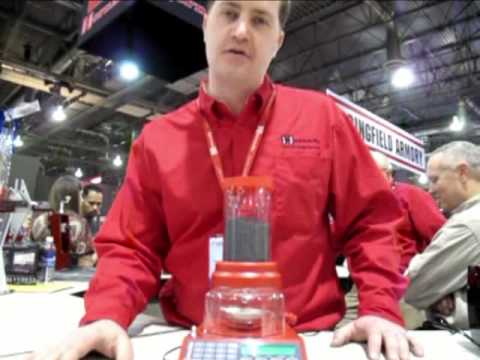
Here’s the first look at Hornady’s brand new Lock-N-Load AutoCharge electronic powder scale/dispenser. This unit can measure up to 1000 grains of powder. According to Hornady, the unit will calculate weight precisely to within ± 0.1 grains. That would put it on a par with the RCBS Chargemaster, though the Hornady unit sells for $60-$80 less than the “green machine”. The Hornady has many nice features, such as an easily readable, back-lit display, trickle function, calibration weights suitable to both low and high powder charges, and plenty of memory for your favorite loads. The Hornady, priced at $249.95 (item 050068) at Sinclair, also features three, user-selectable dispensing speeds — something you won’t find on the RCBS ChargeMaster. Those three speed settings let you optimize dispensing flow for the type of powder you’re using.

We hope to get one of these Hornady AutoCharge units soon and run a head-to-head comparison with our RCBS Chargemaster. Below is a video from SHOT Show 2010 of an early production Hornady AutoCharge.
March 5th, 2010
We recently received a prototype version of the new NEO rest from SebCoax.com. Designer Sebastian Lambang’s new rest is an engineering tour de force. Your editor can say, straight up, that this is the best joystick rest I’ve ever used. It is butter smooth in horizontal travel. The NEO does not suffer from the jerky, or jumpy vertical movement of some other joystick rests. With a 17-lb gun on the rest, yes there is more resistance in the vertical plane than in the horizontal, but you can still move the crosshairs up smoothly in one motion. You don’t have to “over-shoot” and then come back down on your aiming point. If you’ve used other coaxial rests, you know that the upward movement can be jerky if the resistance is set so that the joystick does not droop when you let go. Not so with the NEO. Seb Lambang has fitted the NEO rest with expensive, new German-made internal bearings. These new teflon liner bearings, plus two additional internal leaf springs for weight support, make all the difference.
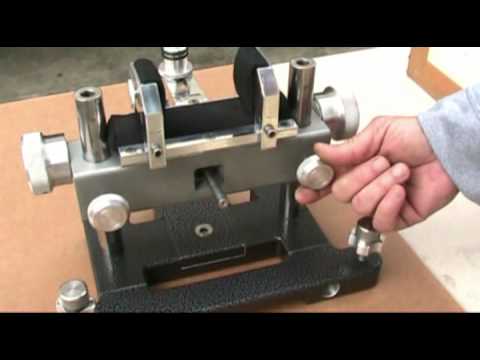
The upward movement is MUCH smoother than before. In this Editor’s opinion, the NEO is smoother (with less jumpiness) than the Farley. It is also easier to set joystick tension on the NEO rest that on the previous (Gen 1) SEB rest. Before you had to fiddle with hex-head bolts. On the NEO rest, SEB has provided two, large diameter knobs. It is easy to set the tension so the joystick doesn’t fall on release, but travel is still smooth and positive in all planes.

Make no mistake, joystick movement on this rest is smooth and fluid, even in straight upwards motion with a 17-pound rifle. No more of the jumpiness or stacking found on lesser designs. SEB has got a winner here. Just as a top-fuel dragster lives or dies on quarter-mile speed, a coaxial rest is judged, foremost, on its ability to move quickly and precisely to point of aim in ONE MOVEMENT. Here the NEO rest shines. It may be the smoothest-functioning coaxial rest ever produced. And it also has the unique feature of adjustable front bag width (see videos). That’s great if you shoot both wide benchrest rigs and narrow-forearm rifles. Also, when disassembled, the NEO rest packs up very compactly — a big plus when traveling. If you didn’t like joystick rests before, the SEB NEO may make you a believer.

Triple-Sandbag Configuration and Vibration Damping
How about shooting performance? The rest is rock-solid, with no wobbly movement, so no mechanical flaws should prevent match-winning performance. However, the NEO rest has three separate, fairly thin bags. This configuration has been used with success in rimfire benchrest. Some European centerfire rests use a similar tri-bag arrangement. However, we are concerned that the smaller, separate bags could behave differently than a conventional front bag. There may be differences in vibration damping and how the bag responds under recoil. We have NOT done enough testing to judge how the NEO’s tri-bag system performs compared to a conventional one-piece sandbag. But it’s something to consider.
NEO Rest Offers More JoyStick Travel
The SEB NEO rest has a very wide range of travel. Running the joystick to max travel, we placed shots 43 MOA apart vertically and 48 MOA apart horizontally. That’s four FEET of horizontal travel at 100 yards using JUST the joystick! If you need more than 43 MOA of vertical travel, the whole coaxial carriage moves up and down on two large columns, delivering a bag height range from about 5″ to 10″ above the bench top. That’s a HUGE amount of travel. The gross height is adjusted with two large knobs, one on either side of the carriage. This movement is very smooth — as if the carriage is on ball bearings.
The geometry of the NEO Rest is somewhat unique. Although the NEO can be positioned in either direction (i.e. it is reversible), it is designed to have the long, narrow foot out front, on the target side. This opens up the entire area behind the rest, so there is no interference with the joystick’s movement. “But what about my vertical speedscrew?” you may be saying. Well, with the SEB NEO’s 43 MOA of vertical travel, you really don’t need a vertical adjustment screw on the shooter’s side of the rest when aiming your rifle. There ARE two adjustment screws on the left and right rear sides, but these are intended to level the rest only.

Overall, we were very impressed with the quality, range of adjustment, and versatility of the NEO rest. It has more than enough joystick travel to shoot an ARA rimfire target with 25 bulls. It has enough gross vertical adjustment for 1000-yard F-Class use, even if the target is way up on a hill or down in a valley. And, the rest is relatively easy to transport, with a fairly small footprint and a convenient carry handle built into the “back” side of the rest.

NEO Rest Specifications
- Reversible base configuration: Rest can work with joystick tension adjustments in front, or in rear, per user preference. If you want the single long foot on the “driver’s side”, that is also possible.
– Size assembled: Approx. 13″ wide x 14″ long, 8.6″ tall.
– MOA adjustment (joystick travel): At least 40 MOA (vertical) x 44 MOA (horizontal).
– Net weight: approx 9.3 kgs (20.5 lbs), with standard aluminum base and filled bags.
– Bag Width Range: 200 mm (approx 7.874″) between posts CTC. This allows a max forearm width of about 4″ (four inches).
– Height Range (from bottom of base to top of horizontal bag): Approx. 5″ (lowest) to 10″ (highest).
– Sand Bag Thickness: Approx. 3/4″ for the “horizontal’ bag, approx. 1/2″ for the side chambers.
– Construction: All metal throughout. Base is cast aluminum. Rack gear posts and pinion are stainless steel (SUS 420J). Coaxial body, rest top, forearm stopper are made from aircraft grade alumunium.
– Price: Not yet set, but probably $675.00 to $750.00 US.
NEO Rest vs. SEB Standard Rest
Seb told us: “The NEO rest is NOT designed to replace the regular SEB rest. It’s only for people that need faster elevation adjustment, and a rest that can be set to a lower level overall or a higher lever overall. On the production NEO rests, the ‘body’ of the coaxial unit will be polished, just like the current (Gen 1) rest. The current (Gen 1) rest will remain in production, so don’t worry if you prefer that design. I haven’t established the final price of the NEO rest yet, but I think it will be about $675.00 to $750.00. Yes, it will be somewhat more expensive because of the extended travel capability and increased cost of materials.”

Further Enhancements for Production Model?
The NEO we received is a prototype model and SEB tells us that he may add or modify some features in the final production version. What changes would we like? First, we think a front rest in the $700+ price range should have a built-in level. Obviously you can buy a bubble level and stick it on, but Seb should include one. Second, we’d like to see some variations on the side sand chambers. They tend to plump up in the middle. For stocks with side flats, such as the McMillan Edge, the thickest part of the side bags is a bit too high. Also the side tension knobs push the bags inwards well above the contact point with the stock. We also would like to have more forearm stop travel. As made, the front forearm stop has a good range of adjustment. But an optional, longer extension for the stop would better suit rifles that balance/shoot best with the rest placed well back on the forearm.
Included Cord Helps Rest Alignment
Included with the NEO rest is a nylon cord with metal ends. Just pop one end of the cord in a hole in the middle of the forearm stop and draw the cord back in line with the target, running the cord through the ears of your rear sandbag. This allows you to center and align the rear bag optimally. The cord is a thoughtful accessory provided by SEB.


Review Disclosure: SebCoax.com provided the Seb NEO rest for testing and evaluation. The rest’s manufacturer is not currently advertising with AccurateShooter.com.
|


