|
|
February 20th, 2010
Caldwell recently sent us some new pre-printed targets that we really like. The new Caldwell Tip Top Targets have a combination of features we’ve never seen before in pre-packaged targets. First, the targets are printed on a unique, plasticized card stock — just slightly thinner than a business card. The plasticized material is very rip-resistant (if you really try, you can make a small tear on the edge, but it takes a LOT of deliberate effort). The plasticized material makes the targets 100% weatherproof, though you can still write on the surface. At the bottom of the targets, Caldwell includes a labeled data entry area where you can record firearm type, shooting conditions, distance, group size, load info, and chron data. Very Handy! The targets even come pre-punched for a 3-ring binder. That’s great if you want to save your targets. The 8″ Sight-In Tip Top Targets cost $7.49 for 25-pack, or $24.99 for 100 targets.

Bullets Punch Perfect Circles on New Target
What makes these “Tip-Top Targets” really unique is the way bullet holes appear. When a bullet passes through a normal paper target, the paper can rip. At best you get a fairly round hole but with a fuzzy, uneven edge. With these Tip Top Targets, the bullet hole looks like it was made with a hole punch. No more ragged, fuzzy edges. If you’ve ever shot wadcutter rounds from a pistol into a paper target, that’s the effect here. But the bullet hole edges are even MORE sharp and uniform. As a result, you can measure your group sizes quickly, with great precision.
Overall, we think the Tip Top Target is a real step forward. Caldwell did a great job with this product. The new material does not tear, does not get soggy in wet conditions, and does not flap around in the wind. The new material delivers crisp, uniform bullet holes for easy group measurement, and the 1″ square gridlines let you quickly estimate your group size.
Caldwell Tip Top Targets are offered in six (6) different versions: large, Inverted “T” for iron-sighted rifles or pistols; 4″-diam. Bullseyes; 8″-diam. single Bullseye; 100-yard Benchrest Target; 200-yard Benchrest Target; and 8″ Sight-in Target with 1″ grid (shown in photos).
We really like the layout of the sight-in target. In has five different aim points with a central diamond split by horizontal and vertical lines running through the points of the diamond. The diamond, which measures 1/4″ on a side, provides a VERY precise aiming point. Just line up your cross-hairs with the heavy black lines and you should be able to shoot bugholes with this target. It’s a very good design, with good contrast in the center of each aiming square.
Is there anything we would change on the Sight-In Target we sampled? Yes… First, we’d like to see a long-range version with an all-white background so that bullet holes are easier to see at long distances. Second, we’d modify the data entry table so you could list results for multiple loads. See our FREE Targets Page for paper targets with multiple load-entry/chron data boxes.
Review Disclosure: Caldwell provided a free 25-ct pack of 8″ Sight-In Targets for testing.
February 18th, 2010
A reliable 22LR conversion kit for an AR-platform rifle lets you train with inexpensive ammo. That’s a big advantage for 3-gun competitors who must engage multiple targets rapidly, often at relatively short distances. Multi-gun competition is a speed game, requiring plenty of practice to “run with the big dogs”. It’s not unusual for elite 3-gun shooters to put hundreds of rifle rounds down range every week. Service Rifle shooters can also benefit from cross-training with an AR equipped to shoot .22LR rimfire rounds. With a good .22LR conversion kit, Service Rifle shooters can practice their positions and gun-handling at minimal expense. In the winter, if you have a .22LR conversion for your AR, you can train at the many indoor ranges that allow rimfire rifles, but not centerfire rifles.
Complete Conversion Kit for $189.99 from CDNN
CDNN Investments in Texas is offering a good deal on the CMMG .22lr Stainless Conversion Kit for AR15-type rifles. This includes a stainless bolt and bolt carrier assembly and two (2) 25-round magazines or two (2) 10-round mags. The CMMG Kit uses your existing fire control (trigger) group and requires no internal gunsmithing. Just drop it in and shoot. While supplies last, the CMMG Conversion Kit with magazine(s) is priced at $189.99. NOTE: CDNN is offering 2 mags with this package as a “limited time offer”. (MidwayUSA also has this Kit, with one mag, for $199.99.)

CMMG .22LR Kit Is Reliable and Affordable
The CMMG conversion is widely used and has proved quite reliable, both with the 10-round and 25-round magazines. It is recommended by Brownells, though some Brownells customers have said the kits required some minor fitting or polishing. (This may be more of an issue with “off-brand” uppers — Colt AR owners reported no issues.) In the video below you see an AR15 being fired with the CMMG .22LR conversion in place. Then the CMMG bolt is exchanged for the original .223 Rem bolt assembly and the gun is shot in centerfire mode.

In the second video below you’ll see the CMMG conversion shot with two full (or nearly full) 25-round magazines, in rapid fire. There are no malfunctions.

February 17th, 2010
Timney Triggers has a new Trigger Pull Gauge. This spring-type tension scale measures pull weights from 8 oz. to 10 lbs. and is also calibrated for metric (kg) weights. The wide hook makes the gauge easy to use even with over-sized trigger guards. The Timney gauge features a “tattle-tail indicator” that stops at the highest resistance. This works as follows — as you pull back on the gauge, the sliding indicator will move towards the heavier side of the scale; once the sear releases the sliding indicator remains at the point where the highest amount of pressure was exerted on the trigger.

We still think the Lyman Digital Trigger Pull Gauge is the best on the market, but it costs $52-55.00 compared to $28.49 for the Timney gauge. The Timney Trigger Pull Gauge will be available at MidwayUSA (item 969947) before the end of February.

February 17th, 2010
After learning that M855 NATO ammo does not perform well from short-barreled rifles such as the M4 carbine, the U.S. Marine Corps has started issuing a new type of 5.56×45 ammo to its troops in Afghanistan. The new SOST (Special Operations Science and Technology) ammo, officially designated MK 318 MOD 0 “Cartridge, Caliber 5.56mm Ball, Carbine, Barrier”, features a different open-tip 62mm bullet. The new bullet, with a lead core (in the top half) and solid copper bottom half, is similar to hunting bullets such as Federal’s Trophy Bonded Bear Claw. The SOST bullet was designed by Federal/ATK, which will produce the loaded ammunition.

The new SOST ammo was first developed for use by SOCOM (Special Operations) in the SCAR rifle, which has a short, 13.8″ barrel. Even in short-barreled rifles, the SOST provides impressive ballistics — achieving 2925 fps in a 14″ barrel. Compared to M855 ball ammo, SOST rounds are more lethal when shot from short-barreled rifles. According to the Marine Times, SOST ammunition delivers “consistent, rapid fragmentation which shortens the time required to cause incapacitation of enemy combatants”. Using an open-tip design common with some sniper ammunition, SOST rounds are designed to be “barrier blind”, meaning they stay on target better than existing M855 rounds after penetrating windshields, car doors and other objects. This is important to troops in the Middle Eastern theater who must engage insurgents inside vehicles or hiding behind barriers.
In Afghanistan, the USMC will issue SOST ammo for both the short-barreled M4 carbine as well as the original, full-length M16A4. The Corps purchased a “couple million” SOST rounds as part of a joint $6 million, 10.4-million-round buy in September — enough to last the service several months in Afghanistan.
M855 Criticized by Ground Troops and Pentagon Testers
The standard Marine 5.56 round, the M855, was developed in the 1970s and approved as an official NATO round in 1980. In recent years, however, it has been the subject of widespread criticism from troops, who question whether it has enough punch to stop oncoming enemies.
In 2002, shortcomings in the M855’s performance were detailed in a report by Naval Surface Warfare Center Crane, Ind., according to Navy Department documents. Additional testing in 2005 showed shortcomings. The Pentagon issued a request to industry for improved ammunition the following year.
CLICK HERE for Full Report on New SOST MK 318 Ammunition.
February 12th, 2010
 Many of our Forum members have reported that they have received their new Sightron SIII 10-50x60mm target scopes. These come with 1/8 MOA clicks and either a Fine Cross Hair reticle or FCH with target dot reticle. Currently the scopes do NOT include lens covers or screw-in sunshades. Many of our Forum members have reported that they have received their new Sightron SIII 10-50x60mm target scopes. These come with 1/8 MOA clicks and either a Fine Cross Hair reticle or FCH with target dot reticle. Currently the scopes do NOT include lens covers or screw-in sunshades.
In terms of optical performance, feedback so far has been very positive. Forum member Nat Lambeth recently received one of the new 10-50 Sightrons. He reports: “This scope, like the 8-32x56mm SIII, is much heavier-built than the first Sightron target scopes. It is very clear and sharp edge to edge. I shot 20, 5-shot groups with my [6BRX rifle with Savage Target action]… off a BR Rest and leather rear bag. The scope was cranked up to 50 power during my entire afternoon of shooting. The focus ring has a very short window of focus for a given distance. Otherwise clarity and light gathering was superb.”
The new scope is pretty large, measuring 16.9″ overall and weighing just under 29 ounces (without rings). Below you see the new Sightron 10-50x60mm next to a Nightforce NXS 12-42x56mm.

Some folks have been concerned about vertical clearance with the large 60mm front objective. The photo below shows the scope mounted on a Weaver-type rail with Burris Signature Zee “Extra-High” scope rings. As you can see, there is more than ample clearance. With most Weaver rails and barrel profiles you could probably go to the next lower Burris ring height — but we recommend you get the specs if you plan to use other types of rings.

The new Sightron 10-50x60mm scopes remin in stock at various vendors, but they are selling fast. MidwayUSA has them in stock today, priced at $994.99 (item 589261). Note: At this time, these scopes ship without scope caps or sunshade. Sightron hopes to have both caps and shades available by mid-summer.
CLICK HERE for more photos by Forum Member SwitchBarrel.
February 10th, 2010
These days, it’s not uncommon for shooters to bring electrical gadgets to the shooting range, particularly when testing loads. You’ll see guys running chronos with laptop computers, or loading with electronic powder dispensers (such as the RCBS ChargeMaster). If your favorite range doesn’t have AC outlets, how do you keep all that stuff powered up? You can get one of those portable 120v power supplies (basically a big battery with inverter and carry handle), but they are heavy and fairly expensive.
Another option, for those needing 120v AC to drive powder dispensers, laptops etc., is to use your car battery. Compact, affordable, and reliable inverters are now available that let you draw current from your car/truck’s cigarette lighter or accessory jack. Yes, it would be possible to run-down your battery, but if you start with a healthy vehicle battery, you’re not going to drain it by throwing a couple dozen charges with a ChargeMaster.

Black & Decker makes a rugged 100-Watt Inverter that converts your vehicle’s 12-volt DC power into 115-volt AC power. The unit has a single AC outlet, with an accessory plug that adjusts 45 degrees for convenience. An automatic low battery shutdown prevents draining the vehicle battery, and an LED indicator shows charging status. Black & Decker backs its inverter with a 2-year warranty. The Black & Decker 100-Watt Inverter costs $22.96 at Amazon.com.
Duracell has a similar Pocket Power Inverter fitted with a cord on the 12V end. (The cord is much longer than shown in picture). The cord can be helpful if your power take-off or cigarette lighter jack is hard to access. The Duracell unit has been popular, but, unlike the Black & Decker, the Duracell only delivers 100 Watts for for 5 minutes, after that it delivers 80 watts. That’s still enough to drive most of the gadgets you’ll use for load testing at the range. Duracells Pocket Power Inverter sells for $19.99 on Amazon.com. A more powerful 175 watt version sells for $48.75.

February 8th, 2010
 Bob “The Nailer” Swagger is back in Stephen Hunter’s new novel, I, Sniper. Released at the end of 2009, Hunter’s new Bob Lee Swagger story has earned praise as “the best Stephen Hunter book in years.” Bob “The Nailer” Swagger is back in Stephen Hunter’s new novel, I, Sniper. Released at the end of 2009, Hunter’s new Bob Lee Swagger story has earned praise as “the best Stephen Hunter book in years.”
In I, Sniper, four Vietnam-era peaceniks are shot dead and retired military sniper Carl Hitchcock is framed for their murders. (The Hitchcock character is based, as you’ve guessed, on famed USMC sniper Carlos Hathcock). Swagger soon realizes that Hitchcock, a fellow ex-Marine and Vietnam vet, is innocent, while the real killer, who’s using high-tech, electronic sniper gear, is still at large. Swagger sets out to find the actual shooter.
If you liked Hunter’s Point of Impact, you’ll probably love the new book. The plot is compelling and Bob Lee Swagger remains the ultimate marksman/crime solver. Hunter, an avid shooter and Pulitzer-prize-winning journalist, knows his firearms, so the gunfights and other action scenes are believable, and the discussions of long-range shooting and ballistics are correct.
 One of the best things about I, Sniper is that Hunter takes on the liberal media. One character is a New York Times reporter, who is used as a foil to show the ignorance of the mainstream media about gun matters. In an interview with American Rifleman magazine, Hunter explains: “One of the themes in I, Sniper is how an extremely sophisticated news organization can make a really stupid gun error and have no idea that they’re doing it. How can you be so certain of your politics if you have such an infirm grasp of the reality of the instrument (firearms). You know, maybe if your grasp of the reality of the instrument is ludicrously incorrect, maybe your grasp of the politics of the instrument is ludicrously incorrect [also], and you want to re-examine both issues.” One of the best things about I, Sniper is that Hunter takes on the liberal media. One character is a New York Times reporter, who is used as a foil to show the ignorance of the mainstream media about gun matters. In an interview with American Rifleman magazine, Hunter explains: “One of the themes in I, Sniper is how an extremely sophisticated news organization can make a really stupid gun error and have no idea that they’re doing it. How can you be so certain of your politics if you have such an infirm grasp of the reality of the instrument (firearms). You know, maybe if your grasp of the reality of the instrument is ludicrously incorrect, maybe your grasp of the politics of the instrument is ludicrously incorrect [also], and you want to re-examine both issues.”
CLICK HERE for Stephen Hunter’s Commentary on I, Sniper
CLICK HERE for Massad Ayoob’s Review of I, Sniper
Below is Michael Bane’s DownrangeTV VIDEO Interview with Stephen Hunter:

If you’re thinking about buying this book, read some of the 50+ reviews on Amazon.com. Most reviews are four-star or five-star, but some folks feel Hunter’s writing is sloppy in places and the book should have been more tightly edited. Other critics say Hunter gets “too political” in this book. This Editor believes the jabs at the liberal media are one of the book’s better features. I suspect Hunter’s viewpoints will be welcomed by most of his readers. Here are representative reader reviews from Amazon.com:
This book is classic Bob Lee Swagger. Great read. Also, as a gun owner and 2nd Amendment supporter, I love the not-so-subtle-jabs at the liberal media and their woeful understanding of the south, gun culture, law abiding citizens who own guns legally. [Hunter] picks on the New York Times, which is hilarious and accurate. Great job Mr. Hunter.
Hunter is at his best in I, Sniper. Dialogue? Crisp, real, down to earth, and sometimes hysterically funny. Action? Have a box of Depends at the ready. Technical support? Pay attention. Reading Hunter is like taking a Master’s course in armament.
CLICK HERE to ORDER I, Sniper: A Bob Lee Swagger Novel
($9.99 Paperback, $9.99 e-Book, $10.19 Audiobook, $14.30 Hardback)
February 4th, 2010
Forum member Thomas Haugland (aka “Roe”) from Norway has created an excellent video comparing the features on four long-range scopes: Schmidt & Bender PMII 3-12x50mm, Schmidt & Bender PMII 12-50x56mm, Leupold MK IV, and Zeiss Diavari Victory 6-24x56mm. Thomas shows how the adjustments function, he records the available vertical elevation, and he takes apart the turrets to show how the weather seals work. While the Leupold MK IV has MOA clicks, the three Euro scopes tested by Thomas have mil-based or mil/cm adjustments. These mil-based clicks work well with first focal plane reticles that have mil or half-mil hash marks.
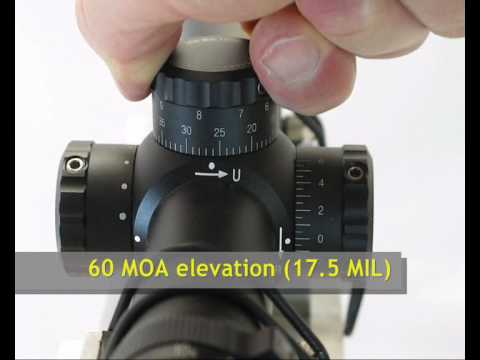
Thomas explains:
These films emphasize the shooter’s Point of View (POV) and ‘user friendliness’. ALL these scopes get the job done, but they have some similarities and differences in the details and your own personal preferences would decide what scope can be labeled ‘best’. The perfect scope doesn’t exist, you’ll have a compromise somewhere — be that economy, magnification, reticle, turret, optical quality, sturdiness…
In these films I’ve set the Schmidt & Bender PMII 3-12×50 as the benchmark for comparison. Not because it is ‘best’ (it isn’t!) but because S&B is one of the manufacturers which first recognized the needs of professional Long Range shooters and put together products [optimized to work well] in high stress environments. The features that are important are: First focal plane, MIL reticles and MIL turrets, plenty of adjustment and suitable magnification.
Note that S&B and Zeiss scopes are also available in the USA with MOA-based turrets and/or second focal plane (SFP) reticles, for those shooters who prefer the MOA system, and SFP. A first focal plane reticle is best for ranging, but a target shooter working at known distances will probably prefer a second focal plane reticle that doesn’t change in size with magnification.
February 3rd, 2010
Today we wrap up our coverage of the 2010 Shot Show. Jason and I visited scores of booths, inspected hundreds of new products and interviewed dozens of industry insiders and “old friends”. We can’t package all the highlights into a single blog post, but here are some “short takes” on SHOT Show items of interest — the new stuff we really liked and some odd but noteworthy elements of the “Shot Show Experience”.
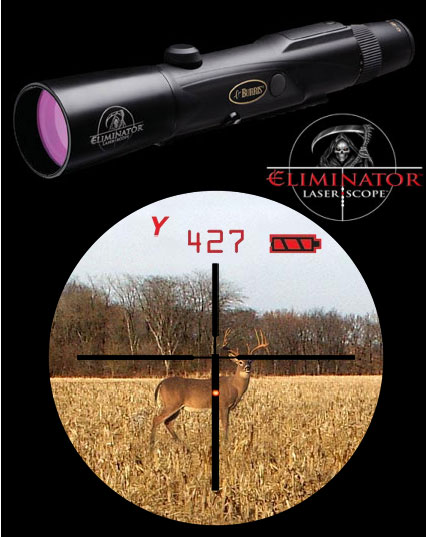
Most Important New Technology — Burris LaserScope
AccurateShooter.com doesn’t give product awards, but if we did, the new Eliminator LaserScope from Burris would be a leading candidate for “Best in Show” honors. This unit employs modern technology to make the shooter’s job easier. A built-in laser rangefinder finds the distance to your target. Then the scope consults a ballistics table, pre-programmed for your cartridge. The scope’s “brain” calculates the precise holdover for your ranged target distance and displays a bright, red dot on the vertical cross-hair. That dot is your calculated correct point of aim. Just put the red dot on the target and squeeze the trigger. For a varmint hunter, this scope could be the best thing since sliced bread. Shoot all week and never touch the elevation knob. We just wish the Eliminator was offered in a higher-power version — say a 6-24×50. Currently the Eliminator is offered only as a 4-12x42mm optic. The Eliminator is far from perfect, but its technology really could render other conventional hunting riflescopes obsolete.
Important Brass Developments
For Benchrest shooters, the big news was Norma’s introduction of 6 PPC brass. According to Lou Murdica, who has tested the early production brass, this new brass is “outstanding” and is fully competitive with cases fire-formed from Lapua 220 Russian brass. Norma’s production of 6 PPC brass demonstrates that the Swedish company is very serious about benchrest shooting and the American market. We had a long, productive conversation with the CEO of Norma, and we could tell he is committed to expanding Norma’s place in the American market. Expect some major developments in the months ahead, including a joint project with AccurateShooter.com. Norma also showed us the 300 Norma case which we feel will eventually be an important chambering for long-range shooters. This case has “just right” capacity to drive the 200+ grain, high-BC 30-caliber bullets.

Unnoticed Excellence — The Barrel-Makers
Flashy new products get the media attention at SHOT Show every year. But we think the most important “back story” involves American barrel-makers. If you want to do a story on EXCELLENCE in today’s gun industry, you need to focus on the elite barrel-makers. Companies such as Bartlein, Broughton, and Krieger continue to make better barrels every year, with new features such as gain-twist rifling, and 5R rifling. Just this Friday, I witnessed a .308 “tactical” rifle with a new Krieger 5R barrel fire two successive three-shot groups that were each just a ragged hole — and the first two out of three shots in each group literally went through the same hole at 100 yards. And that was during barrel break-in with an untested load and untrimmed brass “right out of the box”. America’s top “boutique” barrel-makers are now producing extraordinarily good products, yet they are rarely mentioned by the popular print gun magazines. At a time when we see recall notices from companies such as Ruger and Remington on a regular basis, our American custom barrel makers are building the best barrels in the world, indeed the best barrels ever made.
A Contrast in Style — American vs. European Optics-Makers
Among the major optics makers, the difference between American and European marketing styles was painfully obvious. Leupold and Burris had fast-talking, glad-handing salesmen, who, for the most part, knew very little about their product line and even less about optics engineering. By contrast, Zeiss and Schmidt & Bender staffed their booths with real optics engineers with Ph.Ds, many of whom were directly involved in the design of the products on display. At Zeiss we spent nearly an hour talking with Stephan Albrecht, the German engineer in charge of the new 20-75X Diascope spotting scope and the new Diavari Flourite riflescopes. During our conversations with Stephan he actually solicited our feedback, took careful notes and promised to explore some of our suggestions. We also were able to share our field test results directly with Eric Schumacher, President of Carl Zeiss Optical, USA. By contrast, Leupold’s decision makers and top-level engineers were nowhere to be found, and when we voiced our (now annual) plea that Leupold stop building scopes with canted reticles, we were greeted with nothing but blank stares. Leupold’s reps couldn’t comprehend the canted reticle problem, even after I pulled a scope (with 3° canted reticle) off their display rack and showed them.

Federal FCPA Sting Rocks SHOT Show
In the mainstream media, SHOT Show 2010 will be remembered for one thing — the “Big Bust”. On January 20th, FBI agents arrested 22 gun industry employees and executives for alleged violations of the FCPA (Foreign Corrupt Practices Act). Those arrested, including one of Smith & Wesson’s Vice Presidents, were charged with trying to bribe FBI agents posing as African government officials. This “high-visibility” bust culminated a DOJ sting operation two years in the making that involved 250 federal agents.
Accuracy… Who Needs Accuracy?
There’s a curious thing about SHOT Show. It’s touted as the greatest gunshow in the galaxy, but one thing is sorely missing — really accurate rifles. Heaven forbid there would be a true benchrest rifle or rail gun on display! Many of our readers own more true 1/4-MOA rifles than you’ll find at the entire SHOT Show. We know this is a trade show, but still you’d think somebody would want to show off a really impressive rifle — say the National Championship-winning F-Class rifle or a record-setting rail gun. It would be like having a Top Fuel dragster on display at a car show. But no, what we have instead are acres upon acres of 1-2 MOA factory guns. That’s disappointing to say the least. It’s sort of like going to an air show only to discover the Blue Angles have cancelled and there won’t be any jets at all.
 Pop Stars vs. Legendary Marksmen Pop Stars vs. Legendary Marksmen
At every SHOT Show, I’m struck by some odd ironies. This year I walked past one booth which was absolutely mobbed with people trying to meet an attractive young female celebrity — a contestant from American Idol. Fighting through the throng, I continued down the aisle to the McMillan booth. There was David Tubb, quietly chatting with a McMillan rep. Mind you, David is an 11-time National High Power Champion. He has also won National Silhouette titles and scores of other matches. He is arguably the greatest competitive rifle shooter in American history. Yet hundreds of people walked by without even noticing David. Think of the irony. Imagine if Michael Jordan was sitting in a booth at a sports convention. The place would be mobbed. Yet David has certainly dominated his sport the way Jordan dominated basketball. Jordan won six NBA Championships. Tubb has won ELEVEN National Championships (and he’s not done yet). Yet the vast majority of SHOT attendees don’t seem to care about legends like David Tubb, or about shooting excellence in general… they would rather wait in line to meet a “wannabee” from American Idol than learn something from a truely legendary marksman. Sometimes I DO wonder about our priorities.
Too Many Black Rifles?
After Obama was elected in November 2008, there was a surge in demand for semi-auto, military-style rifles, partcularly AR-platform rifles. Manufacturers of all sizes, from Remington/Bushmaster, to small fabricators, ramped up production of AR uppers, lowers, and complete rifles. Now, 15 months later, demand is slacking off, and there is an over-abundance of ARs. We perceived a notable lack of interest in AR rifles at SHOT Show, unless they had some new bells and whistles. Retailers seemed much more interested in big-bore bolt guns and handguns, or in the completely new semi-auto designs such as Remington’s ACR.
Bring Back the Convention Center
For 2010, SHOT Show was hosted at the Sands Expo Center, behind the Venetian Hotel complex, instead of the Las Vegas Convention Center. On paper, this seemed like a good move. The Sands Expo is nearer the strip and closer to popular hotels. In practice, the Sands Expo proved a poor location for SHOT Show. Outside the main hall, booths were crammed into conference areas with low ceilings and bad lighting. A very large number of exhibitors were assigned to the first-floor “Dungeon”. There, access was difficult, the lighting was bad, and low ceilings and concrete floors worsened the background noise problem.
Just getting into SHOT show was a challenge. For the majority of visitors staying in hotels on the strip, one had to walk through the maze-like interior of the Venetian to get to the Show. This was annoying to say the least. On 3 out of 4 days I took at least one wrong turn, and on Day 2 I got thoroughly lost. I saw plenty of folks with SHOT Show badges walking in circles, completely disoriented — the Venetian is a building where you can’t walk in a straight line for more than 150 feet or so. And once inside the SHOT Show proper it was very easy to get lost as well. Pete Brownell was heard to say that he needed a map just to find his own booth.
February 3rd, 2010
Many of our readers have been looking for a folding shooting mat that does double duty as a rifle case. Well, the NRA just released such a combo mat/carry case that appears to have all the needed capabilities. In carry mode, the case is 48″ long by 13″ wide. The rifle is stowed in a padded center section, and held in place with velcro straps. A center handle lets you carry the bag like a suitcase, or optional shoulder straps allow backpack-style carry. These straps stow away in a zippered compartment when not in use.

When you arrive at the range, just open up the bag and you have a 3 foot wide by 6 foot long shooting mat with rubberized “elbow” contact zones. In shooting position you’ll find a convenient pouch for ammo on the right, and a place for your log-book on the left. Constructed of tough, 600D polyester with heavy-duty silent zippers, the NRA Mat includes four multi-position pouches: a 9″ x 8″ clear map / document pouch, a 10″ x 10″ zippered ammo pouch with 20 cartridge loops, a 9½” x 10″ exterior MOLLE pouch, and a 9″ x 18″ utility / strap pouch. The front exterior has MOLLE loops to attach additional pouches.
The NRA combo carry case/shooting mat costs $99.95, in either “coyote” tan or black. We think thats a pretty good price considering that a quality roll-up mat by itself can cost $80.00 or more and you still need a rifle case. This mat would be a good choice for F-Class shooters, and for long-range High Power shooters, provided their rifle is less than 45-46″ overall. Measure your gun before you order this product from the NRA Store.
|


