|
|
February 2nd, 2010
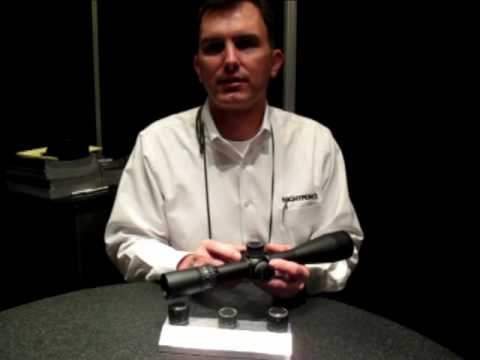
 Nightforce Optics has enhanced their elevation adjustments in this year’s lineup of high-magnification Nightforce scopes. Now you can get DOUBLE the elevation travel with a SINGLE TURN of the elevation knob. For an NXS with 1/4-MOA clicks, this means you can get a full 20 MOA of elevation travel with a single turn of the knob. Nightforce Optics has enhanced their elevation adjustments in this year’s lineup of high-magnification Nightforce scopes. Now you can get DOUBLE the elevation travel with a SINGLE TURN of the elevation knob. For an NXS with 1/4-MOA clicks, this means you can get a full 20 MOA of elevation travel with a single turn of the knob.
Bravo, Nightforce — this simple enhancement can make a BIG difference in the field. With most “high-performance” calibers, 20 MOA will get you to 700 yards or beyond. This means that the varminter can zero at all likely hunting yardages within the same revolution of the turret. That makes life much simpler, and reduces the chance of being way off in your elevation. No more confusion about which revolution you’re on….
Likewise, a tactical shooter, moving from near to far targets and back again, can likely stay on the same revolution at most target yardages. Even if you shoot out to 1000 yards, you will be able to get all the way out to 1K within two complete revolutions. This upgrade — doubling the elevation travel in each turret revolution — gives Nightforce scopes practical performance (inside 700 yards) similar to much more expensive scopes fitted with a single-turn or double-turn elevation systems (such as the U.S. Optics EREK knob). The new high-speed adjustment system will be offered in Nightforce’s 15x, 22x, 32x, and 42x series of scopes. Anticipated delivery date for scopes with the high-speed adjustment is May, 2010.
What About Retro-fitting Older NF Scopes?
Nightforce plans to provide an upgrade path for existing Nightforce scopes “eventually, but not right away”. The upgrade would allow installation of the “high-speed adjustment” system on older NF scopes. We don’t have any more specifics. Nightforce has NOT revealed how much the high-speed conversion would cost or when it might be available for pre-2010 scopes.
February 1st, 2010
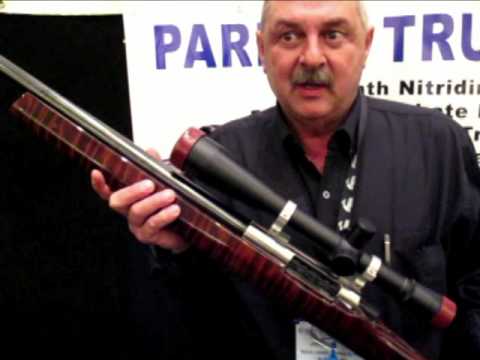
Many of our readers know Joel Kendrick, one of America’s top mid-range shooters. Joel is a two-time IBS 600-yard Shooter of the Year, and we have featured Joel’s match-winning 6×44 as one of our Guns of the Week. Joel now works with MMi-Trutec, specializing in the salt-bath nitriding process. This is a surface-hardening procedure for steel that creates a super-hard, low friction layer for the top 10-20 microns of the metal. Barrels treated with salt-bath-nitriding show much improved wear resistance and reduced friction.
For match rifles, varmint rifles, and hunting rifles, the most significant benefits of salt-bath nitriding are enhanced barrel life, and easier cleaning. Joel’s own F-Class rifle has a nitrided stainless barrel with over 5000 rounds — and it still holds 1/4 MOA at 100 yards. Other well-known shooters, such as John Whidden, have observed that nitrided barrels can shoot longer strings of fire between cleanings, with no reduction of accuracy. What is the cost of nitriding? As Joel explains in the video below, nitriding a single barrel costs $60.00, but there is a minimum first-time lot charge of $200.00. If you submit multiple barrels at the same time, the price per barrel can be reduced significantly. For more info, visit the MMI-Trutec website or contact Joel Kendrick by phone (704) 616-6442, or via email: joelkndrck [at] aol.com .
Is there a downside to nitriding? First, the nitriding process results in a BLACK matte or satin finish. If you like the natural silver finish of stainless steel, you shouldn’t nitride your barrel. Second, and most importantly, the salt-bath-nitriding process creates a surface so hard that you can NOT re-cut the chamber with normal reaming tools. Therefore, before nitriding, the barrel must be finished chambered. Basically the barrel should be fully finished, crowned, chambered and headspaced before nitriding. NOTE: MMi Trutec CAN mask the crown during nitriding so that the barrel can be re-crowned at a later time.

February 1st, 2010
| If you couldn’t attend SHOT Show 2010, don’t despair. You can now download complete digital editions of the official SHOT Show Daily Magazines provided to SHOT Show attendees and exhibitors.
Each of the four (4) issues contains a major product review, and many interesting shorter features. The Day 1 Daily features new Rifles for 2010, while the Day 2 Daily features new Optics and Ammo. New Knives are featured in the Day 3 Daily. In the Day 4 Report, there is a good summary of new Airgun offerings.
Even if you’re not interested in the latest retail trends it’s worth downloading all four issues, because there are a number of features relating to club operations and range management. In addition, you’ll find many shorter items of interest to rifle shooters. As well there are handy directories of manufacturers and distributors. |
 |
January 31st, 2010
On Media Day, just prior to SHOT Show 2010, our Assistant Editor Jason Baney headed straight to the biggest, baddest rifles he could find — a pair of serious-looking tactical rigs from Barrett Rifles. First off was the mighty semi-auto Barrett 82A1, chambered in .416 Barrett. a “beast of a cartridge” according to Jason. The .416 is a very powerful chambering, and you can see the recoil pushed Jason pretty hard. That’s serious energy — Jason’s a big boy, and the Barrett 82A1 weighs nearly 31 pounds. Want one? You may have to liquidate some investments. MSRP on the Barrett 82A1 is a whopping $9345.00.


Ninety-Eight Bravo in .338 Lapua Magnum
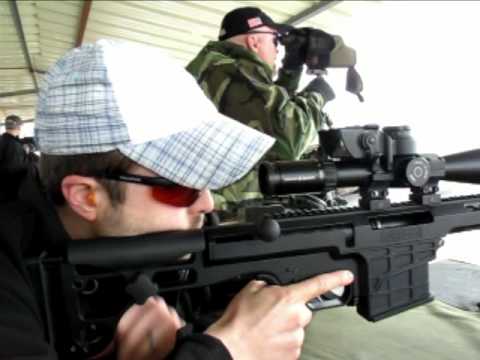
Next up was Barrett’s bolt-action model 98B (“Ninety-Eight Bravo”), chambered in .338 Lapua Magnum. At less than half the weight of the Barrett 82A1, the 98B was much easier to steer on the bench and the ergonomics were generally better according to Jason.
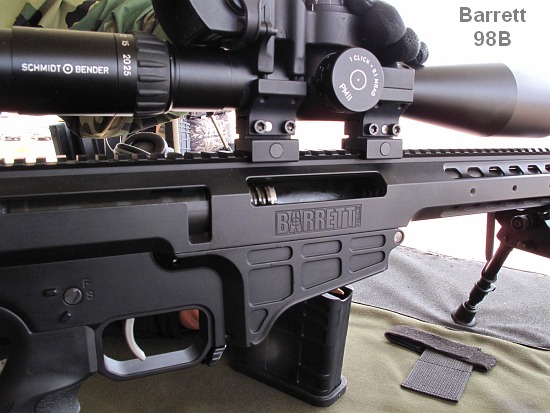
While recoil from the .338 Lapua Mag was stout, you can see in the video that the .338 LM kicked much less than the .416 Barrett, even in a gun with less than half the mass. The 98B gives you a good solid thump to the shoulder when firing. By contrast, the .416 Barrett in the 82A1 shakes your whole body. The 98B weighs 12.4-13.5 pounds (depending on configuration) and starts at $5039.99 without optics. Speaking of optics, the hooded display on top of the 98B is a Barrett Optical Ranging System (BORS). This $1500.00 gadget provides a digital read-out of your actual ballistics settings. It doesn’t control windage and elevation — that is still done manually with the scope knobs. BORS is an integrated electronic ballistic computer that mounts directly on the riflescope and couples to the elevation knob. Just turn the elevation knob until the LCD displays the target’s actual range (which must be pre-determined). The BORS’ three internal sensors automatically calculate a ballistic solution, compensating for up/down angle, temperature, and barometric pressure changes. It even tells you if the rifle is canted. It’s a handy device that eliminates the possibility that you loose track of your turret settings.

January 31st, 2010
The IBS recently announced that it would allow AR-platform rifles to compete in local IBS benchrest matches in their own class. If you plan to campaign your AR in this new class, you should definitely add a 3″-wide front sled and some kind of rear bag-rider to your gun. Without a flat fore-arm “sled” and rear bag-rider, ARs tend to be very wobbly, and the standard rear stock (with sling loop in place) is terrible in a rear sandbag.

 
Robert Whitley’s AR-X Enterprises has just what you need to improve your AR’s bench behavior. AR-X sells precisely-fitted Delrin bag-riders, crafted expressly for ARs by Evolution Gun Works (EGW). The 3″-wide front bag rider (aka “sled”) features a “twin rail” design and attaches to a tubular fore-arm via a swivel stud. The rear bag-rider mates to the bottom of a standard AR stock and attaches via the rear sling swivel anchor. This provides a smooth, straight surface to ride the bags.
These Delrin EGW bag-rider units were originally designed and prototyped for AccurateShooter.com’s 20 Practical AR project rifle. We tried many different designs, and the final production versions really work — as you can see in the video above. The AR bag-riders cost $40 front and $40 rear, or $75.00 for the set of two. To order, visit 6mmAR.com, or email Robert Whitley: rcw3 [at] erols.com .
January 30th, 2010
We had a chance to visit with Jim Kelbly of Kelbly’s Inc., at SHOT Show 2010. Jim had all the new March scopes on display, including the amazing 8-80x56mm long-range scope, part of March’s ground-breaking 10 times zoom range series. Jim reviewed the March line-up, explaining the many high-magnification models available for precision shooters.
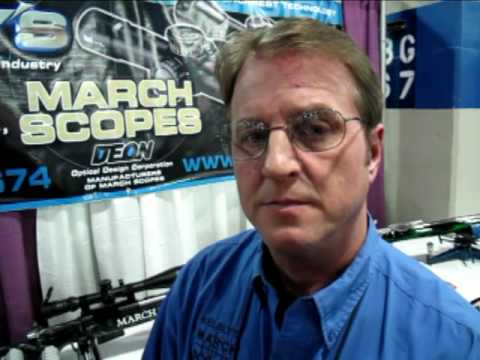

Jim also showed us the stainless Grizzly II action and the new Atlas series of stainless actions. The Atlas actions are designed for varminters, tactical shooters, and long-range shooters who want an affordable stainless action with a Remington 700 action footprint. The Atlas actions should be a simple drop-in installation for stocks inletted for Rem 700s. At the close of the interview, we asked Jim about the future of benchrest competition. Jim believes that we will see more cross-over of short-range shooters into the long-range disciplines (and vice-versa), along with growth in the F-Class and tactical disciplines.

January 30th, 2010
Kent Sakamoto of RCBS showed us the new RCBS products for 2010. The big news for reloaders is an automated, .22-caliber bullet feeder for the RCBS Pro 2000 progressive press. This caliber-specific bullet feeder cycles 22-cal bullets directly into a modified seating die. Now you can load all kinds of 22-cal cartridges without even handling the bullets. The bullet feeder is a simple, bolt-on upgrade to the Pro 2000 press, and it can also be adapted to Hornady’s Lock-N-Load progressive, according to Sakamoto. The new bullet feeder utilizes the RCBS electric collator/hopper, which feeds the bullets from an elevated bin. The 22-cal bullet feeder will be available in March 2010, with a 30-cal version to be released later in the year.
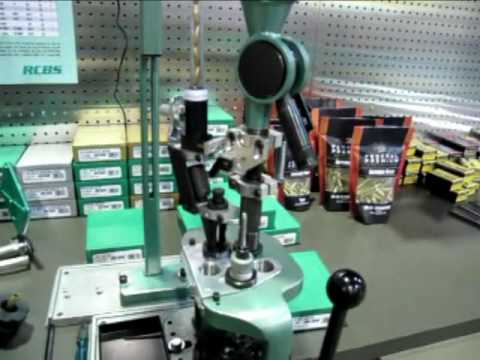
At Media Day, RCBS also showcased its long-awaited new AmmoMaster chronograph. Designed as an affordable, entry-level chrono, the new RCBS AmmoMaster is completely self-contained. All components, including cables and sky-screen, pack up into the central chrono “body” which is shaped like a giant cartridge case. The detachable control/display assembly (shaped like a bullet) can be positioned on your shooting bench for ease of access. The AmmoMaster chrono retails for about $125.00, making it one of the most affordable chronos on the market. It is available right now at leading vendors, including MidwayUSA (product #911572).
January 28th, 2010
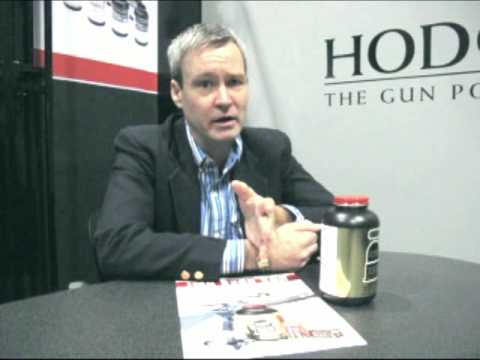
 We know many of our readers are interested in the new IMR 8208 XBR powder distributed by Hodgdon Powder Company. Early test lots of this new propellant have already won important benchrest matches, and field testing has shown that it is extremely stable across a wide temperature range. At SHOT Show 2010, we interviewed Chris Hodgdon, who gave us the “inside story” on this new powder. Before we started taping, Chris shared with us lab test results showing how pressure of a fixed load varied with ambient temperature. The data was stunning. Basically 8208 XBR showed almost constant pressures from below freezing to well over 100° F. This editor has personally never seen a powder test that revealed “flat-line” results like 8208 XBR, with recorded pressures remaining virtually unchanged over a huge temperature range. If the test results are to be believed, this is indeed a very exceptional powder. We know many of our readers are interested in the new IMR 8208 XBR powder distributed by Hodgdon Powder Company. Early test lots of this new propellant have already won important benchrest matches, and field testing has shown that it is extremely stable across a wide temperature range. At SHOT Show 2010, we interviewed Chris Hodgdon, who gave us the “inside story” on this new powder. Before we started taping, Chris shared with us lab test results showing how pressure of a fixed load varied with ambient temperature. The data was stunning. Basically 8208 XBR showed almost constant pressures from below freezing to well over 100° F. This editor has personally never seen a powder test that revealed “flat-line” results like 8208 XBR, with recorded pressures remaining virtually unchanged over a huge temperature range. If the test results are to be believed, this is indeed a very exceptional powder.
On some internet Forums, skeptics have suggested that IMR 8208 XBR is just an “odd lot of H322″, and that, accordingly, 8208 XBR may not be available for long. Chris told us that the skeptics are misinformed — those who have suggested that 8208 XBR is re-labeled H322 are completely wrong. IMR 8208 XBR IS something new and it IS here to stay. IMR 8208 XBR is NOT merely a “tweaked” blend of H322. Though 8208 XBR has small kernels like H322, allowing it to meter well, 8208 XBR is a completely new formulation. Moreover, IMR 8208 XBR is not going to be a “one-production-run” wonder. Chris explained that Hodgdon is fully committed to long-term production of this new powder. So if you acquire some now, and develop a great load, rest assured that you will be able to obtain more IMR 8208 XBR in the future. As Chris explains in the interview, Hodgdon is strongly committed to IMR 8208 XBR and Hodgdon plans to keep it in production for a long time.
January 28th, 2010
Savage Arms caused quite a stir at Media Day when it unveiled its new 110 BA big-bore tactical rifle. The 110 BA is initially available in two chamberings: 300 Win Mag, and .338 Lapua Magnum. The .338 version of this rifle is Savage’s first-ever .338 Lapua Magnum, and it is VERY affordable compared to .338 LM tactical rifles from other manufacturers. We predict this gun will be a big hit with shooters who want the long-range capability of the .338 Lapua Magnum cartridge but who don’t want to sell the farm to acquire a capable rifle. Once the initial demand settles down, you should be able to find a 110 BA for around $2000 (not including optics).

NOTE: Jason removed his eye protection for this photo. We recommend that shooters ALWAYS wear ANSI-certified eye protection.
The 110 BA gun comes complete with a detachable box magazine (DBM), target grip with base, a +20 MOA scope rail, and Picatinny accessory rails ahead of the action and on the side of the chassis. The stock has a comfortable cheekpiece that adjusts for height using a handy rotary knob. A similar knob controls the buttpad position, allowing you to “dial in” length of pull. As you’d expect, the 110 BA features a Savage Accutrigger.
CLICK HERE for large photo of Savage 110 BA (shows buttstock details)
On the gun we tested, the AccuTrigger broke clean and crisp under 2.5 pounds, with little overtravel. Fitted with an oversize bolt handle from the factory, the action was smooth in operation and effortlessly fed and extracted the big .338 LM cartridges. The gun demonstrated good accuracy with Hornady .338 Lapua Mag factory ammo, allowing Jason to make a first-round hit at about 800 yards. Jason liked the gun, telling us it “feels solid and well-balanced”. Jason did note that the large muzzle brake creates quite a side-blast. When this Editor was taking video, Jason warned me to get out of the way of the blast. I moved back behind the shooter, but even there, the brake’s blast could be felt.

Quality Big-Bore Tactical for under Two Grand
The 110 BA establishes a new, affordable price point for a true big-bore tactical rifle. Both the 300 Win Mag and the 338 Lapua Mag versions have an MSRP of just $2267.00. We expect to see the “street price” on these rifles peg below $2000.00. That makes the .338 LM version of the 110 BA one of the most affordable .338 Lapua magnum tactical rifles yet offered to the public.

January 27th, 2010
Howa previewed some impressive new varmint models at SHOT Show 2010. We liked the new Howa 1500 Thumbhole. This features a skeletonized, laminate varmint stock with a nice wide, flat fore-arm. The fore-arm is about 2.25″ wide and is completely flat on the bottom. Slab sides run almost all the way back to the action. This provides a very stable platform that should track well in the bags. Varminters put lots of rounds down-range, so barrel heat can be an issue. To help keep your barrel cool, the fore-arm has four “Buick” vents on each side (left and right), plus SIX large vents cut in the bottom.


Behind the action there is a comfortable pistol grip carved at a good angle for shooting from the bench. It has a nice palm swell at the bottom but is narrow enough at the top that you can get your thumb around for secure, properly aligned grip. I tried out this stock and it was very comfortable. The slightly raised comb was shaped nicely and the grip really felt good in the hand. The middle section of the stock is completely carved away (presumably to save weight). However on the last 5″ or so, the stock has a conventional section on the bottom. This provides a solid platform to ride the bags.

The new Howa 1500 Thumbhole Varminter will cost between $695 and $830 depending on chambering. It will be offered in both short action and long action versions. Available chamberings are: 204 Ruger, 223 Rem, 22-250, 243 Win, 6.5×55, 25-06, 270 Win, 308 Win, 30-06, 300 Win Mag, 7mm Rem Mag, and 338 Win Mag. For more information, contact Legacy Sports Int’l, USA Distributor for Howa rifles.

|


