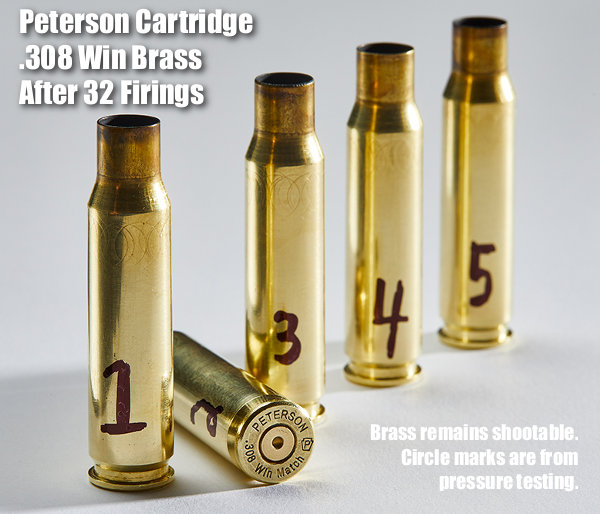
Report from Peterson Cartridge Company
For a while now Peterson Cartridge has made 6mm BR Norma (6BR) casings (sold exclusively through Graf & Sons). These have been popular with benchrest, varmint, and PRS/NRL shooters. But recently we had a customer ask us to make 7mm BR Remington casings. That customer is David Fricke of Lehigh Defense and SSK Firearms. Lehigh is known for making specialized, high-performance bullets.
Recently, Lehigh began making bullets for the J.D. Jones-designed Whisper line of cartridges, which are necked up from 7 BR casings. Some years back, J. D. Jones of SSK industries developed several efficient dual-role cartridges, the .302 Whisper, the .338 Whisper, .375 Whisper and the .416 Whisper. These are all made from necked-up 7mm BR Rem casings. The “dual role” refers to the fact that they can be loaded either for subsonic applications, or for high velocity shooting. According to Fricke, “Remington made the XP-100 bolt-action handgun, and one of the calibers they chambered it in was 7mm BR, which became very popular with Silhouette shooters. Remington also made the 7 BR casings which people like to neck up to the different Whisper calibers.”
Fricke concluded, “The 7mm BR caliber is a highly efficient, inherently accurate round, which doesn’t require much powder. The balance between the powder charge, bullet weight, barrel length and related harmonics results in a caliber with outstanding accuracy.”
Expect this 7mm BR Brass to be Necked-Up and Necked Down for Other Calibers
Commentary: With this new 7mm BR brass, we expect wildcatters will go to work right away, necking the case up to 30 BR, the favored cartridge for 100/200 score benchrest competition. We’ve also heard plans that some PRS shooters may neck down and fire-form the cartridge for a 6.5 BRA version with a 40° shoulder.
Peterson Brass — Strong, Uniform, Durable
Peterson brass is among the most precise, durable (over many load cycles), and uniform on the market. Extended load cycle tests have shown great longevity for Peterson brass, which has performed well in many disciplines from PRS to ELR. For more information on Peterson Cartridge Company or to learn more about its match-grade brass and loaded ammunition, visit PetersonCartridge.com.
Extended Load Cycle Test of Peterson Brass
About Peterson Cartridge Company
Peterson Cartridge Company is a family-owned, American manufacturer of match-grade brass rifle casings and loaded ammunition. This 20-minute video provides an inside look at the Peterson Cartridge company. Host Larry Berg visits Peterson’s modern production facility in Pennsylvania. There are also interviews with Peterson Executives and engineers.
Want to see new-born Pandas? No, not the furry kind — rather Stolle Panda actions produced with state-of-the-art CNC machinery. If you’ve ever wondered how precision benchrest, long-range, and tactical rifles are built, check out video from Kelbly’s. You’ll see actions finished, barrels chambered and crowned, pillars installed in stocks, barreled actions bedded, plus a host of other services performed by Kelbly’s gunsmiths and machinists.
If you’re a fan of fine machine-work, this video should be both informative and entertaining. You can see how precision gun work is done with 21st-Century technology. Tip of the hat to Ian Kelbly and crew for producing this excellent video visit to the Kelbly’s production center.
Click Volume Control to Activate Sound for Kelbly’s Video:
Here’s a radical new rifle. Instead of a vertical trigger that moves rearward when pulled by the index finger, this Blackwater T.O.R. A1 rifle has a lever INSIDE the lower receiver. That lever is moved by the operator’s THUMB, causing the rifle to fire. The claimed benefits of the “thumb-gun” are: 1) Improved Ergonomics (thumb stays in alignment with point of aim); 2) Better Mechanics (thumb is strongest digit and can manipulate lever easily); 3) Enhanced Safety (trigger blade/lever is not exposed).
This AR-type rifle was developed by Iron Horse, now partnered with Blackwater Worldwide. The new T.O.R. (aka “Thumb Operated Receiver”) A1 is the industry’s first AR-platform rifle incorporating patent-pending, lever-driven fire technology.
Iron Horse A1 Precision Rifle
The manufacturer has made some interesting claims about this new thumb-lever system. Blackwater/Iron Horse claims that “Multiple samples of users show a shorter learning curve and reduced shot group size”, and that the design “lends to greater accuracy in precision shooting… with its inherent natural ergonomics.” One claim we do believe, is that the thumb lever may help disabled shooters. Additionally the manufacturer notes that because the “trigger guard completely encases the trigger” there is less chance of snagging the trigger in brush or vegetation.
How the Lever Trigger Works
The operator’s thumb goes into a port in the top of the polymer grip (see grip photo above). This allows ambidextrous firing by right- or left-handed shooters. The thumb points forward, in line with the barrel. The lever itself is contained INSIDE the lower. Watch this video to see how it works:
Is the Thumb Lever a Game-Changer?
“Ironhorse’s revolutionary trigger system has the potential to be a game changer” states Eric Prince, Founder of Blackwater Worldwide. “Our in-house testing has shown a significant decrease in shot group size when compared to a traditional AR-15 trigger set. We think this technology … could replace traditional triggers altogether at some point.” The manufacturer states that the thumb-operated trigger “has been shown to greatly enhance the experience of a large portion of the shooting community and makes shooting possible for those who have limited mobility or severely injured fingers.”
About Iron Horse and Blackwater Worldwide Iron Horse Firearms, based in Salt Lake City, Utah, was founded by a former U.S. Marine Ryan McDonald. The Patent-Pending Thumb-Operated Receiver was first developed in August of 2016 and became a fully operational system in the fall of 2018. Moving forward, Iron Horse Firearms will be doing business as part of Blackwater Worldwide.
In 2019, Blackwater Worldwide re-entered the firearms and ammunition market in the United States. In its first year of operation, it has acquired or developed multiple firearms lines and a proprietary ammunition line. The company is headquartered in Concord, NC.
Spotting scopes are important tools for hunters and target shooters, but until now you had to position your head close to the eye-piece and look directly through the lens. LongShot Target Camera (aka TargetVision) has changed how we can use our spotting scopes with the company’s innovative Hawk Smart Scope Spotting Scope Camera. The Hawk employs a digital camera that “sees” through the lens of your spotting scope and then wirelessly transmits the real-time view to your mobile devices. This allows you to position the spotting scope anywhere you like, and then use a tablet or phone to observe exactly what the scope “sees” down-range. Priced at just $249.00, the advanced Hawk Spotting Scope Camera is a great value.
Hawk Review by F-Class John
As a frequent user of spotting scopes, I often find myself struggling to position my scope close enough without it interfering with my shooting setup. During a match this isn’t a big deal, but when I’m out doing load development or practicing there are plenty of times I’d like to set up my spotting scope out of the way but still see what it’s looking at. I’ve tried other digiscope systems but they’ve all required me to use a cell phone directly over the eyepiece. That can work but it still forces me to position the scope within my shooting space. All of these frustrations ended when I got the Hawk. Now I can put the Hawk anywhere I want, plus a shooting buddy (or coach) can watch the view through the spotter remotely.
Setting Up the Hawk is Easy — WiFi Connection
The Hawk comes in a nice hard-sided case that is big enough to fit the unit and charging cable and easily fits in a range bag for transport. Once its battery is charged, simply slide the Hawk over your eye-piece, tighten the screw clamp down and then turn the Hawk on. To pair, go to WiFi settings, select the HAWK IP address, and then open the TargetVision App. You’ll be asked to enter the provided passcode (only required the first time) and then you’ll automatically begin to see what your spotting scope sees. I like that it connects using WiFi because that frees up my Bluetooth for other items such as a LabRadar. This allows me to use the HAWK alongside other devices without competing for functionality.
Hawk Offers Shot-Marking System — GREAT Feature!
For use while target shooting, the Hawk has one outstanding built-in feature. The digital view from the scope can mark your shots! The Hawk’s shot marking software allows the Hawk to track and identify shots on target. The Hawk has a couple settings that allow you to change the color and size of the marked shots as well as showing your groups and group size. This is really a huge value-added feature of the Hawk. The shot-marking functionality turns your spotting scope into a highly capable shot-marker system. That’s especially great when doing load development.
Rotating Camera Head Adds Versatility
Another ingenious feature of the HAWK is that you can rotate the head unit without affecting your actual scope set-up. This allows you to easily “level up” the output image on your device while leaving your scope tight in its mount after zooming in or out. I found this to be a really useful at my local range which has uneven ground. As I moved the scope around, I simply turned the head and kept watching. With variable-power spotting scopes, the Hawk’s rotating head really helps you adjust the picture output quickly after adjusting the zoom power on the eyepiece.
SUMMARY — Excellent Product with Multiple Functions
Overall the HAWK exceeded my expectations. The image quality was clear and in general matched what my eye would see through the scope itself. In testing I found it worked equally well on my iPad and iPhone with gallery photos and videos easily transferred from the App to my device files. The HAWK is easy to install and configure for your devices. The ability to see downrange remotely — without having to stare through the lens — makes this device a great accessory for any spotting scope.
Great for Training — This unit is especially useful for training purposes. The coach can be watching the shooter’s position/technique, while keeping an eye on target and windflags downrange using the streamed image from the Hawk camera. Overall, we think Longshot Target Camera (TargetVision) has built a winner, and the Hawk is unquestionably a superb value at $249.00.
Hawk Owners Also Praise This Spotting Scope Camera:
“Image quality is outstanding and the camera is very easy to attach, set up, and use. No more straining at the eyepiece of my spotting scope. I love it!” Ned T., Verified Buyer
“The unit is extremely easy to setup. The App has great features and the unit has endless applications. A great addition to a nice spotting scope.” Evan D., Verified Buyer
“Hawk is built very well and works perfect. The App is easy to operate. Marks shots on steel out to 935 yards at the range … would definitely recommend this item.” Brett D., Verified Buyer
This Video Shows the Features of the Hawk Spotting Scope Camera:
Shooting Industry Magazine just released its April 2020 Issue. This contains a comprehensive summary of notable products showcased at SHOT Show 2020. You can access the entire April 2020 issue for FREE. Past monthly issues are free to access as well. This is great for our readers who are stuck at home under government orders. There are over FIVE YEARS of FREE back issues (back to January 2015). That’s a huge trove of FREE Gun-centric content to read while you’re stuck at home.
Dozens of interesting new products are showcased on the Shooting Industry Magazine New Products Page. There you’ll find rifles, pistols, shotguns, optics, powder, bullets, tools, accessories, and more. Here are some of the notable products we found on the New Products Page.
Leica has just introduced a new Amplus 6 line of scopes with 6X zoom, high light transmission, and premium glass — all at affordable prices. The line-up includes: 1-6x24mm, three 2.5-15x50mm models, three 2.4-15x56mm models (larger objective), and a 3-18x44mm. MSRPs range from $1199 to $1499. Designed primarily for hunting, these Second Focal Plane (SFP) scopes offer illuminated dot reticles, wide field of view, generous eye relief (up to 90mm), and large exit pupils.
Leica states: “Leica Amplus 6 balances premium optical performance with rugged features and is complimented by the extremely sharp illuminated dot, 6x zoom, large exit pupil and wide field of view. The extra-precise, illuminated reticles of the Amplus 6 ensure fast target acquisition and a particularly sharp and brilliant image of the illuminated dot – without annoying over-radiation. This means that users always have a clear sight picture, even in challenging light conditions.”
There is a standard, simple L4A hunting Reticle, a L-Ballistic MIL Reticle, and a L-Ballistic MOA Reticle. These are Second Focal Plane. BDC compensating elevation rings and a Leica Ballistic App are also offered. GET Reticle INFO HERE.
The smaller Amplus 6 1-6x24i offers a very wide field of view, fast target acquistion, generous eye relief. This provides a lighter package for hunters.
Amplus 6 Line-Up of Scopes
Amplus 6 1–6 x 24i, 4a – $1,199 (available April 2020)
Amplus 6 2.5-15x50i, 4a – $1,399 (available April 2020)
Amplus 6 2.5-15x50i, 4a BDC – $1,449 (available May 2020)
Amplus 6 2.5-15x50i, Ballistic BDC – $1,449 (available June 2020)
Amplus 6 2.5-15x56i, 4a – $1,449 (available April 2020)
Amplus 6 2.5-15x56i, 4a BDC – $1,499 (available May 2020)
Amplus 6 2.5-15x56i, Ballistic BDC – $1,499 (available June 2020)
Amplus 6 3-18x44i, Ballistic BDC (MOA) – $1,399 (available Aug 2020)
SHOT Show 2020 Special Episode
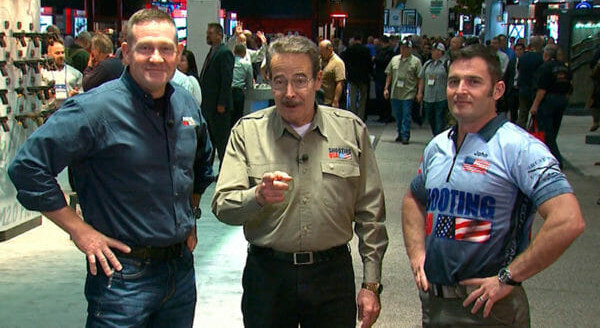
This week, Shooting USA features a full hour of SHOT Show coverage. If you watch just one episode of Shooting USA this year, it should be the SHOT Show 2020 Special which runs today, March 5th at 3:00 pm ET on the Outdoor Channel. Jim Scoutten’s team works hard every January, bringing you highlights from the gun industry’s largest trade show. Jim, son John Scoutten, and other staffers prowled the 12 miles of aisles in the Sands Convention Center in Las Vegas, visiting many of the 1,600+ exhibitors. This episode provides a “first look” at the new guns, optics, and gear introduced for 2020. Click HERE to learn more about this week’s 2020 SHOT Show episode.
2020 SHOT Show Highlights: Colt Python, Hornady A-Tip bullets, Volquartsen Summit .17 WSM, Ruger-57 Pistol, Pinnacle Precision Rifle, HK SP5, Impact Sport Muffs, Laugo Arms Alien Pistol, Vortex 1-10X Scope, Glock 44 Pistol, and much more.
Shooting USA’s SHOT Show 2020 will air today, Thursday, March 5 at 3:00 pm ET on the Outdoor Channel. Look for Shooting USA on the Outdoor Channel. In addition, you can watch all episodes of Shooting USA on the VIMEO channel by subscription. The SHOT Show 2020 edition is jsut $0.99.
Here are some of the 50+ new products featured on the SHOT Show Special. Click Images for detailed product information.
Kestros ZR Stock — Impressive Design for Competition
Review by F-Class John
Walk the line at just about any rifle competition and you’ll see your share of McMillan stocks. Known for crafting high-quality fiberglass/composite stocks, McMillan has long been at top choice for competitive shooters, hunters, and tactical marksmen. Now McMillan is out to dominate F-Open with the Kestros ZR stock. The Kestros line features several models, but the ZR represents the pinnacle of craftmanship. Each one is finished off by a single craftsman and takes roughly four times longer to create than any other Kestros. So when McMillan offered me a chance to test one out, I jumped at the opportunity.
The aluminum Z-Rail extends nicely from the front of the stock and has a nice contrast of metal against the matte finish of the stock. I inspected the rails and noticed that they are very cleanly machined — all the corners and rails were precise and sharp. As a result, I grabbed some 1000-grit sandpaper and just lightly knocked the edges and corners down just to keep from accidentally scratching myself or my gear.
Lead time for a ZR is currently 6-9 months. I was like a kid on Christmas when mine arrived after seven months. Holding a Kestros ZR is definitely a unique experience compared to a traditional wood stock and you can’t help but feel like you’re holding something special. I chose three shades of blue that transitioned dark from the butt stock to lighter on the fore-end in a spectacular flame pattern. With McMillan, there are thousands of possible color and pattern combinations. These color/pattern options are outlined on McMillan’s Gallery Page.
The Kestros ZR comes fully inletted with pillars. I was able to bolt my Defiance action right into the stock “as is” without a bedding job. (McMillan states bedding is not required, though this is certainly something most Kestros owners will do). I threw in my action, fit a couple action screws and tightened it all down. I was amazed at how nicely it all fit together with even the little details like the port cutout being perfectly smooth with my action port. I loaded up some .284 Win rounds and headed to the range to test the new stock at 100 yards.
Here are examples of targets shot with the Kestros ZR at 100 yards.
During initial range testing (see above) I shot nine groups for vertical and all of them were under 0.40″ with the smallest being .08″ of vertical. I topped off the testing by shooting a 200-11X the next week at my club match. The thing that really stood out was how smoothly the stock tracked with its lower center of gravity while shooting free recoil and ultimately this translated to success on target.
Low-Rider — You may find that because of how low the Kestros rides as well as its additional length due to the Z rail, you may require an extension for your front rest.
CONCLUSION — Great Modern Low-Profile F-Class Stock
Overall the Kestros ZR exceeded my expectations. After a small learning curve, it was a joy to shoot and it performed great. As someone who believes in the power of muscle memory, I found each time I transitioned between the Kestros and my traditional wood stocks there was a slight adjustment period but not enough to impair accuracy in any way. Something to consider is that because every Kestros is made to the same dimensions, it makes owning multiples an easy process of switching between guns without any need for readjustment.
For those willing to put in the practice, your patience will be rewarded, and I think most shooters will find the Kestros ZR could become their new favorite stock. If you’re in the market for a new F-Open stock, the Kestros ZR is definitely one to consider.
Tips for Ordering a Kestros ZR
Ordering the Kestros ZR is a simple process thanks to McMillan’s online order form. While there are a number of options available, McMillan has a helpful guide that walks you through each one to ensure you get exactly what you need. While filling out my form I realized that because I have a custom-designed action, I needed some help, so I gave McMillan a call. The staffers were incredibly helpful and their knowledge of all the major actions out there made answering my questions a snap. I liked the fact that there is no set, fixed price on any of the stocks. The pricing system allows customers to get just what they want (within limits) and not have to pay for anything they do not want or need.
A few seasons back, our Editor and his friend Joe Friedrich flew to Texas to visit Gene Beggs and test rifles in Gene’s 100-yard indoor tunnel. That was a once-in-a-lifetime opportunity to shoot centerfire rifles in such a test facility. Here’s our report…
The South Texas Tunnel
Gene Beggs operates his own 100-yard indoor tunnel and rifle testing facility just outside of Odessa, Texas. Surrounded by tall fencing, this place really looks like a “Area 51″ secret military facility.
In his South Texas tunnel, Gene provides instruction and “tunnel time” for serious benchresters looking to improve their skills and optimize the accuracy of their rifles. Along with teaching the fine points of short-range benchrest, Gene employed his tunnel to develop a pair of radical rifles, one chambered in 220 Beggs, a slightly modified 220 Russian, and a second chambered in 6mm Beggs, a necked-up version of the 220 Russian that retains the original body taper and shoulder angle.
Radical Skeleton Stocks with Aluminum Sled mounted to Barrel
Both rifles shared a skeleton design which uses the Stiller Cobra or Viper action as a central load-bearing member. Remarkably, there is no conventional fore-arm at all. Gene has bolted, directly to the barrel, a 3″-wide bag-riding aluminum sled. The sled was not designed as a mid-barrel tuner, but it might have some beneficial effects in that regard. However, the tuning functions are handled by two concentric rings threaded to the muzzle. Gene believes that with minor rotations of his front tuning rings, he can dial the gun into tune and the tune can be easily adjusted as conditions warrant.
Do Mr. Beggs’ guns shoot? Absolutely. We had the chance to visit Gene in Odessa. We shot both the 220 Beggs-chambered rifle, and its 6mm Beggs-chambered cousin. Both rifles are nearly identical, though the Heavy Varmint-weight 220 has a longer, 27″ barrel compared to 22″ for the Light Varmint 6mm.
In the tunnel, the 220 HV, with a no-turn-neck 220 Beggs chamber, produced three-shot groups in the low ones and zeros right out of the gate, even before the tuner was optimized. With a barrel with over 1000 rounds through it, after firing 40 rounds without cleaning, Gene produced a tiny 5-shot group in the low ones. The first shot was slightly high (a common occurrence in the tunnel according to Beggs). The last 4 shots, rounds 42-45 since the barrel had been cleaned, went into 0.084″. This rig, though radical in the extreme, certainly appears fully competitive with more conventional BR rigs, and it tracked superbly, with no hopping or rocking on the bags.
220 Beggs — Simple, Accurate, Efficient
We were also very impressed with the 220 Beggs cartridge. It’s basically a plain 220 Russian with a sharper radius at the neck-shoulder junction. Gene has commissioned a 220 Beggs reamer with matching seating and full-length sizing dies. The little cartridge achieves 3600+ fps with a 52gr bullet, pushed by Benchmark powder.
Less Recoil Than 6PPC — From what we could tell during our short visit, the 220 Beggs is easy to load for, and performs exceptionally well with either turned (.250″) or no-turn necks. The recoil was noticeably less than a 6mm PPC, making the gun a joy to shoot. This round, we felt, could also be an outstanding varmint cartridge. The velocity is there, and we don’t think any other 22-caliber varmint cartridge is going to beat it for inherent accuracy.
As for the 6mm version, Gene told us: “The 6mm version of the cartridge performs best with Hodgdon’s H4198 Extreme, but the 220 has proven it will shoot well with just about anything you put in it including N133, H322, Benchmark, 8208, Norma 200 etc. It is the most trouble-free, user friendly cartridge I have ever worked with and will compete heads-up with anything. It’s also very easy on the shoulder.”
Gene Beggs sells components (reamers, dies etc.) for the 220 and 6mm Beggs, and also, under special circumstances, offers training/testing sessions in his West Texas Tunnel on an appointment basis.
Breaking News: The organizers of the IWA Outdoor Classics Trade Show — the Euro SHOT Show — have postponed the event. The event will NOT be held March 6-9, 2020 in Nuremberg, Germany, as planned, but will be re-scheduled for a later “date in 2020, which has yet to be determined”. NürnbergMesse, operator of the show facility, declared the event is being postponed due to health concerns related to the Coronavirus, COVID-19.
Petra Wolf, Member of the Management Board of NürnbergMesse stated:
“We hope that the industry will understand the decision to postpone. The aim of every exhibition has to be to create a special experience for exhibitors and visitors likewise and to enable networking and expansion of existing business relations. Unfortunately, this goal cannot be achieved under the current circumstances. We are aware of the great importance of the IWA for our exhibitors and visitors. All the more reason for us to put high pressure on the task to find the best possible alternative date for such an important event for our customers.”
NOTE: The Enforce Tac trade show, which normally runs before the IWA Outdoor Classics event, will also be postponed in 2020.




 Here’s a radical new rifle. Instead of a vertical trigger that moves rearward when pulled by the index finger, this Blackwater


 Rotating Camera Head Adds Versatility




 Gene Beggs operates his own 100-yard indoor tunnel and rifle testing facility just outside of Odessa, Texas. Surrounded by tall fencing, this place really looks like a “Area 51″ secret military facility.

 Do Mr. Beggs’ guns shoot? Absolutely. We had the chance to visit Gene in Odessa. We shot both the 220 Beggs-chambered rifle, and its 6mm Beggs-chambered cousin. Both rifles are nearly identical, though the Heavy Varmint-weight 220 has a longer, 27″ barrel compared to 22″ for the Light Varmint 6mm.