|
|
May 30th, 2011
Report by Forum member James Mock
Not only did Gene win the 2-gun at Chippewa SS Warm-up, and the “Heartbreak award for one bad group that cost him last year’s SS; BUT he has now won the BIG ONE. The 2011 Super Shoot champion is Gene Bukys. He persevered after shooting a 1 1/4 inch group at 200 yards. Congratulations to Gene! — James

Further Super Shoot Results will be provided as soon as available. Photo courtesy James Mock.
May 29th, 2011
 While the two trends are not necessarily linked, it is interesting that serious crime continues to decline while firearms ownership expands with each passing year. Last week, the FBI released its Preliminary Annual Uniform Crime Report for 2010, showing a decrease of 5.5 percent in the number of violent crimes brought to its attention in 2010 compared to the previous year. Violent crime, which includes murder, forcible rape, robbery and aggravated assault, decreased in all four regions of the country and in both cities and non-metropolitan areas. For decades, violent crime in the United States has been dropping. Final figures for 2009 showed violent crime at its lowest level since 1984. At the same time, firearms ownership and use has been increasing, as right-to-carry legislation has been passed in 80% of U.S. States. There are now 40 Right-to-Carry States: 37 have “shall issue” laws, requiring that carry permits be issued to applicants who meet uniform standards established by the state legislature. Two have discretionary-issue carry permit systems. Vermont respects the right to carry without a permit. Alaska and Arizona have “shall issue” permit systems and have allowed concealed carrying without a permit since 2003 and July 2010, respectively. The largest surge in firearms sales occurred from late 2008 into 2010, and, according to an NSSF report, an estimated 34.4 million people went target shooting in 2009, the largest number ever. While the two trends are not necessarily linked, it is interesting that serious crime continues to decline while firearms ownership expands with each passing year. Last week, the FBI released its Preliminary Annual Uniform Crime Report for 2010, showing a decrease of 5.5 percent in the number of violent crimes brought to its attention in 2010 compared to the previous year. Violent crime, which includes murder, forcible rape, robbery and aggravated assault, decreased in all four regions of the country and in both cities and non-metropolitan areas. For decades, violent crime in the United States has been dropping. Final figures for 2009 showed violent crime at its lowest level since 1984. At the same time, firearms ownership and use has been increasing, as right-to-carry legislation has been passed in 80% of U.S. States. There are now 40 Right-to-Carry States: 37 have “shall issue” laws, requiring that carry permits be issued to applicants who meet uniform standards established by the state legislature. Two have discretionary-issue carry permit systems. Vermont respects the right to carry without a permit. Alaska and Arizona have “shall issue” permit systems and have allowed concealed carrying without a permit since 2003 and July 2010, respectively. The largest surge in firearms sales occurred from late 2008 into 2010, and, according to an NSSF report, an estimated 34.4 million people went target shooting in 2009, the largest number ever.

May 29th, 2011
Starting June 1, 2011, Satern Custom Machining and Liberty Barrels will no longer produce 6.5 Grendel and .50 Beowolf barrels, as both barrel makers declined to agree to a new, more onerous licensing agreement with Alexander Arms. Satern had produced cut-rifled 6.5 Grendel and Beowolf barrels for the past five (5) years under license to Alexander, while Liberty crafted button-rifled Grendel and Beowolf barrels under license. It may be hard to replace Satern, a highly regarded cut-rifled barrel-maker, as other top-quality barrel makers may likewise reject Alexander Arms’ licensing demands.

Alexander Arms’ Policies Have Impeded 6.5 Grendel Development
Radford, VA-based Alexander Arms continues to paint itself in a corner with respect to the 6.5 Grendel cartridge. Alexander Arms (AA) has aggressively protected the 6.5 Grendel cartridge design, threatening legal action against companies that planned to sell 6.5 Grendel AR uppers, chamber barrels for this cartridge, or even merely offer 6.5 Grendel reamers. One can understand Alexander’s desire to protect its design rights, but many industry experts believe Alexander Arms has gone overboard. Many gun builders and parts markers view the 6.5 Grendel cartridge as a “lawsuit in the making” so they stay away from it. As a result, this accurate and efficient cartridge is not growing in popularity as rapidly as it might otherwise. Alexander Arms has simply made it too difficult to comply with its demands, so many gun makers have decided that they would rather build anything other than a 6.5 Grendel.
Ironically, many shooters have chosen to build guns based on 6.5 Grendel parent brass, but necked down to 6mm. Robert Whitley pioneered a very effective 6mm-6.5 Grendel wildcat he calls the 6mmAR. It shoots great in AR platform rifles, as does a higher-capacity derivative, the 6mmAR “Turbo”. To learn more, visit 6mmAR.com.
May 29th, 2011
 Among Remington rifles, Custom Shop products have long enjoyed a solid reputation, though the quality control has declined in recent years. Remington is looking to return its Custom division to the glory days. As part of that effort, Remington has produced a dedicated Custom Shop website: www.remingtoncustom.com. On the Remington Custom Shop website visitors can browse through series of highly-specialized rifles and shotguns: Hunter Series, Target/Tactical, Historical, Rimfire, 40-X™ Series and High Grade. Within each series, the user can click on a specific model for an overview, features, specifications and images of the selected firearm of interest. The Custom Shop Showcase features high-quality photos illustrating the hand craftsmanship that goes into premium Custom shop arms. Among Remington rifles, Custom Shop products have long enjoyed a solid reputation, though the quality control has declined in recent years. Remington is looking to return its Custom division to the glory days. As part of that effort, Remington has produced a dedicated Custom Shop website: www.remingtoncustom.com. On the Remington Custom Shop website visitors can browse through series of highly-specialized rifles and shotguns: Hunter Series, Target/Tactical, Historical, Rimfire, 40-X™ Series and High Grade. Within each series, the user can click on a specific model for an overview, features, specifications and images of the selected firearm of interest. The Custom Shop Showcase features high-quality photos illustrating the hand craftsmanship that goes into premium Custom shop arms.


May 26th, 2011
The kickoff of the 2011 Steel Safari is just a week away, and things are heating up! Temperatures at this long-range field match are always right around 100-degrees, but this year there will be more competitors than ever (38) and a better prize table than ever before. Match organizers expect strong competition this year, as there will be many seasoned Steel Safari “alumni” competing, including recent Steel Safari Top-5 finishers. The Steel Safari takes place this year on June 3rd, 4th, and 5th at the Blue Steel Ranch located near Logan, NM. Zak Smith is the match director. You can learn more about match details and courses of fire at www.SteelSafari.com.

A true field match with no “square-range” in sight, competitors may need to use improvised and non-standard shoot positions to make shots.
The match showcases practical rifle shooting in the field. Competitors locate small and medium-sized steel targets (often hidden), range them, and engage with one shot only, under a challenging time limit. Some movement on the clock is required, and shoot positions are always improvised, the best you can do while on a reverse incline, over a rock face, shooting down a gully, or leaning out the side of a truck. To add to the challenge, these shooting stations are distributed over two different 3-mile courses in rugged desert terrain. Despite this simple general description, there are a host of individual skills that a competitor must master to place well at this match.
Besides being a test of rifle shooting skill, it also stresses rifle and gear setup and reliability, and individual concentration and mettle. After hiking around in the desert for six hours, it takes talent, determination, and good field skills to find six targets out in the terrain, range them accurately, and then quickly make the shot from sometimes very difficult shooting positions.

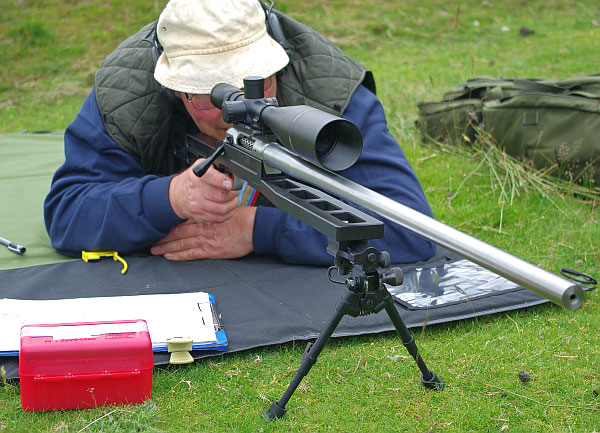
Rugged precision bolt rifles such as this Accuracy International are typical at the Steel Safari. The .260 Remington is one of the most common cartridges in the Winner’s Circle.
A variety of rifles, calibers, and scopes will be used at the match, but most competitors employ more or less similar gear. First, an accurate rifle is critical. Bench-rest accuracy is not required; one MOA is sufficient, but one-half-MOA is preferred. Almost everyone shoots their own hand-loads with premium bullets from Sierra, Berger, or Lapua. Ballistic data, or “dope,” completes the triad with the rifle and ammunition. Most shooters laminate a small card and tie it to their rifle or scope, or use a retractable “pathfinder” available from Allison Machine Tool or Leupold. Long-range ballistic data isn’t useful unless the target distances can be determined, and the best tool for that is a laser range-finder. Since many laser range-finders are monocular units with limited field of view, a good set of binoculars can be a life-saver when trying to find that hidden target.
May 23rd, 2011
At a recent Great Britain F-Class Association Match at the Blair Atholl Glen Tilt range, AccurateShooter Forum member Laurie Holland shot a 96-9V for twenty shots, tying the British F-TR single match record. Laurie accomplished that feat with a Savage-actioned .223 Remington. Laurie proved that the little .223 Rem can be competitive, even at 1000 yards. The Blair Atholl range, 1,000′ ASL in the southern Scottish Highlands, has been described by a top international rifle coach as ‘the world’s second most difficult range for wind’ (behind Trentham in New Zealand). Many British F-Class shooters were therefore surprised when Laurie Holland took his Savage-based .223 Rem F/TR rifle to the range earlier this month to compete in the season’s second GB F-Class Association league round. The event consisted of five, 1000-yard matches over a weekend (three 15-round stages on the Saturday, and two 20-round matches on Sunday). Forty-eight registered GB FCA shooters turned up, split 50/50 between F-Open and F-TR categories.
Though heavy rains were expected, Saturday was dry. However, the predominately 5 o’clock wind grew progressively stronger throughout the day, swinging through 20 or 30° with irregular gusts and lulls. With the range situated on a steep and uneven valley-side, wind changes affect elevation markedly in addition to the usual lateral movements. A gust can send the bullet high and left, while a lull moves POI low and right.

After Matches 1 and 2 Laurie was at the bottom end of the top 10 shooters in the class, but he surged to the lead in the day’s final match that saw the most difficult wind conditions. Laurie’s 66-2V score topped second place Adam Bagnall (reigning GB F-TR league champion) by seven points, and was also better than many F-Open scores. Laurie and his .223 were now tied (on points) with F-TR world champion Russell Simmonds for the overnight lead. Both had 183 points but Laurie was leading by five V-Bulls to one. As chance would have it, Russell and Laurie had been squadded to shoot together on the second detail of Sunday morning’s 20-round Match 4. NOTE: Brits employ a different system for F-Class targets. Target Rings have a 1 through 5 value, with a “V” (rather than “X”) for a dead-center hit. The maximum score possible on a twenty-round match would be 100-20V.

Laurie used the Savage successfully in the 2010 F Class European Championship meeting seen here shooting for GB in the second placed GB F/TR ‘Blue’ Team.
What followed was a classic two-man duel. Laurie explains: “While the F-Open boys on the first detail were still shooting, we had a short but violent rainstorm that really spoiled their day, this finishing just as they took their last shots. As the rain cleared, the wind apparently died too, the flags hanging limp, so we didn’t delay getting set up to take maximum advantage of the conditions. Russell and I both found the Bull / V-Bull on shot 1. Russell drilled five consecutive Vs, while I had two Bulls and three Vs. I began to think I might just hold Russell on points, but he’d hammer me on V-count. We started to find something was moving the bullets about, but there was no way of reading this on the sodden flags or even by the sway of the tops of some tall silver birch trees near the firing point, these usually proving very sensitive. It was a case of watching the plot develop, use intuition, and watch where Russell’s shot went before I took mine. (Remember, we have two competitors to each target taking shots alternately — no string shooting in the UK.)

Kongsberg electronic scoring monitor. This system gives near instant shot marking and lets spectators watch competitors’ performance in real time.
Crowd Watches Two-Man Duel — Laurie Ties Record in Match 4
With the Kongsberg electronic scoring machines, a flashing circle on the target shows the most recent shot, with its numerical Ring Value on the right side of the screen. All of our Fours came up as 4.9s, just leaking out! I was very reluctant to touch the scope knobs knowing just how easily a quarter-MOA ‘click’ can overdo the correction in these conditions and increasingly aimed low and left as the match progressed. As we reached the end we guessed our scores must be close, and amazingly I was getting more Vs now than Russell and his .308. However, neither of us knew we were tied on shot 19, both having dropped four points, and scored eight Vs, so the last shot would be crucial. Russell told me afterwards he sensed the wind had maybe picked up marginally, briefly considered aiming off a little further left, but decided to stick with his previous aim that had given him a ‘V’ – crack, 4.9 at 3 o’clock! My shot 19 had been a Four in exactly the same spot and I eased the Sightron’s reticle dot over to the bottom left corner of the Bull ring – crack, V.0 at six o’ clock for 96.9v total. Just to our right, Adam Bagnall had also shot 96, but with eight Vs, so I won the match and equaled John Cross’s GB F/TR record 20-round 1,000-yard score shot last summer. This increased my overall lead to 1 point. As the shooting concluded, we heard a rising murmur behind and turned to discover we had a substantial audience, mostly of ‘Open’ competitors, who’d been following our progress — electronic scoring not only gives an instant result, but makes shooting a spectator sport!
I’d like to say the fairy tale had a happy ending, but I blew my lead in the final four shots of the final match and ended up fourth in F-TR class, Russell taking the top spot. So, the .223 Rem will have to wait a little longer to get its first GB F-TR league round win.”
Despite faltering in the last match, Laurie still earned two stage medals and posted the highest F-TR V-count (15) in what had been a low scoring weekend. Laurie’s impressive performance with a .223 Rem now has many people reconsidering the Mouse Gun cartridge’s utility in British long-range F-TR competition.
May 19th, 2011
 At most American shooting facilities, you’re lucky to have running water and an electrical hook-up. Those Germans, with their penchant for advanced engineering, have created an amazingly high-tech (and even luxurious) indoor shooting facility that is truly state-of-the art. The NRA is proud of its modern indoor range in Fairfax, Virginia, but the NRA range can’t hold a candle to the advanced Müller Schiess Zentrum facility in Ulm, Germany. This vast complex features an indoor benchrest range with video monitors, a full-sized trap/skeet hall, pistol ranges, and a “running game” hunting simulator that actually displays (in 3D view) the placement of your bullet strike in the moving animal prey. On top of this, the Müller Schiess Zentrum Ulm (MSZU) has a cafe, a restaurant, and a large shopping/retail facility. At most American shooting facilities, you’re lucky to have running water and an electrical hook-up. Those Germans, with their penchant for advanced engineering, have created an amazingly high-tech (and even luxurious) indoor shooting facility that is truly state-of-the art. The NRA is proud of its modern indoor range in Fairfax, Virginia, but the NRA range can’t hold a candle to the advanced Müller Schiess Zentrum facility in Ulm, Germany. This vast complex features an indoor benchrest range with video monitors, a full-sized trap/skeet hall, pistol ranges, and a “running game” hunting simulator that actually displays (in 3D view) the placement of your bullet strike in the moving animal prey. On top of this, the Müller Schiess Zentrum Ulm (MSZU) has a cafe, a restaurant, and a large shopping/retail facility.

We still prefer shooting outdoors, but for a country like Germany, where long, cold winters limit the opportunities for outdoor shooting, a deluxe indoor facility like this makes sense. German reader JPeelen adds: “The problem in Germany is not [just] the weather but density of population. Noise problems led to the closure of many outdoor ranges. Ulm is unique because it offers a 300 meter indoor range, not just 100 meters[.]” Overall, you have to hand it to the Germans for “raising the bar” to a whole new level. View the Müller Schiess Zentrum’s amazing facilities in the video below. The editor of The Firearm Blog wrote: “I have seen the future… and it is in Germany. If you don’t do anything else today, just make sure you watch this video.”

May 17th, 2011
 The National Matches, first held in 1903, have become a huge, national shooting sports festival with well over 6,000 annual participants. To help serve those shooters, the Civilian Marksmanship Program (CMP) has launched a new web page, dedicated to the National Matches at Camp Perry. The CMP’s National Match Page now offers easy-to-use links to Registration Forms, Match Schedules, Rules, and event photo galleries. It’s very handy to have all the key links in one place. If you are thinking of visiting Camp Perry this year, whether as a shooter or a spectator, you should bookmark this page. The National Matches, first held in 1903, have become a huge, national shooting sports festival with well over 6,000 annual participants. To help serve those shooters, the Civilian Marksmanship Program (CMP) has launched a new web page, dedicated to the National Matches at Camp Perry. The CMP’s National Match Page now offers easy-to-use links to Registration Forms, Match Schedules, Rules, and event photo galleries. It’s very handy to have all the key links in one place. If you are thinking of visiting Camp Perry this year, whether as a shooter or a spectator, you should bookmark this page.
May 16th, 2011
 The 2011 CMP Eastern Games and Creedmoor Cup Matches took place the first week of May at Camp Butner, NC. The overall winner (no surprise) was current NRA National High Power Champion SGT Sherri Gallagher, who tallied a spectacular 797-50X. Finishing second was fellow USAMU shooter SSG Tyrell Cooper, with 794-41X. Sherri also had the highest individual score, 499-29X, in the 4-person Team Event. Sherri showed, once again, that she leads the field in High Power Match Rifle shooting. When Sherri is “on her game”, she’s hard to beat. You can see a large collection of Eastern Games photos from the Garand and Springfield matches (on Day 1) at the CMP online photo archive. The 2011 CMP Eastern Games and Creedmoor Cup Matches took place the first week of May at Camp Butner, NC. The overall winner (no surprise) was current NRA National High Power Champion SGT Sherri Gallagher, who tallied a spectacular 797-50X. Finishing second was fellow USAMU shooter SSG Tyrell Cooper, with 794-41X. Sherri also had the highest individual score, 499-29X, in the 4-person Team Event. Sherri showed, once again, that she leads the field in High Power Match Rifle shooting. When Sherri is “on her game”, she’s hard to beat. You can see a large collection of Eastern Games photos from the Garand and Springfield matches (on Day 1) at the CMP online photo archive.

Sean Leighton won the Garand Match (289-3X) AND the Springfield Match (290-9X), and had the highest Three-Gun Aggregate with an 870-15X combined score. Great shooting Sean! In other specialty matches, Ken Lygren won the Carbine Match (356-1X), Doug Armstrong won the individual Vintage Sniper match (194-6X), and William Flagg Jr. won the Rimfire Sporter match. In 4-person team competition, USAMU teams took both Service Rifle (Craig Team, 1967-74X) and Match Rifle Divisions (Praslick Team, 1991-103X).

Complete results are found on the CMP Competition Tracker webpage. This includes Rifle Match Scores and Pistol Match Scores.
Creedmoor Cup Results
Match Rifle
1. SGT Sherri Gallagher, High Master, Agg 797 – 50X
2. SSG Tyrell Cooper, High Master, Agg 794 – 41X
3. SSG Armando Ayala, High Master, Agg 793 – 41X
4. Nat Guernsey, High Master, Agg 792 – 39X
5. John Friguglietti, High Master, Agg 783 – 32X
Service Rifle
1. SPC Kevin Trickett, High Master, Agg 793 – 34X
2. SSG Scott Grant, High Master, Agg 793 – 24X
3. SPC Augustus Dunfey, High Master, Agg 790 – 33X
4. SPC Amanda Elsenboss, High Master, Agg 789 – 25X
5. SFC Grant Singley, High Master, Agg 787 – 30X
May 16th, 2011
In our Shooters’ Forum, French shooter Aurelien posted some spectacular 400m groups shot with a “6×47″ built by Christian Salva. (We believe that is the 6mm based on the 6.5×47 Lapua cases, and not the RUAG 6×47, a separate cartridge.) If you want to see some cool-looking precision rifles (and target pistols) built with a continental flair, check out Christian’s website. Christian has built some wild-looking silhouette pistols, and we are intrigued by his barrel-block F-Class rifle, and thumbhole Varmint rifle.

CLICK HERE FOR MORE PHOTOS


|


