When you make a reloading mistake, you may need to “pull down” assembled ammo. The embedded UltimateReloader.com video demonstrates how to use the Hornady Cam-Lock bullet pulling system.
When Reloading Goes Bad — The Danger of Over-Charging
Our friend Gavin Gear of UltimateReloader.com was recently reloading some 9mm pistol ammo with his Hornady progressive press. As part of his reloading procedure, he visually checks the cases — and he noticed that the charges seemed high. Sure enough, his most recently-produced rounds were about two grains over spec. He diagnosed the issue: “I was using a powder measure without a baffle. What happened was, over the course of the loading session, things settled in, and the charge level increased.”
Not knowing just when his powder measure started delivering too much powder, Gavin decided, for safety’s sake, to pull down all the ammo he had just reloaded. Yes that’s time-consuming, but it’s better than the alternative — having a dangerous Kaboom while shooting. With fast-burning pistol powders, a two-grain over-charge could cause a blown case, damaged firearm, and/or serious injury.
Watch Cam-Lock Bullet Puller Used to Remove Bullets from Loaded Ammo:
Use of Bullet Puller starts 4:00 minutes into video.
Gavin says it is vitally important to perform safety checks during the reloading process: “You’ve got to do it — check every single round to make sure there IS powder, and that there’s not too MUCH powder. Double, Triple, Quadruple check your components… and your powder charges. You can’t be too careful.”
To pull down a loaded round, first place the cartridge in the shellholder on your press ram. Then raise the round up into the bullet puller device installed where a die would go. The Hornady Cam-lock bullet puller works by clamping the bullet in a collet when you flip down the red-coated lever. Then, with the case held by the rim in the shell-holder, the bullet exits the cartridge as the press ram is lowered. It takes time, but it’s pretty fool-proof once you get the hang of it. This entire process is illustrated in Gavin’s video, starting near the four-minute mark.
The Hornady Cam Lock Bullet Puller has four (4) key components: 1. Cam-Lock die body; 2. Cam-Lock lever; 3. Stem; and 4. Collet (Caliber-specific).
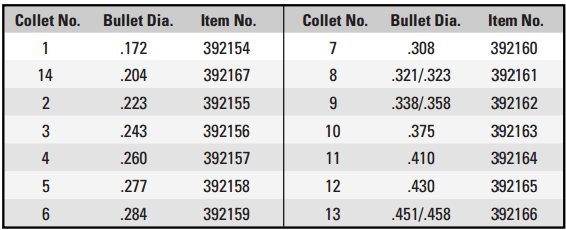
NOTE: In order to use this tool, you’ll need the appropriate collet for each diameter range of bullets you intend to pull. For example use collet #3 for 6mm, collect #6 for 7mm, and collet #7 for .308 Caliber.
If you want smoother bullet seating, inside neck lube can help. Forum member Ackleyman II likes to add a little Mica powder inside his case necks before seating bullets. This is easily done with the Forster three-brush neck lube kit. Ackleyman tells us: “Many loads that I have will not shoot well with a dry neck compared to a neck that is cleaned and lubed with this [Forster Dry Lubricator] — the best $15 you have ever spent.”
The Forster Case Neck Lubricator features three brushes attached to a tough, impact-resistant case with holes for bench mounting. The brushes accommodate all calibers from 22 to 35 caliber. The kit includes enough “motor mica” to process 2000 to 3000 cases and has a cover to keep dust and grit from contaminating the mica. By moving the case neck up and down on the correct mica-covered brush, the neck can be cleaned and lubricated at the same time.
Function: Lubricate case necks for easier resizing
Contents: Kit with base, lid, and three nylon brushes
Lubricant: Includes 1/10 oz. of Motor Mica, enough to process 2000-3000 cases
To err is human… Sooner or later you’ll probably get a case stuck in a die. This “fix-it” article, which originally appeared in the Western Powders Blog, explains the procedure for removing a firmly stuck cartridge case using an RCBS kit. This isn’t rocket science, but you do want to follow the directions carefully, step-by-step. Visit the Western Powders Blog for other helpful Tech Tips.
Curing the Stuck Case Blues
Sticking a case in the sizer die is a rite of passage for the beginning handloader. If you haven’t done it yet, that’s great, but it probably will eventually happen. When it does, fixing the problem requires a bit of ingenuity or a nice little kit like the one we got from RCBS.
The first step is to clear the de-capping pin from the flash hole. Just unscrew the de-capping assembly to move it as far as possible from the primer pocket and flash hole (photo at right). Don’t try to pull it all the way out. It won’t come. Just unscrew it and open as much space as possible inside the case.
Place the die upside down in the padded jaws of a vise and clamp it firmly into place. Using the supplied #7 bit, drill through the primer pocket. Be careful not to go too deeply inside the cartridge once the hole has opened up. It is important to be aware that the de-capping pin and expander ball are still in there and can be damaged by the bit.
Drill and Tap the Stuck Case
Once the cartridge head has been drilled, a ¼ – 20 is tap is used to cut threads into the pocket. Brass is relatively soft compared to a hardened tap, so no lube is needed for the tapping process. RCBS says that a drill can be used for this step, but it seems like a bit of overkill in a project of this nature. A wrench (photo above right) makes short work of the project.
RCBS supplies a part they call the “Stuck Case Remover Body” for the next step. If you are a do-it-yourselfer and have the bit and tap, this piece is easily replicated by a length of electrical conduit of the proper diameter and some washers. In either case, this tool provides a standoff for the screw that will do the actual pulling.
With an Allen Wrench, Finish the Job
Run the screw through the standoff and into the tapped case head. With a wrench, tighten the screw which hopefully pulls the case free. Once the case is free, clamp the case in a vice and pull it free of the de-capping pin. There is tension here because the sizing ball is oversized to the neck dimension as part of the sizing process. It doesn’t take much force, but be aware there is still this last little hurdle to clear before you get back to loading. Don’t feel bad, everyone does this. Just use more lube next time!
Article find by EdLongrange. We welcome reader submissions.
Lyman is introducing three new Brass Smith series reloading presses for 2018. Here we focus on the two full-size Brass Smith presses, the O-Frame Victory Single Stage and the new 8-Station All-American Turret Press. Both these sturdy presses feature an innovative “straight line” priming system with shielded primer tube.
New Cast-Iron Victory O-Frame Single-Stage Press
Lyman’s new Victory™ Press is built on a heavy duty cast iron “O” frame with 1-inch diameter ram and compound linkage. It looks strong and Lyman claims the “Victory Press is one of the most rugged and rigid available on the market.” The Victory Press features a simple, reliable straight-line primer feed. It’s easy to prime a case — simply push the priming arm forward to position a primer beneath the shell holder. As an added safety feature, the primer feed comes with a heavy steel shield surrounding the primer tube. The large 5-inch frame opening can take long magnum cases. MSRP is $199.45. We expect initial “street price” to be around $160.00, less expensive than an RCBS RockChucker, but more pricey than a Lee Classic Cast Press.
“It has been a while since Lyman Products introduced new presses, for the very simple reason that our presses are built to be so durable that they actually end up being handed down in families”, explained Trevor Mullen, Lyman’s VP of Marketing and Business Development. “But for 2018, we decided we needed to add certain features that make these new presses even better than their former models.”
New Cast-Iron 8-Station All-American Turret Press
Along with its new Victory Single-Stage Press, Lyman is releasing a beefy All-American Turret Press with eight (8) stations. That’s one more than the Redding T-7 Turret Press, and two more stations than the six-station RCBS Turret Press. With the Lyman’s EIGHT stations you can hold sizing AND seating dies for four different rifle cartridges. Or, if you seat bullets with an arbor press, you could have sizers for six cartridges, plus a dedicated decapping die and a factory crimp die. With eight stations available — there are countless options.
Rigidity is very important with a turret press — if you have too much “give” of flex with the turret head you may get inconsistent results when bumping shoulders using full-length dies. With a heavy cast-iron frame and turret head, Lyman says its new Turret Press is “the most rugged” on the market. We like the front-mount priming system which can easily be operated with your free hand, whether you mount the press arm on the left or the right. MSRP is $249.95. We expect “street price” to be around $220.00, quite a bit less than the six-station RCBS Turret Press.
Written by Sierra Bullets Ballistic Technician Duane Siercks
One of the first things new reloaders notice is that load data varies between reloading manuals. The Sierra Bullets Technicians frequently get inquiries asking us to explain why the load data appears to be inconsistent. This article explains five key factors that can influence published load data.
Example of load data variances for two 168 grain bullets:
Here are five reasons why the load data varies:
The Bullet
Basically, the similarities in the .30 caliber 168 grain Match bullets (for example) end with weight and diameter. The bullets likely have dimensional differences such as bearing surface length. Bearing surface has a large effect on pressure and velocity. There are also differences in boat tail, flat base, ogive and over-all lengths, which each help determine the cartridge over-all-length (COAL). With different COAL’s, we can expect changes in pressure and velocity also. In some calibers there are differences in bullet diameter with different bullet manufacturers.
It is also worth noting that bullet manufacturers do not all use the same copper alloy for their jackets. This produces more or less friction that results in load pressures and velocities. The solid copper bullets also vary quite a bit in comparison to a lead core and copper jacketed bullet.
The Gun
Each gun is unique, even if you are using the same make, model, and caliber. Special consideration should be used to consider that not all firearm chambers are the same either, creating more variables that need consideration. There can be drastic differences in the throat length. This controls the amount of “jump” that a bullet experiences when the cartridge is fired.
The Powder
Within normal manufacturing tolerances, you can see some variation in a given powders burn rate between different lots of the same powder. So naturally when two different Manuals are produced, it would be doubtful that the same lots would be tested.
The Cartridge Cases
New cases are almost always near minimum specs in dimension. A load fired in a new case would likely have slightly more pressure that when fired in a re-sized case. This would certainly be true if we were loading into fire-formed cases that have had minimal re-sizing done. Fired cases that are full length resized most of the time be slightly larger than the new unfired cases. This gives you differences in case capacity. The same powder charge placed within a new case and a full length resized case will produce different pressure levels and probably different velocities.
Conditions
Temperature can cause pressure increases or decreases. Hot temperatures tend to cause pressures to increase, while cold temperatures will usually do the opposite. Humidity and altitude can impact pressures and velocities likewise.
Conclusion
As you can see, an amazing number of variables effect any load combination. With the differences in the manuals, you’re just seeing firsthand examples of what took place when the data was collected with that particular set of components and firearm. Think of a reloading manual as a report. In essence, a reloading manual says, “We tried this particular component combination, and these are the results we obtained.”
Remember that you may or may not reach the same maximum load safely. There is no “one load fits all bullets.” The minimum load data offers a safe place to start. The maximum load data listed should always be regarded as a safety guideline and not necessarily a goal! Your gun should shoot accurately without breaching the maximum load data. The best advice is: always start low and work your load up!
If you have questions about variances in load data or other reloading questions, please call our ballistic technicians at 1-800-223-8799 or send us an email at sierra [at] sierrabullets.com.
In the past few years, the 6.5 Creedmoor cartridge has become the leading cartridge for tactical/practical gun games. It offers excellent ballistics, moderate recoil, and good accuracy with a variety of powder and bullet combos. Along with the 6.5×47 Lapua, the 6.5 Creedmoor has demonstrated that a .264-Caliber mid-sized caliber is truly a jack of all trades — it can be accurate on paper, win PRS matches, and also harvest game during hunting season. If you own a 6.5 Creedmoor (or plan to get one) and hand-load your ammo, this post should provide a good start. Sierra Bullets now offers 6.5 Creedmoor Load Data for bullets from 120 to 142 grains — the most popular weight range for this chambering.
Sierra Bullets has released very complete load data for the popular 6.5 Creedmoor cartridge. This medium-sized cartridge has become one of the most popular chamberings for tactical and PRS shooters. The 6.5 Creedmoor combines excellent accuracy, good mag-feeding, good barrel life, moderate recoil, and reasonable component cost. That’s why this cartridge has caught on quickly.
The Springfield M1A is now available in 6.5 Creedmoor. For Gas Guns like this, be sure to full-length-size your brass after every firing, with adequate shoulder bump.
Developed in 2007 by Dennis DeMille and Dave Emary, the 6.5 Creedmoor is a shortened and improved 30 TC cartridge case that was inspired by the .308 Winchester design. This short action design was created to maximize case capacity and a wide range of loading lengths, while still fitting in standard short action magazines. With the correct twist barrel, the versatile 6.5 Creedmoor can take advantage of the wide range of bullet weights available in 6.5 mm (i.e. .264 caliber). Reloaders should keep in mind that the 6.5 Creedmoor works best with medium to medium-slow powders such as H4350, Varget, Win 760, and RE-17. The light recoil and adaptability of the efficient 6.5 Creedmoor cartridge has already proven itself in high power, precision rifle series and benchrest competitions. Couple that with respectable barrel life and its intrinsic accuracy potential and you have a recipe for success which should insure its legacy for decades to come.
Here are three tables from the Sierra Bullets Reloading Manual (5th Edition). IMPORTANT — This is just a sample!! Sierra has load data for many other 6.5mm bullet types, including FB, Spitzer, SBT, HPBT, and Tipped MK from 85 grains to 142 grains. To view ALL 6.5 Creedmoor DATA, CLICK HERE.
INDICATES MAXIMUM LOAD – USE CAUTION
LOADS LESS THAN MINIMUM CHARGES SHOWN ARE NOT RECOMMENDED.
INDICATES MAXIMUM LOAD – USE CAUTION
LOADS LESS THAN MINIMUM CHARGES SHOWN ARE NOT RECOMMENDED.
INDICATES MAXIMUM LOAD – USE CAUTION
LOADS LESS THAN MINIMUM CHARGES SHOWN ARE NOT RECOMMENDED.
Shown is the Redding Model 15-P Competition Piloted Inside Chamfering Tool with pilot rod that centers in the case flash hole. Also shown is a Forster 45° Rocket Tool.
There are a wide variety of reloading tools designed to cut a slight chamfer in case necks and deburr the edge of the case mouth. You don’t need to spend a lot of money for an effective tool. A basic “rocket-style” 45° chamfering tool, such as the Forster, actually does a pretty good job taking the sharp edge off case mouths, particularly if you use a little scotch-pad (or steel wool) to smooth the edge of the cut. The Forster chamfer tool, shown below, is a nicely-made product, with sharper cutting blades than you’ll find on most other 45° chamferers. It costs $17.99 at Brownells.com.
Redding sells a handy piloted chamfering tool with a 15° inside cutting angle and removable accessory handle. This Redding Model 15-P chamferer works really well, so long as you have consistent case OALs. The pilot rod (which indexes in the flash hole) is adjustable for different cartridge types (from very short to very long). This ensures the concentricity of the inside neck chamfer to the case mouth. This quality tool works with cases from .22 to .45 Caliber.
Sinclair International offers a 28° carbide chamferer with many handy features (and sharp blades). The $29.99 Sinclair Carbide VLD Case Mouth Chamfering Tool will chamfer cases from .14 through .45 caliber. This tool features a removable 28° carbide cutter mounted in the green plastic Sinclair handle. NOTE: A hex-shaft cutter head power adapter can be purchased separately for $14.99 (Sinclair item 749-002-488WS). This can be chucked in a power screwdriver or used with the Sinclair Case Prep Power Center when doing large volumes of cases.
Many folks feel they can get smoother bullet seating by using a tool that cuts at a steeper angle. We like the 22° cutter sold by Lyman. It has a comfortable handle, and costs just $10.75 at MidsouthShooterssupply.com. The Lyman tool is an excellent value, though we’ve seen examples that needed sharpening even when new. Blade-sharpening is easily done, however.
K&M makes a depth-adjustable, inside-neck chamferer (“Controlled Depth Tapered Reaper”) with ultra-sharp cutting flutes. The latest version, which costs $47.00 at KMShooting.com, features a central pin that indexes via the flash hole to keep the cutter centered. In addition, the tool has a newly-designed handle, improved depth-stop fingers, plus a new set-screw adjustment for precise cutter depth control. We caution, even with all the depth-control features, if you are not careful, it is easy to over-cut, slicing away too much brass and basically ruining your neck. We think that most reloaders will get better results using a more conventional chamfer tool, such as the Forster or Redding 15-P.
One last thing to note — tools like the K&M and the Sinclair chamferer are often described as VLD chamferers. That is really a misnomer, as bullets with long boat-tails actually seat easily with very minimal chamfering. In reality, these high-angle chamferers may be most valuable when preparing brass for flat-base bullets and bullets with pressure rings. Using a 22° or 28° chamferer can reduce the risk of cutting a jacket when using VLD bullets though — so long as you make a smooth cut.
At the request of our readers, we provide select “Deals of the Week”. Every Monday morning we offer our Best Bargain selections. Here are some of the best deals on firearms, hardware, reloading components, optics, and shooting accessories. Be aware that sale prices are subject to change, and once clearance inventory is sold, it’s gone for good. You snooze you lose.
1. Sportsmans Outdoor — T/C Rifle with Vortex Scope, $324.99
Here is a truly great package deal. Right now get a Thompson/Center Arms (T/C) Compass rifle with Vortex 4-12x40mm Diamondback scope for $399.99. But there’s more — this package qualifies for a $75 T/C factory rebate. That lowers your net cost to just $324.99, so you’re effectively getting the rifle for under $200.00! Available chamberings are: 22-250, 6.5 Creedmoor, 7mm-08, .308 Winchester, .30-06 Springfield, .300 Win Mag. If you don’t need a scope, you can also get the Thompson Center Compass for just $224.99 (after Rebate) in a variety of calibers. The Thompson/Center Arms Aim To Save Rebate program is valid from 1/1/2018 until 4/30/2018. REBATE TERMS HERE.
Ruger Precision Rifle, 6.5 Creedmoor, $998.00 complete — what’s not to like? If you’ve been thinking of purchasing a Ruger Precision Rifle (RPR) chambered for the 6.5 Creedmoor cartridge, here’s the best deal we’ve found in recent months. Right now Gunprime.com is offering this poular tactical rig for under $1000.00, in the high-demand 6.5 Creedmoor chambering. Heck of a bargain boys — you can pay $1300 or more elsewhere for the same rifle. This is a good choice for the PRS production class, or you can take in to another level of performance with a Pre-Fit 26″ cut-rifled barrel from Krieger. This is the lastest RPR Gen 2 version with the upgraded handguards. NOTE: GunPrime also has the RPR in 6mm Creedmoor for $1018.45.
3. Amazon — Plano Tactical Rifle Case, $67.99
This Plano All-Weather Tactical Rifle Case is an Amazon Best Seller for good reason. It offers the functionality and durability of an SKB-type hard case for HALF the money. This is under $70.00, while the equivalent SKB is around $220.00, so you can buy three Planos for the price of one SKB. The 43″-long interior will fit most ARs and many hunting/varmint rifles (measure your own rifle to make sure). The handles are convenient and beefy and the wheels make this case easy to move through airports and parking lots. This is a very tough, roomy case for the money. Dimensions: 43″ X 13″ X 5″ (Interior); 46″ x 16″ x 5.5″ (Exterior).
Bushnell’s highly-regarded Elite 4500 Series scopes offer good performance and reliability for the price. Here’s a great deal on a Demo Bushnell 8-32x40mm Elite 4500 with Multi-X Reticle and 1″-diameter main tube. This would be a good choice for an F-Class or long-range varmint rifle. We’ve used this scope in a 600-yard Benchrest match and it worked well, though we would prefer a reticle with MOA-based hold-off marks. We do like the 1/8-MOA clicks for precision target work. NOTE: Natchez also has 6-24x40mm Bushnell 4500 Elite zoom scopes on sale now for just $329.99 (with Multi-X Reticle). That’s a crazy low price for an optic this good.
5. MidwayUSA — Pro Series Padded Shooting Mat, $29.99
Here’s a heck of a deal on a good shooting mat. MidwayUSA has slashed the price on its Pro Series Shooting Mat (in Olive Drab). Get this 73.5″ x 35.5″ padded mat for just $29.99. This Mat has nice features, such as a Bipod Pre-load Web, 0.35″ thick padding, multiple pockets, and 6 grommets for staking. It’s easy to transport, rolling up to about nine inches in diameter and fitted with a nice carry strap. Midway normally sells this Pro Series Mat for $59.99, so the current $29.99 price is a great deal. If you need a good basic shooting mat, check out this deal.
6. Midsouth — Nosler Factory Seconds, Save up to 30%
Nosler Factory Seconds are now available at Midsouth Shooters Supply. These bullets are completely functional (with correct weights and dimensions), with only minor cosmetic blemishes. You’ll find slight tip discolorations, water spots, and little else. The Accubond and Ballistic Tip bullets will work great for hunting — your prey won’t care about the water spots. Available bullets include popular calibers: 55gr 6mm Varmageddon, 140gr 6.5mm 140 tipped Accubond, 168gr and 175gr 7mm tipped Accubond, and 180 gr .308 caliber Spitzer Accubond. NOTE quantities are limited and these factory seconds blems always go fast. Once they are gone, they’re GONE!
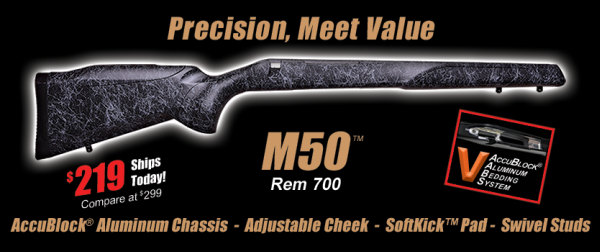
7. Stocky’s Stocks — M50 Hunting Stock with AccuBlock, $219.00
Here’s a very new product from Stocky’s Stocks, at a very good price. This new M50 Monte Carlo-style hunting stock for Rem 700-type actions offers great features you won’t find on some other stock costing three times as much. The action is supported by a built-in Aluminum Accublock chassis. The comb is adjustable for height, and the stock comes with a nice “Softkick buttpad”. A variety of premium finishes are available. If you are thinking of re-stocking your Rem 700 rifle or building a new hunting rig with a Rem 700 clone, this is an excellent choice — an outstanding value.
8. Amazon — Jiallite Scope Bubble Level, $11.29
If you shoot long range, you need a scope level. This nicely designed Jiallite Scope Bubble Level is fully CNC-machined to close tolerances for a good fit. It features a 30mm milled inside diameter, plus an inner insert ring so it will also fit 1″-diameter main tubes — that dual-diameter versatility is a nice feature. We also like the way the unit is nicely radiused, and has a low profile in the middle. User reviews have been very positive. You could easily pay $35.00 or more for a 30mm scope level. Purchasers have praised this product: 89% of verified buyers rated this five stars.
9. Brownells — Save Money Codes plus Free Shipping
Planning to do some shopping on Brownells.com? You can save up to $60.00 on your purchase with these discount codes. Plus you get free shipping — can’t complain about that. For orders $200+ use code M2H to save $20. For orders 400+ use code M2J to get $40 off, and for orders $600+ use Code M2K to save $60. NOTE: Don’t dawdle if you want to take advantage of these savings. The discount codes expire 1/8/2018 at 11:59 pm CST.
Vihtavuori offers free reloading data online, and through a free Mobile App. And now those resources are even better — Vihtavuori has completed a significant enhancement of its reloading information for hand-loaders. First, the Finnish powder company has added the new N565 powder to the data tables. But that’s just for starters.
A massive update has been completed with new bullets added for dozens of popular calibers: “We are happy to announce the addition of more than 130 lines of reloading data, with bullets by Barnes, Brenneke, Lapua, Berger, Sierra, Woodleigh, Hornady, Nosler and LOS”. The updated online information supplements the online Reloading Databases, which has dedicated sections for Rifle Cartridges, Pistol Cartridges, and Cowboy Action.
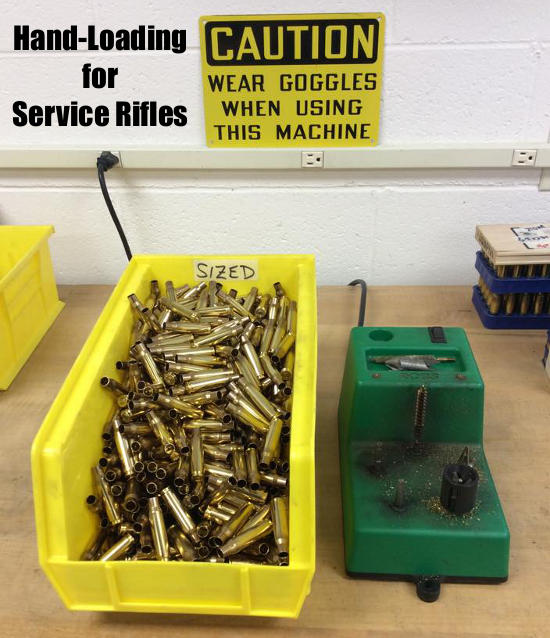
The U.S. Army Marksmanship Unit (USAMU) has published a great series of reloading “how-to” articles on its Facebook Page. This post covers key factors to consider when loading ammunition for Match Rifles and Service Rifles, with a particular focus on self-loading “gas guns”. Visit the USAMU Facebook Page each Wednesday for other, helpful “Handloading Hump-Day” tips.
We offer some “cardinal rules” to help new gas-gun handloaders with safety and efficiency. These address both Match Rifle and Service Rifle versions of the AR15, M1 Garand, M1A, and M110. However, they can also improve safe reloading for many other auto-loaders such as M1 Carbines, FALs, SIGs, etc. The author distilled these principles many years ago to help focus on the essential aspects of these rifles.
RULE ONE: Service Rifles Are Not Benchrest Rifles
Gas-guns require a relatively loose fit between ammunition and chamber (vs. bolt actions) for safe, smooth operation. Many techniques, such as neck sizing and keeping cartridge headspace quite tight, are popular in the extreme bolt gun accuracy realm. However, they are of little value with Service Rifles, and some could even be hazardous. Before adopting a specialized technique, seriously consider whether it is appropriate and beneficial in a gas-gun.
RULE TWO: Never Compromise Safety to Obtain Accuracy
Example: If choosing a brand of great, but ultra-sensitive match primers offers possibly better accuracy at the risk of slam-fires in your design of rifle, don’t do it! You are issued exactly two eyes and ten fingers (best-case scenario). Risking them trying to squeeze 0.25 MOA better accuracy out of an M1A, etc. simply isn’t worth it.
RULE THREE: Tailor the Precision to Your Individual Skill and Your Rifle’s Potential
This has been addressed here before, but bears repeating for newcomers. If you are struggling to break out of the Marksman Class, or using a CMP M1 “As-Issued,” then laboriously turning the necks of your 600-yard brass is a waste of time. Your scores will improve much faster by practicing or dry-firing. On the other hand, if the reigning champions anxiously check your scores each time you fire an event, a little neck-turning might not be so far-fetched.
Verifying Load Improvements — Accuracy hand-loading involves a wide variety of techniques, ranging from basic to rather precise. Carefully select those which offer a good return on investment for your time and labor. In doubt? Do a classic pilot study. Prepare ammo for at least three or four ten-shot groups with your new technique, vs. the same with your standard ammo. Then, pick a calm day and test the ammo as carefully as possible at its full distance (e.g. 200, 300, or 600 yards) to verify a significant improvement. A little testing can save much labor!
RULE FOUR: Be Your Own Efficiency Expert
Serious Service Rifle shooters generally think of ammunition in terms of thousands of rounds, not “boxes”, or even “hundreds”. Analyze, and WRITE DOWN each step in your reloading process. Count the number of times each case is handled. Then, see if any operations can be dropped or changed without reducing safety or accuracy. Eliminating just two operations saves 2000 steps per 1000 rounds loaded. Conversely, carefully consider any measurable benefits before adding a step to your routine.
RULE FIVE: In Searching for Greater Accuracy with Efficiency, Look for System Changes
For example, instead of marking your 300-yard rounds individually to differentiate them from your 200-yard ammo, would a simple change in primers work? If accuracy is maintained, using brass-colored primers for 200 and silver for 300 provides an indelible indicator and eliminates a step! Similarly, rather than spending hours selecting GI surplus brass for weight and neck uniformity, consider splurging on some known, high-quality imported match brass for your 600-yard loads. Results should be excellent, time is saved, and given limited shooting at 600 yards, brass life should be long.
RULE SIX: Check All Your Primers Before Packaging Your Loaded Ammo
This seems simple and even intuitive. However, many slam-fires (which were much more common when M1s and M1As were the standard) are due, at least in part, to “high” primers. Primers should be seated below flush with the case head. The USAMU has addressed this at length in a previous column, but each round should be checked for properly-seated primers before they are packaged for use.




 Sticking a case in the sizer die is a rite of passage for the beginning handloader. If you haven’t done it yet, that’s great, but it probably will eventually happen. When it does, fixing the problem requires a bit of ingenuity or a nice little kit like the one we got from RCBS.


 Developed in 2007 by Dennis DeMille and Dave Emary, the 6.5 Creedmoor is a shortened and improved 30 TC cartridge case that was inspired by the .308 Winchester design. This short action design was created to maximize case capacity and a wide range of loading lengths, while still fitting in standard short action magazines. With the correct twist barrel, the versatile 6.5 Creedmoor can take advantage of the wide range of bullet weights available in 6.5 mm (i.e. .264 caliber). Reloaders should keep in mind that the 6.5 Creedmoor works best with medium to medium-slow powders such as H4350, Varget, Win 760, and RE-17. The light recoil and adaptability of the efficient 6.5 Creedmoor cartridge has already proven itself in high power, precision rifle series and benchrest competitions. Couple that with respectable barrel life and its intrinsic accuracy potential and you have a recipe for success which should insure its legacy for decades to come.