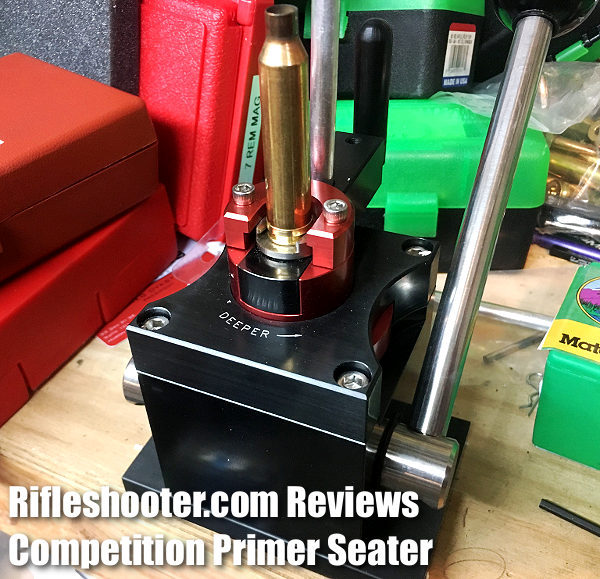
Seating primers is kind of a “dark art”. Many top shooters prefer to seat “by feel” using a hand tool. Others prefer bench-mounted tools that offer higher work-flow rates — with a good bench tool you can prime more cases in a given amount of time, plus it’s easier on the hands.
There have been many bench-mounted priming options — Forster has a tool, as does RCBS, and Lee. But there is a new player in the game — Primal Rights of South Dakota. And Primal Rights’ new Competition Primer Seater (CPS) may be the most precise bench priming tool yet offered to the public. It is certainly the most expensive. This patented tool costs $600.00! But the CPS delivers something special — superb, repeatable depth control, along with the ability to prime 1000 cases per hour. For some reloaders, that precision + productivity will justify the high price.
The Primal Rights CPS is built like a Swiss watch — the machining is beautiful. It also uses some unique internal engineering to achieve a superb “feel” when priming. Unlike some other tools, it is also very easy to adjust — simply turn a wheel to adjust seating depth. You can see this in the photos — the word “Deeper” with the directional arrow.
Operation of Competition Primer System Shown in Video:
Key Features of the Primal Rights CPS, as stated by the manufacturer:
Speed with Precision: Some priming tools are very fast. Others are very precise. The CPS is the only priming tool to combine both features into a single unit. You can achieve seating depths accurate to within a thousandth of an inch, all while priming at a comfortable rate of over 20 cases per minute. At that pace you can easily prime over a thousand cases per hour.
Precision Primer Seating Depth Control: The CPS has a revolutionary adjustable shell holder system which allows you to raise and lower your case in relation to the priming rod. You can seat the primer deeper or shallower in .001″ increments. The adjustment mechanism has tactile and audible clicks to ensure you stay on your desired seating depth. One click = One thousandth of an inch adjustment.
Integrated Shuttle Feeding System: The CPS uses a manually-operated shuttle system to slide primers from the primer tube into position over the primer rod. This ensures that any jams or misaligned primers are easily and safely discovered by the operator.
Check Out Competition Primer Seater Gear Review on Rifleshooter.com
Our friend Bill at RifleShooter.com has just released a detailed review of Primal Rights’ bench-mounted priming tool. He was very impressed with the Primal Rights CPS, finding that it was fast to use yet very precise, with great feel: “The CPS uses a rotational drive system to seat primers. Unlike the lever systems you’ll normally encounter, this allows you better feel as the primer seats. The CPS is expensive. However, it is a solid tool. Amortize it over the time you’ll be reloading and it’ll be worth every cent. If you load a lot of precision ammunition and have the budget to support it, take a look at the CPS. I found it is a game changer. I wish I had one twenty years ago!” READ REVIEW.
Say Hallelujah. These are pallets of Hodgdon H4350, something that’s been very hard to find recently. Check with Bruno’s, Graf’s, Midsouth and Powder Valley very soon.
Hodgdon H4350 has been the Holy Grail of reloading powders — highly desired but near impossible to find. For many popular cartridges such as 6XC, 6.5×47, 6.5 Creedmoor, and .260 Remington, H4350 has been the powder to beat — the “gold standard” for accuracy, low ES/SD, and temp stability. Unfortunately, H4350 has been in very short supply for the last couple of years. Major vendors such as Grafs.com, Midsouth and Powder Valley have been back-ordered for a long, long time.
But now that may change. Hodgdon has received a very large supply of H4350, and has started shipping pallets of the popular powder this week. The photo above was taken May 9, 2017. Hodgdon announced: “We have a lot of powder going out the door most days, but we have some special powder going out again this week. This should be on your local reloading shops’ shelves in the next couple weeks. Reloaders, rejoice!” If you’re in need of H4350, we recommend you contact your favorite shooting shop or online distributors soon. And guys — buy what you need, but don’t horde. Leave some for other shooters.
At the request of our readers, we provide select “Deals of the Week”. Every Monday morning we offer our Best Bargain selections. Here are some of the best deals on firearms, hardware, reloading components, and shooting accessories. Be aware that sale prices are subject to change, and once clearance inventory is sold, it’s gone for good. You snooze you lose.
Each week, Cabelas.com offers select Guns of the Week at special discounted prices. This week one choice is a special 200th Anniversary Remington 700 ADL with upgraded stock. This handsome rifle is $100.00 off, marked down to $549.99 from $649.99. The figured Walnut stock features deluxe Fleur de Lis checkering, plus a Commemorative grip cap. This special model 700 ADL with 24″ blued barrel is offered in three popular chamberings: .243 Winchester, .270 Winchester, and .30-06 Springfield.
This Master Tumbler Kit contains everything you need to tumble rifle or pistol brass. Now on sale for $53.46 with free Prime shipping, this Kit contains: Vibratory Tumbler, Rotary Media Separator, Plastic Bucket, 3 lbs. Cleaning Media, and 4 oz. Brass Polish. NOTE: We considered this an excellent deal when it was priced at $67.99. At $53.46 it is a total steal — you could easily pay that much for a decent vibratory tumbler alone.
3. Grafs.com — 60 for 60 Specials Starting Tuesday, May 9th
This year Graf & Sons is celebrating its 60th year in business. To mark this milestone, Graf’s is having a series of big sales, with huge discounts (up to 60%), and some free product give-aways. This Tuesday, May 9th, Grafs.com will run a special 60 for 60 Flash Sale. This starts at 12:00 PM CT and has items up to 60% off, plus prizes including Free Ammo. An example of the great deals are Walker Ear Muffs at $4.99, 60% off the regular $11.99 price. NOTE: Flash Sale starts TUESDAY May 9, 2017.
4. Monmouth Reloading — Nosler RDF Bullets, $28-$29 per 100
Nosler’s line of RDF (Reduced Drag Factor) bullets have high BCs for their weight. Precision shooters are reporting outstanding accuracy. Given their high performance and consistency, RDF bullets represent a superior value. At Monmouth Reloading you can get Nosler RDFs for under $29 per 100 for popular 6mm, 6.5 mm, and .30-Cal sizes. That’s up to $20 less per box than some premium brands.
There’s a new line of primers on the market, produced by Czech factory Sellier & Bellot. You can save up to 30% compared to name-brand American primers. For example, the S&B Small rifle primers are now just $19.99 at Cabelas.com, compared to $28.00 for CCI Small Rifle Primers at Powder Valley. We’ve shot the S&B pistol ammo and it was very reliable so we wouldn’t hesitate to use these primers for practice ammo in rifle or pistol. This is an attractive option for high-volume reloaders.
You don’t need to spend big bucks for an effective spotting scope to view mirage. You can get the Kowa TSN-601 Angled Body for just $269.00 from B&H Photo. An eyepiece will run another $275.00 or so. Though relatively inexpensive, the TSN-601 is used by many top marksmen. This doesn’t have the resolution of the $1500+ spotters but this is fine for viewing mirage and spotters.
7. Grafs.com — Magnetospeed Sporter $178.99
If you have been waiting to get a Magnetospeed… wait no longer. Priced at just $178.99 at Grafs.com, the Magnetospeed Sporter model costs less than half as much as Magnetospeed’s V3 models. This chronograph attaches directly to your barrel so you don’t have to go downrange to position tripods and set up skyscreens. For most people the Sporter Model contains all the features they need. Using Magnetospeed’s XFR adapter (sold separately), data can be transferred easily from the display module to your mobile device. READ Magnetospeed Sporter Review. Brownells also has the Magnetospeed Sporter at $179.99, and (for a limited time) you can get FREE Shipping with Brownells CODE “MAY”.
8. Sportsman’s Guide — CCI .22 LR Ammo, $3.49 per Box!
This is the cheapest price we’ve seen in a long time for name-brand .22 LR Rimfire ammo. The sale price of $3.49 per 50-ct box works out to just seven cents a round for this 40gr CCI Blazer rimfire ammo. At that price can enjoy rimfire plinking without worrying about cost — just like the “good old days”. Member price is even lower — $3.32 per box. Grab this CCI Ammo at this rock-bottom price before it sells out.
We use 1″-diameter Target Spots for sight-in and practice at 100-300 yards. These bright red/orange self-adhesive dots are easy to see. At 100 yards the high-contrast black diamond centers provide precise aiming points. We found this 10-pack of target spots on Amazon at a rock-bottom price. You get 630 total stick-on dots for just $9.65 with FREE Shipping. You can also get 360 Birchwood Casey 1″ dots from Midsouth for just $3.15, but shipping is extra. If you’re already ordering something from Midsouth, you may want to add the dots to your order.
This is versatile, affordable funnel system works with virtually all cartridge types, from 17 Remington up to 500 S&W. Even if you have a fancy metal funnel, its worth having one of these kits on your reloading bench. The RCBS Quick Change Powder Funnel Kit features five (5) adapters that match case mouth diameter for efficient loading: 17-20 caliber, 22-264 caliber, 27-284 caliber, 30-375 caliber, 40 caliber and higher. The Funnel Kit includes a handy 4-inch drop tube.
At the request of our readers, we provide select “Deals of the Week”. Every Monday morning we offer our Best Bargain selections. Here are some of the best deals on firearms, hardware, reloading components, and shooting accessories. Be aware that sale prices are subject to change, and once clearance inventory is sold, it’s gone for good. You snooze you lose.
1. Monmouth Reloading — Nosler RDF Bullets, $28-$29 per 100
Nosler’s line of RDF (Reduced Drag Factor) bullets have very high BCs for their weight. Precision shooters are reporting outstanding accuracy. Given their high performance and consistency, RDF bullets represent a superior value. At Monmouth Reloading you can get Nosler RDFs for under $29 per 100 for popular 6mm, 6.5 mm, and .30-Cal sizes. That’s up to $20 less per box than some premium brands. Based on user reports, we recommend you start with these pretty far out from the lands. One shooter using the 6.5 mm 140-grainer reports: “This bullet likes to jump. Berger Hybrids liked a jump of about 0.010″ – 0.020″. Once I seated the RDFs to jump 0.045″, my groups shrank to about 0.3 MOA. You cannot beat the price or performance of this bullet!”
2. Amazon.com — Rock Chucker Supreme Reloading Kit, $279.99
Everything you see above can be yours for just $229.99, after manufacturer’s rebate. Right now, Amazon is selling the Rock Chucker Supreme Master Reloading Kit for $279.99. That’s a great deal considering all the hardware you get. Heck, the Rock Chucker press alone is worth $150.00+. But here’s the real incentive — this Rock Chucker Supreme Kit qualifies for a Buck$ or Bullets Rebate — choose either $50 or 500 Speer bullets. If you take the fifty bucks ($50), that reduces your net cost to just $229.00 for the entire RCBS Reloading Kit. That’s a total steal. NOTE: Cabelas.com also sells this RCBS Kit for the same $279.99 (before rebate).
3. Amazon — Neiko Digital Calipers, $16.45
Even if you have a good set of calipers, you may want to get one of these Neiko 01407A Digital Calipers. The #1 best-selling digital caliper on Amazon.com, this Neiko tool features a large LCD Screen and measures up to 6.0 inches. With over 2700 customer reviews, this product has earned an overall rating of 4.4 out of 5 stars. It’s hard to go wrong for $16.45, even if you just use these as a spare set for measuring group sizes and case trim lengths. These are inexpensive but will do the job for basic tasks.
4. Natchez — Surplus SKB 5041 Transport Cases, $129.99
Natchez has obtained a supply of British MOD Surplus SKB 5041 rifle cases. These were ordered as mine detector cases, but were never issued. Natchez has removed the foam cut for the detectors and replaced it with new 2-piece convoluted foam. Interior dimension of the case is 50″x14.5″x5″ so this will hold long-barrel match rifles comfortably. These are extremely high-quality cases, very tough and rugged, waterproof with gaskets. These cases feature four SKB patented trigger latches, four reinforced padlock locations, and inline wheels. Though in excellent condition, some case may have minor exterior scuffs. You won’t find a better case at anywhere near the price. These normally retail for $299.99.
5. Amazon — Lyman Case Prep Xpress $103.99
The Lyman Case Prep Xpress lets you chamfer inside and out, brush your necks, clean/uniform primer pockets, and ream military crimps. On sale at Amazon.com with $103.99 Prime pricing, this is a good deal. Lyman’s Case Prep Xpress sells elsewhere for $130.00 or more. Here is a review from a Verified Purchaser: “The unit is quiet, sturdy, and the attachments do what they are supposed to do. It already has made a difference in my reloading speed, and most importantly, my comfort. I highly recommend this unit.” (Strafer, 4/7/14)
6. Midsouth — Norma Tac-22 .22 LR Ammo, $3.99/box
This Norma .22 LR ammo shoots WAY better than you’d expect given the low price — just $3.99 per 50ct box at Midsouth. These test targets come from Champion Shooters Supply. That vendor reports: “We have found this to run very well in Ruger rifles, handguns, and target pistols. These are 5-shot groups at 50 yards with an Anschutz 1913 rifle. This is an incredible value.” We suggest you grab some of this Tac-22 while you can at these rock-bottom prices.
7. Midsouth — Hornady LnL Auto Charge Scale/Dispenser, $158.99
The Hornady Lock N Load Auto Charge Electronic Scale/Dispenser is now on sale for just $158.99 at Midsouth Shooters Supply, discounted way down from the regular $226.24 price. That’s the lowest price we’ve seen on this product in a long time, making this a real bargain. If you are looking for an affordable combination digital scale and powder dispenser, this is very attractive pricing. By comparison, the new RCBS ChargeMaster Lite sells for around $250.00 and is back-ordered at most vendors. That means you can save at least $90.00 by buying RED instead of GREEN.
Got patches? Here’s a great deal on 100% cotton flannel patches. There are many sizes available, starting at $9.99 for 800 one-inch “17 Cal” patches. For 6mm rifles, we actually like the 1.25″ round “22/223″ sized patches priced at $11.99 for 800. Choose either round patches or square patches in most sizes. We generally like round patches for use with spire-tip jags, but some shooters prefer to wrap their patches around a jag or brush and square patches work better for wrapping. The large, 2″-square .30 Cal patches cost $17.99 for 800. These prices include FREE Shipping for Prime Members.
Estimating Actual Cost per Round by Caliber
This article comes from the USAMU, which provide shooting and reloading tips on its Facebook Page. This week’s USAMU TECH TIP outlines a ballpark-estimate method of calculating the actual cost per round of different calibers. Some applications, and some shooters, by virtue of their high level of competition, require the very best ballistic performance available — “Darn the cost, full speed ahead!
If you are in serious contention to win a major competition, then losing even a single point to inferior ballistic performance could cost you a national title or record. However, this “horsepower” does come at a cost! Some calibers are barrel-burners, and some offer much longer barrel life. Look at this comparison chart:
Estimated Cost Per Round by Cartridge Type
Below are some estimated total expense per round (practice and competition) based on component costs, type used, expected barrel life and a standard, chambered barrel cost of $520.00 across calibers.
5.56x45mm: $0.46/round (barrel life 6,000 rounds)*
6mmBR: $0.81/round (barrel life 2800 rounds)
6XC: $0.97/round (barrel life 2200 rounds)
.308 Win: $0.80/round (barrel life 4500 rounds)
6.5-284: $1.24/round (barrel life 1100 rounds)
*Note the high round count estimate for 5.56x45mm. This is a bit deceptive, as it assumes a period of “lesser accuracy” use. The USAMU says: “Much of the difference you see here between 5.56 and .308 is due to using the 5.56 barrel for 100-200 yard training with less-expensive, 55gr Varmint bullets after its long-range utility is spent”.
Moreover, while some applications require specialized, high-cost components, others do not. And, if the shooter is still relatively new to the sport and hasn’t refined his skill to within the top few percentile of marksmen, a more economical caliber choice can help stretch a limited budget. Translation: More skill per dollar!
In this post, the prices for all items mentioned here were taken from a major component supplier’s current advertisements, and all brass was of top quality, except in the case of 5.56mm. There, 200 top-quality, imported cases were reserved for 600-yard shooting, and the other brass used was once-fired Lake City surplus.
Cartridge cases were assumed to be loaded 10 times each. [Your mileage may vary…] Bullet prices assumed the use of less-expensive, but good-quality match bullets for the bulk of shooting as appropriate.
The cost of top-tier, highly-expensive match bullets was also calculated for a realistic percentage of the shots fired, based on ones’ application. Barrel life by caliber was taken from likely estimates based on experience and good barrel maintenance.
Brass Costs Based on 10 Loads Per Case
Often, handloaders may calculate ammunition cost per round by adding the individual costs of primers, powder charges and projectiles. Many don’t consider the cost of brass, as it is reloaded several times. Here, we’ll consider the cost of enough top-quality brass to wear out a barrel in our given caliber, at 10 loads per case, except as noted above.
Don’t Forget Amortized Barrel Costs
Few shooters factor in the full, true cost of barrel life. Depending on caliber, that can dramatically increase the cost per round. For example, consider a long-range rifle in 6.5/284 caliber. This cartridge performs amazingly well, but at a cost. Ballpark estimated barrel life [in a top-quality barrel] is 1100 rounds. Some wear out faster, some last longer, but this gives a rough idea of what to expect.
Accurate barrels are a joy to use, but they are an expendable resource!
A top-quality barrel plus installation was estimated at about $520.00. At 1100 rounds, barrel life adds $0.47 per round to our total cost. Thus, what had started out as an [components-only estimate, with brass cost] of $0.76/round now totals $1.24 per shot!
Cost Considerations When Choosing a Catridge Type
Some shooters might ask themselves if they could meet their present needs with a more economical caliber. If so, that equates to more practice and matches per available dollar, and more potential skill increase on the available budget.
Each shooter knows his skill level, practice needs, and shooting discipline’s requirements. Some might shoot NRA Service Rifle or Match Rifle using a 5.56mm with a long barrel life. Others might be Match Rifle shooters faced with choosing between, say, a 6mm BR vs. 6XC. A realistic assessment of ones needs, performance-wise, may help guide the shooter toward a caliber that’s most optimized to their needs at the moment.
Admittedly, the factors affecting cost for any individuals circumstances can vary significantly. However, hopefully this will provide one useful method of evaluating one’s training and competition choices, based on their skill, goals and needs.
Got a big shooting shopping list? Then here’s a great opportunity. Now through April 30th at 11:59 PM you can get $9.00 flat-rate shipping from Midsouth Shooters Supply, with a $99.00 minimum order. That can translate to significant savings on big orders, or heavy items. Compare the true shipping costs from other vendors to see what a good deal this can be (some vendors charge $15 to ship a couple boxes of ammo). Note: Regular hazmat charges apply to powder, primers, and other hazmat items.
If you’re shopping at Midsouth, here are some of the very good values you might want to check out:
Most of us assume that if we weigh our powder carefully (down to the tenth of a grain or less) we can achieve a uniform powder fill from case to case in our handloads. Weighing does ensure that the weight of the propellant in each case is the same, but is the column of powder the same by volume each time? “Not necessarily” is the answer. An interesting experiment by our friend Boyd Allen demonstrates that the manner in which you place kernels in the case can make a significant difference in the height of the powder column within the brass case.
Using a Gempro 250 scale, Boyd measured exactly 30.6 grains of Vihtavuori N-133 powder. He then inserted this powder in the same cartridge case multiple times. (The case has a fired primer in place.) But here is the key — Boyd used various filling techniques. He did a slow fill, and a fast fill, and he also experimented with tapping and drop tubes. What Boyd discovered was that you can start with the exact same weight of powder (in fact the very same set of kernels), yet end up with vary different fill heights, depending on how you drop the kernels into the case. Look at the photos. Despite variations in lighting, the photos show the same 30.6 grains of powder, placed in the same cartridge, with four different methods.
Using funnels with long drop tubes packs kernels more tightly, creating a shorter powder column. That allows you to get more propellant (by weight) into the case.
Boyd Explains the Procedure Used for his Experiment.
EDITOR’s NOTE: So there is no misunderstanding, Boyd started with a weighed 30.6 grain charge. This identical charge was used for ALL four fills. After a fill the powder was dumped from the case into a pan which was then used for the next fill technique to be tried. So, the powder weight was constant. Indeed the exact same kernels (of constant weight and number) were used for each fill.
Boyd writes: “I used the same powder for all fills, 30.6 gr. on a GemPro 250 checked more than once. All fills employed the same RCBS green transparent plastic funnel. The fast drop with the funnel only overflowed when it was removed from the case neck, and 15 granules of powder fell on the white paper that the case was sitting on. The fast-funnel-only drop with tapping, was done with the funnel in place and the case and funnel in one hand, while tapping the case body with the index finger hard, many times (about 20 fast double taps). My idea here was to “max out” the potential of this tapping technique.
The slow drop with the funnel and 10″-long .22 cal. Harrell’s Precision drop tube, was done by holding the scale pan over the funnel and tapping the spout of the pan repeatedly on the inside of the funnel about 1/3 down from the top, with the scale pan tilted just enough so that the powder will just flow. Many taps were involved, again, to max out the technique.
Again, to be clear, after each case filling, the powder was poured from the case back into the scale pan carefully. You may notice the similarity between the fast drop with the drop tube, and the funnel only with tapping. Although I did not photograph it, fast tube drop and tapping (combined) improved on tapping alone, but only to about half as far down the neck as the slow with drop tube. Due to the endless possible permutations, I picked four and left it at that.
I believe that I can make the rough judgment that the scale pan funnel and drop tube technique, which involved a longer drop period, and probably less velocity at the top of the tube, left more room in the top of the case neck than the slow drop from the measure with the same drop tube. You have both pictures, so you can make the comparison.” — Boyd
Does Powder Column Height Variance Make a Difference?
Boyd’s experiment proves pretty conclusively that the method of dropping a given weight of powder can affect the height of the powder column in the case and the degree of powder compression (when a bullet is seated). He showed this to be true even when the exact same set of kernels (of constant weight) was used in repetitive loadings. This raises some interesting questions:
1. Will subsequent cartridge transport and handling cause the powder to settle so the variances in powder column height are diminished?
2. If significant inconsistencies in powder column height remain at time of firing, will the difference in fill level hurt accuracy, or result in a higher extreme spread in velocity?
3. Is there any advantage (beyond increased effective case capacity) for a tight (low level) fill vs. a loose (high level) fill?
We don’t know the answer to these follow up questions. This Editor guesses that, if we tested low-fill-height rounds vs. high-fill-height rounds (all with same true fill quantity by weight), we might see meaningful differences in average velocity. I would also guess that if you fired 10 rounds that exhibited quite a difference in powder column heights, you might see a higher ES/SD than if you shot 10 rounds loaded with a very consistent powder column height (either high or low). But further testing is needed to determine if these predictions are true.
Folks have asked if there is a tool that can remove obstructions from a Lapua small, BR-sized flash hole without opening the hole size. The Lapua PPC/BR flash hole is spec’d at 1.5mm, which works out to 0.059055″. Most of the PPC/BR flash-hole uniforming tools on the market use a 1/16″ bit which is nominally 0.0625″, but these often run oversize — up to 0.066″.
If you want to just clear out any obstructions in the flash hole, without increasing the flash hole diameter, you can use an inexpensive “pin vise” with an appropriate drill bit. For $1.00, eHobbyTools.com sells a 1.5mm pin vise bit, item 79186, that matches the Lapua flash hole exactly. Other vendors offer a #53 pin vise bit that measures .0595″ or .060″ (depending or source). An 0.0595″ bit is close enough. You can find pin vises and bits at hobby stores.
by Sierra Bullets Ballistic Technician Philip Mahin for Sierra Bullets Blog
A lot of calls that come into the Sierra Customer Service Center are made by shooters [of retirement age]. Most of the time the shooter used to reload back when they were [younger] and stopped in order to raise a family, pursue a career, or both. Maybe their father or grandfather taught them back in the day and they are looking for an answer to the new whatchamacallit they found on the internet. The point is they are coming back to it because it was fun.
Reloading Can Provide Stress Relief
As a father of three, a husband, a brother, a son and son-in-law, and a friend and neighbor, I get pulled in a lot of directions. In all honesty, reloading and shooting has become a stress relief for me even though I work in the shooting industry.
Sometimes, the shooting gets put on hold for other more important things but there will always be another project or repair to accomplish. There are a lot out there that have found a way to balance the work life, the family life, and the play life. I would like to applaud you on your efforts because it is a hard thing to accomplish.
Remember to take time and relieve that stress. Do something fun, especially if it is shooting that special hand-load you just made.
AccurateShooter Comment — Hand-Loading and the Creative Process
Reloading your own precise ammo can be rewarding in many ways. First it allows you a temporary escape from work pressures, “Honey-Dos”, filing your taxes — whatever. It’s just you and Mr. Rockchucker spending quality time in the loading room. Second, hand-loading is a creative process that engages the mind. During load development, you are like an inventor, selecting a powder charge, choosing the bushing size, experimenting with seating depths, working to perfect your load.
Lastly, the process of hand-loading is rewarding because you are building something start to finish. You begin with components — bullets, brass, and powder, and end up with a finished product that (hopefully) is better than the best factory ammo you could buy. It is enormously satisfying to start with piles of bullets and brass and end up with beautiful hand-loads that can deliver great accuracy.
Right now Midsouth Shooters Supply is running a Spring Inventory Clearance Sale. Everything in the Clearance Sections just got marked down 10% below the previous sale pricing. There are a lot of great bargains here — everything from big name optics to reloading dies to loaded ammo and much more. Hundreds of items are on sale, even top-quality items such as Sierra MatchKing bullets and Norma brass. If you need a scope or dies, you should definitely check out the sale. Likewise if you want factory ammo for a hunting rig, you’ll find some great bargains.
Here’s Some of the Cool Stuff on Sale, at Very Low Prices:
Sierra 7mm and .308 MatchKing Bullets
Federal Primers
Lyman Sonic Cleaning Machine
Hornady Reloading Tools
Norma 22 PPC Brass
Leupold Scopes
Leupold Binoculars
Burris Scopes
Vihtavuori N310 and N350 Powder
Redding Competition Dies
Redding TiN Neck Bushings
RCBS Reloading Dies
Nosler .260 Rem and 300 WSM Ammo
Leica CFR Rangefinders
Weatherby/Howa stocks
Handgun Holsters and Gun Cases
Clearance Sale Tip from EdLongrange. We welcome reader submissions.