Craters may look interesting on the moon, but you don’t want to see them on your primers. Certain mechanical issues that cause primer craters can also cause primer piercing — a serious safety problem that needs to be addressed. If you have a gun that is cratering primers (even at moderate pressure levels), there is a solution that works with many rifles — send your bolt to Greg Tannel to have the firing pin hole bushed.
Shooters who convert factory actions to run 6BRs, 6PPCs or other high-pressure cartridges should consider having the firing pin bushed. These modern cartridges like to run at high pressures. When running stout loads, you can get cratering caused by primer flow around the firing pin hole in the bolt face. The reason is a little complicated, but basically the larger the hole, the less hydraulic pressure is required to crater the primer.
A limited amount of cratering is normally not a big issue, but you can reduce the problem significantly by having a smith fit a bushing in the firing pin hole. In addition to reduced cratering, bushing the firing pin often produces more consistent ignition.
This is a highly recommended procedure that our editors have had done to their own rifles. Greg Tannel (Gre-Tan Rifles) is an expert at this procedure, and he does excellent work on a wide variety of bolts. Current price for a bushing job, which includes turning the firing pin to .062″, is $92.00, or $100.00 with USPS Priority Mail return shipping.
If you have a factory rifle, a bushed firing pin is the way to go if you are shooting the high-pressure cartridges such as 6PPC, 6BR, 6-6.5×47 and 6.5×47. This is one of the most cost-effective and beneficial upgrades you can do to your factory rifle. For more info on the Firing Pin Bushing process, visit GreTanRifles.com, or email greg [at] gretanrifles.com. After clicking the link for GreTanRifles.com, Click on “Services” > “Shop Services” and you’ll see a listing for “Bush Firing Pin Hole & Turn Pin”. CLICK that Box.
Firing Pin Hole Bushing by Greg Tannel
Work Done: Bush firing pin hole and turn pin
Functions: Fixes your cratering and piercing problems
Price: $92.00 + $8.00 return shipping Total Price: $100.00
Actions for which Bushing is Offered: Remington, Winchester, Savage multi-piece pin, Sako, Kimber, Nesika, Stiller, BAT Machine, Kelbly, Lawton, Surgeon, Borden, Wichita, Hall, Ruger, Howa, Weatherby, Dakota, Pacific Tool, Phoenix, and Defiant bolt action rifle or pistol.
Actions for which Bushing is NOT Available: Case hardened receivers, ARs, Accuracy International (AI), Barnard, Big Horn, Cooper, Desert Tactical Arms, Kimber, Rosenthal, New Savage single piece pin, Rim fires, Falling block, Break open, Lever, Pump rifles, 1903-A3, CZ, Mauser.
How to send your bolt in to be bushed:
Send your bolt and firing pin assembly via snail mail, priority mail, or UPS. Please do not use FEDEX as it sometimes has delivery delays.Include your name, phone number, and return shipping address, and a note as to what you want done. Pack your bolt carefully and ship to: Gre’-Tan Rifles, 24005 Hwy. 13, Rifle CO 81650.
Due to the high volume of work, turn-around time for bolt bushing jobs can be 12 weeks (though it usually is faster). Customers can pay by check, money order, or credit card. For more information visit GretanRifles.com.
At the request of our readers, we provide select “Deals of the Week”. Every Monday morning we offer our Bargain selections. Here are some of the best deals on firearms, hardware, reloading components, and shooting accessories. Be aware that sale prices are subject to change, and once clearance inventory is sold, it’s gone for good. You snooze you lose.
1. Amazon — Caldwell Long Range Target Camera System, $349.49
Forum members have purchased this Caldwell Target Cam System and they’ve found that it works reliably, providing a clear signal to any WiFi-enabled mobile device (smartphone, iPad, Laptop). One member specifically tested the unit at 1000 yards and it functioned fine. NOTE: This system does NOT have a zoom camera lens, so you need to position the camera within 10 yards or so of the target. But if you place it to the side a bit, this shouldn’t be a problem. This system comes with a nice, fitted carrying case that holds camera, transceivers, antennas, and stands. You get a very capable system for under $350.00 (Amazon price includes free shipping for Prime members). You can also get this system from Midsouth for $357.02 (shipping extra).
2. Amazon — Tipton Gun Vise, $33.13 (free Prime Shipping)
This is an awesome deal on a durable, well-designed polymer Gun Vise that every rifle owner can use. Your Editor has one of these units which has served well for more than a decade. The base has compartments for solvents, patches, and tools. The cradles and pads contacting your gunstock are a soft, rubber-like material that is gentle on fine finishes. This vise is relatively light in weight, but sturdy enough to support big, heavy rifles. NOTE: This is currently back-ordered, but due in stock August 17, 2016.
3. Midsouth — Burris Eliminator LaserScope with $100.00 Rebate
The Burris Eliminator III is an impressive piece of electro-optical technology. The built-in laser rangefinder senses the distance to your target and the scope’s “brain” calculates the required hold-over. The calculated aiming point is then displayed with an illuminated red dot on the vertical cross-hair. Just put the bright red dot on the target and make the shot. We’ve used this scope out to 600 yards on small steel targets and it worked flawlessly. Right now you can get a $100 Factory REBATE plus attractive sale pricing from Midsouth. After rebate, the 3-12x44mm Eliminator III costs $1199.00.
Here’s a rifle with a smooth three-lug action and good trigger that can take any game in North America. The Browning A-Bolt is justifiably respected as a solid hunting rifle. The 300 Winchester Magnum chambering offers serious hitting power, even at long range. This rifle, with a blued barreled action, normally retails for $600.00+. Now it’s on sale for under $500.00. To sweeten the deal even more, right now Browning is offering $50 CASH BACK on Browning centerfire rifles purchased between August 1, 2016, and September 30, 2016. CLICK HERE for $50.00 REBATE FORM.
5. Grafs.com — Hornady Z-Max Poly-Tip Bullets, $64/500 and Up
It seems like the Zombie craze has run its course (thank goodness), so Hornady’s Zombie bullets are being sold off at very low prices. Graf & Sons acquired a truckload of the green-tipped Z-Max bullets. These are the same as the popular red-tip V-Max bullets, just with a different color for the tips. Choose .204, .224, or .308 calibers in a variety of bullet weights. Prices start at $63.99 for 500, 32 grain .204 caliber varmint bullets. That’s just $12.79 per hundred.
6. Grafs.com — Forster Co-Ax Reloading Press on SALE
The Forster Co-Ax is a unique press that loads very straight ammo. If you’ve been patiently waiting to acquire a Forster Co-Ax® reloading press, now’s the time to strike. Grafs.com has Co-Ax presses on sale at $289.99. That includes shipping charges (with one flat $7.95 handling charge per order).
7. Glen’s Army Navy — CCI 17 HMR Ammo, $10.99 for 50 Rounds
Here’s a good deal on 17 HMR ammo, our favorite cartridge type for small varmints. This quality CCI ammo is loaded with 20 grain jacketed SP bullets. Muzzle velocity is 2375 FPS. If you need 17 HMR ammo, you might want to act quickly. At this price this 17 HMR ammo will sell out.
8. Amazon — Two Rolls of 3″ Neon Target Stickers, $14.95
We like these bright Neon 3″ target stickers. They are big enough to see easily at 600 yards, giving you a 1/2 MOA target center at that distance. For $14.95 at Amazon.com, you get 250 3″-diameter self-adhesive centers (125 targets per roll) that stick to almost any surface The high-contrast fluorescent red/orange color provides an excellent HI-VIZ aiming point, along with good contrast for bullet holes that fall within the 3″ circle. To help line up your reticle cross-hairs, the target centers feature black markers at 3, 6, 9, and 12 O’clock.
Gavin Gear of UltimateReloader.com recently reviewed Lee Precision’s new lever-operated, bench-mounted priming tool. The Lee Auto Bench Prime features a hopper-style primer feeder set at an angle. Gavin likes the tool, reporting that primers feed well and seat fully with very little effort. And switching from large to small primer size (or vice-versa) is quick and easy. Overall, Gavin says the Lee Auto Bench Prime has earned a place in his reloading room: “This is now my tool of choice for off-press priming. The Lee Auto Bench Prime is easier to use than a hand priming tool, and more efficient.”
Watch UltimateReloader.com’s Lee Auto Bench Prime Gear Review
Gavin tells us that the system worked well: “All in all, I’m really liking the LEE Auto Bench Prime. In the video, I prime both small primer .223 Rem brass and large primer .308 Win cases. I was impressed with how easy it was to seat the primers, and how quickly the process goes.”
How the Lee Auto Bench Prime Performs
Gavin had three important “take-aways” from his initial loading sessions with the Lee Auto Bench Prime:
1. I was surprised by the low effort needed to prime cases — it’s pretty amazing.
2. You can quickly and easily install shellholders and change primer sizes.
3. The folding primer tray works very well. It’s a great setup from my testing so far.
Are there any negatives with the tool? Gavin noted that, in the course of loading 100+ rounds, once or twice he had to tap the triangular tray to get the primer to feed: “That’s not a big deal, and may smooth out with time”.
Tool Costs Under $30.00
Available at Grafs.com for just $28.59, the Lee Auto Bench Prime tool is very affordable. It costs much less than competitive bench-mounted priming tools from Forster and RCBS.
NOTE: this tool requires dedicated Auto Prime shell holders (sold separately), but that’s a relatively small added expense. A set of Lee shell-holders (shown at right) costs less than $20.00 (street price).
At the request of our readers, we provide select “Deals of the Week”. Every Monday morning we offer our Bargain selections. Here are some of the best deals on firearms, hardware, reloading components, and shooting accessories. Be aware that sale prices are subject to change, and once clearance inventory is sold, it’s gone for good. You snooze you lose.
1. Precision Reloading — 10% and 15% Off Berger Bullets
Berger projectiles have won countless matches and set scores of World Records. Now you can save big bucks on match and hunting bullets from Berger Bullets in a wide variety of calibers and weights. Right now Precision Reloading is offering 10% off orders of $100 or more (Code BG8161), and 15% off orders of $500.00 or more (Code BG8165). Precision Reloading has many of the most popular Berger match projectiles in stock, including 6mm 105gr Hybrids, and 7mm 180gr Hybrids. NOTE: This special only runs for a few more days, so don’t delay!
2. Midsouth — Lyman BoreCam Digital Borescope, $222.46
Here’s a great deal on an excellent product in high demand. The Lyman BoreCam is an electro-optical borescope with a digital display. You can record “stills” on a SD card. This is one of the hottest products on the market right now. But we found some in stock at a great price. Midsouth Shooters Supply now has the BoreCam for $222.46. Grab it while you can at that price. Other online vendors are charging a LOT more. For example, the MidwayUSA price is $259.99.
3. RCBS — Buy Green, Get Green Rebate
RCBS is running a very attractive Rebate Program currently. If you spend $300.00 on qualifying products you get a $75.00 rebate. Spend $50 and get a $10.00 Rebate. This program is limited to one (1) rebate redemption per calendar year, with a maximum of $75.00. CLICK HERE for more information. NOTE: To qualify, you must supply completed RCBS rebate coupon, original UPC barcodes from package, and original cash register receipt and/or dated, itemized sales invoice.
Get RCBS Chargemaster for $225.00 After Rebate
Using this rebate, you can get an RCBS Chargemaster from Amazon.com for a “final price” of $225.00. Amazon sells the Chargemaster for exactly $300.00 which qualifies for the $75.00 rebate.
4. Natchez Shooters Supply — 325 Rounds .22 LR Ammo, $22.99
This Federal .22 LR ammo is just 7 cents per round — the kind of pricing on bulk rimfire ammo we used to see in the “good old days”. Act quickly, this $22.99 Federal .22 LR Ammo deal won’t last long. Each box contains 325 rounds — enough ammo for many sessions at the range. The bullets are 40 grains, solid lead.
5. Grafs.com — Magnetospeed Sporter $179.99
If you have been waiting to get a Magnetospeed… wait no longer. Priced at just $179.99 at Grafs.com, the Magnetospeed Sporter model costs less than half as much as Magnetospeed’s V3 models. This chronograph attaches directly to your barrel so you don’t have to go downrange to position tripods and set up skyscreens. For most people the Sporter Model contains all the features they need. Using Magnetospeed’s XFR adapter (sold separately), data can be transferred easily from the display module to your mobile device. READ Magnetospeed Sporter Review.
This is a very good spotting scope for the price. Yes it gives up some low-light performance to a spotter with an 80mm objective, but otherwise it is a good performer, and we can’t think of much that will touch this Vortex Diamondback spotting scope for anywhere near the $399.99 sale price. Choose from angled or straight version for the same $399.99 price, which includes the 20-60X zoom eyepiece.
7. Amazon — Howard Leight Electronic Earmuffs $40.97
Every shooter should own a pair of Electronic muffs, even if you prefer shooting with earplugs and/or standard muffs. Electronic muffs are great when you are doing spotting duties or are working near the firing line. They allow you to hear ordinary conversations while still providing vital hearing protection. Right now Amazon.com has the Howard Leight Impact Sport Electronic Muffs on sale for just $40.97. This is good deal — these NRR 22 muffs are currently Amazon’s #1 seller in the category. NOTE: For regular, sustained shooting we recommend muffs and/or earplugs with a higher NRR rating.
8. Amazon — Leight MAX NRR33 Earplugs, $7.58 for 50 Pairs.
These Howard Leight NRR33 Max plugs are your Editor’s favorite foam earplugs. Between shooting, motorcycling and mowing lawns, I probably have Max plugs in my ears 2-3 days a week. This is a very good price for a bulk pack of 50 pairs. And if you act soon, you can get free shipping to boot.
Wouldn’t it be nice to have a print resource at your fingertips that has hundreds of true-size cartridge illustrations, plus technical descriptions of thousands of popular cartridge types? That could be a real time-saver. It’s no wonder this book is an Amazon best-seller in its category.
If you’re a serious shooter, the latest 5th Edition of the Ammo Encyclopedia belongs in your library. This 1008-page book by Michael Bussard is probably the most comprehensive and up-to-date book in print covering current and obsolete cartridges and shotshells. The Ammo Encyclopedia is a massive resource work. The 5th Edition now boasts 105 chapters, covering thousands of handgun, rifle, and shotgun cartridges from the past century and a half.
One of the best features is a 12-page color section depicting actual size drawings of 265 current rimfire/centerfire cartridges and shotshells. You won’t find that many “life-size” cartridge drawings in one place even on the internet. Cartridge profiles and ballistic charts have been expanded to include all new factory cartridges. The authors have even included air rifle pellets and historical images and charts. Softcover, 1008 pages — edited by S.P. Fjestad.
Comments from guys who bought the book:
“This book contains a vast array of information on many modern and even obsolete ammunition. Definitely recommend for any modern reloader novice or experienced.” – Duggaboy460
“It’s a great reference book for individuals who reload their own ammunition. There is a lot more info in this Edition. Everyone who likes this information should have it in their library.” – Reloader
“I like the general and technical comments that are available for each and every cartridge. Information that predicts if a cartridge will stay in production for many more years or rapidly become obsolete.” – RSL1
In this video, Bryan Litz of Applied Ballistics explains how to choose a bullet for long-range shooting and explains what you should be looking for when developing a long-range load. Bryan notes that, with a new rifle build, the bullet you select may actually dictate your gun components. When starting from a “clean slate”, once you select a bullet, you will then pick a barrel, twist rate, and cartridge that are appropriate for that bullet. In choosing a long-range projectile, Bryan recommends you choose a high-BC bullet “that is known for precision”. Then you need to find an ultra-consistent, reliable load.
This video is worth watching. Bryan Litz makes some very good points.
Load Development — Why Consistency is Key (and Half-MOA May Be Good Enough)
After choosing a bullet for your long-range project, then you need to develop a load through testing. Bryan explains: “Once you’ve selected a bullet … and you have selected the components around that bullet, the most important thing to remember in hand-loading is consistency. You’re going to do some testing to see what combination of powder charge, powder type, and seating depth give you the best groups and lowest standard deviations in muzzle velocity.”
Bryan says that if you develop a load that can shoot consistent, half-minute groups in all conditions, you should be satisfied. Bryan says that many long-range shooters “spin their wheels” trying to achieve a quarter-MOA load. Often they give up and start all over with a new bullet, new powder, and even a new cartridge type. That wastes time, money, and energy.
Bryan cautions: “My advice for hand-loaders who are long-range shooters, is this: If you can get a load that is reliable and can shoot consistent, half-minute groups with low MV variation and you can shoot that load in any condition and it will work well, then STICK with THAT LOAD. Then focus on practicing, focus on the fundamentals of marksmanship. The consistency you develop over time by using the same ammunition will mean more to your success in long range shooting than refining a half-minute load down to a quarter-minute load.”
Bryan notes that, at very long range, shooting skills and wind-calling abilities count most: “Your ability to hit a 10″ target at 1000 yards doesn’t improve very much if you can make your rifle group a quarter-minute vs. a half a minute. What’s going to determine your hit percentage on a target like that is how well you can calculate an accurate firing solution and center your group on that target. A lot of people would be more effective if they focused on the fire solution and accurately centering the group on the target [rather than attempting to achieve smaller groups through continuous load development].”
Editor’s Note: We agree 100% with the points Bryan makes in this video. However, for certain disciplines, such as 600-yard benchrest, you WILL need a sub-half-MOA rifle to be competitive at major matches. Well-tuned, modern 600-yard benchrest rigs can shoot 1/4-MOA or better at 100 yards. Thankfully, with the powder, bullets, and barrels available now, 1/4-MOA precision (in good, stable conditions) is achievable with a 17-lb benchgun built by a good smith with premium components.
At the request of our readers, we provide select “Deals of the Week”. Every Monday morning we offer our Bargain selections. Here are some of the best deals on firearms, hardware, reloading components, and shooting accessories. Be aware that sale prices are subject to change, and once clearance inventory is sold, it’s gone for good. You snooze you lose.
If you shoot long range, you need a scope level. This Discovery scope level is fully CNC-machined to close tolerances for a good fit. It is available with three inner diameters to fit scopes with 1″, 30mm, or 34mm main tubes. The 1″ version is just $11.99 while the 30mm model is $13.95 and the large 34mm version is $15.95. You could easily pay $35.00 or more for a 30mm scope level. Purchasers have praised this product: 89% of verified buyers rated this five stars.
2. CDNN Sports — Smith & Wesson SW1911TA E-Series, $999.99
This is a very accurate, high quality Smith & Wesson 1911. The SW1911TA Tactical E-Series™ (“Enhanced”) sells elsewhere for around $1170.00 so this CDNN $999.99 special is a very good deal. This pistol features tritium night sights, front rail, high-quality wood grips, and snakeskin-style slide serrations. We’ve shot this S&W pistol. With our handloads, our sample SW1911TA was more accurate than a $2850.00 Wilson Combat CQB 1911 we tried for comparison. YMMV but expect excellent accuracy and a really fine trigger right out of the box. Some folks may not like the external extractor, but in our mind it’s a smart feature that improves reliability. Think about it, the most reliable semi-auto handguns — Sigs, Glocks, HKs — all have external extractors.
3. Amazon — Plano Double Rifle Case with Wheels, $118.64
This Plano Double Scoped Rifle Case is an Amazon Best Seller for good reason. It offers the functionality and durability of an SKB-type hard case for HALF the money. This is under $120.00, while the equivalent SKB is around $240.00, so you can buy two Planos for the price of one SKB. The 51.5″ interior will fit most scoped competition rifles up to about 29″ barrels (measure your own rifle to make sure). The handles are convenient and beefy and the wheels make this case easy to move through airports and parking lots. This is a very tough, roomy case for the money.
This is a totally new kind of hearing protection. Walker’s Razor-X and Razor-XV operate like electronic muffs — allowing you to hear commands and conversations while still blocking gunshots and other loud noises. The Razor-X combines a collar unit (containing the electronics) with retractable, foam-tipped ear buds. Unlike conventional earmuffs, the Razor-X system doesn’t interfere with your cheek weld. The patent-pending earbuds allow the user to be in loud environments without damaging their hearing, providing an impressive 31dB of noise reduction.
To ensure a good fit (for optimal noise reduction), the Razor-X and Razor-VX come with two styles of noise-reducing foam tips. The Razor-X also features an auto-shut off after 4 to 6 hours. An AC wall adapter with USB port and a one-meter micro USB cord is provided.
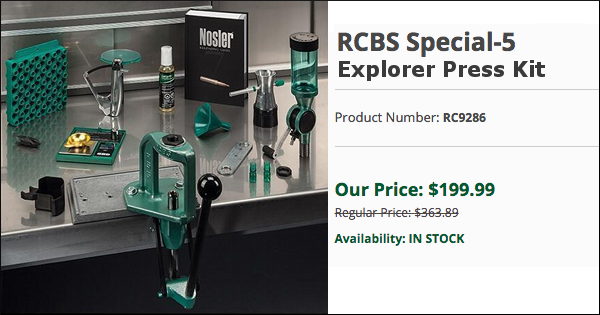
5. Natchez — Special 5 Reloading Press Kit, $199.99
This is an excellent entry-level reloading kit, which is on sale for $199.99 at Natchez Shooters Supplies. We like the relatively compact Special 5 press for most reloading duties. Eventually you many want to add an additional large heavy press, but this will get the job done. This kit includes an RCBS Powder Measure, Digital Scale, Powder Trickler, Hand Priming Tool, Load Manual, Loading Tray, and more. It’s hard to beat this combination of tools for under $200.00.
6. MidwayUSA — Pro Series Folding Shooting Mat, $89.99
We like this folding shooting mat for three main reasons. First, it has nice half-inch-thick EVA high-density foam inside. That 0.5″ padding makes this mat MUCH more comfortable than thin mats when shooting from concrete or hard ground. Second, at 76″ long x 35.5″ wide, the mat is big enough for tall guys and there’s plenty of width for log-books, ammo boxes, and other gear. Third, the multi-cam pattern is distinctive. When you’re at a big match with many competitors, this mat is easy to spot, so you can quickly find your place on the firing line. The Multi-cam Pro Series Folding Shooting Mat is currently on sale for $89.99, marked down from $189.00. It is also offered in OD Green for $89.99.
7. Amazon — Long Range Shooting Handbook, $13.02 plus s/h
This 250-page book is Amazon.com’s #1 Top Seller among shooting books. The author, a former U.S. Army Sniper Instructor, knows his stuff. Ryan’s Long Range Shooting Handbook contains a thorough discussion of MOA and MilRadian concepts. The handbook is broken down into three section: Part One covers equipment, terminology, and basic principles. Part Two covers the theory of long range shooting. Part Three offers practical advice on implementing the information taught. This book has earned rave reviews — 91% of verified purchasers gave the book Five Stars. Note, we show the Prime Price. However, this book is available from other Amazon sellers starting at $13.02 plus $3.99 shipping.
8. Sportsman’s Guide — Frankford Arsenal Case Tumbler Kit
For just $69.99, this Frankford Arsenal Kit provides everything you need to clean brass: Vibratory Tumbler, Rotary Media Separator, Bucket, Corn Cob Media (3 lbs.), and Brass Polish. The Case Tumbler holds up to 600 9mm cases or 350 .223 Rem cases. The separator system is generous, with a 3.5-gallon bucket. NOTE: Sportsman’s Guide Buyers Club members can purchase for $62.99.
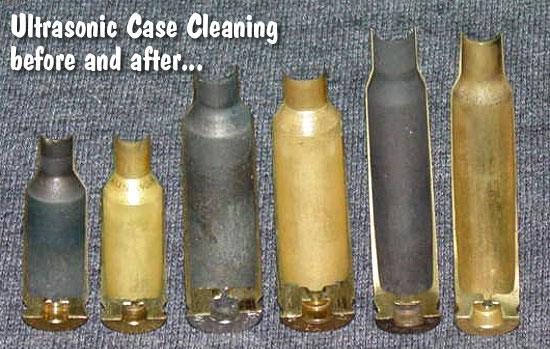
With the price of premium brass topping $1.00 per case for popular match cartridges, it makes sense to consider annealing your brass to extend its useful life. You don’t want to chuck out brass that costs a buck a case (or more)! Forum member Darrell Jones offers a full range of brass prep, brass forming, and brass restoration (annealing, ultra-sonic cleaning) at very affordable prices. Starting at just $20 per 100 cases ($25/100 for magnum cases), Darrell’s company, DJ’s Brass, will anneal your used brass using state-of-the-art Bench-Source annealing machines. Annealing plus ultrasonic cleaning starts at $35 per 100 cases ($45 for magnum cases). For a bit more money Darrell can also uniform the primer pockets and chamfer the case necks.
Custom Neck-Turning Services
Another great service DJ’s Brass provides is precision neck-turning. Darrell can neck-turn any size case to your specified neck-wall thickness. The price starts at $60.00 per hundred for standard cases or $75.00/100 for magnum size with a $25.00 minimum order. And if you’ve got a bucket of brass to neck-turn, that’s fine with Darrell — he recently neck-turned 1500 pieces of brass for one customer!
DJ’s Brass can process everything from .17 Fireball all the way up to the big magnum cases. And the job gets done quickly. Darrell normally offers a 10-day turn-around. For most jobs, Darrell tells us, he gets the processed brass to the Post Office within three business days. For more info, visit DJsBrass.com or call Darrell Jones at 205-461-4680. IMPORTANT: Contact Darrell for shipping instructions BEFORE sending any brass for processing. ALL BRASS MUST BE DE-PRIMED before you send it.
• Anneal Case Necks Only ($20.00/100 normal or $25.00/100 magnum)
• Ultrasonic Cleaning, Check Necks, and Annealing ($35.00/100 normal or $45.00/100 magnum)
• Full Service: Uniform primer pockets, Chamfer case mouths, Ultrasonic cleaning and Polishing, Anneal case necks (Starting at $50.00/100 call for quote)
• Neck Turning or trim-to-length Custom Order Service (Starting at $60.00/100 for standard cases and $75.00/100 for magnums)
• Hydro-Form Specialty cases (such as Dasher) $0.60 (sixty cents) each minimum of 100 pieces plus actual return shipping cost
• Expand Case Necks and Anneal brass (Call for Price)
• Create False Shoulder for Fire-Forming (Call for Price)
• Ultrasonic Cleaning of Muzzle Brake, $5.00 plus actual shipping
Hydro-Forming Cartridge Brass
Hydro-forming by Darrell costs $0.60 per case with a minimum order of 100 pieces. After hydro-forming, Darrell can also neck-turn the case for an additional charge (call for combined quote). In addition to the 6mmBR-based cases shown below, Darrell can now hydro-form 6PPC cases from .220 Russian brass.
With Darrell’s hydro-forming service you don’t have to buy any special dies or other equipment. Darrell says: “Simply send me the brass you need or have it dropped-shipped to me along with a fired case that has not been sized. If you need formed brass for a new build (gun not yet fired), let me know and I will size the brass to fit within .001″ of a PT&G GO gauge.”
DJ’s Brass Offers Specialized Custom Services
Darrell tells us: “At DJ’s Brass, we can handle all your brass refurbishing needs. From ultrasonic cleaning to custom annealing for specific wildcat cartridges. We can expand your necks from .22 caliber to .30 caliber and anneal shoulders for consistent bump-back. We can turn your case-necks and trim the brass to your specs. For some cartridge types, I can pre-form cases to assist in fire-forming a wildcat cartridge. We also remove the carbon build-up in muzzle brakes. Don’t lose your accuracy by having carbon build up and close off the clearance required for the most accurate bullet release through a muzzle brake.” Note: Extra charges apply for neck-turning and neck expansion operations, or specialized cartridge-forming operations. Please call Darrell at 205-461-4680 for special services pricing.
What is the most-used piece of equipment on this editor’s reloading bench? No it’s not my Rock-Chucker press, or even my calipers. The one item in near-constant use is a small, folding magnifying glass. Mine folds into a square case and offers 4X viewing with an 8X bifocal insert. With this handy tool I can inspect case mouths for burrs, check primer pockets, inspect meplats, and look for flaws on bullet jackets. I also use the magnifier to see rifling marks on bullets seated into the rifling, or check my bolt for galling. The number of uses is nearly endless. I keep one magnifier at my reloading bench and another in my range kit.
Folding magnifiers are so handy yet inexpensive that you should own a couple spares (including one in the range box). I bought my magnifier in a book-store, but you can also find them on the web at FoldingMagnifier.com and WidgetSupply.com starting at just $1.95. To see the finest details, Widget Supply offers a powerful 9X/18X slide-out magnifier with a built-in, battery-powered LED light. With that gadget, you can easily see any minute flaws in your barrel crowns. That’s important because crown damage can cause hard-to-diagnose accuracy issues. We’ve known guys who spend weeks tinkering with loads, when the real problem was a worn-out or damaged crown.
PrecisionRifleBlog.com (PRB) recently published results from a field test PRB conducted to quantify the temperature stability of the popular Hodgdon H4350 and Varget powders and compare those to IMR’s new Enduron line of powders, specifically IMR 4166 and 4451.
Hodgdon Extreme Series powders have attracted quite a fan base, with over 90% of the top shooters in the Precision Rifle Series choosing to run one of those powders. IMR recently released a new line of powders “with Enduron Technology” — which is also marketed to have “extreme temperature stability”. Sounds familiar! These new powders should compete directly with the Hodgdon Extreme Series, which gives shooters more temp-stable powder options to consider.
The top shooters in the PRS and veteran long-range shooters in other disciplines have learned to value a temperature-stable powder. That’s because a change in temperature can affect the trajectory or “flight path” of the bullet in two well-known ways:
1. Assuming all other environmental conditions remain the same, an increase in air temperature will cause a flatter trajectory due to a lower air density (easier for the bullet to cut through the air).
2. The same increase in temperature also causes the nitrocellulose-based powder inside the cartridge to burn at a higher rate, producing approximately four times the Point of Impact (POI) shift than just air temperature alone. (SEE: Temperature Effects On Zero on KestrelMeters.com.)
“The initial heat condition of your powder will affect the burn rate,” Bryan Litz explained at a recent Applied Ballistics Seminar. That means swings in ambient outside temperature can affect your internal ballistics, which will directly affect your muzzle velocity, which will change your bullet’s trajectory. Some powders are more affected by changes in temperature than others. So if your goal is first-shot hits and you may shoot in a variety of conditions — you should care about temperature stable powders.
The folks at PrecisionRifleBlog.com meticulously loaded 6.5×47 Lapua ammo with each powder using some of the best equipment available. This included the top-of-the-line Prometheus Gen II Powder Scale, which is capable of loading to the nearest kernel of powder. This ensured the powder charges were identical for each round of ammo. PRB’s testers explain the full set of equipment and steps in their loading process in the Full Test Report.
Once they had a couple dozen rounds loaded with each powder, they went and shot them with each powder at 25° F, 65° F, and 140° F. The muzzle velocity of each shot was recorded using both a LabRadar Doppler Radar and a MagnetoSpeed Chronograph. The LabRadar is a new type of device that allows you to measure muzzle velocity within at least +/- 0.1% of the reading.
Here are the results from the PRB Powder Temp Stability Tests:
You can see Hodgdon H4350 had the least variance in muzzle velocity, with just 25 fps over the 115° swing in temperature! That is very, very low. Hodgdon Varget was the second least temperature sensitive powder in this test, with 46 fps of variance in muzzle velocity between temperatures of 25° F and 140° F. IMR 4166 performed very similar to Varget, and proved to be fairly insensitive to large swings in temperature. IMR 4451 had the largest swing in muzzle velocity of the powders tested, but keep in mind just 68 fps over 115° F swing is still a good performance.
Most powders aren’t specially formulated to be temperature stable. So they would likely show much larger swings than what these four top-performing powders showed.
PRB’s test team also noticed other interesting trends in the data. For example, variation in velocity does NOT appear to be linear across the full range of temperatures. By that, they mean the change per degree from 20° to 65° might be smaller or larger than the change per degree from 65° to 140°.


 Craters may look interesting on the moon, but you don’t want to see them on your primers. Certain mechanical issues that cause primer craters can also cause primer piercing — a serious safety problem that needs to be addressed. If you have a gun that is cratering primers (even at moderate pressure levels), there is a solution that works with many rifles — send your bolt to Greg Tannel to have the firing pin hole bushed.
Firing Pin Hole Bushing by Greg Tannel




 With the price of premium brass topping $1.00 per case for popular match cartridges, it makes sense to consider annealing your brass to extend its useful life. You don’t want to chuck out brass that costs a buck a case (or more)! Forum member


 What is the most-used piece of equipment on this editor’s reloading bench? No it’s not my Rock-Chucker press, or even my calipers. The one item in near-constant use is a small, folding magnifying glass. Mine folds into a square case and offers 4X viewing with an 8X bifocal insert. With this handy tool I can inspect case mouths for burrs, check primer pockets, inspect meplats, and look for flaws on bullet jackets. I also use the magnifier to see rifling marks on bullets seated into the rifling, or check my bolt for galling. The number of uses is nearly endless. I keep one magnifier at my reloading bench and another in my range kit.


