At the request of our readers, we provide select “Deals of the Week”. Every Monday morning we offer our Bargain selections. Here are some of the best deals on firearms, hardware, reloading components, and shooting accessories. Be aware that sale prices are subject to change, and once clearance inventory is sold, it’s gone for good. You snooze you lose.
Vortex’s Precision Shooting Tactical (PST) line of riflescopes offers features that are normally only available in high-priced optics. This 4-16x50mm EBR-1 Scope offers an illuminated second focal plane EBR-1 reticle, side-focus parallax adjustment, tactical turrets, and an objective lens that will allow you to see well into twilight. This scope also offers Milradian adjustments, a 30mm main tube, and a weight of only 22 ounces — making it an ideal optic for a tactical or precision rifle, varmint blaster, or hunting rifle. For current stock only at EuroOptic.com, save $200 off this already competitively-priced scope for an out-the-door price of only $499.99. No doubt about it — this is a great deal.
2. Powder Valley — $10 Off Berger 6mm and 6.5mm Hybrids
Here’s a special deal for AccurateShooter.com readers. Our friends at Powder Valley have just put two of the most popular Berger match projectiles on sale. Right now you can get $10.00 off all 500-count boxes of Berger 6mm 105gr Hybrid and 6.5mm 140gr Hybrid bullets. This special sale runs from now until July 31 or when stock runs out (subject to quantity on hand). We recommend you act quickly — these are popular bullets. To get this deal, visit PowderValleyInc.com then click on the “Specials” link.
The LabRadar is the most advanced chronograph on the market. When it was first released, you had to wait months to get one of these Doppler Radar units. Now they are in-stock and ready to ship at Bruno Shooters Supply for $559.95. Once you learn how to position and adjust the LabRadar, you should find the machine reliable and versatile. We do recommend getting a separate battery pack. If you are considering purchasing a LabRadar Chronograph, we strongly suggest you read the very thorough and informative LabRadar Review by Ray Gross, Captain of the USA F-TR team. NOTE: If the LabRadar sells out at Bruno’s, you should be able to get it from MidwayUSA, for the same $559.95 price.
3. Natchez — Special 5 Reloading Press Kit, $199.99
This is an excellent entry-level reloading kit, which is on sale for $199.99 at Natchez Shooters Supply. We like the relatively compact Special 5 press for most reloading duties. Eventually you many want to add an additional large heavy press, but this will get the job done. This kit includes an RCBS Powder Measure, Digital Scale, Powder Trickler, Hand Priming Tool, Load Manual, Loading Tray, and more. It’s hard to beat this combination of tools for under $200.00.
If you shoot long range, you need a scope level. This Discovery scope level is fully CNC-machined to close tolerances for a good fit. It is available with three inner diameters to fit scopes with 1″, 30mm, or 34mm main tubes. The 1″ version is just $11.99 while the 30mm model is $13.95 and the large 34mm version is $15.95. You could easily pay $35.00 or more for a 30mm scope level. Purchasers have praised this product: 89% of verified buyers rated this five stars.
If you have brass or small parts to clean an ultrasonic cleaning machine really comes in handy. This Lyman machine was a good deal at $69.99 before. Now it is an awesome deal at $49.99 from Cabela’s. Plus you may even be able to get it for less. One buyer said you can get this item for $44.99 including shipping if you use code “16CAVE” at check-out. Worth a try.
6. NRA & MidwayUSA — NRA Life Membership, $500.00
Here’s the best deal going right now on an NRA Life Membership. This normally costs $1500.00, but if you CLICK HERE, you can get a life membership for just $500.00, thanks to an NRA/MidwayUSA promotion. This deal is good through July 31, 2016. You can also save on 1-year, 3-year, and 5-year NRA memberships.
7. Midsouth — Ammo Crates: Medium $12.97, Large $14.94
These stackable, lockable “Ammo Crates” hold up to 85 pounds of shooting supplies. Choose from two different OD green versions on sale now at Midsouth. The $12.97 Medium (4.5″-deep) Ammo Crate is good for smaller boxes of bullets, factory ammo, or shotshells, while the $14.94 Large (7.25″-deep) Ammo Crate is ideal for packing the plastic 50-count and 100-count plastic ammo boxes. We like the Large-size, deeper crate for the added capacity since we typical carry our cartridges in the large 100-count MTM boxes with carry handles. Purchasers like these big Ammo Crates. Verified purchaser B-Lo states: “This thing is sweet and fully-loaded doesn’t flex and has good, tight locking lid/handles. A must have for anyone looking to store or transport larger quantities of ammo”.
Lyman’s new Bleacher Block stepped cartridge holders are great. Use the different levels for sorting brass. Or, migrate the brass from top to bottom as you proceed through case prep stages. Made of durable polymer, Bleacher Blocks are molded in three sizes. The smallest size (with 0.388″-diam holes) fits .223 Rem-size case heads. The middle size (with 0.485″-diam holes) fits .308 Win-size case heads. The biggest Bleacher Block has 0.565″-diameter recesses for magnum-size cases. All three cartridge block sizes hold fifty (50) rounds. Purchase any size for just $5.90 per Block at Midsouth.
The AccurateShooter.com Shooters’ Forum hit another membership milestone. We’ve surpassed 32,000 registered members. Now we hope to reach 35,000 members in the next few months. If you have considered joining our Forum, but haven’t done so yet, there’s no better time than now. We have recently installed new “mobile-friendly” Forum software that works great with smart phones and tablets. You can now stay in touch when you’re on the go. Log in with your iPhone or Android phone. The new software also makes it much easier to add photos to your posts and classified adverts.
As a Forum member, you’ll be part of an active community of serious shooters. You can get valuable advice on shooting and reloading from top shooters such as National Champions Larry Bartholome, Sam Hall, and Derek Rodgers. As well, many top experts visit the Forum, such as Bryan Litz (Applied Ballistics), Shiraz Balolia (Bullets.com), Frank Green (Bartlein Barrels), and John Perkins (21st Century Shooting).
Visit Forum.AccurateShooter.com to check out our Forum features. You’ll find a wealth of information shared by thousands of knowledgeable members. The boards are tightly moderated to prevent the ego battles common to some other internet forums. Our Shooters’ Forum maintains a high “signal to noise ratio”, with courteous and respectful exchange of ideas.
Sell Your Gear with FREE Classifieds
Along with our informational Forum areas, we offer FREE CLASSIFIEDS for all registered Forum members. You’ll find some great values in the Classifieds, and we provide a feedback system for buyers and sellers. Published feedback helps you buy and sell with greater confidence.
With the increased interest in the 6.5 Grendel cartridge and Grendel-based wildcats (such as the 6mmAR and 30 Major), today we’ve re-released a review by Robert Whitley.
Robert Whitley of AR-X Enterprises, LLC builds match-grade uppers for AR-platform rifles. Many of Robert’s favorite chamberings are based on the 6.5 Grendel case necked-down to 6mm. Until 2011, Lapua was the only source for 6.5 Grendel brass. As you’d expect, Lapua’s Grendel brass is truly excellent, but it is also pricey, and sometimes hard to find. Now Hornady is producing USA-made 6.5 Grendel brass. Robert Whitley has worked with the Hornady 6.5 Grendel brass for over a year now and he is able to assess its performance compared to the original Lapua version. Writing in our Shooters’ Forum, Robert reveals: “It’s decent brass but hot loads will loosen the primer pockets fast. With moderate loads you will get good case life and service from the brass and it can deliver excellent accuracy as well. Not Lapua but not bad either.”
Robert reports: “I was able to get my hands on some of Hornady’s 6.5 Grendel brass. My big question was how it would measure up, particularly the loaded necks, and whether it would be compatible with our existing 6mmAR and Turbo 40 die sets. As it turns out, this brass looks like a perfect fit for our existing die sets (and obviously 6.5 Grendel die sets too). Accordingly, folks with existing die sets will be able to use the Hornady brass without any issues.” However, as the loaded neck on the Hornady brass is .001″ (one-thousandth) slimmer than Lapua brass, you may want to try a smaller bushing when sizing Hornady Grendel brass.
The Hornady 6.5 Grendel brass has a LARGE Flash Hole, about .078″ versus .0591″ for Lapua brass. Dimensionally, the biggest difference is the shoulder diameter, with the Hornady brass measuring 0.428″ vs. 0.424″ for the Lapua brass. The Hornady is actually a better fit for 6mmAR chambers which are about 0.432″ at the shoulder. Interestingly, case H20 capacity is virtually identical. Water capacity of new, unfired Hornady 6.5 Grendel brass is 35.1 grains, while new, unfired Lapua Grendel brass holds 35.0 grains of H20. Both brands of Grendel brass increase to about 36.0 grains H20 capacity after firing and full-length sizing.
Here are some of the particulars of the Hornady cases:
Hornady 6.5 Grendel Brass
Lapua 6.5 Grendel Brass
Flash hole diameter: ~ .078″
OAL of brass: Average 1.515″
Weight of cases: 111.7 to 113.0 grains
Web diameter, unfired: 0.4375″
Shoulder diameter, unfired: 0.428″
Loaded neck diameter: 0.2895″
6mmAR loaded neck: 0.270″
Flash hole diameter: 1.5mm (0.0591″)
OAL of brass: Average 1.515″
Weight of cases: 111.0 to 112.5 grains
Web diameter, unfired: 0.4385″
Shoulder diameter, unfired: 0.424″
Loaded neck diameter: 0.290″
6mmAR loaded neck: 0.271″
Many Forum members have been looking for a good substitute for Hodgdon H4350 powder, which remains hard-to-find in many parts of the country. One of the best alternatives is IMR 4451, part of IMR’s new Enduron line of powders. Last year, top F-Class shooter Rick Jensen did a comparison between H4350 and IMR 4451, shooting the two powder in a wide range of temperatures. His data suggests that both powders show good temp stability.
Powder Comparison Test: H4350 vs. IMR 4451
Rick Jensen, Captain of the U.S. F-Open Rifle Team, has tested some of the new IMR 4451 powder. Rick and other team members were looking for a good powder that could replace Hodgdon 4350 which is difficult to obtain currently. The makers of IMR 4451 claim that it is not sensitive to temperature and that it delivers competitive accuracy. So far, Rick’s tests, done with a .284 Winchester and 180gr Berger Hybrids, appear to confirm those claims. Rick posts:
“I did a little informal powder comparison of H4350 versus the new IMR 4451. Rifle used was a Kelbly Panda with a 30″, 1:8.75″ twist 5R Bartlein barrel [chambered in .284 Win]. All charge weights were 50.0 grains using CCI BR2 primers. I was very impressed with this new powder and I believe it to be equal to H4350 as far as temperature sensitivity.
I did not test for accuracy but I will tell you my groups were pretty much equal between the two and all were in the .2-.3 MOA range. I will defiantly be shooting more of this powder in the weeks to come, assuming the supply chain will allow. It looks very encouraging to finally have a alternative to H4350 that we might actually be able to buy.”
Chronograph Results with Temps from 23° F to 101°
Here are chronograph results of a comparison test between IMR 4451 and H4350. Rick’s rifle was cleaned and allowed to cool between each test. Five fouling shots were fired before each test. Important: Note that for both Test #1 and Test #2, the powder order is reversed in the mid-temp fields (IMR 4451 first, then H4350). For the low and high temp entries, H4350 is listed first.
Here are the IMR 4451 fired cases, displayed Left to right, coldest to the hottest (in terms of case temp when fired). All charge weights were the same: 50.0 grains.
In our Shooters’ Forum, many questions are asked about QuickLOAD software — how to get best results, how to use the advanced features, how to adjust for temperature and so on. To help answer those questions, here’s a short feature we first ran during SHOT Show 2012. You can also CLICK HERE for a very detailed explanation of QuickLOAD in our main site.
At SHOT Show, we had the chance to meet with German software engineer Hartmut Broemel, creator of QuickLOAD software. This software program, while not a substitute for conventional load manuals, allows shooters to evaluate a wide range of powders and bullets, comparing potential loads on the basis of predicted pressures, velocities, load density and projectile in-barrel time.
We took the opportunity, in the video below, to explain some of the fine points of QuickLOAD for our members. QuickLOAD, sold by Neconos.com, helps reloaders understand how changing variables can affect pressures and velocities. It can predict the effect of changes in ambient temperature, bullet seating depth, and barrel length.
In the video below we explain how to adjust the program for true case capacity, bullet seating into the lands, and other important factors. If you are a new QuickLOAD user, or are contemplating buying the $152.95 program, you should watch the video. The program isn’t perfect, but it can accelerate the load development process, and it can save you money by narrowing down the list of appropriate powders for your cartridge.
No other product currently available to serious reloaders offers as much predictive power as QuickLOAD, and you’ll find your money well spent just for the vast collection of data on bullets and cartridges. With a couple mouse-clicks you can instantly get the specifications of hundreds of bullets and cartridges. Likewise, in a matter of seconds, you can compare load density for a half-dozen powders, or compare the projected velocities of one cartridge versus another.
Behold… the Holy Grail, Hodgdon Varget powder. Among all the rifle propellants on the market, Varget may have been the hardest to find in the last couple of years. But take heart, Midsouth Shooters Supply and Powder Valley Inc. now have 1-pound containers of Varget in stock for immediate delivery. To get to the PVI order screen, from the PVI Home page, click “Powders” then click “Hodgdon”.
Over the years, Hodgdon Varget has proven to be one of the most accurate powders ever created. And it is also exceptionally temp-stable. In the .308 Win, 6mmBR, 6mm Dasher and other popular cartridges, Varget has set many records and won countless matches. It meters well (for an extruded powder) and can be used in a very large range of calibers and cartridge types. If you need Varget… don’t hesitate. Supplies are limited. This may sell out by the end of the day today..
TIME STAMP: This Notice Issued at 9:30 am EST Saturday, June 25, 2016.
At the request of our readers, we provide select “Deals of the Week”. Every Monday morning we offer our Bargain selections. Here are some of the best deals on firearms, hardware, reloading components, and shooting accessories. Be aware that sale prices are subject to change, and once clearance inventory is sold, it’s gone for good. You snooze you lose.
1. Monmouth Reloading — Sig Sauer Kilo 2000 LRF $499.00
This excellent laser rangefinder rivals other premium LRFs selling for hundreds more. Head-to-head field tests with Leica, Zeiss, and Swarovski LRFs proved that the new Sig Sauer Kilo 2000 can play in that league, but at a much more affordable price point. Sig accomplishes that with tight beam divergence and state-of-the-art DSP technology which allows the Kilo 2000 to range faster (and more reliably) at longer distances. Optic magnification is 7X. The Kilo 2000 weighs 7.5 oz and measures 3″ x 4.2″ x 1.3″.
— Lumatic OLED Display™ monitors ambient light and adjusts display brightness.
— AMR™ (Angle Modified Range) built-in angle compensation.
— 4X per second refresh rate in scan mode.
— Dependable waterproof (IP X-4) and fog-proof performance.
— Lightweight magnesium body and compact form.
SAVE MORE: Right now you can save an additional $110 off every Rangefinder Monmouth Reloading sells, including the Sig Kilo 2000. To save an additional $110, use Coupon Code LRF 110. That will lower your cost to $389.00 for the Kilo 2000, which is a total steal. (Time-limited offer).
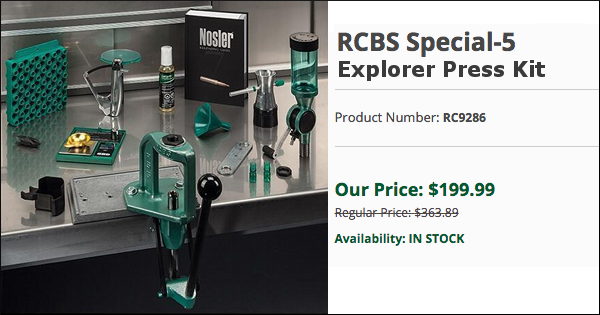
2. Natchez — Special 5 Reloading Press Kit, $199.99
This is an excellent entry-level reloading kit, which is on sale for $199.99 at Natchez Shooters Supply. We like the relatively compact Special 5 press for most reloading duties. Eventually you many want to add an additional large heavy press, but this will get the job done. This kit includes an RCBS Powder Measure, Digital Scale, Powder Trickler, Hand Priming Tool, Load Manual, Loading Tray, and more. It’s hard to beat this combination of tools for under $200.00.
3. NRA Life Membership $500 — Offer Ends 7/31/2016
If you are considering getting an NRA Life membership, now is the time to buy. You can get a Life Membership for $500.00. That’s $1000.00 off the regular $1500.00 price. You heard us right — save a thousand bucks on an NRA Life Membership. This offer is good through July 31, 2016. And with each lifetime membership, you get your choice of one of four print magazines: American Hunter, American Rifleman, Shooting Illustrated, or America’s First Freedom.
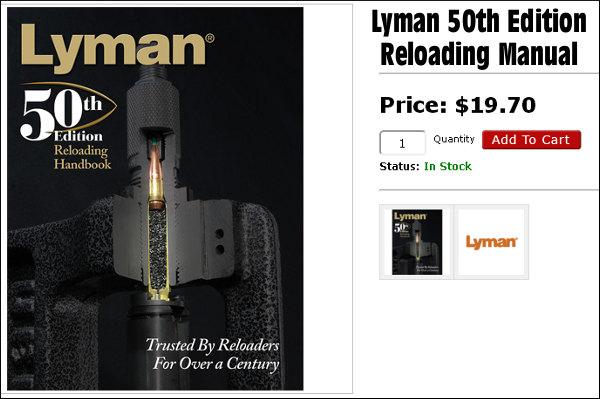
4. Midsouth — Lyman 50th Edition Reloading Manual
Here’s a good deal on the new Lyman 50th Ed. Reloading Manual. Our Forum members have rated this as the best Loading Manual for starting hand-loaders. This 50th Anniversary Edition, the first to be produced in full color, includes more load data, and covers more cartridge and bullet types than ever before. This handbook has a strong heritage, starting with the Ideal/Lyman reloading manuals from the early 20th Century. (In 1925, Lyman purchased Ideal Reloading Products, which produced the Ideal reloading handbooks.)
Bullet-maker Bart Sauter used this RAVpower portable charging unit to power his LabRadar chronograph at a short-range shooting match. He reports: “I bought a RAVPower pack from Amazon. It was the most powerful cell phone charger they had and it was reduced to $31. It was able to run the LabRadar for two full days without recharging and still had juice.” This unit has impressive specs: “4.5A Output: Highest output in the market, featuring a 4.5A total output capable of simultaneously charging two tablets, making it faster and more powerful than the rest. Exclusive iSmart Technology… ensures fastest and most efficient charge.”
Need quality .22 LR rimfire ammo at an affordable price? Consider Norma. Most folks think Norma only produces centerfire ammo and cartridge brass. As a result, people haven’t been looking for Norma rimfire ammo. Their loss is your gain. Accurate, reliable Norma .22 LR ammunition is in-stock right now at leading online vendors. This is good quality ammo, made in Europe. Bullets.com has Norma Tac-22 ammo in stock at $5.25 per 50-rd box (SKU: BL7819). In addition, Bullets.com offers Norma Match-22 ammunition at $7.50 per 50-rd box (SKU: BL11887).
7. Cabela’s — Lyman Turbo Sonic 1200, $59.99
Looking for a reliable ultrasonic cleaning unit at a rock-bottom, $59.99 price? Here’s a very good deal — this new Lyman 1200 sells elsewhere for up to $110.00. This machine will hold up to 350 9mm cases, and clean them in 10-15 minutes. The see-through cover lets you view the progress in the 6.5″L x 5.4″W x 2.6″D heated tank. Select four different dwell times with handy touch controls.
8. Amazon — 34 NRR Top-Selling Ear Muffs
If you want serious hearing protection, and can tolerate large muffs, these Clear Armor earmuffs are hard to beat for the price. They seal very well and carry an unsurpassed 34db Noise Reduction Rating (NRR). These are the #1 Best Selling Safety Muffs on Amazon. Yes they are big and bulky — but you only have one set of ears. These are a good choice for loud magnum rifles and noisy indoor ranges.
Each Wednesday, the U.S. Army Marksmanship Unit publishes a reloading “how-to” article on the USAMU Facebook page. Recently the USAMU’s reloading gurus looked at the subject of case lubrication. Tasked with producing thousands of rounds of ammo for team members, the USAMU’s reloading staff has developed very efficient procedures for lubricating large quantities of cases. This article reveals the USAMU’s clever “big-batch” lube methods. For other hand-loading tips, visit the USAMU Facebook page next Wednesday for the next installment.
Rapid, High-Volume Case Lubrication
Today’s topic covers methods for quickly applying spray lube to cartridge cases prior to sizing. A typical order for this shop may be 25,000 rounds, so [speeding up] the lubrication process can be a real time-saver. While your ammunition lots probably aren’t this large, the efficient methods discussed here may help save a considerable amount of time over your handloading career. Our case lubrication rates range from 1500-1600 cases per hour, to 2400-2500 cases per hour, depending on caliber.
This shop uses virgin brass, whereas most home handloaders use fired brass, which necessitates some small changes at times. These will be discussed as they arise. Begin with fired brass that has been tumbled clean.
Ensure as much tumbling media as possible is removed from the brass, as when it gets into a size die, it can dent cases significantly. This is a good time to round out dents in the case mouths using a tapered tool to prevent damage from the decapping stem.
First, dump the clean cases into a large box or reloading bin. Shake the bin back and forth so that many cases are oriented with the mouths up. Next, pick up as many cases as is convenient with the mouths “up”, from natural clusters of correctly-oriented cases. With 7.62mm-size cases, this is usually 3-4, and with 5.56mm cases, this can be up to 8-10. Place the cases into the rack slots, mouth-up. Doing this in groups rather than singly saves considerable time. Once these clusters have been depleted, it will be time to re-shake the bin to orient more cases “up.”.
This photo shows a case lubrication rack made by a USAMU staffer.
Naturally, adjust the spacing to best fit the calibers you reload. We have found this size … convenient for handling through the various phases of case lubrication/transfer to progressive case feeders for processing. Note that the 1/2-inch angle does not cover much of the critical case area at the base, just forward of the extractor groove, where most re-sizing force will be exerted. As the USAMU uses virgin brass, less lubrication is required for our brass than would be needed for Full Length (FL) sizing of previously-fired brass.
NOTE: The amount applied using our rack is easily enough for our purpose. If using fired brass, be sure to adequately lube this base area to avoid having cases stick in the full-length sizing die.
Using a spray lube, coat the cases adequately, but not excessively, from all sides. Be sure to get some lube into the case mouths/necks, in order to reduce expander ball drag and case stretching/headspace changes. The spray lube this shop uses does not harm primers or powder, and does not require tumbling to remove after lubing.*
Take a close look at the photo above. The USAMU shop uses a common kitchen turntable, which allows the rack to be rotated easily. We place this in a custom-made box which prevents over-spray on to floors and walls.
Angled Box Method for Smaller Cases to be Neck-Sized
A refinement of the above method which especially speeds processing of 5.56x45mm cases is as follows. A small cardboard box which holds about 100 cases is fitted with an angled “floor” secured by tape. With the smaller 5.56mm cases, usually about 8-10 cases per handful can be picked up, already correctly-oriented, and placed into the box together. This prevents having to place them into the rack slots, saving time.
HOWEVER, note that this does not allow nearly as much lube access to the case bodies as does the rack. For our purposes — neck-sizing and setting neck tension on new brass, this works well. If using this procedure with fired brass, take steps to ensure adequate lube to prevent stuck cases.
As always, we hope this will help our fellow handloaders. Good luck, and good shooting!
*A two-part test performed here involved spraying primed cases heavily, while getting more lube into the case mouth/body than even a careless handloader would likely apply. The second part of the test involved literally spraying considerable quantities of the lube directly into the cases, drenching the primers. After a several-day wait to allow the lube to penetrate the primers, they were then fired in a test barrel. All fired normally; no unusual reports were noted. This bolstered confidence that normal amounts of the lube would not adversely affect our ammunition, and we have been pleased with the results over several years.
IMR® Legendary Powders now offers four (4) Enduron powders: IMR 4166, IMR 4451, IMR 4955, and IMR 7977. Shooters looking for readily-available alternatives to hard-to-find extruded powders should definitely check out the Enduron line-up. Precision shooters will find an Enduron option well-suited to most of the popular precision cartridge types. For example, IMR 4166 is a good replacement for Hodgdon Varget (commonly used in the .223 Rem, 6mmBR and .308 Win), while IMR 4955 is a fine substitute for H4831 (favored by F-Open shooters for the .284 Win and 7mm WSM cartridges).
Modern Powder Technology for Enhanced Performance
The technology in IMR’s Enduron line of powders provides four very important qualities that enhance both in-gun and downrange performance.
Copper fouling reduction – these powders contain an additive that drastically reduces copper fouling in the gun barrel. Copper fouling should be minimal, allowing shooters to spend more time shooting and less time cleaning a rifle to retain accuracy.
Temperature change stability – the Enduron line is insensitive to temperature changes. Whether a rifle is sighted in during the heat of summer, hunted in a November snowstorm or hunting multiple locations with drastic temperature swings, point of impact with ammunition loaded with Enduron technology will be very consistent.
Optimal load density - Enduron powders provide optimal load density, assisting in maintaining low standard deviations in velocity and pressure, a key feature for top accuracy.
Environmentally friendly - Enduron technology is environmentally friendly, crafted using raw materials that are not harmful to the environment.
The Enduron Line-Up of Four Powders
IMR now offers four Enduron powders that cover a broad range of burn rates. They are suitable for a wide variety of cartridges, from small varmint cartridges all the way up to the .338 Lapua Magnum.
IMR 4166 possesses the fastest burn rate in the Enduron lineup. It is the perfect burn speed for cartridges such as .308 Win, 7.62mm NATO, 22-250 Rem and 257 Roberts. A versatile, match-grade propellant, IMR 4166 is comparable to Hodgdon® Varget.
IMR 4451 is a mid-range burn speed powder, ideally suited for cartridges such as .270 Winchester, .30-06 and 300 Winchester Short Magnum. This powder is comparable to Hodgdon H4350.
IMR 4955 is a medium burn speed powder, falling in between IMR 4451 and IMR 7977 in burn speed. It provides top performance in big game cartridges such as 25-06, 280 Remington and 300 Winchester Magnum. This powder is comparable to Hodgdon H4831.
IMR 7977 has the slowest burn rate among the Enduron Technology powders. Its loading density is perfect for magnum cartridges and contributes to superb uniformity, yielding outstanding performance in 300 Winchester Magnum, 7MM Remington Magnum and .338 Lapua Magnum. IMR 7977 is comparable to Hodgdon H1000.
The Enduron Technology powders are available in one-pound (1 lb) and eight-pound (8-lb) containers from quality reloading retailers. Learn more about Enduron powders at www.enduronimr.com. For info on other IMR powders, visit www.imrpowder.com.
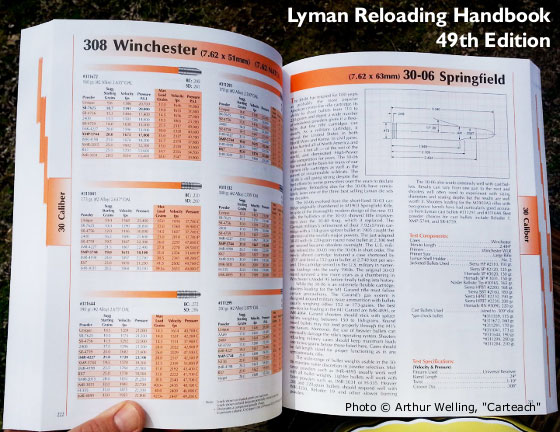
What’s the best book for folks getting started in metallic cartridge reloading? According to our Forum members, the best manual for “newbie” reloaders is the Lyman Reloading Handbook. In our Shooters’ Forum, a newcomer to reloading was looking for a basic reloading guide that also included load data. The most recommended book was the Lyman Handbook, now in its 50th Edition (just released). Along with “how-to” advice on reloading procedures, the Lyman Manual features cartridge specifications and load data for the most popular cartridges.*
Here are some comments from Forum members:
“The Lyman book is an excellent manual with a large section describing the process of reloading. I heartily recommend it. As a beginning reloader, you may want to consider purchasing more than one book in order to get different perspectives on the reloading regimen. One can never be too careful. A ‘minor’ mistake can be costly.” — Cort
“In my opinion, the Lyman Manual is one of the best for the beginning reloader since it covers all the basics and some advanced methods. If possible, you would be also well served to hook up with an experienced reloader, preferably a target shooter or long-range varmint hunter, who can also give you some very useful pointers on precision reloading.” – K22
Editor’s NOTE: K22 echoes the advice we give to new hand-loaders. We suggest that novices find an experienced mentor who can “show them the ropes” and guide them through the basics.
Another gun blogger agrees that the Lyman Manual is a logical choice for new handloaders:
Carteach Review: The Lyman Reloading Manual
“[Lyman publishes] an excellent manual for any handloader, but especially for those new to the craft. Perhaps the best judgment of a handloader’s regard for a reloading manual is which one he chooses to give someone new to the fold. The needs of a new reloader differ from those of someone with long experience, and the right manual can set the foundation for years of safe procedures. Here is the one I choose to give a good friend embarking down the path:”
Carteach adds: “Lyman has always taken pains to provide very clear and understandable instruction on the basic process of reloading cartridges. The imaging is helpful and to the point. The load data Lyman provides is comprehensive, and [Lyman] takes the time to note special circumstances which new loaders need to be aware of. As example, the .30-06 section has some words regarding the M-1 Garand and its special needs. For someone who has never loaded for the Garand, these few sentences are golden!”
*We recommend that you always double-check printed load data with the latest web-based data from the actual powder manufacturers. Powder properties can change. The most current powder data is usually found on the powder-makers’ websites.







 Visit
Visit 

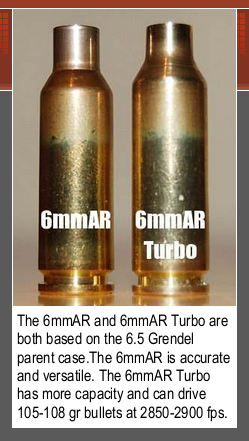 Robert reports: “I was able to get my hands on some of Hornady’s 6.5 Grendel brass. My big question was how it would measure up, particularly the loaded necks, and whether it would be compatible with our existing 6mmAR and Turbo 40 die sets. As it turns out, this brass looks like a perfect fit for our existing die sets (and obviously 6.5 Grendel die sets too). Accordingly, folks with existing die sets will be able to use the Hornady brass without any issues.” However, as the loaded neck on the Hornady brass is .001″ (one-thousandth) slimmer than Lapua brass, you may want to try a smaller bushing when sizing Hornady Grendel brass.
 “I did a little informal powder comparison of H4350 versus the new IMR 4451. Rifle used was a Kelbly Panda with a 30″, 1:8.75″ twist 5R Bartlein barrel [chambered in .284 Win]. All charge weights were 50.0 grains using CCI BR2 primers. I was very impressed with this new powder and I believe it to be equal to H4350 as far as temperature sensitivity.


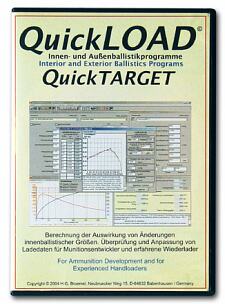 At SHOT Show, we had the chance to meet with German software engineer Hartmut Broemel, creator of QuickLOAD software. This software program, while not a substitute for conventional load manuals, allows shooters to evaluate a wide range of powders and bullets, comparing potential loads on the basis of predicted pressures, velocities, load density and projectile in-barrel time.