|
|
May 30th, 2016

At the request of our readers, we provide select “Deals of the Week”. Every Monday morning we offer our Bargain selections. Here are some of the best deals on firearms, hardware, reloading components, and shooting accessories. Be aware that sale prices are subject to change, and once clearance inventory is sold, it’s gone for good. You snooze you lose.
1. Amazon — Caldwell Long Range Target Camera System, $367.70

A few Forum members have purchased this Caldwell Target Cam System and they’ve found that it works reliably, providing a clear signal to any WiFi-enabled mobile device (smartphone, iPad, Laptop). One member specifically tested the unit at 1000 yards and it functioned fine. NOTE: This system does NOT have a zoom camera lens, so you need to position the camera within 10 yards or so of the target. But if you place it to the side a bit, this shouldn’t be a problem. This system comes with a nice, fitted carrying case that holds camera, transceivers, antennas, and stands. You get a very capable system for under $400.00.
2. Natchez — Special 5 Reloading Press Kit, $199.99
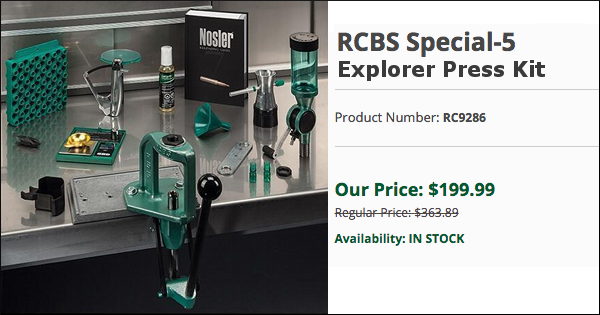
This is an excellent entry-level reloading kit, which is on sale for $199.99 at Natchez Shooters Supply. We like the relatively compact Special 5 press for most reloading duties. Eventually you many want to add an additional large heavy press, but this will get the job done. This kit includes an RCBS Powder Measure, Digital Scale, Powder Trickler, Hand Priming Tool, Load Manual, Loading Tray, and more. It’s hard to beat this combination of tools for under $200.00.
3. Walmart — 14-gun Stack-on Gun Safe

If you need a smaller, secondary safe that can fit in a closet, here’s a 14-gun Stack-On Safe that is a great bargain right now. The safe is on sale at Walmart for $399.00 — nearly $200 off the regular price. And Walmart offers FREE shipping or FREE Pickup. Don’t expect this to hold anywhere near 14 scoped rifles — 8 or so long-guns will probably be the most you can fit comfortably. But that’s fine for a secondary “closet” safe that will also articles such as cameras, jewelry, and important documents. One verified safe purchaser states: “This safe is 300 pounds, not too hard to move around, took it home in my truck.”
4. Cabela’s — Lyman Turbo Sonic 1200, $69.99

Looking for a reliable ultrasonic cleaning unit at a rock-bottom price? Here’s a very good deal, $69.99 for the Lyman 1200 (this popular unit sells elsewhere for up to $110.00). This machine will hold up to 350 9mm cases, and clean them in 10-15 minutes. The see-through cover lets you view the progress in the 6.5″L x 5.4″W x 2.6″D heated tank. Select four different dwell times with handy touch controls.
5. CDNN Sports — Ruger American Ranch Rifle (Tan), $389.99

Here’s a nice little varmint rifle from Ruger with some nice features at a very attractive price, $389.99. This .223 Rem rifle features a 16.5″ hammer-forged barrel barrel threaded 1/2″-28 at the muzzle for brake or suppressor. The action, which features a 70° three-lug bolt, and Picatinny-style scope rail, sits in an aluminum bedding block. The crisp trigger adjusts down to 3 pounds. With a weight (before optics) of 6.1 pounds, this is a handy carry-around varminter.
6. MidwayUSA — Free Shipping with Order of $150.00 or More.

Here’s a deal that can save you big bucks on shipping. But don’t procrastinate — this free shipping offer runs out tomorrow (5/31/2016). If you shop at MidwayUSA during the next two days, you can get FREE Shipping on all orders of $150.00 or more for in-stock merchandise. Use Promo Code FSMEMORIAL on check-out. NOTE: This offer expires Tuesday, May 31, 2016 at 11:59 PM CST.
7. Midsouth — Lyman Bleacher Loading Blocks

Lyman’s new Bleacher Block stepped cartridge holders are great. Use the different levels for sorting brass. Or, migrate the brass from top to bottom as you proceed through case prep stages. Made of durable polymer, Bleacher Blocks are molded in three sizes. The smallest size (with 0.388″-diam holes) fits .223 Rem-size case heads. The middle size (with 0.485″-diam holes) fits .308 Win-size case heads. The biggest Bleacher Block has 0.565″-diameter recesses for magnum-size cases. All three cartridge block sizes hold fifty (50) rounds. Purchase any size for just $5.90 per Block at Midsouth.
8. RCBS — Buy Green, Get Green Rebate

RCBS is running a very attractive Rebate Program currently. If you spend $300.00 on qualifying products you get a $75.00 rebate. Spend $50 and get a $10.00 Rebate. This program is limited to one (1) rebate redemption per calendar year, with a maximum of $75.00. CLICK HERE for more information. NOTE: To qualify, you must supply completed RCBS rebate coupon, original UPC barcodes from package, and original cash register receipt and/or dated, itemized sales invoice.
May 29th, 2016

If you’re planning a significant purchase, such as a new riflescope, or a couple new barrels, then head over to Bruno Shooters Supply in the next two days. Now through 8:00 am on May 31st, 2016, Bruno’s is running a Memorial Day Sale. You can get 7% off ALL online orders (other than firearms or actions). So you can save 7% on optics, 7% on powder and primers, 7% on barrels, 7% on reloading tools… you get the idea. Doing the math, seven percent off a $2000.00 scope is $140.00 — that’s a fair chunk of change.
NOTE: This deal applies to Online Orders Only, placed through www.BrunoShooters.com. (Phone lines will NOT be open over the holiday.) Bruno’s stocks all your favorite products, including brass from Lapua and Norma, bullets from Barts, Berger, Sierra, and Nosler, dies from Redding and Wilson, and Powder from Hodgdon, IMR, Norma, Alliant and Western. Bruno’s also has a large selection of optics including comp scopes from Leupold, Nightforce, Sightron, and Weaver.

Sale tip from EdLongrange. We welcome Reader Submissions.
May 27th, 2016

When developing loads, it is important to know the true internal capacity of your cases, both fired and “as FL-sized”. In particular, when using the QuickLOAD program, it is vital to determine true case capacity. The default case capacity values listed by QuickLOAD may be off half a grain (or more) because brass from different manufacturers can vary considerably in capacity. Case capacity is a very important variable that will affect the pressure of a load and the velocity of your bullets.
To determine the true internal capacity of your cases, first weigh an empty cartridge case, then fill the case with water (all the way to the top of the neck) and weigh the case again. The difference in weight is your H20 capacity in grains. But how do you keep the H20 from flowing out the bottom? When measuring fired, unsized cases, you can simply leave the spent primer in the pocket. However, if you want to measure new brass or “as-FL sized” cases that have been deprimed, you’d have to insert a spent primer to “stem the tide”. Until now that is… 21st Century Shooting sells a great little $5.50 tool that plugs the bottom of the case so you can measure H20 capacity with ease.
When we saw 21st Century’s Primer Pocket Plug we thought “That’s smart — why didn’t someone think about that a long time ago?”. This handy “end-cap” lets you quickly measure multiple new brass cases or deprimed FL-sized cases so you can get an average H20 capacity. The primer pocket plugs are NOT case-specific (they feature an O-ring that fits the pocket). One version will work with all small-primer-pocket cases, while another works with all large-primer-pocket cartridge types. Price is $11.99 for either small-pocket or large-pocket version.
NOTE: If you want to measure H20 capacity on fired, sized brass, but don’t want to shell out the money for the tool (or re-insert a spent primer), here’s a simple suggestion. When you size your case, first remove the decapping rod from the die. Then you can FL-size the case without removing the primer. Of course, you will eventually have to knock the primer out, and that requires putting the decapping rod back in the die and running the case through a second time. To avoid that hassle, the Primer Pocket Plug may be worth the twelve bucks over the long haul.
Product Find by EdLongrange. We welcome reader submissions.
May 23rd, 2016
At the request of our readers, we provide select “Deals of the Week”. Every Monday morning we offer our Bargain selections. Here are some of the best deals on firearms, hardware, reloading components, and shooting accessories. Be aware that sale prices are subject to change, and once clearance inventory is sold, it’s gone for good. You snooze you lose.
1. Midsouth — Nikon Buckmaster II Scopes, $129.95

If you need a good, basic mid-range zoom for a hunting rifle or general-purpose rifle, this deal is hard to beat. Choose either 4-12x40mm or 3-9x40mm for just $129.95. And there’s free shipping to boot! Both scopes feature Nikon’s patented BDC reticle and are backed by Nikon’s no-nonsense, lifetime warranty. CLICK HERE to see this offer at Midsouth Shooters Supply.
2. CDNN — Howa 1500 Rifle with Vortex Viper Scope, $899.99

Here’s a great deal on an outstanding hunting combo. You get a complete Howa 1500 Alpine rifle PLUS a quality Vortex Viper 3-9x40mm scope for $899.99. Two chamberings are available with this package. Select the 7mm-08 model for bigger game or choose the .243 Win model for predators and varmints. The Howa 1500 has a smooth-running action and excellent 2-stage HACT trigger. The highly-regarded Vortex Viper scope sells elsewhere for $300.00 or more by itself.
3. Amazon — Caldwell Long Range Target Camera System, $399.49

A few Forum members have purchased this system and they’ve found that it works reliably, providing a clear signal to any WiFi-enabled mobile device (smartphone, iPad, Laptop). One member specifically tested the unit at 1000 yards and it functioned fine. NOTE: This system does NOT have a zoom camera lens, so you need to position the camera with 10 yards or so of the target. But if you place it to the side a bit, this shouldn’t be a problem. This system comes with a very nice, fitted carrying case that holds camera, transceivers, antennas, and stands. You get a very capable system for under $400.00.
4. Cabela’s — RCBS Master Reloading Kit, $225.00 After Rebate

Everything you see above can be yours for just $225.00, after manufacturer’s rebate. Right now, Cabela’s is selling the Rock Chucker Supreme Master Reloading Kit for $300.00. This Reloading Kit sells elsewhere for up to $360.00. But he’s the real incentive — if you spend $300.00 on RCBS products in 2016, RCBS will send you a $75.00 rebate. With that RCBS mail-in rebate, your net cost is just $225.00 for the entire Kit.
5. MidwayUSA — $75 Gift Certificate with 1-4x24mm Vortex Scope

Looking for a quality, low-power variable optic for an AR or hunting rifle? Look no more. Right now, at MidwayUSA, you can get a $75.00 Gift Certificate with the purchase of a 1-4x24mm Vortex scope with either 1/2 MOA or 2/10 Mil clicks. And you won’t pay a penny for shipping as MidwayUSA is currently offering free shipping on orders of $150.00 or more. NOTE — 1/2 MOA (or 2/10 Mil) clicks are pretty course — this may NOT be precise enough more for Service Rifle Matches (1/2 MOA is about 3 inches at 600 yards). However the scope may be fine for 3-Gun matches or hunting.
6. Bruno Shooters Supply — Free $100+ Shipping and $10 Hazmat

This is a very short-lived special promotion by Bruno Shooters Supply so act soon. Right now you can get powder and primers shipped with a mere $10.00 Hazmat fee (other vendors charge up to $35.00 for Hazmat). Regular shipping charges apply. However, Bruno’s is also offering FREE
Shipping on orders of $100.00 or more. This offer expires today, May 23, 2016.
7. Natchez — Dewey Cleaning Rods 36″ or 44″, $19.99

We featured this Dewey Deal before, but it’s good enough to be spotlighted again this week. Right now you can get a quality Dewey Cleaning Rod from Natchez for under twenty bucks. These bearing-equipped rods are very well made and can last for many seasons. This editor has a couple Dewey rods that are still going strong after 12 years. For just $19.99, you can get either a 36″ or 44″ coated Dewey rod. NOTE: Select “.22-.26 cal” from the pull-down menu (the other options are for short pistol rods). It’s hard to beat a quality cleaning rod for under twenty bucks. Credit Boyd Allen for finding this bargain.
8. Clinger Holsters — Atom Kydex IWB Holster, $19.99

Our systems admin Jay C. recently acquired a Walther PPS M2 carry gun. After looking at many options, Jay chose a Kydex Clinger Atom Holster. The most important design feature of the $19.99 Clinger Atom is that the belt clip is located over the trigger guard area (not the slide). This design pulls the holster in closer to the body for better concealment. Jay says: “This is a great IWB holster that feels very secure. I still can’t believe it only costs $19.99.”
May 19th, 2016

 Hodgdon Powder Company (Hodgdon) offers a series of professionally produced how-to videos on its popular Reloading Data Center. These 3.5-minute videos present rifle, pistol, and shotshell reloading basics in an easy-to-understand,step-by-step format. These mobile-friendly, informative videos can also be viewed on a smart phone or tablet. Hodgdon Powder Company (Hodgdon) offers a series of professionally produced how-to videos on its popular Reloading Data Center. These 3.5-minute videos present rifle, pistol, and shotshell reloading basics in an easy-to-understand,step-by-step format. These mobile-friendly, informative videos can also be viewed on a smart phone or tablet.
To watch the reloading videos go to the Reloading Data Center at hodgdon.com. Click to the right/left of the displayed video to switch between pistol, rifle, and shotgun videos. Or, for your convenience, we have embedded the Rifle and Pistol videos here. Just click to watch!
Click to Watch Hodgdon Rifle Reloading Video:
Click to Watch Hodgdon Pistol Reloading Video:
In addition to these videos, Hodgdon’s Reloading Data Center (RDC) provides a wealth of information on Hodgdon®, IMR®, and Winchester® propellants. Along with reliable load data, you’ll find explanations of reloading basics, safety procedures, plus answers to frequently asked questions (FAQ).
May 16th, 2016
At the request of our readers, we provide select “Deals of the Week”. Every Monday morning we offer our Bargain selections. Here are some of the best deals on firearms, hardware, reloading components, and shooting accessories. Be aware that sale prices are subject to change, and once clearance inventory is sold, it’s gone for good. You snooze you lose.
1. Cabelas.com — Nikon Scope, Rings and Wind Meter, $249.99

Here’s a great deal if you have a hunting rifle chambered in .308 Win or .223 Rem. Right now, for under $250.00, you can get a Nikon scope, a set of cantilevered rings, plus a Wind Meter that plugs into your smart-phone. The $249.99 P-308 Package features a 4-12x40mm Nikon Scope with BDC reticle calibrated for.308 Win. Likewise the $199.99 P-223 Package offers a 3-9x40mm Nikon Scope with BDC reticle calibrated for the .223 Remington. These cantilevered rings work well with AR-platform rifles.
2. Amazon — Lyman Electronic Trigger Pull Gauge, $51.87

If you are serious about your precision firearms, you need one of these. We use the Lyman Electronic Trigger Pull Gauge to test the triggers on all our match and varmint rifles. The unit is precise and repeatable. Once you try one of these you won’t want to go back to crude spring trigger gauges. Amazon.com offers this unit for $51.87 with free shipping for Prime members. Walmart also has it for $51.87 with free shipping or free in-store pickup.
3. Natchez — Dewey Cleaning Rods 36″ or 44″, $19.99
Natchez is running a great special right now on quality Dewey Cleaning Rods. These bearing-equipped rods are very well made and can last for many seasons. This editor has a couple Dewey rods that are still going strong after 12 years. For just $19.99, you can get either a 36″ or 44″ coated Dewey rod. NOTE: Select “.22-.26 cal” from the pull-down menu (the other options are for short pistol rods). It’s hard to beat a quality cleaning rod for under twenty bucks. Credit Boyd Allen for finding this bargain.
4. Amazon.com — Sightron 10-50x60mm SIII Competition Scope

Match photo courtesy Varide Cicognati, Sightron dealer in Italy.
This 10-50X Sightron isn’t as good as a Nightforce 15-55X Competition scope, but it is definitely good enough to win long-range benchrest and F-Class matches. At $965.69, the Sightron is nearly $1400 cheaper than the 15-55X Nightforce. It is even $450 cheaper than the old 12-42x56mm NF Benchrest scope. On a value-for-money basis, then, the Sightron 10-50x60mm makes sense for competitors on a budget. The money you save (compared to a 15-55X NF) will pay for a BAT or Kelbly action, with money left over.
5. Cabela’s — Lyman Turbo Sonic 1200, $69.99
Looking for a reliable ultrasonic cleaning unit at a rock-bottom price? Here’s a very good deal — this new Lyman 1200 sells elsewhere for up to $110.00. This machine will hold up to 350 9mm cases, and clean them in 10-15 minutes. The see-through cover lets you view the progress in the 6.5″L x 5.4″W x 2.6″D heated tank. Select four different dwell times with handy touch controls.
6. Southern Shooters — 17 HMR Ruger American Rimfire

With ballistics far superior to a .22 LR, the 17 HMR is ideal for Prairie Dogs and small varmints out to 180 yards or so. Now you can get a reliable, name brand 17 HMR rifle for a very attractive price. That’s right, Southern Shooters is selling the 17 HMR Ruger American Rimfire, with 22″ barrel, for just $252.63. FFL required. For other vendors with this rifle, CLICK HERE.
7. Brownells — Ten Magpul 30-Round PMags for $99.99

Need high-capacity magazines for 3-Gun competition or a tactical match? Then check out this great Magpul deal from Brownells.com. Right now you can get TEN (10) high-quality Magpul PMags for $99.99. These GEN M2 MOE PMags are excellent .223/5.56 AR15 magazines that set the industry standard for functionality, reliability, and durability.
8. NRA — Free Duffle Bag with $25.00 NRA Membership

The NRA Convention runs this week in Louisville, KY — so there’s no better time to become an NRA member. Plus, if you join right now you can get a free duffle bag, in either black or camo fabric. In addition, the regular NRA Membership is discounted from $40.00 to $25.00. With your NRA Annual membership you also get your choice of four (4) print magazines: American Rifleman, American Hunter, Shooting Illustrated, or America’s 1st Freedom.
May 11th, 2016
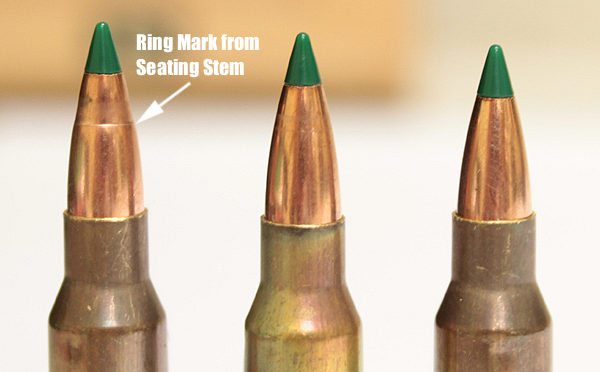
Here’s a helpful hint for hand-loaders from Sierra Bullets. While this article focuses on Sierra’s new Tipped Match-King bullets, the recommended solutions apply to other bullet types as well. The article explains how sharp edges on a seating stem can cause a ring to be pressed into the bullet jacket — especially with compressed loads that resist downward bullet movement. Here Sierra technician Rich Machholz diagnoses the problem and provides a solution.
Solutions for Ring Marks Caused by Seating Stems
by Sierra Bullets Ballistic Technician Rich Machholz
Now that the new Tipped MatchKing® (TMK) bullets are being shipped and shooters are putting them to use I have received several calls regarding marking on the bullet ogive from the seating stem.
The cause can be traced to one of several things.
In the .223 and especially with the long, 77 grain TMK seated at 2.250” or even 2.260” most loads of Varget® and Reloder® 15 are compressed loads, sometimes heavily compressed. This puts a great deal of pressure on the bullet through the seating stem. The result of all this pressure is a mark of varying depth and appearance on the ogive of the bullet. [Editor: We have seen this issue with a variety of other bullet types/shapes as well, including non-tipped VLDs. The solution is profiling the internal cone of the seating stem to match your bullet shape.]
Some older seating stems might even bear against the tip of the bullet which can make a slight bulge in the jacket just below the junction of the resin tip and the copper jacket in a compressed load. If this is the case there is not a ready fix other than calling the die manufacturer and requesting a new deeper seating stem.
Polish Your Seating Stem to Remove Sharp Internal Edges
If the seating stem is of proper depth the culprit most generally is a thin sharp edge on the inside taper of the seating stem. This is an easy fix that can be accomplished by chucking a spare 77 grain bullet in your drill, coating it with valve grinding compound or even rubbing compound or in a pinch even tooth paste.* Remove the seating stem assembly from the seating die. Turn the drill on and put the seating stem recess over the spinning bullet with the polishing compound to break or smooth the sharp edge that is making the offending mark. This might take more than one application to get the proper polish depending upon what you use, but the more you polish the better the blend of angles which will [ensure the stem matches the bullet contours, not leaving a sharp ring].

If the above is a little more than you care to tackle you might try very fine emery cloth twisted to a point that can be inserted into the mouth to the seating stem and rotated to polish the inside to eliminate any sharp edges that might be present.
Load Advice for 77gr TMKs in the .223 Rem
And last but certainly not least. Actually, even though we don’t say you need additional data for the TMKs, remember you are dealing with heavily-compressed loads in some cases because of the additional bullet length. Due to the additional length of these new bullets and in the interest of gaining some room in the case you might consider trying a slightly faster extruded powder like BenchMark or the 4895s or an even more dense powder like the spherical H335®, CFE223 or TAC. The extra room will allow for trouble free bullet seating also.
Good luck and remember we are no further away than your telephone: 1-800-223-8799.

May 10th, 2016

The 50th Edition of the Lyman Reloading Handbook is here — and it’s bigger and better than ever. This 50th Anniversary Edition, the first to be produced in full color, includes more load data, and covers more cartridge and bullet types than ever before. This handbook has a strong heritage, starting with the Ideal reloading manuals from the early 20th Century. For more than a century the Ideal Handbook (and later) Lyman Handbooks have been popular and reliable data sources for hand-loaders. (In 1925, Lyman purchased Ideal Reloading Products, which produced the Ideal reloading handbooks.)
View Lyman 50th Anniversary Handbook at the NRA Annual Meeting in Louisville
The full-color Lyman 50th Edition will be available for the first time at the upcoming NRA Annual Meeting in Louisville, Kentucky on May 19-22, 2016. The Hardcover Edition (item #9816050) is priced at $39.98, while the Softcover Edition (item #9816051) retails for $29.98. Notably, Lyman will donate $1.00 to the NRA for every Lyman 50th Edition Reloading Handbook sold during the first year of its publication.

Lyman 50th Edition Handbook Features and Highlights:
• New Cartridges in 50th Edition: 17 Hornet, 6.5 Grendel, 6.5 Creedmoor, 6.5-284, 26 Nosler, 28 Nosler, 300 Blackout, 300 RCM, 338 RCM, 450 Bushmaster, 458 SOCOM, 50 Beowulf
• Expanded Selection of Bullets: Barnes, Hornady, Remington, Sierra, Speer, Swift and Winchester plus full selection of cast bullets
• Feature Articles by Top Gun Writers and Firearm Industry Experts
• “Barrels – Looking into the Unknown” by Ryan Newport
• “Advanced Case Preparation Techniques” by John Haviland
• “What is a Ballistic Coefficient and How Do You Use It?” by Dave Emary and Lane Pearce
• “The History of Modern Lyman Handbooks” by Ed Matunas, Ken Ramage and Tom Griffin
May 10th, 2016
 Bryce Towsley has authored an informative article on Reclaiming .223 Rem Brass. Writing for Shooting Illustrated Online, Towsley confesses: “I’m a brass horder…. I end every shooting match on my hands and knees. If the rest of the competitors want to litter the range with their discarded cases, I see it as my civic duty to clean up the mess.” If you burn through a lot of .223 Rem ammo on the varmint fields or in multi-gun matches, we suggest you read Towsley’s article. Bryce Towsley has authored an informative article on Reclaiming .223 Rem Brass. Writing for Shooting Illustrated Online, Towsley confesses: “I’m a brass horder…. I end every shooting match on my hands and knees. If the rest of the competitors want to litter the range with their discarded cases, I see it as my civic duty to clean up the mess.” If you burn through a lot of .223 Rem ammo on the varmint fields or in multi-gun matches, we suggest you read Towsley’s article.
Towsley advises that you need to be cautious with range pick-up brass: “Range brass is full of dirt, dust, sand and debris that can be damaging to loading dies, as well as causing other problems.” So, range pick-up brass must be cleaned and then sorted carefully. Towsley explains that you should toss brass that is badly dented, and you have to make sure to remove the primer pocket crimp in military brass. This can be done with a crimp reamer or a swaging tool such as the Dillon Super Swage 600. The latter works well, but Towsley cautions: “For the swager to work properly, you must sort the cases by brand and lot, and then readjust the swager for each new lot.”
 Trimming Quantities of Brass Trimming Quantities of Brass
Before loading, “reclaimed” range brass should, of course, be full-length sized and you should trim all the brass to the same length. “Cases that are too long can cause all kinds of problems”, explains Towsley.
We envy the system Towsley uses to trim brass. He has a Dillon Rapid Trim 1200B set up on the top of a single-stage press: “You simply insert a case into the shell holder and raise the ram to trim it instantly. The process is so fast, it almost feels like cheating.” The Rapid Trim is a very neat gadget — it even has an attachment for a vacuum hose to remove the cuttings. The photo at right shows a 1200B installed on a Dillon progressive press.
We definitely recommend you read Bryce Towsley’s Reclaiming Range Brass Article from start to finish. The article offers useful advice that will help you reload any rifle cartridge — not just .223 Rem range brass. Towsley also showcases many good labor-saving devices that can speed up and simplify the process of bulk rifle cartridge reloading.
May 9th, 2016
At the request of our readers, we provide select “Deals of the Week”. Every Monday morning we offer our Bargain selections. Here are some of the best deals on firearms, hardware, reloading components, and shooting accessories. Be aware that sale prices are subject to change, and once clearance inventory is sold, it’s gone for good. You snooze you lose.
1. Cabelas.com — Rock Chucker Supreme Reloading Kit
Everything you see above can be yours for just $225.00, after manufacturer’s rebate. Right now, Cabela’s is selling the Rock Chucker Supreme Master Reloading Kit for $300.00. That’s a good deal as this Reloading Kit sells elsewhere for up to $360.00. But he’s the real incentive — if you spend $300.00 on RCBS products in 2016, RCBS will send you a $75.00 rebate. That reduces your net cost to just $225.00 for the entire Kit.
2. Bullets.com — Norma .22LR Ammo (Match 22 & Tac 22)

Need quality .22 LR rimfire ammo at an affordable price? Consider Norma. Most folks think Norma only produces centerfire ammo and cartridge brass. As a result, people haven’t been looking for Norma rimfire ammo. Their loss is your gain. Accurate, reliable Norma .22 LR ammunition is in-stock right now at leading online vendors. This is good quality ammo, made in Europe. Bullets.com has Norma Tac-22 ammo in stock at $5.25 per 50-rd box (SKU: BL7819). In addition, Bullets.com offers Norma Match-22 ammunition at $7.50 per 50-rd box (SKU: BL11887).
3. Natchez — RCBS ChargeMaster Dispenser, $279.99

Here’s a very good deal on the popular RCBS ChargeMaster combo scale/powder dispenser. This unit sells elsewhere for up to $389.00. You may want to act quickly as sale pricing changes frequently and many other vendors have recently raised their price on the Chargemaster. MidwayUSA sells this for $349.99 now while the current Amazon.com price is $322.99.
4. Midsouth — Plano All-Weather Hard Case, $74.72

Here is a very rugged hard case that compares well with a Pelican case, yet is less than half the cost. Plano’s new GunGuard All Weather™ 46″ gun case features heavy-duty, dual-stage lockable latches, a user-configurable foam interior, and a watertight/airtight closure with built-in pressure valve. The interior size is 43″ X 13″ X 5″, while the pluckable foam zone is 39.25″ X 10.25″. This is a very tough case that can withstand hard handling.
5. Sportsman’s Guide — Frankford Arsenal Case Tumbler Kit

For just $69.99, this Frankford Arsenal Kit provides everything you need to clean brass: Vibratory Tumbler, Rotary Media Separator, Bucket, Corn Cob Media (3 lbs.), and Brass Polish. The Case Tumbler holds up to 600 9mm cases or 350 .223 Rem cases. The separator system is generous, with a 3.5-gallon bucket. NOTE: Sportsman’s Guide Buyers Club members can purchase for $62.99.
6. Grafs.com — Magnetospeed Sporter $179.99

If you have been waiting to get a Magnetospeed… wait no longer. Priced at just $179.99 at Grafs.com, the Magnetospeed Sporter model costs less than half as much as Magnetospeed’s V3 models. This chronograph attaches directly to your barrel so you don’t have to go downrange to position tripods and set up skyscreens. For most people the Sporter Model contains all the features they need. Using Magnetspeed’s XFR adapter (sold separately), data can be transferred easily from the display module to your mobile device. READ Magnetospeed Sporter Review.
|


