Rick Jensen, Captain of the U.S. F-Open Rifle Team, recently tested some of the new IMR 4451 powder. Rick and other team members were looking for a good powder that could replace Hodgdon 4350 which is difficult to obtain currently. The makers of IMR 4451 claim that it is not sensitive to temperature and that it delivers competitive accuracy. So far, Rick’s tests, done with a .284 Winchester and 180gr Berger Hybrids, appear to confirm those claims. Rick posts:
“I did a little informal powder comparison of H4350 versus the new IMR 4451. Rifle used was a Kelbly Panda with a 30″, 1:8.75″ twist 5R Bartlein barrel [chambered in .284 Win]. All charge weights were 50.0 grains using CCI BR2 primers. I was very impressed with this new powder and I believe it to be equal to H4350 as far as temperature sensitivity.
I did not test for accuracy but I will tell you my groups were pretty much equal between the two and all were in the .2-.3 MOA range. I will defiantly be shooting more of this powder in the weeks to come, assuming the supply chain will allow. It looks very encouraging to finally have a alternative to H4350 that we might actually be able to buy.”
Chronograph Results with Temps from 23° F to 101°
Here are chronograph results of a comparison test between IMR 4451 and H4350. Rick’s rifle was cleaned and allowed to cool between each test. Five fouling shots were fired before each test. Important: Note that for both Test #1 and Test #2, the powder order is reversed in the mid-temp fields (IMR 4451 first, then H4350). For the low and high temp entries, H4350 is listed first.
Here are the IMR 4451 fired cases, displayed Left to right, coldest to the hottest (in terms of case temp when fired). All charge weights were the same: 50.0 grains.
If you have been patiently waiting to acquire a Forster Co-Ax® reloading press, now’s the time to strike. These popular presses have been out-of-stock for months, but now Grafs.com has Co-Ax presses in the warehouse and ready to ship. Price is $319.99. That includes shipping charges (but there is a flat $7.95 additional handling charge per order).
If you aren’t familiar with the unique design and function of the Forster Co-Ax Press, watch this video by Forum member Erik Cortina:
Man does not live by long-guns alone. We know that many of our readers own .45 ACP handguns and load for this extremely accurate “classic” cartridge. When selecting a powder for the .45 ACP, there are many good options. All the major powder manufacturers make propellants with appropriate density and burn rate characteristics for the .45 ACP. Popular powder choices include: AA #5 (Accurate Powder); Bullseye (Alliant); Clays, HP-38, and Titegroup (Hodgdon); VV N310, N320, N340 (Vihtavuori); and WW 231 and WST (Winchester). We’ve tried these powders in a variety of .45 ACP handguns. When we consider the factors that make for a good pistol powder, we think N320 is one of the best available propellants for the .45 ACP. Vihtavuori N320 is very accurate, it meters well, and it burns clean, with minimal smoke and flash. If you haven’t tried VV N320 yet, you should.
Pros/Cons of Different Powders for .45 ACP
This Editor has personally tried out eight or more different powders for the .45 ACP. Bullseye works but it is very dirty (both smoke out the barrel and sooty powder fouling on case). Though it otherwise burns clean, Titegroup leaves a singular (and nasty) high-temp flame streak on your brass that is hard to remove. AA #5 is a good choice for progressive press newbies as you use more powder so a double charge will (usually) be obvious. I like AA #5 but N320 was more accurate. Clays burns clean but some powder measures struggle with flake powders like this. WW 231 offered excellent accuracy and metered well, but it kicked out sparks with little pieces of debris that would hit me in the face. Who wants that?
I personally tried all the powders listed above with lead, plated, and jacketed bullets. After testing for accuracy, consistency, and ease of metering, I selected VV N320 as the best overall performer.
Vihtavuori N320
No powder tested was more accurate (WW 231 was equally accurate).
Meters very well in all kinds of powder measures.
Produces very little smoke from muzzle.
Does not put nasty burn streak on brass like Tite-Group does.
Low Flash — you don’t get particles and sparks flying out like WW 231.
Cases come out from gun very clean — so you can tumble less often.
Forum member and gunsmith Michael Ezell agrees that N320 is a good choice for the .45 ACP. Mike has also found that WW 231, while accurate, produces sparks and a large flash. Mike writes: “I first started using N320 after my first night shoot, while shooting IDPA/IPSC matches. It was astonishing how much of a fireball the WW 231 created. I was literally blinded by the flash while trying to shoot a match. As you can imagine, that didn’t work out very well. I went from WW 231 to N320 and never looked back…and the flash from it was a fraction of what a kid’s sparkler would give off. I have nothing but good things to say about [N320] after using both. Night shoots are a real eye-opener! When it comes to a personal protection… there is, statistically, a very high chance that if you ever have to use a gun to protect yourself or your family, it’ll be in the darkness[.] Being blinded by muzzle flash (and deafened by the noise) are things that should be considered, IMO.”
This Editor owns a full-size, all-stainless S&W 1911. After trying numerous powders, I found VV N320 delivered the best combination of accuracy, easy metering, consistency, clean burning qualities, and low muzzle flash. My gun has proven exceptionally accurate using N320 with bullets from 180 grains to 230 grains — it will shoot as accurately as some expensive customs I’ve tried. At right is 5-round group I shot offhand at 10 yards with my 5″ S&W 1911. The bullet hole edges are sharp because I was using semi-wad-cutters. Rounds were loaded with Vihtavuori N320 and 200-grain SWCs from Precision Bullets in Texas.
Over the years, many different concentricity tools have been on the market. Various approaches have been taken to straightening rounds that exhibit poor concentricity. With extreme examples of excessive run-out, the bullet is is visibly crooked in the neck with the bullet tip clearly off-center. That’s never a good thing. Straight ammo shoots better.
Straighten-Up and Fly Right
If you could straighten up crooked rounds, accuracy should be improved. In the past, some tools promised more than they delivered. But now Bill Goad, a record-setting benchrest shooter, has invented a new tool that improves concentricity via an impact or “jarring” method. A vertical rod with a curved face mates with the case-neck. You spin the case to find the “high spot” of max eccentricity. Then just tap the rod a couple of times and the neck comes back onto centerline. You can then confirm the concentricity improvement with the dial indicator. Watch the video to see how this is done. Pay particular attention to times 01:25 to 01:45. The case starts at .004″ run-out (01:32). After correction (01:40) the neck shows less than .001″ (one-thousandth) run-out.
Benchrest ace Bill Goad demonstrates his innovative Fli-Right Concentricity gauge tool. It works differently than other concentricity enhancers on the market.
Bill Goad knows something about accuracy. He shot a 10-target 100/200 benchrest Combined Aggregate of 0.178″ (see video at 00:15-00:35). Bill Goad’s tool offers advantages over systems that clamp a cartridge at both ends and try to bend the case or tilt the bullet without straightening the neck. Goad’s new Fli-Right tool is available now from PremierAccuracy.com.
Gavin Gear tests .308 ammo with his DPMS LR-308B, AR10-type rifle.
Our friend Gavin Gear of UltimateReloader.com owns a DPMS LR-308B, an AR10-type semi-auto rifle. Gavin finds that his DPMS has a healthy appetite for ammunition. So, he set up his Hornady Lock-N-Load progressive press to produce .308 Win ammo. This video shows the process of press set-up and operation, complete with Hornady’s automated Case Feeder and Bullet Feeder. Employing elevated rotary hoppers, the case feed and bullet feed systems really speed up production. The automated feeders allow the operator to produce cartridges without ever touching case or bullet with his hands.
If you need large quantities of .308 Win ammo for 3-Gun matches or tactical games, and if you value your time, a progressive press may be a wise investment. The progressive can load a complete round with every cycle of the press handle. With Case Feeder and Bullet Feeder in place, the Hornady L-N-L can easily crank out a new .308 round every 3-4 seconds (watch video at 5:25). Conservatively speaking, that’s 15 rounds per minute sustained production (and some guys can go even faster).
Get updates from UltimateReloader.com via Gavin’s twitter feed: @UReloader. To learn more about the Hornady Lock-N-Load Progressive Press (with case/bullet feed options), and to see a list of the dies and accessories Gavin uses, click the link below:
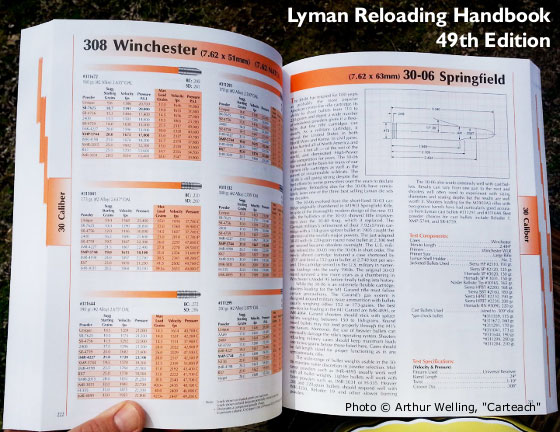
What’s the best book for folks getting started in metallic cartridge reloading? According to our Forum members, the best manual for “newbie” reloaders is the Lyman Reloading Handbook. In our Shooters’ Forum, a newcomer to reloading was looking for a basic reloading guide that also included load data. The most recommended book was the Lyman Handbook, now in its 49th Edition. Along with “how-to” advice on reloading procedures, the Lyman Manual features cartridge specifications and load data for the most popular cartridges.*
Here are some comments from Forum members:
“The Lyman book is an excellent manual with a large section describing the process of reloading. I heartily recommend it. As a beginning reloader, you may want to consider purchasing more than one book in order to get different perspectives on the reloading regimen. One can never be too careful. A ‘minor’ mistake can be costly.” — Cort
“In my opinion, the Lyman Manual is one of the best for the beginning reloader since it covers all the basics and some advanced methods. If possible, you would be also well served to hook up with an experienced reloader, preferably a target shooter or long-range varmint hunter, who can also give you some very useful pointers on precision reloading.” – K22
Editor’s NOTE: K22 echoes the advice we give to new hand-loaders. We suggest that novices find an experienced mentor who can “show them the ropes” and guide them through the basics.
Another gun blogger agrees that the Lyman Manual is a logical choice for new handloaders:
Carteach Review: The Lyman Reloading Manual
“[Lyman publishes] an excellent manual for any handloader, but especially for those new to the craft. Perhaps the best judgment of a handloader’s regard for a reloading manual is which one he chooses to give someone new to the fold. The needs of a new reloader differ from those of someone with long experience, and the right manual can set the foundation for years of safe procedures. Here is the one I choose to give a good friend embarking down the path:”
Carteach adds: “Lyman has always taken pains to provide very clear and understandable instruction on the basic process of reloading cartridges. The imaging is helpful and to the point. The load data Lyman provides is comprehensive, and [Lyman] takes the time to note special circumstances which new loaders need to be aware of. As example, the .30-06 section has some words regarding the M-1 Garand and its special needs. For someone who has never loaded for the Garand, these few sentences are golden!”
More Good Reference Books for Reloaders
Other book suggestions include The ABCs of Reloading, Glen Zediker’s Handloading for Competition, and The Book of Rifle Accuracy by Tony Boyer. The Boyer book is more for advanced handloaders, though it contains advice that can help beginners too. Forum member VTMarmot writes: “I wish I had read Tony Boyer’s book before I ever started handloading. The concept of using a bushing neck die that also sizes the body is the simplest, most accurate way to get accurate handloads and long brass life. This is true whether or not you turn necks, and whether you are loading for competition or hunting.”
*We recommend that you always double-check printed load data with the latest web-based data from the actual powder manufacturers. Powder properties can change. The most current powder data is usually found on the powder-makers’ websites.
You guys like saving money, right? We’ll here’s your chance to get 10% off precision reloading gear from PMA Tool. You probably know that PMA offers some of the best neck turners, priming tools, die adjusters, mandrels, and case prep accessories you can buy. PMA products feature smart design and quality craftsmanship.
To celebrate the roll-out of its updated website, PMA has announced a 10% OFF promotion. PMA President Pat Reagin tells us: “The new website is up and running. If you get a chance, take a look. Use coupon code 1B65B218A3C95ED to receive 10% off all items from now until March 1st. — Good shooting, Pat.”
Get 10% OFF PMA Products with PMA Code 1B65B218A3C95ED
Discount Code Good through March 1, 2015. Does Not Apply to Back-orders.
You can never be too safe when hand-loading your own ammunition. This helpful Brownells video outlines the Seven Fundamental Reloading Safety Tips. This is important information for novice hand-loaders and a good refresher for those with reloading experience!
Summary of the Seven Safety Tips:
1. Store your reloading supplies in a safe and dry location, away from children and away from any possible source of ignition. This includes keeping your powder and primers separate.
2. Get and use respected reloading manuals, especially for new cartridges. Start low and work up slowly while watching for warning signs of pressure and/or case fatigue.
3. Locate your reloading activity where you will not be distracted. If you get interrupted, stop. (Distractions will eventually lead to mistakes.)
4. Do NOT mix powders. Keep your powders clearly marked and dated. You can use masking tape to write the date on the container.
5. If you load the same cartridge type for different firearms, make sure your ammo headspaces properly in each gun.
6. Check cases frequently. Look for split necks, case head separation or other signs of fatigue and excessive pressure.
7. If reloading military brass, be aware that case capacity is usually reduced, and initial loads should be at least 10-15% lower than published data.
Here are some other tips that will help your avoid making costly mistakes (such as using the wrong powder, or undercharging a case):
Powder Type — Always double-check the label on your powder containers. After placing powder in the powder measure, put a piece of tape on the measure with the powder type written on it. Some guys write the powder type on a card and place that right in the hopper.
Scale Drift — Electronic balances can drift. If you are using a digital powder scale, calibrate the scale with a test weight every 50 rounds or so.
Case Fill — If you throw more than one charge at a time, look INSIDE every case before seating a bullet. Squib charges can be dangerous if you don’t notice them before firing the next round.
Progressive Presses — When using a progressive press, consider using an RCBS Lock-Out Die. This will detect a low charge and stop the machine. These dies will work with RCBS, Hornady, and Dillon progressives.
Each Wednesday, the U.S. Army Marksmanship Unit publishes a reloading “how-to” article on the USAMU Facebook page. Yesterday’s “Handloading Hump Day” post covered preparation of once-fired 5.56x45mm brass. This article, the first in a 3-part series, has many useful tips. If you shoot a rifle chambered in .223 Rem or 5.56x45mm, this article is worth reading. And visit the USAMU Facebook page next Wednesday for the next installment.
This week, Handloading Hump-Day will answer a special request from several competitive shooters in Alaska. They asked about procedures for morphing once-fired GI 5.56mm brass into accurate match brass for NRA High Power Rifle use. The USAMU has used virgin Lake City (LC) 5.56 brass to win National Championships and set National Records for many years. In this 3-part series, we’ll share techniques proven to wring match-winning accuracy from combat-grade brass.
Preparing Once-Fired GI 5.56 Brass for Reloading (Part 1 of 3)
Assuming our readers will be getting brass once-fired as received from surplus dealers, the following steps can help process the low-cost raw material into reliably accurate components.
1. Clean the Brass
First, clean the brass of any dirt/mud/debris, if applicable. Depending on the brass’s condition, washing it in a soap solution followed by a thorough rinsing may help. [This step also extends the life of the tumbling media.] Approaches range from low-tech, using gallon jugs 1/2 full of water/dish soap plus brass and shaking vigorously, to more high-tech, expensive and time-consuming methods.
2. Wet-Tumbling Options (Be Sure to Dry the Brass)
When applying the final cleaning/polish, some use tumblers with liquid cleaning media and stainless steel pins for a brilliant shine inside and out, while others take the traditional vibratory tumbler/ground media approach. Degree of case shine is purely personal preference, but the key issue is simple cleanliness to avoid scratching ones’ dies.
If a liquid cleaner is used, be SURE to dry the cases thoroughly to preclude corrosion inside. One method is to dump the wet brass into an old pillow case, then tilt it left/right so the cases re-orient themselves while shifting from corner to corner. Several repetitions, pausing at each corner until water stops draining, will remove most water. They can then be left to air-dry on a towel, or can be dried in a warm (150° F-200° F max) oven for a few minutes to speed evaporation.
Shown below are Lake City cases after cleaning with Stainless Media (STM). Note: STM Case cleaning was done by a third party, not the USAMU, which does not endorse any particular cleaning method.
3. Inspect Every Case
Once dry, inspect each case for significant deformation (i.e., someone stepped on it), damaged mouths/necks and case head/rim damage. Some rifles’ ejectors actually dig small chunks of brass out of the case head — obviously, not ideal for precision shooting. Similarly, some extractors can bend the case rims so badly that distortion is visible when spinning them in one’s fingers. These can be used for plinking, but our match brass should have straight, undamaged rims.
Dented case mouths are common, and these can easily be rounded using a conical, tapered tool, [such as a .223 expander mandrel. A dummy 7.62 or .30-06 cartridge with a FMJ spitzer can also work.] If most of your brass is of one headstamp, this is a good time to cull out any odd cases.
4. Check the Primers Before Decapping
Your clean, dry and inspected brass is now ready for full-length sizing, decapping and re-priming. Historically, primer crimps on GI brass have caused some head-scratching (and vile language) among handloaders. Our next installment will detail efficient, easy and practical methods to remove primer crimp, plus other useful handloading tips. Until next week, Good Shooting!
NOTE: The USAMU Handloading (HL) Shop does not RE-load fired 5.56 brass. We use virgin LC brass with our chosen primer already staked in place. However, our staff has extensive personal experience reloading GI brass for competition, which will supplement the Shop’s customary steps. In handloading, as in life, there are many ways to accomplish any given task. Our suggestions are note presented as the “only way,” by any means. Time for loading/practicing is always at a premium. Readers who have more efficient, alternative methods that maintain top accuracy are invited to share them here.
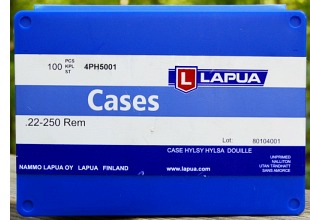
Editor’s Note: We originally ran this story in 2010. Since then we have had many reader inquiries about using .22-250 Lapua brass for a 6mm cartridge. Well our friend Robert Whitley worked hard on that concept a few years back, when Lapua .22-250 brass first became available. He came up with a nice 30°-shoulder wildcat that matches the accuracy of the best mid-sized 6mm cartridges. Read all about Whitley’s 6mm-250 Imp 30 below.
Our friend Robert Whitley of 6mmAR.com has come up with a new, accurate 6mm wildcat based on the new Lapua .22-250 brass that has just started arriving. Robert provides this report:
“I just received a box of the new Lapua .22-250 cases — beautiful brass! My real desire with it was to make it into a 6mm version, preferably something that was ‘no neck-turn’ with a .308 Win-type body taper that would work well in bolt gun and semi-auto magazines and would have a capacity to allow superior velocities. I considered the 6XC, but since you have to bring a whole lot of the shoulder of the brass up into the neck (when you re-form the brass from .22-250 to 6XC) that would necessitate neck-turning it because with Lapua brass the shoulder metal is thicker than neck metal of the brass.
I wanted a simple ‘neck it up and shoot it’ approach so I made up a 6mm-250 Improved 30 cartridge (i.e. 6mm-250 Improved with a 30 degree shoulder) and this thing works great — just neck up the brass, load it and shoot it! The case is like a 6XC with a .030″ longer body and a .030″ shorter neck, which works out fine if you are going to be shooting mainly the 105-108 gr bullets (which it will do very well shooting 2950 – 3000 fps). If you want to hot-rod things, which I do not, I am certain the case can push the 105-108 gr bullets a fair amount faster.
I set it up and throated the reamer for the Sierra 107s and the Berger or JLK 105 VLDs (i.e. a .090″ free bore on the reamer) and it works great with them. If I was going to use it with the Lapua 105s or the Berger 108s I would add about .025″ – .030″ to the freebore of the reamer (i.e. make the freebore around .115″ to .120″).
The great thing is you can use a 6XC die set for it without modification, and all you need to do is keep the dies about .030″ up off the shell holder from their normal position and use them as is. You can make a spacer washer about .030″ thick that you can put on and take off the 6XC dies and use the dies for both cartridges (i.e. 6XC and 6mm-250 Imp 30).
6mm-250 Imp 30 Shows Great Accuracy
Fire-forming loads are real accurate. Here is a 10-shot group I shot prone at 100 yards shooting fire-forming loads with it — the group is the size of a dime. For fire-forming I use a milder, but still very accurate load: 32.0 grains of N140 with a Sierra 107 and a BR2 primer. For fire-formed cases you can jump up to N160 (around 38-40 grains — depending on lot) and it will push the 105-108 gr bullets real accurately in the 2950-3000 fps range, with low ES and SD. This cartridge has a neck length of .268″ which is plenty long for a 6mm shooting bullets with varying bearing surface lengths. The reamer diagram (link below) leaves about a .003″ neck clearance over a loaded round, which seems to work out very well for a ‘no-turn neck’ set-up.
So there you have it … the 6mm-250 Imp 30 is simple, easy to make, accurate as all get out, there are available factory die sets you can use, and it uses great new Lapua brass — what’s not to like!”


“I did a little informal powder comparison of H4350 versus the new IMR 4451. Rifle used was a Kelbly Panda with a 30″, 1:8.75″ twist 5R Bartlein barrel [chambered in .284 Win]. All charge weights were 50.0 grains using CCI BR2 primers. I was very impressed with this new powder and I believe it to be equal to H4350 as far as temperature sensitivity.


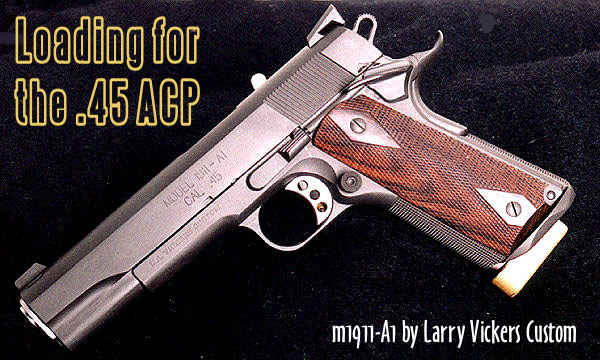
 Man does not live by long-guns alone. We know that many of our readers own .45 ACP handguns and load for this extremely accurate “classic” cartridge. When selecting a powder for the .45 ACP, there are many good options. All the major powder manufacturers make propellants with appropriate density and burn rate characteristics for the .45 ACP. Popular powder choices include: AA #5 (Accurate Powder); Bullseye (Alliant); Clays, HP-38, and Titegroup (Hodgdon); VV N310, N320, N340 (Vihtavuori); and WW 231 and WST (Winchester). We’ve tried these powders in a variety of .45 ACP handguns. When we consider the factors that make for a good pistol powder, we think N320 is one of the best available propellants for the .45 ACP.
  This Editor owns a full-size, all-stainless S&W 1911. After trying numerous powders, I found VV N320 delivered the best combination of accuracy, easy metering, consistency, clean burning qualities, and low muzzle flash. My gun has proven exceptionally accurate using N320 with bullets from 180 grains to 230 grains — it will shoot as accurately as some expensive customs I’ve tried. At right is 5-round group I shot offhand at 10 yards with my 5″ S&W 1911. The bullet hole edges are sharp because I was using semi-wad-cutters. Rounds were loaded with Vihtavuori N320 and 200-grain SWCs from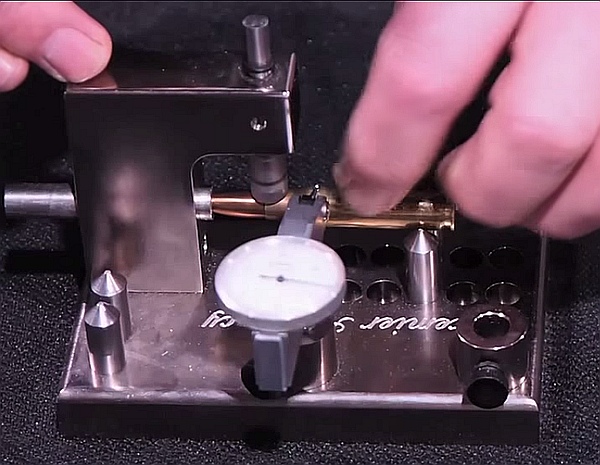


 You guys like saving money, right? We’ll here’s your chance to get 10% off precision reloading gear from


 Preparing Once-Fired GI 5.56 Brass for Reloading (Part 1 of 3)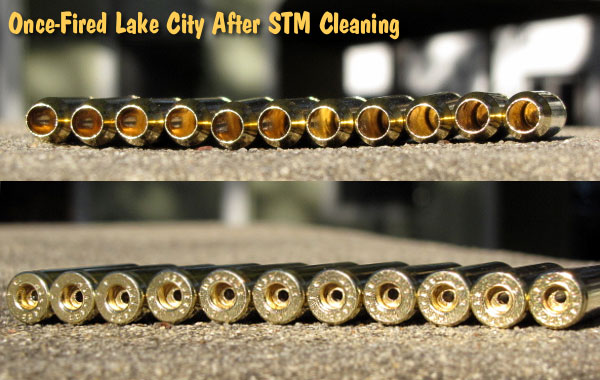
 Our friend Robert Whitley of
 6mm-250 Imp 30 Shows Great Accuracy


