|
|
July 11th, 2010
MidwayUSA has the Lee Classic Cast Iron “O” press (item 317-831) on sale now through the end of July. Priced at $77.29 (marked down from $82.99), this is an outstanding single-stage press for the money. It performs as well or better than some presses costing twice as much. If you don’t believe us… read the dozens of positive reviews from Lee Classic Cast Press owners.
Modern precision machining ensures a precise fit of the ram so it moves smoothly. There is plenty of leverage, and the handle can be moved from left side to right side. One really cool feature is that spent primers eject straight down through the center of the ram, exiting through a tube.

Save an Extra $10 off Order of $50.00 or More
If the price reduction for the Lee Class Cast Press isn’t enough of an incentive, MidwayUSA is offering an exclusive promotion for AccurateShooter.com readers this July. To save an additional ten bucks on your order of $50 or more, use PROMO CODE 2437210 during check-out. This promo expires 7/31/2010.
July 10th, 2010
 Having a quality funnel helps you get carefully-measured powder charges in your cases, with no spillage, every time. If you’ve tried cheap, plastic funnels you know that they can rock on the case mouth. Also, if the fit isn’t good, some kernels end up on your bench, instead of inside the case. Having a quality funnel helps you get carefully-measured powder charges in your cases, with no spillage, every time. If you’ve tried cheap, plastic funnels you know that they can rock on the case mouth. Also, if the fit isn’t good, some kernels end up on your bench, instead of inside the case.
Thankfully, precision, caliber-specific metal funnels are available to reloaders for about $10-$12.00. Satern Custom Machining funnels feature an aluminum top with a caliber-specific, machined brass base/neck. The Satern funnel’s aluminum body is completely static-free so powder flows into the case without bridging. Dick Saunders makes a similar, turned-aluminum funnel sized for particular calibers. Both these metal funnels make reloading easier (and they are ideal for blackpowder loading because they do not give off static electricity). As Forum member Wes notes, with a fitted metal funnel: “the possibility of the funnel sliding to the side, and spilling powder all over the place is drastically reduced.”
Satern Aluminum/Brass Funnels
Steve Satern crafts rugged aluminum funnels with brass ends. The caliber-specific sizes offer a snug fit that keeps the funnel tight on the case neck while the powder is flowing. Forum member Danny Reever reports: “If you are tired of the generic ‘fits all’ funnels falling over and powder spraying every where, try one of the Satern funnels. Sinclair Int’l sells them and they are top notch.” SMike308 adds: “I have retired my plastic funnels after buying my first Satern funnel. I now have one for each different caliber that I load for. I especially like that the Satern has the brass weight at the bottom, which adds stability to the funnel.”

Satern funnels are sold by MidwayUSA (6mm $11.29), Satern Machining (6mm $11.25), and Sinclair International (Item 11-9XX, 6mm $11.95). Satern Machining also offers two types of universal funnels, 22-30 caliber and 30-50 caliber. Satern’s universal funnels, along with the larger .338 to .50 caliber funnels, cost $18.45.
Saunders Aluminum Funnels
Some of our Forum members prefer the turned aluminum funnels made by Dick Saunders. You’ll need to order these direct from Saunders. Specify .17, .20, .22, 6mm, 6.5mm, .30 caliber or “all-purpose”. The Saunders funnels start at about $10.00. Contact Dick Saunders at the address below:
Dick Saunders
145 Delphi Rd.
Manchester, IA 52057
563-927-4026
June 25th, 2010
 With the high cost of manufactured ammunition, the reloading market continues to grow, and Redding Reloading is growing with it. With the goal of doubling its production capacity, Redding has invested over $1,000,000 in the past two years in new equipment. Just this month, Redding added two more American-made CNC machines. These latest machines complete Phase One of Redding’s strategic growth plan. With the high cost of manufactured ammunition, the reloading market continues to grow, and Redding Reloading is growing with it. With the goal of doubling its production capacity, Redding has invested over $1,000,000 in the past two years in new equipment. Just this month, Redding added two more American-made CNC machines. These latest machines complete Phase One of Redding’s strategic growth plan.
Redding Expands Its New York Production Facility
At a time when some historic firearms factories (such as the Marlin plant in North Haven, CT) are shutting their doors, Redding is buying land and putting up new buildings. As Phase Two of Redding’s growth plan, the company is acquiring adjacent real property to expand Redding’s manufacturing facility. The planned physical plant expansion begins in late summer, 2010. This will add an additional 40% of dedicated production and warehousing space to the company’s current facility in Upstate New York. For more information, contact Redding Reloading Equipment, 1089 Starr Road, Cortland, NY 13045, or visit Redding-Reloading.com.
 CLICK HERE to download 2010 Redding Reloading Catalog PDF CLICK HERE to download 2010 Redding Reloading Catalog PDF
June 23rd, 2010
 Midsouth Shooters Supply has some excellent deals in its 2010 Summer Shooting Flyer. To download the complete flyer as a PDF file, CLICK HERE Midsouth Shooters Supply has some excellent deals in its 2010 Summer Shooting Flyer. To download the complete flyer as a PDF file, CLICK HERE
Midsouth has knocked $44.00 off the price of the RCBS Chargemaster — it’s now on sale for just $279.99. If you need a media separator, Midsouth’s “house brand” rotary sifter is a steal for $19.29. There are many other great deals in the flyer.

Special Replacement Parts Packs for AR Shooters
Midsouth has done something really fantastic — it has created affordable kits that include all the key internal parts and pieces that can wear out (or get lost) on an AR15. Great idea. AR manufacturers should provide kits like these with every complete rifle sold! For under $30.00, Midsouth’s Field Repair Kit includes: firing pin, 2 firing pin retainers, bolt cam pin, 3 bolt gas rings, buffer detent, buffer detent spring, extractor springs, & pads, disconnector spring, disconnector, hammer spring and trigger spring.

May 29th, 2010
 Since it was first released in 1965, Cartridges of the World by Frank Barnes, has been considered the definitive print resource on firearm cartridges. The current 12th Edition, edited by Holt Bodinson, was released late last year. The 568-page 12th Edition now describes over 1500 cartridges (from 0.1 inch to 0.95 inch caliber). This edition has interesting new articles on cartridge design and performance. The book includes dimensions, illustrations, a short history, and sample loading data for over 1500 different cartridges, including virtually every significant cartridge introduced since the early 1870s, with separate chapters on rimfires, shotgun shells, sporting rifle cartridges from the United States and Canada, Britain, and Europe, plus handgun cartridges, military cartridges, and limited production “wildcat” and “proprietary” cartridges. You won’t find all the narrow-focus or obscure wildcats, but the book is still a useful resource, well worth owning. It’s a “must-have” item for any serious cartridge collector. Since it was first released in 1965, Cartridges of the World by Frank Barnes, has been considered the definitive print resource on firearm cartridges. The current 12th Edition, edited by Holt Bodinson, was released late last year. The 568-page 12th Edition now describes over 1500 cartridges (from 0.1 inch to 0.95 inch caliber). This edition has interesting new articles on cartridge design and performance. The book includes dimensions, illustrations, a short history, and sample loading data for over 1500 different cartridges, including virtually every significant cartridge introduced since the early 1870s, with separate chapters on rimfires, shotgun shells, sporting rifle cartridges from the United States and Canada, Britain, and Europe, plus handgun cartridges, military cartridges, and limited production “wildcat” and “proprietary” cartridges. You won’t find all the narrow-focus or obscure wildcats, but the book is still a useful resource, well worth owning. It’s a “must-have” item for any serious cartridge collector.
Frank C. Barnes (1918-1992) began collecting information on handgun cartridges at the early age of 12, thanks to his father, a police officer. Frank Barnes was an innovative cartridge designer, who invented the original 308 x 1.5″ Barnes, predecessor of the 30BR case. Before Frank began a law enforcement career, he was a college professor. Frank was also a pilot, and a race-car driver.
Cartridges of the World was first published in 1965. It’s lived through 12 editions and can be found on many reloaders’ bookshelves today. Suggested retail for the book is $32.99, but MidwayUSA currently sells the 12th Edition for $19.99 plus shipping (Midway item 242319). Amazon.com offers the book for $21.77 with free shipping on combined orders over $25.00.
AMAZON LINK: Cartridges of the World (12th Ed.): Complete Reference for Over 1500 Cartridges
May 26th, 2010
 Electronic powder dispensers are more popular than ever, and the RCBS ChargeMaster is still the top seller (though the new Hornady dispenser is worth checking out). We know you guys are always looking for the best deal on your reloading equipment. Well, right now, Natchez Shooters Supply has the RCBS Chargemaster Combo Scale/Dispenser on sale for just $279.95 (Natchez item #RC98923). That’s $40-$50 bucks lower than the price at most other vendors. Electronic powder dispensers are more popular than ever, and the RCBS ChargeMaster is still the top seller (though the new Hornady dispenser is worth checking out). We know you guys are always looking for the best deal on your reloading equipment. Well, right now, Natchez Shooters Supply has the RCBS Chargemaster Combo Scale/Dispenser on sale for just $279.95 (Natchez item #RC98923). That’s $40-$50 bucks lower than the price at most other vendors.
CCI Small Rifle Primers Available at Natchez
Some folks are still looking for CCI primers. Well Natchez has plenty of CCI small rifle primers in stock. Here’s what’s currently available, with prices. NOTE: If you need the BR4s, Powder Valley has them at $37.00/1000, which beats Natchez’s price by a wide margin. Federal Primers are still very hard to find. Powder Valley and Natchez are both out of stock.
- CCI 400, Small Rifle Primers, 1000 primers, $32.50
- CCI 450, Small Rifle Magnum Primers, 1000 primers, $36.16
- CCI BR4, Small Rifle BR Primers, 1000 primers, $50.43
CLICK HERE for Natchez May/June 2010 Product Flyer.
May 20th, 2010
 Lapua developed the 6.5×47 Lapua cartridge for International 300m competition. Lapua wanted a cartridge that could match the “pure accuracy” of the 6mmBR, but with even better ballistics and good barrel life. The 6.5x47L is now really coming into its own. In the hands of NBRSA long-range Hall of Famer Don Nielson, the 6.5x47L has won two NBRSA 600-yard Nationals convincingly. The cartridge is winning Varmint Silhouette matches, and Tactical competitors are finding the cartridge delivers great accuracy with much less recoil than a .308 — plus it feeds well from magazines. With advanced powders such as Alliant’s Reloder 17, the 6.5x47L can deliver surprising velocities, even with the heavy 139-142 grain bullets, though we still think the 130-grainers may be optimal for the cartridge. Don Nielson used Berger 130gr bullets “right out of the box” to win the NBRSA 600-yard Nationals, setting records in the process. In addition to its paper-punching abilities, the 6.5×47 Lapua is a capable hunting cartridge, delivering velocities that approach a .260 Remington with 120-130 grain projectiles. Considering all this — is the 6.5×47 Lapua the next, great do-it-all cartridge — a chambering that can win a benchrest match one weekend and harvest a whitetail the next? Lapua developed the 6.5×47 Lapua cartridge for International 300m competition. Lapua wanted a cartridge that could match the “pure accuracy” of the 6mmBR, but with even better ballistics and good barrel life. The 6.5x47L is now really coming into its own. In the hands of NBRSA long-range Hall of Famer Don Nielson, the 6.5x47L has won two NBRSA 600-yard Nationals convincingly. The cartridge is winning Varmint Silhouette matches, and Tactical competitors are finding the cartridge delivers great accuracy with much less recoil than a .308 — plus it feeds well from magazines. With advanced powders such as Alliant’s Reloder 17, the 6.5x47L can deliver surprising velocities, even with the heavy 139-142 grain bullets, though we still think the 130-grainers may be optimal for the cartridge. Don Nielson used Berger 130gr bullets “right out of the box” to win the NBRSA 600-yard Nationals, setting records in the process. In addition to its paper-punching abilities, the 6.5×47 Lapua is a capable hunting cartridge, delivering velocities that approach a .260 Remington with 120-130 grain projectiles. Considering all this — is the 6.5×47 Lapua the next, great do-it-all cartridge — a chambering that can win a benchrest match one weekend and harvest a whitetail the next?

6.5×47 Lapua Ballistics Chart | 6.5×47 Lapua Cartridge Diagram (PDF)
6.5×47 Lapua Is a Hot Topic on Our Forum
In our AccurateShooter Forum, there has been a thread discussing whether the 6.5x47L or 6mmBR is better for the 600-yard game. Forum member Lloyd (aka “1Shot”) wrote:
How many years have the 6BR and its variants been in existence as opposed to the 6.5x47L? I pose this question to you because we all know that with time and experience, comes knowledge. In a short period of time, (relatively speaking) the 6.5x47L has made great strides. I’ll make a bet that the 6.5x47L will outshoot the 6BR within the same time frame of its existence. It will just take time and shooters like Sam Hall to bring this cartridge to its full potential.”
Responding to Lloyd’s post, British gun writer Laurie Holland analyzed the present and possible future of the 6.5x47L cartridge. Laurie makes some very interesting points, considering the role the 6.5x47L may play in F-class competition, and in 300 to 600-yard benchrest. Laurie’s post is worth a read….
 Laurie Holland Talks About the 6.5×47 Lapua Laurie Holland Talks About the 6.5×47 Lapua
“Lloyd, you may well be right on this. There is that intangible something issue though that sees one cartridge become ‘great’ in a shooting field, while others that should theoretically compete somehow never quite get there. The example that comes to mind is the PPC in short range BR of course[.] The PPC outshoots similar rivals, and we don’t know why. At the moment, the 6BR and BRX/Dasher variants look like they may be getting to the same point in 300 to 600-yard BR type competition. That’s not to say they won’t be pushed out of the top spot by something better, or even matched by a rival, but it looks like it won’t happen quickly or soon.
One thing people often forget is that BR can see 5 shots rattled off in under 30 seconds while the wind conditions hold. F-Class or any other form of deliberate, marked-target shooting is different because of the enforced gap between shots. This is particularly so on our side of the Atlantic (or north of the 49th Parallel). Unlike your F-Class, Fullbore, Palma, CLRP etc. shooting, we British Commonwealth types are squadded two to a target (sometimes up to four in local shoots) and there is therefore a minimum three or so minutes between taking each shot by an individual shooter. Fairly typically, I shot in a club 600-yard F-Class comp last Sunday and found myself with two others on ‘my’ target. Throw in one of them missing with both sighters and the resulting delays while the RO had to be asked for the target to be pulled and checked and people looking for his subsequent fall of shot and it took around 70-75 minutes to get through 2 sighters and 20 score shots. So each shot is virtually a new start so far as the wind-call goes.
The 6.5X47L likely gives a significant benefit even at 600 yards over the 6mmBR thanks to the external ballistics improvements in such a scenario. What has to be seen is how it stands up in national level competition against the big sevens since that’s the competition in F-Open. Until this year, all national GB F-Class Association rounds were shot over a mixture of 800, 900, 1000-yard matches with the emphasis on the 1000. The 6.5X47L can’t hack it against 180gr 7mm Berger VLDs at 3,200 fps in these conditions (nor could the US F-Class Team’s 6.5-284 Norma in last summer’s F-Class World Championship at Bisley). Club / regional level may turn out different with a bigger mix of ranges (distances) in a season’s programme. And (here’s the killer) — the 7mmWSM brigade can’t afford to shoot say 15 such matches in a season given the barrel life issue. 15 matches is 300-330 shots, or 50% of barrel life. So they enter one or two matches only for practice, checking sight-settings etc. Unless you do your own gunsmithing, barrel replacement by a top gunsmith with a Bartlein or Krieger tube is an expensive job here — a bit over £700 all in which is $1,000 + in translation[.]
So, accurate and ballistically-efficient smaller cartridges that give long barrel life have a bright future in European and British Commonwealth shooting, and I think the 6.5X47L is going to be a key player in this role. Also, as in the USA, many people want a multi-purpose longarm, and this cartridge is an excellent long-range fox/crow round and ideal for most of our deer species too.
To go back to the very original question in this thread, if I were having a multi-discipline target shooting single-shot rifle built for club / regional competition shooting, I’d stick to 6BR or variants if it were primarily for 600-yard or shorter range competitions, but I’d go for 6.5X47L if there were 800 to 1,000-yard matches in the mix. If it were for F-Class at national level, I’d have neither, but stick to .308W in the F/TR division which I shoot now. — Laurie, York, England”
May 19th, 2010
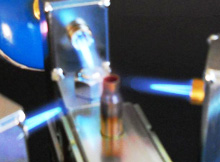 Forum member and long-range shooter Jerry Brandon has launched a new company, Ballistics Edge Mfg., which produces cartridge annealing machines for use by home reloaders. Brandon, a talented designer and fabricator, first tried annealing to maintain the quality of his own match brass. Brandon then built and tested a series of prototype annealing machines, working with a variety of brass sizes. Now Ballistics Edge Mfg. offers a full line of four annealing machines: the manually-operated Model 200 ($250), the motorized twin-torch Model 300 ($345), the motorized triple-torch Model 350 ($395), and the motorized Model 400 ($475), a beautifully-machined carousel design. Forum member and long-range shooter Jerry Brandon has launched a new company, Ballistics Edge Mfg., which produces cartridge annealing machines for use by home reloaders. Brandon, a talented designer and fabricator, first tried annealing to maintain the quality of his own match brass. Brandon then built and tested a series of prototype annealing machines, working with a variety of brass sizes. Now Ballistics Edge Mfg. offers a full line of four annealing machines: the manually-operated Model 200 ($250), the motorized twin-torch Model 300 ($345), the motorized triple-torch Model 350 ($395), and the motorized Model 400 ($475), a beautifully-machined carousel design.
Brandon’s most versatile machine, and the one he recommends for annealing both normal- and magnum-sized cases, is the Model 350. Like the Model 300, the Model 350 features all-metal construction and motorized case transport. The Model 350 uses three torches rather than the Model 300’s two. The triple-torch system does a better job heating the large-diameter necks on .338, .416 and .50-caliber cases. The triple-torch design also ensures fast, uniform heating of the case-necks on smaller cases. The video below shows the Model 350 in action, annealing jumbo-sized .50 BMG cases.

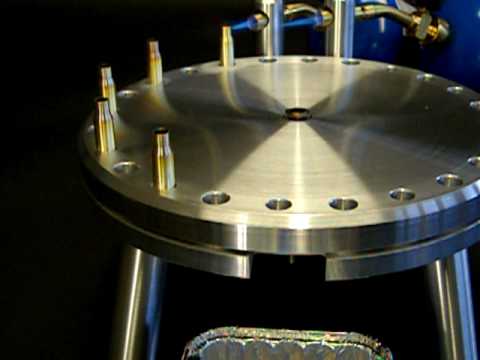
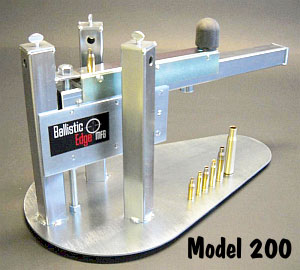 For PPC, 6mmBR, and .308-sized cases, you can use the Model 200, the Model 300, or the Model 400. The Model 200 is a simple, one-at-a-time annealer that works remarkably well using a sliding arm. Simply slide the case into the flame, then slide it out after the required dwell time. For the average reloader, the Model 200 may be more than adequate. If, however, you plan to anneal hundreds of cases a week, you may want to consider the beautifully-machined Model 400 carousel, which will anneal 100 cases in less than 15 minutes. The Model 400 features both .308-size and magnum/ultra magnum-size holes to accept both .47X and .56X diameter cases. Just choose the correct size hole and adjust the torch height to match your case. The .75″-thick shell-plate top acts as a heat-sink to protect the lower case body. View the Model 400 carousel annealer in the video below. For PPC, 6mmBR, and .308-sized cases, you can use the Model 200, the Model 300, or the Model 400. The Model 200 is a simple, one-at-a-time annealer that works remarkably well using a sliding arm. Simply slide the case into the flame, then slide it out after the required dwell time. For the average reloader, the Model 200 may be more than adequate. If, however, you plan to anneal hundreds of cases a week, you may want to consider the beautifully-machined Model 400 carousel, which will anneal 100 cases in less than 15 minutes. The Model 400 features both .308-size and magnum/ultra magnum-size holes to accept both .47X and .56X diameter cases. Just choose the correct size hole and adjust the torch height to match your case. The .75″-thick shell-plate top acts as a heat-sink to protect the lower case body. View the Model 400 carousel annealer in the video below.
Ballistics Edge Website Offers Good Technical Advice on Annealing
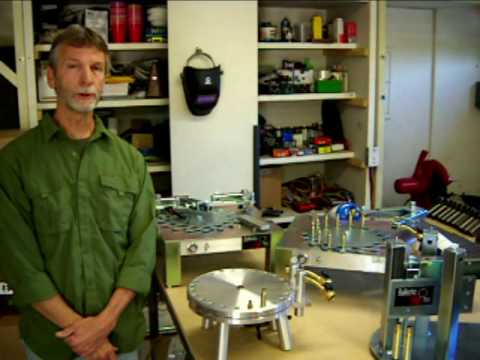
Anyone interested in learning about cartridge annealing should visit www.AnnealingMachines.com, Jerry Brandon’s website. There you’ll find a helpful, authoritative discussion of annealing, including the all-important factors of time and temperature. As Brandon observes, much MISinformation about annealing can be found. Brandon will set you straight. Read Brandon’s How to Anneal article and you can avoid making costly (and potentially dangerous) mistakes, whether you anneal manually or use an annealing machine. In the video below, Jerry Brandon reviews the features of Ballistics Edge annealing machines. He also provides some good, basic advice for shooters who are looking to try their hand at annealing for the first time.
May 1st, 2010
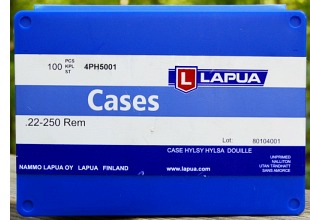 Our friend Robert Whitley of 6mmAR.com has come up with a new, accurate 6mm wildcat based on the new Lapua 22-250 brass that has just started arriving. Robert provides this report: Our friend Robert Whitley of 6mmAR.com has come up with a new, accurate 6mm wildcat based on the new Lapua 22-250 brass that has just started arriving. Robert provides this report:
“I just received a box of the new Lapua 22/250 cases — beautiful brass! My real desire with it was to make it into a 6mm version, preferably something that was ‘no neck-turn’ with a .308 Win-type body taper that would work well in bolt gun and semi-auto magazines and would have a capacity to allow superior velocities. I considered the 6XC, but since you have to bring a whole lot of the shoulder of the brass up into the neck (when you re-form the brass from 22-250 to 6XC) that would necessitate neck-turning it because with Lapua brass the shoulder metal is thicker than neck metal of the brass.
I wanted a simple ‘neck it up and shoot it’ approach so I made up a 6mm-250 Improved 30 cartridge (i.e. 6mm-250 Improved with a 30 degree shoulder) and this thing works great — just neck up the brass, load it and shoot it! The case is like a 6XC with a .030″ longer body and a .030″ shorter neck, which works out fine if you are going to be shooting mainly the 105-108 gr bullets (which it will do very well shooting 2950 – 3000 fps). If you want to hot-rod things, which I do not, I am certain the case can push the 105-108 gr bullets a fair amount faster.

I set it up and throated the reamer for the Sierra 107s and the Berger or JLK 105 VLDs (i.e. a .090″ free bore on the reamer) and it works great with them. If I was going to use it with the Lapua 105s or the Berger 108s I would add about .025″ – .030″ to the freebore of the reamer (i.e. make the freebore around .115″ to .120″).
The great thing is you can use a 6XC die set for it without modification, and all you need to do is keep the dies about .030″ up off the shell holder from their normal position and use them as is. You can make a spacer washer about .030″ thick that you can put on and take off the 6XC dies and use the dies for both cartridges (i.e. 6XC and 6mm-250 Imp 30).
 6mm-250 Imp 30 Shows Great Accuracy 6mm-250 Imp 30 Shows Great Accuracy
Fire-forming loads are real accurate. Here is a 10-shot group I shot prone at 100 yards shooting fire-forming loads with it — the group is the size of a dime. For fire-forming I use a milder, but still very accurate load: 32.0 grains of N140 with a Sierra 107 and a BR2 primer. For fire-formed cases you can jump up to N160 (around 38-40 grains — depending on lot) and it will push the 105-108 gr bullets real accurately in the 2950-3000 fps range, with low ES and SD. This cartridge has a neck length of .268″ which is plenty long for a 6mm shooting bullets with varying bearing surface lengths. The reamer diagram (link below) leaves about a .003″ neck clearance over a loaded round, which seems to work out very well for a ‘no-turn neck’ set-up.
So there you have it … the 6mm-250 Imp 30 is simple, easy to make, accurate as all get out, there are available factory die sets you can use, and it uses great new Lapua brass — what’s not to like!”
CLICK HERE to download Whitley 6mm-250 Imp 30 Reamer Print.
April 22nd, 2010
The 6mm Dasher is based on the 6mm BR cartridge with the shoulder blown forward about 0.100″ and “improved” to 40°. Case capacity is raised to about 41.0 grains. This allows the Dasher to drive 105-108gr bullets comfortably at 2970-3000 fps without over-stressing the brass. A popular load used by many successful Dasher shooters is 33.3 grains of Reloder 15, CCI 450 primers, with 105gr Berger VLDs, .010″ in the lands. This is a “warm load” and should only be used with fire-formed brass. As with any load, start 10% low and work up. You may also have good luck jumping the bullets .020″ or more.

Robert Hoppe, one of the top 600-yard shooters in the country, was the 2009 NBRSA 600-yard champion. In 2007, shooting a 6 Dasher, Robert nailed a 0.5823″, 5-shot group. At the time it was the smallest group ever shot in 600-yard registered benchrest competition. In 2008, John Lewis shot even smaller with an IBS Heavy Gun, but Robert’s 0.5823″ still remains the NBRSA 600-yard record, and we believe it is the smallest group ever shot at 600 (in registered BR competition) by a 17-lb class rifle. Robert has been very successful in the 600-yard game, and is one of the best 600-yard shooters in the West. He knows how to wring the best accuracy out of the 6mm Dasher cartridge. Here Robert offers some tips on load development and tuning for the 6mm Dasher.

|


