|
|
December 6th, 2009
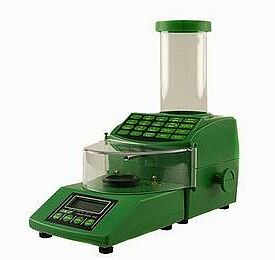 The RCBS ChargeMaster 1500 electronic powder scale and dispenser is the most popular product of its kind on the market. In our original Electronic Powder Dispenser Comparison Test, the ChargeMaster normally dispensed most kinds of powder faster than competitive units from Lyman and PACT. However, after the initial release of the ChargeMaster 1500, RCBS “tweaked” the software a bit to achieve more consistent charge-throws. This slowed down the process somewhat. Some owners have wanted to speed up their ChargeMaster. This IS possible with a relatively simple reprogramming. Most of the internal parameters of the Chargemaster can be modified, under guidance from the tech staff at RCBS. The RCBS ChargeMaster 1500 electronic powder scale and dispenser is the most popular product of its kind on the market. In our original Electronic Powder Dispenser Comparison Test, the ChargeMaster normally dispensed most kinds of powder faster than competitive units from Lyman and PACT. However, after the initial release of the ChargeMaster 1500, RCBS “tweaked” the software a bit to achieve more consistent charge-throws. This slowed down the process somewhat. Some owners have wanted to speed up their ChargeMaster. This IS possible with a relatively simple reprogramming. Most of the internal parameters of the Chargemaster can be modified, under guidance from the tech staff at RCBS.
Gunsmith and Forum member NAT Lambeth reports: “I thought My RCBS ChargeMaster 1500 Combo was fast enough. But I still called RCBS and asked for the programing changes to see if I could speed it up. It was a lot easier than I thought. My 1500 Combo was taking from 15-30 seconds to dispense the powder to the tenth of a grain. I reprogrammed the numbers and now it takes between 7 and 15 seconds to dispense to a tenth. This effectively doubled my loading speed. I only changed the HSB_A1, HSB_B1, and BSP_C1 settings.”
Key ChargeMaster Parameters with Default Settings
HSB_A1 (15.68) Grains under target weight to go from full to high speed
HSB_B1 (3.42) Grains under target weight to go from high to slow speed
BSP_C1 (1.08) Grains under target weight to go from slow to final trickle speed
Nat cautions that you should talk to a RCBS tech before attempting to re-program your ChargeMaster: “You will benefit from talking to the RCBS tech. I have now gone back and played with the numbers a couple of times. (The numbers given to me by the tech at RCBS were still a little conservative.) I think each machine may have its own likes and dislikes. If you get too aggresive with lowering your numbers it will over-throw your intended load.”
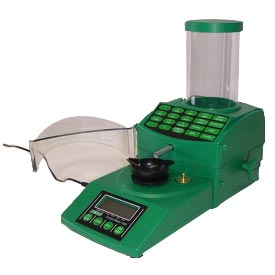 Source for ALL the Parameters Source for ALL the Parameters
There is an extensive discussion of RCBS ChargeMaster programming on the South Africa Hunting Rifle Shooting Assn. (SAJSV) Forum. In this SAJSV Forum ARTICLE, Jaco Brink lists virtually all the programming codes. Importantly, Jaco also provides the default values for various parameters. This is very important, because the ChargeMaster does not have a “return to default” option. Once you change any value, if you want to return to the original value you must enter it manually. Jaco cautions: “I have to advise you to only make changes to your scale if you are confident to do so, and remember that there is not a ‘return to default’ setting in the scale. If all else fails return your scale to the default settings [I have listed].”
CLICK HERE for list of RCBS ChargeMaster Default Programming Values
Use a McDonald’s Straw to Reduce “Over-Throws”
Jaco Brink provided another useful tip to avoid “over-throws” (excess charge weight): “The RCBS employee advised me to take a McDonnell’s straw (because it is thicker than a normal straw), cut off about a half inch piece and put it into the tube where the powder exits. This caused the last [few kernels] of an extruded powder to cluster less, and reduced the amount of overthrows dramatically.”
CLICK HERE for more ChargeMaster 1500 optimization TIPS.
December 5th, 2009
 We have confirmed that Lapua will produce and distribute 22-250 cartridge brass starting in early 2010. The official product release will be at SHOT Show in Las Vegas (Jan. 19-22). We don’t have production samples yet, but there are about 1000 pieces of brass in the hands of testers in the United States at this time. This stuff is for real — CLICK THIS LINK for PHOTOS. We have confirmed that Lapua will produce and distribute 22-250 cartridge brass starting in early 2010. The official product release will be at SHOT Show in Las Vegas (Jan. 19-22). We don’t have production samples yet, but there are about 1000 pieces of brass in the hands of testers in the United States at this time. This stuff is for real — CLICK THIS LINK for PHOTOS.
 One of the folks lucky enough to get his hands on the new Lapua 22-250 brass is writer/shooter Steven Boelter, author of the Rifleman’s Guide to Rimfire Ammunition. Steven has measured and inspected the new brass and he says it appears to be “on a par, quality-wise, with Lapua’s 220 Russian and 6BR brass”, which is saying a lot. Steve adds that: “[what I have] is in fact part of a pre-production run, and the main stuff will be ready for second quarter, 2010″. Steven is working on an article for Precision Shooting magazine that will include exact dimensions for the new brass, as well as initial load testing results. An exact release date for Steven’s article has not yet been set, but Boelter hopes the story will come out in January or February. One of the folks lucky enough to get his hands on the new Lapua 22-250 brass is writer/shooter Steven Boelter, author of the Rifleman’s Guide to Rimfire Ammunition. Steven has measured and inspected the new brass and he says it appears to be “on a par, quality-wise, with Lapua’s 220 Russian and 6BR brass”, which is saying a lot. Steve adds that: “[what I have] is in fact part of a pre-production run, and the main stuff will be ready for second quarter, 2010″. Steven is working on an article for Precision Shooting magazine that will include exact dimensions for the new brass, as well as initial load testing results. An exact release date for Steven’s article has not yet been set, but Boelter hopes the story will come out in January or February.
Boelter can’t say much more about the brass prior to publication of the article. But we can confirm that it has a large primer pocket, standard 22-250 rim size, and it is annealed like other premium Lapua brass. Steven has posted a couple photos of the brass on the Saubier.com web site.
We’re always excited when Lapua decides to expand its line of cartridge brass. For 22-250 shooters, who will now have a new ultra-high-quality brass option, the news of Lapua 22-250 brass must be like an early Christmas present.
Link to Lapua 22-250 Brass Photo

Above is a QuickDESIGN diagram of the 22-250 Remington cartridge based on CIP Metrics converted to English units. This is NOT the official print for the new Lapua 22-250 brass, which may vary slightly in dimensions. We suggest you get the actual production brass in hand before ordering new chamber reamers or dies.
November 29th, 2009
Sinclair International has some nice deals for the holidays. And, through Monday 11/30/2009 at 11:59 pm, if your online order totals $200.00 or more, you can save an additional 10% using Promo Code SAVE10. Here are some of the good holiday deals.
Wolf Small Magnum Primers: $31.24 per 1000 primers
Wolf Large Rifle Primers: $32.25 per 1000 primers
The Small Rifle Magnum primers work very well with BR, 6.5 Grendel, 6-6×47, and 6.5×47 cases. The Large Rifle Primers are a good choice for 6XC, .243 Win, 6.5 Creedmoor, .308 Win, .284 Win and 30-06. We list this product here, not so much because the price is the best, but because readers are constantly asking us “where can I get Wolf primers?”. If you need them, Sinclair Int’l has them in stock right now. (NOTE: Wolf regular Small Rifle Primers, which shoot great in PPCs, are still out of stock.)

RCBS ChargeMaster Combo, Scale and Dispenser: $299.99 (Reg. $328.40)
This is the device that created an electronic revolution in reloading. The latest generation of Chargemasters is more reliable than ever. If you make sure the unit is level in all planes, and you have good, uniform current, the Chargemasters will deliver very consistent charges. With H4350, a fairly long extruded powder, our tests showed that 48 out of 50 throws were within the claimed ± one-tenth of a grain (0.1 grain) spread. Sinclair’s $299.99 price is very good, and with the 10% off SAVE10 Promo Code you’ll pay $269.99, which is cheaper that both Midsouth ($279.99), and Natchez ($279.95)

Sinclair/Wilson Ultimate Micrometer Trimmer w/ Shark Fin, $134.95 (Reg. $145.00)
By most standards, this is the best manual case trimmer on the market. The micrometer on this trimmer effortlessly adjusts cutting lengths, so it’s easy to change from one cartridge type to another. Changing trim length on a Forster or Lyman trimmer is much more time-consuming, requiring you to fiddle around with set screws, and possibly replace pilots and collets. With a Wilson trimmer, you DO have to purchase case-holders for your cartridges, but that’s often cheaper than buying the pilots and/or collets required by other manual trimmers. Remember that a Wilson case holder will often work for a whole family of cartridges. For example a single .308 case-holder will work for a .243 Win, Rem 260, 7mm-08, or .308 Win.

November 28th, 2009
 When using the Stoney Point type OAL gauge (now sold by Hornady), we sometimes get a bullet stuck in the rifling. This can also happen with a squib load or when extracting a round with the bullet seated hard in the lands. You can use a cleaning rod or a wood dowel to tap out the bullet, but a brass drop rod will do the job faster and easier, with less risk of nicking your crown. When using the Stoney Point type OAL gauge (now sold by Hornady), we sometimes get a bullet stuck in the rifling. This can also happen with a squib load or when extracting a round with the bullet seated hard in the lands. You can use a cleaning rod or a wood dowel to tap out the bullet, but a brass drop rod will do the job faster and easier, with less risk of nicking your crown.
You can make a drop rod yourself from brass or bronze rod. Just make sure to smooth over any burrs or rough spots on the ends. Or just order a set of brass bullet drop rods from Sinclair Int’l. You drop the Sinclair Rods (item 52-500) down the barrel from the muzzle end with the rifle standing upright. Sinclair Bullet Drop Rods are made of brass so they will not harm the rifling in your barrel. Each $11.95 set consists of two Drop Rods — a 3/16″ diameter rod for 20 caliber through 25 caliber bores, and 1/4″ diameter rod for 6.5 through 416 caliber bores.
Remember, for safety sake:
Drop Rods are never to be used to dislodge live or loaded rounds! Always remove the Drop Rod from the barrel before chambering another round!

November 6th, 2009
 Electronic scales, even expensive lab-grade units, can be influenced by a wide variety of electronic “emissions”. We’ve seen Chargemasters being affected by cordless telephones and older CRT computer monitors. When stray emissions interfere with digital scales, you can get erractic readings, or the scales can drift with time. The smart thing to do, of course, is to physically isolate your digital scale from the sources of interference — keep them away from computer equipment and wireless base units. If you still have problems with drift or unstable read-outs, thankfully there are some inexpensive accessories that can restore your scale’s reliability. Reader Scott G. found a ferrous (magnetic) filter that attaches to the cord of his digital scale. This inexpensive filter cured his scale’s tendency to drift. Electronic scales, even expensive lab-grade units, can be influenced by a wide variety of electronic “emissions”. We’ve seen Chargemasters being affected by cordless telephones and older CRT computer monitors. When stray emissions interfere with digital scales, you can get erractic readings, or the scales can drift with time. The smart thing to do, of course, is to physically isolate your digital scale from the sources of interference — keep them away from computer equipment and wireless base units. If you still have problems with drift or unstable read-outs, thankfully there are some inexpensive accessories that can restore your scale’s reliability. Reader Scott G. found a ferrous (magnetic) filter that attaches to the cord of his digital scale. This inexpensive filter cured his scale’s tendency to drift.
Scott explains: “I had an issue with a drifting zero on my PACT, which made it unusable. It was happening at my house, but not at other locations, such as my office. The fix for my issue was a ferrous noise filter on the scale’s power supply cord. It is basically a hinged barrel-shaped plastic tube that contains two magnets. Near the scale end of the cord, lay the cord into the slot, wrap it back through, then close the filter around the cord. Before installing the ferrous filters, my scale would drift off as much as 2.9 grains, which was being caused by some type of electronic ‘noise’ in the environment. The PACT is absolutely stable now.”
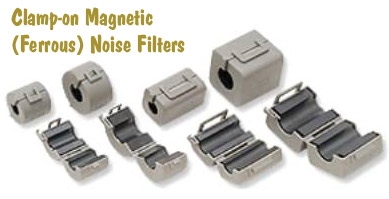
Finding and Installing Magnetic Noise Filters
Scott tells us: “You’ll see a lot of these type filters on the cords for computer acessories. You may have to experiment to find one that works for you. Some have different magnets that have different filtering abilities. My filter cost about $3.00. I purchased it at Randolph and Rice Industrial Electronics in Nashville, TN, item #SF.065.” You should also be able to find these kind of filters at Fry’s, Radio Shack, or other electronics supply stores.

While some magnetic filters require the power cord to run straight through, other designs allow you to loop the cord once around the filter (see photos). Looping the cord actually enhances the performance of the filter. You can also get improved filtration of electronic interference by putting a magnetic ‘noise’ filter on BOTH ends of your scale’s power cord.
November 5th, 2009
 In this feature, Bill Gravatt, President of Sinclair International, explains how to clean and maintain precision reloading dies. This article first appeared in Sinclair’s online Blog, The Reloading Press, where you’ll find many other useful Product Spotlights and ‘How-to’ articles. In this feature, Bill Gravatt, President of Sinclair International, explains how to clean and maintain precision reloading dies. This article first appeared in Sinclair’s online Blog, The Reloading Press, where you’ll find many other useful Product Spotlights and ‘How-to’ articles.
Reloading dies if taken care of properly will provide years of service to their owner. Most dies are hardened and then micro-polished for that mirror internal finish many of the dies exhibit. Many of them are also treated with some type of rust preventative before they leave the factory floor. But dies still need some attention before they are put to use.
Clean Your Dies Before First Use
The first step in taking care of your dies starts when you receive them. We advocate cleaning all new dies before you begin to use them. Beginning with your sizing dies; take the decapping assembly completely out of the die body. Flush the decapping assembly with a good degreaser (such as Hornady One-Shot Cleaner & Dry Lube, Birchwood Casey Gun Scrubber or Shooter’s Choice Quickscrub III) and wipe the expander ball clean.
 The only part of the decapping assembly that should come in contact with your brass is the expander ball and the decapping pin. Pay particular attention to the decapping ball as it determines the final interior dimension (bullet grip) of your case neck. Make sure you inspect it after cleaning to make sure that the surface is clean and free of burrs. The only part of the decapping assembly that should come in contact with your brass is the expander ball and the decapping pin. Pay particular attention to the decapping ball as it determines the final interior dimension (bullet grip) of your case neck. Make sure you inspect it after cleaning to make sure that the surface is clean and free of burrs.
Next, flush the interior of the die body out with some more degreaser. Using a pistol cleaning rod or a dowel rod, push a couple of wet patches all the way through the die. Then run a couple of dry patches through. Reassemble your sizing die and you should be good to go.
Seating Die Cleaning and Maintenance
Taking apart your seater is fairly simple depending on the complexity of your seating die. A standard seater just requires you to turn the seating stem out of the die body exposing the interior of the seater. Flush and clean both the body and seater as described above. Benchrest sliding sleeve seaters such as Forster or Redding Competition Dies have a few more parts involved. Just make sure as you take them apart you know how the spring is oriented and how any other parts such as chamber sleeves or seating plugs are arranged. Any springs or threads can be wiped down with a very rag or patch lightly coated with a fine oil. Make sure you inspect the opening in the seating stem for debris. You can twist a patch and use the end to clean out the smaller caliber stems/plugs.
 Regular Cleaning and Storage Advice Regular Cleaning and Storage Advice
Regular maintenance of your dies should include their routine cleaning. Sizing dies collect excess lube off the cases and this lube can begin to build up. We have seen dents formed in the case shoulder from the hydraulic compression of the excess lube in the die when the case was sized. We recommend cleaning the dies every 500 to 1000 rounds depending on how frequently they are used and the cleanliness of your reloading area. For longer term storage of your dies, I recommend putting a light oil or rust preventative on them, especially if you have a shop that has a humid environment.
My reloading area is in the same building (different room) as my woodshop and I have to watch the dust so I keep most of my reloading dies covered or stored away. I keep a cover over my press and scales as well.
October 29th, 2009
 Natchez Shooters Supplies currently has the RCBS ChargeMaster 1500 Scale and Dispenser combo (item RC98923) on sale for just $279.95, a very good price. These units have become increasingly popular over the past couple of years. Now even some short-range benchresters are weighing their loads with RCBS ChargeMasters. When these units are set up correctly (i.e. level in all planes) and kept away from wind drafts or electrical interference, they work very well. After acquiring his ChargeMaster earlier this year, Jason Baney, our assistant editor, told us: “Man, I wish I had this thing years ago… it probably cuts my reloading time in half.” Natchez Shooters Supplies currently has the RCBS ChargeMaster 1500 Scale and Dispenser combo (item RC98923) on sale for just $279.95, a very good price. These units have become increasingly popular over the past couple of years. Now even some short-range benchresters are weighing their loads with RCBS ChargeMasters. When these units are set up correctly (i.e. level in all planes) and kept away from wind drafts or electrical interference, they work very well. After acquiring his ChargeMaster earlier this year, Jason Baney, our assistant editor, told us: “Man, I wish I had this thing years ago… it probably cuts my reloading time in half.”
October 24th, 2009
We are often asked “Can I get more velocity by switching primer types?” The answer is “maybe”. The important thing to know is that changing primer types can alter your load’s performance in many ways — velocity average, velocity variance (ES/SD), accuracy, and pressure. Because there are so many variables involved you can’t really predict whether one primer type is going to be better or worse than another. This will depend on your cartridge, your powder, your barrel, and even the mechanics of your firing pin system.
Interestingly, however, a shooter on another forum recently did a test with his .308 Win semi-auto. Using Hodgdon Varget powder and Sierra 155gr Palma MatchKing (item 2156) bullets, he found that Wolf Large Rifle primers gave slightly higher velocities than did CCI-BR2s. Interestingly, the amount of extra speed (provided by the Wolfs) increased as charge weight went up, though the middle value had the largest speed variance. The shooter observed: “The Wolf primers seemed to be obviously hotter and they had about the same or possibly better ES average.” See table:
| Varget .308 load |
45.5 grains |
46.0 grains |
46.5 grains |
| CCI BR2 Primers |
2751 fps |
2761 fps |
2783 fps |
| Wolf LR Primers |
2757 fps |
2780 fps |
2798 fps |
| Speed Delta |
6 fps |
19 fps |
15 fps |
You can’t extrapolate too much from the table above. This describes just one gun, one powder, and one bullet. Your Mileage May Vary (YMMV) as they say. However, this illustration does show that by substituting one component you may see significant changes. Provided it can be repeated in multiple chrono runs, an increase of 19 fps (with the 46.0 grain powder load) is meaningful. An extra 20 fps or so may yield a more optimal accuracy node or “sweet spot” that produces better groups. (Though faster is certainly NOT always better for accuracy — you have to test to find out.)
WARNING: When switching primers, you should exercise caution. More speed may be attractive, but you have to consider that the “speedier” primer choice may also produce more pressure. Therefore, you must carefully monitor pressure signs whenever changing ANY component in a load.
Plenty of CCI-BR2 and Wolf Large Rifle Primers in Stock
If you’re looking for either the CCI BR-2 or Wolf Large Rifle Primers, Wideners.com currently has both in stock. The CCI BR2 primers (item CCIBR2) cost $42.50 per 1000. The Wolf LR Primers (item QQQLR KVB-7) cost $29.50 per 1000 OR $142.00 per 5000.
October 22nd, 2009
 The 2010 edition of the Hodgdon® Annual Manual has just been announced, and should be at newstands in January 2010. Now in its 7th year, the Hodgdon Annual Manual includes over 5,000 rifle and pistol loads, with information on 56 Hodgdon, IMR® and Winchester® powders. The new 2010 Manual features 44 cartridge updates, brand new data for the 6.5 Grendel and 6.5 Creedmoor, and updated propellant burn rate and usage charts. The 2010 edition of the Hodgdon® Annual Manual has just been announced, and should be at newstands in January 2010. Now in its 7th year, the Hodgdon Annual Manual includes over 5,000 rifle and pistol loads, with information on 56 Hodgdon, IMR® and Winchester® powders. The new 2010 Manual features 44 cartridge updates, brand new data for the 6.5 Grendel and 6.5 Creedmoor, and updated propellant burn rate and usage charts.
Extensive reloading information is provided for popular cartridges such as the 17 Remington, 223 Remington, 204 Ruger, 6PPC, 308 Winchester, 338 Federal and more. In addition, the 2010 Manual includes articles by top gun writers like Layne Simpson and Jim Carmichael plus many other resources for shooters and reloaders.
Articles in the 2010 Hodgdon Annual Manual spotlight the new varmint/match powder, IMR 8208 XBR. Test lots of this new powder have shown truly exceptional temperature stability. In addition, IMR 8208 XBR should deliver excellent accuracy in cartridges such as the 6mm PPC, 6BR, 22BR, and .308 Winchester. Lou Murdica and Jim Carmichael have already recorded impressive benchrest wins with prototype IMR 8208 XBR.
The 2010 Hodgdon Annual Manual costs $8.99 and should be available at newsstands and gun dealers by January 2010. For more on the manual contact Hodgdon at 913-362-9455, visit Hodgdon.com, or write to 6231 Robinson, Shawnee Mission, KS 66202.
October 9th, 2009
Brass jags perform well for their intended purpose — with one hitch. Strong copper solvents can actually leech metal from the jag itself, leaving the tell-tale blue tint on your patches. This “false positive” can be frustrating, and may lead shooters to over-clean their barrels.
 There are now some good alternatives to brass jags. The best may be the Gunslick® Nylon Snap-Lock™ jags shown at left. These never leave a “false positive” and snap on and off quickly. Larry Bartholome, past USA F-Class Team Captain says: “The best spear-type jags I have used are the GunSlick black nylon tips. I have used the model 92400 for the last couple years in my 6BR and 6.5-284s. Unlike the white plastic jags, these are strong and there’s no brass to worry about.” There are now some good alternatives to brass jags. The best may be the Gunslick® Nylon Snap-Lock™ jags shown at left. These never leave a “false positive” and snap on and off quickly. Larry Bartholome, past USA F-Class Team Captain says: “The best spear-type jags I have used are the GunSlick black nylon tips. I have used the model 92400 for the last couple years in my 6BR and 6.5-284s. Unlike the white plastic jags, these are strong and there’s no brass to worry about.”
92400 22 through 270 calibers: $1.49
92421 30 through 375 Calibers: $1.49
If you prefer a metal jag, MidwayUSA sells Tipton Nickel-coated jags, both individually and as a boxed set. The vast majority of user reviews have been very positive. A few guys have complained that the nickel-plated Tipton jags run oversize, but we use a .22-caliber jag in our 6mms anyway, so this hasn’t been a problem for us. The 22-caliber nickel-plated jag (item 996840) costs $4.79. The complete 12-jag set (item 812503), covering .17 to .45 calibers, costs $24.49 including a fitted box, shown below.

K&M Stainless Jags
K&M Tools offers stainless spire-point jags in .22, .243, and .308 calibers. These are well-made and won’t produce false positives. However, with stainless jags, you MUST always keep the jag covered with a patch when inside the barrel. Otherwise you can rub steel against steel — not good. The downside of stainless is the potential for barrel scratching. On the other hand, according to Forum member Dans40x: “300 series stainless steel jags last a few lifetimes”.
Clear-Coating Your Brass Jags
If you’re reluctant to give up your collection of brass jags (after all they’ve worked pretty well so far), try covering the jag itself with a thin, transparent coating. Forum Member BillPA says: “I give the brass jags a coat of clear lacquer or acrylic; that works for me”. You may need to experiment to find a coating that stands up to your favorite solvent. BillPA says: “The only solvent I’ve found that eats the lacquer off is TM Solution. Butch’s, Shooter’s Choice, or Wipe-Out don’t seem to bother it. Most of the time I use rattle-can clear lacquer”. If you’re feeling creative, you could even color-code your jags by adding tints to the clear-coat.
|


